Tibial Plafond/Pilon Fractures 
2/2/2011
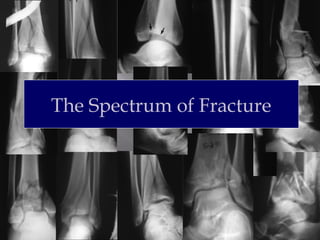
The Spectrum of Fracture
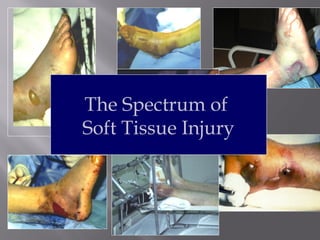
The Spectrum of 
Soft Tissue Injury
Relative Success 
vs 
Dismal Failure
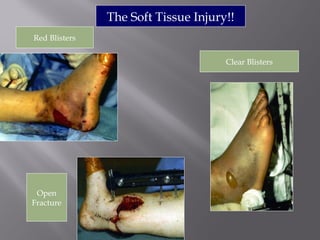
The Soft Tissue Injury!! 
Red Blisters 
Clear Blisters 
Open 
Fracture
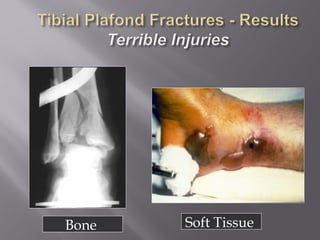
Terrible Injuries 
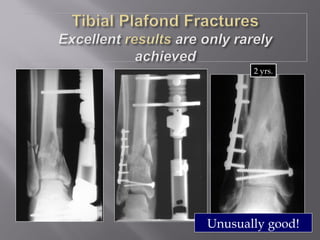
ā€œExcellent Resultsā€ are rarely achieved 
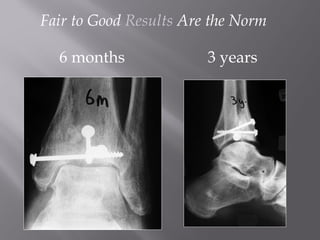
Fair-Good results are the norm 
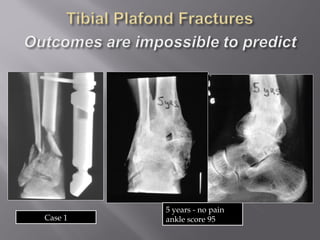
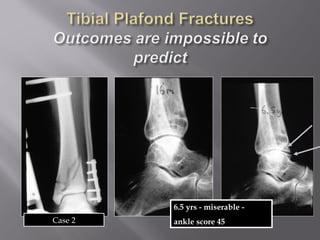
Outcomes are impossible to predict 
Treatment complications must be avoided
Bone Soft Tissue
2 yrs. 
Unusually good!
Tibial Plafond Fractures 
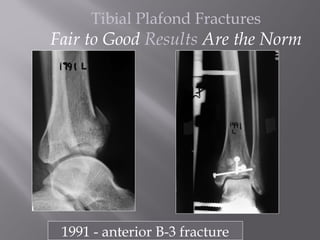
Fair to Good Results Are the Norm 
1991 - anterior B-3 fracture
Fair to Good Results Are the Norm 
6 months 3 years
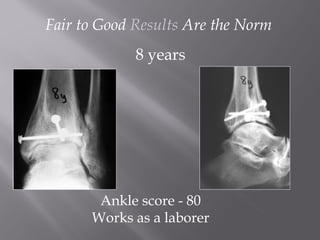
Fair to Good Results Are the Norm 
8 years 
Ankle score - 80 
Works as a laborer
5 years - no pain 
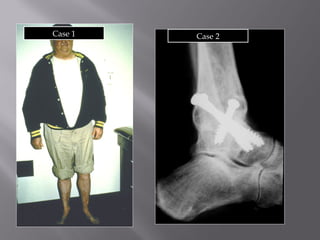
Case 1 ankle score 95
6.5 yrs - miserable - 
Case 2 ankle score 45
Case 1 Case 2
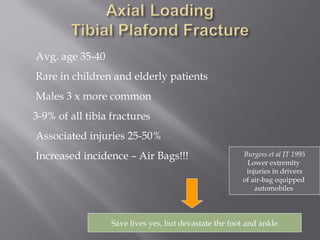
Avg. age 35-40 
 Rare in children and elderly patients 
 Males 3 x more common 
 3-9% of all tibia fractures 
 Associated injuries 25-50% 
 Increased incidence – Air Bags!!! 
Burgess et al JT 1995 
Lower extremity 
injuries in drivers 
of air-bag equipped 
automobiles 
Save lives yes, but devastate the foot and ankle
 Multiply injured patients with and without 
foot injuries ( 24 and 12 month follow ups) 
 Dramatic differences in pain, function and 
health related quality of life
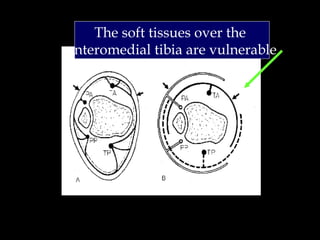
Ankle Soft Tissues 
Thin skin 
Absent muscle 
and adipose tissue 
Lack of deep veins 
Particularly 
vulnerable!
The soft tissues over the 
anteromedial tibia are vulnerable
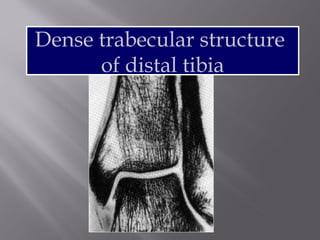
Dense trabecular structure 
of distal tibia
Bone is viscoelastic 
Axial load is rapid 
Shift in stress strain curve 
Tremendous energy release
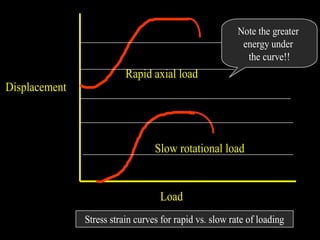
Displacement 
Rapid axial load 
Note the greater 
energy under 
the curve!! 
Slow rotational load 
Load 
Stress strain curves for rapid vs. slow rate of loading
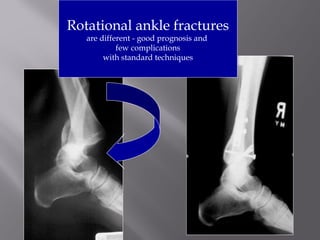
Rotational ankle fractures 
are different - good prognosis and 
few complications 
with standard techniques
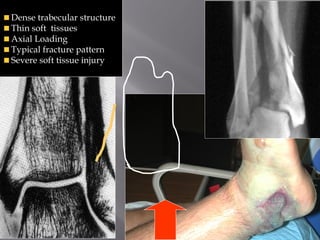
Dense trabecular structure 
Thin soft tissues 
Axial Loading 
Typical fracture pattern 
Severe soft tissue injury
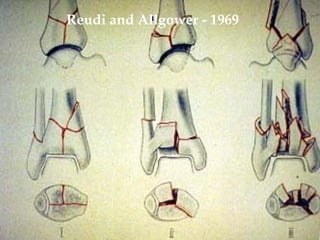
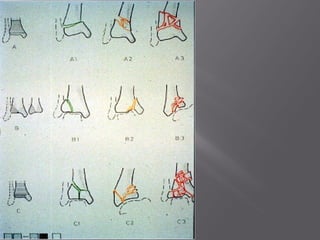
Reudi and Allgower - 1969
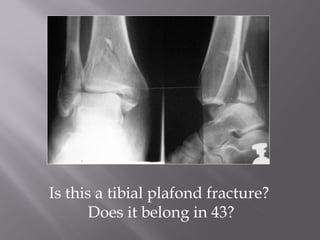
Is this a tibial plafond fracture? 
Does it belong in 43?
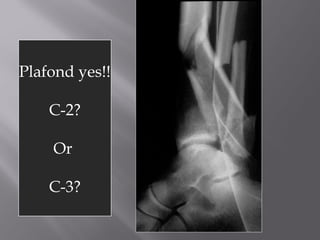
Plafond yes!! 
C-2? 
Or 
C-3?
Four principles ā€œstood the test 
of timeā€ 
 Anatomical reduction 
 Stable internal fixation 
 Atraumatic technique 
 Early pain-free mobilization 
ā€œPrecise reconstruction of 
articular surfaces is the goal, 
and is always preferred to 
tolerable malalignmentā€.
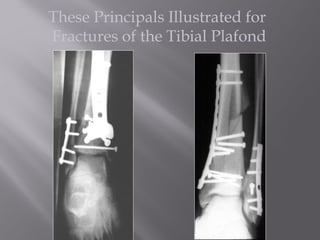
These Principals Illustrated for 
Fractures of the Tibial Plafond
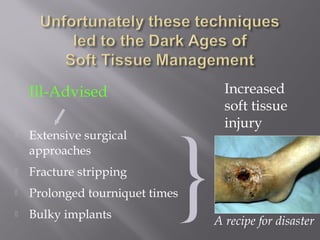
Ill-Advised 
 Extensive surgical 
approaches 
 Fracture stripping 
 Prolonged tourniquet times 
 Bulky implants 
Increased 
soft tissue 
injury 
A recipe for disaster }
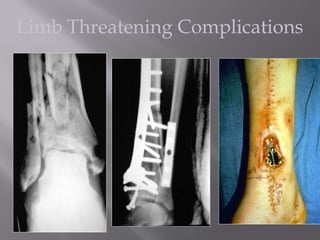
Limb Threatening Complications
McFerran et al JOT 1992 
21pts (40%) with major complications 
require 77 additional operations 
Wyrsch et al JBJS 1996 
3/18 amputations in closed fractures 
Teeney and Wiss CORR 1993 
37% infection and 26% fusion in Type 3’s 
Cases 
Treated 
1980’s 
Early 
1990’s
Delays until surgery 
Spanning ex fix part of most 
protocols 
Percutaneous and limited 
approaches
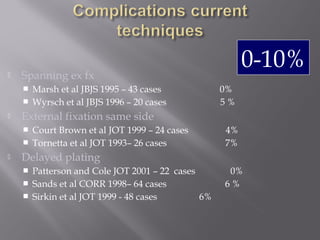
 Spanning ex fx 
ļ‚” Marsh et al JBJS 1995 – 43 cases 0% 
ļ‚” Wyrsch et al JBJS 1996 – 20 cases 5 % 
 External fixation same side 
ļ‚” Court Brown et al JOT 1999 – 24 cases 4% 
ļ‚” Tornetta et al JOT 1993– 26 cases 7% 
 Delayed plating 
0-10% 
ļ‚” Patterson and Cole JOT 2001 – 22 cases 0% 
ļ‚” Sands et al CORR 1998– 64 cases 6 % 
ļ‚” Sirkin et al JOT 1999 - 48 cases 6%
1. Spanning articulated fixation with 
percutaneous or limited approaches to the 
articular surface and screw fixation 
2. Percutaneous plating 
3. Standard plating through open approaches 
after long delays for soft tissue recovery
 Spanning fixator for three months 
 A large monolateral frame fixed into the 
talus and calcaneus 
 Relatively earlier approaches to reduce the 
articular surface percutaneously
 Suited for all tibial plafond fractures 
 Ideal for very comminuted cases 
 Contraindicated with ipsilateral talus or 
calcaneus fractures 
 Beware diaphyseal extension or severe open 
fractures which might delay healing
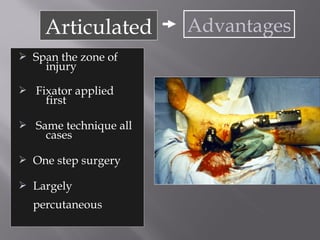
Articulated Advantages 
 Span the zone of 
injury 
 Fixator applied 
first 
 Same technique all 
cases 
 One step surgery 
 Largely 
percutaneous
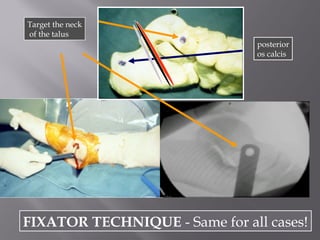
Target the neck 
of the talus 
posterior 
os calcis 
FIXATOR TECHNIQUE - Same for all cases!
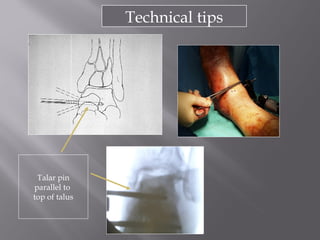
Technical tips 
Talar pin 
parallel to 
top of talus
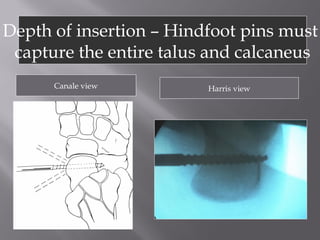
Depth of insertion – Hindfoot pins must 
capture the entire talus and calcaneus 
Canale view Harris view
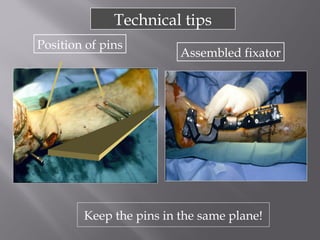
Technical tips 
Position of pins Assembled fixator 
Keep the pins in the same plane!
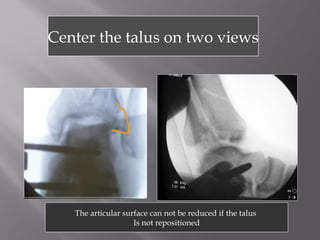
Center the talus on two views 
The articular surface can not be reduced if the talus 
Is not repositioned
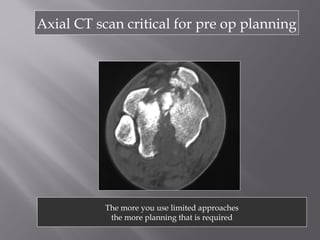
Axial CT scan critical for pre op planning 
The more you use limited approaches 
the more planning that is required
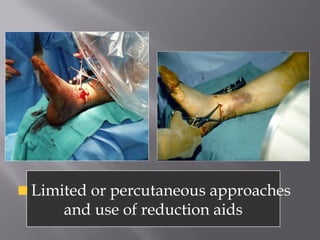
Limited or percutaneous approaches 
and use of reduction aids
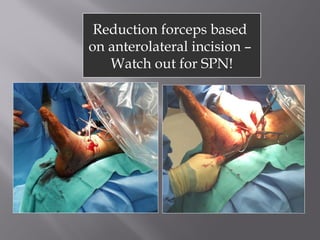
Reduction forceps based 
on anterolateral incision – 
Watch out for SPN!
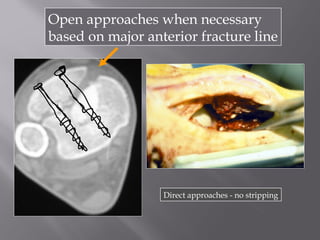
Open approaches when necessary 
based on major anterior fracture line 
Direct approaches - no stripping
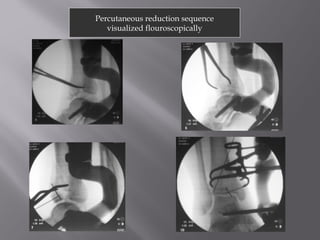
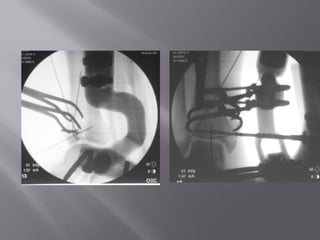
Percutaneous reduction sequence 
visualized flouroscopically
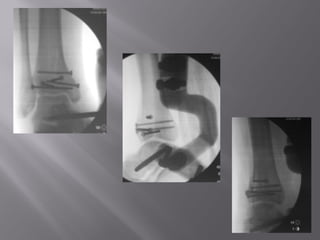
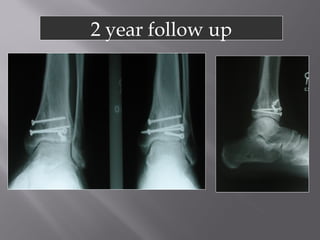
2 year follow up
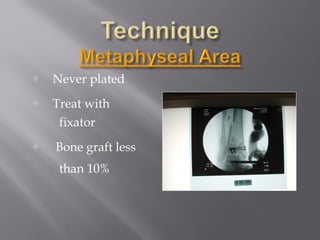
 Never plated 
 Treat with 
fixator 
 Bone graft less 
than 10%
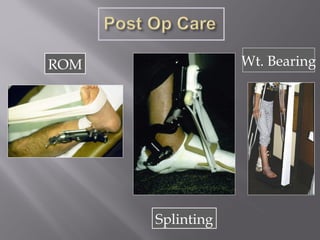
ROM 
Splinting 
Wt. Bearing
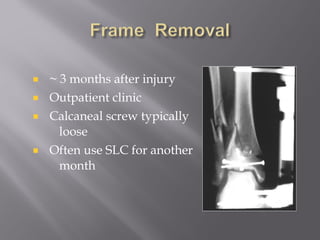
~ 3 months after injury 
Outpatient clinic 
Calcaneal screw typically 
loose 
Often use SLC for another 
month
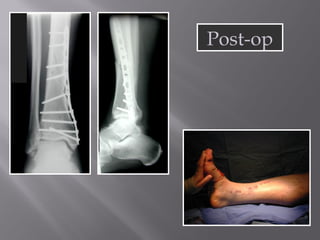
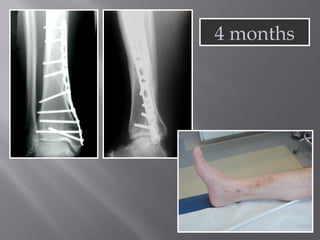
 Uses medial sub cutaneous border 
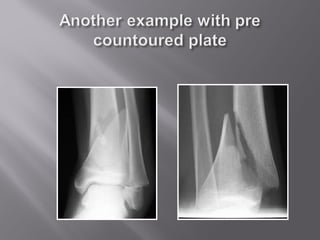
 Needs pre contoured plate 
 Locking may offer advantages 
 Ideal for a select group of fractures 
ļ‚” Non articular distal tibia 
ļ‚” Limited articular involvement 
ļ‚” Build back articular block through limited 
approaches
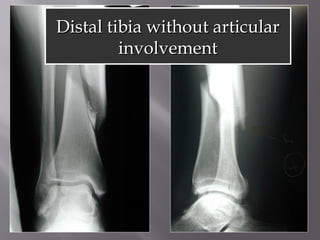
Distal ttiibbiiaa wwiitthhoouutt aarrttiiccuullaarr 
iinnvvoollvveemmeenntt
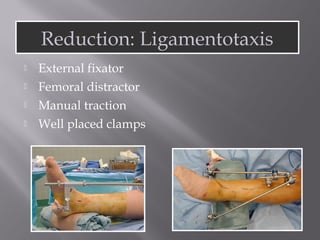
Reduction: Ligamentotaxis 
 External fixator 
 Femoral distractor 
 Manual traction 
 Well placed clamps
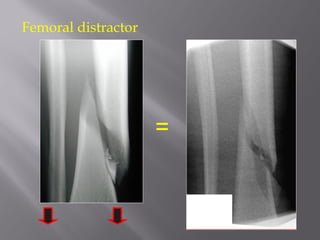
Femoral distractor 
=
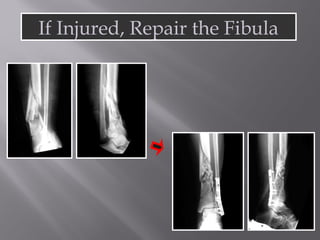
If Injured, Repair the Fibula
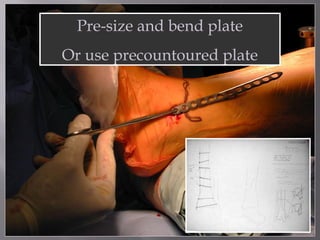
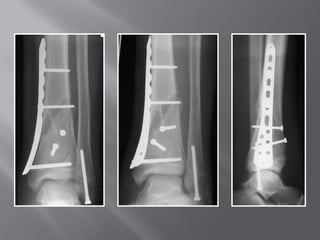
Pre-size and bend plate 
Or use precountoured plate
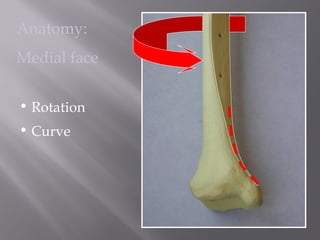
Anatomy: 
Medial face 
• Rotation 
• Curve
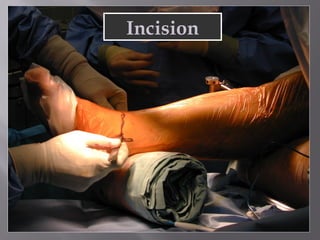
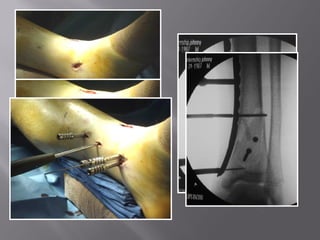
Incision
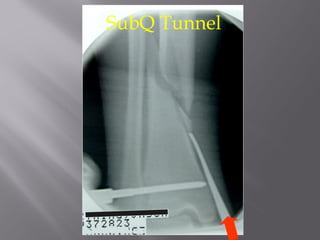
SubQ Tunnel
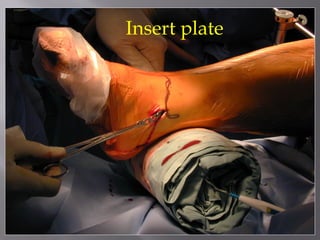
Insert plate
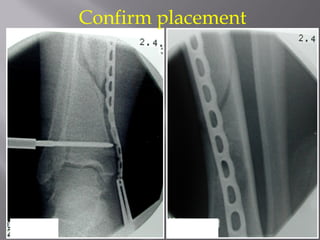
Confirm placement
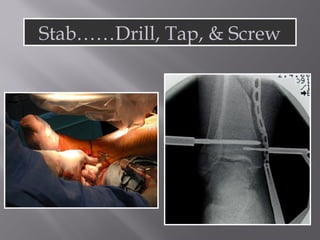
Stab……Drill, Tap,  Screw
Post-op
4 months
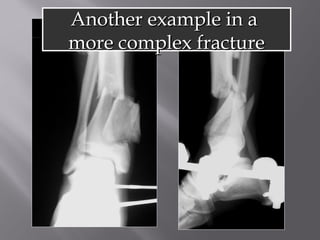
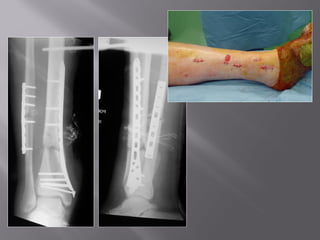
AAnnootthheerr eexxaammppllee iinn aa 
mmoorree ccoommpplleexx ffrraaccttuurree
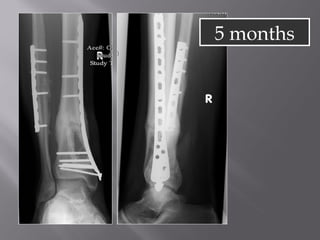
5 months
 Indicated to treat the range of tibial plafond 
fractures 
 Temporary spanning fixation and long 
delay to definitive surgery 
 Several different open approaches
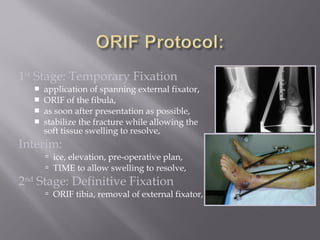
1st Stage: Temporary Fixation 
ļ‚” application of spanning external fixator, 
ļ‚” ORIF of the fibula, 
ļ‚” as soon after presentation as possible, 
ļ‚” stabilize the fracture while allowing the 
soft tissue swelling to resolve, 
Interim: 
 ice, elevation, pre-operative plan, 
 TIME to allow swelling to resolve, 
2nd Stage: Definitive Fixation 
 ORIF tibia, removal of external fixator,
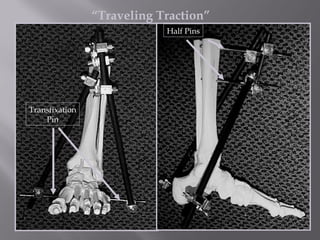
ā€œTraveling Tractionā€ 
Half Pins 
Transfixation 
Pin
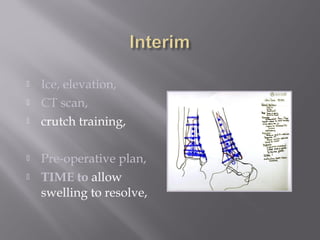
 Ice, elevation, 
 CT scan, 
 crutch training, 
 Pre-operative plan, 
 TIME to allow 
swelling to resolve,
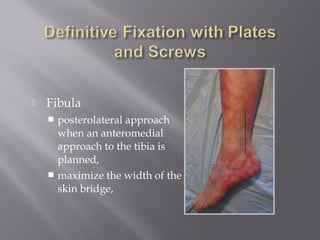
 Fibula 
ļ‚” posterolateral approach 
when an anteromedial 
approach to the tibia is 
planned, 
ļ‚” maximize the width of the 
skin bridge,
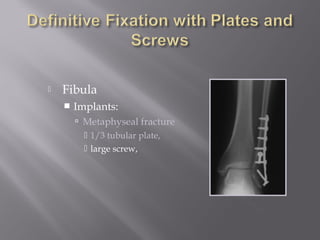
 Fibula 
ļ‚” Implants: 
 Metaphyseal fracture 
 1/3 tubular plate, 
 large screw,
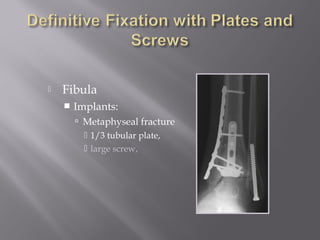
 Fibula 
ļ‚” Implants: 
 Metaphyseal fracture 
 1/3 tubular plate, 
 large screw,
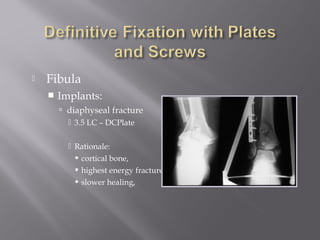
 Fibula 
ļ‚” Implants: 
 diaphyseal fracture 
 3.5 LC – DCPlate 
 Rationale: 
ļ‚  cortical bone, 
ļ‚  highest energy fractures, 
ļ‚  slower healing,
ļ‚” Extensile Anteromedial Approach: 
 ā€œWorkhorseā€, 
ļ‚” Anterolateral Approach: 
 gaining in popularity, 
ļ‚” Posterolateral Approach: 
 recently proposed,
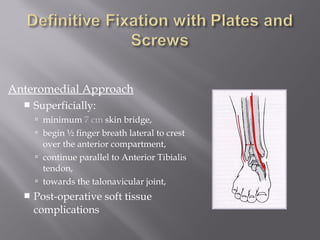
Anteromedial Approach 
ļ‚” Superficially: 
 minimum 7 cm skin bridge, 
 begin ½ finger breath lateral to crest 
over the anterior compartment, 
 continue parallel to Anterior Tibialis 
tendon, 
 towards the talonavicular joint, 
ļ‚” Post-operative soft tissue 
complications
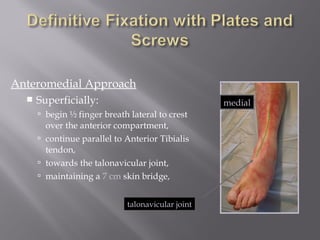
Anteromedial Approach 
ļ‚” Superficially: 
 begin ½ finger breath lateral to crest 
over the anterior compartment, 
 continue parallel to Anterior Tibialis 
tendon, 
 towards the talonavicular joint, 
 maintaining a 7 cm skin bridge, 
Medial 
talonavicular joint 
medial
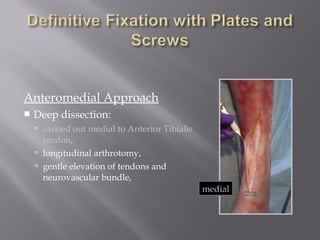
Anteromedial Approach 
ļ‚” Deep dissection: 
 carried out medial to Anterior Tibialis 
tendon, 
 longitudinal arthrotomy, 
 gentle elevation of tendons and 
neurovascular bundle, 
medial
Anteromedial Approach 
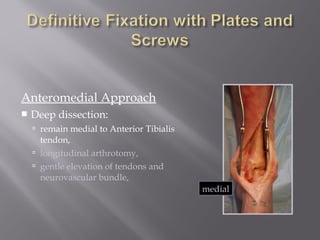
ļ‚” Deep dissection: 
 remain medial to Anterior Tibialis 
tendon, 
 longitudinal arthrotomy, 
 gentle elevation of tendons and 
neurovascular bundle, 
medial
Articular Reduction: 
ļ‚” largest and least displaced articular fragments 
first, 
ļ‚” reduced fragments held with: 
 K-wires (1.2 or 1.6mm), 
 pointed reduction forceps, 
 lag screws, 
ļ‚” reduce articular bloc to shaft, 
ļ‚” definitive fixation,
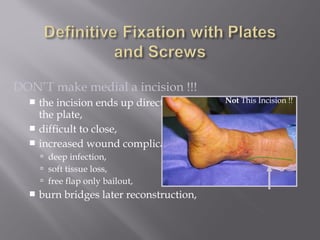
DON’T make medial a incision !!! 
ļ‚” the incision ends up directly over 
the plate, 
ļ‚” difficult to close, 
ļ‚” increased wound complications, 
 deep infection, 
 soft tissue loss, 
 free flap only bailout, 
ļ‚” burn bridges later reconstruction, 
Not This Incision !!
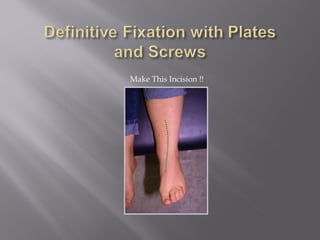
Make This Incision !!
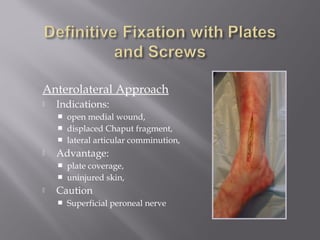
Anterolateral Approach 
 Indications: 
ļ‚” open medial wound, 
ļ‚” displaced Chaput fragment, 
ļ‚” lateral articular comminution, 
 Advantage: 
ļ‚” plate coverage, 
ļ‚” uninjured skin, 
 Caution 
ļ‚” Superficial peroneal nerve
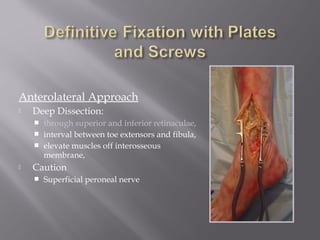
Anterolateral Approach 
 Deep Dissection: 
ļ‚” through superior and inferior retinaculae, 
ļ‚” interval between toe extensors and fibula, 
ļ‚” elevate muscles off interosseous 
membrane, 
 Caution 
ļ‚” Superficial peroneal nerve
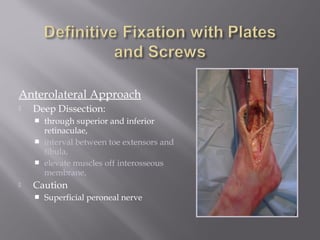
Anterolateral Approach 
 Deep Dissection: 
ļ‚” through superior and inferior 
retinaculae, 
ļ‚” interval between toe extensors and 
fibula, 
ļ‚” elevate muscles off interosseous 
membrane, 
 Caution 
ļ‚” Superficial peroneal nerve
Posterolateral Approach 
 Advantages 
ļ‚” a single incision for ORIF 
of the tibia and fibula, 
ļ‚” FHL is positioned 
between the skin and the 
implants in case of post-op 
wound complication, 
 Disadvantages 
ļ‚” limited access to anterior 
articular fracture fragments, 
ļ‚” prone position, 
ļ‚” sural nerve at risk,
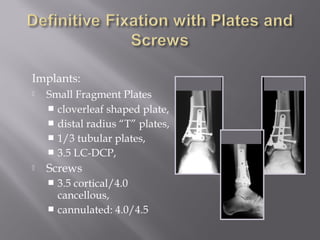
Implants: 
 Small Fragment Plates 
ļ‚” cloverleaf shaped plate, 
ļ‚” distal radius ā€œTā€ plates, 
ļ‚” 1/3 tubular plates, 
ļ‚” 3.5 LC-DCP, 
 Screws 
ļ‚” 3.5 cortical/4.0 
cancellous, 
ļ‚” cannulated: 4.0/4.5
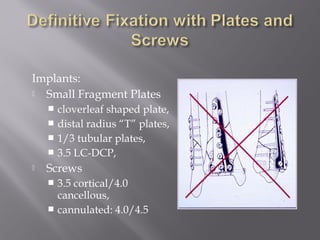
Implants: 
 Small Fragment Plates 
ļ‚” cloverleaf shaped plate, 
ļ‚” distal radius ā€œTā€ plates, 
ļ‚” 1/3 tubular plates, 
ļ‚” 3.5 LC-DCP, 
 Screws 
ļ‚” 3.5 cortical/4.0 
cancellous, 
ļ‚” cannulated: 4.0/4.5
Bone Graft 
ļ‚” support articular 
fragments, 
ļ‚” augment healing, 
ļ‚” fill cancellous defects, 
 ICBG, 
 Allograft, 
 Synthetic 
ļ‚” Calcium putties,
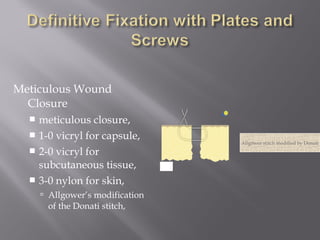
Meticulous Wound 
Closure 
ļ‚” meticulous closure, 
ļ‚” 1-0 vicryl for capsule, 
ļ‚” 2-0 vicryl for 
subcutaneous tissue, 
ļ‚” 3-0 nylon for skin, 
 Allgower’s modification 
of the Donati stitch, 
Allgƶwer stitch modified by 
ADllognƶawtier stitch modified by Donati
 Summary: Tibial Plafond Fractures 
ļ‚” Represent both a bony and soft tissue injury, 
ļ‚” AO Principles: 
 Anatomic articular reduction, 
 stable fixation, 
 early mobilization of patient and limb. 
ļ‚” several approaches to the tibia can be safely used, 
ļ‚” internal fixation is accomplished with small fragment 
implants, 
ļ‚” meticulous soft tissue closure,
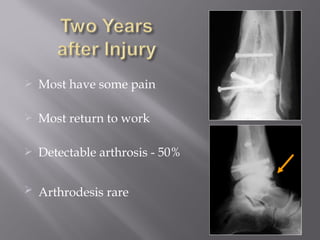
Results
 Most have some pain 
 Most return to work 
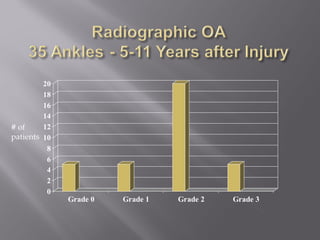
 Detectable arthrosis - 50% 
 Arthrodesis rare
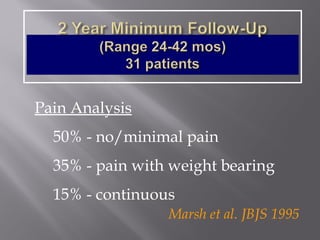
Pain Analysis 
 50% - no/minimal pain 
 35% - pain with weight bearing 
 15% - continuous 
Marsh et al. JBJS 1995
 Sands et al CORR 1998 - 2-4 years after 
injury 
ļ‚” Delayed plating 
 Pollak et al JBJS 2003 – average 3.2 years after injury 
ļ‚” Plating and external fixation 
 Marsh et al JBJS Feb 2003 – 5-11 years after 
injury 
ļ‚” Spanning external fixation
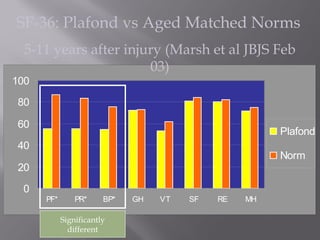
SF-36: Plafond vs Aged Matched Norms 
5-11 years after injury (Marsh et al JBJS Feb 
100 
80 
60 
40 
20 
0 
PF* PR* BP* GH VT SF RE MH 
Plafond 
Norm 
03) 
Significantly 
different
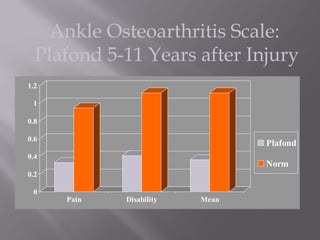
Ankle Osteoarthritis Scale: 
Plafond 5-11 Years after Injury 
1.2 
1 
0.8 
0.6 
0.4 
0.2 
0 
Pain Disability Mean 
Plafond 
Norm
20 
18 
16 
14 
12 
10 
8 
6 
4 
2 
0 
Grade 0 Grade 1 Grade 2 Grade 3 
# of 
patients
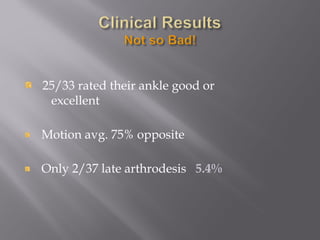
25/33 rated their ankle good or 
excellent 
Motion avg. 75% opposite 
Only 2/37 late arthrodesis 5.4%
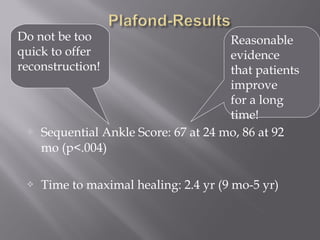
Reasonable 
evidence 
that patients 
improve 
for a long 
time! 
Do not be too 
quick to offer 
reconstruction! 
 Sequential Ankle Score: 67 at 24 mo, 86 at 92 
mo (p.004) 
 Time to maximal healing: 2.4 yr (9 mo-5 yr)
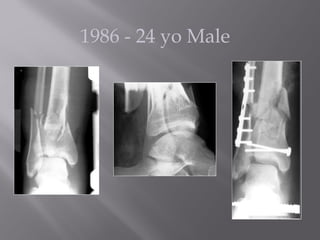
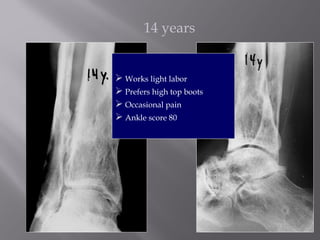
1986 - 24 yo Male
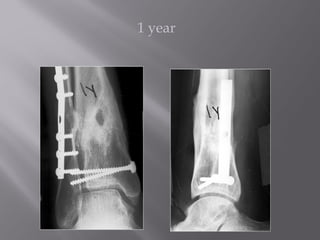
1 year
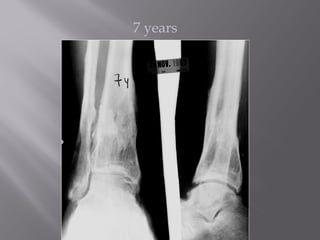
7 years
14 years 
 Works light labor 
 Prefers high top boots 
 Occasional pain 
 Ankle score 80
Excellent results are only rarely achieved 
Most have some ankle pain 
Can not run or play sports 
Measurable effect on general 
health status 
70% with moderate or severe 
arthrosis
Fair to Good Results Are the Norm 
Most rate their outcome as good or 
excellent 
Arthrodesis rate only ~ 5% 
Most feel they improve for years
Summary and 
Conclusions
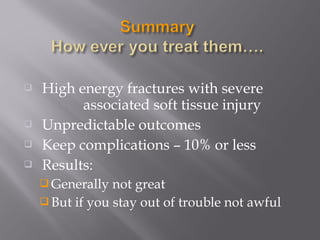
 High energy fractures with severe 
associated soft tissue injury 
 Unpredictable outcomes 
 Keep complications – 10% or less 
 Results: 
Generally not great 
But if you stay out of trouble not awful
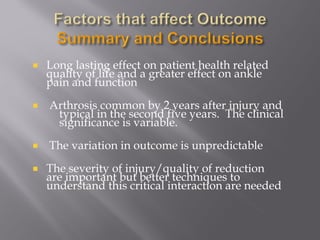
Long lasting effect on patient health related 
quality of life and a greater effect on ankle 
pain and function 
Arthrosis common by 2 years after injury and 
typical in the second five years. The clinical 
significance is variable. 
The variation in outcome is unpredictable 
The severity of injury/quality of reduction 
are important but better techniques to 
understand this critical interaction are needed
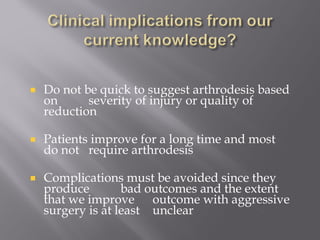
Do not be quick to suggest arthrodesis based 
on severity of injury or quality of 
reduction 
Patients improve for a long time and most 
do not require arthrodesis 
Complications must be avoided since they 
produce bad outcomes and the extent 
that we improve outcome with aggressive 
surgery is at least unclear
Lecture ucmc pilon plafond fracture distal tibia

Lecture ucmc pilon plafond fracture distal tibia

  • 1.
  • 2.
  • 3.
    The Spectrum of Soft Tissue Injury
  • 4.
    Relative Success vs Dismal Failure
  • 5.
    The Soft TissueInjury!! Red Blisters Clear Blisters Open Fracture
  • 6.
    Terrible Injuries ā€œExcellentResultsā€ are rarely achieved Fair-Good results are the norm Outcomes are impossible to predict Treatment complications must be avoided
  • 7.
  • 8.
  • 9.
    Tibial Plafond Fractures Fair to Good Results Are the Norm 1991 - anterior B-3 fracture
  • 10.
    Fair to GoodResults Are the Norm 6 months 3 years
  • 11.
    Fair to GoodResults Are the Norm 8 years Ankle score - 80 Works as a laborer
  • 12.
    5 years -no pain Case 1 ankle score 95
  • 13.
    6.5 yrs -miserable - Case 2 ankle score 45
  • 14.
  • 15.
    Avg. age 35-40 Rare in children and elderly patients Males 3 x more common 3-9% of all tibia fractures Associated injuries 25-50% Increased incidence – Air Bags!!! Burgess et al JT 1995 Lower extremity injuries in drivers of air-bag equipped automobiles Save lives yes, but devastate the foot and ankle
  • 16.
     Multiply injuredpatients with and without foot injuries ( 24 and 12 month follow ups)  Dramatic differences in pain, function and health related quality of life
  • 17.
    Ankle Soft Tissues Thin skin Absent muscle and adipose tissue Lack of deep veins Particularly vulnerable!
  • 18.
    The soft tissuesover the anteromedial tibia are vulnerable
  • 19.
  • 20.
    Bone is viscoelastic Axial load is rapid Shift in stress strain curve Tremendous energy release
  • 21.
    Displacement Rapid axialload Note the greater energy under the curve!! Slow rotational load Load Stress strain curves for rapid vs. slow rate of loading
  • 22.
    Rotational ankle fractures are different - good prognosis and few complications with standard techniques
  • 23.
    Dense trabecular structure Thin soft tissues Axial Loading Typical fracture pattern Severe soft tissue injury
  • 24.
  • 26.
    Is this atibial plafond fracture? Does it belong in 43?
  • 27.
  • 28.
    Four principles ā€œstoodthe test of timeā€  Anatomical reduction  Stable internal fixation  Atraumatic technique  Early pain-free mobilization ā€œPrecise reconstruction of articular surfaces is the goal, and is always preferred to tolerable malalignmentā€.
  • 29.
    These Principals Illustratedfor Fractures of the Tibial Plafond
  • 30.
    Ill-Advised  Extensivesurgical approaches  Fracture stripping  Prolonged tourniquet times  Bulky implants Increased soft tissue injury A recipe for disaster }
  • 31.
  • 32.
    McFerran et alJOT 1992 21pts (40%) with major complications require 77 additional operations Wyrsch et al JBJS 1996 3/18 amputations in closed fractures Teeney and Wiss CORR 1993 37% infection and 26% fusion in Type 3’s Cases Treated 1980’s Early 1990’s
  • 33.
    Delays until surgery Spanning ex fix part of most protocols Percutaneous and limited approaches
  • 34.
     Spanning exfx ļ‚” Marsh et al JBJS 1995 – 43 cases 0% ļ‚” Wyrsch et al JBJS 1996 – 20 cases 5 %  External fixation same side ļ‚” Court Brown et al JOT 1999 – 24 cases 4% ļ‚” Tornetta et al JOT 1993– 26 cases 7%  Delayed plating 0-10% ļ‚” Patterson and Cole JOT 2001 – 22 cases 0% ļ‚” Sands et al CORR 1998– 64 cases 6 % ļ‚” Sirkin et al JOT 1999 - 48 cases 6%
  • 35.
    1. Spanning articulatedfixation with percutaneous or limited approaches to the articular surface and screw fixation 2. Percutaneous plating 3. Standard plating through open approaches after long delays for soft tissue recovery
  • 36.
     Spanning fixatorfor three months  A large monolateral frame fixed into the talus and calcaneus  Relatively earlier approaches to reduce the articular surface percutaneously
  • 37.
     Suited forall tibial plafond fractures  Ideal for very comminuted cases  Contraindicated with ipsilateral talus or calcaneus fractures  Beware diaphyseal extension or severe open fractures which might delay healing
  • 38.
    Articulated Advantages Span the zone of injury  Fixator applied first  Same technique all cases  One step surgery  Largely percutaneous
  • 39.
    Target the neck of the talus posterior os calcis FIXATOR TECHNIQUE - Same for all cases!
  • 40.
    Technical tips Talarpin parallel to top of talus
  • 41.
    Depth of insertion– Hindfoot pins must capture the entire talus and calcaneus Canale view Harris view
  • 42.
    Technical tips Positionof pins Assembled fixator Keep the pins in the same plane!
  • 43.
    Center the taluson two views The articular surface can not be reduced if the talus Is not repositioned
  • 44.
    Axial CT scancritical for pre op planning The more you use limited approaches the more planning that is required
  • 45.
    Limited or percutaneousapproaches and use of reduction aids
  • 46.
    Reduction forceps based on anterolateral incision – Watch out for SPN!
  • 47.
    Open approaches whennecessary based on major anterior fracture line Direct approaches - no stripping
  • 48.
    Percutaneous reduction sequence visualized flouroscopically
  • 51.
  • 52.
     Never plated  Treat with fixator  Bone graft less than 10%
  • 53.
  • 54.
    ~ 3 monthsafter injury Outpatient clinic Calcaneal screw typically loose Often use SLC for another month
  • 55.
     Uses medialsub cutaneous border  Needs pre contoured plate  Locking may offer advantages  Ideal for a select group of fractures ļ‚” Non articular distal tibia ļ‚” Limited articular involvement ļ‚” Build back articular block through limited approaches
  • 56.
    Distal ttiibbiiaa wwiitthhoouuttaarrttiiccuullaarr iinnvvoollvveemmeenntt
  • 57.
    Reduction: Ligamentotaxis External fixator  Femoral distractor  Manual traction  Well placed clamps
  • 58.
  • 59.
  • 60.
    Pre-size and bendplate Or use precountoured plate
  • 61.
    Anatomy: Medial face • Rotation • Curve
  • 62.
  • 63.
  • 64.
  • 65.
  • 66.
  • 67.
  • 68.
  • 72.
    AAnnootthheerr eexxaammppllee iinnaa mmoorree ccoommpplleexx ffrraaccttuurree
  • 74.
  • 75.
     Indicated totreat the range of tibial plafond fractures  Temporary spanning fixation and long delay to definitive surgery  Several different open approaches
  • 76.
    1st Stage: TemporaryFixation ļ‚” application of spanning external fixator, ļ‚” ORIF of the fibula, ļ‚” as soon after presentation as possible, ļ‚” stabilize the fracture while allowing the soft tissue swelling to resolve, Interim:  ice, elevation, pre-operative plan,  TIME to allow swelling to resolve, 2nd Stage: Definitive Fixation  ORIF tibia, removal of external fixator,
  • 77.
  • 78.
     Ice, elevation,  CT scan,  crutch training,  Pre-operative plan,  TIME to allow swelling to resolve,
  • 79.
     Fibula ļ‚”posterolateral approach when an anteromedial approach to the tibia is planned, ļ‚” maximize the width of the skin bridge,
  • 80.
     Fibula ļ‚”Implants:  Metaphyseal fracture  1/3 tubular plate,  large screw,
  • 81.
     Fibula ļ‚”Implants:  Metaphyseal fracture  1/3 tubular plate,  large screw,
  • 82.
     Fibula ļ‚”Implants:  diaphyseal fracture  3.5 LC – DCPlate  Rationale: ļ‚  cortical bone, ļ‚  highest energy fractures, ļ‚  slower healing,
  • 83.
    ļ‚” Extensile AnteromedialApproach:  ā€œWorkhorseā€, ļ‚” Anterolateral Approach:  gaining in popularity, ļ‚” Posterolateral Approach:  recently proposed,
  • 84.
    Anteromedial Approach ļ‚”Superficially:  minimum 7 cm skin bridge,  begin ½ finger breath lateral to crest over the anterior compartment,  continue parallel to Anterior Tibialis tendon,  towards the talonavicular joint, ļ‚” Post-operative soft tissue complications
  • 85.
    Anteromedial Approach ļ‚”Superficially:  begin ½ finger breath lateral to crest over the anterior compartment,  continue parallel to Anterior Tibialis tendon,  towards the talonavicular joint,  maintaining a 7 cm skin bridge, Medial talonavicular joint medial
  • 86.
    Anteromedial Approach ļ‚”Deep dissection:  carried out medial to Anterior Tibialis tendon,  longitudinal arthrotomy,  gentle elevation of tendons and neurovascular bundle, medial
  • 88.
    Anteromedial Approach ļ‚”Deep dissection:  remain medial to Anterior Tibialis tendon,  longitudinal arthrotomy,  gentle elevation of tendons and neurovascular bundle, medial
  • 89.
    Articular Reduction: ļ‚”largest and least displaced articular fragments first, ļ‚” reduced fragments held with:  K-wires (1.2 or 1.6mm),  pointed reduction forceps,  lag screws, ļ‚” reduce articular bloc to shaft, ļ‚” definitive fixation,
  • 90.
    DON’T make mediala incision !!! ļ‚” the incision ends up directly over the plate, ļ‚” difficult to close, ļ‚” increased wound complications,  deep infection,  soft tissue loss,  free flap only bailout, ļ‚” burn bridges later reconstruction, Not This Incision !!
  • 91.
  • 92.
    Anterolateral Approach Indications: ļ‚” open medial wound, ļ‚” displaced Chaput fragment, ļ‚” lateral articular comminution,  Advantage: ļ‚” plate coverage, ļ‚” uninjured skin,  Caution ļ‚” Superficial peroneal nerve
  • 93.
    Anterolateral Approach Deep Dissection: ļ‚” through superior and inferior retinaculae, ļ‚” interval between toe extensors and fibula, ļ‚” elevate muscles off interosseous membrane,  Caution ļ‚” Superficial peroneal nerve
  • 94.
    Anterolateral Approach Deep Dissection: ļ‚” through superior and inferior retinaculae, ļ‚” interval between toe extensors and fibula, ļ‚” elevate muscles off interosseous membrane,  Caution ļ‚” Superficial peroneal nerve
  • 95.
    Posterolateral Approach Advantages ļ‚” a single incision for ORIF of the tibia and fibula, ļ‚” FHL is positioned between the skin and the implants in case of post-op wound complication,  Disadvantages ļ‚” limited access to anterior articular fracture fragments, ļ‚” prone position, ļ‚” sural nerve at risk,
  • 96.
    Implants:  SmallFragment Plates ļ‚” cloverleaf shaped plate, ļ‚” distal radius ā€œTā€ plates, ļ‚” 1/3 tubular plates, ļ‚” 3.5 LC-DCP,  Screws ļ‚” 3.5 cortical/4.0 cancellous, ļ‚” cannulated: 4.0/4.5
  • 97.
    Implants:  SmallFragment Plates ļ‚” cloverleaf shaped plate, ļ‚” distal radius ā€œTā€ plates, ļ‚” 1/3 tubular plates, ļ‚” 3.5 LC-DCP,  Screws ļ‚” 3.5 cortical/4.0 cancellous, ļ‚” cannulated: 4.0/4.5
  • 98.
    Bone Graft ļ‚”support articular fragments, ļ‚” augment healing, ļ‚” fill cancellous defects,  ICBG,  Allograft,  Synthetic ļ‚” Calcium putties,
  • 99.
    Meticulous Wound Closure ļ‚” meticulous closure, ļ‚” 1-0 vicryl for capsule, ļ‚” 2-0 vicryl for subcutaneous tissue, ļ‚” 3-0 nylon for skin,  Allgower’s modification of the Donati stitch, Allgƶwer stitch modified by ADllognƶawtier stitch modified by Donati
  • 100.
     Summary: TibialPlafond Fractures ļ‚” Represent both a bony and soft tissue injury, ļ‚” AO Principles:  Anatomic articular reduction,  stable fixation,  early mobilization of patient and limb. ļ‚” several approaches to the tibia can be safely used, ļ‚” internal fixation is accomplished with small fragment implants, ļ‚” meticulous soft tissue closure,
  • 101.
  • 102.
     Most havesome pain  Most return to work  Detectable arthrosis - 50%  Arthrodesis rare
  • 103.
    Pain Analysis 50% - no/minimal pain 35% - pain with weight bearing 15% - continuous Marsh et al. JBJS 1995
  • 104.
     Sands etal CORR 1998 - 2-4 years after injury ļ‚” Delayed plating  Pollak et al JBJS 2003 – average 3.2 years after injury ļ‚” Plating and external fixation  Marsh et al JBJS Feb 2003 – 5-11 years after injury ļ‚” Spanning external fixation
  • 105.
    SF-36: Plafond vsAged Matched Norms 5-11 years after injury (Marsh et al JBJS Feb 100 80 60 40 20 0 PF* PR* BP* GH VT SF RE MH Plafond Norm 03) Significantly different
  • 106.
    Ankle Osteoarthritis Scale: Plafond 5-11 Years after Injury 1.2 1 0.8 0.6 0.4 0.2 0 Pain Disability Mean Plafond Norm
  • 107.
    20 18 16 14 12 10 8 6 4 2 0 Grade 0 Grade 1 Grade 2 Grade 3 # of patients
  • 108.
    25/33 rated theirankle good or excellent Motion avg. 75% opposite Only 2/37 late arthrodesis 5.4%
  • 109.
    Reasonable evidence thatpatients improve for a long time! Do not be too quick to offer reconstruction!  Sequential Ankle Score: 67 at 24 mo, 86 at 92 mo (p.004)  Time to maximal healing: 2.4 yr (9 mo-5 yr)
  • 110.
    1986 - 24yo Male
  • 111.
  • 112.
  • 113.
    14 years Works light labor  Prefers high top boots  Occasional pain  Ankle score 80
  • 114.
    Excellent results areonly rarely achieved Most have some ankle pain Can not run or play sports Measurable effect on general health status 70% with moderate or severe arthrosis
  • 115.
    Fair to GoodResults Are the Norm Most rate their outcome as good or excellent Arthrodesis rate only ~ 5% Most feel they improve for years
  • 116.
  • 117.
     High energyfractures with severe associated soft tissue injury  Unpredictable outcomes  Keep complications – 10% or less  Results: Generally not great But if you stay out of trouble not awful
  • 118.
    Long lasting effecton patient health related quality of life and a greater effect on ankle pain and function Arthrosis common by 2 years after injury and typical in the second five years. The clinical significance is variable. The variation in outcome is unpredictable The severity of injury/quality of reduction are important but better techniques to understand this critical interaction are needed
  • 119.
    Do not bequick to suggest arthrodesis based on severity of injury or quality of reduction Patients improve for a long time and most do not require arthrodesis Complications must be avoided since they produce bad outcomes and the extent that we improve outcome with aggressive surgery is at least unclear