Gastrointestinal physiology. General principles .  Dr.M.A.M.Shaikhani. Assistant professor Consultant physician CABM Arabic board in internal medicine   Subspecialty in gastroenterology & endoscopy
 
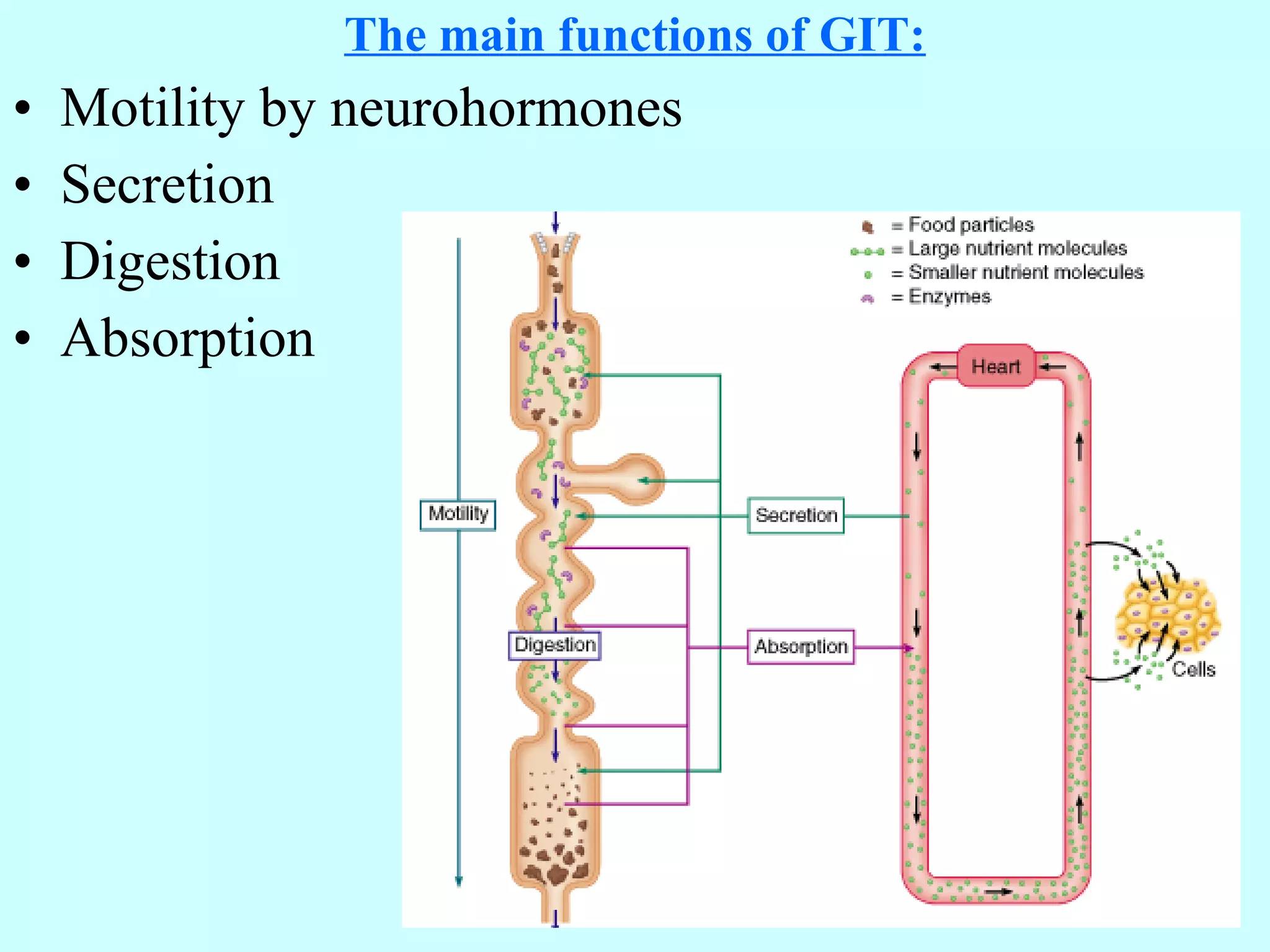
The main functions of GIT: Motility by neurohormones Secretion Digestion Absorption
Characteristics of GIT wall: 5 layers from outside towards the lumen: 1.Serosa. 2.Longitudinal muscle layer. 3.Circular muscle layer. 4.Submucosa. 5.Mucosa with muscularis mucosal in its deeper  layer.
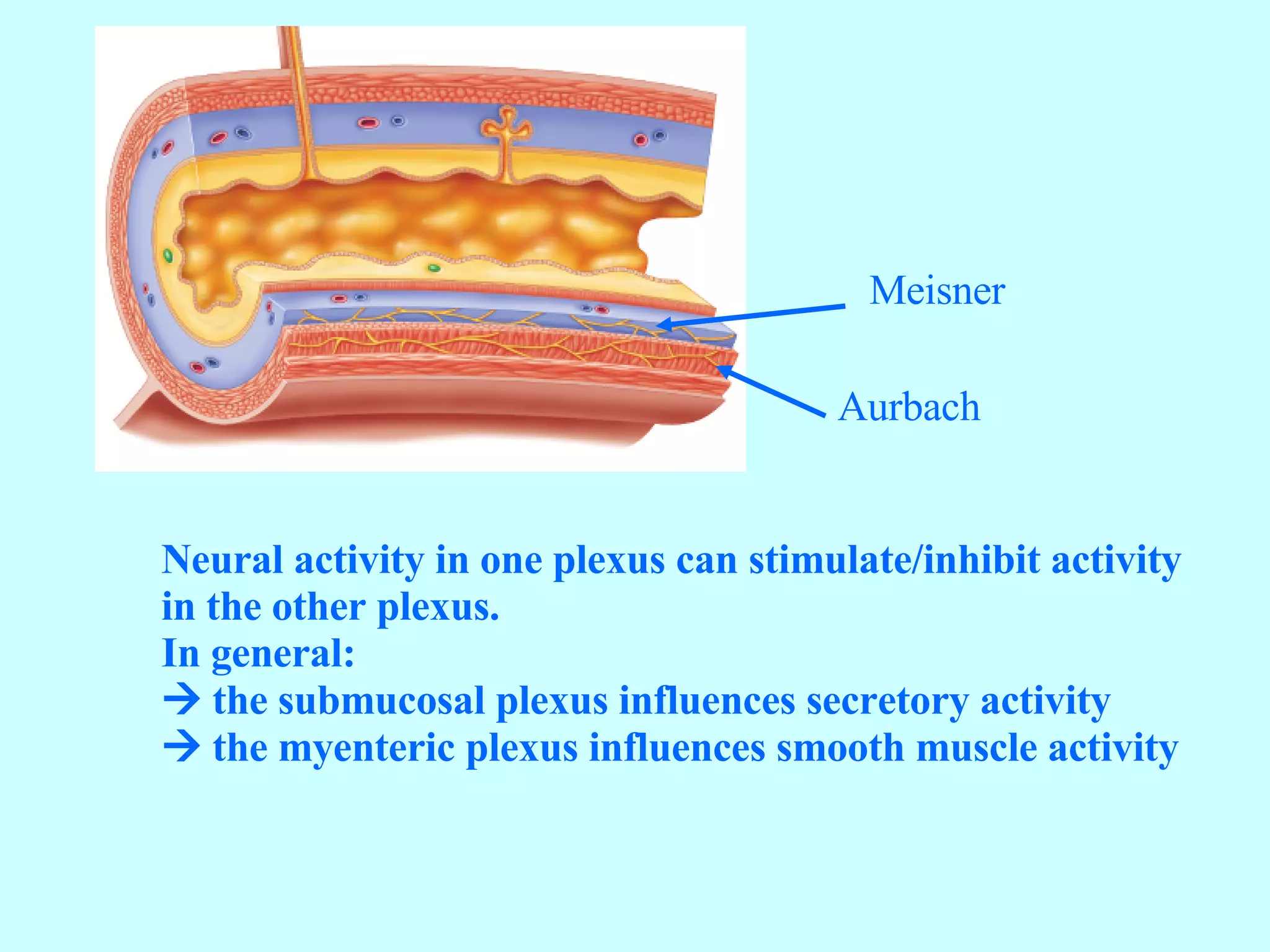
Meisner Aurbach Circular layer Longitudinal layer
Meisner Aurbach Neural activity in one plexus can stimulate/inhibit activity in the other plexus. In general:    the submucosal plexus influences secretory activity     the myenteric plexus influences smooth muscle activity
 
  GIT longitudinal & circular muscle layers   Smooth muscles, form a syncyctium of 2 types:  1.Longitudinal extends down the whole length of  intestinal tract  2.Circular extends around the gut . Connection between the longitudinal muscle fibers themselves &few other connections between the longitudinal & circular ones So the electrical signals can travel readily from one fiber to the next depending on the their exitability traveling few mms or many cms or along the entire length of GIT  exitation of the long. Layer exits the circular one.
  Electrical activity of GIT smooth muscles: 2 types : 1.Slow waves:  not the action potential but slow undulating changes in the resting  membrane action potential(-50 to –60 mv) in a frequency of 3-12/min.  It isa slow undulation in the activity of Na-K pump. involve only Na+ ions. Do not directly cause muscle contraction but they control the appearance of  intermittent  real contractions  spikes
  2.Spike potential:  true action potential of –40 mv of 1-10 spike /sec. lasting for 19-20 m.secs.  caused by Ca++- Na+ Channels which are more slower to open / close & Ca++ ions stemulate smooth muscles contraction by calmodulen control mechanism causing attraction between actin & myosin muscle filaments. Excitable by: A.stretching.  B.ACH. C.parasympathetics. D.specific GIT hormones. They become less excitable by: A.Norepinephrine & epinephrine B. Sympathetics.
-70 -60 -50 -40 -30 -20 Slow wave Resting Spike action potential Depolarization Stretch Ach Parasympathetic . Hyperpolarization: NE, Sympathetics
  Tonic contractions are continuous  lasting( mins. - several hs. ), repetitive series of spike potential produced by continuous entry of Ca++ ions to the interior of the cell ,facilitated by some hormones or other factors.
  Nervous control of GIT movements. Controlled by the (enteric nervous system) lying in the gut wall consisting of > 100 million neurons connecting the gut with the the CNS explaining the major effect of  emotions & psychology on the gut movements & functions. It consists of 2 plexuses: 1.Myenteric or Aurbach or outer  plexus Lie between longitudinal & circular muscle fibers extends along the entire length of  the GIT  mainly excitatory causes: tonic contractions,intensifies rhythmical contrsctions,increases rate of contraction , velocity of contractions & peristaltic waves. It is not entirely excitatory as some of its neurons are inhibitory secreting inhibitory neurotransmitors(NTMS) as vasoactive intestinal peptides (VIP) inhibiting some intestinal sphincters as pyeloric,GE& IC.
2.Miesner or submucosal or inner plexus lies in submucosa ,only within the inner wall of each minute segment of intestine ,Controls local intestinal contraction by submucosal muscles , local intestinal secretion, absorbtion & local blood flow. There are nervous  connections  within & between both plexuses & with the autonomic nervous system(sympathetic & parasympathetic nerve fibers).The enteric NS can function independently or in cooperation with AUT NS.            NTMS secreted by enteric NS: Acetylcholine(ACH),norepinephrine,ATP,serotonin,dopamine,substance P,VIP,Somatostatin,leu-enkephalin,met-enkephalin & bombesin . ACH most often is excitatory while noreepinephrine is most often  inhibitory & the others are mixture of both.
Autonomic control of GIT: Of 2 types: 1.Parasympathetics:  Of 2 types: A.Cranial:through the vagus to the oeso,stomach,pancreas & the 1 st   half of the large intestine with little T o SI. B.Sacral from the 2,3& 4 th  sacral segments of  SC passing to the pelvic nerves & to the distal half of the large intestine  serving defecation reflexes. 2.Sympathetic  innervations: From T5-L2 segments to the celiac ganglia & various mesenteric ganglia .The postganglionic neurons spread along the blood vessels to all parts of the gut & connect with the enteric NS  secreting noreepinephrine which is inhibitory.
Sympathetic ParaSympathetic Celiac ganglia Sup mesenteric ganglia Inf mesenteric ganglia vagus medulla Pelvic nerves
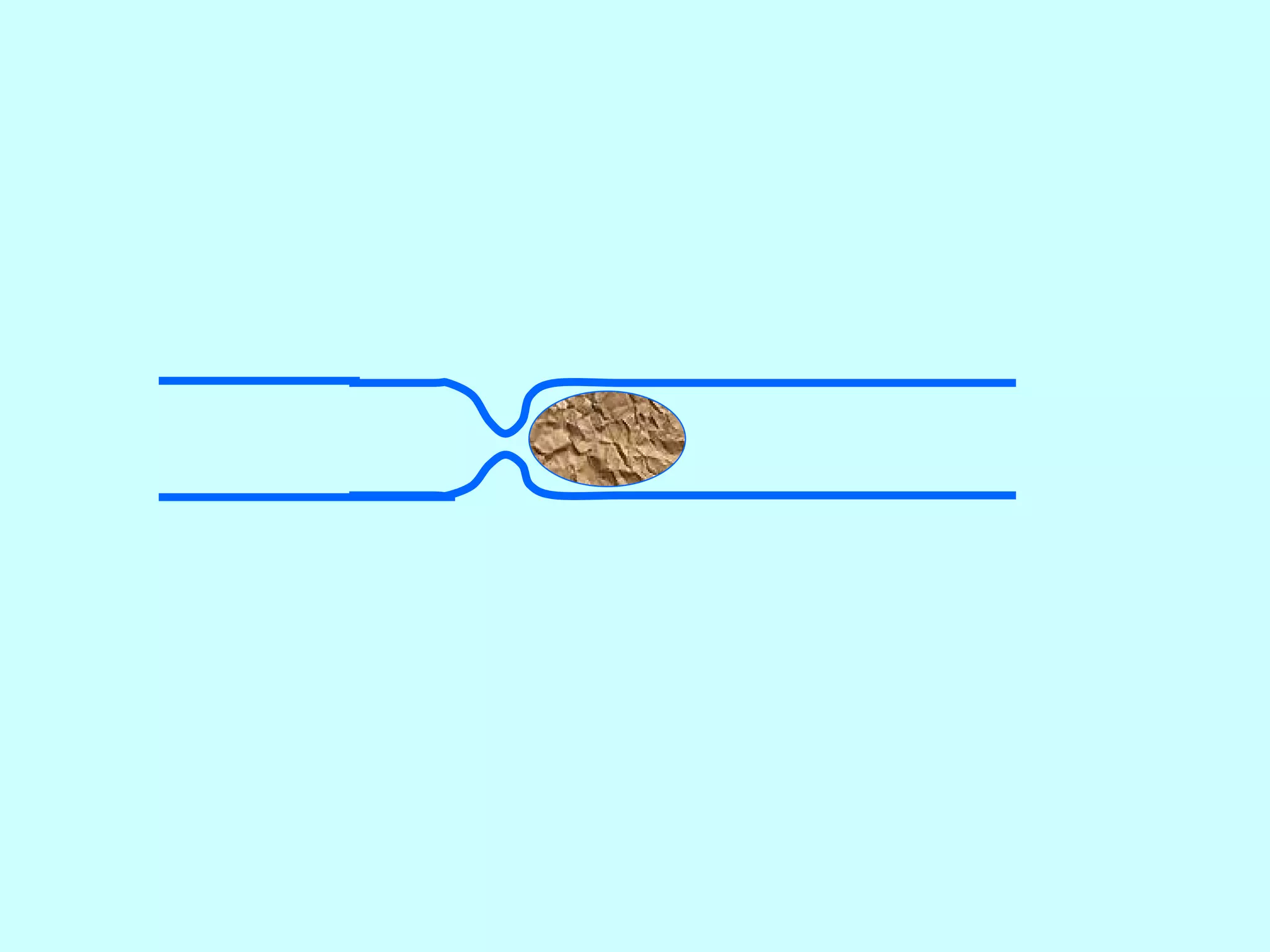
         Functional types of GIT movements:   Two types; 1.propulsive peristaltic movements: is a contractile ring appear around the gut & moves forward the intestinal contents in anal direction called (law of the gut).The stimulus is distention of the gut or irritation of the gut wall & extrinsic nerve signals particularly parasympathetic nerves .An effective peristaltic movement needs active myenteric plexus. 2.Mixing movements: this occurs when forward peristaltic movement is opposed by a sphincteric contraction so the peristaltic wave compresses the gut contents rather than pushing it forward causing mixing the food as in stomach when pyeloric sphincter is blocked.
Two basic types of motility are involved: peristalsis: propels contents through the GIT.
 
 
Segmentation: mixes contents.
 
Intestinal motility Peristalsis:Slow Segmentation: Major  Contraction of circular smooth muscle. Mixes chyme.
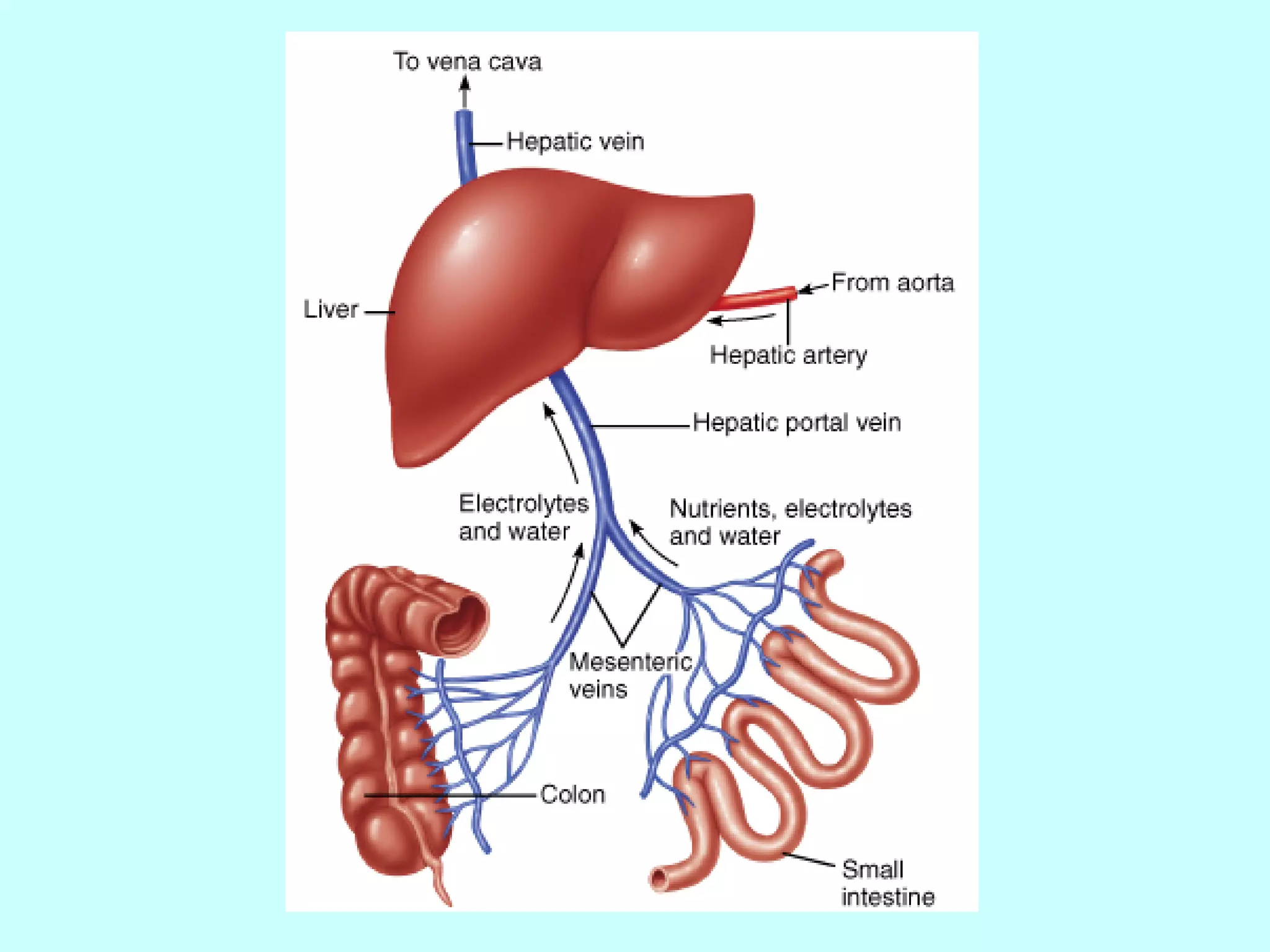
         GIT blood flow:   Is part of more extensive blood system ( splanlic circulation ) include the blood supply to the GIT,Spleen,liver & pancrease .The blood passes to the liver to remove the bacteria & the other harmfull substances to prevent its passage to the general systemic circulation.The gut blood supply is through superior,inferior &celiac plexuses supplying small,large & stomach respectively. The intestinal villi are small projections from small intestine to increase the absorptive surface area  & its microvasculature  including arterioles,venioles & central lymohatic lacteals are arranged in a way  to form a countercurrent for the optimum effective absorption of nutrients.  
        Countercurrent flow in villi:   In villus, arterial flow into & venous flow out of villus are opposite to each other & in close apposition.  Much O2 diffuses from arterioles into adjacent venules without reaching villus tip (short circuit) & may not be available for local metabolic function of villi.  Under normal conditions this shunting is not harmful, but in disease conditions in which flow to gut is already compromised, such as circulatory shock, the O2 deficit can be great that the villus tip will become ischemic & disintegrate.  This is reason why in many GI diseases villi are blunted & lead to greatly decreased GI absorptive capacity.


Physio Gi 1,2.

  • 1.
    Gastrointestinal physiology. Generalprinciples . Dr.M.A.M.Shaikhani. Assistant professor Consultant physician CABM Arabic board in internal medicine Subspecialty in gastroenterology & endoscopy
  • 2.
  • 3.
    The main functionsof GIT: Motility by neurohormones Secretion Digestion Absorption
  • 4.
    Characteristics of GITwall: 5 layers from outside towards the lumen: 1.Serosa. 2.Longitudinal muscle layer. 3.Circular muscle layer. 4.Submucosa. 5.Mucosa with muscularis mucosal in its deeper layer.
  • 5.
    Meisner Aurbach Circularlayer Longitudinal layer
  • 6.
    Meisner Aurbach Neuralactivity in one plexus can stimulate/inhibit activity in the other plexus. In general:  the submucosal plexus influences secretory activity  the myenteric plexus influences smooth muscle activity
  • 7.
  • 8.
      GIT longitudinal& circular muscle layers Smooth muscles, form a syncyctium of 2 types: 1.Longitudinal extends down the whole length of intestinal tract 2.Circular extends around the gut . Connection between the longitudinal muscle fibers themselves &few other connections between the longitudinal & circular ones So the electrical signals can travel readily from one fiber to the next depending on the their exitability traveling few mms or many cms or along the entire length of GIT exitation of the long. Layer exits the circular one.
  • 9.
      Electrical activityof GIT smooth muscles: 2 types : 1.Slow waves: not the action potential but slow undulating changes in the resting membrane action potential(-50 to –60 mv) in a frequency of 3-12/min. It isa slow undulation in the activity of Na-K pump. involve only Na+ ions. Do not directly cause muscle contraction but they control the appearance of intermittent real contractions spikes
  • 10.
      2.Spike potential: true action potential of –40 mv of 1-10 spike /sec. lasting for 19-20 m.secs. caused by Ca++- Na+ Channels which are more slower to open / close & Ca++ ions stemulate smooth muscles contraction by calmodulen control mechanism causing attraction between actin & myosin muscle filaments. Excitable by: A.stretching. B.ACH. C.parasympathetics. D.specific GIT hormones. They become less excitable by: A.Norepinephrine & epinephrine B. Sympathetics.
  • 11.
    -70 -60 -50-40 -30 -20 Slow wave Resting Spike action potential Depolarization Stretch Ach Parasympathetic . Hyperpolarization: NE, Sympathetics
  • 12.
      Tonic contractionsare continuous lasting( mins. - several hs. ), repetitive series of spike potential produced by continuous entry of Ca++ ions to the interior of the cell ,facilitated by some hormones or other factors.
  • 13.
      Nervous controlof GIT movements. Controlled by the (enteric nervous system) lying in the gut wall consisting of > 100 million neurons connecting the gut with the the CNS explaining the major effect of emotions & psychology on the gut movements & functions. It consists of 2 plexuses: 1.Myenteric or Aurbach or outer plexus Lie between longitudinal & circular muscle fibers extends along the entire length of the GIT mainly excitatory causes: tonic contractions,intensifies rhythmical contrsctions,increases rate of contraction , velocity of contractions & peristaltic waves. It is not entirely excitatory as some of its neurons are inhibitory secreting inhibitory neurotransmitors(NTMS) as vasoactive intestinal peptides (VIP) inhibiting some intestinal sphincters as pyeloric,GE& IC.
  • 14.
    2.Miesner or submucosalor inner plexus lies in submucosa ,only within the inner wall of each minute segment of intestine ,Controls local intestinal contraction by submucosal muscles , local intestinal secretion, absorbtion & local blood flow. There are nervous connections within & between both plexuses & with the autonomic nervous system(sympathetic & parasympathetic nerve fibers).The enteric NS can function independently or in cooperation with AUT NS.          NTMS secreted by enteric NS: Acetylcholine(ACH),norepinephrine,ATP,serotonin,dopamine,substance P,VIP,Somatostatin,leu-enkephalin,met-enkephalin & bombesin . ACH most often is excitatory while noreepinephrine is most often inhibitory & the others are mixture of both.
  • 15.
    Autonomic control ofGIT: Of 2 types: 1.Parasympathetics: Of 2 types: A.Cranial:through the vagus to the oeso,stomach,pancreas & the 1 st half of the large intestine with little T o SI. B.Sacral from the 2,3& 4 th sacral segments of SC passing to the pelvic nerves & to the distal half of the large intestine serving defecation reflexes. 2.Sympathetic innervations: From T5-L2 segments to the celiac ganglia & various mesenteric ganglia .The postganglionic neurons spread along the blood vessels to all parts of the gut & connect with the enteric NS secreting noreepinephrine which is inhibitory.
  • 16.
    Sympathetic ParaSympathetic Celiacganglia Sup mesenteric ganglia Inf mesenteric ganglia vagus medulla Pelvic nerves
  • 17.
            Functionaltypes of GIT movements: Two types; 1.propulsive peristaltic movements: is a contractile ring appear around the gut & moves forward the intestinal contents in anal direction called (law of the gut).The stimulus is distention of the gut or irritation of the gut wall & extrinsic nerve signals particularly parasympathetic nerves .An effective peristaltic movement needs active myenteric plexus. 2.Mixing movements: this occurs when forward peristaltic movement is opposed by a sphincteric contraction so the peristaltic wave compresses the gut contents rather than pushing it forward causing mixing the food as in stomach when pyeloric sphincter is blocked.
  • 18.
    Two basic typesof motility are involved: peristalsis: propels contents through the GIT.
  • 19.
  • 20.
  • 21.
  • 22.
  • 23.
  • 24.
    Intestinal motility Peristalsis:SlowSegmentation: Major Contraction of circular smooth muscle. Mixes chyme.
  • 25.
            GITblood flow: Is part of more extensive blood system ( splanlic circulation ) include the blood supply to the GIT,Spleen,liver & pancrease .The blood passes to the liver to remove the bacteria & the other harmfull substances to prevent its passage to the general systemic circulation.The gut blood supply is through superior,inferior &celiac plexuses supplying small,large & stomach respectively. The intestinal villi are small projections from small intestine to increase the absorptive surface area & its microvasculature including arterioles,venioles & central lymohatic lacteals are arranged in a way to form a countercurrent for the optimum effective absorption of nutrients.  
  • 26.
           Countercurrentflow in villi: In villus, arterial flow into & venous flow out of villus are opposite to each other & in close apposition. Much O2 diffuses from arterioles into adjacent venules without reaching villus tip (short circuit) & may not be available for local metabolic function of villi. Under normal conditions this shunting is not harmful, but in disease conditions in which flow to gut is already compromised, such as circulatory shock, the O2 deficit can be great that the villus tip will become ischemic & disintegrate. This is reason why in many GI diseases villi are blunted & lead to greatly decreased GI absorptive capacity.
  • 27.
  • 28.
  • 29.