MUHAMMAD RAMZAN UL REHMAN 1
GGII hhoorrmmoonnee 
BY MUHAMMAD RAMZAN UL REHMAN 
MUHAMMAD RAMZAN UL REHMAN 2
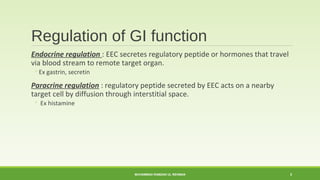
Regulation of GI function 
Endocrine regulation : EEC secretes regulatory peptide or hormones that travel 
via blood stream to remote target organ. 
◦Ex gastrin, secretin 
Paracrine regulation : regulatory peptide secreted by EEC acts on a nearby 
target cell by diffusion through interstitial space. 
◦ Ex histamine 
MUHAMMAD RAMZAN UL REHMAN 3
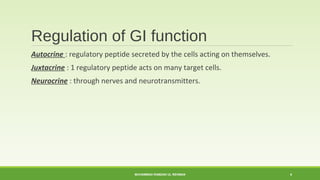
Regulation of GI function 
Autocrine : regulatory peptide secreted by the cells acting on themselves. 
Juxtacrine : 1 regulatory peptide acts on many target cells. 
Neurocrine : through nerves and neurotransmitters. 
MUHAMMAD RAMZAN UL REHMAN 4
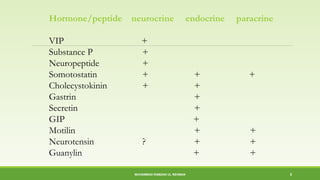
Hormone/peptide neurocrine endocrine paracrine 
VIP + 
Substance P + 
Neuropeptide + 
Somotostatin + + + 
Cholecystokinin + + 
Gastrin + 
Secretin + 
GIP + 
Motilin + + 
Neurotensin ? + + 
Guanylin + + 
MUHAMMAD RAMZAN UL REHMAN 5
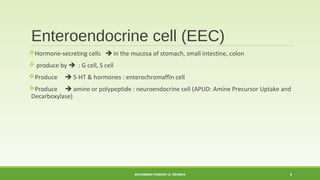
Enteroendocrine cell (EEC) 
Hormone-secreting cells  in the mucosa of stomach, small intestine, colon 
 produce by  : G cell, S cell 
Produce  5-HT & hormones : enterochromaffin cell 
Produce  amine or polypeptide : neuroendocrine cell (APUD: Amine Precursor Uptake and 
Decarboxylase) 
MUHAMMAD RAMZAN UL REHMAN 6
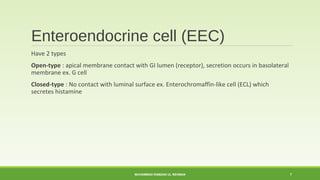
Enteroendocrine cell (EEC) 
Have 2 types 
Open-type : apical membrane contact with GI lumen (receptor), secretion occurs in basolateral 
membrane ex. G cell 
Closed-type : No contact with luminal surface ex. Enterochromaffin-like cell (ECL) which 
secretes histamine 
MUHAMMAD RAMZAN UL REHMAN 7
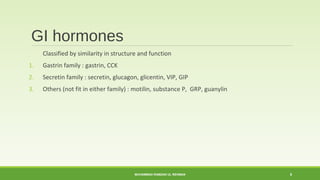
GI hormones 
Classified by similarity in structure and function 
1. Gastrin family : gastrin, CCK 
2. Secretin family : secretin, glucagon, glicentin, VIP, GIP 
3. Others (not fit in either family) : motilin, substance P, GRP, guanylin 
MUHAMMAD RAMZAN UL REHMAN 8
Gastrin 
Produced by G cell in the mucosal gland of gastric antrum and duodenum 
Can be found in fetal pancreatic islet, hypothalamus, medulla oblongata, vagus n. (unidentified 
function) 
MUHAMMAD RAMZAN UL REHMAN 9
Structure of gastrin 
Polypeptide hormone with multiple forms 
1. Macroheterogenity : diff in length of peptide chain 
2. Microheterogenity : diff on derivatization of amino acid residues 
ex. Sulfation of tyrosine (6th aa residue from C-terminal), amidation of the C-terminal 
phynylalanine 
MUHAMMAD RAMZAN UL REHMAN 10
Structure of gastrin 
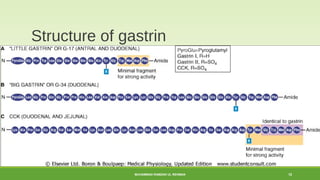
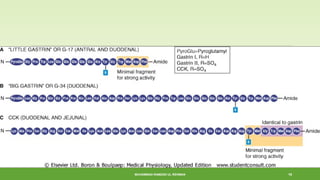
Preprogastrin (101 aa) is processed into 3 fragments 
1. G34 : 34 aa secreted mainly by duodenal G cell 
2. G17 : 17 aa secreted mainly by antral G cell 
3. G14 : 14 aa 
All forms have the same C-terminal configuration 
MUHAMMAD RAMZAN UL REHMAN 11
Structure of gastrin 
MUHAMMAD RAMZAN UL REHMAN 12
Gastrin 
Different forms, different activity, different tissues that are found 
G17 : principal form of gastric acid secretion (more active and more amount than G34) 
Half Life (t1/2) : G14, G17 2-3 min in blood. 
 G34 15 min 
Inactivated in kidney, small bowel 
MUHAMMAD RAMZAN UL REHMAN 13
Action of gastrin 
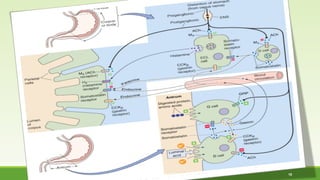
Stimulation of gastric acid and pepsin secretion 
Stimulation of mucosal growth in stomach, SB, colon (trophic action) 
Stimulation of gastric motility 
Release of histamine from ECL cell 
Stimulate insulin secretion after protein meal (not CHO) 
+/- constriction of LES 
MUHAMMAD RAMZAN UL REHMAN 14
MUHAMMAD RAMZAN UL REHMAN 15
Regulation of gastrin secretion 
↑ gastrin secretion 
Luminal : peptide, aa (Phy, Tryp), 
gastric distention 
Neural : vagal stimulation via GRP 
(can’t be blocked by atropine) 
Blood : Ca, epinephrine 
↓ gastrin secretion 
Luminal : acid, somatostatin 
Blood : secretin, GIP, VIP, glucagon, 
calcitonin 
MUHAMMAD RAMZAN UL REHMAN 16
Feedback inhibition of gastrin 
Acid in antrum inhibit gastrin secretion by 2 ways 
1. Direct action on G cell 
2. Stimulate release of somatostatin by D cell 
In condition which parietal cells are damaged, pernicious anemia, 
gastrin level is elevated. 
MUHAMMAD RAMZAN UL REHMAN 17
Cholecystokinin-Pancreozymin 
(CCK) 
Also shows macro- and microheterogenity Prepro-CCK is processed into several fragments 
CCK58, CCK39, CCK33, CCK22 ,CCK12, CCK8 
Every forms has the same 5 aa at C-terminal as gastrin 
Every forms has amidation of C-terminal, sulfation of 7thtyrosine from C-terminal 
MUHAMMAD RAMZAN UL REHMAN 18
MUHAMMAD RAMZAN UL REHMAN 19
CCK 
Secreted by I cell in duodenum and jejunum 
Also found in nerves in distal ileum and colon, neurons in brain (regulation of food intake) 
CCK8, CCK22, CCK33 : principal circulating forms secreted in response to meal 
Enteric & pancreatic nerve : CCK4 
Brain : CCK8, CCK58 
MUHAMMAD RAMZAN UL REHMAN 20
Action of CCK 
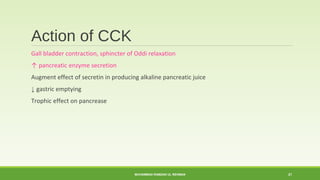
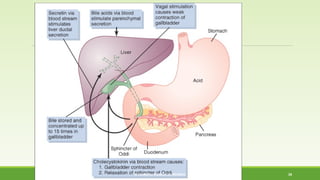
Gall bladder contraction, sphincter of Oddi relaxation 
↑ pancreatic enzyme secretion 
Augment effect of secretin in producing alkaline pancreatic juice 
↓ gastric emptying 
Trophic effect on pancrease 
MUHAMMAD RAMZAN UL REHMAN 21
Action of CCK 
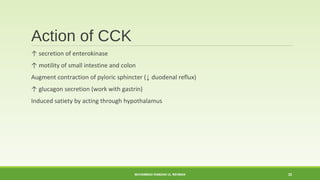
↑ secretion of enterokinase 
↑ motility of small intestine and colon 
Augment contraction of pyloric sphincter (↓ duodenal reflux) 
↑ glucagon secretion (work with gastrin) 
Induced satiety by acting through hypothalamus 
MUHAMMAD RAMZAN UL REHMAN 22
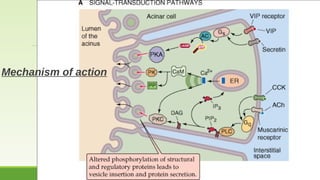
Mechanism of action 
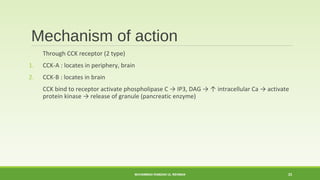
Through CCK receptor (2 type) 
1. CCK-A : locates in periphery, brain 
2. CCK-B : locates in brain 
CCK bind to receptor activate phospholipase C → IP3, DAG → ↑ intracellular Ca → activate 
protein kinase → release of granule (pancreatic enzyme) 
MUHAMMAD RAMZAN UL REHMAN 23
Mechanism of action 
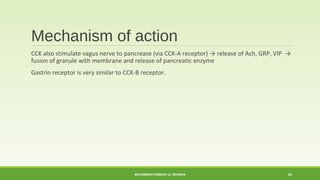
CCK also stimulate vagus nerve to pancrease (via CCK-A receptor) → release of Ach, GRP, VIP → 
fusion of granule with membrane and release of pancreatic enzyme 
Gastrin receptor is very similar to CCK-B receptor. 
MUHAMMAD RAMZAN UL REHMAN 24
Mechanism of action 
25 
MUHAMMAD RAMZAN UL REHMAN
Control of CCK secretion 
Most potent stimulator of CCK release is lipid 
Peptones, amino acid also increase CCK release but CHO has little effect. 
Also secreted in response to CCK-releasing factor 
Positive feedback : CCK → enzyme release → more digestive products → more CCK (stop when 
digestive products move to next part) 
MUHAMMAD RAMZAN UL REHMAN 26
CCK-releasing peptide & monitor 
peptide 
CCK-RP is secreted from duodenal mucosa, and monitor peptide by 
pancreatic acinar cell 
Secreted in response to fat, protein digestive products, and also to 
neural input (cephalic phase) 
Match the release of CCK, pancreatic enzyme and the need for enzyme 
to digest foods 
These peptides are degraded by pancreatic trypsin (if there are 
proteins in duodenum, these peptides won’t be degraded and CCK will 
be released ) 
MUHAMMAD RAMZAN UL REHMAN 27
Secretin 
27 amino-acid polypeptide 
Secreted by S cell located deeply in the mucosal gland of duodenum and jejunum 
Similar structure with glucagon, VIP, GIP 
Only 1 form has been isolated 
t1/2 : 5 min 
Stored in an inactive form (prosecretin) 
MUHAMMAD RAMZAN UL REHMAN 28
Action of secretin 
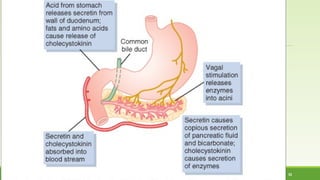
Most potent humoral stimulator of fluid and HCO3 secretion by 
pancrease 
Acts in concert with CCK, Ach to stimulate HCO3 secretion 
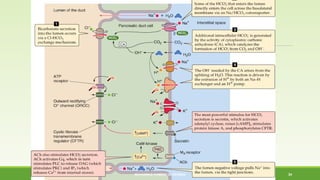
↑ HCO3 secretion by duct cells of pancrease and biliary tract→ 
↑secretion of a watery, alkaline pancreatic juice 
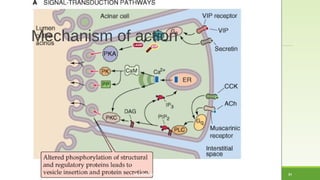
Acting through cAMP 
MUHAMMAD RAMZAN UL REHMAN 29
Action of secretin 
↑ pancreatic enzyme secretion (augment CCK) 
↓ gastric acid secretion 
Pyloric sphincter contraction 
Stimulate growth of exocrine pancrease (work with CCK) 
MUHAMMAD RAMZAN UL REHMAN 30
Mechanism of action 
MUHAMMAD RAMZAN UL REHMAN 31
MUHAMMAD RAMZAN UL REHMAN 32
Effect of secretin on bile secretion 
Produce a watery bile rich in HCO3 
Activate via cAMP → stimulate CFTR (Chloride channel) and Cl– HCO3 exchanger 
Work in concert with glucagon, VIP 
MUHAMMAD RAMZAN UL REHMAN 33
Action of secretin in bile secretion 
MUHAMMAD RAMZAN UL REHMAN 34
MUHAMMAD RAMZAN UL REHMAN 35
Control of secretin secretion 
Secretin is secreted in response to protein digestive 
products, bile acid, fatty food and increased acidity in 
duodenal content (pH< 4.5-5) 
Inhibited by somatostatin and Met-enkephalin 
Secretin release may be mediated by secretin-releasing 
peptide 
MUHAMMAD RAMZAN UL REHMAN 36
Gastric inhibitory peptide (GIP) 
42 amino-acid polypeptide 
Produced by K cell in duodenal and jejunal mucosa 
Stimulated by glucose and fat in duodenum, acid in stomach 
Inactivated by dipeptidyl-peptidase IV (DPP-IV) 
in many tissues and in portal circulation 
MUHAMMAD RAMZAN UL REHMAN 37
Action of GIP 
Mild effect in decreasing gastric motility 
Inhibit gastric acid secretion by directly inhibit parietal cells or indirectly inhibit gastrin release 
from antral G cells (via somatostatin) 
Stimulate insulin release from pancreatic islet in response to duodenal glucose and fatty acid 
Oral glucose can stimulate larger amount of insulin release than IV glucose 
MUHAMMAD RAMZAN UL REHMAN 38
Enteric factors increasing insulin 
release 
CCK, GIP, GLP-1, Glucagon 
GIP is also called glucose-dependent insulinotropic polypeptide by this action 
GLP-1 is more potent than GIP (limited study) 
GIP, GLP-1 act via protein kinase A pathway (increased cAMP and cytosolic calcium) 
MUHAMMAD RAMZAN UL REHMAN 39
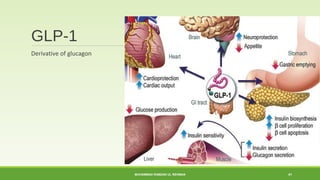
Glucagon-Like Peptide 1 (GLP-1) 
30 amino-acid polypeptide 
Incretin hormone : intestinal hormone secreted in response to nutrient ingestion which 
potentiate glucose-induced insulin release 
Produced by L cell in ileum and colon, pancreatic alpha cell, neurons in hypothalamus, pituitary 
gland 
2 bioactive forms : GLP-1[7-36] amide , GLP-1[7-37] both forms are equipotent, same t1/2 
MUHAMMAD RAMZAN UL REHMAN 40
GLP-1 
Derivative of glucagon 
MUHAMMAD RAMZAN UL REHMAN 41
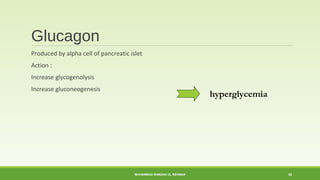
Glucagon 
Produced by alpha cell of pancreatic islet 
Action : 
Increase glycogenolysis 
Increase gluconeogenesis 
hyperglycemia 
MUHAMMAD RAMZAN UL REHMAN 42
Glicentin 
69 amino-acid polypeptide derived from proglucagon 
Secreted from L cell along with GLP-1 and GLP-2 
Action : stimulation of insulin secretion, inhibit gastric acid secretion, regulation of gut motility, 
stimulation of intestinal growth 
MUHAMMAD RAMZAN UL REHMAN 43
Vasoactive intestinal peptide (VIP) 
28 amino-acid polypeptide 
Found in ENS neurons (both myenteric and submucosal plexus), brain, autonomic nerves 
Released in response to esophageal and gastric distention, vagal stimulation, fatty acid and 
ethanol in duodenum 
Amino acid and glucose don’t affect VIP release 
Half life 2 min in circulation 
MUHAMMAD RAMZAN UL REHMAN 44
Action of VIP 
↑ secretion of E’lyte and water from small bowel 
Intestinal circular smooth ms relaxation 
Longitudinal smooth muscle contraction 
↑ pancreatic secretion 
Inhibit gastric acid secretion and motility 
Potentiate axn of Ach in salivary gland 
VIPoma : presented with profused diarrhea 
MUHAMMAD RAMZAN UL REHMAN 45
Motilin 
22 amino-acid polypeptide 
Secreted by enterochromaffin cell and M cell in duodenum, jejunum 
Acts on G-protein coupled receptor on enteric neurons in stomach, duodenum → GI tract 
smooth muscle contraction 
Its circulating level increased at interval of 90-100 mins in the interdigestive state 
MUHAMMAD RAMZAN UL REHMAN 46
Motilin 
Major regulator of MMCs (Migrating Motor Complex) that move through the stomach and small 
intestine every 90 mins in fasted person 
Motilin secretion is inhibited after ingestion 
Vagal nerve may play some role in motilin secretion 
Erythromycin bind to motilin receptor → ↑ GI motility in constipated person 
MUHAMMAD RAMZAN UL REHMAN 47
Somatostatin 
Growth hormone inhibitory hormone (GH-IH) 
First found in hypothalamus 
Secreted by D cell in stomach, duodenum, pancreatic islet 
Secreted in larger amount into gastric lumen > circulation 
Released in response to acid in stomach 
MUHAMMAD RAMZAN UL REHMAN 48
somatostatin 
Presented in 2 forms 
1. Somatostatin 14 : prominent in hypothalamus 
2. Somatostatin 28 : prominent in GI tract 
Acts through G-protein couple receptor (inhibit adenylate cyclase) 
MUHAMMAD RAMZAN UL REHMAN 49
Action of somatostatin 
Inhibit secretion of gastrin, VIP, GIP, secretin, motilin, GH, insulin, glucagon 
↑ fluid absorption and ↓ secretion from intestine 
↓ endocrine and exocrine pancreatic secretion 
↓ bile flow and gall bladder contraction 
↓ gastric acid secretion and motility 
↓ absorption of glucose, amino acid, triglyceride 
MUHAMMAD RAMZAN UL REHMAN 50
Summation of 
GI hormone 
MUHAMMAD RAMZAN UL REHMAN 51
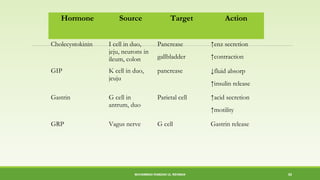
Hormone Source Target Action 
Cholecystokinin I cell in duo, 
jeju, neurons in 
ileum, colon 
Pancrease 
gallbladder 
↑enz secretion 
↑contraction 
GIP K cell in duo, 
jeuju 
pancrease ↓fluid absorp 
↑insulin release 
Gastrin G cell in 
antrum, duo 
Parietal cell ↑acid secretion 
↑motility 
GRP Vagus nerve G cell Gastrin release 
MUHAMMAD RAMZAN UL REHMAN 52
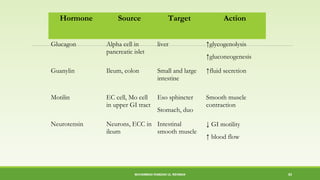
Hormone Source Target Action 
Glucagon Alpha cell in 
pancreatic islet 
liver ↑glycogenolysis 
↑gluconeogenesis 
Guanylin Ileum, colon Small and large 
intestine 
↑fluid secretion 
Motilin EC cell, Mo cell 
in upper GI tract 
Eso sphincter 
Stomach, duo 
Smooth muscle 
contraction 
Neurotensin Neurons, ECC in 
ileum 
Intestinal 
smooth muscle 
↓ GI motility 
↑ blood flow 
MUHAMMAD RAMZAN UL REHMAN 53
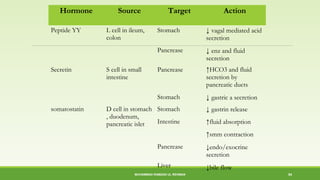
Hormone Source Target Action 
Peptide YY L cell in ileum, 
colon 
Stomach 
Pancrease 
↓ vagal mediated acid 
secretion 
↓ enz and fluid 
secretion 
Secretin S cell in small 
intestine 
Pancrease 
Stomach 
↑HCO3 and fluid 
secretion by 
pancreatic ducts 
↓ gastric a secretion 
somatostatin D cell in stomach 
, duodenum, 
pancreatic islet 
Stomach 
Intestine 
Pancrease 
Liver 
↓ gastrin release 
↑fluid absorption 
↑smm contraction 
↓endo/exocrine 
secretion 
↓bile flow 
MUHAMMAD RAMZAN UL REHMAN 54
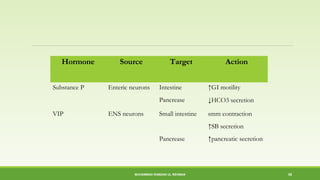
Hormone Source Target Action 
Substance P Enteric neurons Intestine 
Pancrease 
↑GI motility 
↓HCO3 secretion 
VIP ENS neurons Small intestine 
Pancrease 
smm contraction 
↑SB secretion 
↑pancreatic secretion 
MUHAMMAD RAMZAN UL REHMAN 55
Thank You 
BY MUHAMMAD RAMZAN UL REHMAN 
MUHAMMAD RAMZAN UL REHMAN 56

GIT Hormones

  • 1.
  • 2.
    GGII hhoorrmmoonnee BYMUHAMMAD RAMZAN UL REHMAN MUHAMMAD RAMZAN UL REHMAN 2
  • 3.
    Regulation of GIfunction Endocrine regulation : EEC secretes regulatory peptide or hormones that travel via blood stream to remote target organ. ◦Ex gastrin, secretin Paracrine regulation : regulatory peptide secreted by EEC acts on a nearby target cell by diffusion through interstitial space. ◦ Ex histamine MUHAMMAD RAMZAN UL REHMAN 3
  • 4.
    Regulation of GIfunction Autocrine : regulatory peptide secreted by the cells acting on themselves. Juxtacrine : 1 regulatory peptide acts on many target cells. Neurocrine : through nerves and neurotransmitters. MUHAMMAD RAMZAN UL REHMAN 4
  • 5.
    Hormone/peptide neurocrine endocrineparacrine VIP + Substance P + Neuropeptide + Somotostatin + + + Cholecystokinin + + Gastrin + Secretin + GIP + Motilin + + Neurotensin ? + + Guanylin + + MUHAMMAD RAMZAN UL REHMAN 5
  • 6.
    Enteroendocrine cell (EEC) Hormone-secreting cells  in the mucosa of stomach, small intestine, colon  produce by  : G cell, S cell Produce  5-HT & hormones : enterochromaffin cell Produce  amine or polypeptide : neuroendocrine cell (APUD: Amine Precursor Uptake and Decarboxylase) MUHAMMAD RAMZAN UL REHMAN 6
  • 7.
    Enteroendocrine cell (EEC) Have 2 types Open-type : apical membrane contact with GI lumen (receptor), secretion occurs in basolateral membrane ex. G cell Closed-type : No contact with luminal surface ex. Enterochromaffin-like cell (ECL) which secretes histamine MUHAMMAD RAMZAN UL REHMAN 7
  • 8.
    GI hormones Classifiedby similarity in structure and function 1. Gastrin family : gastrin, CCK 2. Secretin family : secretin, glucagon, glicentin, VIP, GIP 3. Others (not fit in either family) : motilin, substance P, GRP, guanylin MUHAMMAD RAMZAN UL REHMAN 8
  • 9.
    Gastrin Produced byG cell in the mucosal gland of gastric antrum and duodenum Can be found in fetal pancreatic islet, hypothalamus, medulla oblongata, vagus n. (unidentified function) MUHAMMAD RAMZAN UL REHMAN 9
  • 10.
    Structure of gastrin Polypeptide hormone with multiple forms 1. Macroheterogenity : diff in length of peptide chain 2. Microheterogenity : diff on derivatization of amino acid residues ex. Sulfation of tyrosine (6th aa residue from C-terminal), amidation of the C-terminal phynylalanine MUHAMMAD RAMZAN UL REHMAN 10
  • 11.
    Structure of gastrin Preprogastrin (101 aa) is processed into 3 fragments 1. G34 : 34 aa secreted mainly by duodenal G cell 2. G17 : 17 aa secreted mainly by antral G cell 3. G14 : 14 aa All forms have the same C-terminal configuration MUHAMMAD RAMZAN UL REHMAN 11
  • 12.
    Structure of gastrin MUHAMMAD RAMZAN UL REHMAN 12
  • 13.
    Gastrin Different forms,different activity, different tissues that are found G17 : principal form of gastric acid secretion (more active and more amount than G34) Half Life (t1/2) : G14, G17 2-3 min in blood.  G34 15 min Inactivated in kidney, small bowel MUHAMMAD RAMZAN UL REHMAN 13
  • 14.
    Action of gastrin Stimulation of gastric acid and pepsin secretion Stimulation of mucosal growth in stomach, SB, colon (trophic action) Stimulation of gastric motility Release of histamine from ECL cell Stimulate insulin secretion after protein meal (not CHO) +/- constriction of LES MUHAMMAD RAMZAN UL REHMAN 14
  • 15.
  • 16.
    Regulation of gastrinsecretion ↑ gastrin secretion Luminal : peptide, aa (Phy, Tryp), gastric distention Neural : vagal stimulation via GRP (can’t be blocked by atropine) Blood : Ca, epinephrine ↓ gastrin secretion Luminal : acid, somatostatin Blood : secretin, GIP, VIP, glucagon, calcitonin MUHAMMAD RAMZAN UL REHMAN 16
  • 17.
    Feedback inhibition ofgastrin Acid in antrum inhibit gastrin secretion by 2 ways 1. Direct action on G cell 2. Stimulate release of somatostatin by D cell In condition which parietal cells are damaged, pernicious anemia, gastrin level is elevated. MUHAMMAD RAMZAN UL REHMAN 17
  • 18.
    Cholecystokinin-Pancreozymin (CCK) Alsoshows macro- and microheterogenity Prepro-CCK is processed into several fragments CCK58, CCK39, CCK33, CCK22 ,CCK12, CCK8 Every forms has the same 5 aa at C-terminal as gastrin Every forms has amidation of C-terminal, sulfation of 7thtyrosine from C-terminal MUHAMMAD RAMZAN UL REHMAN 18
  • 19.
  • 20.
    CCK Secreted byI cell in duodenum and jejunum Also found in nerves in distal ileum and colon, neurons in brain (regulation of food intake) CCK8, CCK22, CCK33 : principal circulating forms secreted in response to meal Enteric & pancreatic nerve : CCK4 Brain : CCK8, CCK58 MUHAMMAD RAMZAN UL REHMAN 20
  • 21.
    Action of CCK Gall bladder contraction, sphincter of Oddi relaxation ↑ pancreatic enzyme secretion Augment effect of secretin in producing alkaline pancreatic juice ↓ gastric emptying Trophic effect on pancrease MUHAMMAD RAMZAN UL REHMAN 21
  • 22.
    Action of CCK ↑ secretion of enterokinase ↑ motility of small intestine and colon Augment contraction of pyloric sphincter (↓ duodenal reflux) ↑ glucagon secretion (work with gastrin) Induced satiety by acting through hypothalamus MUHAMMAD RAMZAN UL REHMAN 22
  • 23.
    Mechanism of action Through CCK receptor (2 type) 1. CCK-A : locates in periphery, brain 2. CCK-B : locates in brain CCK bind to receptor activate phospholipase C → IP3, DAG → ↑ intracellular Ca → activate protein kinase → release of granule (pancreatic enzyme) MUHAMMAD RAMZAN UL REHMAN 23
  • 24.
    Mechanism of action CCK also stimulate vagus nerve to pancrease (via CCK-A receptor) → release of Ach, GRP, VIP → fusion of granule with membrane and release of pancreatic enzyme Gastrin receptor is very similar to CCK-B receptor. MUHAMMAD RAMZAN UL REHMAN 24
  • 25.
    Mechanism of action 25 MUHAMMAD RAMZAN UL REHMAN
  • 26.
    Control of CCKsecretion Most potent stimulator of CCK release is lipid Peptones, amino acid also increase CCK release but CHO has little effect. Also secreted in response to CCK-releasing factor Positive feedback : CCK → enzyme release → more digestive products → more CCK (stop when digestive products move to next part) MUHAMMAD RAMZAN UL REHMAN 26
  • 27.
    CCK-releasing peptide &monitor peptide CCK-RP is secreted from duodenal mucosa, and monitor peptide by pancreatic acinar cell Secreted in response to fat, protein digestive products, and also to neural input (cephalic phase) Match the release of CCK, pancreatic enzyme and the need for enzyme to digest foods These peptides are degraded by pancreatic trypsin (if there are proteins in duodenum, these peptides won’t be degraded and CCK will be released ) MUHAMMAD RAMZAN UL REHMAN 27
  • 28.
    Secretin 27 amino-acidpolypeptide Secreted by S cell located deeply in the mucosal gland of duodenum and jejunum Similar structure with glucagon, VIP, GIP Only 1 form has been isolated t1/2 : 5 min Stored in an inactive form (prosecretin) MUHAMMAD RAMZAN UL REHMAN 28
  • 29.
    Action of secretin Most potent humoral stimulator of fluid and HCO3 secretion by pancrease Acts in concert with CCK, Ach to stimulate HCO3 secretion ↑ HCO3 secretion by duct cells of pancrease and biliary tract→ ↑secretion of a watery, alkaline pancreatic juice Acting through cAMP MUHAMMAD RAMZAN UL REHMAN 29
  • 30.
    Action of secretin ↑ pancreatic enzyme secretion (augment CCK) ↓ gastric acid secretion Pyloric sphincter contraction Stimulate growth of exocrine pancrease (work with CCK) MUHAMMAD RAMZAN UL REHMAN 30
  • 31.
    Mechanism of action MUHAMMAD RAMZAN UL REHMAN 31
  • 32.
  • 33.
    Effect of secretinon bile secretion Produce a watery bile rich in HCO3 Activate via cAMP → stimulate CFTR (Chloride channel) and Cl– HCO3 exchanger Work in concert with glucagon, VIP MUHAMMAD RAMZAN UL REHMAN 33
  • 34.
    Action of secretinin bile secretion MUHAMMAD RAMZAN UL REHMAN 34
  • 35.
  • 36.
    Control of secretinsecretion Secretin is secreted in response to protein digestive products, bile acid, fatty food and increased acidity in duodenal content (pH< 4.5-5) Inhibited by somatostatin and Met-enkephalin Secretin release may be mediated by secretin-releasing peptide MUHAMMAD RAMZAN UL REHMAN 36
  • 37.
    Gastric inhibitory peptide(GIP) 42 amino-acid polypeptide Produced by K cell in duodenal and jejunal mucosa Stimulated by glucose and fat in duodenum, acid in stomach Inactivated by dipeptidyl-peptidase IV (DPP-IV) in many tissues and in portal circulation MUHAMMAD RAMZAN UL REHMAN 37
  • 38.
    Action of GIP Mild effect in decreasing gastric motility Inhibit gastric acid secretion by directly inhibit parietal cells or indirectly inhibit gastrin release from antral G cells (via somatostatin) Stimulate insulin release from pancreatic islet in response to duodenal glucose and fatty acid Oral glucose can stimulate larger amount of insulin release than IV glucose MUHAMMAD RAMZAN UL REHMAN 38
  • 39.
    Enteric factors increasinginsulin release CCK, GIP, GLP-1, Glucagon GIP is also called glucose-dependent insulinotropic polypeptide by this action GLP-1 is more potent than GIP (limited study) GIP, GLP-1 act via protein kinase A pathway (increased cAMP and cytosolic calcium) MUHAMMAD RAMZAN UL REHMAN 39
  • 40.
    Glucagon-Like Peptide 1(GLP-1) 30 amino-acid polypeptide Incretin hormone : intestinal hormone secreted in response to nutrient ingestion which potentiate glucose-induced insulin release Produced by L cell in ileum and colon, pancreatic alpha cell, neurons in hypothalamus, pituitary gland 2 bioactive forms : GLP-1[7-36] amide , GLP-1[7-37] both forms are equipotent, same t1/2 MUHAMMAD RAMZAN UL REHMAN 40
  • 41.
    GLP-1 Derivative ofglucagon MUHAMMAD RAMZAN UL REHMAN 41
  • 42.
    Glucagon Produced byalpha cell of pancreatic islet Action : Increase glycogenolysis Increase gluconeogenesis hyperglycemia MUHAMMAD RAMZAN UL REHMAN 42
  • 43.
    Glicentin 69 amino-acidpolypeptide derived from proglucagon Secreted from L cell along with GLP-1 and GLP-2 Action : stimulation of insulin secretion, inhibit gastric acid secretion, regulation of gut motility, stimulation of intestinal growth MUHAMMAD RAMZAN UL REHMAN 43
  • 44.
    Vasoactive intestinal peptide(VIP) 28 amino-acid polypeptide Found in ENS neurons (both myenteric and submucosal plexus), brain, autonomic nerves Released in response to esophageal and gastric distention, vagal stimulation, fatty acid and ethanol in duodenum Amino acid and glucose don’t affect VIP release Half life 2 min in circulation MUHAMMAD RAMZAN UL REHMAN 44
  • 45.
    Action of VIP ↑ secretion of E’lyte and water from small bowel Intestinal circular smooth ms relaxation Longitudinal smooth muscle contraction ↑ pancreatic secretion Inhibit gastric acid secretion and motility Potentiate axn of Ach in salivary gland VIPoma : presented with profused diarrhea MUHAMMAD RAMZAN UL REHMAN 45
  • 46.
    Motilin 22 amino-acidpolypeptide Secreted by enterochromaffin cell and M cell in duodenum, jejunum Acts on G-protein coupled receptor on enteric neurons in stomach, duodenum → GI tract smooth muscle contraction Its circulating level increased at interval of 90-100 mins in the interdigestive state MUHAMMAD RAMZAN UL REHMAN 46
  • 47.
    Motilin Major regulatorof MMCs (Migrating Motor Complex) that move through the stomach and small intestine every 90 mins in fasted person Motilin secretion is inhibited after ingestion Vagal nerve may play some role in motilin secretion Erythromycin bind to motilin receptor → ↑ GI motility in constipated person MUHAMMAD RAMZAN UL REHMAN 47
  • 48.
    Somatostatin Growth hormoneinhibitory hormone (GH-IH) First found in hypothalamus Secreted by D cell in stomach, duodenum, pancreatic islet Secreted in larger amount into gastric lumen > circulation Released in response to acid in stomach MUHAMMAD RAMZAN UL REHMAN 48
  • 49.
    somatostatin Presented in2 forms 1. Somatostatin 14 : prominent in hypothalamus 2. Somatostatin 28 : prominent in GI tract Acts through G-protein couple receptor (inhibit adenylate cyclase) MUHAMMAD RAMZAN UL REHMAN 49
  • 50.
    Action of somatostatin Inhibit secretion of gastrin, VIP, GIP, secretin, motilin, GH, insulin, glucagon ↑ fluid absorption and ↓ secretion from intestine ↓ endocrine and exocrine pancreatic secretion ↓ bile flow and gall bladder contraction ↓ gastric acid secretion and motility ↓ absorption of glucose, amino acid, triglyceride MUHAMMAD RAMZAN UL REHMAN 50
  • 51.
    Summation of GIhormone MUHAMMAD RAMZAN UL REHMAN 51
  • 52.
    Hormone Source TargetAction Cholecystokinin I cell in duo, jeju, neurons in ileum, colon Pancrease gallbladder ↑enz secretion ↑contraction GIP K cell in duo, jeuju pancrease ↓fluid absorp ↑insulin release Gastrin G cell in antrum, duo Parietal cell ↑acid secretion ↑motility GRP Vagus nerve G cell Gastrin release MUHAMMAD RAMZAN UL REHMAN 52
  • 53.
    Hormone Source TargetAction Glucagon Alpha cell in pancreatic islet liver ↑glycogenolysis ↑gluconeogenesis Guanylin Ileum, colon Small and large intestine ↑fluid secretion Motilin EC cell, Mo cell in upper GI tract Eso sphincter Stomach, duo Smooth muscle contraction Neurotensin Neurons, ECC in ileum Intestinal smooth muscle ↓ GI motility ↑ blood flow MUHAMMAD RAMZAN UL REHMAN 53
  • 54.
    Hormone Source TargetAction Peptide YY L cell in ileum, colon Stomach Pancrease ↓ vagal mediated acid secretion ↓ enz and fluid secretion Secretin S cell in small intestine Pancrease Stomach ↑HCO3 and fluid secretion by pancreatic ducts ↓ gastric a secretion somatostatin D cell in stomach , duodenum, pancreatic islet Stomach Intestine Pancrease Liver ↓ gastrin release ↑fluid absorption ↑smm contraction ↓endo/exocrine secretion ↓bile flow MUHAMMAD RAMZAN UL REHMAN 54
  • 55.
    Hormone Source TargetAction Substance P Enteric neurons Intestine Pancrease ↑GI motility ↓HCO3 secretion VIP ENS neurons Small intestine Pancrease smm contraction ↑SB secretion ↑pancreatic secretion MUHAMMAD RAMZAN UL REHMAN 55
  • 56.
    Thank You BYMUHAMMAD RAMZAN UL REHMAN MUHAMMAD RAMZAN UL REHMAN 56