Dr. Mohamed Alshekhani
Professor in Medicine
MBChB-CABM-FRCP-EBGH
2017
1
Inflammatory Bowel Disease(IBD):
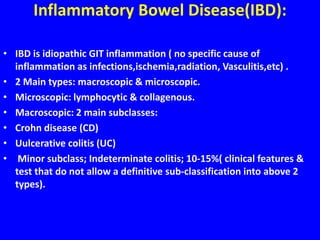
• IBD is idiopathic GIT inflammation ( no specific cause of
inflammation as infections,ischemia,radiation, Vasculitis,etc) .
• 2 Main types: macroscopic & microscopic.
• Microscopic: lymphocytic & collagenous.
• Macroscopic: 2 main subclasses:
• Crohn disease (CD)
• Uulcerative colitis (UC)
• Minor subclass; Indeterminate colitis; 10-15%( clinical features &
test that do not allow a definitive sub-classification into above 2
types).
Risk Factors:
• Interplay between genetic & environmental factors.
• Genetics:
• Increased risk in family members.
• Monozygotic twins have a higher risk than dizygotics or siblings.
• The risk in an offspring is higher if both parents are affected.
• Certain ethnic groups (Jewish) are at higher risk > others (blacks).
• Genes identified, but contribution to overall population is small.
Risk Factors:
• Interplay between genetic & environmental factors.
• Environmental:
• Smoking&appendisectomy is a risk factor for the development of
CD, protective factor for UC.
• Dietary factors inconsistent.
• IBD is more common in developed countries.
• A north-south gradient, ? vitamin D.
Clinical Manifestations:Ulcerative Colitis
• Typically presents with bloody diarrhea & abdominal discomfort,
the severity related to the extent / severity of inflammation.
• The distribution:
• Proctitis 25%(involving the rectum only); can present with
constipation owing to rectal spasm & stasis of stool.
• Left-sided colitis 25% (not extend beyond splenic flexure).
• Pancolitis 50% (inflammation extends above the splenic flexure).
• Because UC typically involves the rectum, so tenesmus, urgency,
rectal pain& fecal incontinence are common.
• Fever& weight loss are uncommon, suggest severe disease.
Clinical Manifestations:Ulcerative Colitis
• PE:
• With mild disease, physical exam may be normal.
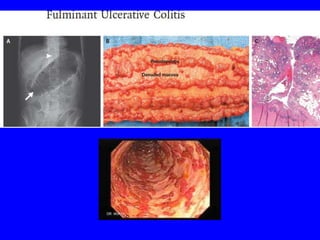
• Severe disease: fever, tachycardia, dehydration, abd tenderness, or
pallor.
• Abdominal distention, hypoactive bowel sounds, & rebound
tenderness suggest fulminant colitis or perforation or toxic
megacolon.
• Lab findings: significant anemia, leukocytosis, hypoalbuminemia&
electrolyte abnormalities, reflect the severity of disease.
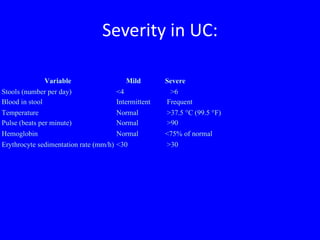
Severity in UC:
Variable Mild Severe
Stools (number per day) <4 >6
Blood in stool Intermittent Frequent
Temperature Normal >37.5 °C (99.5 °F)
Pulse (beats per minute) Normal >90
Hemoglobin Normal <75% of normal
Erythrocyte sedimentation rate (mm/h) <30 >30
Clinical Manifestations:CD
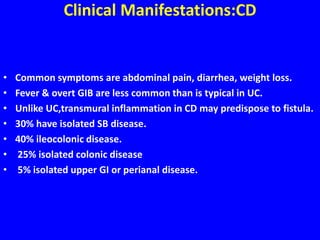
• Common symptoms are abdominal pain, diarrhea, weight loss.
• Fever & overt GIB are less common than is typical in UC.
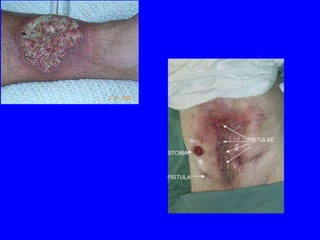
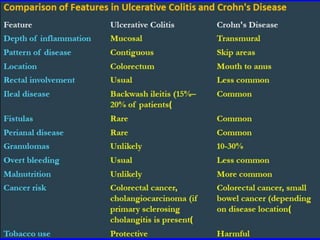
• Unlike UC,transmural inflammation in CD may predispose to fistula.
• 30% have isolated SB disease.
• 40% ileocolonic disease.
• 25% isolated colonic disease
• 5% isolated upper GI or perianal disease.
Clinical Manifestations:CD
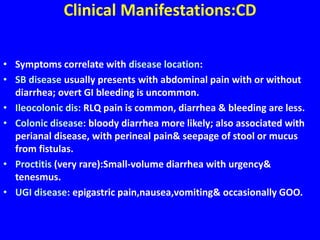
• Symptoms correlate with disease location:
• SB disease usually presents with abdominal pain with or without
diarrhea; overt GI bleeding is uncommon.
• Ileocolonic dis: RLQ pain is common, diarrhea & bleeding are less.
• Colonic disease: bloody diarrhea more likely; also associated with
perianal disease, with perineal pain& seepage of stool or mucus
from fistulas.
• Proctitis (very rare):Small-volume diarrhea with urgency&
tenesmus.
• UGI disease: epigastric pain,nausea,vomiting& occasionally GOO.
Clinical Manifestations:CD
• PE:
• From normal to significantly abn depending on location& severity.
• Patients may appear pale, malnourished, or chronically ill.
• Fever; if high it suggests an abscess or peritonitis.
• Abd tenderness, sometimes with a mass or fullness, is often located
in RLQ.
• Perianal exam may reveal skin tags, induration, or fistulas.
• As in UC, abnormal lab findings correlate with disease severity:
• Leukocytosis, anemia, hypoalbuminemia, vitamin deficiencies.
• The ESR& CRP are often elevated; if so, can be monitored as signs of
response to therapy & subsequent disease flare.
Clinical Manifestations:EIM
• In 10% of patients.
• In both CD or UC, it may precede GI symptoms.
• The most common:
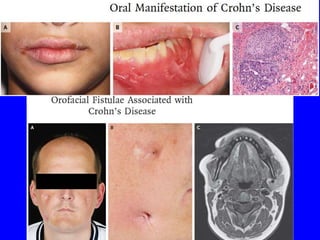
• Oral aphthous ulcers, arthralgia, back pain (ankylosing spondylitis
or sacroiliitis).
• Eye symptoms (redness, pain, swelling) may be due to uveitis,
scleritis, or other causes of ocular inflammation & warrant
immediate examination by an ophthalmologist.
• Skin manifestations are common include pyoderma gangrenosum &
erythema nodosum.
• Liver involvement, most commonly ;primary sclerosing cholangitis.
• In CD, EIMs are more common with colitis than SB disease.
• Some EIMs correlate with IBD activity, whereas others do not.
Diagnosis: UC
• Colonoscopy & biopsy of the colon & ileum, is required.
• All should undergo stool &lab exam to exclude infectious colitis,
including C. difficile & CMV & non-infectious colitis as
ischemic&radiation COLITIS.
• Some patients with pancolitis extend into the ileum for a few
centimeters(backwash ileitis) not indicative of CD.
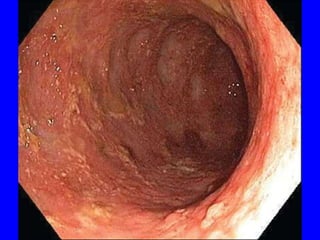
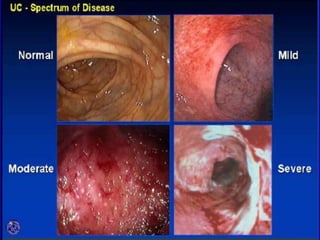
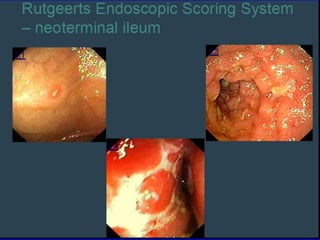
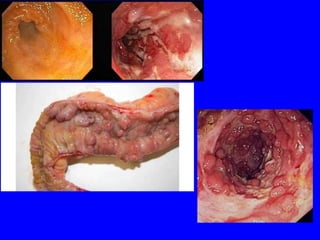
• Mild UC is characterized by mucosal edema, erythema& loss of the
normal vascular pattern.
• More significant disease produces granularity, friability, ulceration&
bleeding.
• Histology shows altered crypt architecture with shortened,
branched crypts, acute &chronic inflammation of the lamina
propria.
Diagnosis:CD
• Endoscopic findings vary from superficial aphthous ulcers to
discrete, deep ulcers that can be linear, stellate, or serpiginous &
that may coalesce into a “cobblestone” appearance
• Rectal sparing is typical, as are areas of inflammation separated by
normal mucosa (known as skip lesions).
• The ileum should be inspected during colonoscopy to detect ileal
inflammation characteristic of CD.
• Histology may show patchy transmural inflammation, but more
superficial inflammation does not rule out CD. Aphthous ulcers &
granulomas are characteristic findings but are often not seen.
Diagnosis:CD
• CD can affect any part of GIT&in some patients inflammation is
beyond the reach of colonoscopy.
• In these patients, supportive evidence can be obtained with CT or
(MR) enterography, capsule endoscopy, or directly by deep
enteroscopy.
• Enterography also rules out complications such as obstruction,
perforation, fistulas, abscesses.
• Radiographs are more often used in CD than UC owing to the
frequent involvement of the small intestine.
• Plain films can evaluate bowel obstruction & dilatation.
• Small-bowel barium radiographs have largely been replaced by the
more sensitive CT or MR enterography.
Diagnosis:IDC
• 10-15% have indeterminate colitis.
• In these patients, serologic tests have been proposed as a way to
distinguish UC from CD,but are expensive,relatively insensitive or
nonspecific&often do not add useful information to standard
diagnostic tests such as colonoscopy & enterography.
Treatment:UC
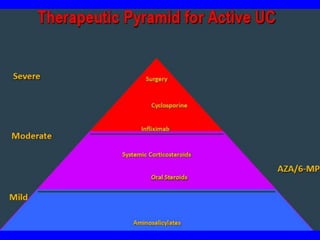
• For mild to moderate UC, the 5-ASA drugs are first-line therapy for
inducing & maintaining remission.
• 5-ASA is delivered topically to the bowel lumen, primarily to the
colon, with the exception of the time-release formulation of
mesalamine, which is able to deliver the drug throughout the small
bowel & the colon.
• Sulfasalazine may cause folate deficiency& supplementation is
recommended.
• More severe UC is often treated with oral glucocorticoids as
prednisone, 40-60 mg/d.
Treatment:
• Budesonide is a glucocorticoid with high first-pass metabolism
available in a controlled ileal-release formulation frequently used in
CD, but (multi-matrix [MMX] system) formulation provides release
of the drug throughout the colon useful in treating UC.
• It has similar efficacy as prednisone but has fewer side effects but
high cost.
• Patients whose disease does not respond to oral glucocorticoids
should be hospitalized&given IV glucocorticoids or biologic agent.
• Glucocorticoids are not effective for maintaining remission in UC.
• In patients whose disease responds to glucocorticoids, the dose
should be tapered over 2 - 4 months while transitioning to a
maintenance medication (AZA, 6-MP, or a biologic agent).
Treatment:
• Patients whose symptoms do not respond to glucocorticoids are
treated with cyclosporine, a biologic agent, or colectomy.
• Cyclosporine is effective for avoiding colectomy in the short term.
• Many patients eventually require colectomy.
• The three anti-TNF antibodies approved for inducing/ maintaining
remission in UC are infliximab, adalimumab&golimumab.
• The integrin-blocking antibody vedolizumab blocks leukocyte
trafficking ,also approved for the treatment of UC.
Treatment:CD
• 5-ASA drugs for CD little or no benefit.
• Antimicrobial agents are important in patients with fistulas or
abscesses, but no treating luminal disease.
• Patients with mild to moderate inflammatory CD are often treated
initially with glucocorticoids. Prednisone is often used.
• For ileocolonic CD, controlled-release budesonide is an alternative
to prednisone, with fewer side effects but higher cost.
• As in UC, glucocorticoids are not effective for maintaining remission
in CD,SO patients who responds to glucocorticoids should be
transitioned to an immunomodulator while the glucocorticoid is
tapered.
Treatment:CD
• In addition to AZA / 6-MP, methotrexate is an option in CD.
• AZA, 2 -3 mg/kg/d; 6-MP, 1.5 mg/kg/d; methotrexate, 25 mg/week,
are effective for inducing & maintaining remission.
• AZA / 6-MP are effective for closing fistulas.
• Some adverse events from methotrexate minimized by the use of
folic acid,but should not be used in pregnant or lactating women.
Treatment:CD
• Patients with more severe disease are treated with a biologic agent.
The three anti-TNF agents approved for CD are infliximab,
adalimumab, and certolizumab.
• These medications are effective for inducing / maintaining
remission & closing fistulas, generally considered to be safe in
pregnancy.
• Anti-TNF efficacy is better when used with an immunomodulator&
risk of developing anti-TNF antibodies is lower.
Treatment:CD
• Patients whose disease does not respond to one anti-TNF agent are
often switched to a second or third anti-TNF agent.
• Those with no response to or intolerance of anti-TNF agents should
be treated with either surgery or a leukocyte trafficking blocker
(natalizumab or vedolizumab).
• Natalizumab increases the risk of infections, including progressive
multifocal leukoencephalopathy (PML), specially if JC virus sero +ve
making the risk unacceptably high & should not be used.
IBD: Health maintinance
• CRC Surveillance: Patients with long-standing IBD are at increased
risk for CRC & should undergo surveillance colonoscopy every 1- 2
years beginning after 8-10 years of disease.
IBD: Health maintinance
• Nutritional support:
• Patients with severely active disease, particularly CD, are at risk for
malnutrition & various vitamin deficiencies & should undergo
screening for these conditions,sp distal ileal disease is associated
with vitamin B12 malabsorption.
IBD: Health maintinance
• Osteoporosis screen:
• Steriod use for > 3 mons is a risk factor for osteoporosis &indication
to assess bone density.
IBD: Health maintinance
• Vaccination:
• Routine adult vaccines+annual killed influenza vaccine( not
attenuated vaccine) hepatitis A & B virus (if not already immune),
pneumococcus&meningococcal vaccine.
IBD: Health maintinance
• TB screen:
• Before starting anti-TNF, patients assessed for TB (with Tuberculin
or IGRA) & for immunity to hepatitis A / B viruses.
Microscopic colitis:
• Accounts for 10- 15% of patients with chronic, watery diarrhea.
• > Common in elderly.
• Endoscopically normal.
• The symptoms similar to other chronic causes of non-bloody
diarrhea, such as celiac disease & IBS which should be excluded.
• Colonic mucosal biopsies are required for diagnosis.
• Lymphocytic & collagenous colitis are the two subtypes &
distinguishable only by histology.
• In some patients, certain medications (NSAIDs /PPI).
• MC is associated with other AI diseases as DM & psoriasis.
Microscopic colitis:treatment
• Based on symptom severity.
• Suspected drugs stopped if possible.
• In mild disease, antidiarrheal as loperamide or diphenoxylate used.
• In moderate disease, bismuth subsalicylate may be beneficial.
• In severe cases or those that do not respond to antidiarrheal agents
or bismuth, budesonide is the treatment of choice,highly effective
(response rates of ≥80%), but the risk of relapse is high once
stopped (70%-80%); many patients require long-term low dose
maintenance or an immunomodulator as AZA.
• The 5-ASA medications are not very effective for MC.
• If not respond or not tolerate budesonide, cholestyramine effective.
• In severe cases, treatment with an anti-TNF agent may be needed.
BO5:1
• 1.Inflammatory Bowel disease includes:
• A.Ischemic colitis.
• B.Infectious colitis.
• C.Idiopathic inflammattory colitis.
• D.Radiation colitis.
• E.Behcet-associated colitis.
BO5:2
• 2.The following are Inflammatory Bowel
disease except:
• A.Ulcerative colitis.
• B.Crohns disease.
• C.Intdermined colitis.
• D.TB-induced colitis.
• E.Microscopic colitis.
BO5:3
• 3.The least common subtype of IBD is:
• A.Ulcerative colitis.
• B.Crohns disease.
• C.Intdermined colitis.
• D.Collagenous colitis.
• E.Lymphocytic colitis.
BO5:4
• 4.Hematochesia is more common with:
• A.Ulcerative colitis.
• B.Crohns disease.
• C. Both above.
• D.Collagenous colitis.
• E.Lymphocytic colitis.
BO5:5
• 5.Skiped lesions are more characteristic of:
• A.Ulcerative colitis.
• B.Crohns disease.
• C. Both above.
• D.Collagenous colitis.
• E.Lymphocytic colitis.
BO5:6
• 6.Transmural colonic involvement is
characteristic of:
• A.Ulcerative colitis.
• B.Crohns disease.
• C. Both above.
• D.Collagenous colitis.
• E.Lymphocytic colitis.
BO5:7
• 7.Granuloma on histopathology is
characteristic of:
• A.Ulcerative colitis.
• B.Crohns disease.
• C. Both above.
• D.Collagenous colitis.
• E.Lymphocytic colitis.
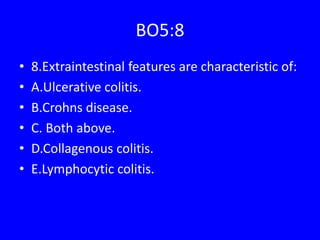
BO5:8
• 8.Extraintestinal features are characteristic of:
• A.Ulcerative colitis.
• B.Crohns disease.
• C. Both above.
• D.Collagenous colitis.
• E.Lymphocytic colitis.
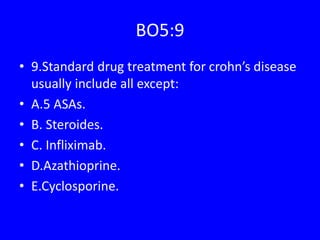
BO5:9
• 9.Standard drug treatment for crohn’s disease
usually include all except:
• A.5 ASAs.
• B. Steroides.
• C. Infliximab.
• D.Azathioprine.
• E.Cyclosporine.
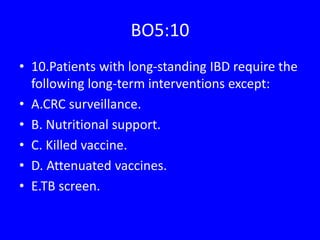
BO5:10
• 10.Patients with long-standing IBD require the
following long-term interventions except:
• A.CRC surveillance.
• B. Nutritional support.
• C. Killed vaccine.
• D. Attenuated vaccines.
• E.TB screen.
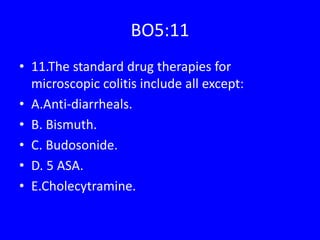
BO5:11
• 11.The standard drug therapies for
microscopic colitis include all except:
• A.Anti-diarrheals.
• B. Bismuth.
• C. Budosonide.
• D. 5 ASA.
• E.Cholecytramine.
BO5:12
• 12.The biological agent that increase the risk
of CJD in IBD treated patients is:
• A.Infliximab.
• B. Adalimumab.
• C. Golizumab.
• D. Natalizumab.
• E. None of the above.
BO5:13
• 13.The IBD subtype that has a more
complicated course is:
• A.Crohn’s disease.
• B. Ulcerative colitis.
• C. Indetermined colitis.
• D. Lymphocytic colitis.
• E. Collagenous colitis.
BO5:14
• 14.patients with long-standing active
extensive disease should start surveillance
colonoscopy after how many years:
• A. 15.
• B. 5.
• C. 7.
• D. 20.
• E. 8.
BO5:15
• 15.Important differential diagnosis of
Microscopic colitis include:
• A. UC.
• B. IBS.
• C. Celiac disease.
• D. Crohn’s disease.
• E. The last 3.
BO5:16
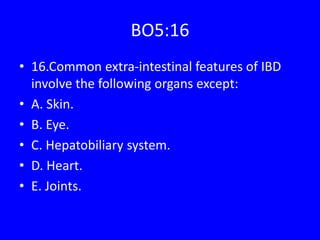
• 16.Common extra-intestinal features of IBD
involve the following organs except:
• A. Skin.
• B. Eye.
• C. Hepatobiliary system.
• D. Heart.
• E. Joints.

GIT 4th ibd 2017

  • 1.
    Dr. Mohamed Alshekhani Professorin Medicine MBChB-CABM-FRCP-EBGH 2017 1 Inflammatory Bowel Disease(IBD):
  • 2.
    Inflammatory Bowel Disease(IBD): •IBD is idiopathic GIT inflammation ( no specific cause of inflammation as infections,ischemia,radiation, Vasculitis,etc) . • 2 Main types: macroscopic & microscopic. • Microscopic: lymphocytic & collagenous. • Macroscopic: 2 main subclasses: • Crohn disease (CD) • Uulcerative colitis (UC) • Minor subclass; Indeterminate colitis; 10-15%( clinical features & test that do not allow a definitive sub-classification into above 2 types).
  • 3.
    Risk Factors: • Interplaybetween genetic & environmental factors. • Genetics: • Increased risk in family members. • Monozygotic twins have a higher risk than dizygotics or siblings. • The risk in an offspring is higher if both parents are affected. • Certain ethnic groups (Jewish) are at higher risk > others (blacks). • Genes identified, but contribution to overall population is small.
  • 4.
    Risk Factors: • Interplaybetween genetic & environmental factors. • Environmental: • Smoking&appendisectomy is a risk factor for the development of CD, protective factor for UC. • Dietary factors inconsistent. • IBD is more common in developed countries. • A north-south gradient, ? vitamin D.
  • 5.
    Clinical Manifestations:Ulcerative Colitis •Typically presents with bloody diarrhea & abdominal discomfort, the severity related to the extent / severity of inflammation. • The distribution: • Proctitis 25%(involving the rectum only); can present with constipation owing to rectal spasm & stasis of stool. • Left-sided colitis 25% (not extend beyond splenic flexure). • Pancolitis 50% (inflammation extends above the splenic flexure). • Because UC typically involves the rectum, so tenesmus, urgency, rectal pain& fecal incontinence are common. • Fever& weight loss are uncommon, suggest severe disease.
  • 6.
    Clinical Manifestations:Ulcerative Colitis •PE: • With mild disease, physical exam may be normal. • Severe disease: fever, tachycardia, dehydration, abd tenderness, or pallor. • Abdominal distention, hypoactive bowel sounds, & rebound tenderness suggest fulminant colitis or perforation or toxic megacolon. • Lab findings: significant anemia, leukocytosis, hypoalbuminemia& electrolyte abnormalities, reflect the severity of disease.
  • 8.
    Severity in UC: VariableMild Severe Stools (number per day) <4 >6 Blood in stool Intermittent Frequent Temperature Normal >37.5 °C (99.5 °F) Pulse (beats per minute) Normal >90 Hemoglobin Normal <75% of normal Erythrocyte sedimentation rate (mm/h) <30 >30
  • 9.
    Clinical Manifestations:CD • Commonsymptoms are abdominal pain, diarrhea, weight loss. • Fever & overt GIB are less common than is typical in UC. • Unlike UC,transmural inflammation in CD may predispose to fistula. • 30% have isolated SB disease. • 40% ileocolonic disease. • 25% isolated colonic disease • 5% isolated upper GI or perianal disease.
  • 10.
    Clinical Manifestations:CD • Symptomscorrelate with disease location: • SB disease usually presents with abdominal pain with or without diarrhea; overt GI bleeding is uncommon. • Ileocolonic dis: RLQ pain is common, diarrhea & bleeding are less. • Colonic disease: bloody diarrhea more likely; also associated with perianal disease, with perineal pain& seepage of stool or mucus from fistulas. • Proctitis (very rare):Small-volume diarrhea with urgency& tenesmus. • UGI disease: epigastric pain,nausea,vomiting& occasionally GOO.
  • 11.
    Clinical Manifestations:CD • PE: •From normal to significantly abn depending on location& severity. • Patients may appear pale, malnourished, or chronically ill. • Fever; if high it suggests an abscess or peritonitis. • Abd tenderness, sometimes with a mass or fullness, is often located in RLQ. • Perianal exam may reveal skin tags, induration, or fistulas. • As in UC, abnormal lab findings correlate with disease severity: • Leukocytosis, anemia, hypoalbuminemia, vitamin deficiencies. • The ESR& CRP are often elevated; if so, can be monitored as signs of response to therapy & subsequent disease flare.
  • 12.
    Clinical Manifestations:EIM • In10% of patients. • In both CD or UC, it may precede GI symptoms. • The most common: • Oral aphthous ulcers, arthralgia, back pain (ankylosing spondylitis or sacroiliitis). • Eye symptoms (redness, pain, swelling) may be due to uveitis, scleritis, or other causes of ocular inflammation & warrant immediate examination by an ophthalmologist. • Skin manifestations are common include pyoderma gangrenosum & erythema nodosum. • Liver involvement, most commonly ;primary sclerosing cholangitis. • In CD, EIMs are more common with colitis than SB disease. • Some EIMs correlate with IBD activity, whereas others do not.
  • 15.
    Diagnosis: UC • Colonoscopy& biopsy of the colon & ileum, is required. • All should undergo stool &lab exam to exclude infectious colitis, including C. difficile & CMV & non-infectious colitis as ischemic&radiation COLITIS. • Some patients with pancolitis extend into the ileum for a few centimeters(backwash ileitis) not indicative of CD. • Mild UC is characterized by mucosal edema, erythema& loss of the normal vascular pattern. • More significant disease produces granularity, friability, ulceration& bleeding. • Histology shows altered crypt architecture with shortened, branched crypts, acute &chronic inflammation of the lamina propria.
  • 18.
    Diagnosis:CD • Endoscopic findingsvary from superficial aphthous ulcers to discrete, deep ulcers that can be linear, stellate, or serpiginous & that may coalesce into a “cobblestone” appearance • Rectal sparing is typical, as are areas of inflammation separated by normal mucosa (known as skip lesions). • The ileum should be inspected during colonoscopy to detect ileal inflammation characteristic of CD. • Histology may show patchy transmural inflammation, but more superficial inflammation does not rule out CD. Aphthous ulcers & granulomas are characteristic findings but are often not seen.
  • 19.
    Diagnosis:CD • CD canaffect any part of GIT&in some patients inflammation is beyond the reach of colonoscopy. • In these patients, supportive evidence can be obtained with CT or (MR) enterography, capsule endoscopy, or directly by deep enteroscopy. • Enterography also rules out complications such as obstruction, perforation, fistulas, abscesses. • Radiographs are more often used in CD than UC owing to the frequent involvement of the small intestine. • Plain films can evaluate bowel obstruction & dilatation. • Small-bowel barium radiographs have largely been replaced by the more sensitive CT or MR enterography.
  • 20.
    Diagnosis:IDC • 10-15% haveindeterminate colitis. • In these patients, serologic tests have been proposed as a way to distinguish UC from CD,but are expensive,relatively insensitive or nonspecific&often do not add useful information to standard diagnostic tests such as colonoscopy & enterography.
  • 25.
    Treatment:UC • For mildto moderate UC, the 5-ASA drugs are first-line therapy for inducing & maintaining remission. • 5-ASA is delivered topically to the bowel lumen, primarily to the colon, with the exception of the time-release formulation of mesalamine, which is able to deliver the drug throughout the small bowel & the colon. • Sulfasalazine may cause folate deficiency& supplementation is recommended. • More severe UC is often treated with oral glucocorticoids as prednisone, 40-60 mg/d.
  • 26.
    Treatment: • Budesonide isa glucocorticoid with high first-pass metabolism available in a controlled ileal-release formulation frequently used in CD, but (multi-matrix [MMX] system) formulation provides release of the drug throughout the colon useful in treating UC. • It has similar efficacy as prednisone but has fewer side effects but high cost. • Patients whose disease does not respond to oral glucocorticoids should be hospitalized&given IV glucocorticoids or biologic agent. • Glucocorticoids are not effective for maintaining remission in UC. • In patients whose disease responds to glucocorticoids, the dose should be tapered over 2 - 4 months while transitioning to a maintenance medication (AZA, 6-MP, or a biologic agent).
  • 27.
    Treatment: • Patients whosesymptoms do not respond to glucocorticoids are treated with cyclosporine, a biologic agent, or colectomy. • Cyclosporine is effective for avoiding colectomy in the short term. • Many patients eventually require colectomy. • The three anti-TNF antibodies approved for inducing/ maintaining remission in UC are infliximab, adalimumab&golimumab. • The integrin-blocking antibody vedolizumab blocks leukocyte trafficking ,also approved for the treatment of UC.
  • 29.
    Treatment:CD • 5-ASA drugsfor CD little or no benefit. • Antimicrobial agents are important in patients with fistulas or abscesses, but no treating luminal disease. • Patients with mild to moderate inflammatory CD are often treated initially with glucocorticoids. Prednisone is often used. • For ileocolonic CD, controlled-release budesonide is an alternative to prednisone, with fewer side effects but higher cost. • As in UC, glucocorticoids are not effective for maintaining remission in CD,SO patients who responds to glucocorticoids should be transitioned to an immunomodulator while the glucocorticoid is tapered.
  • 30.
    Treatment:CD • In additionto AZA / 6-MP, methotrexate is an option in CD. • AZA, 2 -3 mg/kg/d; 6-MP, 1.5 mg/kg/d; methotrexate, 25 mg/week, are effective for inducing & maintaining remission. • AZA / 6-MP are effective for closing fistulas. • Some adverse events from methotrexate minimized by the use of folic acid,but should not be used in pregnant or lactating women.
  • 31.
    Treatment:CD • Patients withmore severe disease are treated with a biologic agent. The three anti-TNF agents approved for CD are infliximab, adalimumab, and certolizumab. • These medications are effective for inducing / maintaining remission & closing fistulas, generally considered to be safe in pregnancy. • Anti-TNF efficacy is better when used with an immunomodulator& risk of developing anti-TNF antibodies is lower.
  • 32.
    Treatment:CD • Patients whosedisease does not respond to one anti-TNF agent are often switched to a second or third anti-TNF agent. • Those with no response to or intolerance of anti-TNF agents should be treated with either surgery or a leukocyte trafficking blocker (natalizumab or vedolizumab). • Natalizumab increases the risk of infections, including progressive multifocal leukoencephalopathy (PML), specially if JC virus sero +ve making the risk unacceptably high & should not be used.
  • 33.
    IBD: Health maintinance •CRC Surveillance: Patients with long-standing IBD are at increased risk for CRC & should undergo surveillance colonoscopy every 1- 2 years beginning after 8-10 years of disease.
  • 34.
    IBD: Health maintinance •Nutritional support: • Patients with severely active disease, particularly CD, are at risk for malnutrition & various vitamin deficiencies & should undergo screening for these conditions,sp distal ileal disease is associated with vitamin B12 malabsorption.
  • 35.
    IBD: Health maintinance •Osteoporosis screen: • Steriod use for > 3 mons is a risk factor for osteoporosis &indication to assess bone density.
  • 36.
    IBD: Health maintinance •Vaccination: • Routine adult vaccines+annual killed influenza vaccine( not attenuated vaccine) hepatitis A & B virus (if not already immune), pneumococcus&meningococcal vaccine.
  • 37.
    IBD: Health maintinance •TB screen: • Before starting anti-TNF, patients assessed for TB (with Tuberculin or IGRA) & for immunity to hepatitis A / B viruses.
  • 38.
    Microscopic colitis: • Accountsfor 10- 15% of patients with chronic, watery diarrhea. • > Common in elderly. • Endoscopically normal. • The symptoms similar to other chronic causes of non-bloody diarrhea, such as celiac disease & IBS which should be excluded. • Colonic mucosal biopsies are required for diagnosis. • Lymphocytic & collagenous colitis are the two subtypes & distinguishable only by histology. • In some patients, certain medications (NSAIDs /PPI). • MC is associated with other AI diseases as DM & psoriasis.
  • 39.
    Microscopic colitis:treatment • Basedon symptom severity. • Suspected drugs stopped if possible. • In mild disease, antidiarrheal as loperamide or diphenoxylate used. • In moderate disease, bismuth subsalicylate may be beneficial. • In severe cases or those that do not respond to antidiarrheal agents or bismuth, budesonide is the treatment of choice,highly effective (response rates of ≥80%), but the risk of relapse is high once stopped (70%-80%); many patients require long-term low dose maintenance or an immunomodulator as AZA. • The 5-ASA medications are not very effective for MC. • If not respond or not tolerate budesonide, cholestyramine effective. • In severe cases, treatment with an anti-TNF agent may be needed.
  • 40.
    BO5:1 • 1.Inflammatory Boweldisease includes: • A.Ischemic colitis. • B.Infectious colitis. • C.Idiopathic inflammattory colitis. • D.Radiation colitis. • E.Behcet-associated colitis.
  • 41.
    BO5:2 • 2.The followingare Inflammatory Bowel disease except: • A.Ulcerative colitis. • B.Crohns disease. • C.Intdermined colitis. • D.TB-induced colitis. • E.Microscopic colitis.
  • 42.
    BO5:3 • 3.The leastcommon subtype of IBD is: • A.Ulcerative colitis. • B.Crohns disease. • C.Intdermined colitis. • D.Collagenous colitis. • E.Lymphocytic colitis.
  • 43.
    BO5:4 • 4.Hematochesia ismore common with: • A.Ulcerative colitis. • B.Crohns disease. • C. Both above. • D.Collagenous colitis. • E.Lymphocytic colitis.
  • 44.
    BO5:5 • 5.Skiped lesionsare more characteristic of: • A.Ulcerative colitis. • B.Crohns disease. • C. Both above. • D.Collagenous colitis. • E.Lymphocytic colitis.
  • 45.
    BO5:6 • 6.Transmural colonicinvolvement is characteristic of: • A.Ulcerative colitis. • B.Crohns disease. • C. Both above. • D.Collagenous colitis. • E.Lymphocytic colitis.
  • 46.
    BO5:7 • 7.Granuloma onhistopathology is characteristic of: • A.Ulcerative colitis. • B.Crohns disease. • C. Both above. • D.Collagenous colitis. • E.Lymphocytic colitis.
  • 47.
    BO5:8 • 8.Extraintestinal featuresare characteristic of: • A.Ulcerative colitis. • B.Crohns disease. • C. Both above. • D.Collagenous colitis. • E.Lymphocytic colitis.
  • 48.
    BO5:9 • 9.Standard drugtreatment for crohn’s disease usually include all except: • A.5 ASAs. • B. Steroides. • C. Infliximab. • D.Azathioprine. • E.Cyclosporine.
  • 49.
    BO5:10 • 10.Patients withlong-standing IBD require the following long-term interventions except: • A.CRC surveillance. • B. Nutritional support. • C. Killed vaccine. • D. Attenuated vaccines. • E.TB screen.
  • 50.
    BO5:11 • 11.The standarddrug therapies for microscopic colitis include all except: • A.Anti-diarrheals. • B. Bismuth. • C. Budosonide. • D. 5 ASA. • E.Cholecytramine.
  • 51.
    BO5:12 • 12.The biologicalagent that increase the risk of CJD in IBD treated patients is: • A.Infliximab. • B. Adalimumab. • C. Golizumab. • D. Natalizumab. • E. None of the above.
  • 52.
    BO5:13 • 13.The IBDsubtype that has a more complicated course is: • A.Crohn’s disease. • B. Ulcerative colitis. • C. Indetermined colitis. • D. Lymphocytic colitis. • E. Collagenous colitis.
  • 53.
    BO5:14 • 14.patients withlong-standing active extensive disease should start surveillance colonoscopy after how many years: • A. 15. • B. 5. • C. 7. • D. 20. • E. 8.
  • 54.
    BO5:15 • 15.Important differentialdiagnosis of Microscopic colitis include: • A. UC. • B. IBS. • C. Celiac disease. • D. Crohn’s disease. • E. The last 3.
  • 55.
    BO5:16 • 16.Common extra-intestinalfeatures of IBD involve the following organs except: • A. Skin. • B. Eye. • C. Hepatobiliary system. • D. Heart. • E. Joints.