POSTURE
AND EQUILIBRIUM
Dr. Sejal Sailor.
M.P.T. (Ortho)
DEFINITION
ļ‚§ Subconscious adjustment of tone in the different muscles in
relation to every movement is known as the Posture.
ļ‚§ The significance of posture,
ļ‚§ To make the movement smooth and accurate.
ļ‚§ To maintain the line of gravity constant
ļ‚§ To keep the body in equilibrium with the line of gravity.
ļ‚§ Posture is not the active movement.
ļ‚§ It is the passive movement associated with redistribution of the tone in
different groups of related muscles.
ļ‚§ BASIC PHENOMENA OF POSTURE INCLUDES,
– Muscle Tone
– Stretch Reflex
MUSCE TONE
ļ‚§ The continuous state of tension development in the muscle is known as
Muscle Tone.
ļ‚§ The muscle tone is purely a reflex process.
ļ‚§ This reflex is a spinal segmental reflex.
Significance of Muscle tone
ļ‚§ Muscle tone plays an important role in maintenance of posture.
ļ‚§ Change in muscle tone enables movement of different parts of the body.
ļ‚§ Muscle tone is present in all the skeletal muscles.
ļ‚§ However, tone is greater in the antigravity muscle such as extensors of
the lower limb, trunk muscles and neck muscles.
Development of muscle tone
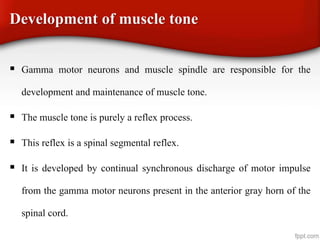
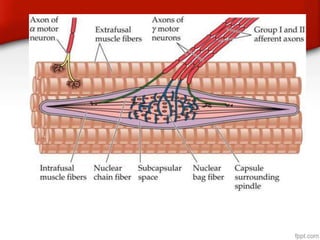
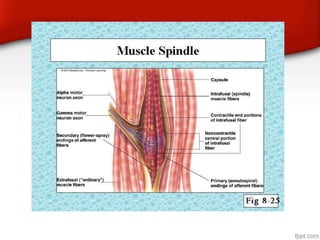
ļ‚§ Gamma motor neurons and muscle spindle are responsible for the
development and maintenance of muscle tone.
ļ‚§ The muscle tone is purely a reflex process.
ļ‚§ This reflex is a spinal segmental reflex.
ļ‚§ It is developed by continual synchronous discharge of motor impulse
from the gamma motor neurons present in the anterior gray horn of the
spinal cord.
ļ‚§ The impulses from the gamma motor neurons causes contraction of
end portion of intrafusal fibers. (Stimulus)
ļ‚§ This stretches and activates the central portion of the intrafusal fibers
which initiates the reflex action for the development of muscle tone by
discharging the impulses.
ļ‚§ The impulses from the central portion of intrafusal fibers pass through
the primary sensory nerve fibers (afferent fibers) and reach the anterior
gray horn of spinal cord.
ļ‚§ These impulses stimulate the alpha motor neurons in anterior gray horn.
(center)
ļ‚§ The alpha motor neurons in turn, send impulses to extrafusal fibers of
the muscle through spinal nerve fibers. (efferent fibers)
ļ‚§ These impulses produce partial contraction of the muscle fibers
resulting in development of muscle tone. (response)
ļ‚§ When the frequency of the discharge from gamma motor neurons
increases the activity of muscle spindle is increased and the muscle tone
is also increases.
ļ‚§ Stimulation of gamma motor neurons increases the muscle tone.
ļ‚§ Lesion in gamma motor neurons leads to loss of tone in muscles.
Regulation of Muscle Tone
ļ‚§ Though the muscle tone is developed by discharges from gamma motor
neurons, it is maintained continuously and regulated by some
supraspinal centers situated in different parts of brain.
ļ‚§ Some of these centers increase the muscle tone by sending facilitatory
impulses while other centers decreases the muscle tone by inhibitory
impulses.
ļ‚§ Supraspinal facilitatory centers:
The Supraspinal centers which increases the muscle tone are,
1. Motor area 4 in cerebral cortex
2. Cerebellum
3. Descending facilitatory reticular system
4. Red nucleus
5. Vestibular nucleus
ļ‚§ Supraspinal inhibitory centers:
The supraspinal centers which decreases the muscle tone
are,
1. Suppressor areas of cerebral cortex
2. Basal ganglia
3. Descending inhibitory reticular system
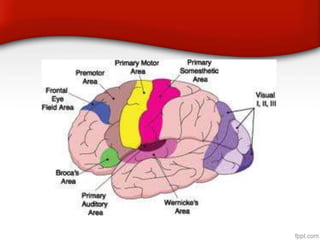
ļ‚§ Role of motor area of cerebral cortex – Coactivation
ļ‚§ Motor area of cerebral cortex influences the activity of lower motor
neurons by sending motor impulses through the pyramidal tract
fibers.
ļ‚§ The motor impulses from cerebral cortex stimulate both α motor
neurons and γ motor neurons simultaneously.
ļ‚§ This type of simultaneously stimulation is called coactivation.
(α-γ Coactivation)
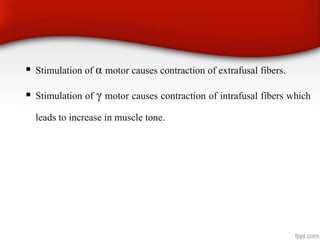
ļ‚§ Stimulation of α motor causes contraction of extrafusal fibers.
ļ‚§ Stimulation of γ motor causes contraction of intrafusal fibers which
leads to increase in muscle tone.
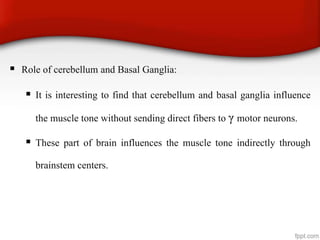
ļ‚§ Role of cerebellum and Basal Ganglia:
ļ‚§ It is interesting to find that cerebellum and basal ganglia influence
the muscle tone without sending direct fibers to γ motor neurons.
ļ‚§ These part of brain influences the muscle tone indirectly through
brainstem centers.
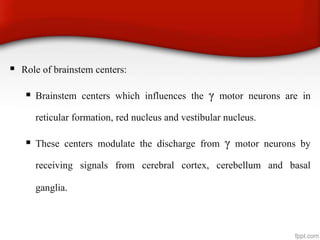
ļ‚§ Role of brainstem centers:
ļ‚§ Brainstem centers which influences the γ motor neurons are in
reticular formation, red nucleus and vestibular nucleus.
ļ‚§ These centers modulate the discharge from γ motor neurons by
receiving signals from cerebral cortex, cerebellum and basal
ganglia.
STRETCH REFLEX
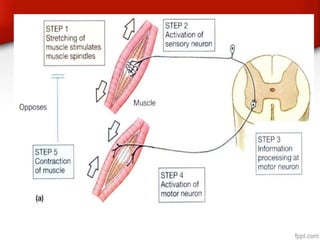
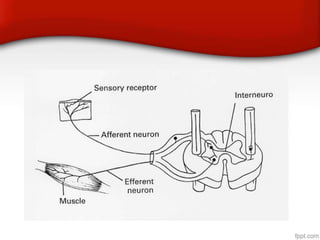
ļ‚§ The basic reflex involved in the maintenance of posture is the stretch
reflex.
ļ‚§ It is describe d as,
When a muscle is stretched, it contract reflexly. It is called
as stretch reflex or myotatic reflex.
ļ‚§ The extensor muscles, particularly the antigravity muscles exhibit a
severe and prolonged contraction during stretch reflex.
ļ‚§ This reflex is normally present and serves particullarly to
maintain the body in an upright position.
ļ‚§ Such reflex are, therefore more pronounced in the extensor
muscles.
POSTURAL REFLEX
ļ‚§ The reflexes, which are responsible for the maintenance of posture are
called as Postural Reflex.
ļ‚§ The afferent impulses for the maintenance of the posture arise from the
proprioceptors, vestibular apparatus and retina of the eye and reach the
centers in CNS.
ļ‚§ The centers maintains the posture are at different levels of the CNS
particularly cerebral cortex, cerebellum, brainstem and spinal cord.
ļ‚§ These centers send motor impulses to the different groups of skeletal
muscles so that appropriate movements occurs to maintain the posture.
CLASSIFICATION OF POSTURAL
REFLEX
ļ‚§ Classified in to two groups:
1. Static reflexes: the reflexes which maintain posture at rest.
2. Statokinetic reflexes: the reflexes which maintain posture during
movement.
STATIC REFLEXES
ļ‚§ THEY ARE OF FOUR TYPES:
1. General Static Reflexes / Righting Reflexes
2. Local Static Reflexes / Supporting Reflexes
3. Segmental Static Reflexes
4. Statotonic Reflexes/ attitudinal reflexes
1. General Static Reflexes/Righting Reflexes
ļ‚§ It is called as righting reflexes because it helps to maintain an upright
position of the body.
ļ‚§ They also help to orientation of the head In space, position of head in
relation to the body and appropriate adjustment of the limbs and eyes in
relation to the position of the head, so that upright position of the body
is maintained.
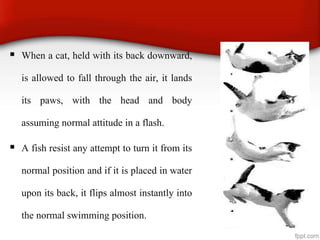
ļ‚§ When a cat, held with its back downward,
is allowed to fall through the air, it lands
its paws, with the head and body
assuming normal attitude in a flash.
ļ‚§ A fish resist any attempt to turn it from its
normal position and if it is placed in water
upon its back, it flips almost instantly into
the normal swimming position.
ļ‚§ All these action occur because of the righting reflexes.
ļ‚§ The righting reflexes consist of a chain of reactions which occur one
after another in an orderly sequence.
ļ‚§ Each reflexes causes the development of the succeeding one.
ļ‚§ The righting reflexes are divided into five types:
1. Labyrinthine righting reflexes acting upon the neck muscle
2. Neck righting reflexes acting upon the body
3. Body righting reflexes acting upon the head
4. Body righting reflexes acting upon the body
5. Optical righting reflexes
The first four reflexes are easily demonstrated on a thalamic
animal or a normal animal, which is blindfolded.
Labyrinthine righting reflexes acting upon the neck muscle
ļ‚§ When a thalamic animal is suspended by holding at the pelvic region,
the head turns up, until it assumes its normal position.
ļ‚§ It is because of the reflexes arising from labyrinth, the sensory organ
concerned with equilibrium of the head, in regards to the position of the
body.
ļ‚§ Turning the body of the animal through the air into different position is
followed by compensatory movement of the head.
ļ‚§ After extirpation of the
labyrinths, the head shows no
compensatory movements
when the rabbit is suspended.
ļ‚§ It hangs simply like that of a
dead rabbit.
Neck righting reflexes acting upon the body
ļ‚§ It is noticed that during labyrinthine righting reflexes, the head raises up
to the normal position. it is because of the contraction of the neck
muscles.
ļ‚§ Now, the contraction of neck muscles produces the proprioceptive
impulses, which act on the body and rotate the body in relation to the
position of the head.
ļ‚§ This reflex is laid down in resting position upon its side on a table.
Body righting reflexes acting upon the head
ļ‚§ Labyrinthine righting reflexes are not the only reflexes acting on the
neck muscle to cause rotation of the head.
ļ‚§ If the animal is laid down upon its side on a table, the unequal
distribution of pressure on that particular side of the body stimulates the
exteroceptor on the skin.
ļ‚§ The impulse thus generated by the exteroceptors, act on the neck
muscles and rotate the head.
Body righting reflexes acting upon the Body
ļ‚§ When the same animal is laid down on the table on its side, with the
head held down to the table, to eliminate labyrinthine and neck righting
reflexes, the body attempts to right itself by raising the lower parts.
ļ‚§ It is because of the impulses from the exteroceptors on that side of the
body acting on the body itself.
Optical righting reflexes
ļ‚§ Optical righting reflexes are initiated through the retinal impulses.
ļ‚§ The center for optical righting reflexes is in the occipital lobe of
cerebral cortex.
ļ‚§ So, these reflexes are absent in thalamic animal.
ļ‚§ The optical righting reflexes help to correct the position of the body or
head with the help of sight.
ļ‚§ It is proved in the labyrinthectomized animal.
ļ‚§ When such an animal is suspended, it rotates its head to normal position
with the help of sight.
ļ‚§ But, the movements of the head do not occur if the eyes of the animal
are closed.
Sequential events of righting reflexes,
1. When the animal is placed upon its back, the labyrinthine reflexes
acting upon the neck muscles turn the head into its normal position in
space, in relation to the body.
2. The proprioceptive reflexes of the neck muscles then bring the body
into its normal position in relation to the position of head.
3. When resting upon a rigid support, these reflexes are reinforced by the
body righting reflexes on head as well as on the body.
4. If the animal happens to be a labyrinthectomized one, then it makes an
attempt to recover its upright position as a result of operation of the
optical righting reaction.
If the optical righting reflexes are abolished by covering
the eyes, the righting ability is lost.
Optical righting reflexes are also demonstrated in 3 or 4
weeks old baby. When laid down on belly, i.e. prone position , the
baby tries to raise the head to a vertical position.
Centers for righting reflexes
ļ‚§ The centers for the first four righting reflexes are in the red nucleus
situated in midbrain.
ļ‚§ The centers for the optical righting reflexes is in the occipital lobe of
cerebral cortex.
2. Local Static Reflexes/Supporting Reflexes
ļ‚§ These reflexes are the reactions support the body in different positions
against the gravity and also protect the limbs against hyperextension or
hyperflexion.
ļ‚§ They are classified in to two categories:
1. Positive Supporting Reflexes
2. Negative Supporting Reflexes
Positive Supporting Reflexes
ļ‚§ They are the reactions, which help to fix the joint and make the limbs
rigid like pillars, so that limbs can support the weight of the body
against gravity.
ļ‚§ It is brought about by simultaneous reflex contraction of both extensor
and flexor muscles and other opposing muscles.
ļ‚§ The impulses for these reflexes are arise from proprioceptors present in
the muscles, joints, and tendons and the exteroceptors, perticularly
pressure receptors present in the deep layer of the skin of the sole.
ļ‚§ While standing, the positive supportive reflexes are developed in the
following manner.
I. When animal stands on its limbs, the pressure of the animal’s paw
upon the ground produces proprioceptive impulses from flexor
and extensors muscles of the limbs- perticularly in the terminal
segments of the limb like digits, ankle or wrist. The
proprioceptive impulse causes reflex contraction of the muscles
of limb making the limbs rigid.
II. Excessive extension at the joint is checked or guarded by the
myotatic reflexes setting up in the flexor muscles.
When the flexor muscles are simultaneously contracting,
extensor muscles cannot be stretched beyond the physiological
limits.
Similarly, over activity of the flexor muscles is prevented
by the stretch reflexes developed in the extensor muscles.
III. Impulses arise even from exteroceptors while standing. While
standing, the sole remains in contact with the ground.
It causes stimulation of the pressure receptors, which are
present in the deep layers of the skin.
These impulses from pressure receptors reinforce the
rigidity of the limbs caused by the proprioceptive impulses.
Negative Supporting Reflexes
ļ‚§ Relaxation of the muscles and unfixing of the joints enables the limbs
to flex and move to a new position.
ļ‚§ It is called negative supporting reactions.
ļ‚§ It is brought about by raising the leg off the ground and plantar flexion
of toes and ankle.
ļ‚§ When the leg is lifted off the ground, the exteroceptive impulses are
stopped.
ļ‚§ When the toes and ankle joints are plantar flexed, the stretch stimulus
for the plantar muscles is stopped.
ļ‚§ So, unlocking of the limbs occurs.
ļ‚§ Moreover, by the plantar flexion of the toes and ankle, the dorsiflexor
muscles are stretched, causing relaxation of the extensors and
contraction of the flexors of the knee.
ļ‚§ The centers for the supporting reflexes are located in the spinal cord.
3. Segmental Static Reflexes
ļ‚§ They are very essential for walking.
ļ‚§ During walking, in one leg, the flexor are active and the extensors are
inhibited.
ļ‚§ On the opposite leg, the flexor and extensor of the same limb are not
active simultaneously. It is known as cross extensor reflex.
ļ‚§ It is due to reciprocal inhibition and the neural mechanism responsible
for this reflex is called Sherrington’s reciprocal innervation.
ļ‚§ The segmental static reflexes are demonstrated in spinal animal.
ļ‚§ The centers for these reflexes are situated in the spinal cord.
4. Statotonic /Attitudinal Reflexes
ļ‚§ They are developed according to the attitude of the body.
ļ‚§ They are of two types,
1. Tonic Labyrinthine and neck reflexes acting on the limbs.
2. Labyrinthine and neck reflexes acting upon eyes.
Tonic Labyrinthine and neck reflexes acting on
the limbs
ļ‚§ These reflexes decreases or increases the tone of the skeletal muscles of
the limbs in accordance to the attitude or position of the head.
ļ‚§ Theses reflexes are best studied in decerebrate animal.
ļ‚§ The proprioceptors concerned with these reflexes are in the
Labyrinthine apparatus.
ļ‚§ Whenever the position of head is altered, the receptors present in
Labyrinthine are stimulated and generate impulses.
ļ‚§ The impulses are also generated from the neck muscles, when the
position of the head is altered.
ļ‚§ The impulses from Labyrinth produce the same effect on all the four
limbs.
ļ‚§ But the impulses from neck muscles causes opposite effects in the
forelimbs and hind limbs.
ļ‚§ The Labyrinthine reflexes are particularly effective on extensor
muscle.
ļ‚§ When the head is dorsiflexed,
all the four limbs are
extended maximally and,
when the head is
ventriflexed, all the four
limbs are flexed.
ļ‚§ In a Labyrinthectomized animal where only neck reflexes are operated,
during dorsiflexion of the head, there is extension of the forelimbs and
flexion of the hind limbs.
ļ‚§ The ventriflexion of the head causes flexion of the fore limbs and
extension of the hind limbs.
ļ‚§ When an animal turns to one side, the limbs of that side become rigid in
order to support the weight of the body.
ļ‚§ A cat looking upwards, keeps the hind limbs flexed but forelimbs
remain extended.
ļ‚§ It gives a suitable inclination to the back of the animal, which improves
the position of the head and eyes.
ļ‚§ When the cat looks down, forelimbs are flexed and hind limbs are
extended, giving the proper supported inclination at the at the neck
region.
Labyrinthine and neck reflexes acting upon the
eyes
ļ‚§ According to the changes in the position of the head and neck, the eyes
are also moved.
ļ‚§ These reflexes arise from Labyrinth and neck muscles.
ļ‚§ Turning the head downward causes upward movement of the eyes.
ļ‚§ The eyes remain in these position as long as the position of the head is
retained.
ļ‚§ When the head is moved down, the tone in the superior recti and
inferior oblique are increased and tone of inferior recti and superior
oblique are reduced.
ļ‚§ So, that the eyeballs move upwards.
ļ‚§ When the head is turned to one side, a corresponding compensatory
movement of the eyes occurs.
ļ‚§ When the head is turned to one side, the eyes deviate outward or inward
in relation to the head.
ļ‚§ The eyes are moved in the direction opposite to that of the head
movement.
ļ‚§ It is because of external and internal recti.
ļ‚§ The centers for the statotonic reflexes are present in the medulla
oblongata.
STATOKINETIC REFLEXES
ļ‚§ Statokinetic reflexes are the postural reflexes that maintain posture
during movement.
ļ‚§ These reflexes are concerned with both angular and linear movement.
ļ‚§ The vestibular apparatus is responsible for these reflexes.
ļ‚§ So, it is essential to study the structure and function of the vestibular
apparatus to understand the statokinetic reflexes.
THANK YOU
Posture and equilibrium

Posture and equilibrium

  • 1.
    POSTURE AND EQUILIBRIUM Dr. SejalSailor. M.P.T. (Ortho)
  • 2.
    DEFINITION ļ‚§ Subconscious adjustmentof tone in the different muscles in relation to every movement is known as the Posture. ļ‚§ The significance of posture, ļ‚§ To make the movement smooth and accurate. ļ‚§ To maintain the line of gravity constant ļ‚§ To keep the body in equilibrium with the line of gravity.
  • 3.
    ļ‚§ Posture isnot the active movement. ļ‚§ It is the passive movement associated with redistribution of the tone in different groups of related muscles. ļ‚§ BASIC PHENOMENA OF POSTURE INCLUDES, – Muscle Tone – Stretch Reflex
  • 4.
    MUSCE TONE ļ‚§ Thecontinuous state of tension development in the muscle is known as Muscle Tone. ļ‚§ The muscle tone is purely a reflex process. ļ‚§ This reflex is a spinal segmental reflex.
  • 5.
    Significance of Muscletone ļ‚§ Muscle tone plays an important role in maintenance of posture. ļ‚§ Change in muscle tone enables movement of different parts of the body. ļ‚§ Muscle tone is present in all the skeletal muscles. ļ‚§ However, tone is greater in the antigravity muscle such as extensors of the lower limb, trunk muscles and neck muscles.
  • 6.
    Development of muscletone ļ‚§ Gamma motor neurons and muscle spindle are responsible for the development and maintenance of muscle tone. ļ‚§ The muscle tone is purely a reflex process. ļ‚§ This reflex is a spinal segmental reflex. ļ‚§ It is developed by continual synchronous discharge of motor impulse from the gamma motor neurons present in the anterior gray horn of the spinal cord.
  • 9.
    ļ‚§ The impulsesfrom the gamma motor neurons causes contraction of end portion of intrafusal fibers. (Stimulus) ļ‚§ This stretches and activates the central portion of the intrafusal fibers which initiates the reflex action for the development of muscle tone by discharging the impulses. ļ‚§ The impulses from the central portion of intrafusal fibers pass through the primary sensory nerve fibers (afferent fibers) and reach the anterior gray horn of spinal cord.
  • 10.
    ļ‚§ These impulsesstimulate the alpha motor neurons in anterior gray horn. (center) ļ‚§ The alpha motor neurons in turn, send impulses to extrafusal fibers of the muscle through spinal nerve fibers. (efferent fibers) ļ‚§ These impulses produce partial contraction of the muscle fibers resulting in development of muscle tone. (response)
  • 12.
    ļ‚§ When thefrequency of the discharge from gamma motor neurons increases the activity of muscle spindle is increased and the muscle tone is also increases. ļ‚§ Stimulation of gamma motor neurons increases the muscle tone. ļ‚§ Lesion in gamma motor neurons leads to loss of tone in muscles.
  • 13.
    Regulation of MuscleTone ļ‚§ Though the muscle tone is developed by discharges from gamma motor neurons, it is maintained continuously and regulated by some supraspinal centers situated in different parts of brain. ļ‚§ Some of these centers increase the muscle tone by sending facilitatory impulses while other centers decreases the muscle tone by inhibitory impulses.
  • 14.
    ļ‚§ Supraspinal facilitatorycenters: The Supraspinal centers which increases the muscle tone are, 1. Motor area 4 in cerebral cortex 2. Cerebellum 3. Descending facilitatory reticular system 4. Red nucleus 5. Vestibular nucleus
  • 15.
    ļ‚§ Supraspinal inhibitorycenters: The supraspinal centers which decreases the muscle tone are, 1. Suppressor areas of cerebral cortex 2. Basal ganglia 3. Descending inhibitory reticular system
  • 16.
    ļ‚§ Role ofmotor area of cerebral cortex – Coactivation ļ‚§ Motor area of cerebral cortex influences the activity of lower motor neurons by sending motor impulses through the pyramidal tract fibers. ļ‚§ The motor impulses from cerebral cortex stimulate both α motor neurons and γ motor neurons simultaneously. ļ‚§ This type of simultaneously stimulation is called coactivation. (α-γ Coactivation)
  • 18.
    ļ‚§ Stimulation ofα motor causes contraction of extrafusal fibers. ļ‚§ Stimulation of γ motor causes contraction of intrafusal fibers which leads to increase in muscle tone.
  • 19.
    ļ‚§ Role ofcerebellum and Basal Ganglia: ļ‚§ It is interesting to find that cerebellum and basal ganglia influence the muscle tone without sending direct fibers to γ motor neurons. ļ‚§ These part of brain influences the muscle tone indirectly through brainstem centers.
  • 20.
    ļ‚§ Role ofbrainstem centers: ļ‚§ Brainstem centers which influences the γ motor neurons are in reticular formation, red nucleus and vestibular nucleus. ļ‚§ These centers modulate the discharge from γ motor neurons by receiving signals from cerebral cortex, cerebellum and basal ganglia.
  • 21.
    STRETCH REFLEX ļ‚§ Thebasic reflex involved in the maintenance of posture is the stretch reflex. ļ‚§ It is describe d as, When a muscle is stretched, it contract reflexly. It is called as stretch reflex or myotatic reflex. ļ‚§ The extensor muscles, particularly the antigravity muscles exhibit a severe and prolonged contraction during stretch reflex.
  • 23.
    ļ‚§ This reflexis normally present and serves particullarly to maintain the body in an upright position. ļ‚§ Such reflex are, therefore more pronounced in the extensor muscles.
  • 24.
    POSTURAL REFLEX ļ‚§ Thereflexes, which are responsible for the maintenance of posture are called as Postural Reflex. ļ‚§ The afferent impulses for the maintenance of the posture arise from the proprioceptors, vestibular apparatus and retina of the eye and reach the centers in CNS. ļ‚§ The centers maintains the posture are at different levels of the CNS particularly cerebral cortex, cerebellum, brainstem and spinal cord.
  • 25.
    ļ‚§ These centerssend motor impulses to the different groups of skeletal muscles so that appropriate movements occurs to maintain the posture.
  • 26.
    CLASSIFICATION OF POSTURAL REFLEX ļ‚§Classified in to two groups: 1. Static reflexes: the reflexes which maintain posture at rest. 2. Statokinetic reflexes: the reflexes which maintain posture during movement.
  • 27.
    STATIC REFLEXES ļ‚§ THEYARE OF FOUR TYPES: 1. General Static Reflexes / Righting Reflexes 2. Local Static Reflexes / Supporting Reflexes 3. Segmental Static Reflexes 4. Statotonic Reflexes/ attitudinal reflexes
  • 28.
    1. General StaticReflexes/Righting Reflexes ļ‚§ It is called as righting reflexes because it helps to maintain an upright position of the body. ļ‚§ They also help to orientation of the head In space, position of head in relation to the body and appropriate adjustment of the limbs and eyes in relation to the position of the head, so that upright position of the body is maintained.
  • 29.
    ļ‚§ When acat, held with its back downward, is allowed to fall through the air, it lands its paws, with the head and body assuming normal attitude in a flash. ļ‚§ A fish resist any attempt to turn it from its normal position and if it is placed in water upon its back, it flips almost instantly into the normal swimming position.
  • 30.
    ļ‚§ All theseaction occur because of the righting reflexes. ļ‚§ The righting reflexes consist of a chain of reactions which occur one after another in an orderly sequence. ļ‚§ Each reflexes causes the development of the succeeding one. ļ‚§ The righting reflexes are divided into five types:
  • 31.
    1. Labyrinthine rightingreflexes acting upon the neck muscle 2. Neck righting reflexes acting upon the body 3. Body righting reflexes acting upon the head 4. Body righting reflexes acting upon the body 5. Optical righting reflexes The first four reflexes are easily demonstrated on a thalamic animal or a normal animal, which is blindfolded.
  • 32.
    Labyrinthine righting reflexesacting upon the neck muscle ļ‚§ When a thalamic animal is suspended by holding at the pelvic region, the head turns up, until it assumes its normal position. ļ‚§ It is because of the reflexes arising from labyrinth, the sensory organ concerned with equilibrium of the head, in regards to the position of the body. ļ‚§ Turning the body of the animal through the air into different position is followed by compensatory movement of the head.
  • 33.
    ļ‚§ After extirpationof the labyrinths, the head shows no compensatory movements when the rabbit is suspended. ļ‚§ It hangs simply like that of a dead rabbit.
  • 34.
    Neck righting reflexesacting upon the body ļ‚§ It is noticed that during labyrinthine righting reflexes, the head raises up to the normal position. it is because of the contraction of the neck muscles. ļ‚§ Now, the contraction of neck muscles produces the proprioceptive impulses, which act on the body and rotate the body in relation to the position of the head. ļ‚§ This reflex is laid down in resting position upon its side on a table.
  • 35.
    Body righting reflexesacting upon the head ļ‚§ Labyrinthine righting reflexes are not the only reflexes acting on the neck muscle to cause rotation of the head. ļ‚§ If the animal is laid down upon its side on a table, the unequal distribution of pressure on that particular side of the body stimulates the exteroceptor on the skin. ļ‚§ The impulse thus generated by the exteroceptors, act on the neck muscles and rotate the head.
  • 36.
    Body righting reflexesacting upon the Body ļ‚§ When the same animal is laid down on the table on its side, with the head held down to the table, to eliminate labyrinthine and neck righting reflexes, the body attempts to right itself by raising the lower parts. ļ‚§ It is because of the impulses from the exteroceptors on that side of the body acting on the body itself.
  • 37.
    Optical righting reflexes ļ‚§Optical righting reflexes are initiated through the retinal impulses. ļ‚§ The center for optical righting reflexes is in the occipital lobe of cerebral cortex. ļ‚§ So, these reflexes are absent in thalamic animal. ļ‚§ The optical righting reflexes help to correct the position of the body or head with the help of sight. ļ‚§ It is proved in the labyrinthectomized animal.
  • 38.
    ļ‚§ When suchan animal is suspended, it rotates its head to normal position with the help of sight. ļ‚§ But, the movements of the head do not occur if the eyes of the animal are closed.
  • 39.
    Sequential events ofrighting reflexes, 1. When the animal is placed upon its back, the labyrinthine reflexes acting upon the neck muscles turn the head into its normal position in space, in relation to the body. 2. The proprioceptive reflexes of the neck muscles then bring the body into its normal position in relation to the position of head. 3. When resting upon a rigid support, these reflexes are reinforced by the body righting reflexes on head as well as on the body.
  • 40.
    4. If theanimal happens to be a labyrinthectomized one, then it makes an attempt to recover its upright position as a result of operation of the optical righting reaction. If the optical righting reflexes are abolished by covering the eyes, the righting ability is lost. Optical righting reflexes are also demonstrated in 3 or 4 weeks old baby. When laid down on belly, i.e. prone position , the baby tries to raise the head to a vertical position.
  • 41.
    Centers for rightingreflexes ļ‚§ The centers for the first four righting reflexes are in the red nucleus situated in midbrain. ļ‚§ The centers for the optical righting reflexes is in the occipital lobe of cerebral cortex.
  • 42.
    2. Local StaticReflexes/Supporting Reflexes ļ‚§ These reflexes are the reactions support the body in different positions against the gravity and also protect the limbs against hyperextension or hyperflexion. ļ‚§ They are classified in to two categories: 1. Positive Supporting Reflexes 2. Negative Supporting Reflexes
  • 43.
    Positive Supporting Reflexes ļ‚§They are the reactions, which help to fix the joint and make the limbs rigid like pillars, so that limbs can support the weight of the body against gravity. ļ‚§ It is brought about by simultaneous reflex contraction of both extensor and flexor muscles and other opposing muscles. ļ‚§ The impulses for these reflexes are arise from proprioceptors present in the muscles, joints, and tendons and the exteroceptors, perticularly pressure receptors present in the deep layer of the skin of the sole.
  • 44.
    ļ‚§ While standing,the positive supportive reflexes are developed in the following manner. I. When animal stands on its limbs, the pressure of the animal’s paw upon the ground produces proprioceptive impulses from flexor and extensors muscles of the limbs- perticularly in the terminal segments of the limb like digits, ankle or wrist. The proprioceptive impulse causes reflex contraction of the muscles of limb making the limbs rigid.
  • 45.
    II. Excessive extensionat the joint is checked or guarded by the myotatic reflexes setting up in the flexor muscles. When the flexor muscles are simultaneously contracting, extensor muscles cannot be stretched beyond the physiological limits. Similarly, over activity of the flexor muscles is prevented by the stretch reflexes developed in the extensor muscles.
  • 46.
    III. Impulses ariseeven from exteroceptors while standing. While standing, the sole remains in contact with the ground. It causes stimulation of the pressure receptors, which are present in the deep layers of the skin. These impulses from pressure receptors reinforce the rigidity of the limbs caused by the proprioceptive impulses.
  • 47.
    Negative Supporting Reflexes ļ‚§Relaxation of the muscles and unfixing of the joints enables the limbs to flex and move to a new position. ļ‚§ It is called negative supporting reactions. ļ‚§ It is brought about by raising the leg off the ground and plantar flexion of toes and ankle. ļ‚§ When the leg is lifted off the ground, the exteroceptive impulses are stopped.
  • 48.
    ļ‚§ When thetoes and ankle joints are plantar flexed, the stretch stimulus for the plantar muscles is stopped. ļ‚§ So, unlocking of the limbs occurs. ļ‚§ Moreover, by the plantar flexion of the toes and ankle, the dorsiflexor muscles are stretched, causing relaxation of the extensors and contraction of the flexors of the knee. ļ‚§ The centers for the supporting reflexes are located in the spinal cord.
  • 49.
    3. Segmental StaticReflexes ļ‚§ They are very essential for walking. ļ‚§ During walking, in one leg, the flexor are active and the extensors are inhibited. ļ‚§ On the opposite leg, the flexor and extensor of the same limb are not active simultaneously. It is known as cross extensor reflex. ļ‚§ It is due to reciprocal inhibition and the neural mechanism responsible for this reflex is called Sherrington’s reciprocal innervation.
  • 50.
    ļ‚§ The segmentalstatic reflexes are demonstrated in spinal animal. ļ‚§ The centers for these reflexes are situated in the spinal cord.
  • 51.
    4. Statotonic /AttitudinalReflexes ļ‚§ They are developed according to the attitude of the body. ļ‚§ They are of two types, 1. Tonic Labyrinthine and neck reflexes acting on the limbs. 2. Labyrinthine and neck reflexes acting upon eyes.
  • 52.
    Tonic Labyrinthine andneck reflexes acting on the limbs ļ‚§ These reflexes decreases or increases the tone of the skeletal muscles of the limbs in accordance to the attitude or position of the head. ļ‚§ Theses reflexes are best studied in decerebrate animal. ļ‚§ The proprioceptors concerned with these reflexes are in the Labyrinthine apparatus. ļ‚§ Whenever the position of head is altered, the receptors present in Labyrinthine are stimulated and generate impulses.
  • 53.
    ļ‚§ The impulsesare also generated from the neck muscles, when the position of the head is altered. ļ‚§ The impulses from Labyrinth produce the same effect on all the four limbs. ļ‚§ But the impulses from neck muscles causes opposite effects in the forelimbs and hind limbs. ļ‚§ The Labyrinthine reflexes are particularly effective on extensor muscle.
  • 54.
    ļ‚§ When thehead is dorsiflexed, all the four limbs are extended maximally and, when the head is ventriflexed, all the four limbs are flexed.
  • 55.
    ļ‚§ In aLabyrinthectomized animal where only neck reflexes are operated, during dorsiflexion of the head, there is extension of the forelimbs and flexion of the hind limbs. ļ‚§ The ventriflexion of the head causes flexion of the fore limbs and extension of the hind limbs.
  • 56.
    ļ‚§ When ananimal turns to one side, the limbs of that side become rigid in order to support the weight of the body. ļ‚§ A cat looking upwards, keeps the hind limbs flexed but forelimbs remain extended. ļ‚§ It gives a suitable inclination to the back of the animal, which improves the position of the head and eyes.
  • 57.
    ļ‚§ When thecat looks down, forelimbs are flexed and hind limbs are extended, giving the proper supported inclination at the at the neck region.
  • 58.
    Labyrinthine and neckreflexes acting upon the eyes ļ‚§ According to the changes in the position of the head and neck, the eyes are also moved. ļ‚§ These reflexes arise from Labyrinth and neck muscles. ļ‚§ Turning the head downward causes upward movement of the eyes. ļ‚§ The eyes remain in these position as long as the position of the head is retained.
  • 59.
    ļ‚§ When thehead is moved down, the tone in the superior recti and inferior oblique are increased and tone of inferior recti and superior oblique are reduced. ļ‚§ So, that the eyeballs move upwards. ļ‚§ When the head is turned to one side, a corresponding compensatory movement of the eyes occurs. ļ‚§ When the head is turned to one side, the eyes deviate outward or inward in relation to the head.
  • 60.
    ļ‚§ The eyesare moved in the direction opposite to that of the head movement. ļ‚§ It is because of external and internal recti. ļ‚§ The centers for the statotonic reflexes are present in the medulla oblongata.
  • 61.
    STATOKINETIC REFLEXES ļ‚§ Statokineticreflexes are the postural reflexes that maintain posture during movement. ļ‚§ These reflexes are concerned with both angular and linear movement. ļ‚§ The vestibular apparatus is responsible for these reflexes. ļ‚§ So, it is essential to study the structure and function of the vestibular apparatus to understand the statokinetic reflexes.
  • 62.

Editor's Notes

  • #33Ā It helps to keep the head upright if the body is tilted in various ways and is due to stimulation of the vestibular apparatus.