Kuridistan Board GEH/GIT Surgery J Club topic
Supervised by:
Professor Dr.Mohamed Alshekhani
MBChB-CABM-FRCP-EBGH
Introduction:
• IBD, UC& CD, affects >3 million in USA.
• 50% <40 ys at diagnosis.often present between 2nd &4th
fourth decades of life, when sexual identity & relationships
are evolving& fertility /conception are major concerns.
• Only 25% of male patients would like to discuss sexuality with
a doctor and only 44% of those actually do so.
• There is also a lack of awareness among treating physicians,
contributing to inadequate management.
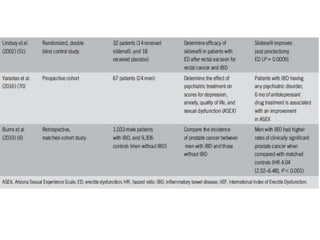
• Men with IBD may be at a higher risk of prostate cancer than
the general population.
Sexual dysfunction:
• Sexual health is defined as a state of physical, emotional,
mental& social well-being in relation to sexuality, rather than just
the absence of dysfunction.
• Sexual dysfunction in men can be categorized as erectile
dysfunction (ED), decreased libido, or abnormal ejaculation.
• International Index of Erectile Dysfunction (IIEF) is widely used
,comprises 15 questions covering 5 domains: erectile function,
orgasmic function, sexual desire, intercourse satisfaction& overall
satisfaction; lacks an IBD-specific domain.
• An IBD-specific sexual function psychometric tool has been
recently proposed.
• Age associated with sexual dysf in patients with IBD, prevalence
may be higher (95% vs 10%–40% in men 40ys& over.
Sexual dysfunction:
• There is association between IBD&male sexual function.
• There was no difference in sexual intercourse frequency between
men with IBD and patients without IBD; but concerns were raised
about incontinence, tiredness, abdominal pain&proximity of toilet
facilities.
• IBD symptoms, complications&treatments were associated with
sexual function, intimacy&body image.
• Body image dissatisfaction remained stable despite improvement
in disease activity &associated with lower health-related QOL.
• 40% of IBD men felt severely compromised sexually &1/3 felt that
sexual desire &satisfaction worsened after diagnosis.
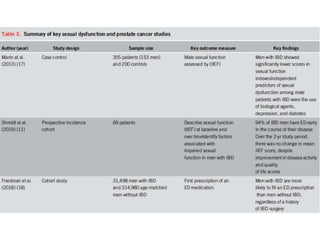
• 39%ofmen with IBD had global sexual dysfunction &94% had ED
early in disease course without change over time.
Sexual dysfunction:
• Men with IBD were more likely to fill an ED prescription &their
sexual dysfunction rates were 15%–25% compared with 5% in the
general population
• A meta-analysis showed a relative risk of 1.41 for sexual
dysfunction &lower mean IIEF scores in men with IBD compared
with non-IBD comparators.
Surgery:
• The 10-year cumulative risk of major abdominal surgery in CD is
nearly 50%, whereas 25%–35% of patients with UC will require
surgery, with proctocolectomy & ileal pouch-anal anastomosis
(IPAA) being the most frequent procedures.
• Urogenital dysfunction after rectal surgery is due to intraoperative
damage to the autonomic pelvic nerve
• ED prevalence after proctocolectomy 0- 26%, although a recent
study found no association between IBD surgery&filling an ED
prescription.
• Patients undergoing proctocolectomy with IPAA experienced fewer
sexual activity restrictions than patients undergoing continent (Koch
pouches) or traditional ileostomies related to body image rather
than pelvic innervation damage.
Surgery:
• Patients who had conversion of traditional (Brooke) to continent
ileostomy reported improvement in sexual life quality.
• IPAA can be associated with SD, RFs include age&total preop CS
dose, other studies showed no difference or improvement.
• Type of anastomosis—hand-sewn vs stapled IPAA&open vs
laparoscopic IPAA had no impact on the rate of sexual dysfunction.
• Pouch dysf in IPAA may be associated with sexual dysfunction.
• ED after rectal excision for cancer or IBD, good response to sildenafil
• In summary, SD after undergoing IBD surgery is multifactorial &
occurs more with end ileostomy& continent pouch vs IPAA, with
failed pouch & with advanced age.
• Men with IBD may be assured that the incidence of SD post-IPAA is
low & can be successfully treated with sildenafil in most cases.
Disease activity:
• Disease activity associated with sexual dysfunction.
• Poor health /nutrition,inflammatory factors, the unpredictability of
symptoms &depression all play a role.
• Men with IBD in remission or with mild disease activity had similar
rates of ED compared with healthy controls, but by Arizona Sexual
Experience Scale, mean scores were significantly higher (worse) in
men with IBD with active disease, with 64% having sexual
dysfunction.
• Another study noted that men with IBD with active disease
reported greater ED rates &lower orgasmic ability, desire& sexual
gratification relative to patients in remission&controls, mostly
mediated by depression.
• By contrast, 2 studies found no association between sexual
dysfunction & disease activity.
Drugs:
• No studies on association between IBD medications&SD in men However,
• case reports note an association of impotence with methotrexate in RA
&with sulfasalazine (SASP) in a patient with UC.
• Ischemic priapism was associated with adalimumab in a patient with
refractory erosive RA.
• Natalizumab-treated MS experienced improvement in sexual dysfunction.
• Several drugs affect sexual function, as opioids,antidepressants,
antianxiety medications, are commonly prescribed to patients with IBD.
• Of patients on SSRI, 24%–80% have erectile/ ejaculatory dysfunction.
• Delayed ejaculation has been associated with citalopram & fluoxetine,
sexual dysfunction occurred in 80% of patients on buprenorphine or
naltrexone,&opiates increased premature ejaculation risk by threefold
Psychopathos:
• Anxiety / depression are present in 19% &21% of patients with
IBD, respectively &twice as likely to report depressive symptoms
• SD significantly associated with depression in men with IBD, the
most consistent negative predictive factor of sexual function&the
most critical determinant for impaired sexual function.
&depression rates may not be related to disease activity.
• Treatment of psychological disorders may have a positive impact
on sexual function & IBD disease activity.
• Six months of antidepressant treatment was associated with
significant improvement in depression, anxiety, quality of
life&sexual functioning scores, as well as CD activity index
Others:
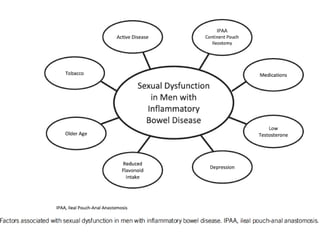
• Low testosterone levels have been reported in men with IBD&
associated with IBD activity and treatment.
• No significant differences in follicle-stimulating hormone, luteinizing
hormone, or testosterone &global IIEF-15 score, erectile function, sexual
satisfaction,orgasmic function& sexual desire were also similar among
the groups.
• If sexual dysfunction is present, testosterone levels should be measured,
& if low, the patient should be referred for an endocrinological eval.
• Malnutrition is prevalent in patients with IBD &reduced intake of
flavonoids found in fruits / vegetables, common in patients with IBD,
increases ED risk in young men.
• Tobacco smokers are approximately 1.5–2 times more likely to report ED
compared with nonsmokers
• Light to moderate alcohol consumption is associated with a decreased
risk of ED in the general population.
Infertility:
• Men with IBD have lower birth rates after diagnosis & had fear of infertility, but
only 19% consulting a doctor for fertility problems.
• Sexual dysfunction may contribute to male infertility, although fertility may be
preserved in the setting of sexual dysfunction&vice versa.
• Severe active IBD is linked to reduced testosterone&progressive sperm motility
but with preserved sperm DNA integrity.
• Infertility in men with IBD may also be related to nutritional deficiency, tobacco /
alcohol use&IBD therapies.
• Low birth rates may be a consequence of voluntary childlessness& independent
of infertility.
• CD was associated with a significant reduction in family size independent
• of steroid or SASP treatment.
• An increase in infertility risk of up to 18%–50% was reported in men with CD
without differences in reproductive capacity, suggesting voluntary
• Childlessness.
• Patients reported fear of congenital abnormalities, transmitting IBD&
teratogenicity of medications&receiving negative medical opinion.
Infertility:
• Antisperm antibodies have been reported in both
men&women with IBD
• Zinc deficiency observed in up to 70% of IBD patients and may
be related to decreased testicular function.
• Oligospermia was found in 4 of 5 men with restricted zinc
intake
• Alcohol intake & smoking reduce sperm quality & fertility.
• Semen analysis is fundamental in the evaluation of male
fertility, with reference values set by WHO.
IBD Medications safety:
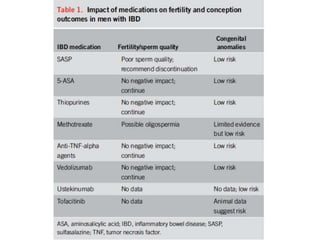
• The use of medication during conception
should balance disease control, which
impacts ability to conceive&safety of
therapies taken.
IBD medication safety:5-ASA
• Prospective fathers should discontinue SASP 3–4
months before attempting conception given
negative impact on semen quality.
• They can be switched to a 5-ASA compound which is
compatible with use throughout conception.
IBD medication safety:thiopurines
• Thiopurines are compatible with use among men with IBD
considering conception.
IBD medication safety:MTX
• Although women on methotrexate should certainly stop
treatment before attempting conception, the limited
available data do not suggest an increase in birth defects in
offspring of men on this therapy.
IBD medication safety:CSs
• Corticosteroids can be continued during
conception.
IBD medication safety:Other biologicals
• Anti-TNF can be continued during conception
in men, given the lack of evidence of impact
on fertility or infant outcomes.
• The other available biologics also appear low
risk.
IBD medication safety:JAK inhibs
• There are no available human data.
• Until better safety information is available, JAK
inhibitors should be used with caution if it
cannot be discontinued or transitioned to
other drugs before conception.
Prostate cancer:
• Chronic prostate inflammation is a suspected risk factor for
prostate cancer.
• IBD-associated local inflammation (when IBD involves the
rectum) or systemic inflammation may be associated with
chronic prostatic inflammation.
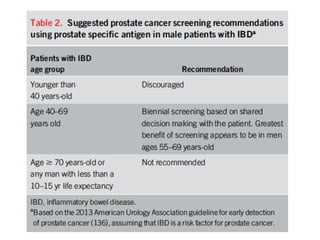
• Prostate cancer screening guidelines depend on estimated risk
• DRE is advocated during lower endoscopy, despite its inherent
limitations.
• In patients with proctocolectomy or sewn anus, evaluation for
prostate cancer may be achieved by transperineal ultrasound-
guided biopsy
• The choice of prostate cancer therapy is not associated with
IBD flare.
Summary
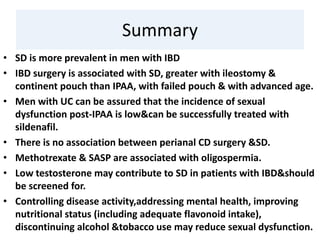
• SD is more prevalent in men with IBD
• IBD surgery is associated with SD, greater with ileostomy &
continent pouch than IPAA, with failed pouch & with advanced age.
• Men with UC can be assured that the incidence of sexual
dysfunction post-IPAA is low&can be successfully treated with
sildenafil.
• There is no association between perianal CD surgery &SD.
• Methotrexate & SASP are associated with oligospermia.
• Low testosterone may contribute to SD in patients with IBD&should
be screened for.
• Controlling disease activity,addressing mental health, improving
nutritional status (including adequate flavonoid intake),
discontinuing alcohol &tobacco use may reduce sexual dysfunction.
Summary
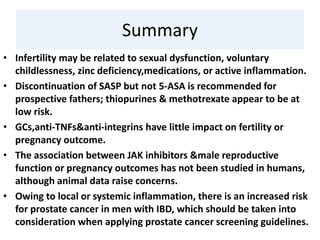
• Infertility may be related to sexual dysfunction, voluntary
childlessness, zinc deficiency,medications, or active inflammation.
• Discontinuation of SASP but not 5-ASA is recommended for
prospective fathers; thiopurines & methotrexate appear to be at
low risk.
• GCs,anti-TNFs&anti-integrins have little impact on fertility or
pregnancy outcome.
• The association between JAK inhibitors &male reproductive
function or pregnancy outcomes has not been studied in humans,
although animal data raise concerns.
• Owing to local or systemic inflammation, there is an increased risk
for prostate cancer in men with IBD, which should be taken into
consideration when applying prostate cancer screening guidelines.
Summary
• Half of patients with IBD are men.
• Less attention focused on their sexual issues despite higher rates of
sexual dysfunction &infertility than the general population.
• Depression & IBD disease activity are the most consistently
reported risk factor for sexual dysfunction among men with IBD.
• Methotrexate & sulfasalazine rarely associated with impotence.
• Sulfasalazine reversibly reduces male fertility.
• No other medications used in IBD significantly affect fertility in
humans.
• There is no increase adverse fetal outcomes among offsprings.
• Patients with IBD are at a higher risk for PC,so screening
recommended as for high-risk patients.
CME1:
• A 30-ys man with ulcerative pancolitis treated with sulfasalazine,
azathioprine& infliximab for the last 18 months in clinical/
endoscopic remission. He wants to father a child in the next 6–12
months but is concerned about the effect of IBD medications on
fertility & asks if he should stop his medications prior to conception.
What advice do you give him regarding his medications based on
their effect on fertility?
• A. Stop azathioprine but continue sulfasalazine&infliximab.
• B. Stop sulfasalazine, azathioprine& infliximab&switch to the small
molecule tofacitinib.
• C. Stop infliximab, continue azathioprine&sulfasalazine&start
vedolizumab.
• D. Continue infliximab,azathioprine, but discontinue sulfasalazine
3–4 months prior to conception or switch to a 5ASA.
CME2:
• Which one of the following is the most consistent negative
predictive factor of sexual function in men with IBD?
• A. Increased IBD activity
• B. Depression
• C. Low testosterone levels
• D. Undergoing proctocolectomy with ileal pouch anal anastomosis
(IPAA)
CME3:
• A 55-year-old man with a 10-y H/O ulcerative pancolitis seen for
annual check-up. His UC is in remission on 5-ASA & 6-
mercapotopurine. A recent surveillance colonoscopy was also
normal demonstrating endoscopic histological remission. He is
concerned about his risk of prostate disease in connection with
IBD.Which one of the following statements regarding the risk of
prostate disease & IBD is correct?
• A. Patients with IBD are at greater risk of BPH.
• B. The risk of prostatitis in IBD is low.
• C. A higher risk of prostate cancer in men with IBD and biennial
screening is recommended between age 40 and 69 years.
• D. No association between prostate cancer in men with IBD in the
post- PSA era so screening for prostate cancer is not necessary.

GIT J Club IBD- sexual dysfunction20.

  • 1.
    Kuridistan Board GEH/GITSurgery J Club topic Supervised by: Professor Dr.Mohamed Alshekhani MBChB-CABM-FRCP-EBGH
  • 2.
    Introduction: • IBD, UC&CD, affects >3 million in USA. • 50% <40 ys at diagnosis.often present between 2nd &4th fourth decades of life, when sexual identity & relationships are evolving& fertility /conception are major concerns. • Only 25% of male patients would like to discuss sexuality with a doctor and only 44% of those actually do so. • There is also a lack of awareness among treating physicians, contributing to inadequate management. • Men with IBD may be at a higher risk of prostate cancer than the general population.
  • 3.
    Sexual dysfunction: • Sexualhealth is defined as a state of physical, emotional, mental& social well-being in relation to sexuality, rather than just the absence of dysfunction. • Sexual dysfunction in men can be categorized as erectile dysfunction (ED), decreased libido, or abnormal ejaculation. • International Index of Erectile Dysfunction (IIEF) is widely used ,comprises 15 questions covering 5 domains: erectile function, orgasmic function, sexual desire, intercourse satisfaction& overall satisfaction; lacks an IBD-specific domain. • An IBD-specific sexual function psychometric tool has been recently proposed. • Age associated with sexual dysf in patients with IBD, prevalence may be higher (95% vs 10%–40% in men 40ys& over.
  • 4.
    Sexual dysfunction: • Thereis association between IBD&male sexual function. • There was no difference in sexual intercourse frequency between men with IBD and patients without IBD; but concerns were raised about incontinence, tiredness, abdominal pain&proximity of toilet facilities. • IBD symptoms, complications&treatments were associated with sexual function, intimacy&body image. • Body image dissatisfaction remained stable despite improvement in disease activity &associated with lower health-related QOL. • 40% of IBD men felt severely compromised sexually &1/3 felt that sexual desire &satisfaction worsened after diagnosis. • 39%ofmen with IBD had global sexual dysfunction &94% had ED early in disease course without change over time.
  • 5.
    Sexual dysfunction: • Menwith IBD were more likely to fill an ED prescription &their sexual dysfunction rates were 15%–25% compared with 5% in the general population • A meta-analysis showed a relative risk of 1.41 for sexual dysfunction &lower mean IIEF scores in men with IBD compared with non-IBD comparators.
  • 6.
    Surgery: • The 10-yearcumulative risk of major abdominal surgery in CD is nearly 50%, whereas 25%–35% of patients with UC will require surgery, with proctocolectomy & ileal pouch-anal anastomosis (IPAA) being the most frequent procedures. • Urogenital dysfunction after rectal surgery is due to intraoperative damage to the autonomic pelvic nerve • ED prevalence after proctocolectomy 0- 26%, although a recent study found no association between IBD surgery&filling an ED prescription. • Patients undergoing proctocolectomy with IPAA experienced fewer sexual activity restrictions than patients undergoing continent (Koch pouches) or traditional ileostomies related to body image rather than pelvic innervation damage.
  • 7.
    Surgery: • Patients whohad conversion of traditional (Brooke) to continent ileostomy reported improvement in sexual life quality. • IPAA can be associated with SD, RFs include age&total preop CS dose, other studies showed no difference or improvement. • Type of anastomosis—hand-sewn vs stapled IPAA&open vs laparoscopic IPAA had no impact on the rate of sexual dysfunction. • Pouch dysf in IPAA may be associated with sexual dysfunction. • ED after rectal excision for cancer or IBD, good response to sildenafil • In summary, SD after undergoing IBD surgery is multifactorial & occurs more with end ileostomy& continent pouch vs IPAA, with failed pouch & with advanced age. • Men with IBD may be assured that the incidence of SD post-IPAA is low & can be successfully treated with sildenafil in most cases.
  • 8.
    Disease activity: • Diseaseactivity associated with sexual dysfunction. • Poor health /nutrition,inflammatory factors, the unpredictability of symptoms &depression all play a role. • Men with IBD in remission or with mild disease activity had similar rates of ED compared with healthy controls, but by Arizona Sexual Experience Scale, mean scores were significantly higher (worse) in men with IBD with active disease, with 64% having sexual dysfunction. • Another study noted that men with IBD with active disease reported greater ED rates &lower orgasmic ability, desire& sexual gratification relative to patients in remission&controls, mostly mediated by depression. • By contrast, 2 studies found no association between sexual dysfunction & disease activity.
  • 9.
    Drugs: • No studieson association between IBD medications&SD in men However, • case reports note an association of impotence with methotrexate in RA &with sulfasalazine (SASP) in a patient with UC. • Ischemic priapism was associated with adalimumab in a patient with refractory erosive RA. • Natalizumab-treated MS experienced improvement in sexual dysfunction. • Several drugs affect sexual function, as opioids,antidepressants, antianxiety medications, are commonly prescribed to patients with IBD. • Of patients on SSRI, 24%–80% have erectile/ ejaculatory dysfunction. • Delayed ejaculation has been associated with citalopram & fluoxetine, sexual dysfunction occurred in 80% of patients on buprenorphine or naltrexone,&opiates increased premature ejaculation risk by threefold
  • 10.
    Psychopathos: • Anxiety /depression are present in 19% &21% of patients with IBD, respectively &twice as likely to report depressive symptoms • SD significantly associated with depression in men with IBD, the most consistent negative predictive factor of sexual function&the most critical determinant for impaired sexual function. &depression rates may not be related to disease activity. • Treatment of psychological disorders may have a positive impact on sexual function & IBD disease activity. • Six months of antidepressant treatment was associated with significant improvement in depression, anxiety, quality of life&sexual functioning scores, as well as CD activity index
  • 11.
    Others: • Low testosteronelevels have been reported in men with IBD& associated with IBD activity and treatment. • No significant differences in follicle-stimulating hormone, luteinizing hormone, or testosterone &global IIEF-15 score, erectile function, sexual satisfaction,orgasmic function& sexual desire were also similar among the groups. • If sexual dysfunction is present, testosterone levels should be measured, & if low, the patient should be referred for an endocrinological eval. • Malnutrition is prevalent in patients with IBD &reduced intake of flavonoids found in fruits / vegetables, common in patients with IBD, increases ED risk in young men. • Tobacco smokers are approximately 1.5–2 times more likely to report ED compared with nonsmokers • Light to moderate alcohol consumption is associated with a decreased risk of ED in the general population.
  • 13.
    Infertility: • Men withIBD have lower birth rates after diagnosis & had fear of infertility, but only 19% consulting a doctor for fertility problems. • Sexual dysfunction may contribute to male infertility, although fertility may be preserved in the setting of sexual dysfunction&vice versa. • Severe active IBD is linked to reduced testosterone&progressive sperm motility but with preserved sperm DNA integrity. • Infertility in men with IBD may also be related to nutritional deficiency, tobacco / alcohol use&IBD therapies. • Low birth rates may be a consequence of voluntary childlessness& independent of infertility. • CD was associated with a significant reduction in family size independent • of steroid or SASP treatment. • An increase in infertility risk of up to 18%–50% was reported in men with CD without differences in reproductive capacity, suggesting voluntary • Childlessness. • Patients reported fear of congenital abnormalities, transmitting IBD& teratogenicity of medications&receiving negative medical opinion.
  • 14.
    Infertility: • Antisperm antibodieshave been reported in both men&women with IBD • Zinc deficiency observed in up to 70% of IBD patients and may be related to decreased testicular function. • Oligospermia was found in 4 of 5 men with restricted zinc intake • Alcohol intake & smoking reduce sperm quality & fertility. • Semen analysis is fundamental in the evaluation of male fertility, with reference values set by WHO.
  • 15.
    IBD Medications safety: •The use of medication during conception should balance disease control, which impacts ability to conceive&safety of therapies taken.
  • 16.
    IBD medication safety:5-ASA •Prospective fathers should discontinue SASP 3–4 months before attempting conception given negative impact on semen quality. • They can be switched to a 5-ASA compound which is compatible with use throughout conception.
  • 17.
    IBD medication safety:thiopurines •Thiopurines are compatible with use among men with IBD considering conception.
  • 18.
    IBD medication safety:MTX •Although women on methotrexate should certainly stop treatment before attempting conception, the limited available data do not suggest an increase in birth defects in offspring of men on this therapy.
  • 19.
    IBD medication safety:CSs •Corticosteroids can be continued during conception.
  • 20.
    IBD medication safety:Otherbiologicals • Anti-TNF can be continued during conception in men, given the lack of evidence of impact on fertility or infant outcomes. • The other available biologics also appear low risk.
  • 21.
    IBD medication safety:JAKinhibs • There are no available human data. • Until better safety information is available, JAK inhibitors should be used with caution if it cannot be discontinued or transitioned to other drugs before conception.
  • 23.
    Prostate cancer: • Chronicprostate inflammation is a suspected risk factor for prostate cancer. • IBD-associated local inflammation (when IBD involves the rectum) or systemic inflammation may be associated with chronic prostatic inflammation. • Prostate cancer screening guidelines depend on estimated risk • DRE is advocated during lower endoscopy, despite its inherent limitations. • In patients with proctocolectomy or sewn anus, evaluation for prostate cancer may be achieved by transperineal ultrasound- guided biopsy • The choice of prostate cancer therapy is not associated with IBD flare.
  • 27.
    Summary • SD ismore prevalent in men with IBD • IBD surgery is associated with SD, greater with ileostomy & continent pouch than IPAA, with failed pouch & with advanced age. • Men with UC can be assured that the incidence of sexual dysfunction post-IPAA is low&can be successfully treated with sildenafil. • There is no association between perianal CD surgery &SD. • Methotrexate & SASP are associated with oligospermia. • Low testosterone may contribute to SD in patients with IBD&should be screened for. • Controlling disease activity,addressing mental health, improving nutritional status (including adequate flavonoid intake), discontinuing alcohol &tobacco use may reduce sexual dysfunction.
  • 28.
    Summary • Infertility maybe related to sexual dysfunction, voluntary childlessness, zinc deficiency,medications, or active inflammation. • Discontinuation of SASP but not 5-ASA is recommended for prospective fathers; thiopurines & methotrexate appear to be at low risk. • GCs,anti-TNFs&anti-integrins have little impact on fertility or pregnancy outcome. • The association between JAK inhibitors &male reproductive function or pregnancy outcomes has not been studied in humans, although animal data raise concerns. • Owing to local or systemic inflammation, there is an increased risk for prostate cancer in men with IBD, which should be taken into consideration when applying prostate cancer screening guidelines.
  • 29.
    Summary • Half ofpatients with IBD are men. • Less attention focused on their sexual issues despite higher rates of sexual dysfunction &infertility than the general population. • Depression & IBD disease activity are the most consistently reported risk factor for sexual dysfunction among men with IBD. • Methotrexate & sulfasalazine rarely associated with impotence. • Sulfasalazine reversibly reduces male fertility. • No other medications used in IBD significantly affect fertility in humans. • There is no increase adverse fetal outcomes among offsprings. • Patients with IBD are at a higher risk for PC,so screening recommended as for high-risk patients.
  • 30.
    CME1: • A 30-ysman with ulcerative pancolitis treated with sulfasalazine, azathioprine& infliximab for the last 18 months in clinical/ endoscopic remission. He wants to father a child in the next 6–12 months but is concerned about the effect of IBD medications on fertility & asks if he should stop his medications prior to conception. What advice do you give him regarding his medications based on their effect on fertility? • A. Stop azathioprine but continue sulfasalazine&infliximab. • B. Stop sulfasalazine, azathioprine& infliximab&switch to the small molecule tofacitinib. • C. Stop infliximab, continue azathioprine&sulfasalazine&start vedolizumab. • D. Continue infliximab,azathioprine, but discontinue sulfasalazine 3–4 months prior to conception or switch to a 5ASA.
  • 31.
    CME2: • Which oneof the following is the most consistent negative predictive factor of sexual function in men with IBD? • A. Increased IBD activity • B. Depression • C. Low testosterone levels • D. Undergoing proctocolectomy with ileal pouch anal anastomosis (IPAA)
  • 32.
    CME3: • A 55-year-oldman with a 10-y H/O ulcerative pancolitis seen for annual check-up. His UC is in remission on 5-ASA & 6- mercapotopurine. A recent surveillance colonoscopy was also normal demonstrating endoscopic histological remission. He is concerned about his risk of prostate disease in connection with IBD.Which one of the following statements regarding the risk of prostate disease & IBD is correct? • A. Patients with IBD are at greater risk of BPH. • B. The risk of prostatitis in IBD is low. • C. A higher risk of prostate cancer in men with IBD and biennial screening is recommended between age 40 and 69 years. • D. No association between prostate cancer in men with IBD in the post- PSA era so screening for prostate cancer is not necessary.

Editor's Notes

  • #3 Presented with 2 years of progressively worsening Parkinsonian-like tremors and speech difficulties. On Zinc his tremors were controlled and his transaminases were usually within normal range. Urine copper on zinc was in the 100 range Tetrathiomolybdate - acts both by competing with copper absorption in the bowel and by increasing excretion. Clinical studies have shown ATTM can effectively lower copper levels faster than currently available treatments, and that fewer patients with an initial neurological presentation of their disease who are treated with ATTM experience neurological deterioration
  • #7 Noted to have elevated ammonia, weakness, lethargy
  • #8 Noted to have elevated ammonia, weakness, lethargy
  • #9 Trientine Dihydrochloride, is a chelating agent. Excess copper is chelated (or bonded) by forming a stable complex with Trientine and is excreted from the body via the urinary excretion. Trientine is indicated especially in Wilson Disease patients who are intolerant to D-penicillamine or have clinical features indication potential intolerance.
  • #23 Hepatic manifestations of Wilson’s disease vary from asymptomatic disease to hepatomegaly with mild serum AST/ALT elevation to acute liver failure In Wilson disease, the development of acute liver failure differs in that it is development of acute-on-chronic liver disease, and most patients have advanced fibrosis or cirrhosis at the time of development of acute liver failure Wilson disease accounts for 6 to 12 percent of patients with acute liver failure who are referred for emergency transplantation. The female to male ratio of patients with acute liver failure due to Wilson disease is 2:1 to 4:1 Features seen in acute liver failure due to Wilson’s disease -hemolytic anemia: This is usually present in patients with acute liver failure due to Wilson disease and results from the release of copper ions into the circulation due to hepatocellular necrosis -Ratio AST/ALT usually greater than 2 -ratio of the alkaline phosphatase (int. unit/L) to total bilirubin (mg/dL) is typically less <4.
  • #25 As mentioned before a combination of clinical findings and biochemical testing is usually necessary to make diagnosis of Wilson’s disease
  • #26 As mentioned before a combination of clinical findings and biochemical testing is usually necessary to make diagnosis of Wilson’s disease
  • #27 As mentioned before a combination of clinical findings and biochemical testing is usually necessary to make diagnosis of Wilson’s disease