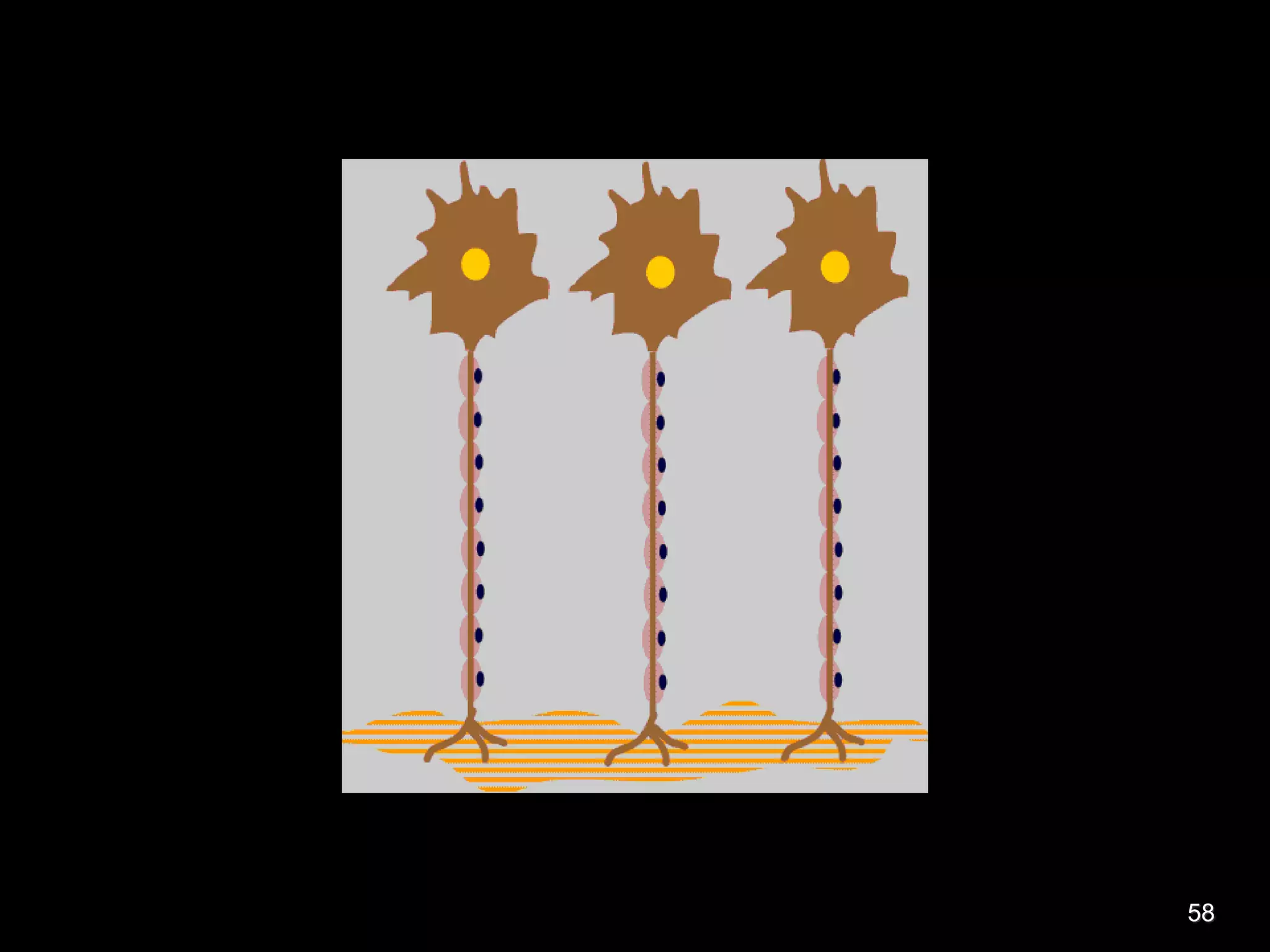
CLASSIFICATION &
PROPERTIES OF NERVE
FIBERS
DR. NABEEL BEERAN
MBBS, MD
DEPARTMENT OF PHYSIOLOGY, YMC
1
CLASSIFICATION OF NERVE FIBERS
2
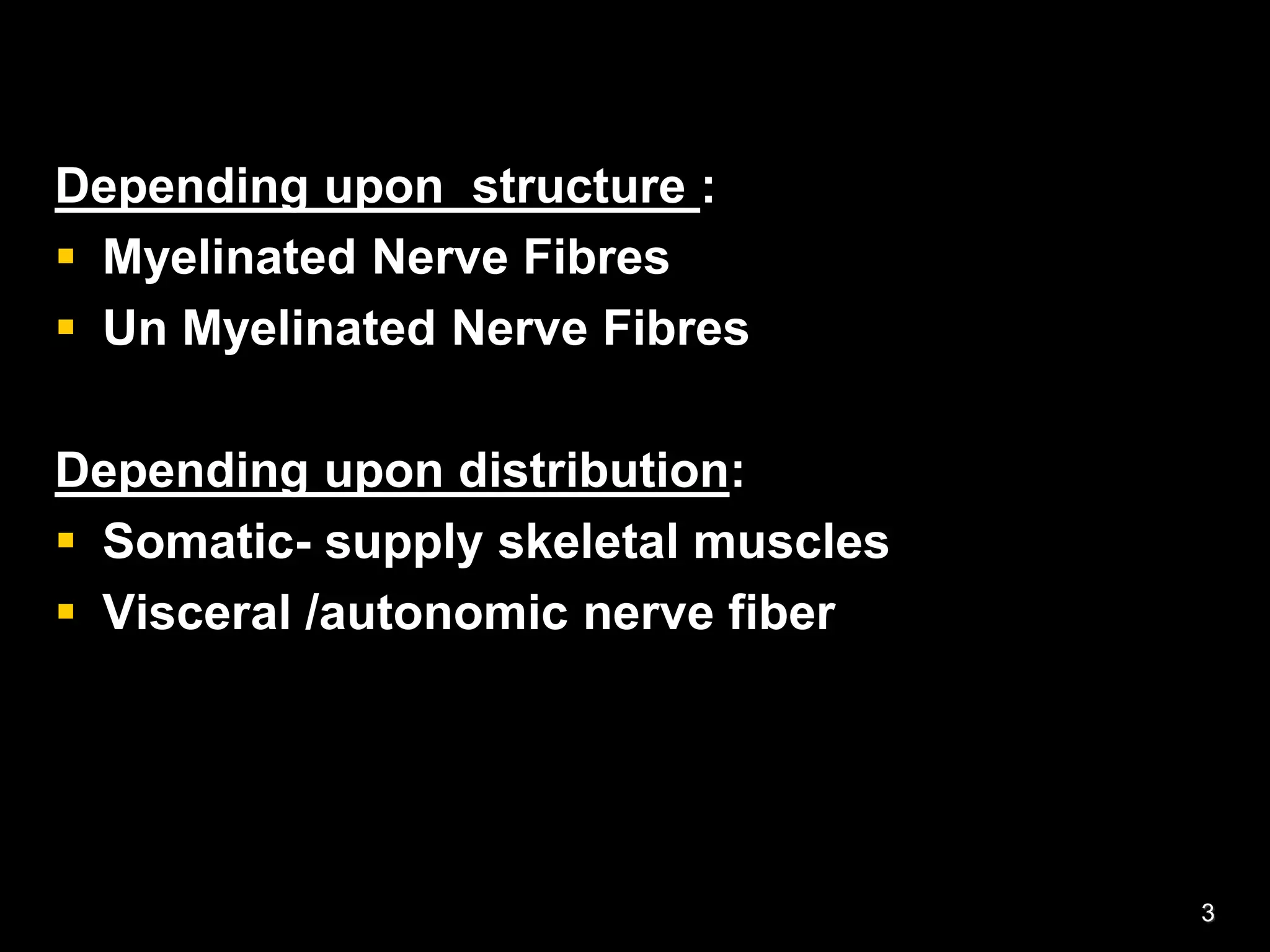
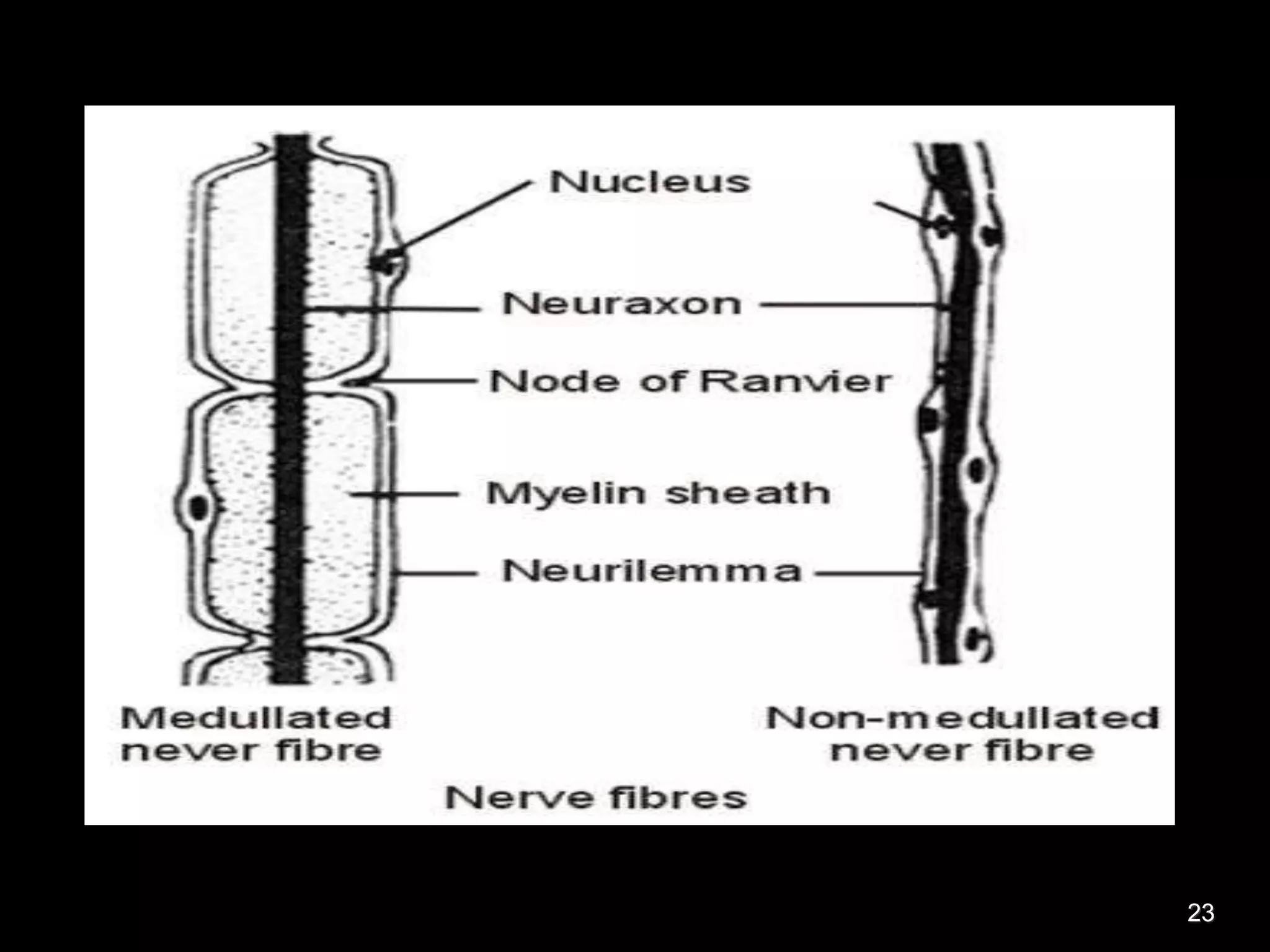
Depending upon structure :
 Myelinated Nerve Fibres
 Un Myelinated Nerve Fibres
Depending upon distribution:
 Somatic- supply skeletal muscles
 Visceral /autonomic nerve fiber
3
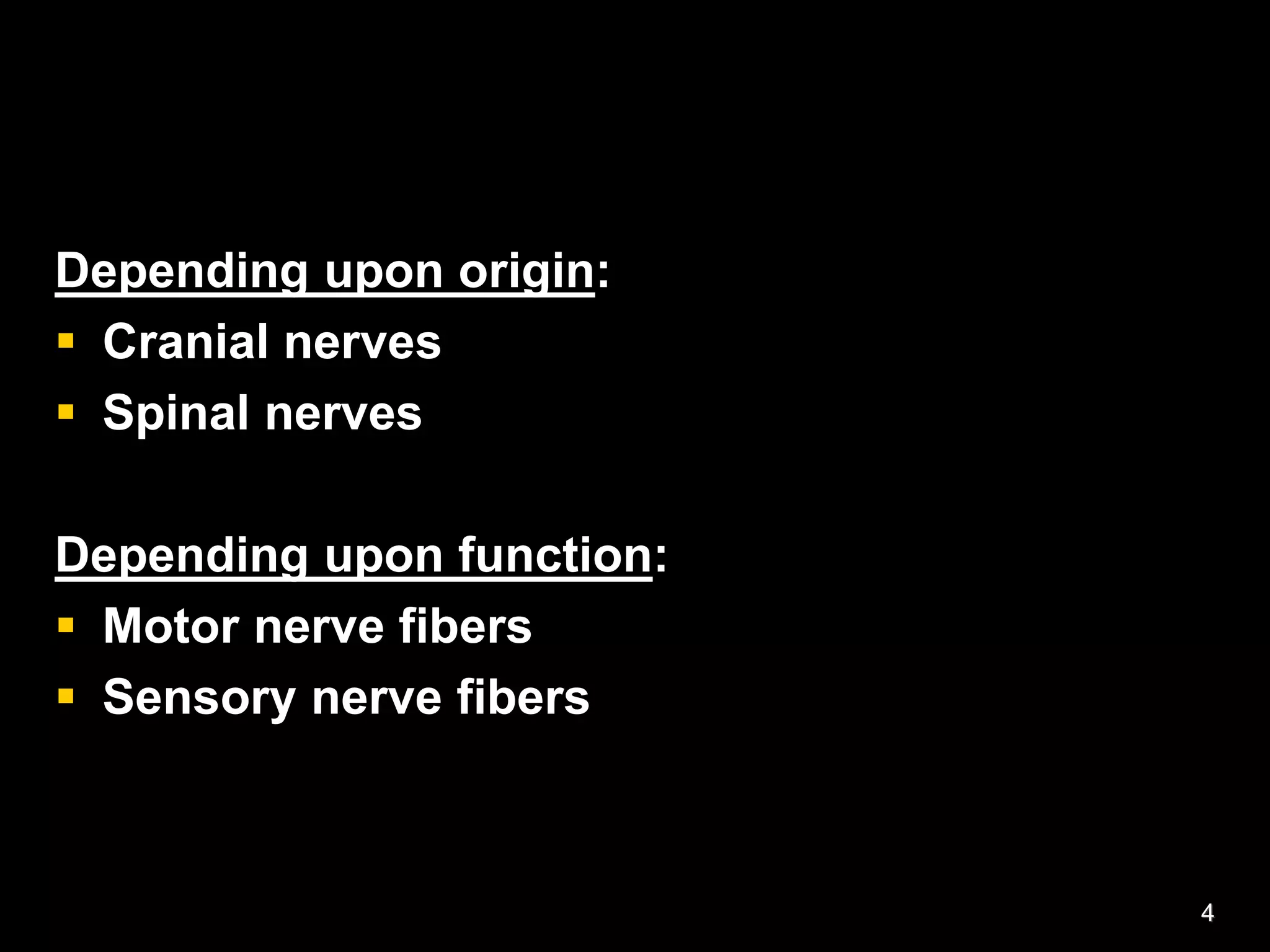
Depending upon origin:
 Cranial nerves
 Spinal nerves
Depending upon function:
 Motor nerve fibers
 Sensory nerve fibers
4
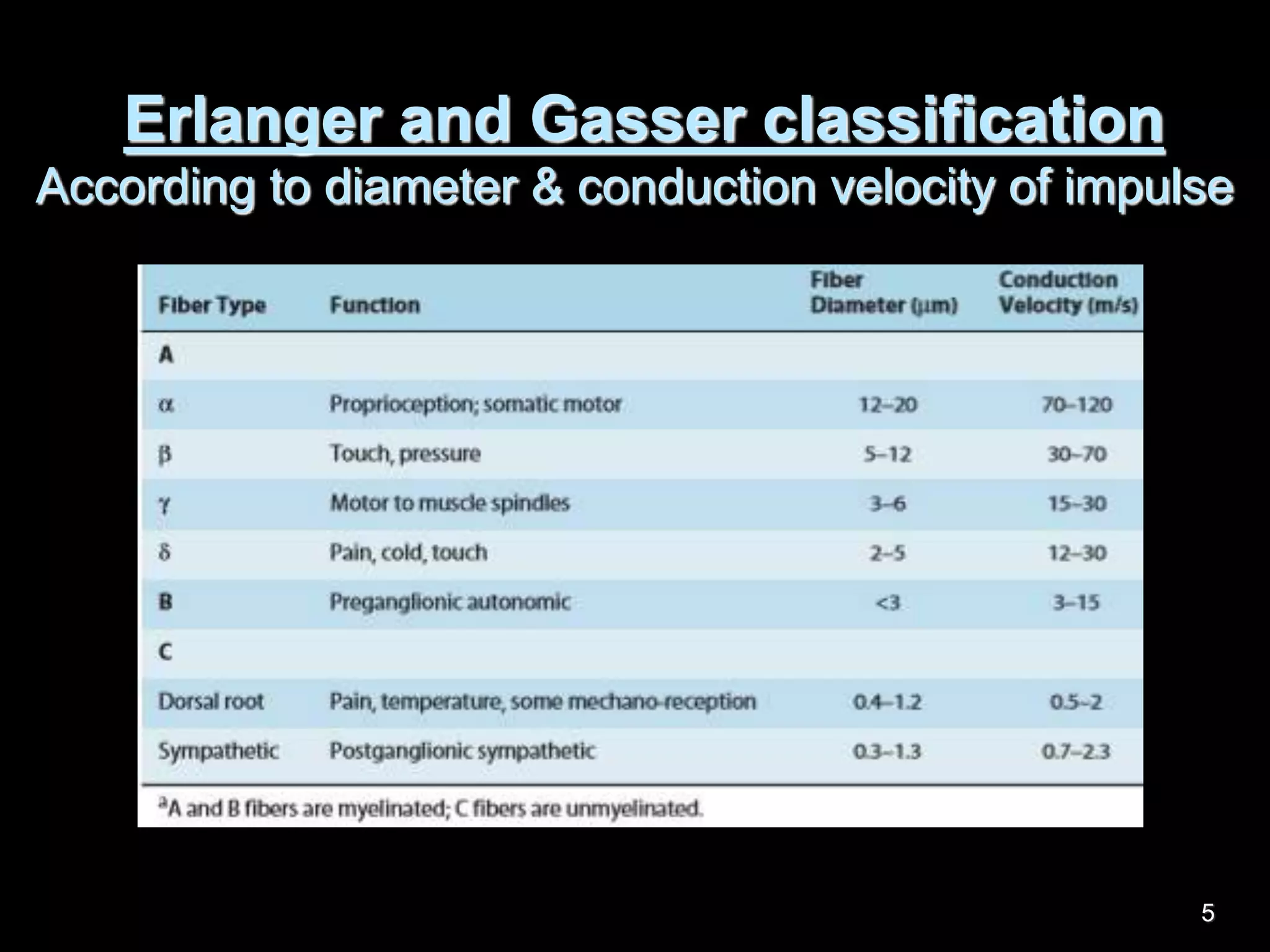
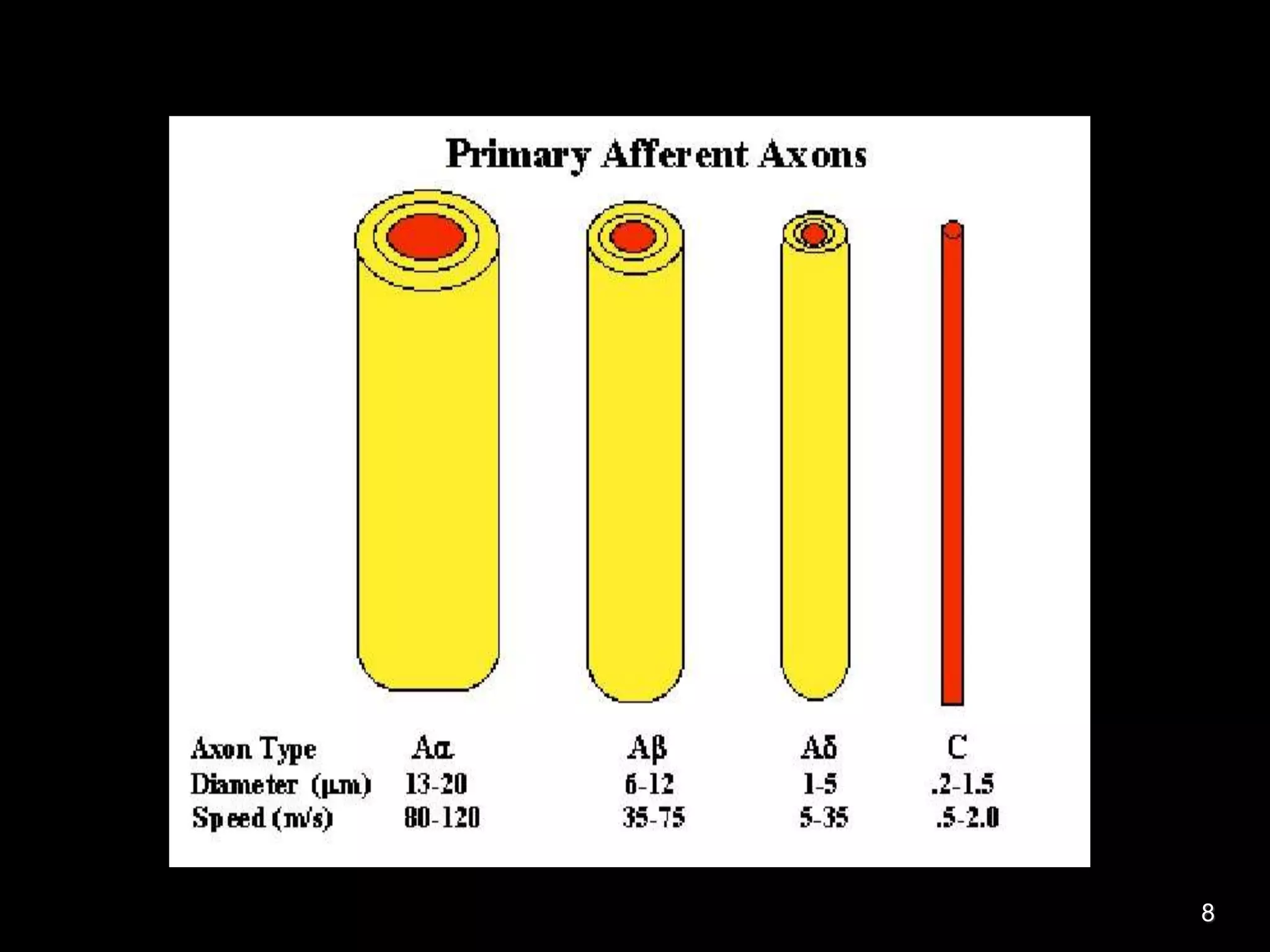
Erlanger and Gasser classification
According to diameter & conduction velocity of impulse
5
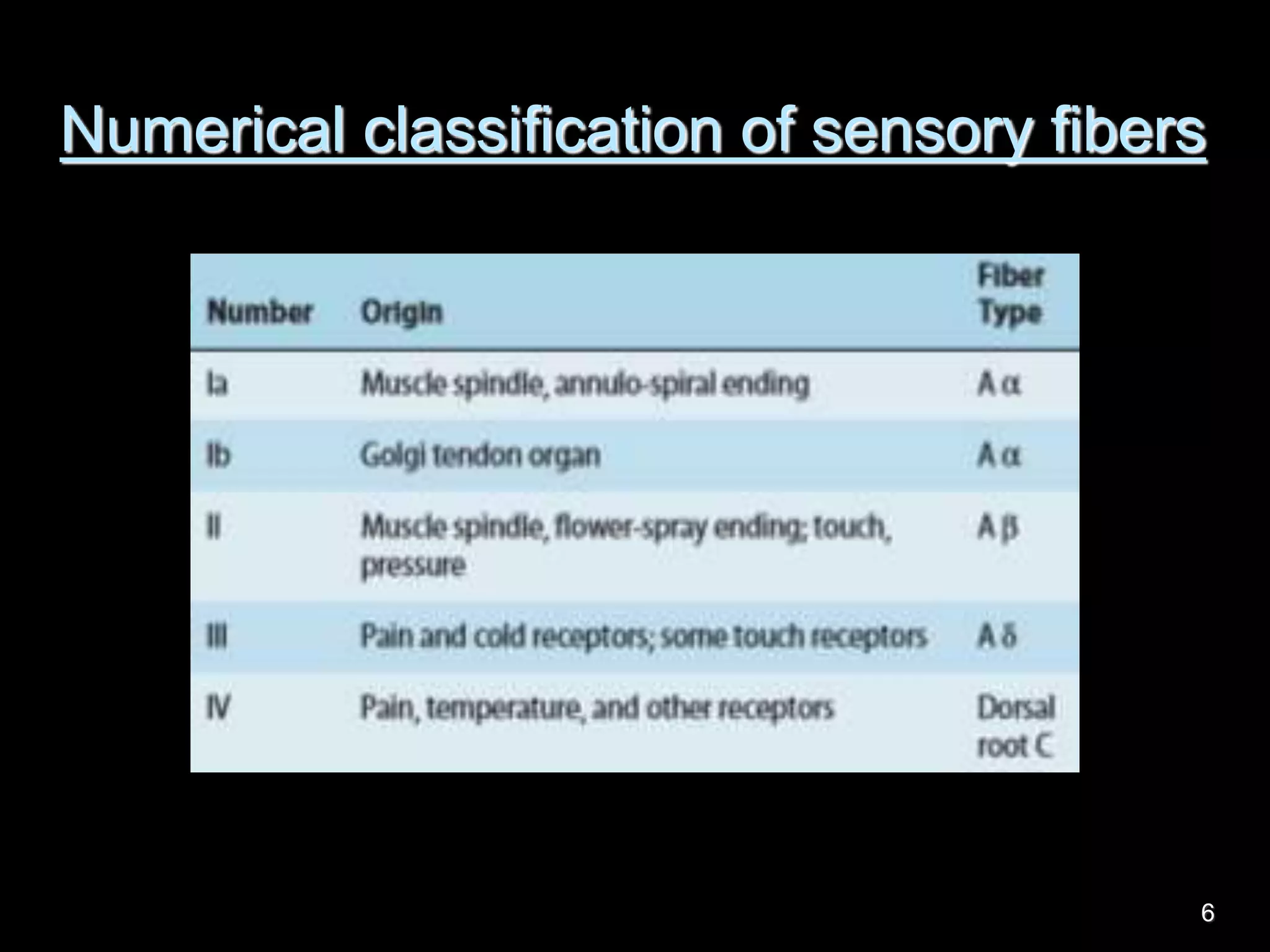
Numerical classification of sensory fibers
6
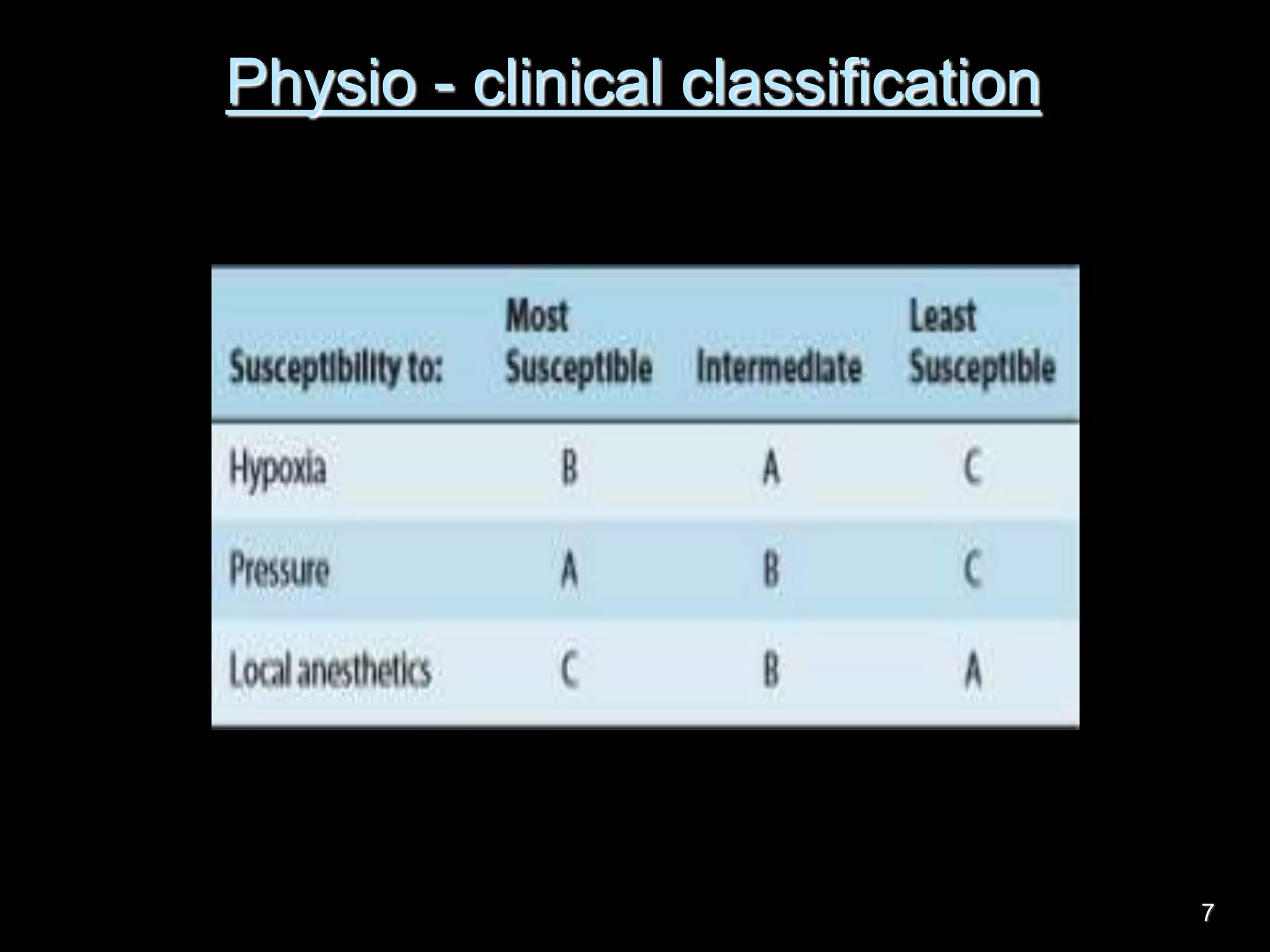
Physio - clinical classification
7
8
PROPERTIES OF NERVE FIBERS
9
10
PROPERTIES OF NERVE FIBER
1. EXCITABILITY
2. CONDUCTIVITY
3. ALL OR NONE LAW
4. REFRACTORY PERIOD
11
EXCITABILITY
It’s the ability of a cell to produce
action potential in response to a
stimulus.
12
Stimulus –
A change in environment which
brings about a change in
potential across a membrane in
an excitable tissue
13
Types of stimuli
 Electrical
 Chemical
 Thermal
 Mechanical
14
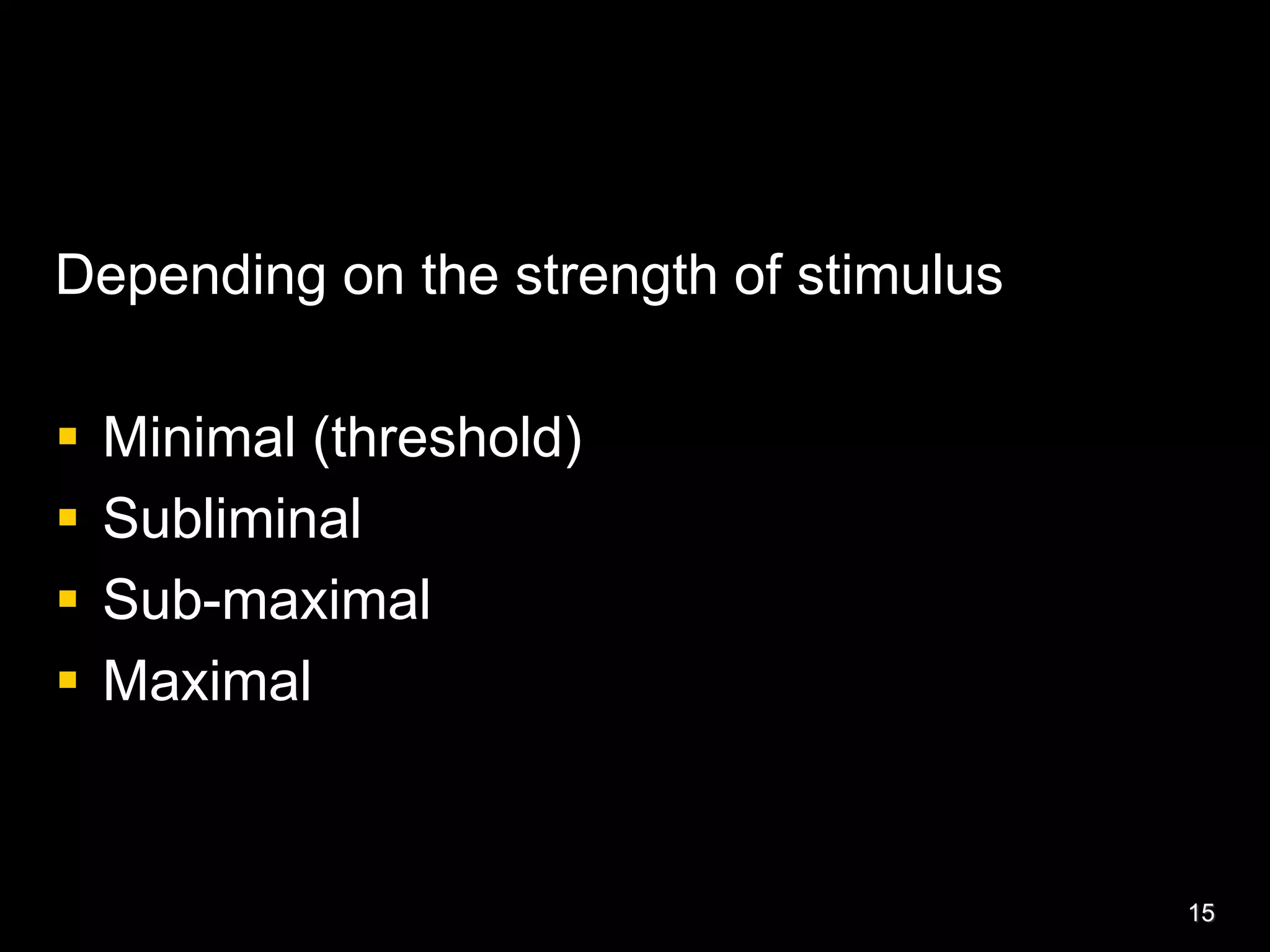
Depending on the strength of stimulus
 Minimal (threshold)
 Subliminal
 Sub-maximal
 Maximal
15
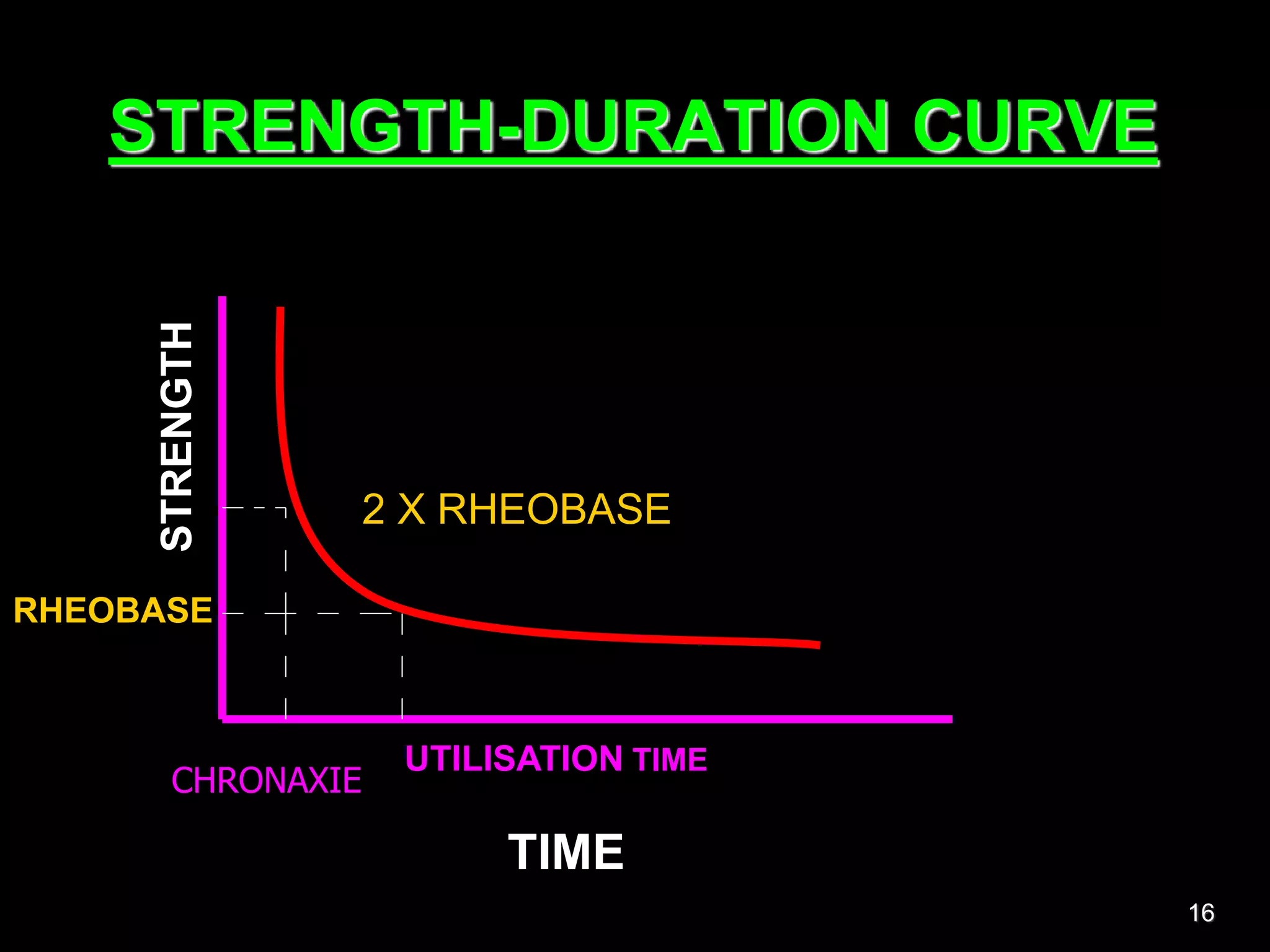
STRENGTH-DURATION CURVE
TIME
UTILISATION TIME
STRENGTH
RHEOBASE
2 X RHEOBASE
CHRONAXIE
16
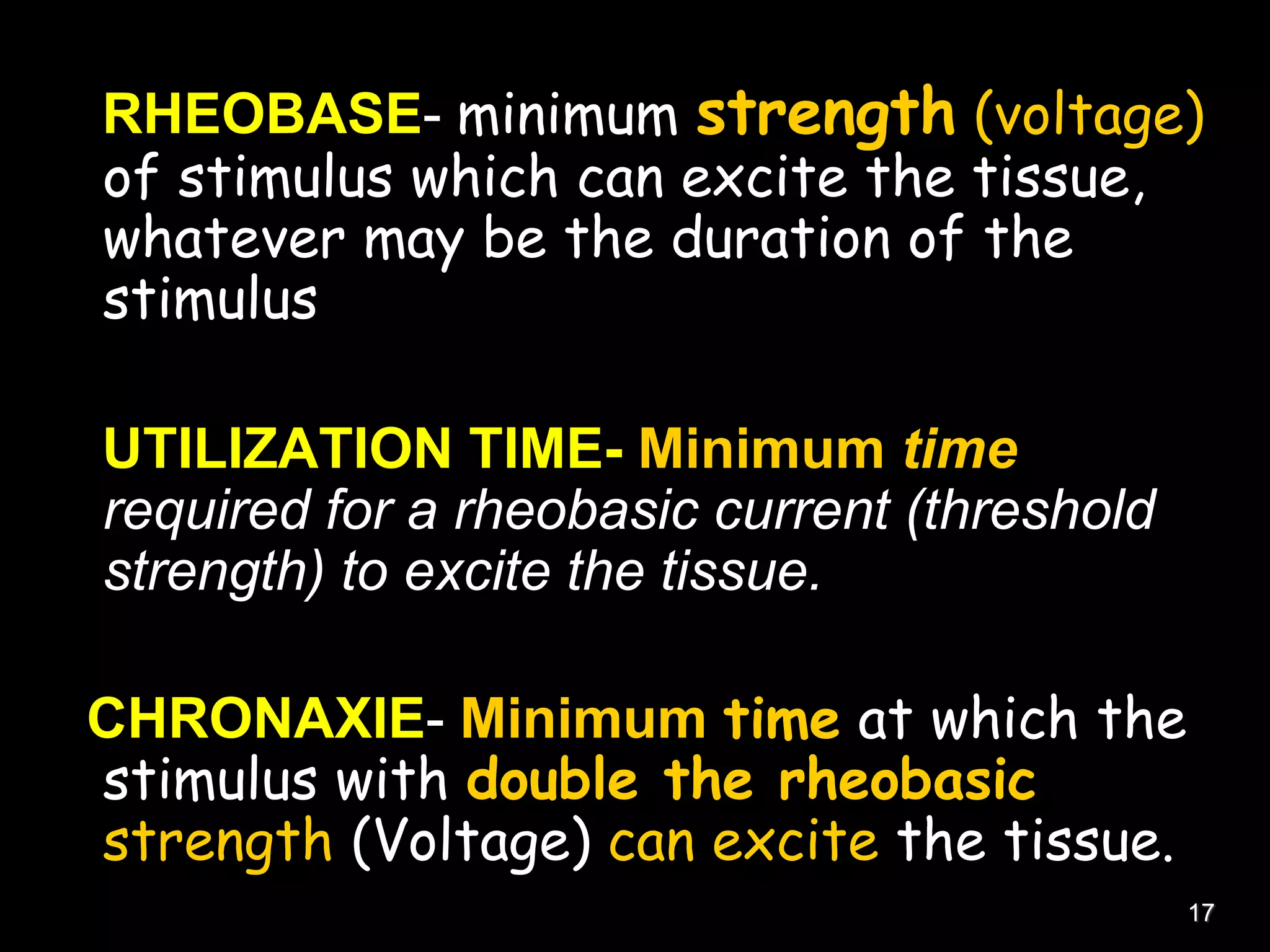
RHEOBASE- minimum strength (voltage)
of stimulus which can excite the tissue,
whatever may be the duration of the
stimulus
UTILIZATION TIME- Minimum time
required for a rheobasic current (threshold
strength) to excite the tissue.
CHRONAXIE- Minimum time at which the
stimulus with double the rheobasic
strength (Voltage) can excite the tissue.
17
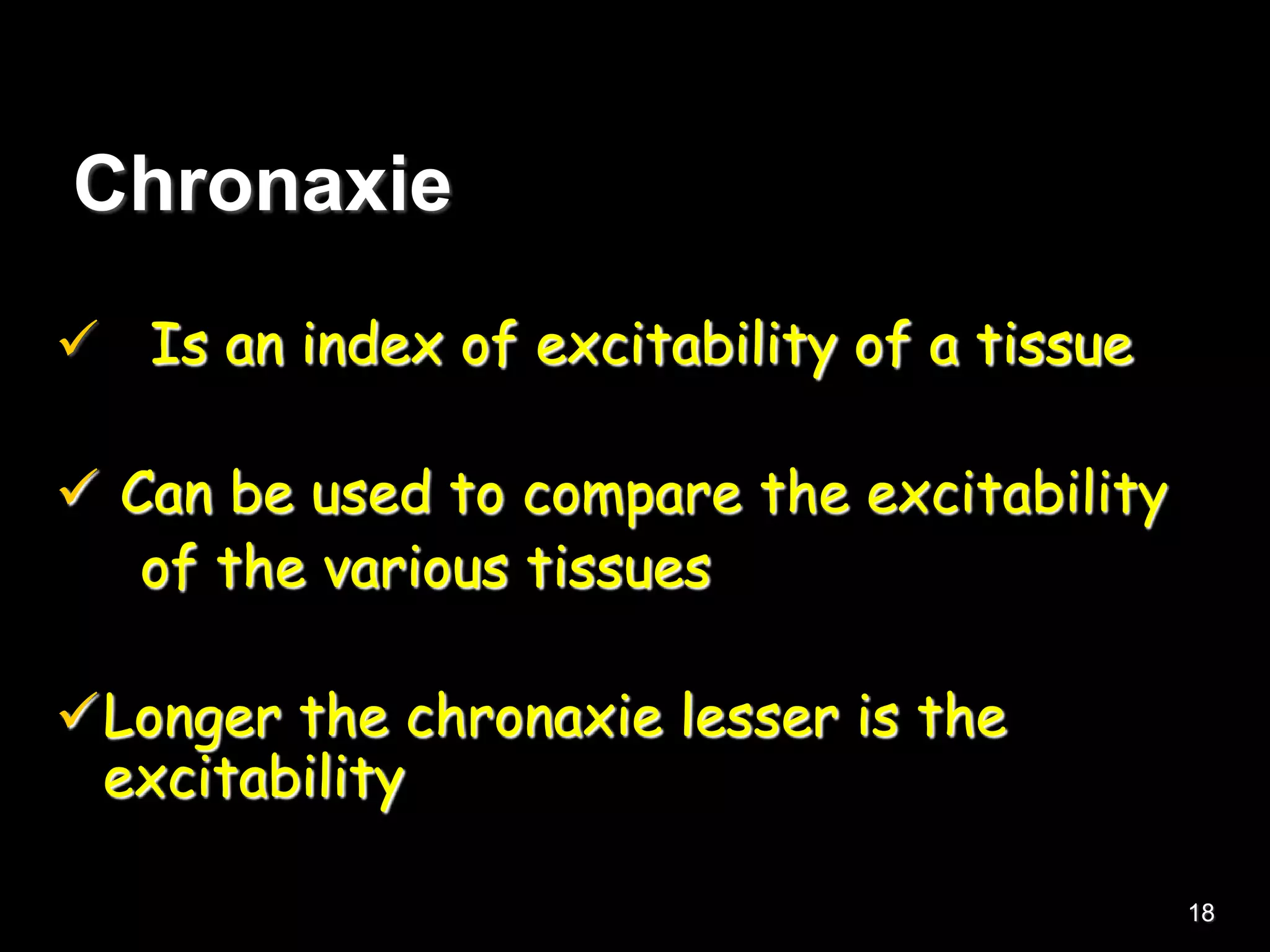
Chronaxie
 Is an index of excitability of a tissue
 Can be used to compare the excitability
of the various tissues
Longer the chronaxie lesser is the
excitability
18
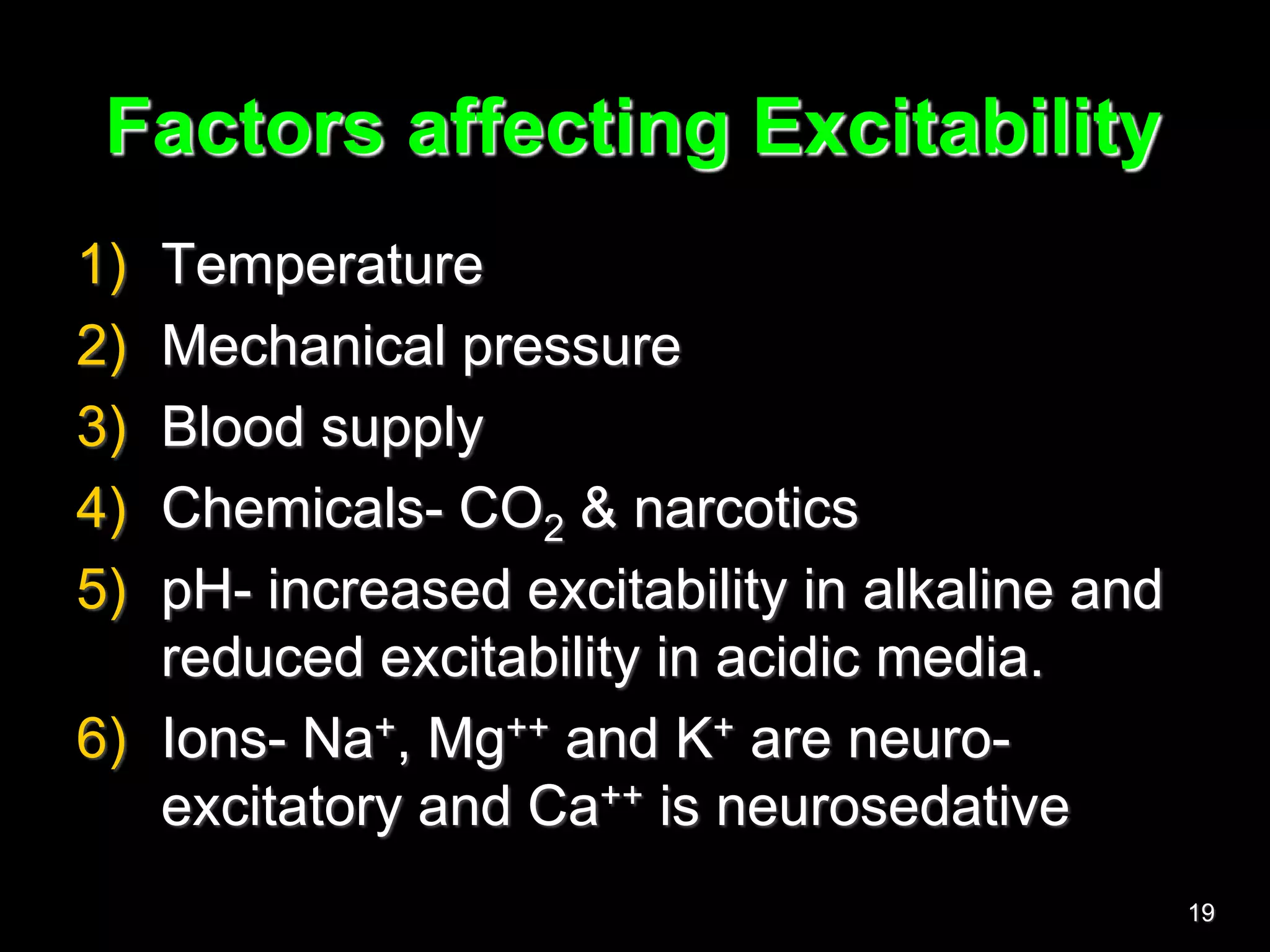
Factors affecting Excitability
1) Temperature
2) Mechanical pressure
3) Blood supply
4) Chemicals- CO2 & narcotics
5) pH- increased excitability in alkaline and
reduced excitability in acidic media.
6) Ions- Na+, Mg++ and K+ are neuro-
excitatory and Ca++ is neurosedative
19
Nerve and muscle are excitable
Capable of self-generation of
electrochemical impulses at
their membrane
Transmit signals along the
membrane
20
CONDUCTIVITY
 Ability to conduct an impulse is called
Conductivity.
TWO TYPES:
 Orthodromic conduction
 Antidromic conduction
21
Factors affecting Conductivity
 Temperature
 Mechanical pressure
 Blood supply
 Chemicals
 pH
 Ions
 Size of the nerve
 Myelination
22
23
ALL OR NONE RESPONSE
A single nerve fiber obeys “all or none law”
When stimulus of sub-threshold intensity is
applied to the axon , then no action potential is
produced (NONE RESPONSE)
A response in the spike of action potential is
observed when the stimulus if of threshold intensity
There occurs no increase in the magnitude of
action potential when the strength of stimulus is
more than the threshold level (ALL RESPONSE) 24
REFRACTORY PERIOD
The period of time during
which an excitable cell
cannot generate another
action potential is called the
refractory period.
25
1) Absolute refractory period-
 it is the period during an action potential,
during which a second stimulus can’t
produce a second response.
 period of action potential from firing level
until repolarization is almost 1/3rd
complete (spike potential)
26
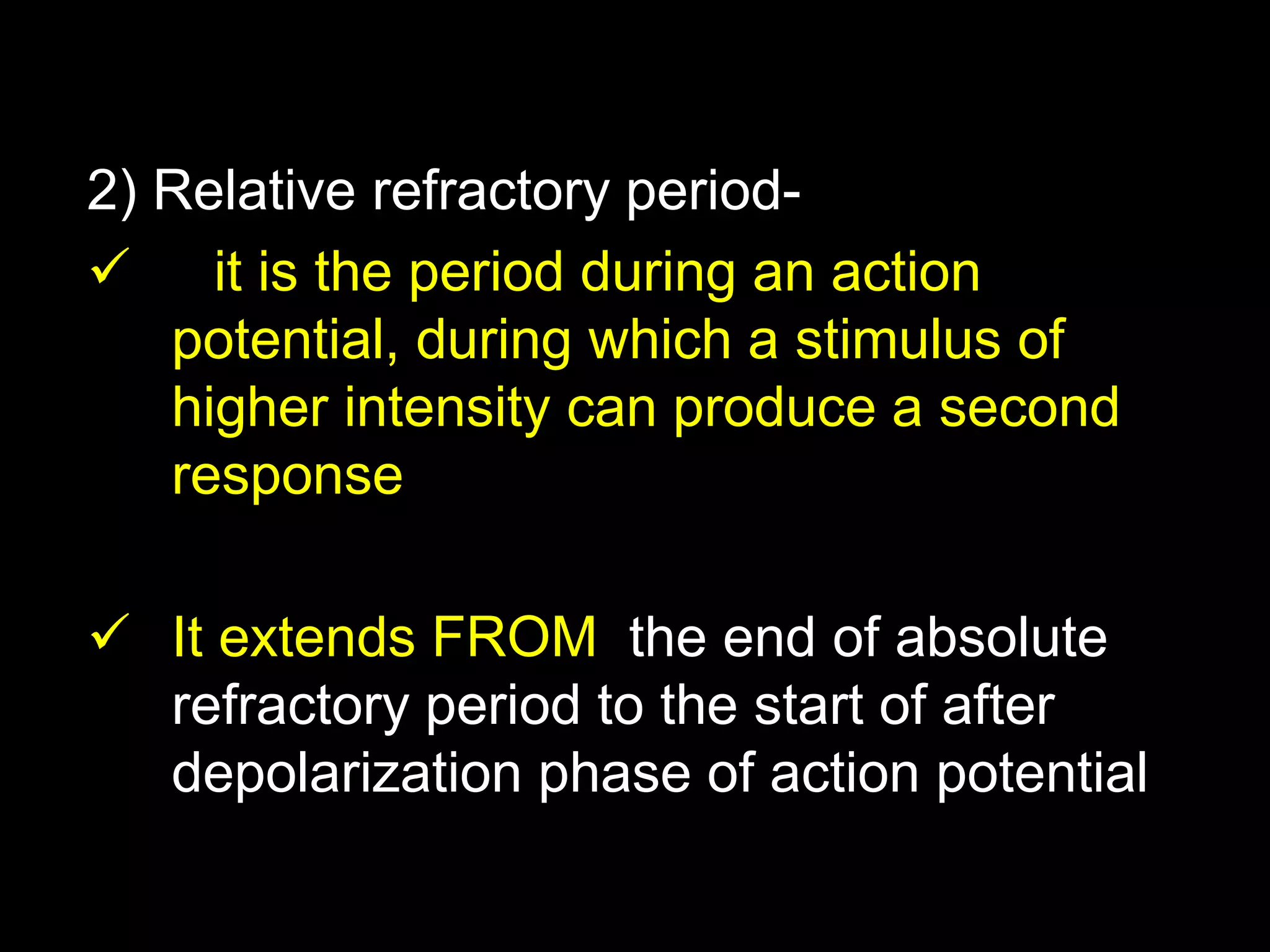
2) Relative refractory period-
 it is the period during an action
potential, during which a stimulus of
higher intensity can produce a second
response
 It extends FROM the end of absolute
refractory period to the start of after
depolarization phase of action potential
27
28
CONDUCTION OF IMPULSES IN THE
NERVE FIBRE
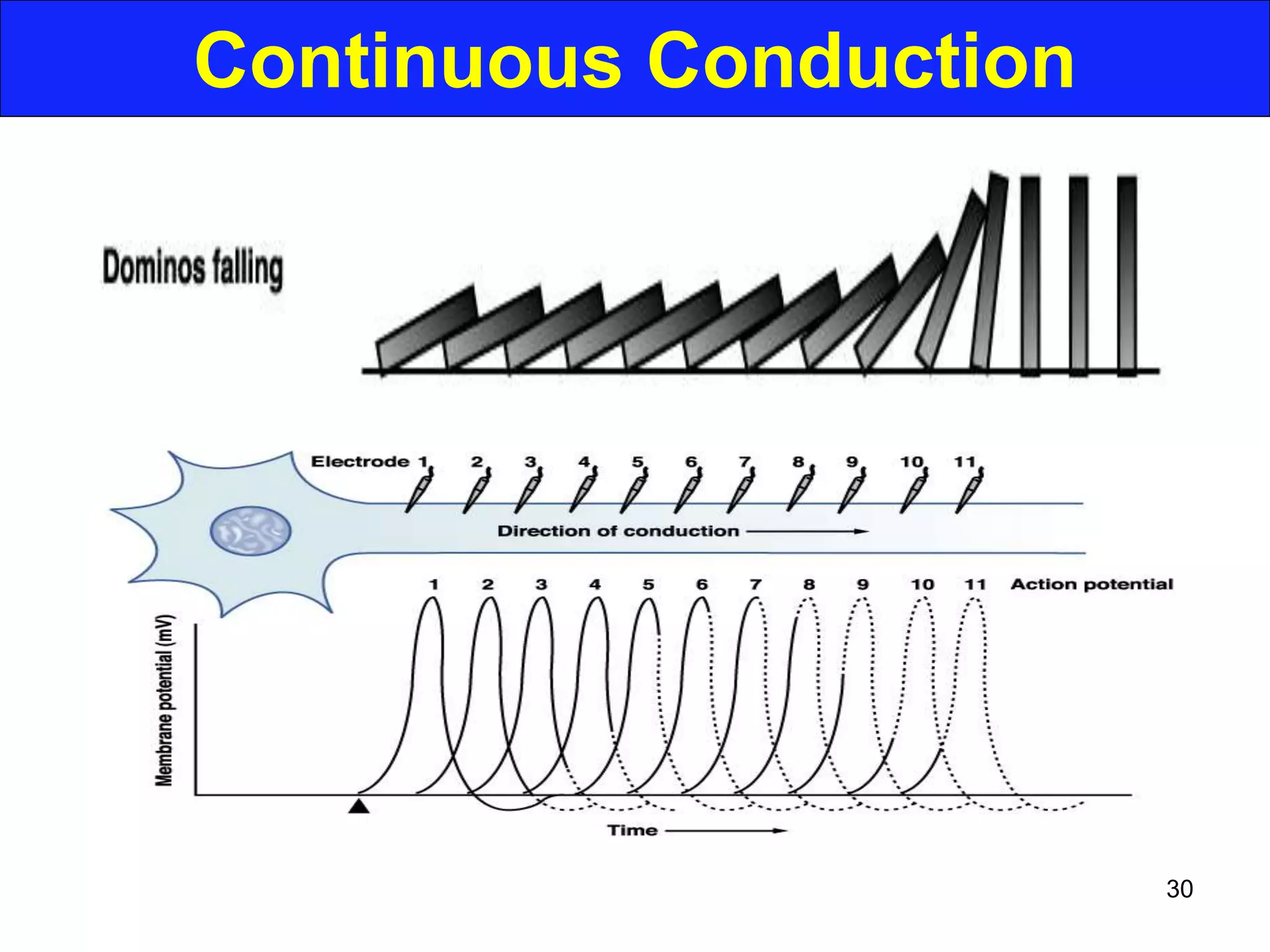
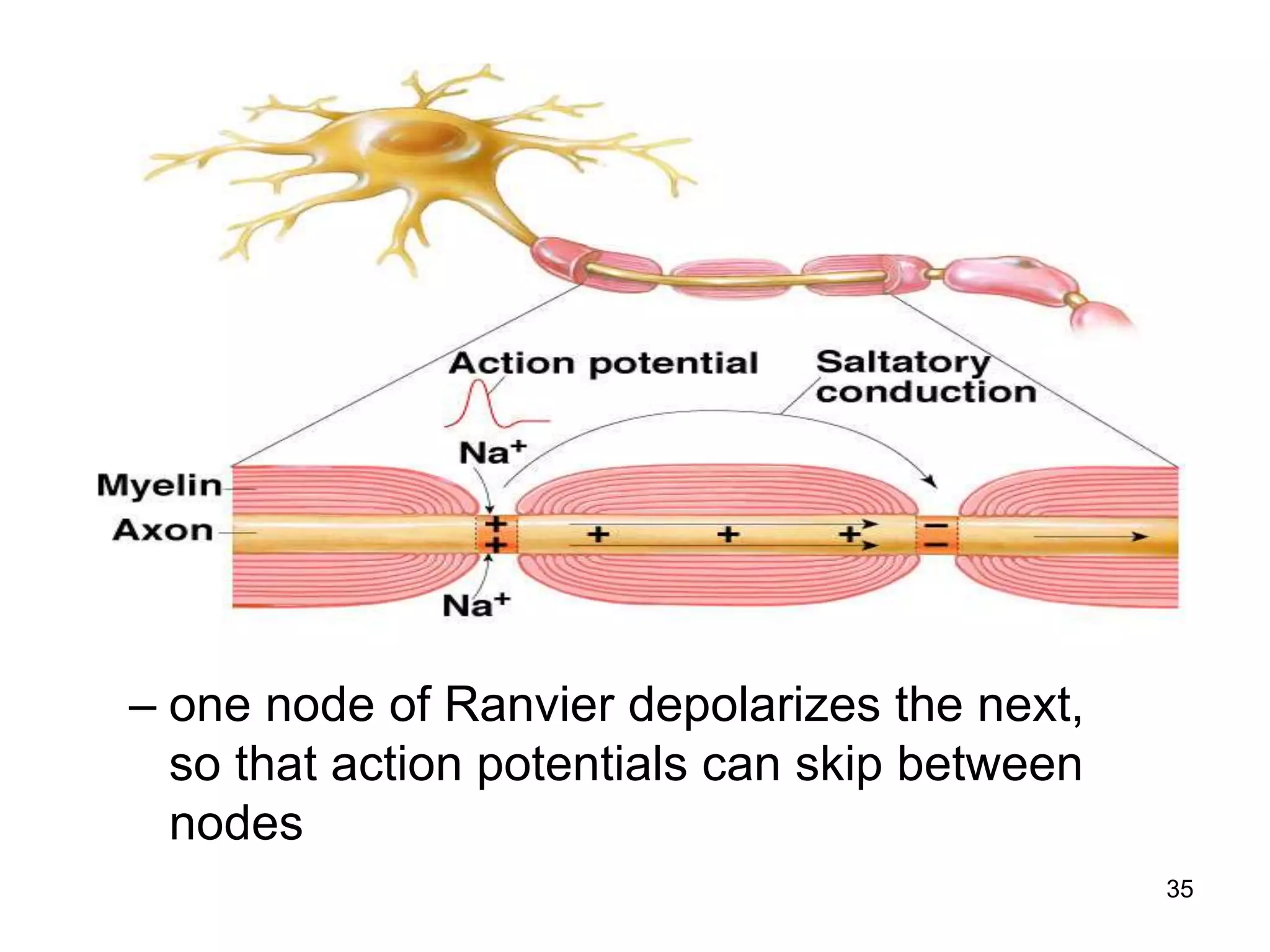
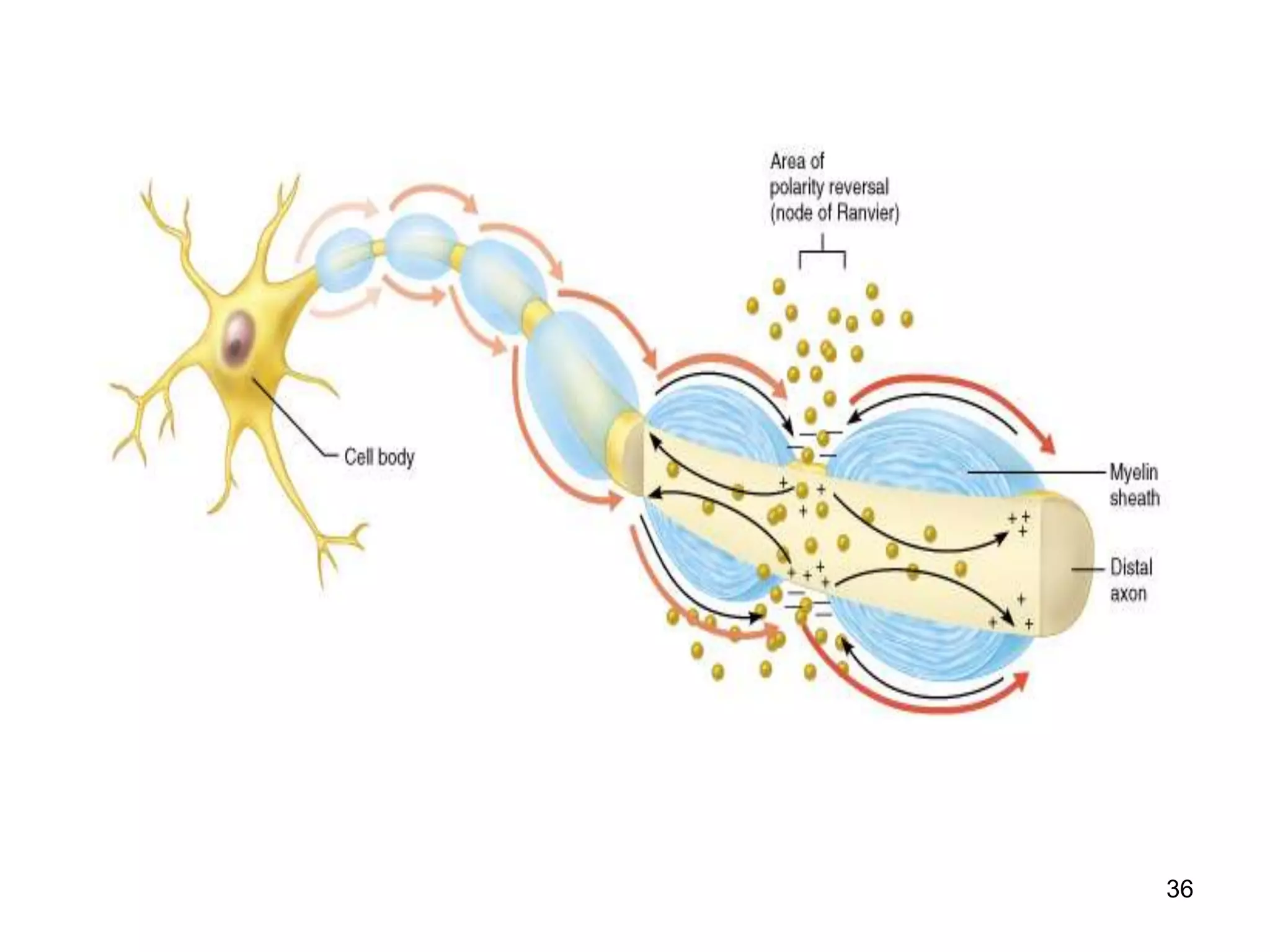
• Unmyelinated neurons undergo the
Continuous conduction of an AP.
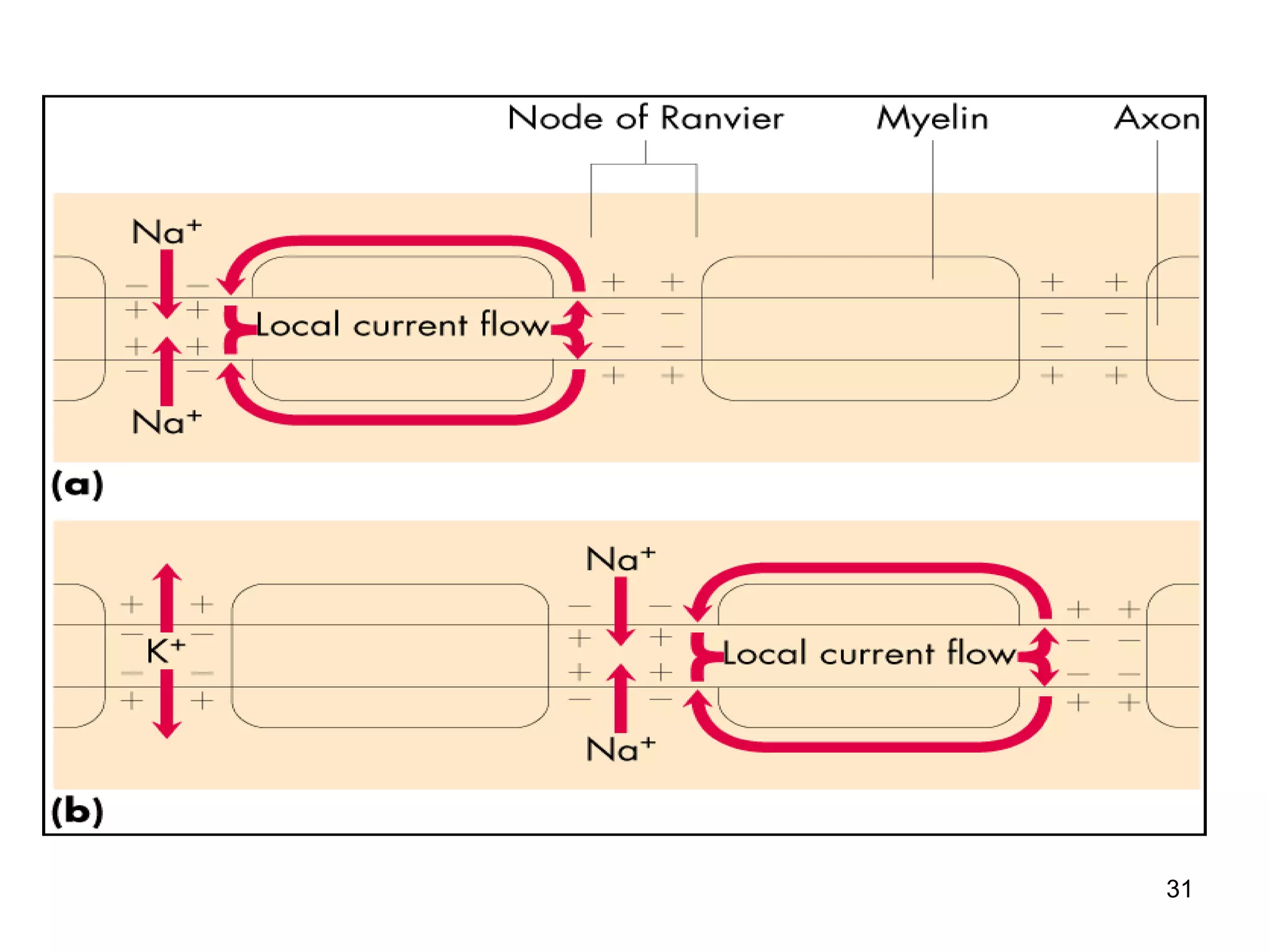
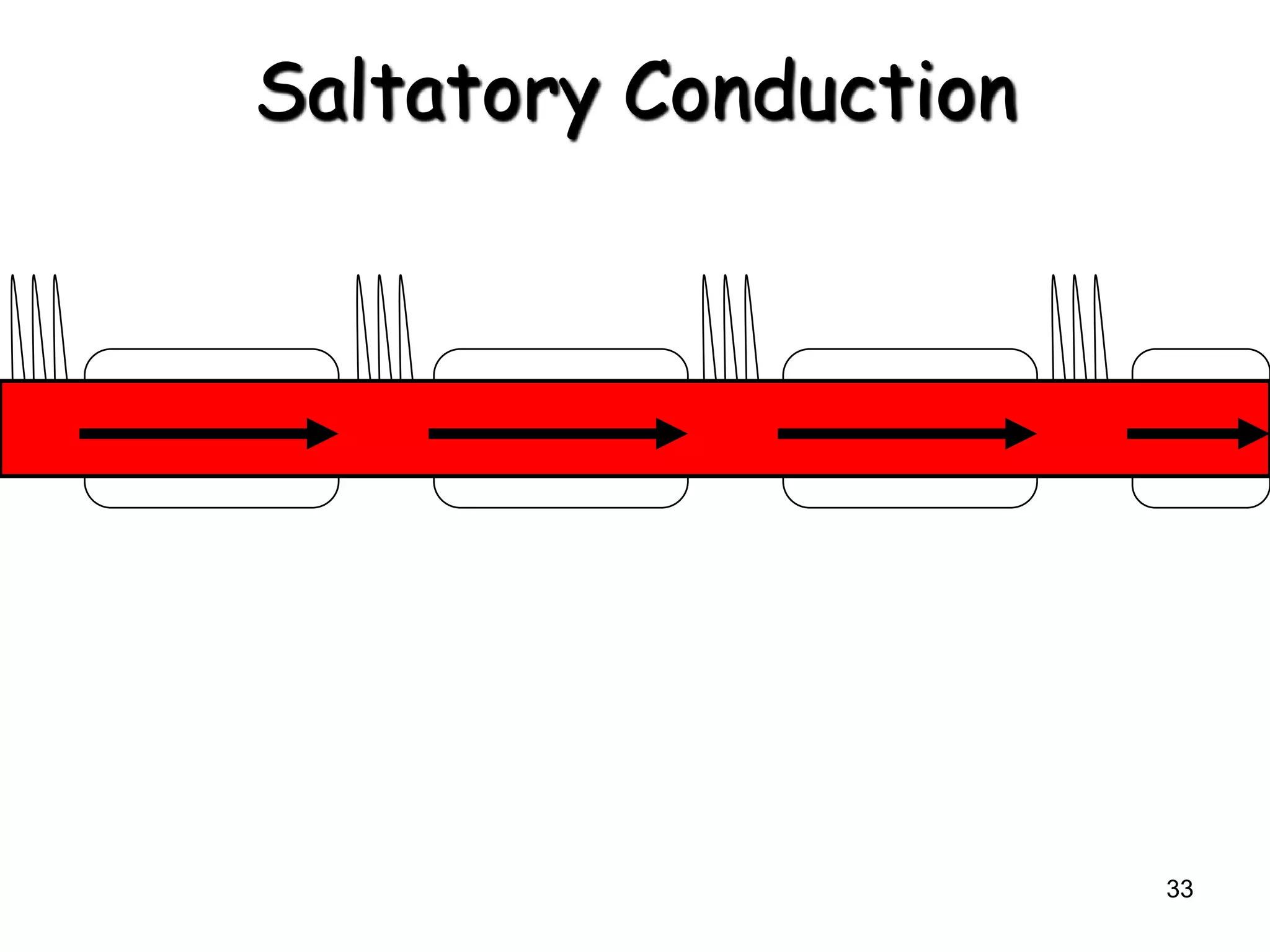
• Myelinated neurons undergo Saltatory
conduction of an AP.
29
Continuous Conduction
30
31
• There are two advantages of saltatory
conduction.
1.Energy is saved as sodium-potassium
pumps are only required at specific points
along the axon.
2. Conduction of an action potential is much
faster within a myelinated axon (around
120 m/sec as opposed to around 35 m/sec)
in unmyelinated ones.
32
33
Saltatory Conduction
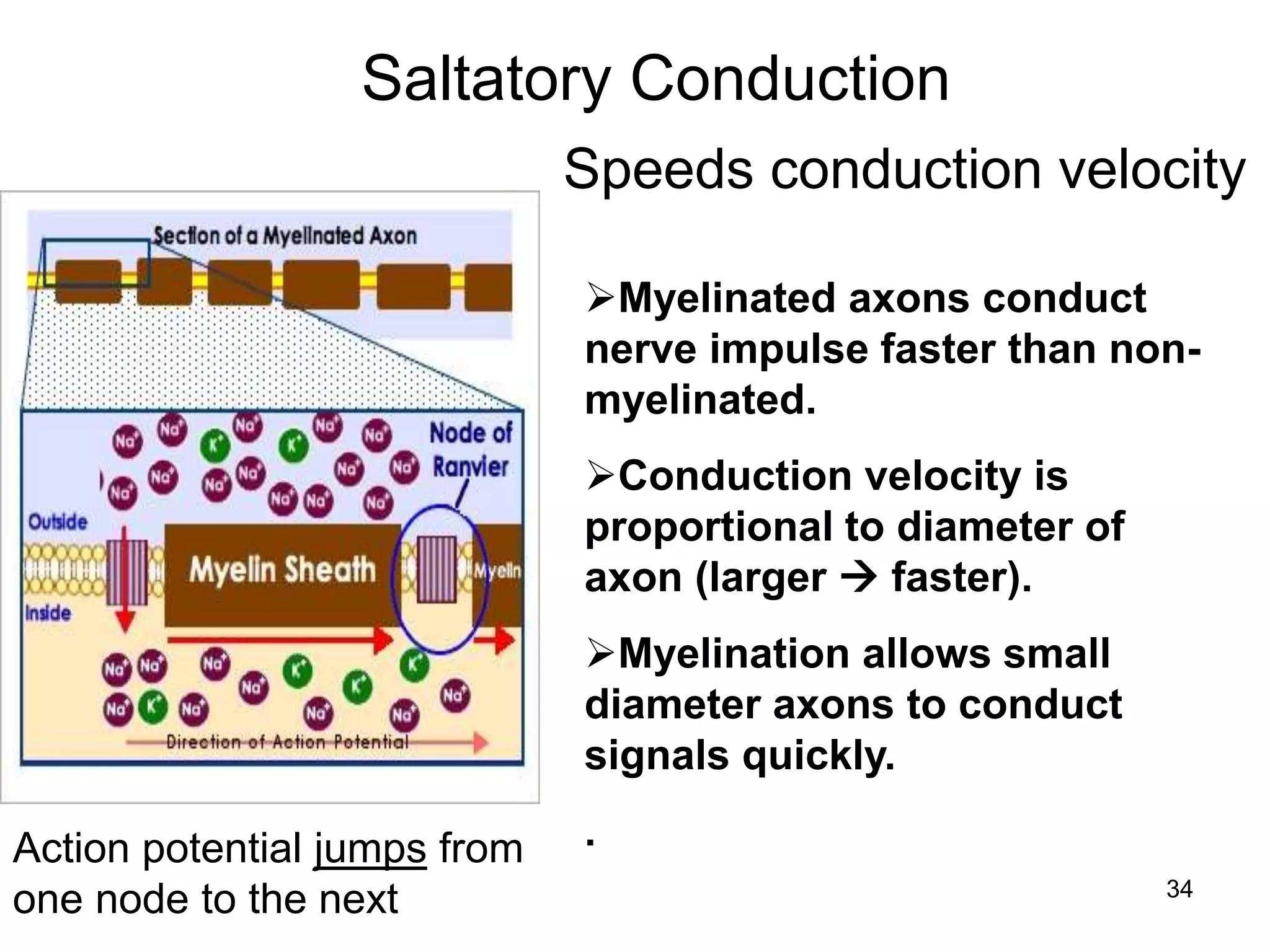
Myelinated axons conduct
nerve impulse faster than non-
myelinated.
Conduction velocity is
proportional to diameter of
axon (larger  faster).
Myelination allows small
diameter axons to conduct
signals quickly.
.
Saltatory Conduction
Action potential jumps from
one node to the next
Speeds conduction velocity
34
– one node of Ranvier depolarizes the next,
so that action potentials can skip between
nodes
35
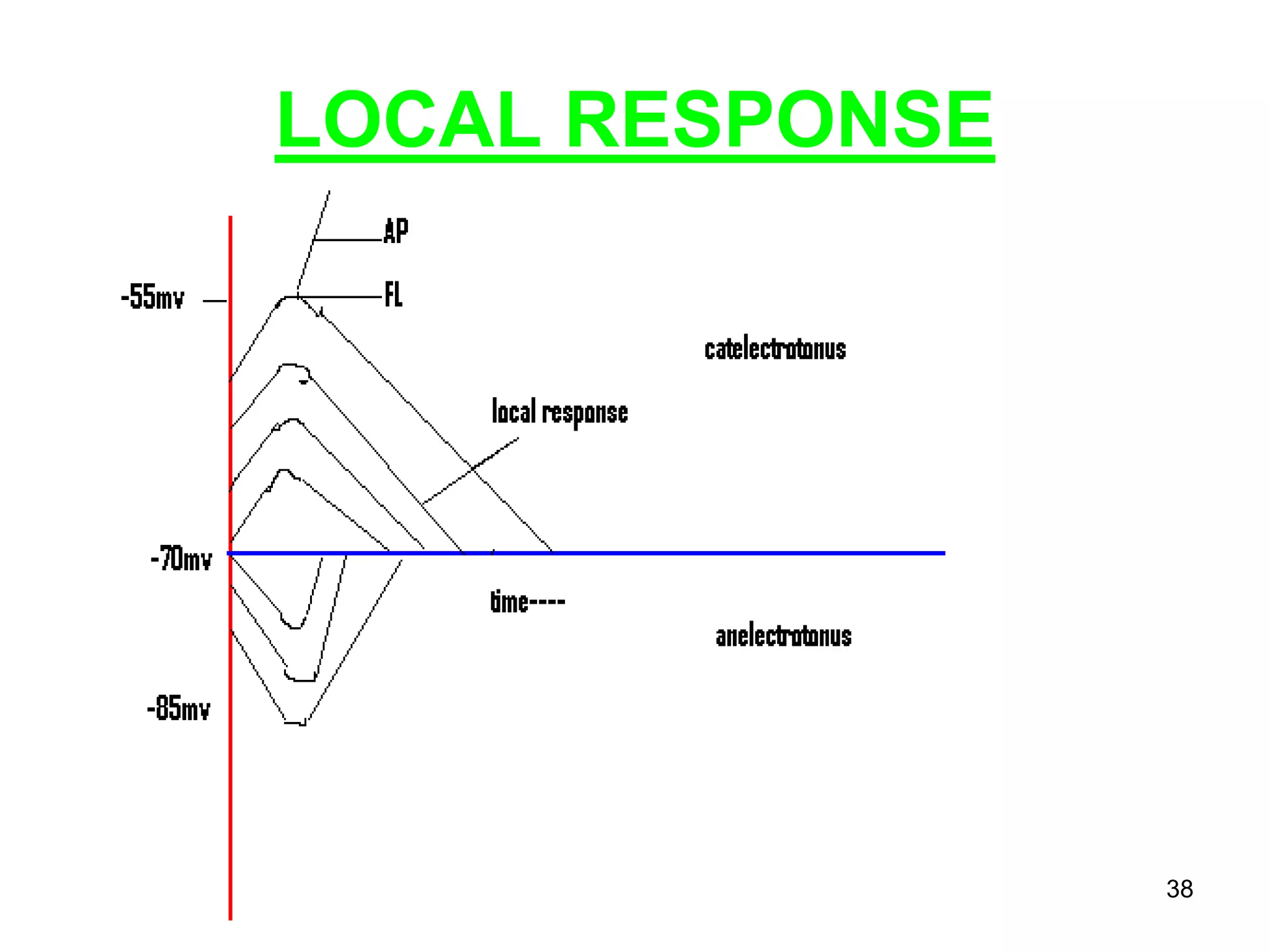
36
A “Nerve impulse” consists
of two components:
a local potential
and
an action potential
37
LOCAL RESPONSE
38
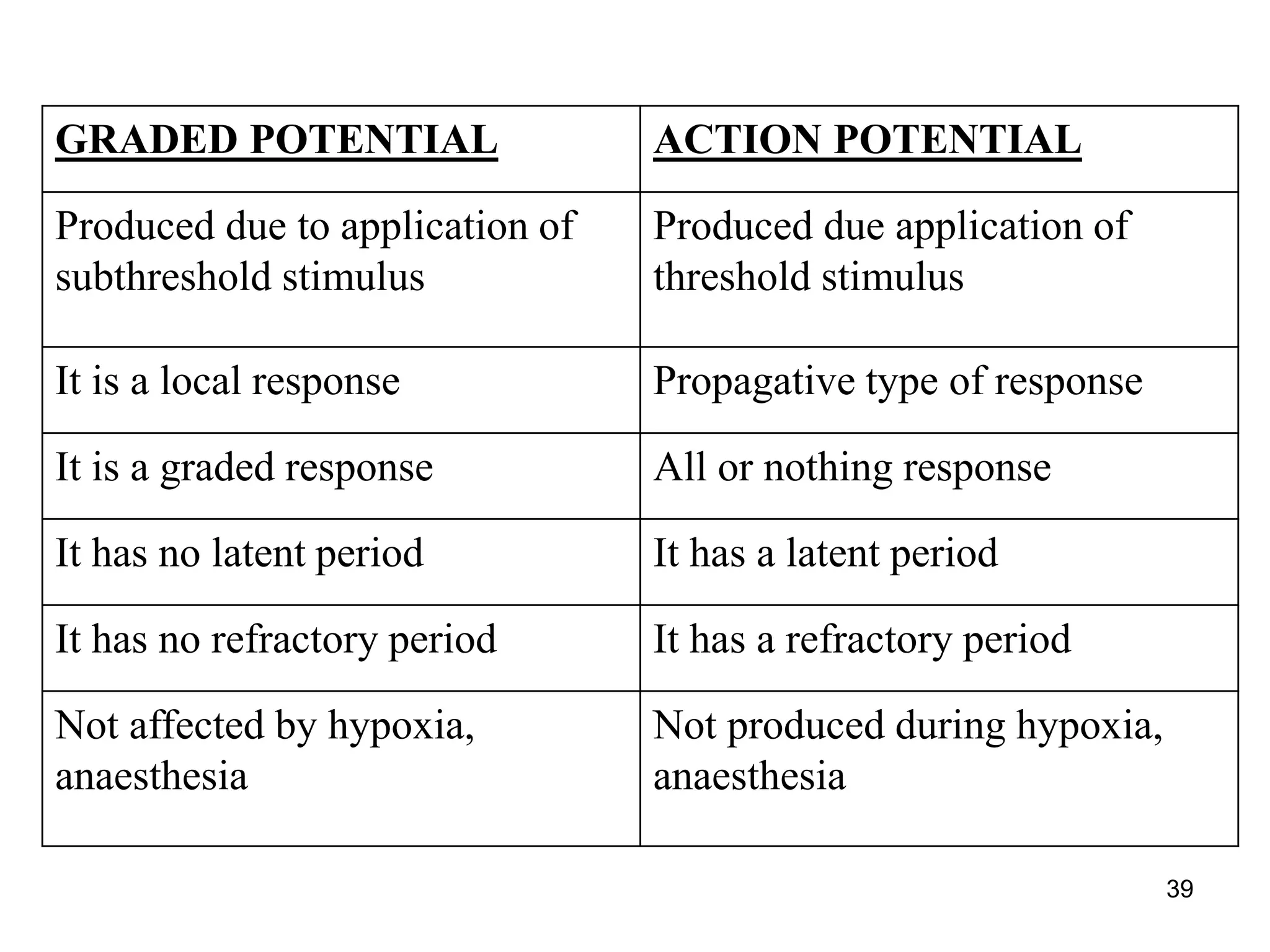
GRADED POTENTIAL ACTION POTENTIAL
Produced due to application of
subthreshold stimulus
Produced due application of
threshold stimulus
It is a local response Propagative type of response
It is a graded response All or nothing response
It has no latent period It has a latent period
It has no refractory period It has a refractory period
Not affected by hypoxia,
anaesthesia
Not produced during hypoxia,
anaesthesia
39
DEGENERATION
AND
REGENERATION
OF
NERVE FIBERS
40
• When the axon of the neuron is injured,
a series of degenerative changes are
seen at three levels
In the axon distal to the site of injury
In the axon proximal to injury
In the cell body
41
Common causes of injury
• Transections
• Crushing of nerve fibers
• Local injection of toxic substance
• Ischemia due to obstruction of blod flow
42
SUNDERLAND had graded the injury of
• First degree injury- transient loss of
function (mild pressure)
• Second degree injury – severe nerve
damage with intact endometrial tube
• Third degree injury – endoneural tube is
degenerated
• Fourth degree injury- Fasciculi
disorganized
• Fifth degree injury- Nerve trunk is cut 43
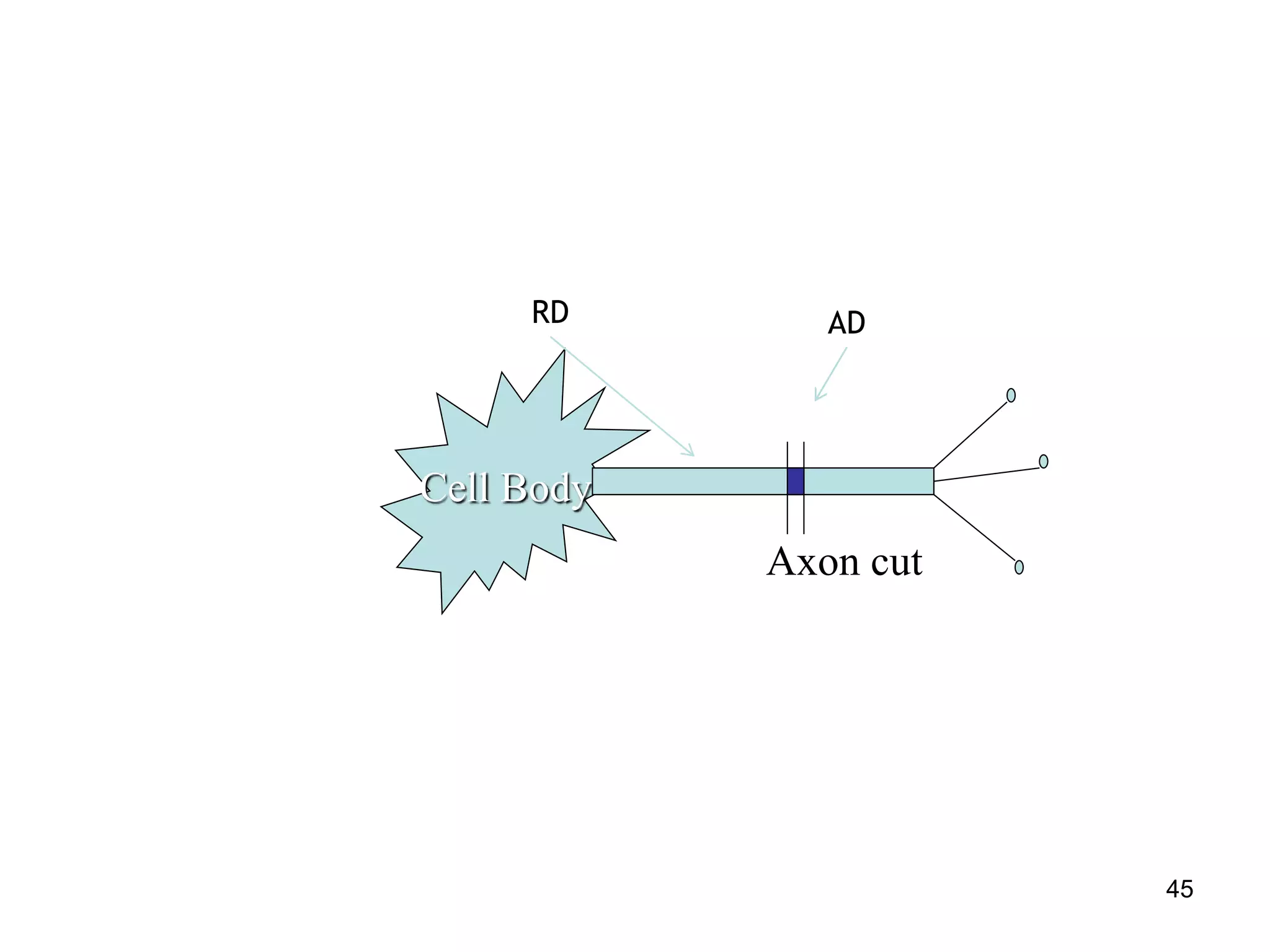
• The degenerative changes which occur in the
part of axon distal to the site of injury are
referred as anterogade degeneration or
wallerian degeneration
• The degenerative changes occurring in the
neuron proximal to the injury are referred as
retrograde degeneration . These changes
takes place in the cell body and the axon
proximal to the injury
44
Cell Body
Axon cut
ADRD
45
• The degenerative changes
start within few hours of
injury and continue for about
3 months
46
CHANGES IN THE PART OF THE AXON DISTAL
TO INJURY
• Axis cylinder becomes swollen and breaks
up into small pieces
• After few days, the broken pieces appear as
debris in the space occupied by the axis
cylinder
• The myelin sheath slowly disintegrates into
fat droplets (8th to 35 day)
• Neurilemmal sheath is unaffected 47
• Schwann cell multiply rapidly
• The macrophages remove the debris of
axis cylinder and the fat droplets of
disintegrated myelin sheath
• Neurilemmal tube becomes empty
• Changes takes place for about 2 months
from day of injury
48
Changes in the action
potential and the ability of
the nerve to conduct an
impulse decreases
markedly.
49
Changes in the cell bodyCHANGES IN THE CELL BODY OF THE
NEURON (start within 48 hours and
continue for 15-20 days)
 Nissl substances undergo disintegration
and dissolution (chromatolysis)
 Golgi apparatus, mitochondria and
neurofibrils are fragmented and
eventually disappear
50
Changes in the cell body
Cell body draws in more fluid, enlarges
and become spherical
 Nucleus is displaced to the periphery ,
sometimes extruded out of the cell
51
52
 FACTORS AFFECTING REGENERATION
 1. Chances of regeneration are considerably
increased if the two cut ends are near each
other (gap does not exceed 3mm)
2. Presence of neurilemma is a must
3. Presence of nucleus I the neuron cell
body is also must
53
REGENERATION IN
PERIPHERAL NERVES
 Recovery in the nerve cell body begins in 20days
and is completed in 80days.
 Changes in the distal stump and at site of injury.
 (i) Axis cylinder from the proximal stump elongates
and then grows out in all directions.
 (ii) Initial rate of growth 0.25mm/day but once it
enters the distal stump, it becomes 3-4mm/day.
54
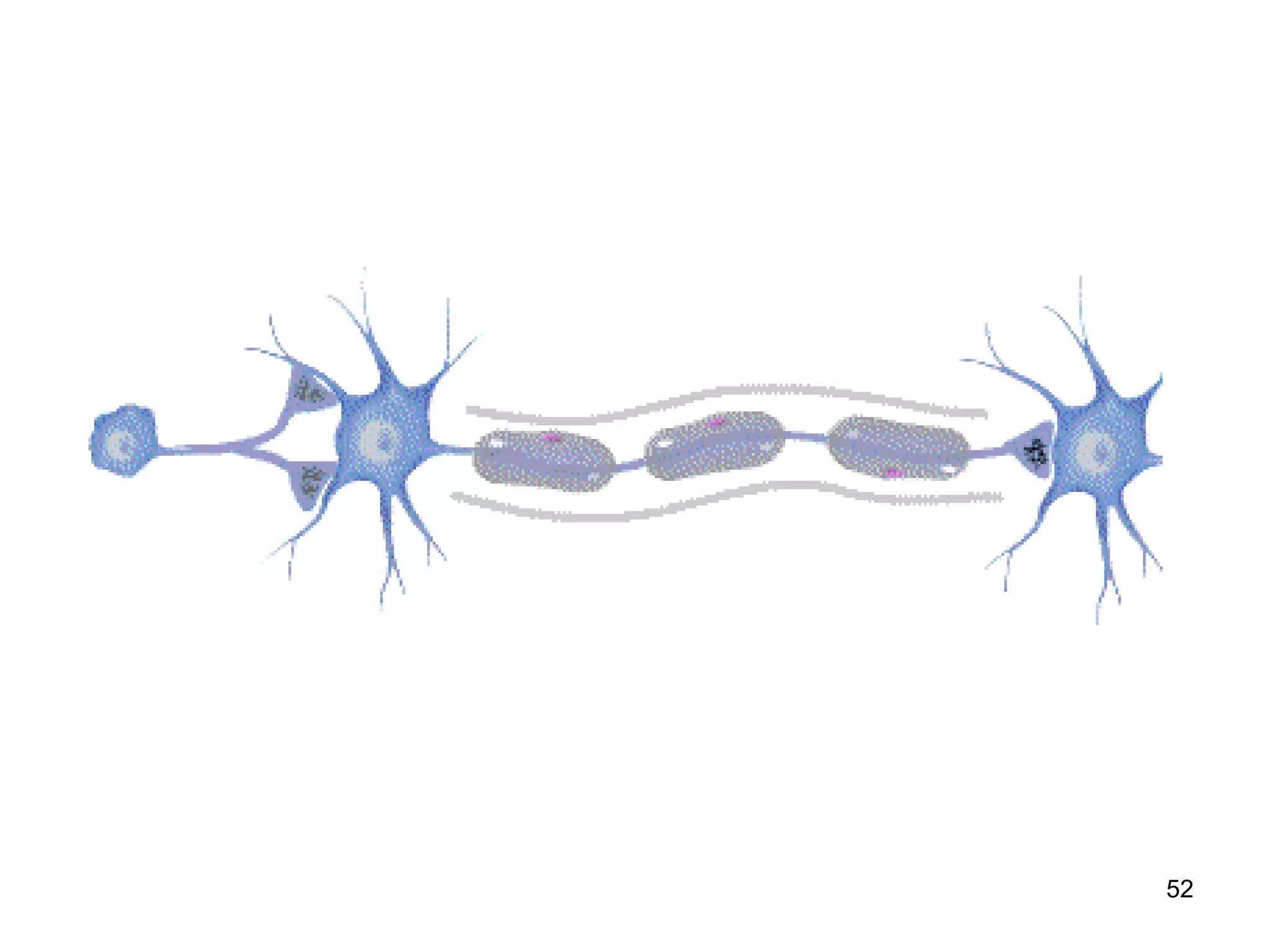
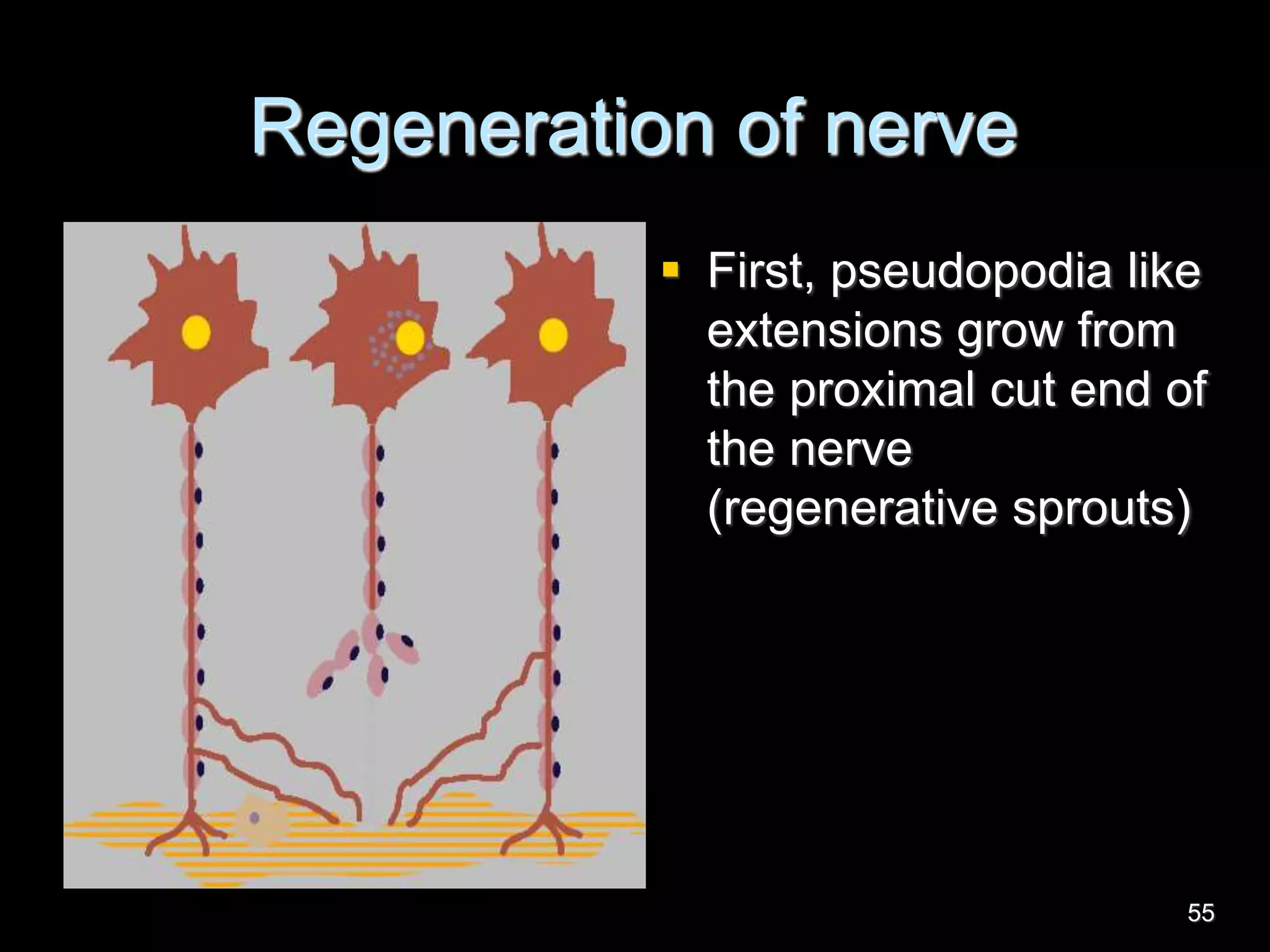
Regeneration of nerve
 First, pseudopodia like
extensions grow from
the proximal cut end of
the nerve
(regenerative sprouts)
55
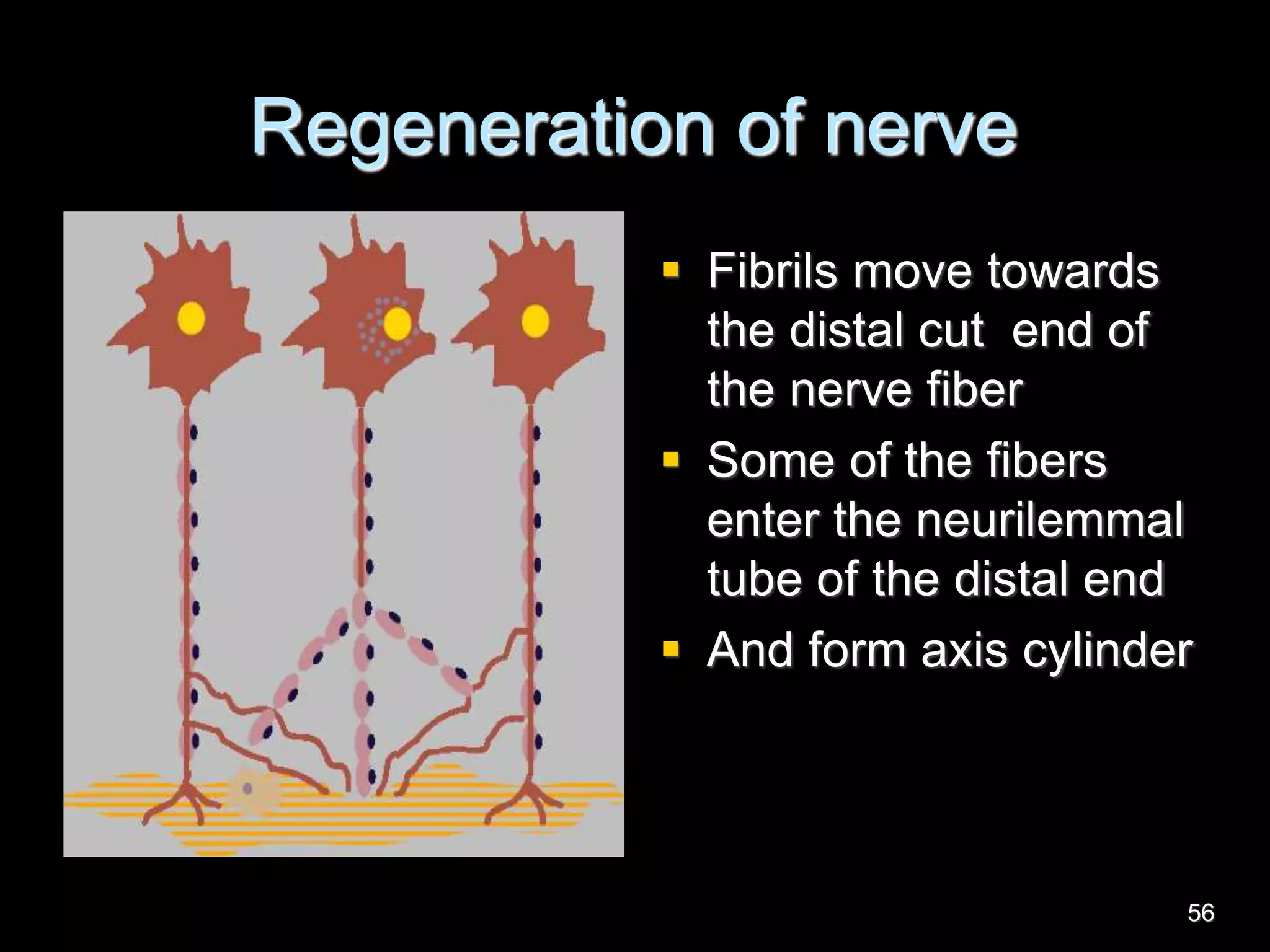
Regeneration of nerve
 Fibrils move towards
the distal cut end of
the nerve fiber
 Some of the fibers
enter the neurilemmal
tube of the distal end
 And form axis cylinder
56
 In about 15 days, schwann cell starts laying down
myelin sheath round the successful fibril, which is
completed within one year.
 In the nerve cell body , first the nissl granules
appear followed by golgi apparatus
 cell looses excess fluid .
 The nucleus occupies the central portion
 Though anatomical regeneration occur the
functional recovery occurs after long period
57
58
Thank you………
59

NERVE PHYSIOLOGY- CLASSIFICATION & PROPERTIES OF NERVE FIBERS

  • 1.
    CLASSIFICATION & PROPERTIES OFNERVE FIBERS DR. NABEEL BEERAN MBBS, MD DEPARTMENT OF PHYSIOLOGY, YMC 1
  • 2.
  • 3.
    Depending upon structure:  Myelinated Nerve Fibres  Un Myelinated Nerve Fibres Depending upon distribution:  Somatic- supply skeletal muscles  Visceral /autonomic nerve fiber 3
  • 4.
    Depending upon origin: Cranial nerves  Spinal nerves Depending upon function:  Motor nerve fibers  Sensory nerve fibers 4
  • 5.
    Erlanger and Gasserclassification According to diameter & conduction velocity of impulse 5
  • 6.
  • 7.
    Physio - clinicalclassification 7
  • 8.
  • 9.
  • 10.
  • 11.
    PROPERTIES OF NERVEFIBER 1. EXCITABILITY 2. CONDUCTIVITY 3. ALL OR NONE LAW 4. REFRACTORY PERIOD 11
  • 12.
    EXCITABILITY It’s the abilityof a cell to produce action potential in response to a stimulus. 12
  • 13.
    Stimulus – A changein environment which brings about a change in potential across a membrane in an excitable tissue 13
  • 14.
    Types of stimuli Electrical  Chemical  Thermal  Mechanical 14
  • 15.
    Depending on thestrength of stimulus  Minimal (threshold)  Subliminal  Sub-maximal  Maximal 15
  • 16.
  • 17.
    RHEOBASE- minimum strength(voltage) of stimulus which can excite the tissue, whatever may be the duration of the stimulus UTILIZATION TIME- Minimum time required for a rheobasic current (threshold strength) to excite the tissue. CHRONAXIE- Minimum time at which the stimulus with double the rheobasic strength (Voltage) can excite the tissue. 17
  • 18.
    Chronaxie  Is anindex of excitability of a tissue  Can be used to compare the excitability of the various tissues Longer the chronaxie lesser is the excitability 18
  • 19.
    Factors affecting Excitability 1)Temperature 2) Mechanical pressure 3) Blood supply 4) Chemicals- CO2 & narcotics 5) pH- increased excitability in alkaline and reduced excitability in acidic media. 6) Ions- Na+, Mg++ and K+ are neuro- excitatory and Ca++ is neurosedative 19
  • 20.
    Nerve and muscleare excitable Capable of self-generation of electrochemical impulses at their membrane Transmit signals along the membrane 20
  • 21.
    CONDUCTIVITY  Ability toconduct an impulse is called Conductivity. TWO TYPES:  Orthodromic conduction  Antidromic conduction 21
  • 22.
    Factors affecting Conductivity Temperature  Mechanical pressure  Blood supply  Chemicals  pH  Ions  Size of the nerve  Myelination 22
  • 23.
  • 24.
    ALL OR NONERESPONSE A single nerve fiber obeys “all or none law” When stimulus of sub-threshold intensity is applied to the axon , then no action potential is produced (NONE RESPONSE) A response in the spike of action potential is observed when the stimulus if of threshold intensity There occurs no increase in the magnitude of action potential when the strength of stimulus is more than the threshold level (ALL RESPONSE) 24
  • 25.
    REFRACTORY PERIOD The periodof time during which an excitable cell cannot generate another action potential is called the refractory period. 25
  • 26.
    1) Absolute refractoryperiod-  it is the period during an action potential, during which a second stimulus can’t produce a second response.  period of action potential from firing level until repolarization is almost 1/3rd complete (spike potential) 26
  • 27.
    2) Relative refractoryperiod-  it is the period during an action potential, during which a stimulus of higher intensity can produce a second response  It extends FROM the end of absolute refractory period to the start of after depolarization phase of action potential 27
  • 28.
  • 29.
    CONDUCTION OF IMPULSESIN THE NERVE FIBRE • Unmyelinated neurons undergo the Continuous conduction of an AP. • Myelinated neurons undergo Saltatory conduction of an AP. 29
  • 30.
  • 31.
  • 32.
    • There aretwo advantages of saltatory conduction. 1.Energy is saved as sodium-potassium pumps are only required at specific points along the axon. 2. Conduction of an action potential is much faster within a myelinated axon (around 120 m/sec as opposed to around 35 m/sec) in unmyelinated ones. 32
  • 33.
  • 34.
    Myelinated axons conduct nerveimpulse faster than non- myelinated. Conduction velocity is proportional to diameter of axon (larger  faster). Myelination allows small diameter axons to conduct signals quickly. . Saltatory Conduction Action potential jumps from one node to the next Speeds conduction velocity 34
  • 35.
    – one nodeof Ranvier depolarizes the next, so that action potentials can skip between nodes 35
  • 36.
  • 37.
    A “Nerve impulse”consists of two components: a local potential and an action potential 37
  • 38.
  • 39.
    GRADED POTENTIAL ACTIONPOTENTIAL Produced due to application of subthreshold stimulus Produced due application of threshold stimulus It is a local response Propagative type of response It is a graded response All or nothing response It has no latent period It has a latent period It has no refractory period It has a refractory period Not affected by hypoxia, anaesthesia Not produced during hypoxia, anaesthesia 39
  • 40.
  • 41.
    • When theaxon of the neuron is injured, a series of degenerative changes are seen at three levels In the axon distal to the site of injury In the axon proximal to injury In the cell body 41
  • 42.
    Common causes ofinjury • Transections • Crushing of nerve fibers • Local injection of toxic substance • Ischemia due to obstruction of blod flow 42
  • 43.
    SUNDERLAND had gradedthe injury of • First degree injury- transient loss of function (mild pressure) • Second degree injury – severe nerve damage with intact endometrial tube • Third degree injury – endoneural tube is degenerated • Fourth degree injury- Fasciculi disorganized • Fifth degree injury- Nerve trunk is cut 43
  • 44.
    • The degenerativechanges which occur in the part of axon distal to the site of injury are referred as anterogade degeneration or wallerian degeneration • The degenerative changes occurring in the neuron proximal to the injury are referred as retrograde degeneration . These changes takes place in the cell body and the axon proximal to the injury 44
  • 45.
  • 46.
    • The degenerativechanges start within few hours of injury and continue for about 3 months 46
  • 47.
    CHANGES IN THEPART OF THE AXON DISTAL TO INJURY • Axis cylinder becomes swollen and breaks up into small pieces • After few days, the broken pieces appear as debris in the space occupied by the axis cylinder • The myelin sheath slowly disintegrates into fat droplets (8th to 35 day) • Neurilemmal sheath is unaffected 47
  • 48.
    • Schwann cellmultiply rapidly • The macrophages remove the debris of axis cylinder and the fat droplets of disintegrated myelin sheath • Neurilemmal tube becomes empty • Changes takes place for about 2 months from day of injury 48
  • 49.
    Changes in theaction potential and the ability of the nerve to conduct an impulse decreases markedly. 49
  • 50.
    Changes in thecell bodyCHANGES IN THE CELL BODY OF THE NEURON (start within 48 hours and continue for 15-20 days)  Nissl substances undergo disintegration and dissolution (chromatolysis)  Golgi apparatus, mitochondria and neurofibrils are fragmented and eventually disappear 50
  • 51.
    Changes in thecell body Cell body draws in more fluid, enlarges and become spherical  Nucleus is displaced to the periphery , sometimes extruded out of the cell 51
  • 52.
  • 53.
     FACTORS AFFECTINGREGENERATION  1. Chances of regeneration are considerably increased if the two cut ends are near each other (gap does not exceed 3mm) 2. Presence of neurilemma is a must 3. Presence of nucleus I the neuron cell body is also must 53
  • 54.
    REGENERATION IN PERIPHERAL NERVES Recovery in the nerve cell body begins in 20days and is completed in 80days.  Changes in the distal stump and at site of injury.  (i) Axis cylinder from the proximal stump elongates and then grows out in all directions.  (ii) Initial rate of growth 0.25mm/day but once it enters the distal stump, it becomes 3-4mm/day. 54
  • 55.
    Regeneration of nerve First, pseudopodia like extensions grow from the proximal cut end of the nerve (regenerative sprouts) 55
  • 56.
    Regeneration of nerve Fibrils move towards the distal cut end of the nerve fiber  Some of the fibers enter the neurilemmal tube of the distal end  And form axis cylinder 56
  • 57.
     In about15 days, schwann cell starts laying down myelin sheath round the successful fibril, which is completed within one year.  In the nerve cell body , first the nissl granules appear followed by golgi apparatus  cell looses excess fluid .  The nucleus occupies the central portion  Though anatomical regeneration occur the functional recovery occurs after long period 57
  • 58.
  • 59.