Gastric Cancer
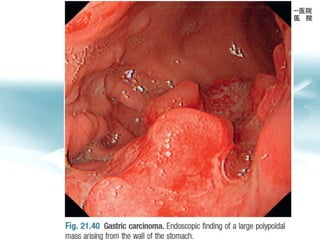
Gastric carcinoma is the third leading cause of cancer death
•worldwide but there is marked geographical variation in incidence.
•It is most common in China, Japan, Korea (incidence 40/100
000 males), Eastern Europe ,middle east & parts of South
America (20/100 000).
•In most countries, the incidence is 50% lower in women. I
•n both sexes, it rises sharply after 50 years of age.
•The overall prognosis is poor, with less than 30% surviving 5
years
•The best hope for improved survival lies in more efficient
detection
•of tumours at an earlier stage through proper management
of dyspepsia by doing endoscopy if the patients is middle
age or red flags( anorexia,weight loss,
dysphagia,hematemesis or melena,IDA,family H/O GC.
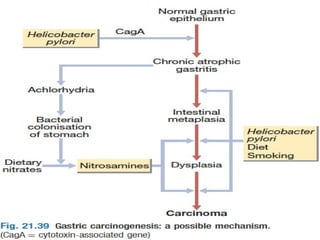
• H. pylori infection may contribute to GC in 70% of cases.
• H. pylori eradication, especially before irreversible pre-
neoplastic changes (atrophy &intestinal metaplasia) have
developed, reduces the risk of cancer development in high-
risk populations & is cost-effective.
• Cancer risk is increased two- to threefold in first-degree
relatives of patients,&links with blood group A reported.
Some host genetic factors related to inflammatory
genes&stem cell antigen associated with increased risk.
Rarely, gastric cancer may be inherited in an autosomal
dominant manner in association with mutations of the E-
cadherin (CDH1) gene.
Risk factors:
•Helicobacter pylori
• Smoking
• Alcohol
• Dietary associations (see text)
• Autoimmune gastritis (pernicious anaemia)
• Adenomatous gastric polyps
• Previous partial gastrectomy (> 20 years)
• Ménétrier’s disease
• Hereditary diffuse gastric cancer families (CDH1 mutations)
• Familial adenomatous polyposis
Clinical features:
Early gastric cancer is usually asymptomatic but may be
discovered during endoscopy for investigation of dyspepsia.
Two-thirds with advanced cancers have weight loss
50% have ulcer-like pain. A
Anorexia / nausea occur in one-third, while early
satiety, haematemesis, melaena & dyspepsia alone are less
common.
Dysphagia occurs in tumours of the gastric cardia that
obstruct GEJ.
Anaemia from occult bleeding is also common.
Clin exam:
•Examination may reveal no abnormalities but signs of
weight loss, anaemia & a palpable epigastric mass are not
infrequent.
•Jaundice or ascites signifies metastatic spread.
•Occasionally, tumour spread occurs to the supraclavicular
lymph nodes (Troisier’s sign), umbilicus (Sister Joseph’s
nodule) or ovaries (Krukenberg tumour).
•Paraneoplastic phenomena, such as acanthosis nigricans,
thrombophlebitis (Trousseau’s sign) ,dermatomyositis, occur
rarely.
•Metastases arise most commonly in the liver, lungs,
peritoneum & bone marrow.
Investigations:
•Upper GI endoscopy is the investigation of choice&should
be performed promptly in any dyspeptic patient with ‘alarm
features.
•Multiple biopsies from the edge & base of a gastric ulcer are
required.
•Barium meal is a poor alternative, since any abnormalities
must be followed by endoscopy / biopsy.
•Once the diagnosis is made, further imaging is necessary for
staging and assessment of resectability.
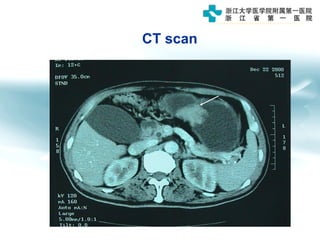
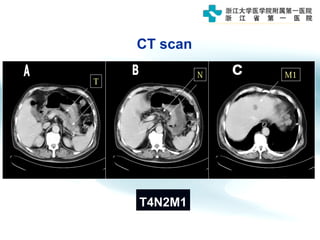
•CT will provide evidence of intra-abd spread or liver mets.
•Even with these techniques, laparoscopy with peritoneal
washings is required to determine whether the tumour is
resectable, as it is the only modality that will reliably detect
peritoneal spread.
Management : surgery
•Resection offers the only hope of cure &can be achieved in
90% of patients with EGC.
•For the majority of patients with locally advanced disease,
total gastrectomy with lymphadenectomy is the operation of
choice, preserving the spleen if possible.
•Proximal tumours involving GEJ also require a distal
oesophagectomy + total gastrectomy.
•Small, distally sited tumours can be managed by a partial
gastrectomy with lymphadenectomy & Billroth I or a Roux en
Y GJ reconstruction.
•More extensive lymph node resection may increase
•survival rates but carries greater morbidity.
•If cannot be cured, palliative resection necessary for
bleeding or GOO.
Management:surgery
•Following surgery, recurrence is much more likely if serosal
penetration has occurred, although complete removal of all
macroscopic tumour combined with lymphadenectomy will
achieve a 50–60% 5-year survival.
•Perioperative chemotherapy with epirubicin, cisplatin&
fluorouracil (ECF) improves survival rates.
Palliative treatment
•In inoperable tumours, survival can be improved& palliation
of symptoms achieved with chemotherapy using
•5-fluorouracil , cisplatin, ECF or other platinum & taxane-
based regimens.
•The biological agent trastuzumab may benefit some patients
whose tumours over-express HER2.
•Endoscopic laser ablation for control of dysphagia or
recurrent bleeding benefits some patients.
•Carcinomas at the cardia or pylorus may require endoscopic
dilatation or insertion of expandable metallic stents for relief
of dysphagia or vomiting.
•A nasogastric tube may offer temporary relief of vomiting
due to gastric outlet obstruction.
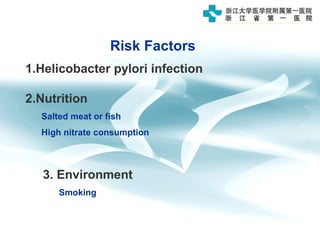
Risk Factors
1.Helicobacter pylori infection
2.Nutrition
Salted meat or fish
High nitrate consumption
3. Environment
Smoking
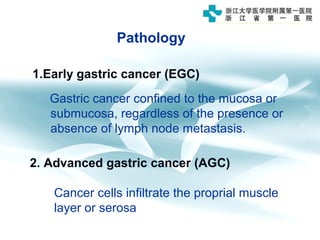
Pathology
1.Early gastric cancer (EGC)
Gastric cancer confined to the mucosa or
submucosa, regardless of the presence or
absence of lymph node metastasis.
2. Advanced gastric cancer (AGC)
Cancer cells infiltrate the proprial muscle
layer or serosa
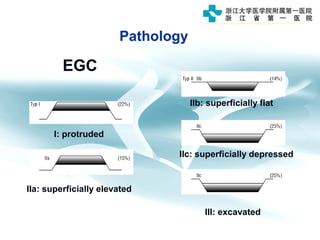
EGC
Pathology
I: protruded
IIa: superficially elevated
IIc: superficially depressed
IIb: superficially flat
III: excavated
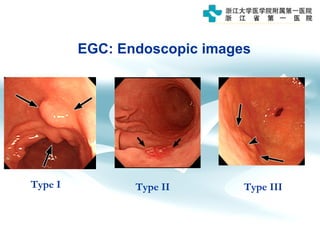
EGC: Endoscopic images
Type I Type II Type III
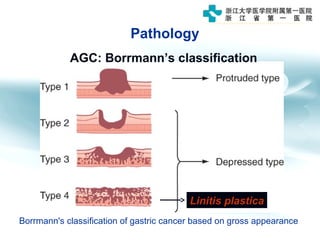
Pathology
Borrmann's classification of gastric cancer based on gross appearance
AGC: Borrmann’s classification
Linitis plastica
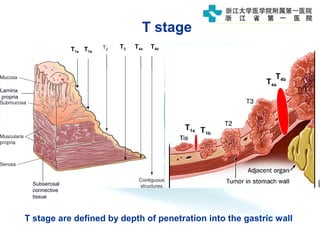
T stage are defined by depth of penetration into the gastric wall
Lamina
propria
T1a T1b
T4a T4bT3
Subserosal
connective
tissue
T1b
T1a
T4a
T4b
T stage
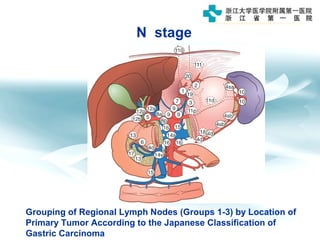
Grouping of Regional Lymph Nodes (Groups 1-3) by Location of
Primary Tumor According to the Japanese Classification of
Gastric Carcinoma
N stage
Metastesis
Direct invasion
Lyphmatic metastesis
Hematogenous metastasis
Seeding metastasis
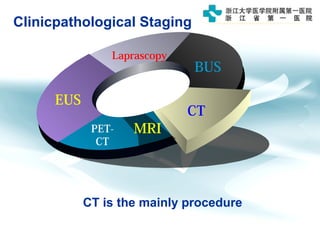
Clinicpathological Staging
EUS
Laprascopy
BUS
CT
PET-
CT
CT is the mainly procedure
MRI
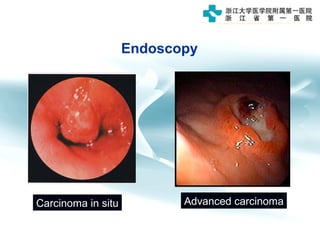
Endoscopy
Carcinoma in situ Advanced carcinoma
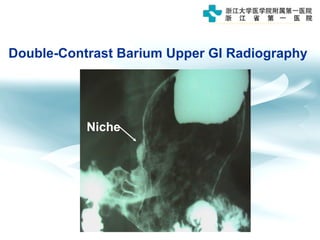
Niche
Double-Contrast Barium Upper GI Radiography
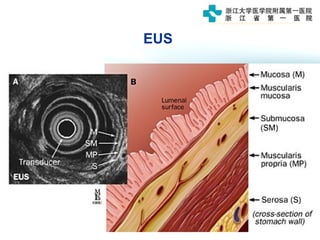
EUS
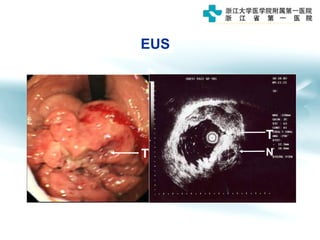
EUS
T
T
N
CT scan
T
N M1
T4N2M1
CT scan
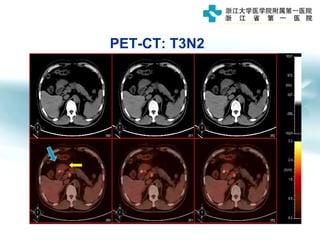
PET-CT: T3N2
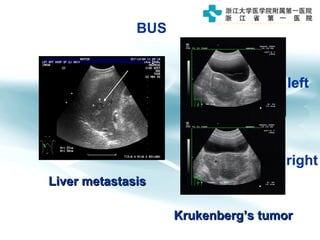
BUS
Liver metastasisLiver metastasis
KrukenbergKrukenberg’s tumor’s tumor
left
right
T
T
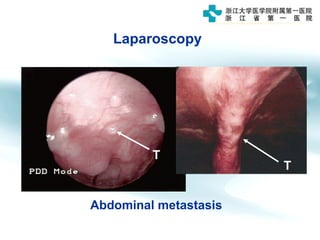
Laparoscopy
Abdominal metastasis
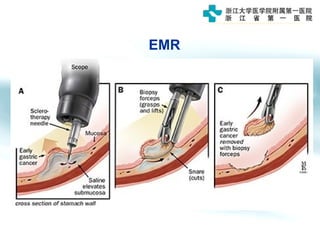
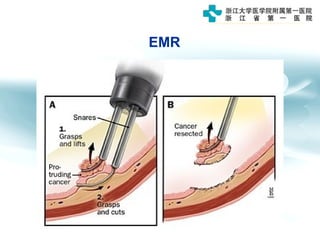
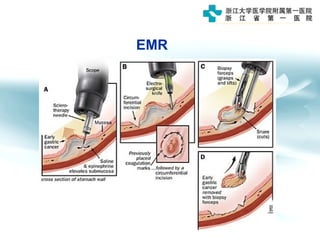
EMR for Earlier gastric cancer (EGC )
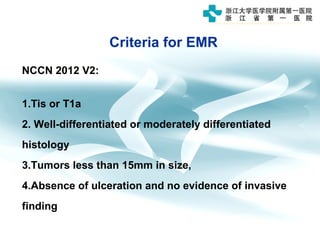
Criteria for EMR
NCCN 2012 V2:
1.Tis or T1a
2. Well-differentiated or moderately differentiated
histology
3.Tumors less than 15mm in size,
4.Absence of ulceration and no evidence of invasive
finding
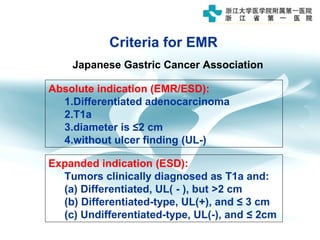
Criteria for EMR
Absolute indication (EMR/ESD):
1.Differentiated adenocarcinoma
2.T1a
3.diameter is ≤2 cm
4.without ulcer finding (UL-)
Japanese Gastric Cancer Association
Expanded indication (ESD):
Tumors clinically diagnosed as T1a and:
(a) Differentiated, UL( - ), but >2 cm
(b) Differentiated-type, UL(+), and ≤ 3 cm
(c) Undifferentiated-type, UL(-), and ≤ 2cm
EMR
EMR
EMR
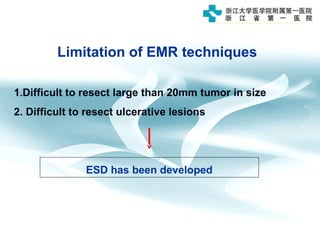
1.Difficult to resect large than 20mm tumor in size
2. Difficult to resect ulcerative lesions
Limitation of EMR techniques
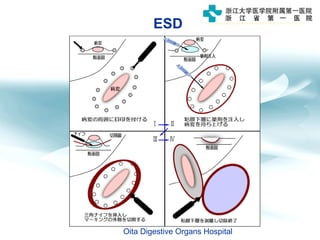
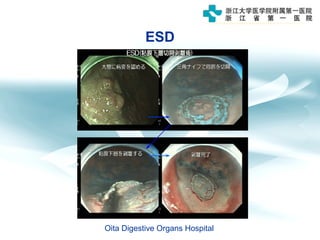
ESD has been developed
ESD for Earlier gastric cancer (EGC )
ESD
Oita Digestive Organs Hospital
ESD
Oita Digestive Organs Hospital

Git 4th GC18.

  • 1.
  • 2.
    Gastric carcinoma isthe third leading cause of cancer death •worldwide but there is marked geographical variation in incidence. •It is most common in China, Japan, Korea (incidence 40/100 000 males), Eastern Europe ,middle east & parts of South America (20/100 000). •In most countries, the incidence is 50% lower in women. I •n both sexes, it rises sharply after 50 years of age. •The overall prognosis is poor, with less than 30% surviving 5 years •The best hope for improved survival lies in more efficient detection •of tumours at an earlier stage through proper management of dyspepsia by doing endoscopy if the patients is middle age or red flags( anorexia,weight loss, dysphagia,hematemesis or melena,IDA,family H/O GC.
  • 4.
    • H. pyloriinfection may contribute to GC in 70% of cases. • H. pylori eradication, especially before irreversible pre- neoplastic changes (atrophy &intestinal metaplasia) have developed, reduces the risk of cancer development in high- risk populations & is cost-effective. • Cancer risk is increased two- to threefold in first-degree relatives of patients,&links with blood group A reported. Some host genetic factors related to inflammatory genes&stem cell antigen associated with increased risk. Rarely, gastric cancer may be inherited in an autosomal dominant manner in association with mutations of the E- cadherin (CDH1) gene.
  • 5.
    Risk factors: •Helicobacter pylori •Smoking • Alcohol • Dietary associations (see text) • Autoimmune gastritis (pernicious anaemia) • Adenomatous gastric polyps • Previous partial gastrectomy (> 20 years) • Ménétrier’s disease • Hereditary diffuse gastric cancer families (CDH1 mutations) • Familial adenomatous polyposis
  • 6.
    Clinical features: Early gastriccancer is usually asymptomatic but may be discovered during endoscopy for investigation of dyspepsia. Two-thirds with advanced cancers have weight loss 50% have ulcer-like pain. A Anorexia / nausea occur in one-third, while early satiety, haematemesis, melaena & dyspepsia alone are less common. Dysphagia occurs in tumours of the gastric cardia that obstruct GEJ. Anaemia from occult bleeding is also common.
  • 7.
    Clin exam: •Examination mayreveal no abnormalities but signs of weight loss, anaemia & a palpable epigastric mass are not infrequent. •Jaundice or ascites signifies metastatic spread. •Occasionally, tumour spread occurs to the supraclavicular lymph nodes (Troisier’s sign), umbilicus (Sister Joseph’s nodule) or ovaries (Krukenberg tumour). •Paraneoplastic phenomena, such as acanthosis nigricans, thrombophlebitis (Trousseau’s sign) ,dermatomyositis, occur rarely. •Metastases arise most commonly in the liver, lungs, peritoneum & bone marrow.
  • 8.
    Investigations: •Upper GI endoscopyis the investigation of choice&should be performed promptly in any dyspeptic patient with ‘alarm features. •Multiple biopsies from the edge & base of a gastric ulcer are required. •Barium meal is a poor alternative, since any abnormalities must be followed by endoscopy / biopsy. •Once the diagnosis is made, further imaging is necessary for staging and assessment of resectability. •CT will provide evidence of intra-abd spread or liver mets. •Even with these techniques, laparoscopy with peritoneal washings is required to determine whether the tumour is resectable, as it is the only modality that will reliably detect peritoneal spread.
  • 9.
    Management : surgery •Resectionoffers the only hope of cure &can be achieved in 90% of patients with EGC. •For the majority of patients with locally advanced disease, total gastrectomy with lymphadenectomy is the operation of choice, preserving the spleen if possible. •Proximal tumours involving GEJ also require a distal oesophagectomy + total gastrectomy. •Small, distally sited tumours can be managed by a partial gastrectomy with lymphadenectomy & Billroth I or a Roux en Y GJ reconstruction. •More extensive lymph node resection may increase •survival rates but carries greater morbidity. •If cannot be cured, palliative resection necessary for bleeding or GOO.
  • 10.
    Management:surgery •Following surgery, recurrenceis much more likely if serosal penetration has occurred, although complete removal of all macroscopic tumour combined with lymphadenectomy will achieve a 50–60% 5-year survival. •Perioperative chemotherapy with epirubicin, cisplatin& fluorouracil (ECF) improves survival rates.
  • 11.
    Palliative treatment •In inoperabletumours, survival can be improved& palliation of symptoms achieved with chemotherapy using •5-fluorouracil , cisplatin, ECF or other platinum & taxane- based regimens. •The biological agent trastuzumab may benefit some patients whose tumours over-express HER2. •Endoscopic laser ablation for control of dysphagia or recurrent bleeding benefits some patients. •Carcinomas at the cardia or pylorus may require endoscopic dilatation or insertion of expandable metallic stents for relief of dysphagia or vomiting. •A nasogastric tube may offer temporary relief of vomiting due to gastric outlet obstruction.
  • 13.
    Risk Factors 1.Helicobacter pyloriinfection 2.Nutrition Salted meat or fish High nitrate consumption 3. Environment Smoking
  • 14.
    Pathology 1.Early gastric cancer(EGC) Gastric cancer confined to the mucosa or submucosa, regardless of the presence or absence of lymph node metastasis. 2. Advanced gastric cancer (AGC) Cancer cells infiltrate the proprial muscle layer or serosa
  • 15.
    EGC Pathology I: protruded IIa: superficiallyelevated IIc: superficially depressed IIb: superficially flat III: excavated
  • 16.
    EGC: Endoscopic images TypeI Type II Type III
  • 17.
    Pathology Borrmann's classification ofgastric cancer based on gross appearance AGC: Borrmann’s classification Linitis plastica
  • 18.
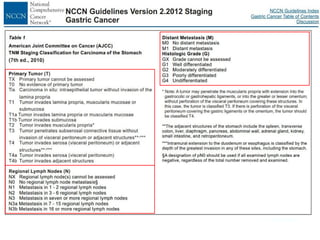
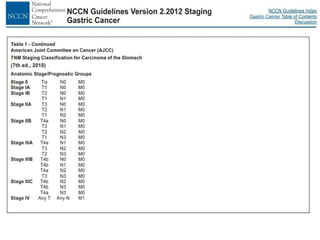
    T stage aredefined by depth of penetration into the gastric wall Lamina propria T1a T1b T4a T4bT3 Subserosal connective tissue T1b T1a T4a T4b T stage
  • 19.
    Grouping of RegionalLymph Nodes (Groups 1-3) by Location of Primary Tumor According to the Japanese Classification of Gastric Carcinoma N stage
  • 20.
  • 23.
  • 24.
    Endoscopy Carcinoma in situAdvanced carcinoma
  • 25.
  • 26.
  • 27.
  • 28.
  • 29.
  • 30.
  • 31.
  • 32.
  • 33.
    EMR for Earliergastric cancer (EGC )
  • 34.
    Criteria for EMR NCCN2012 V2: 1.Tis or T1a 2. Well-differentiated or moderately differentiated histology 3.Tumors less than 15mm in size, 4.Absence of ulceration and no evidence of invasive finding
  • 35.
    Criteria for EMR Absoluteindication (EMR/ESD): 1.Differentiated adenocarcinoma 2.T1a 3.diameter is ≤2 cm 4.without ulcer finding (UL-) Japanese Gastric Cancer Association Expanded indication (ESD): Tumors clinically diagnosed as T1a and: (a) Differentiated, UL( - ), but >2 cm (b) Differentiated-type, UL(+), and ≤ 3 cm (c) Undifferentiated-type, UL(-), and ≤ 2cm
  • 36.
  • 37.
  • 38.
  • 39.
    1.Difficult to resectlarge than 20mm tumor in size 2. Difficult to resect ulcerative lesions Limitation of EMR techniques ESD has been developed
  • 40.
    ESD for Earliergastric cancer (EGC )
  • 41.
  • 42.

Editor's Notes

  • #16 The are Five types of early gastric cancinoma:type I: protruded type,type Iia :superficially elevated type,type IIb:superficially flat type ,type IIc: superficially depressed types and type III: excavated type.
  • #17 Endoscopic images of different types early gastric carcinoma.
  • #18 Normally, the Borrmann system divides gastric carcinoma into four types depending on the lesion's macroscopic appearance. Borrmann type 1 represents polypoid or fungating lesions; type 2, ulcerating lesions surrounded by elevated borders; type 3, ulcerating lesions with infiltration into the gastric wall and type 4, diffusely infiltrating lesions.
  • #19 T stage are defined by depth of penetration into the gastrci wall, T1:Tumor invades lamina propria or submucosa, T2:Tumor invades muscularis propria or subserosa,T3: Tumor penetrates serosa (visceral peritoneum) without invasion of adjacent structures; T4: Tumor invades adjacent structures.
  • #20 This picture shows the grouping of regional lymph nodes by location of primary tumor according to the Japanese classification of gastric carcinoma.
  • #21 Gastric carcinoma can spread to other organs via at least 4 different routines, which are direct invasion ,lyphmatic metastesis,hematogenous metastasis and seeding metastasis.
  • #25 When gastric cancer is suspected based on history and physical examination, flexible upper endoscopy is the diagnostic modality of choice
  • #26 A Niche can be shown by double-contrast barium upper GI radiography in ulcerating tumor.
  • #27 EUS can detect the tumor infilltrated layer of the gastric wall.
  • #28 EUS aslo can detect the enlarged perigastric lymph nodes.
  • #32 Krukenberg‘s tumor and live metastasis are detected by peroperative B ultrasonograph.
  • #33 Diagnostic laparoscopy detected metastases on the peritoneum and round ligaments of liver
  • #34 EMR represents a major advance in minimally invasive surgery for gastric carcinoma. Indicators for EMR include well-differentiated or moderately differentiated histology,tumors less than 30mm in size,absence of ulceration and no evidence of invasive findings.
  • #35 EMR represents a major advance in minimally invasive surgery for gastric carcinoma. Indicators for EMR include well-differentiated or moderately differentiated histology,tumors less than 30mm in size,absence of ulceration and no evidence of invasive findings.
  • #41 EMR represents a major advance in minimally invasive surgery for gastric carcinoma. Indicators for EMR include well-differentiated or moderately differentiated histology,tumors less than 30mm in size,absence of ulceration and no evidence of invasive findings.