

Invasive options in palliative care Tim Bushnell
So: what do you want? Various models: tradesman?, superhero,? team member? Not all pain specialists are anaesthetists, and not all pain medicine involves anaesthetic techniques.
Coeliac Plexus Block Saddle block Epidural/spinal infusions. Superior Hypogastric Block Cordotomy Tender point injections. General comments
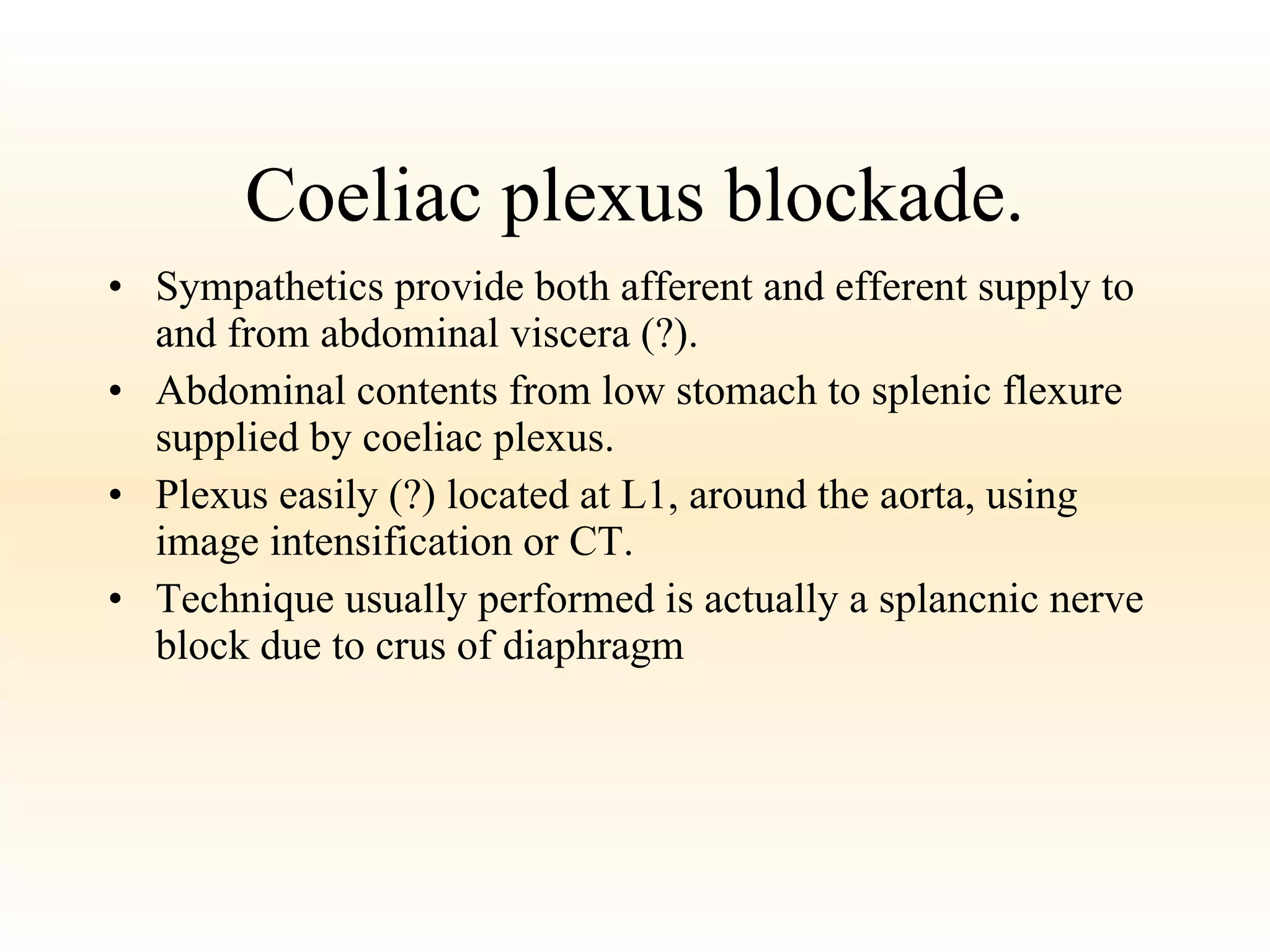
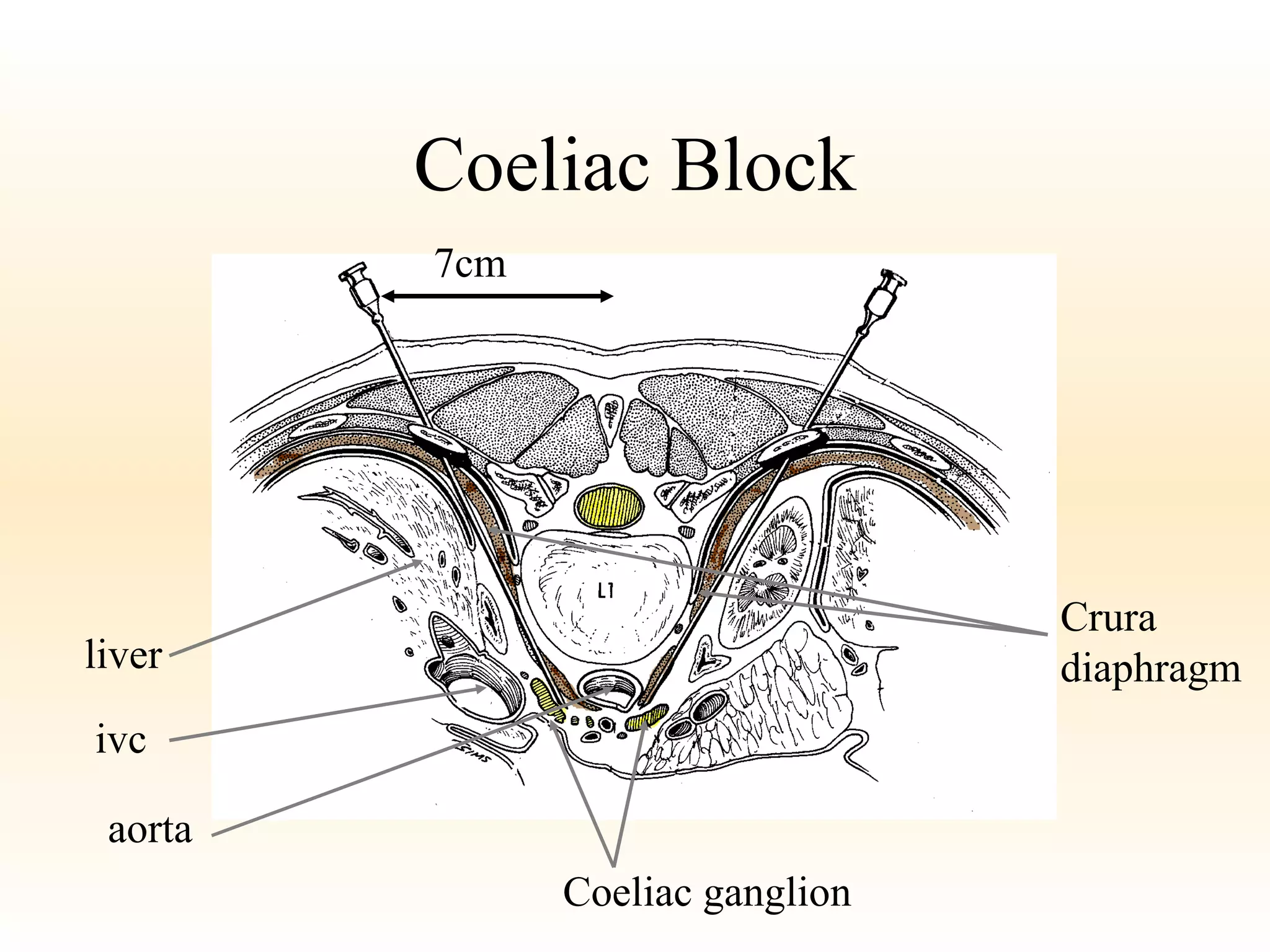
Coeliac plexus blockade. Sympathetics provide both afferent and efferent supply to and from abdominal viscera (?). Abdominal contents from low stomach to splenic flexure supplied by coeliac plexus. Plexus easily (?) located at L1, around the aorta, using image intensification or CT. Technique usually performed is actually a splancnic nerve block due to crus of diaphragm
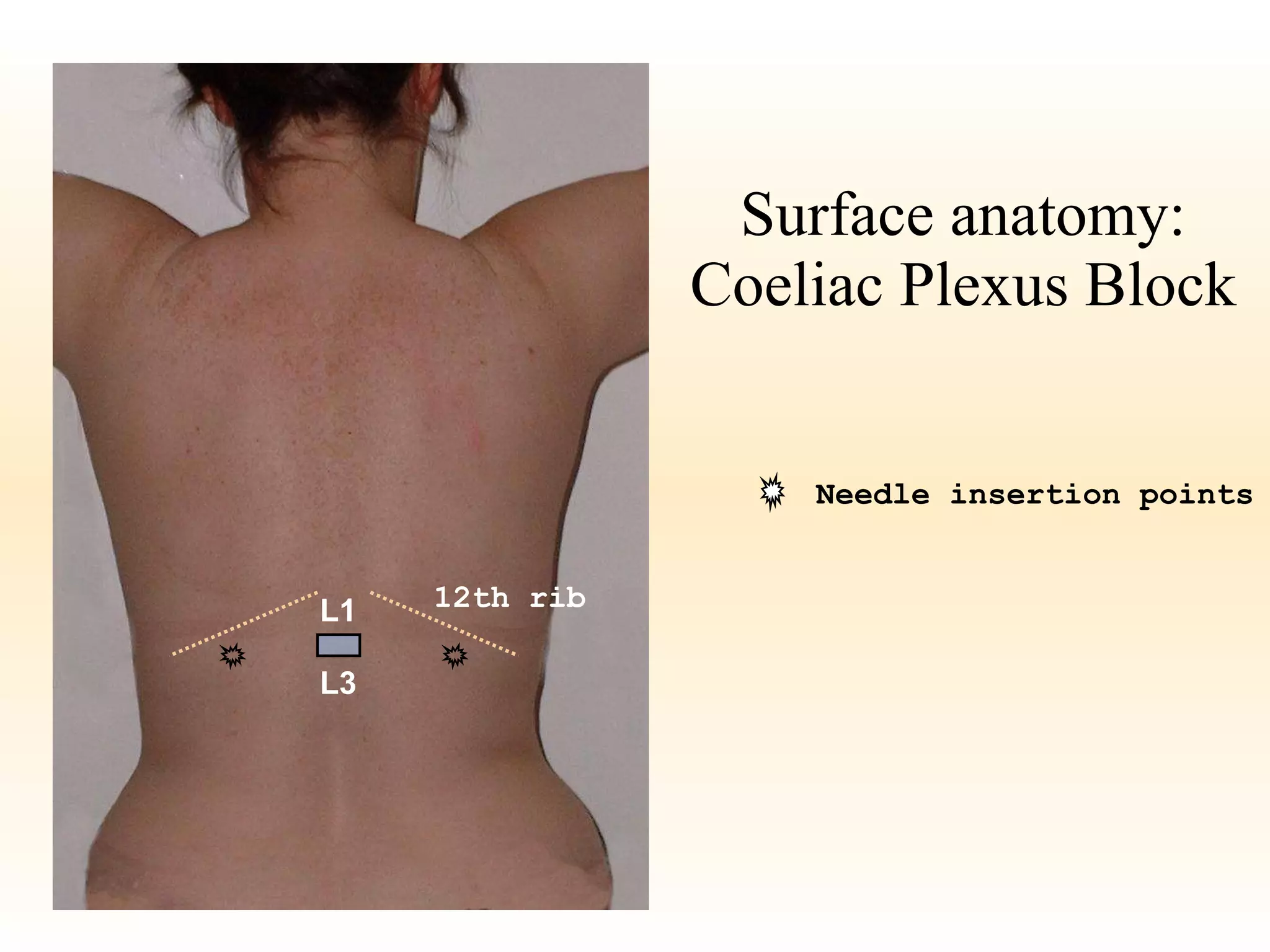
Surface anatomy: Coeliac Plexus Block Needle insertion points 12th rib L1 L3
Coeliac Block Coeliac ganglion aorta ivc liver Crura  diaphragm 7cm
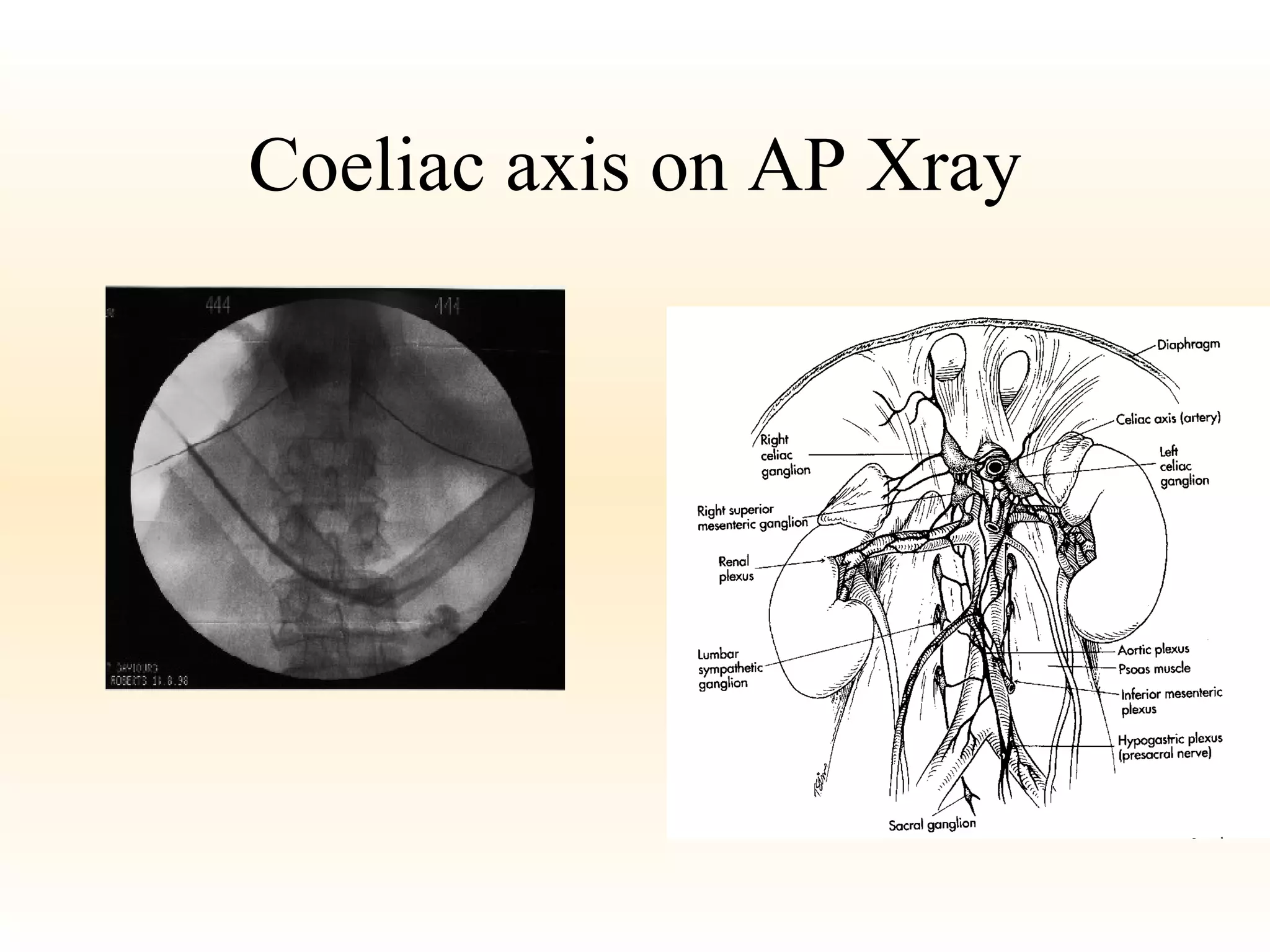
Coeliac axis on AP Xray
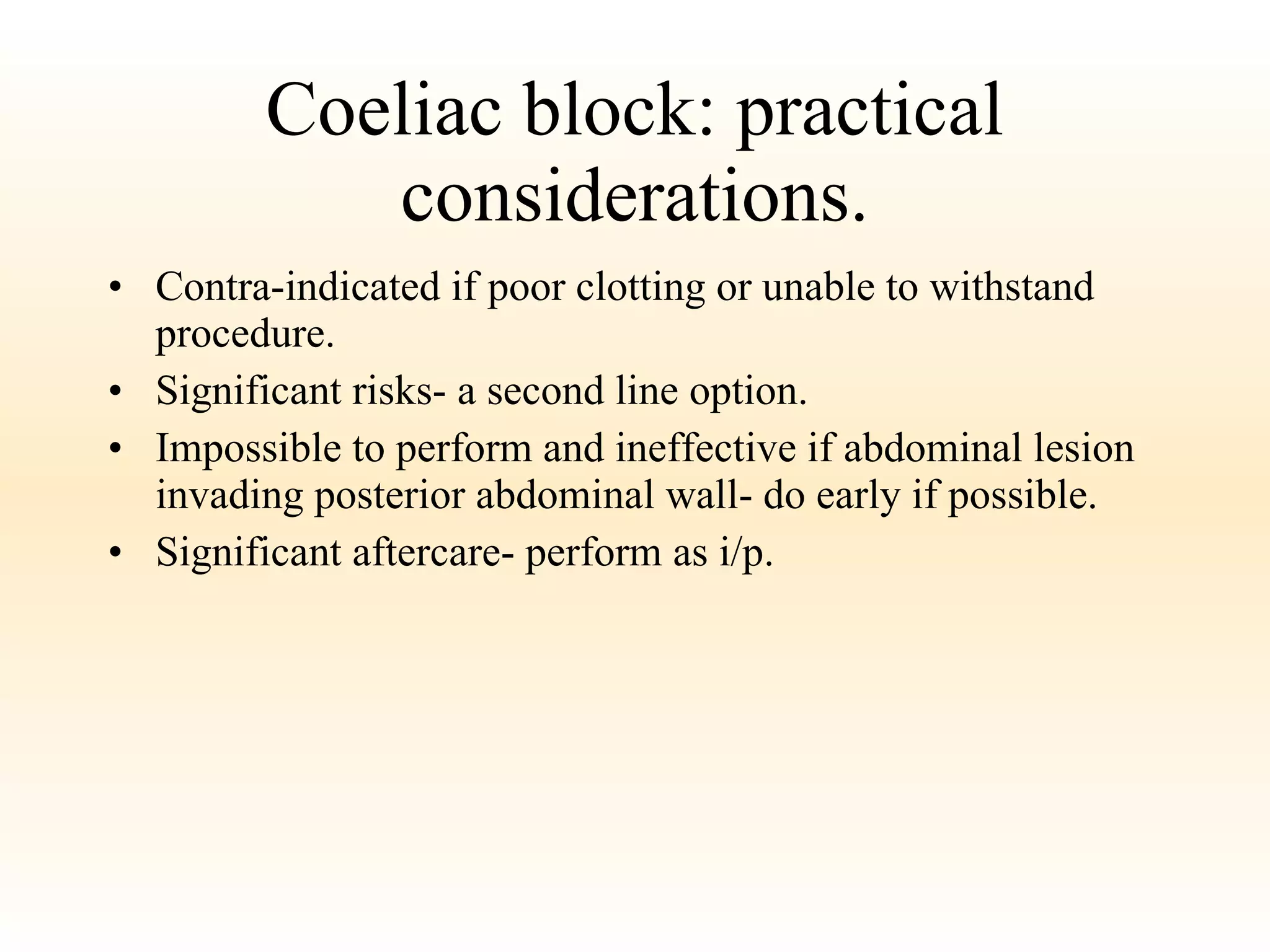
Coeliac block: practical considerations. Contra-indicated if poor clotting or unable to withstand procedure. Significant risks- a second line option. Impossible to perform and ineffective if abdominal lesion invading posterior abdominal wall- do early if possible. Significant aftercare- perform as i/p.
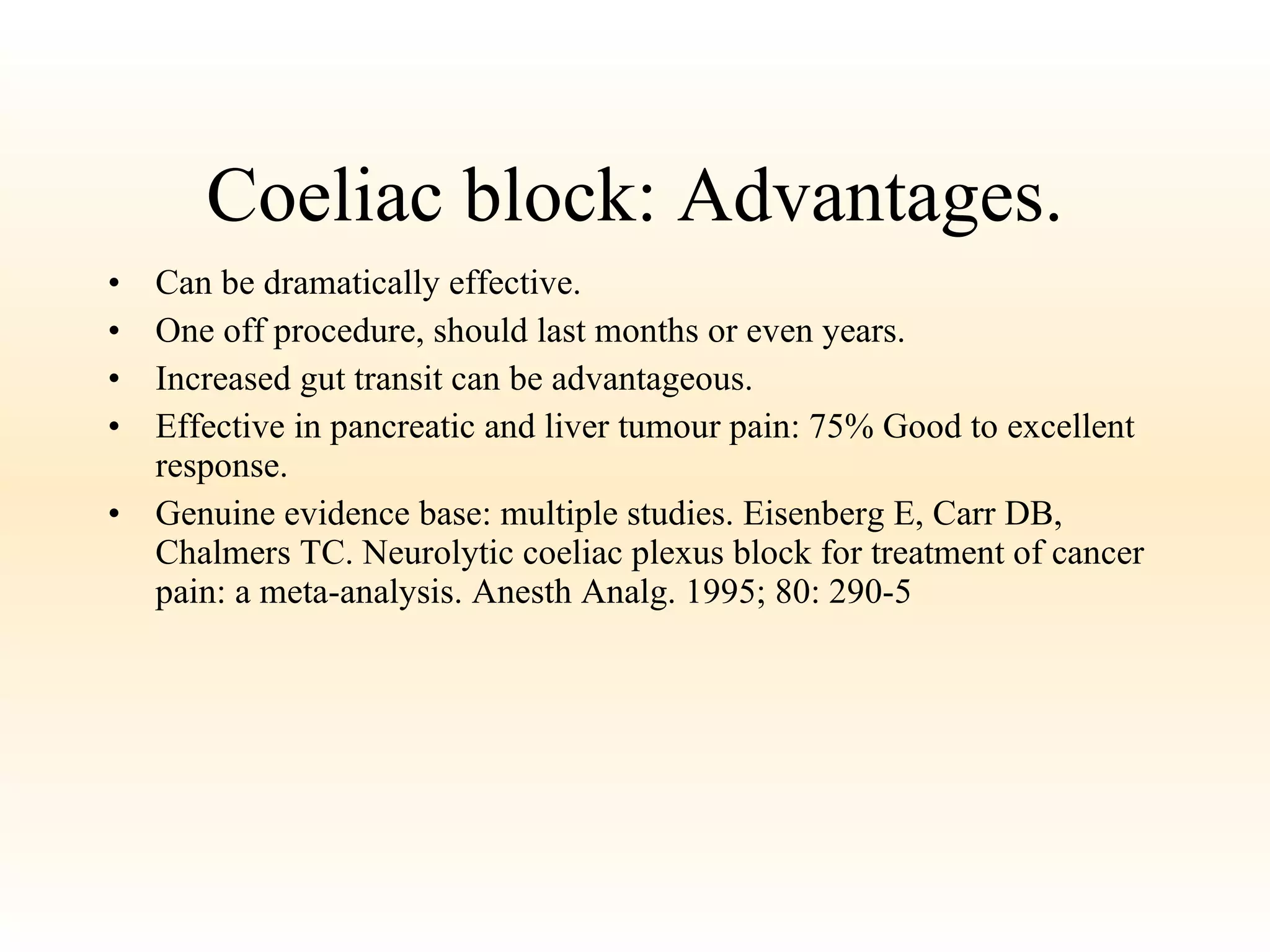
Coeliac block: Advantages. Can be dramatically effective. One off procedure, should last months or even years. Increased gut transit can be advantageous. Effective in pancreatic and liver tumour pain: 75% Good to excellent response. Genuine evidence base: multiple studies. Eisenberg E, Carr DB, Chalmers TC. Neurolytic coeliac plexus block for treatment of cancer pain: a meta-analysis. Anesth Analg. 1995; 80: 290-5
Coeliac block: Disadvantages. Difficult, anatomy can be disrupted by tumour. Side effects: postural hypotension, shoulder pain, diarrhoea, sexual dysfunction, haemorrhage, paralysis (1:200-1:600) etc. Usually “incomplete” effect : patients still require opioids in majority of cases Only effective if pain still mediated by sympathetics: ineffective if involving posterior abdominal wall. May wear off and need to be repeated.
Newer approaches to the coeliac plexus CT guided: Good when there is significant anatomical disturbance: however availability issues and involves much more movement for patient. CT guided Anterior approach. Good if patient can’t lie prone. Otherwise no particular advantage though as performed under CT less skill needed (radiologist does most of the work) Peri-operative.  Useful if having “staging” surgery.
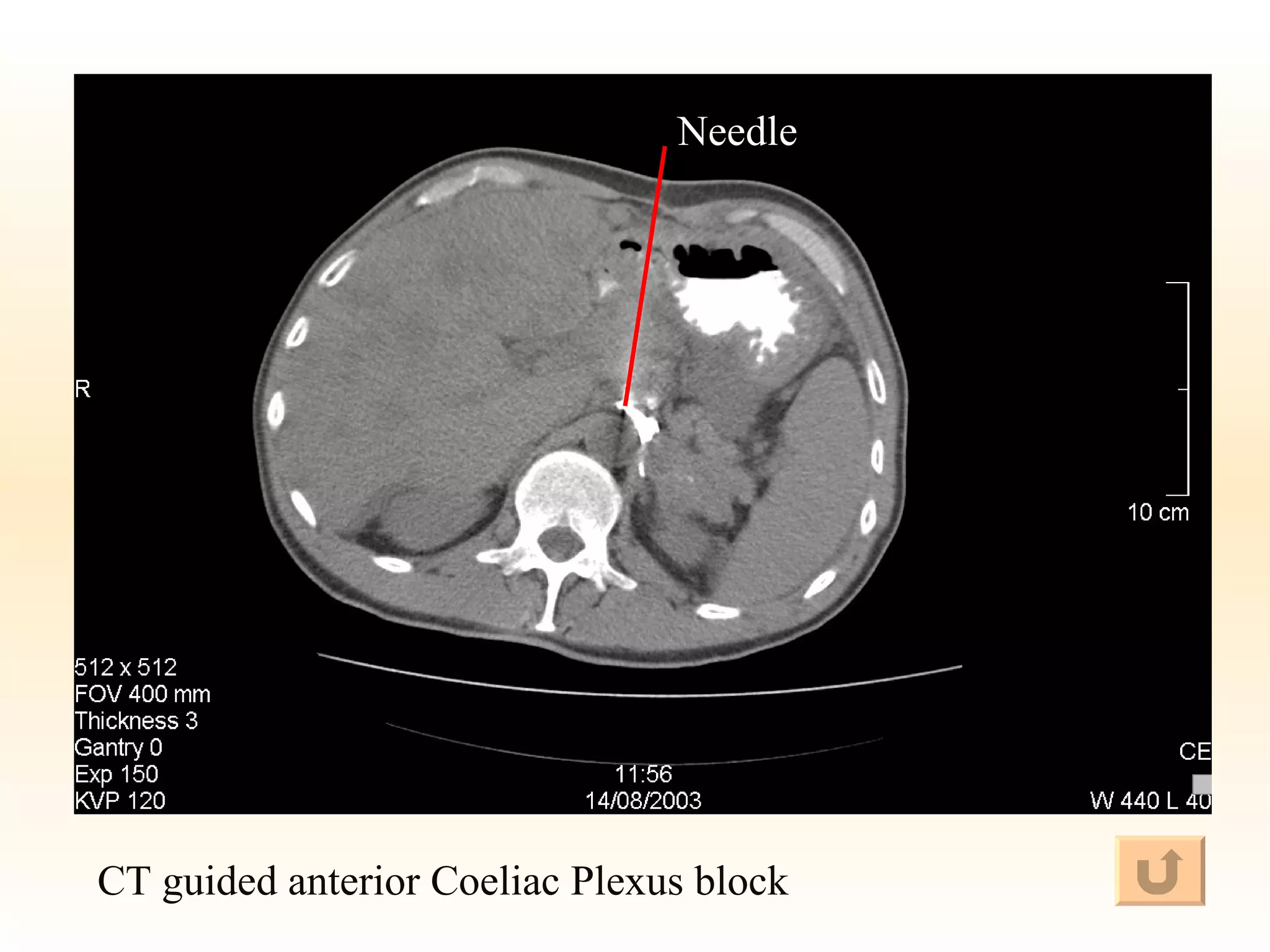
CT guided anterior Coeliac Plexus block Needle
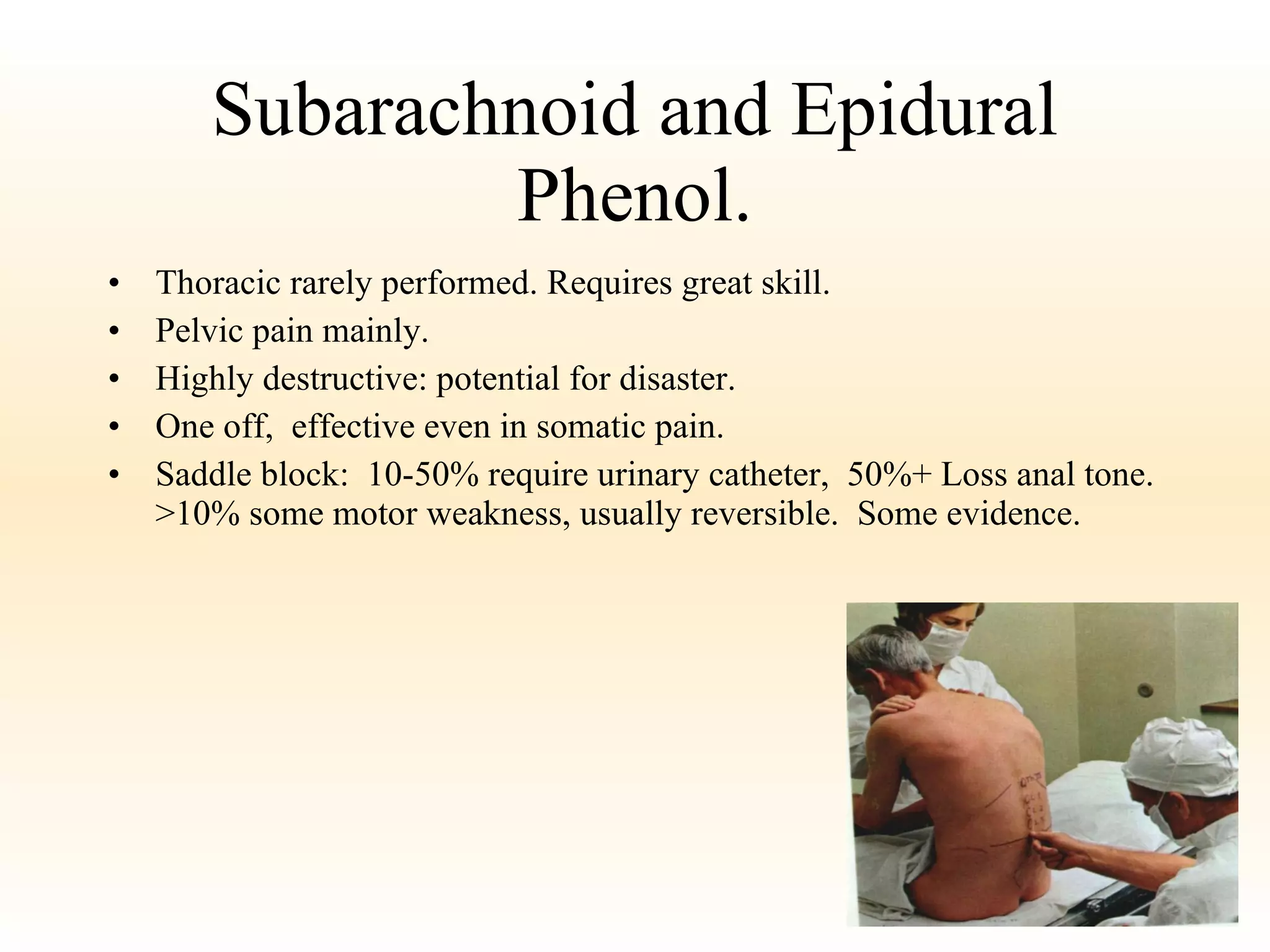
Subarachnoid and Epidural Phenol. Thoracic rarely performed. Requires great skill. Pelvic pain mainly. Highly destructive: potential for disaster. One off,  effective even in somatic pain. Saddle block:  10-50% require urinary catheter,  50%+ Loss anal tone. >10% some motor weakness, usually reversible.  Some evidence.
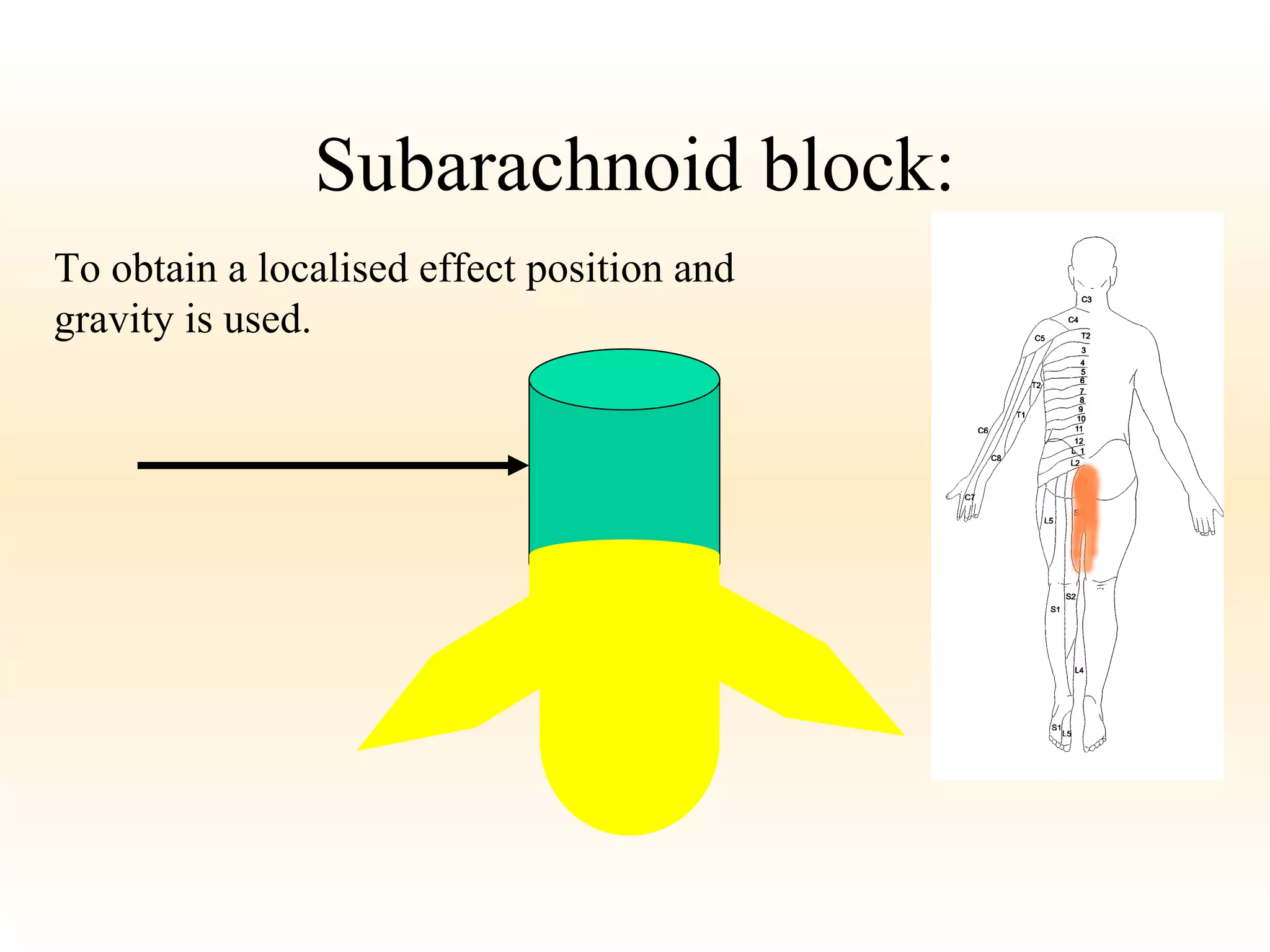
Subarachnoid block: To obtain a localised effect position and gravity is used.
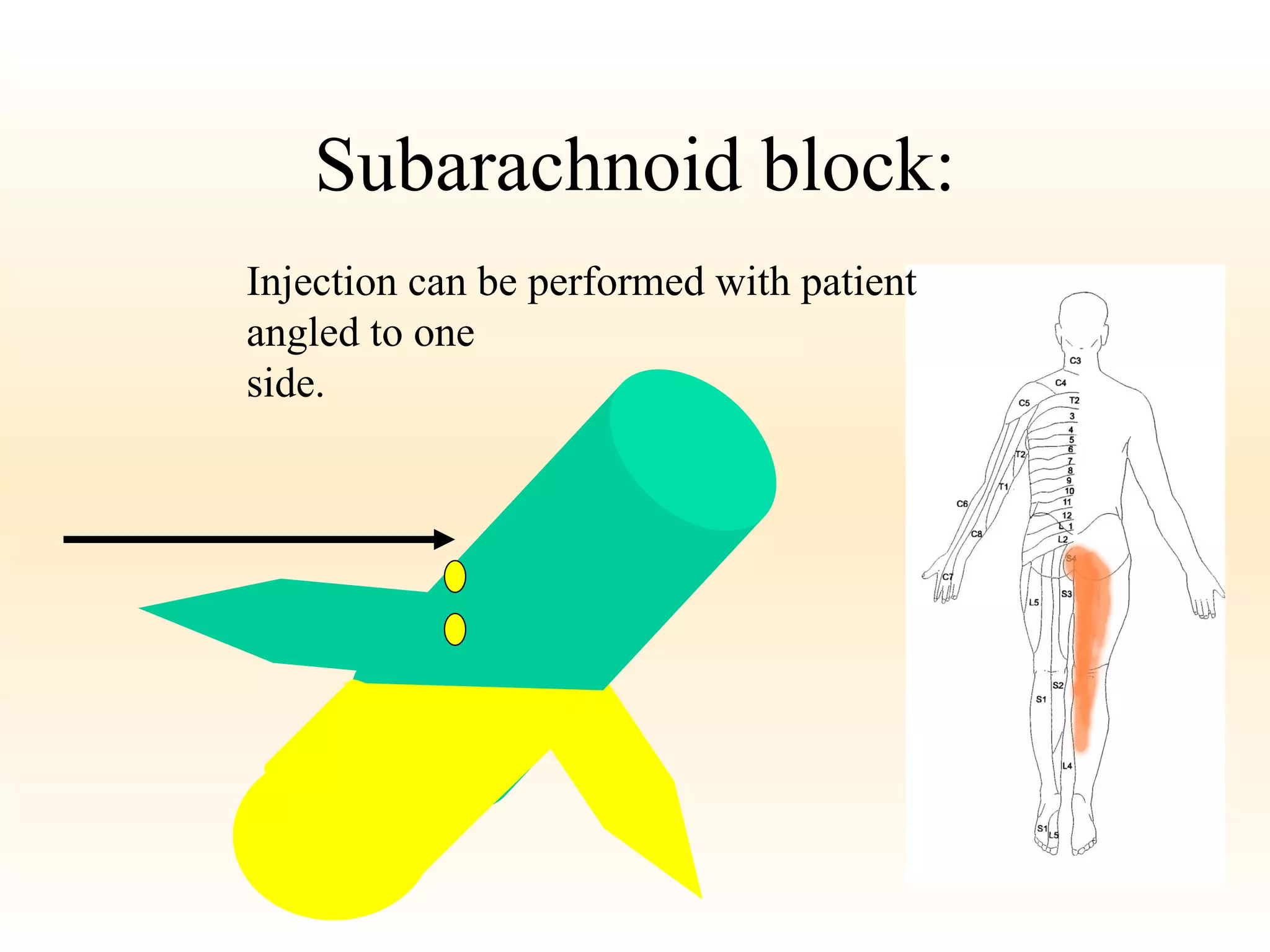
Subarachnoid block: Injection can be performed with patient  angled to one  side.
Neurolytic Subarachnoid Block Phenol 6-10% Usually at level of cauda equina (L2) or below: occasionally higher. Difficult to predict effect therefore Perform first with LA (eg reversible!).  Allow patient to feel the numbness: some would prefer the pain.
Side effects One off/LA Difficult to do Bruising Hypotension: sympathetic block SA bleed: disastrous Infection: disastrous “ Total spinal” Spinal cord trauma Post spinal headache Neurolytic All above plus…. Indiscriminate: blocks motor, autonomic and sensory nerves. Therefore…. 30% chance doubly incontinent 10% unable to walk Replaces pain with numbness Therefore: perform temporary block first
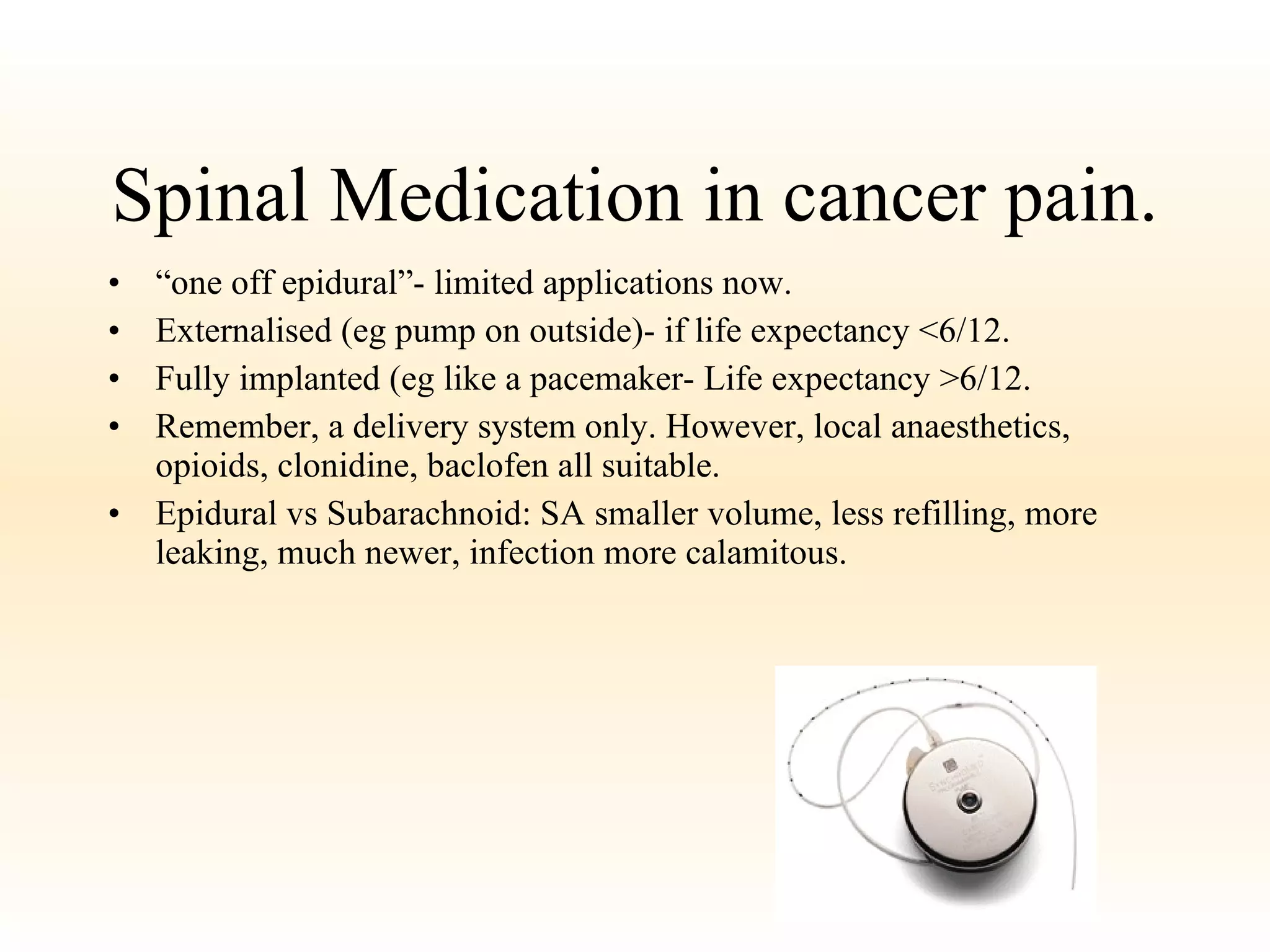
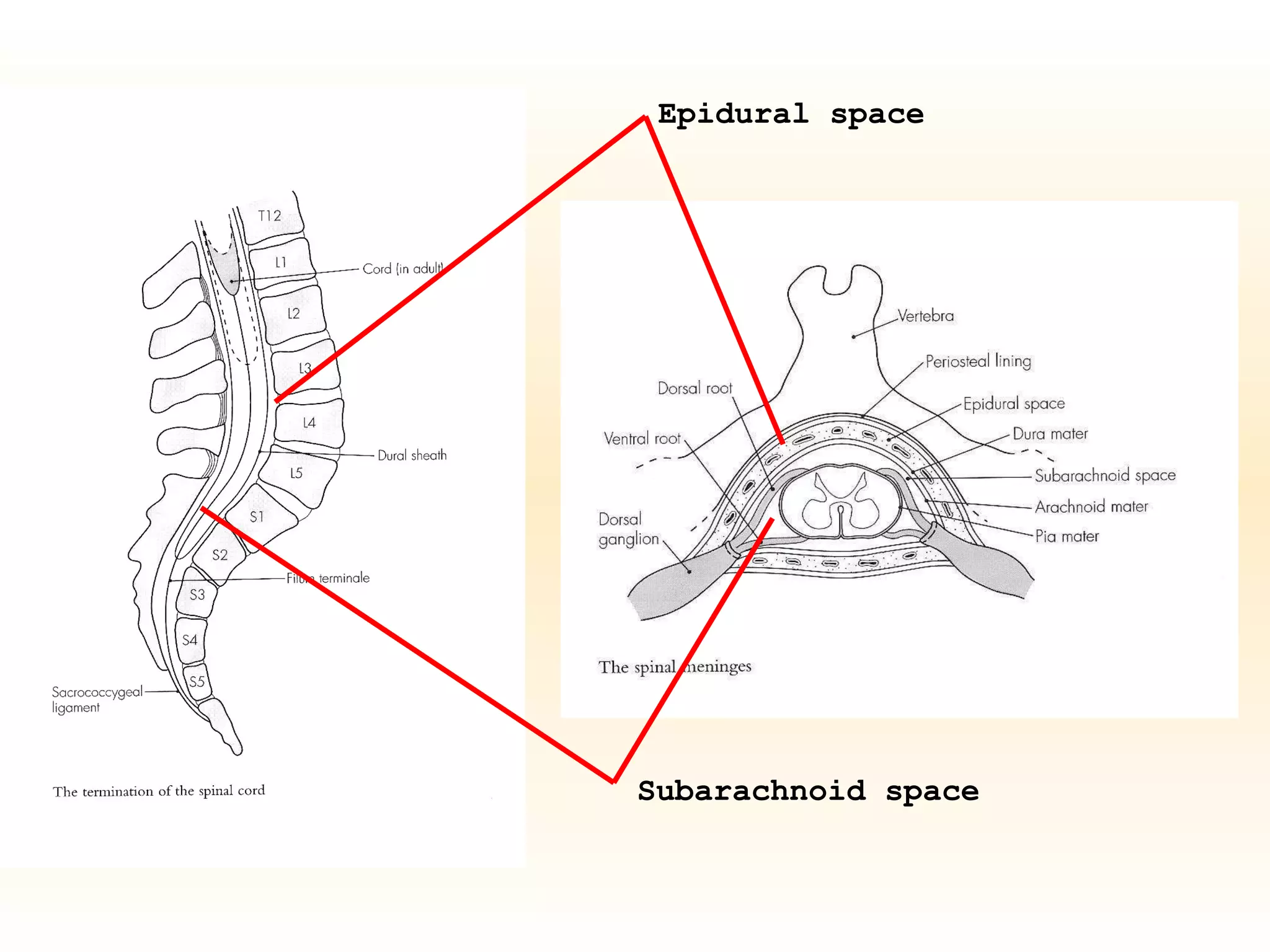
Spinal Medication in cancer pain. “ one off epidural”- limited applications now. Externalised (eg pump on outside)- if life expectancy <6/12.  Fully implanted (eg like a pacemaker- Life expectancy >6/12. Remember, a delivery system only. However, local anaesthetics, opioids, clonidine, baclofen all suitable. Epidural vs Subarachnoid: SA smaller volume, less refilling, more leaking, much newer, infection more calamitous.
Epidural space Subarachnoid space
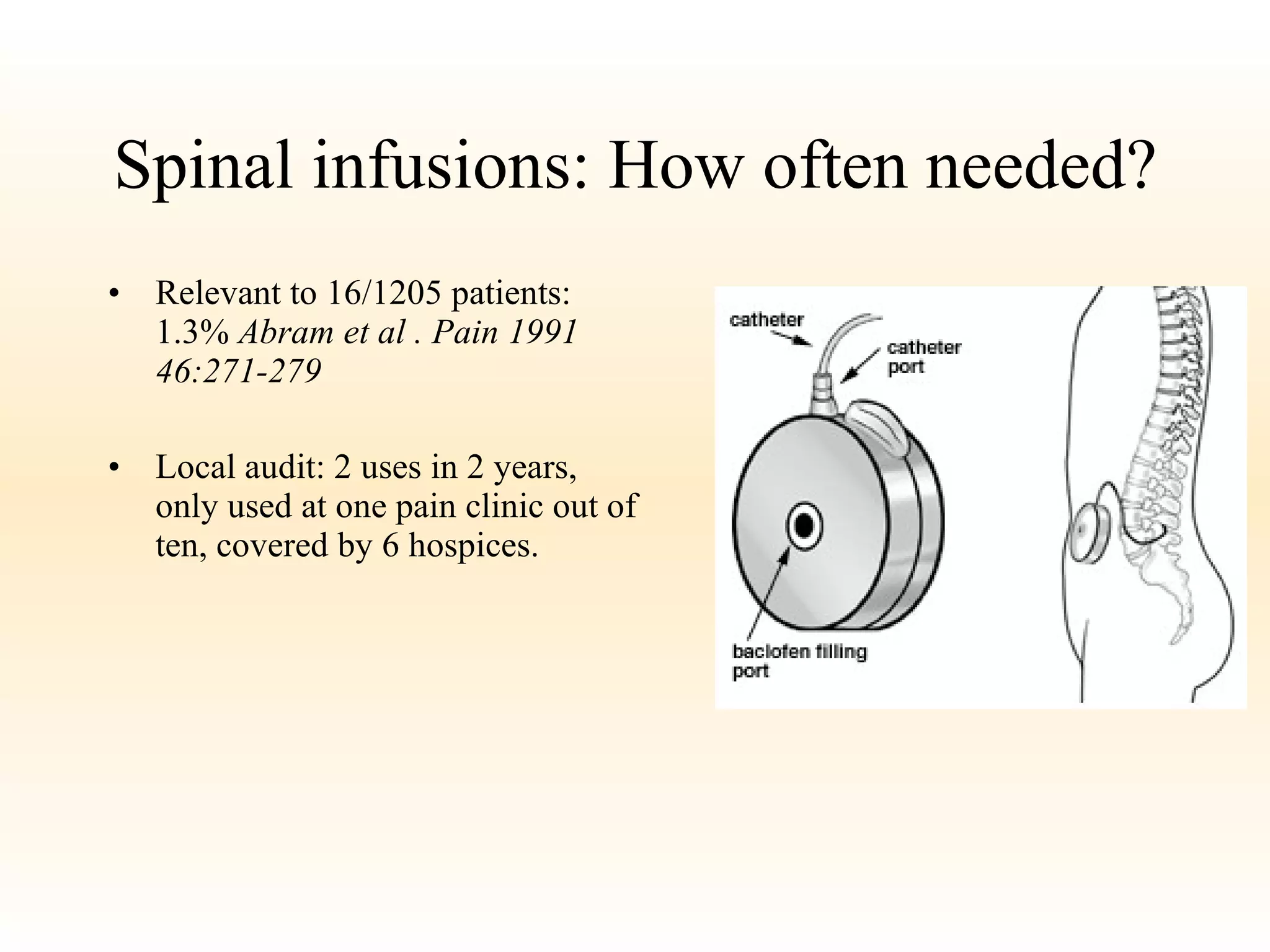
Spinal infusions: How often needed? Relevant to 16/1205 patients: 1.3%  Abram et al . Pain 1991 46:271-279 Local audit: 2 uses in 2 years, only used at one pain clinic out of ten, covered by 6 hospices.
Intrathecal opioids in Palliative care: Criteria for use. Appropriate trial of strong opioids Intolerable side effects from systemic opioids. Life expectancy >3mnths Exclude tumour encroachment on theca/ Interrupted cns circulation. Krames Schuchard Pain reviews 1995 Deer, Winkelmuller et all, Neuromodulation  1999
Very “In” in USA: some good trials showing better pain improvement than “medical” approach alone. Maintenance/down time real issues Side effects: Catheter problems 22%, N&V 25%, pruritis 13%, constipation 50%, Infection ?  Intrathecal opioids in Palliative care: Continued
Advantages of spinal infusions. Use of local anaesthetic possible: can be wonderfully effective in poorly opioid sensitive pain eg incident pain, pelvic pain, thoracic wall involvement. Opioid side effects MAY be reduced, but no evidence that efficacy is greater. Continuous delivery with bolus doses available.
Disadvantages of spinal. Complicated, difficult to do and maintain. Continuous link required for reservoir filling etc. Calamitous side effects possible: postural hypotension, infection etc, etc.  LAs may lead to muscular weakness. What is the “down time” of the system? Eg waiting for refills, consultant review etc etc. Huge demands place on support teams. Expensive.
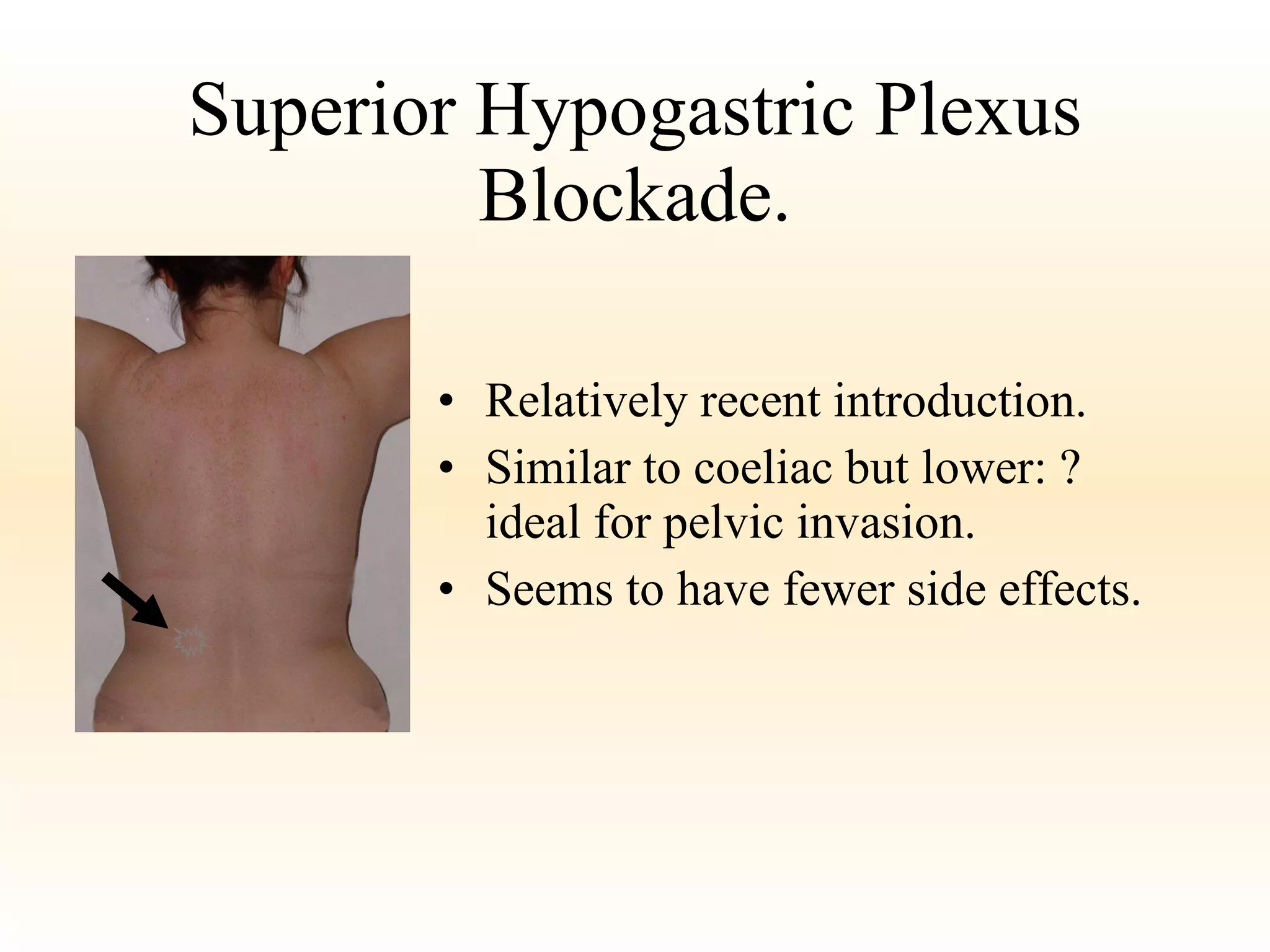
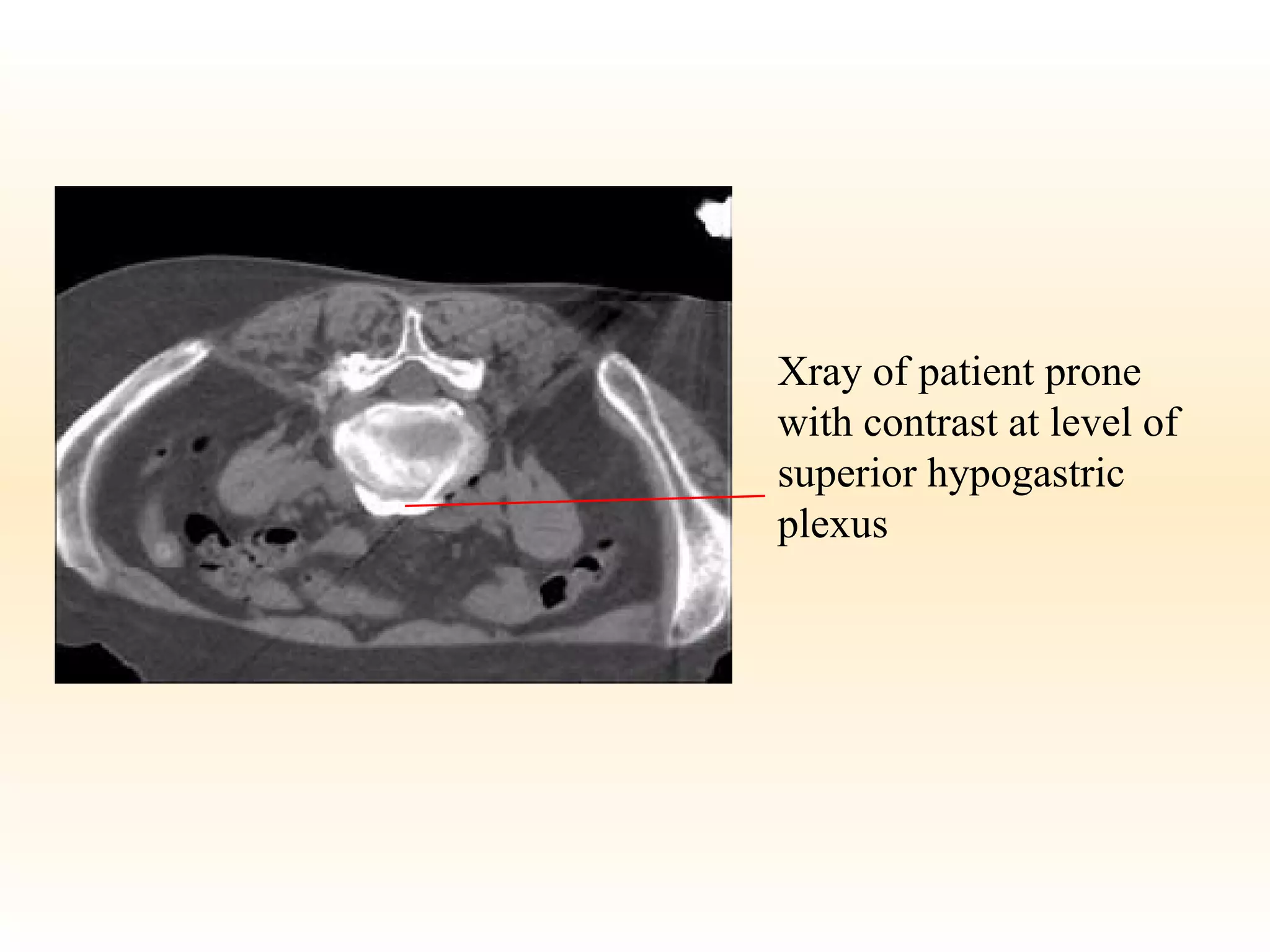
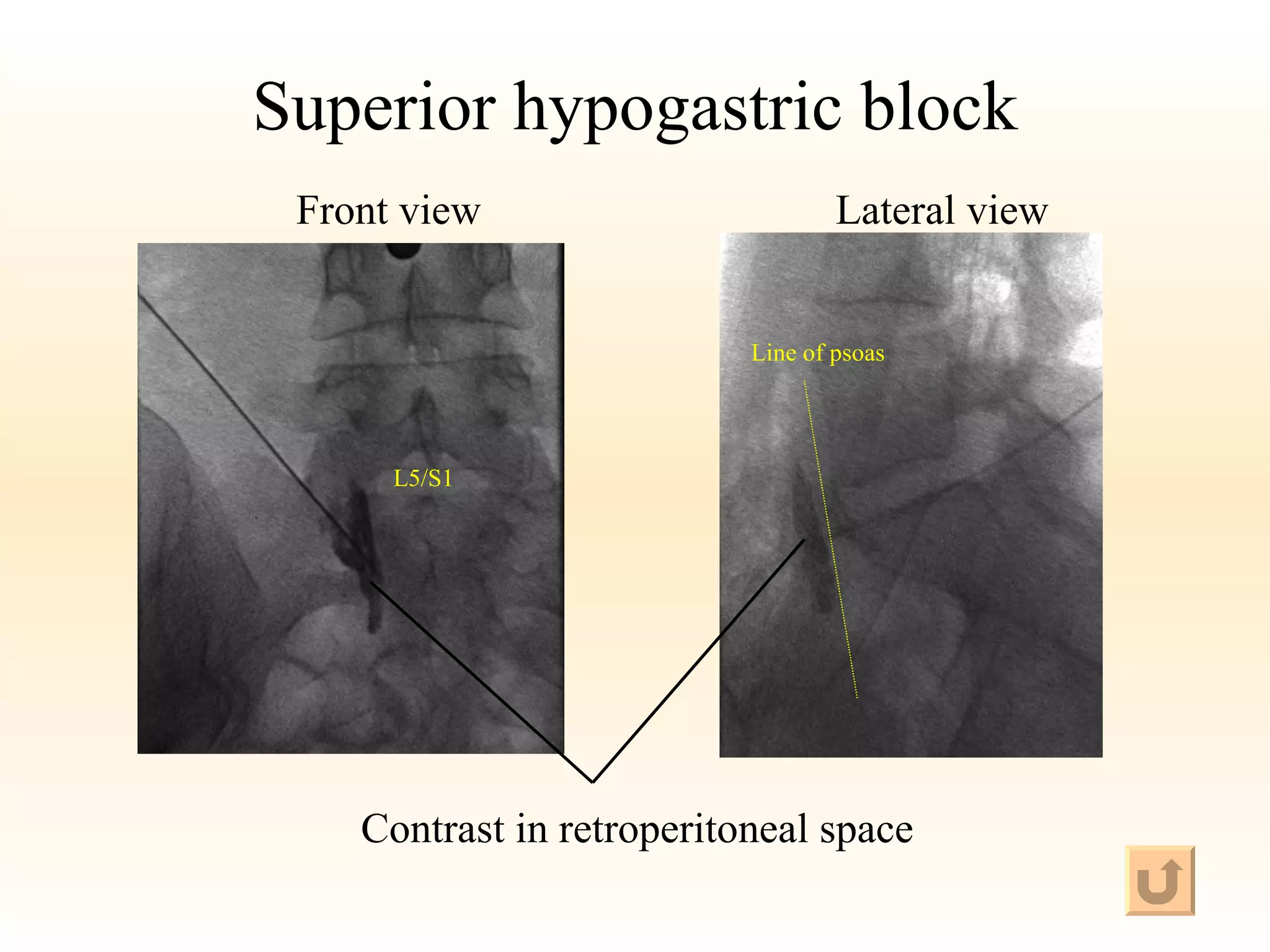
Superior Hypogastric Plexus Blockade. Relatively recent introduction.  Similar to coeliac but lower: ? ideal for pelvic invasion. Seems to have fewer side effects.
Xray of patient prone with contrast at level of superior hypogastric plexus
Superior hypogastric block L5/S1 Line of psoas Contrast in retroperitoneal space Front view Lateral view
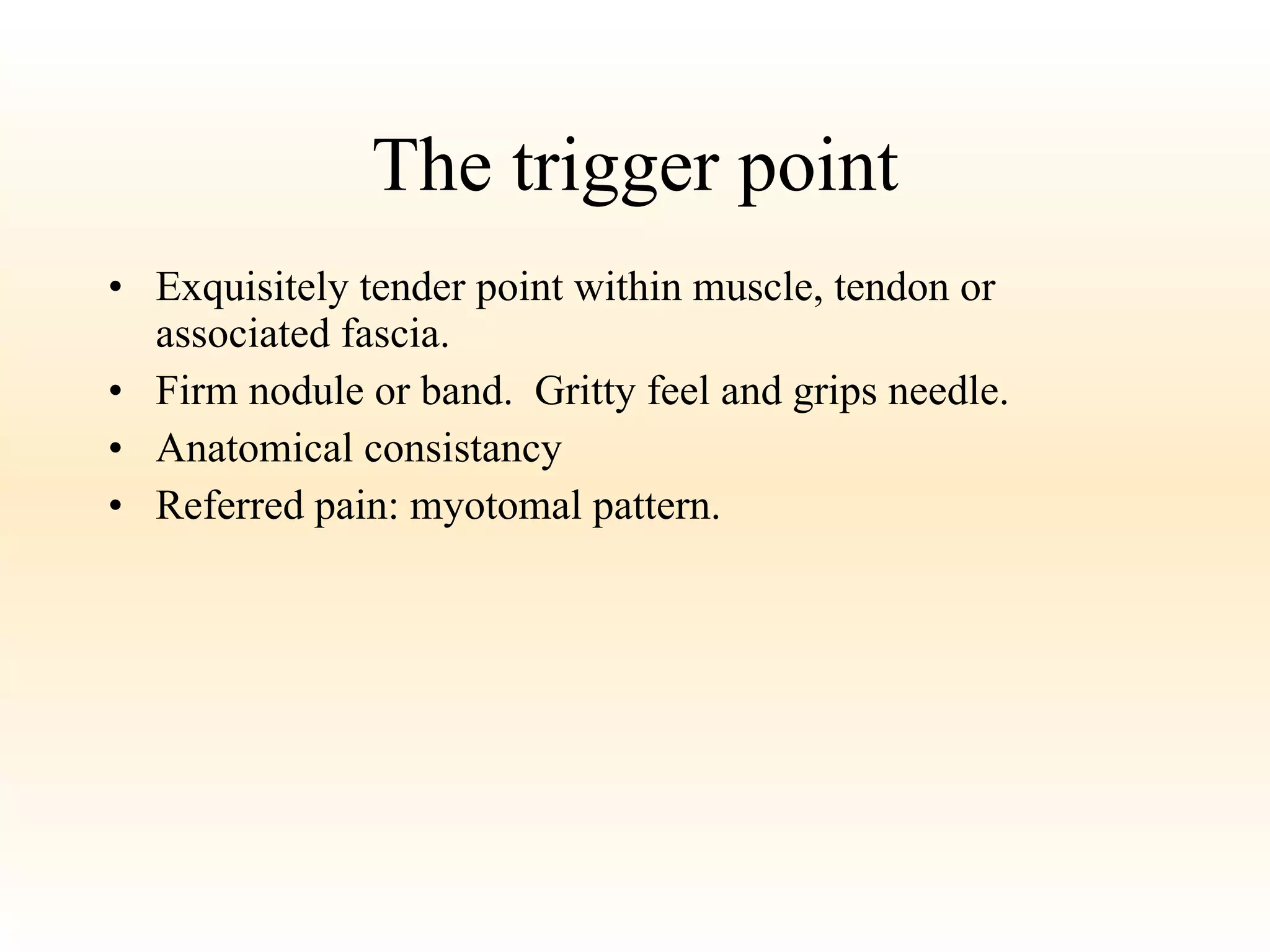
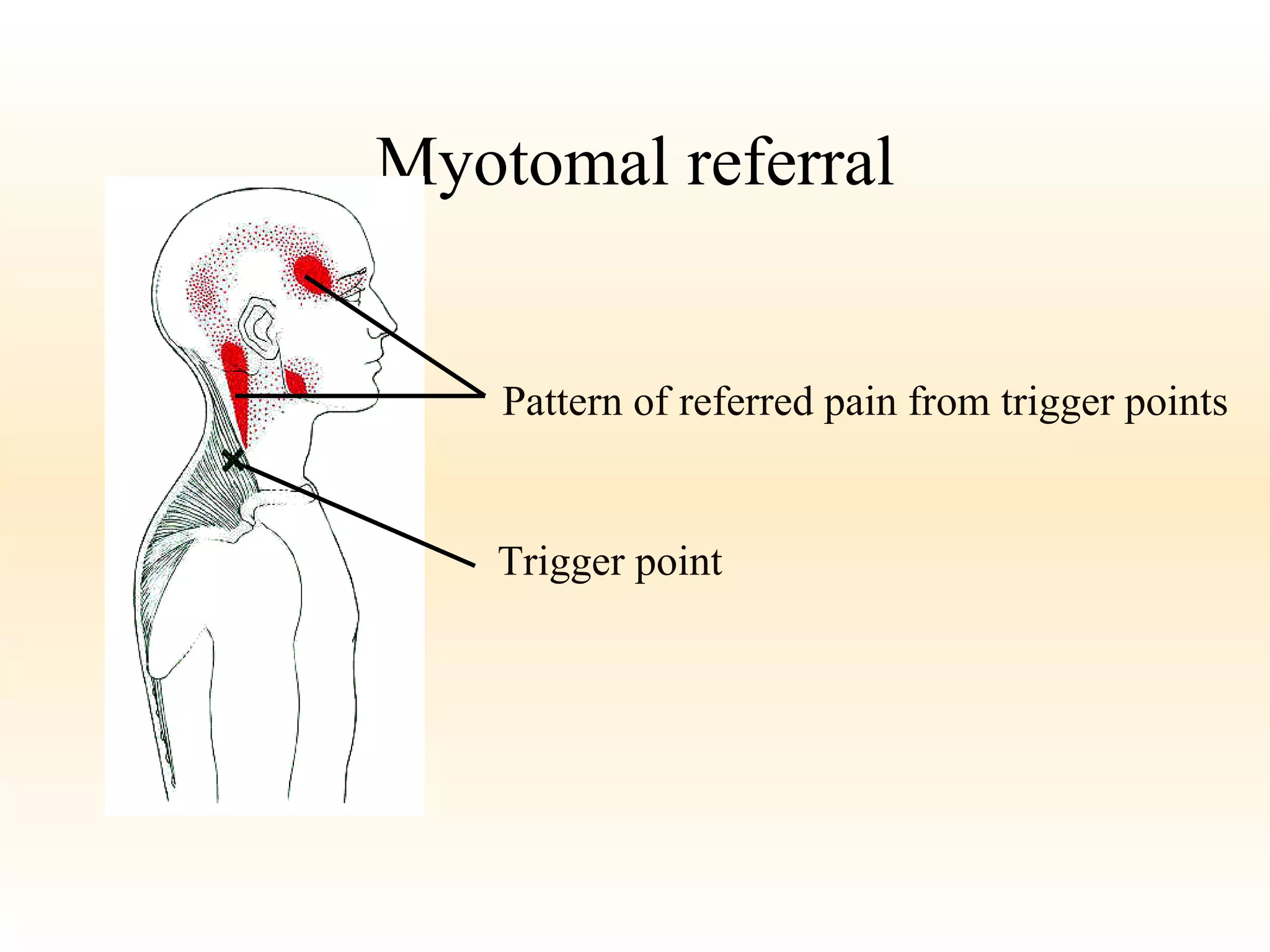
The trigger point Exquisitely tender point within muscle, tendon or associated fascia. Firm nodule or band.  Gritty feel and grips needle. Anatomical consistancy Referred pain: myotomal pattern.
The Trigger point Injury/overload Ruptured sacoplasmic reticulum Release Ca : sustained contraction ATP depletion results in local contraction and electrical silence Local hypoxia/ ischaemia Release Kinins, prostaglandins Sensitized nociceptors
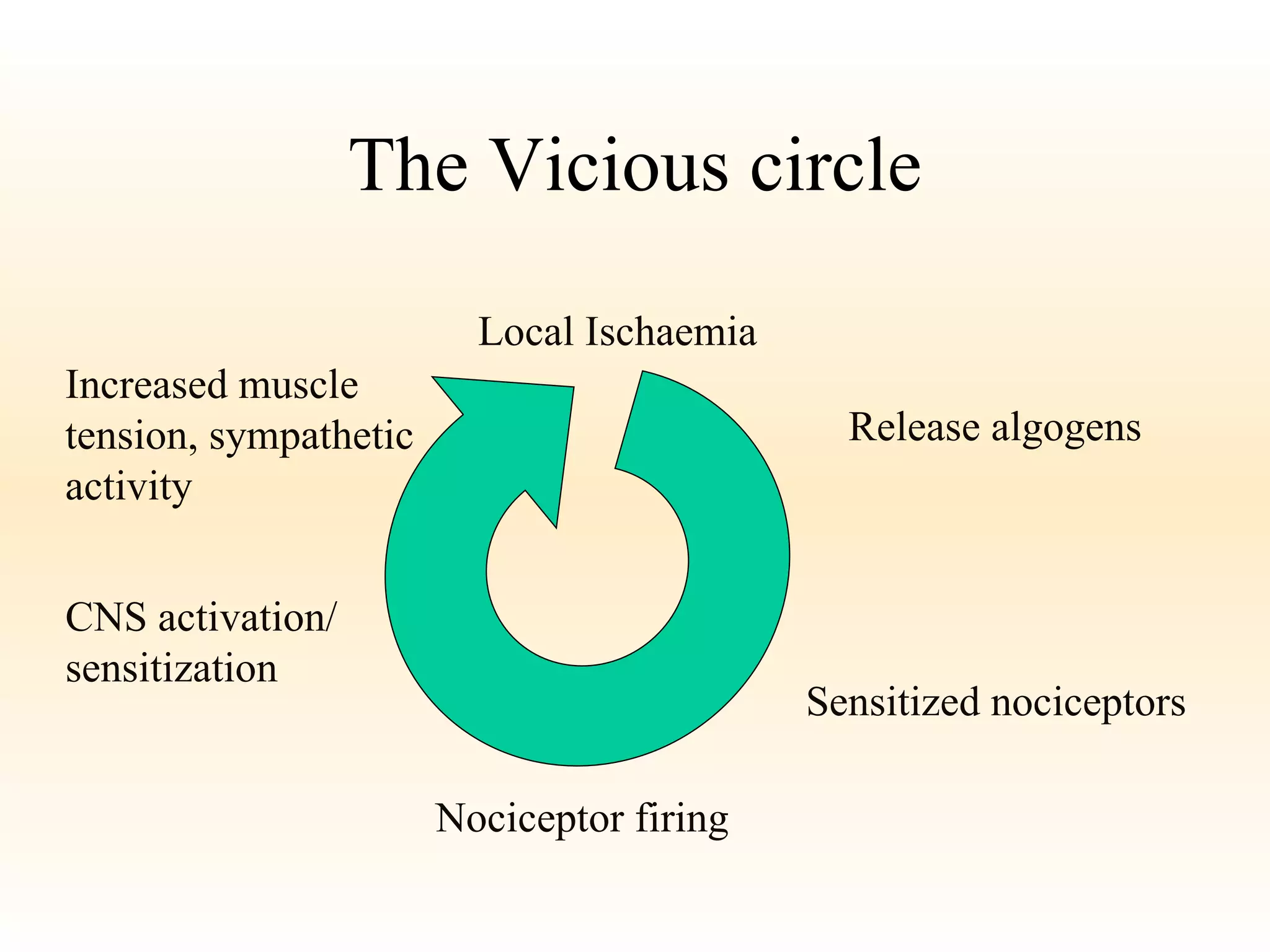
The Vicious circle Local Ischaemia Release algogens Sensitized nociceptors Nociceptor firing CNS activation/ sensitization Increased muscle  tension, sympathetic  activity
Myotomal referral Pattern of referred pain from trigger points Trigger point
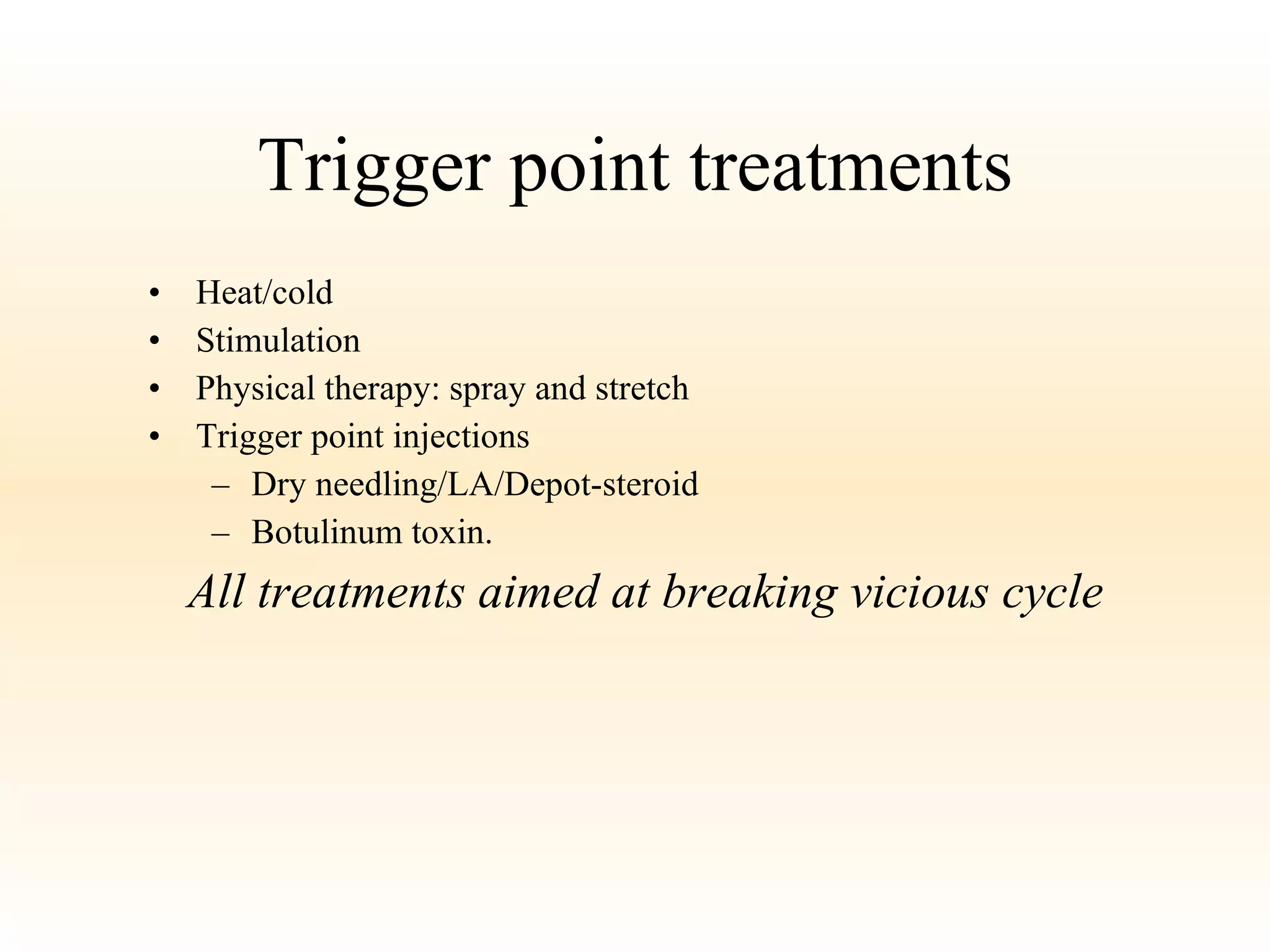
Trigger point treatments Heat/cold Stimulation Physical therapy: spray and stretch Trigger point injections Dry needling/LA/Depot-steroid Botulinum toxin. All treatments aimed at breaking vicious cycle
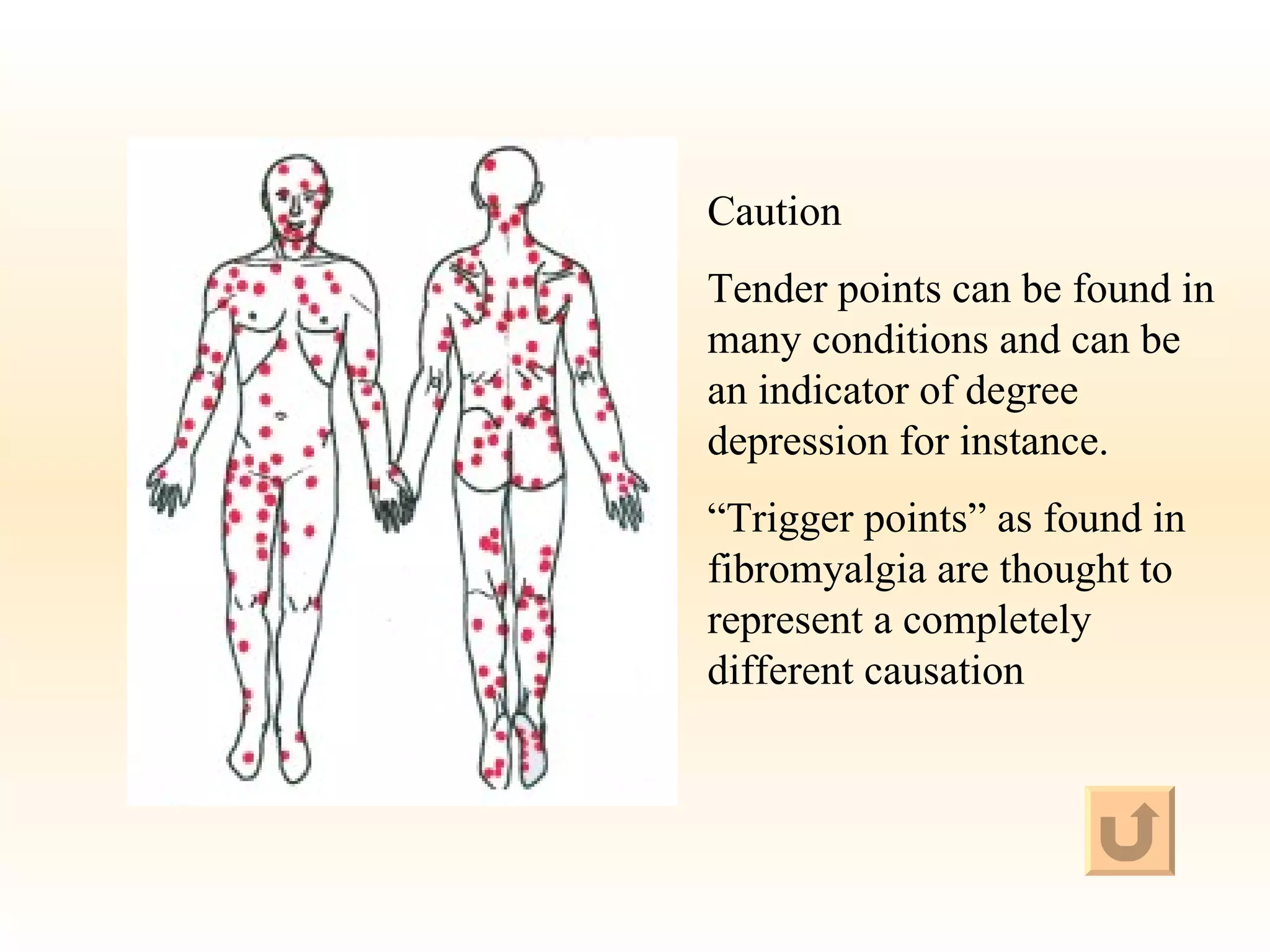
Caution Tender points can be found in many conditions and can be an indicator of degree depression for instance. “ Trigger points” as found in fibromyalgia are thought to represent a completely different causation
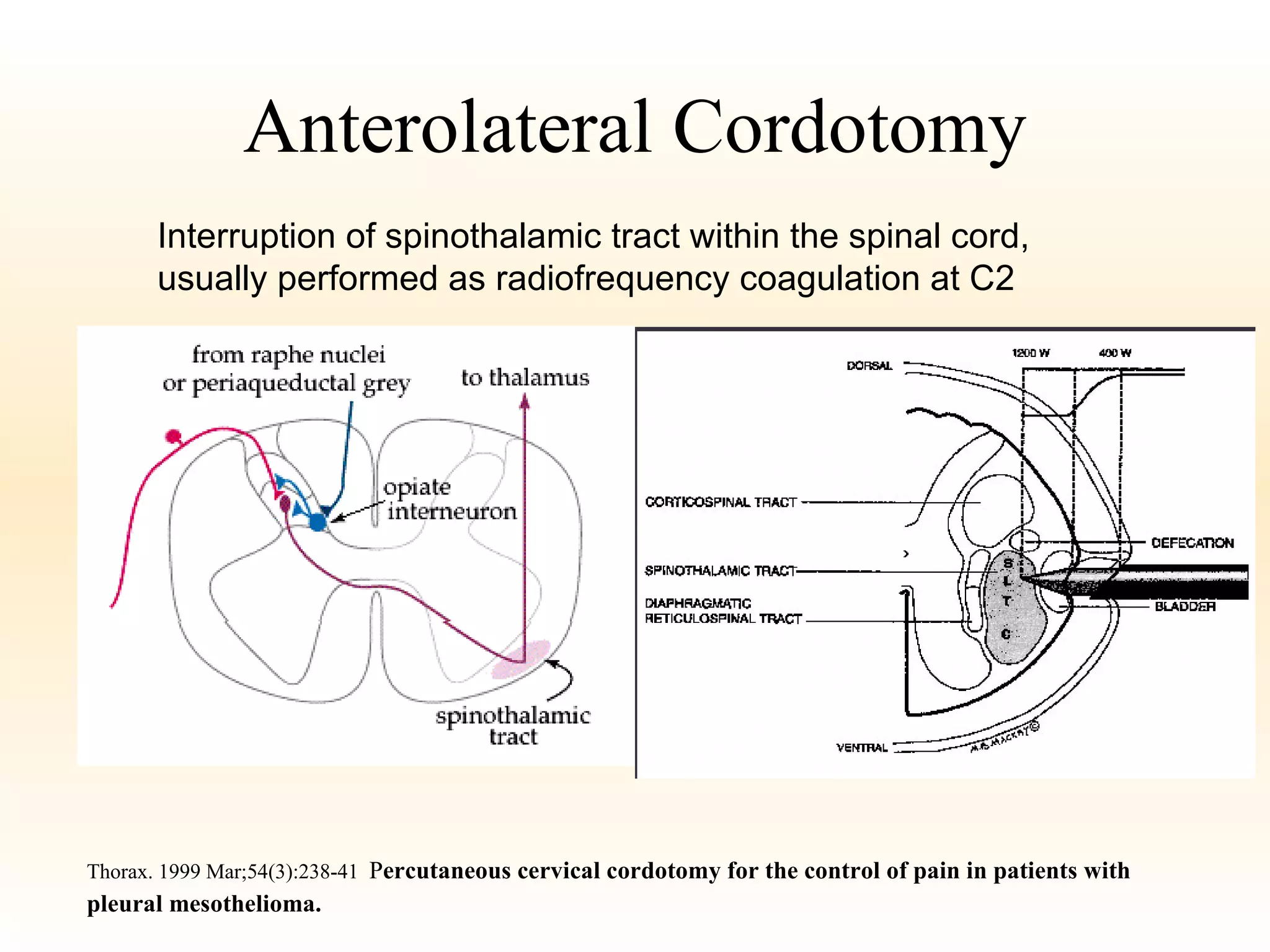
Anterolateral Cordotomy Thorax. 1999 Mar;54(3):238-41   P ercutaneous cervical cordotomy for the control of pain in patients with pleural mesothelioma. Interruption of spinothalamic tract within the spinal cord, usually performed as radiofrequency coagulation at C2
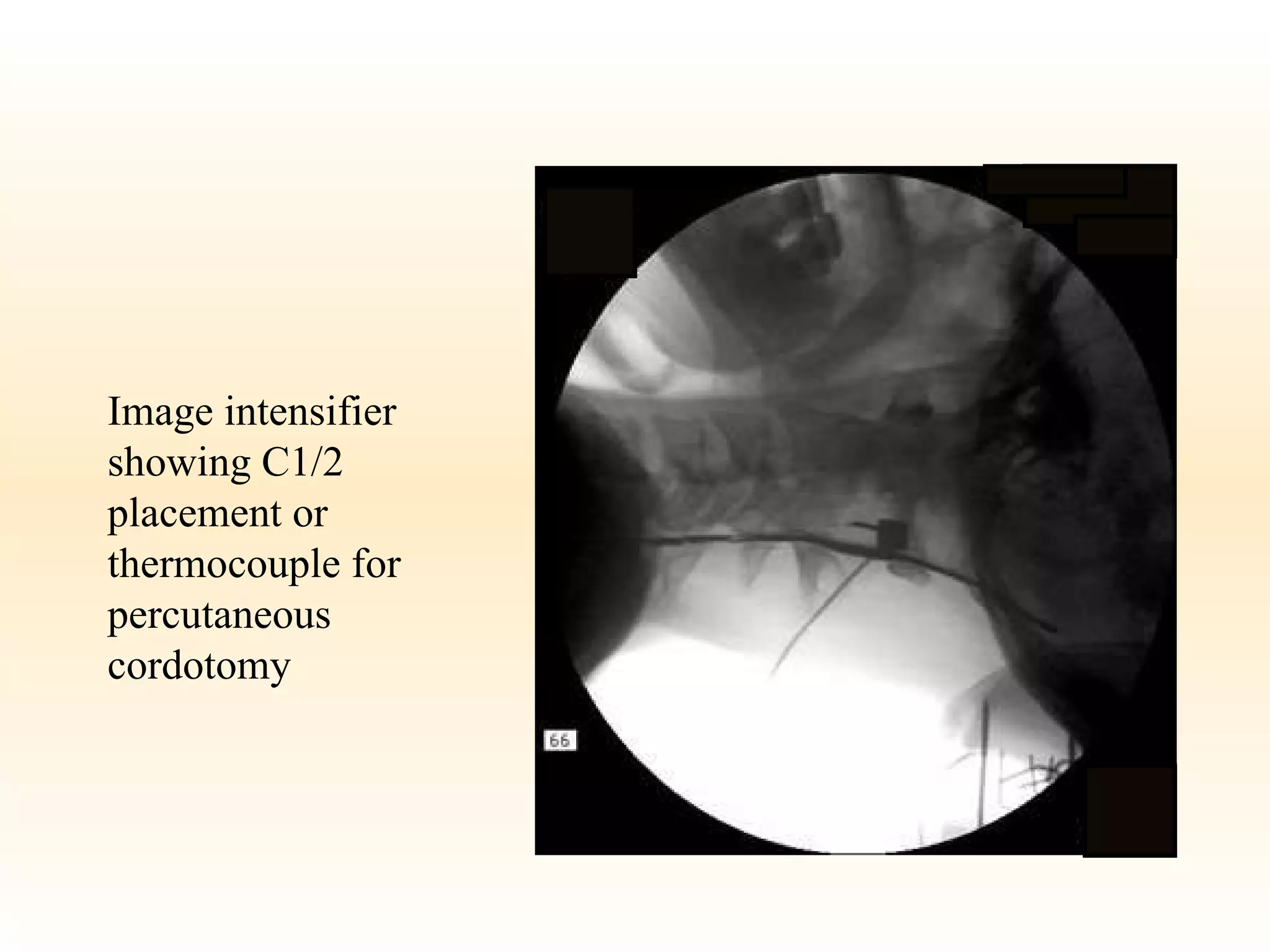
Cordotomy Only treats pain on one side of the body. Bilateral cordotomy can be performed, but although this will stop pain on both sides of the body it does not affect midline pain and is generally associated with a higher incidence of side effects.  Evidence level IV Percutaneous procedure is more commonly used, and is performed in the cervical region at C1-2. The highest level of analgesia obtainable is about C4 which corresponds to the shoulder. Neck pain does not normally respond. Special care is needed in patients with impaired lung function, as percutaneous cervical cordotomy may cause some reduction in the expansion of the lung on the side of the procedure. This is obviously important in patients with lung tumours. Cordotomy can provide complete analgesia in about 2/3 of patients. If a patient has widespread pain, but one location where it is not controlled by simple measures, then cordotomy may be useful in controlling that pain. The pain relief is not permanent, and the duration is variable. Pain relief will seldom last longer than one year in most patients.  Evidence level IV
Image intensifier showing C1/2 placement or thermocouple for percutaneous  cordotomy
Evidence Based Care: Evidence base  very confused Background schism in chronic pain management: psychologists vs cutters and burners Cancer pain main justification for implanted techniques in chronic pain. What is asked for? Specialist pain management or a specific technique.
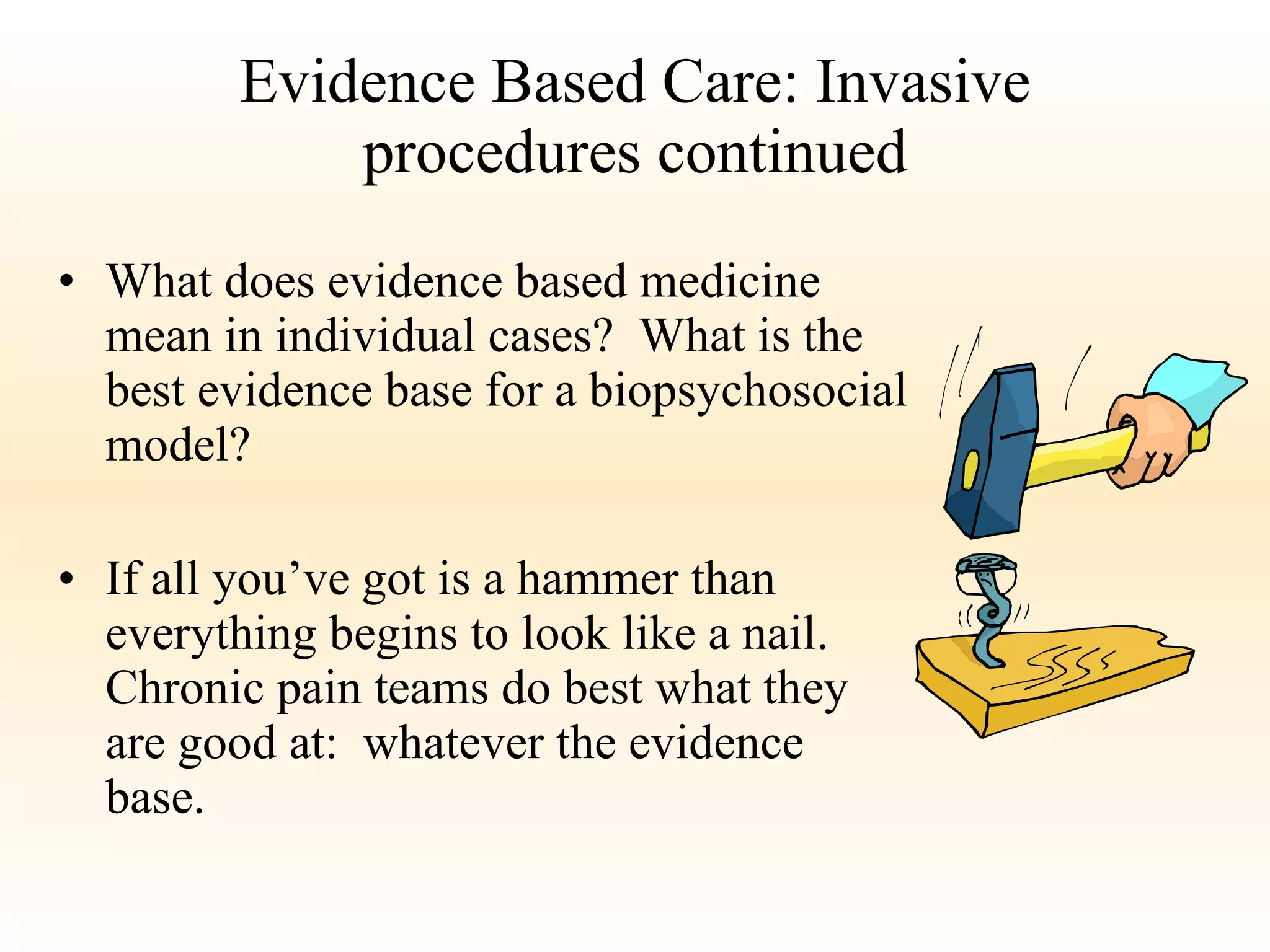
Evidence Based Care: Invasive procedures continued What does evidence based medicine mean in individual cases?  What is the best evidence base for a biopsychosocial model? If all you’ve got is a hammer than everything begins to look like a nail.  Chronic pain teams do best what they are good at:  whatever the evidence base.
Summary Do you need a different approach (alternative opioids, alternative routes, alternative adjuncts unhelpful?) Would invasive option be feasible? Would invasive option help (33% patients>= 3 different pains, is this “Total pain”?) Can you support and maintain the new option? Is this the right time?  Is this what the patient wants? If so: go for it!
 
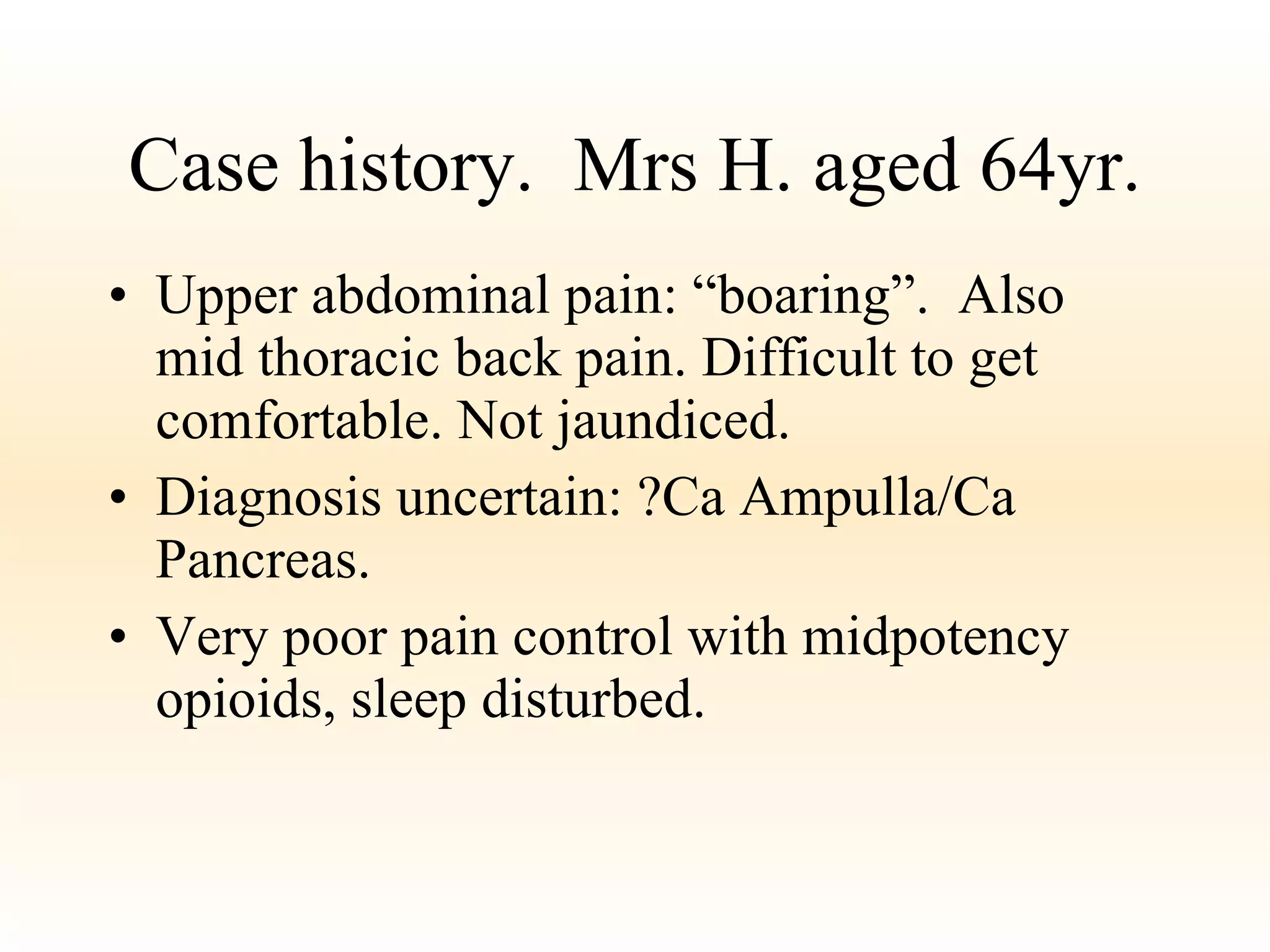
Case history.  Mrs H. aged 64yr. Upper abdominal pain: “boaring”.  Also mid thoracic back pain. Difficult to get comfortable. Not jaundiced. Diagnosis uncertain: ?Ca Ampulla/Ca Pancreas. Very poor pain control with midpotency opioids, sleep disturbed.

Invasive Options Kimh Invasive 2009

  • 1.
    Invasive options inpalliative care Tim Bushnell
  • 2.
    So: what doyou want? Various models: tradesman?, superhero,? team member? Not all pain specialists are anaesthetists, and not all pain medicine involves anaesthetic techniques.
  • 3.
    Coeliac Plexus BlockSaddle block Epidural/spinal infusions. Superior Hypogastric Block Cordotomy Tender point injections. General comments
  • 4.
    Coeliac plexus blockade.Sympathetics provide both afferent and efferent supply to and from abdominal viscera (?). Abdominal contents from low stomach to splenic flexure supplied by coeliac plexus. Plexus easily (?) located at L1, around the aorta, using image intensification or CT. Technique usually performed is actually a splancnic nerve block due to crus of diaphragm
  • 5.
    Surface anatomy: CoeliacPlexus Block Needle insertion points 12th rib L1 L3
  • 6.
    Coeliac Block Coeliacganglion aorta ivc liver Crura diaphragm 7cm
  • 7.
  • 8.
    Coeliac block: practicalconsiderations. Contra-indicated if poor clotting or unable to withstand procedure. Significant risks- a second line option. Impossible to perform and ineffective if abdominal lesion invading posterior abdominal wall- do early if possible. Significant aftercare- perform as i/p.
  • 9.
    Coeliac block: Advantages.Can be dramatically effective. One off procedure, should last months or even years. Increased gut transit can be advantageous. Effective in pancreatic and liver tumour pain: 75% Good to excellent response. Genuine evidence base: multiple studies. Eisenberg E, Carr DB, Chalmers TC. Neurolytic coeliac plexus block for treatment of cancer pain: a meta-analysis. Anesth Analg. 1995; 80: 290-5
  • 10.
    Coeliac block: Disadvantages.Difficult, anatomy can be disrupted by tumour. Side effects: postural hypotension, shoulder pain, diarrhoea, sexual dysfunction, haemorrhage, paralysis (1:200-1:600) etc. Usually “incomplete” effect : patients still require opioids in majority of cases Only effective if pain still mediated by sympathetics: ineffective if involving posterior abdominal wall. May wear off and need to be repeated.
  • 11.
    Newer approaches tothe coeliac plexus CT guided: Good when there is significant anatomical disturbance: however availability issues and involves much more movement for patient. CT guided Anterior approach. Good if patient can’t lie prone. Otherwise no particular advantage though as performed under CT less skill needed (radiologist does most of the work) Peri-operative. Useful if having “staging” surgery.
  • 12.
    CT guided anteriorCoeliac Plexus block Needle
  • 13.
    Subarachnoid and EpiduralPhenol. Thoracic rarely performed. Requires great skill. Pelvic pain mainly. Highly destructive: potential for disaster. One off, effective even in somatic pain. Saddle block: 10-50% require urinary catheter, 50%+ Loss anal tone. >10% some motor weakness, usually reversible. Some evidence.
  • 14.
    Subarachnoid block: Toobtain a localised effect position and gravity is used.
  • 15.
    Subarachnoid block: Injectioncan be performed with patient angled to one side.
  • 16.
    Neurolytic Subarachnoid BlockPhenol 6-10% Usually at level of cauda equina (L2) or below: occasionally higher. Difficult to predict effect therefore Perform first with LA (eg reversible!). Allow patient to feel the numbness: some would prefer the pain.
  • 17.
    Side effects Oneoff/LA Difficult to do Bruising Hypotension: sympathetic block SA bleed: disastrous Infection: disastrous “ Total spinal” Spinal cord trauma Post spinal headache Neurolytic All above plus…. Indiscriminate: blocks motor, autonomic and sensory nerves. Therefore…. 30% chance doubly incontinent 10% unable to walk Replaces pain with numbness Therefore: perform temporary block first
  • 18.
    Spinal Medication incancer pain. “ one off epidural”- limited applications now. Externalised (eg pump on outside)- if life expectancy <6/12. Fully implanted (eg like a pacemaker- Life expectancy >6/12. Remember, a delivery system only. However, local anaesthetics, opioids, clonidine, baclofen all suitable. Epidural vs Subarachnoid: SA smaller volume, less refilling, more leaking, much newer, infection more calamitous.
  • 19.
  • 20.
    Spinal infusions: Howoften needed? Relevant to 16/1205 patients: 1.3% Abram et al . Pain 1991 46:271-279 Local audit: 2 uses in 2 years, only used at one pain clinic out of ten, covered by 6 hospices.
  • 21.
    Intrathecal opioids inPalliative care: Criteria for use. Appropriate trial of strong opioids Intolerable side effects from systemic opioids. Life expectancy >3mnths Exclude tumour encroachment on theca/ Interrupted cns circulation. Krames Schuchard Pain reviews 1995 Deer, Winkelmuller et all, Neuromodulation 1999
  • 22.
    Very “In” inUSA: some good trials showing better pain improvement than “medical” approach alone. Maintenance/down time real issues Side effects: Catheter problems 22%, N&V 25%, pruritis 13%, constipation 50%, Infection ? Intrathecal opioids in Palliative care: Continued
  • 23.
    Advantages of spinalinfusions. Use of local anaesthetic possible: can be wonderfully effective in poorly opioid sensitive pain eg incident pain, pelvic pain, thoracic wall involvement. Opioid side effects MAY be reduced, but no evidence that efficacy is greater. Continuous delivery with bolus doses available.
  • 24.
    Disadvantages of spinal.Complicated, difficult to do and maintain. Continuous link required for reservoir filling etc. Calamitous side effects possible: postural hypotension, infection etc, etc. LAs may lead to muscular weakness. What is the “down time” of the system? Eg waiting for refills, consultant review etc etc. Huge demands place on support teams. Expensive.
  • 25.
    Superior Hypogastric PlexusBlockade. Relatively recent introduction. Similar to coeliac but lower: ? ideal for pelvic invasion. Seems to have fewer side effects.
  • 26.
    Xray of patientprone with contrast at level of superior hypogastric plexus
  • 27.
    Superior hypogastric blockL5/S1 Line of psoas Contrast in retroperitoneal space Front view Lateral view
  • 28.
    The trigger pointExquisitely tender point within muscle, tendon or associated fascia. Firm nodule or band. Gritty feel and grips needle. Anatomical consistancy Referred pain: myotomal pattern.
  • 29.
    The Trigger pointInjury/overload Ruptured sacoplasmic reticulum Release Ca : sustained contraction ATP depletion results in local contraction and electrical silence Local hypoxia/ ischaemia Release Kinins, prostaglandins Sensitized nociceptors
  • 30.
    The Vicious circleLocal Ischaemia Release algogens Sensitized nociceptors Nociceptor firing CNS activation/ sensitization Increased muscle tension, sympathetic activity
  • 31.
    Myotomal referral Patternof referred pain from trigger points Trigger point
  • 32.
    Trigger point treatmentsHeat/cold Stimulation Physical therapy: spray and stretch Trigger point injections Dry needling/LA/Depot-steroid Botulinum toxin. All treatments aimed at breaking vicious cycle
  • 33.
    Caution Tender pointscan be found in many conditions and can be an indicator of degree depression for instance. “ Trigger points” as found in fibromyalgia are thought to represent a completely different causation
  • 34.
    Anterolateral Cordotomy Thorax.1999 Mar;54(3):238-41 P ercutaneous cervical cordotomy for the control of pain in patients with pleural mesothelioma. Interruption of spinothalamic tract within the spinal cord, usually performed as radiofrequency coagulation at C2
  • 35.
    Cordotomy Only treatspain on one side of the body. Bilateral cordotomy can be performed, but although this will stop pain on both sides of the body it does not affect midline pain and is generally associated with a higher incidence of side effects. Evidence level IV Percutaneous procedure is more commonly used, and is performed in the cervical region at C1-2. The highest level of analgesia obtainable is about C4 which corresponds to the shoulder. Neck pain does not normally respond. Special care is needed in patients with impaired lung function, as percutaneous cervical cordotomy may cause some reduction in the expansion of the lung on the side of the procedure. This is obviously important in patients with lung tumours. Cordotomy can provide complete analgesia in about 2/3 of patients. If a patient has widespread pain, but one location where it is not controlled by simple measures, then cordotomy may be useful in controlling that pain. The pain relief is not permanent, and the duration is variable. Pain relief will seldom last longer than one year in most patients. Evidence level IV
  • 36.
    Image intensifier showingC1/2 placement or thermocouple for percutaneous cordotomy
  • 37.
    Evidence Based Care:Evidence base very confused Background schism in chronic pain management: psychologists vs cutters and burners Cancer pain main justification for implanted techniques in chronic pain. What is asked for? Specialist pain management or a specific technique.
  • 38.
    Evidence Based Care:Invasive procedures continued What does evidence based medicine mean in individual cases? What is the best evidence base for a biopsychosocial model? If all you’ve got is a hammer than everything begins to look like a nail. Chronic pain teams do best what they are good at: whatever the evidence base.
  • 39.
    Summary Do youneed a different approach (alternative opioids, alternative routes, alternative adjuncts unhelpful?) Would invasive option be feasible? Would invasive option help (33% patients>= 3 different pains, is this “Total pain”?) Can you support and maintain the new option? Is this the right time? Is this what the patient wants? If so: go for it!
  • 40.
  • 41.
    Case history. Mrs H. aged 64yr. Upper abdominal pain: “boaring”. Also mid thoracic back pain. Difficult to get comfortable. Not jaundiced. Diagnosis uncertain: ?Ca Ampulla/Ca Pancreas. Very poor pain control with midpotency opioids, sleep disturbed.