Dr. Mohamed Alshekhani
Professor in Medicine
MBChB-CABM-FRCP-EBGH 2017
1
Irritable bowel syndrome (IBS):
IBS:
• A heterogeneous symptom complex characterized by abdominal
pain &altered bowel habits.
• A chronic condition affects 10- 15% of the general population
• Lacks a single unifying pathophysiology & biomarkers.
IBS:Diagnosis
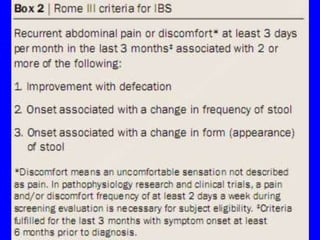
• By fulfillment of symptom-based Rome III criteria
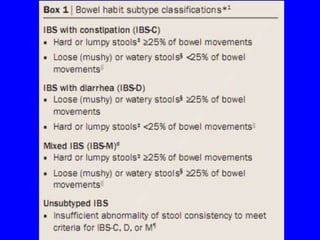
• IBS is further subtyped based on the predominant stool pattern as
IBS -constipation (IBS-C), IBS - diarrhea (IBS-D), or mixed (IBS-M).
• Additional symptoms not part of diagnostic criteria but frequently
reported include:
• <3 bowel movements/ week
• >3 bowel movements/day
• Abnormal stool form
• Straining.
• Rectal urgency
• Sensation of incomplete evacuation.
• Passage of mucus
• Bloating.
IBS: Rome 4
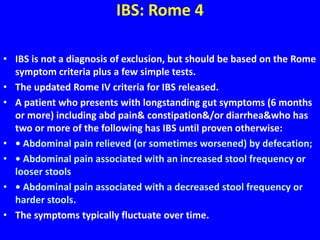
• IBS is not a diagnosis of exclusion, but should be based on the Rome
symptom criteria plus a few simple tests.
• The updated Rome IV criteria for IBS released.
• A patient who presents with longstanding gut symptoms (6 months
or more) including abd pain& constipation&/or diarrhea&who has
two or more of the following has IBS until proven otherwise:
• • Abdominal pain relieved (or sometimes worsened) by defecation;
• • Abdominal pain associated with an increased stool frequency or
looser stools
• • Abdominal pain associated with a decreased stool frequency or
harder stools.
• The symptoms typically fluctuate over time.
IBS: Differential Diagnosis
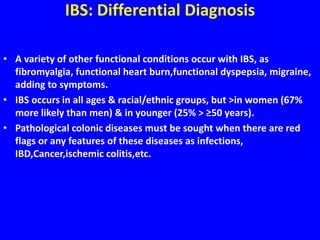
• A variety of other functional conditions occur with IBS, as
fibromyalgia, functional heart burn,functional dyspepsia, migraine,
adding to symptoms.
• IBS occurs in all ages & racial/ethnic groups, but >in women (67%
more likely than men) & in younger (25% > ≥50 years).
• Pathological colonic diseases must be sought when there are red
flags or any features of these diseases as infections,
IBD,Cancer,ischemic colitis,etc.
Evaluation:
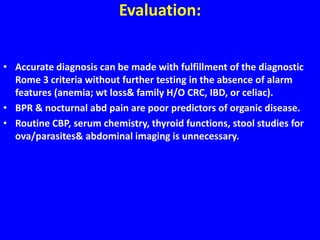
• Accurate diagnosis can be made with fulfillment of the diagnostic
Rome 3 criteria without further testing in the absence of alarm
features (anemia; wt loss& family H/O CRC, IBD, or celiac).
• BPR & nocturnal abd pain are poor predictors of organic disease.
• Routine CBP, serum chemistry, thyroid functions, stool studies for
ova/parasites& abdominal imaging is unnecessary.
Evaluation:
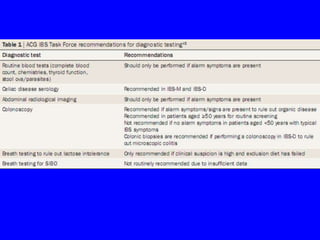
• Testing for celiac disease with serum IgA–based tTG should be
considered in patients with IBS-D or IBS-M symptoms.
• Breath testing for lactase deficiency or SIBO can be considered
based on initial treatment response &/or presence of risk factors.
• Colonoscopy should be pursued only in patients who meet criteria
for colon cancer screening based on age, race& family history.
• Random colon biopsies should be obtained at the time of
colonoscopy to screen for microscopic colitis in patients with IBS-D.
• There is no established role for food allergy testing in IBS.
Management:
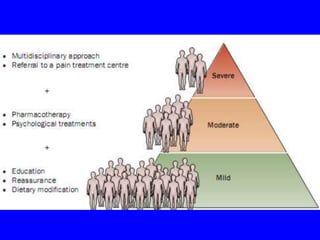
• An essential step is clear diagnosis with explanation& reassurance.
• A strong clinician-patient relationship should be established using a
patient-centered approach focused on effective patient & clinician
communication, using open-ended Qs, actively listening& empathy.
• The growing role of presumed food intolerances (> 50% report
symptom onset following meals), dietary interventions include the
avoidance of trigger foods (caffeine, carbonated beverages, or fatty
foods), increased dietary fiber&various elimination diets to restrict
gluten, lactose, fructose, or FODMAPs (Fermentable
Oligosaccharides, Disaccharides, Monosaccharides& Polyols).
• It is best to involve a dietitian when pursuing elimination diets to
ensure safety & improve efficacy.
• These initial management steps may lead to symptom
improvement in mild symptoms.
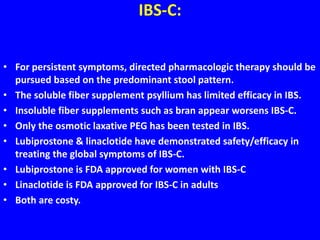
IBS-C:
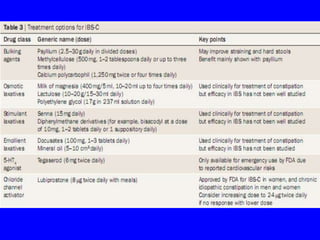
• For persistent symptoms, directed pharmacologic therapy should be
pursued based on the predominant stool pattern.
• The soluble fiber supplement psyllium has limited efficacy in IBS.
• Insoluble fiber supplements such as bran appear worsens IBS-C.
• Only the osmotic laxative PEG has been tested in IBS.
• Lubiprostone & linaclotide have demonstrated safety/efficacy in
treating the global symptoms of IBS-C.
• Lubiprostone is FDA approved for women with IBS-C
• Linaclotide is FDA approved for IBS-C in adults
• Both are costy.
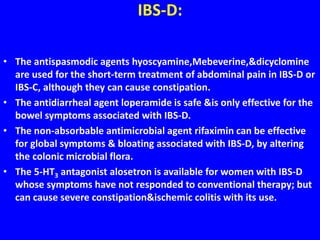
IBS-D:
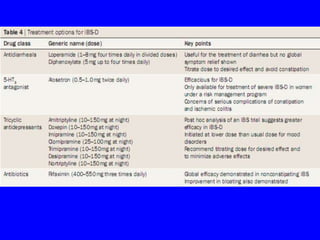
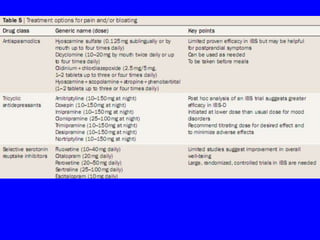
• The antispasmodic agents hyoscyamine,Mebeverine,&dicyclomine
are used for the short-term treatment of abdominal pain in IBS-D or
IBS-C, although they can cause constipation.
• The antidiarrheal agent loperamide is safe &is only effective for the
bowel symptoms associated with IBS-D.
• The non-absorbable antimicrobial agent rifaximin can be effective
for global symptoms & bloating associated with IBS-D, by altering
the colonic microbial flora.
• The 5-HT3 antagonist alosetron is available for women with IBS-D
whose symptoms have not responded to conventional therapy; but
can cause severe constipation&ischemic colitis with its use.
Other therapies:
• When the previously mentioned therapies are unsuccessful, central-
acting agents such as TADs&SSRIs are effective, primarily for overall
symptoms & abdominal pain.
• TADs is preferred in IBS-D given their constipating side effects.
• SSRIs are preferred in IBS-C.
Complementary Therapy
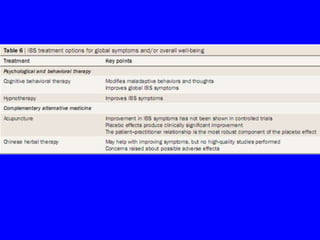
• If pharmacologic therapies are not effective or not desired by the
patient, a variety of complementary interventions considered:
• Prebiotics (nondigestible nutrients intended to encourage desirable
bacterial growth)
• Probiotics
• Herbal medicine
• Cognitive behavioral therapy
• Hypnotherapy
• Acupuncture.
BO5:1
• 1. Irritable bowel syndrome is:
• Common.
• Uncommon.
• Not uncommon.
• Rare.
• Very rare.
BO5:2
• 2. Irritable bowel syndrome is currently
diagnosed by:
• Rome 1 criteria.
• Rome 2 criteria.
• Rome 3 criteria.
• Rome 4.
• None of the above.
BO5:3
• 3. Irritable bowel syndrome is usually
diagnosed by:
• Exclusion.
• Symptom – based.
• Immune markers.
• Serum markers.
• All of the above.
BO5:4
• 4.The following are subtypes of Irritable bowel
syndrome except:
• IBS-C.
• IBS-D.
• IBS-U.
• IBS-S.
• IBS-M.
BO5:5
• 5.The following are parts of Rome 4 criteria for
diagnosis of IBS except:
• Abdominal pain.
• Diarrhea.
• Mucus in stool.
• Improvement with defecation.
• Constipation.
BO5:6
• 6.IBS is diagnosed when the symptoms fulfills
Rome 4 criteria in the absence of:
• Depression.
• Anxiety.
• Red flags.
• Family history of the condition.
• Headache.
BO5:7
• 7.The only lab test which may be needed for
investigating a case of Rome 4 –diagnosed IBS
is :
• CBP.
• GSE.
• GUE.
• Celiac serology.
• Abdominal utrasound.
BO5:8
• 8.The lab test needed for investigating a case
of Rome 4 – diagnosed IBS-D is :
• CBP.
• GSE.
• GUE.
• Celiac serology.
• Abdominal utrasound.
BO5:9
• 9.The lab test needed for investigating a case
of Rome 4 – diagnosed IBS-M is :
• CBP.
• GSE.
• GUE.
• Celiac serology.
• Abdominal utrasound.
BO5:10
• 10.The cornerstone for effective management
of Rome 4- diagnosed IBS is :
• Exclusion of psychiatric diseases.
• Exclusion of pathological conditions.
• Solid diagnosis & reassurance.
• Exhaustive investigations.
• Drug treatment in all cases.
BO5:11
• 11.Treatments of choice for IBS-C include all
except:
• Fiber diet.
• PEG laxative.
• Lactulose.
• Tricyclic antidepressant.
• Linaclotide.
BO5:12
• 12.Treatments of choice for IBS-D include all
except:
• Loperamide.
• Diphenoxylate.
• Antispasmotics.
• SSRI.
• Rifaximine.
BO5:13
• 13.Treatments for severe refractory IBS
include all except:
• Pain clinic referral.
• Cognitive behavioral therapy.
• Surgery.
• Hypnotherapy.
• Acupuncture.
BO5:14
• 14.Red flags that warrants investigations to
exclude an alternative diagnosis for IBS
include all except:
• Anemia.
• Weight loss.
• Age < 50 years.
• Family history of CRC.
• Family history of IBD.
BO5:15
• 15.A 33-year-old female sales manager presents for management
of uninvestigated crampy lower abd pain, diarrhea&bloating
that have been troubling her for 15 years. The pain occurs
frequently after meals often relieved for a few minutes by
defecation; loose stools are common with pain. No family H/O
CRC but there is a family H/O celiac dis in her mother No other
red flags (no wt loss, vomiting, bleeding, or other worrying
symptoms). She is well nourished & weighs 77 kg; physical exam
is normal. What should be done next:
• A: Perform a colonoscopy?
• B: Screen for CD serologically on a normal diet?
• C: Perform an OGD with biopsies?
• D: treat the symptoms empirically & reassess?

GIT 4th IBS 2017

  • 1.
    Dr. Mohamed Alshekhani Professorin Medicine MBChB-CABM-FRCP-EBGH 2017 1 Irritable bowel syndrome (IBS):
  • 2.
    IBS: • A heterogeneoussymptom complex characterized by abdominal pain &altered bowel habits. • A chronic condition affects 10- 15% of the general population • Lacks a single unifying pathophysiology & biomarkers.
  • 3.
    IBS:Diagnosis • By fulfillmentof symptom-based Rome III criteria • IBS is further subtyped based on the predominant stool pattern as IBS -constipation (IBS-C), IBS - diarrhea (IBS-D), or mixed (IBS-M). • Additional symptoms not part of diagnostic criteria but frequently reported include: • <3 bowel movements/ week • >3 bowel movements/day • Abnormal stool form • Straining. • Rectal urgency • Sensation of incomplete evacuation. • Passage of mucus • Bloating.
  • 6.
    IBS: Rome 4 •IBS is not a diagnosis of exclusion, but should be based on the Rome symptom criteria plus a few simple tests. • The updated Rome IV criteria for IBS released. • A patient who presents with longstanding gut symptoms (6 months or more) including abd pain& constipation&/or diarrhea&who has two or more of the following has IBS until proven otherwise: • • Abdominal pain relieved (or sometimes worsened) by defecation; • • Abdominal pain associated with an increased stool frequency or looser stools • • Abdominal pain associated with a decreased stool frequency or harder stools. • The symptoms typically fluctuate over time.
  • 7.
    IBS: Differential Diagnosis •A variety of other functional conditions occur with IBS, as fibromyalgia, functional heart burn,functional dyspepsia, migraine, adding to symptoms. • IBS occurs in all ages & racial/ethnic groups, but >in women (67% more likely than men) & in younger (25% > ≥50 years). • Pathological colonic diseases must be sought when there are red flags or any features of these diseases as infections, IBD,Cancer,ischemic colitis,etc.
  • 8.
    Evaluation: • Accurate diagnosiscan be made with fulfillment of the diagnostic Rome 3 criteria without further testing in the absence of alarm features (anemia; wt loss& family H/O CRC, IBD, or celiac). • BPR & nocturnal abd pain are poor predictors of organic disease. • Routine CBP, serum chemistry, thyroid functions, stool studies for ova/parasites& abdominal imaging is unnecessary.
  • 9.
    Evaluation: • Testing forceliac disease with serum IgA–based tTG should be considered in patients with IBS-D or IBS-M symptoms. • Breath testing for lactase deficiency or SIBO can be considered based on initial treatment response &/or presence of risk factors. • Colonoscopy should be pursued only in patients who meet criteria for colon cancer screening based on age, race& family history. • Random colon biopsies should be obtained at the time of colonoscopy to screen for microscopic colitis in patients with IBS-D. • There is no established role for food allergy testing in IBS.
  • 11.
    Management: • An essentialstep is clear diagnosis with explanation& reassurance. • A strong clinician-patient relationship should be established using a patient-centered approach focused on effective patient & clinician communication, using open-ended Qs, actively listening& empathy. • The growing role of presumed food intolerances (> 50% report symptom onset following meals), dietary interventions include the avoidance of trigger foods (caffeine, carbonated beverages, or fatty foods), increased dietary fiber&various elimination diets to restrict gluten, lactose, fructose, or FODMAPs (Fermentable Oligosaccharides, Disaccharides, Monosaccharides& Polyols). • It is best to involve a dietitian when pursuing elimination diets to ensure safety & improve efficacy. • These initial management steps may lead to symptom improvement in mild symptoms.
  • 13.
    IBS-C: • For persistentsymptoms, directed pharmacologic therapy should be pursued based on the predominant stool pattern. • The soluble fiber supplement psyllium has limited efficacy in IBS. • Insoluble fiber supplements such as bran appear worsens IBS-C. • Only the osmotic laxative PEG has been tested in IBS. • Lubiprostone & linaclotide have demonstrated safety/efficacy in treating the global symptoms of IBS-C. • Lubiprostone is FDA approved for women with IBS-C • Linaclotide is FDA approved for IBS-C in adults • Both are costy.
  • 15.
    IBS-D: • The antispasmodicagents hyoscyamine,Mebeverine,&dicyclomine are used for the short-term treatment of abdominal pain in IBS-D or IBS-C, although they can cause constipation. • The antidiarrheal agent loperamide is safe &is only effective for the bowel symptoms associated with IBS-D. • The non-absorbable antimicrobial agent rifaximin can be effective for global symptoms & bloating associated with IBS-D, by altering the colonic microbial flora. • The 5-HT3 antagonist alosetron is available for women with IBS-D whose symptoms have not responded to conventional therapy; but can cause severe constipation&ischemic colitis with its use.
  • 18.
    Other therapies: • Whenthe previously mentioned therapies are unsuccessful, central- acting agents such as TADs&SSRIs are effective, primarily for overall symptoms & abdominal pain. • TADs is preferred in IBS-D given their constipating side effects. • SSRIs are preferred in IBS-C.
  • 19.
    Complementary Therapy • Ifpharmacologic therapies are not effective or not desired by the patient, a variety of complementary interventions considered: • Prebiotics (nondigestible nutrients intended to encourage desirable bacterial growth) • Probiotics • Herbal medicine • Cognitive behavioral therapy • Hypnotherapy • Acupuncture.
  • 21.
    BO5:1 • 1. Irritablebowel syndrome is: • Common. • Uncommon. • Not uncommon. • Rare. • Very rare.
  • 22.
    BO5:2 • 2. Irritablebowel syndrome is currently diagnosed by: • Rome 1 criteria. • Rome 2 criteria. • Rome 3 criteria. • Rome 4. • None of the above.
  • 23.
    BO5:3 • 3. Irritablebowel syndrome is usually diagnosed by: • Exclusion. • Symptom – based. • Immune markers. • Serum markers. • All of the above.
  • 24.
    BO5:4 • 4.The followingare subtypes of Irritable bowel syndrome except: • IBS-C. • IBS-D. • IBS-U. • IBS-S. • IBS-M.
  • 25.
    BO5:5 • 5.The followingare parts of Rome 4 criteria for diagnosis of IBS except: • Abdominal pain. • Diarrhea. • Mucus in stool. • Improvement with defecation. • Constipation.
  • 26.
    BO5:6 • 6.IBS isdiagnosed when the symptoms fulfills Rome 4 criteria in the absence of: • Depression. • Anxiety. • Red flags. • Family history of the condition. • Headache.
  • 27.
    BO5:7 • 7.The onlylab test which may be needed for investigating a case of Rome 4 –diagnosed IBS is : • CBP. • GSE. • GUE. • Celiac serology. • Abdominal utrasound.
  • 28.
    BO5:8 • 8.The labtest needed for investigating a case of Rome 4 – diagnosed IBS-D is : • CBP. • GSE. • GUE. • Celiac serology. • Abdominal utrasound.
  • 29.
    BO5:9 • 9.The labtest needed for investigating a case of Rome 4 – diagnosed IBS-M is : • CBP. • GSE. • GUE. • Celiac serology. • Abdominal utrasound.
  • 30.
    BO5:10 • 10.The cornerstonefor effective management of Rome 4- diagnosed IBS is : • Exclusion of psychiatric diseases. • Exclusion of pathological conditions. • Solid diagnosis & reassurance. • Exhaustive investigations. • Drug treatment in all cases.
  • 31.
    BO5:11 • 11.Treatments ofchoice for IBS-C include all except: • Fiber diet. • PEG laxative. • Lactulose. • Tricyclic antidepressant. • Linaclotide.
  • 32.
    BO5:12 • 12.Treatments ofchoice for IBS-D include all except: • Loperamide. • Diphenoxylate. • Antispasmotics. • SSRI. • Rifaximine.
  • 33.
    BO5:13 • 13.Treatments forsevere refractory IBS include all except: • Pain clinic referral. • Cognitive behavioral therapy. • Surgery. • Hypnotherapy. • Acupuncture.
  • 34.
    BO5:14 • 14.Red flagsthat warrants investigations to exclude an alternative diagnosis for IBS include all except: • Anemia. • Weight loss. • Age < 50 years. • Family history of CRC. • Family history of IBD.
  • 35.
    BO5:15 • 15.A 33-year-oldfemale sales manager presents for management of uninvestigated crampy lower abd pain, diarrhea&bloating that have been troubling her for 15 years. The pain occurs frequently after meals often relieved for a few minutes by defecation; loose stools are common with pain. No family H/O CRC but there is a family H/O celiac dis in her mother No other red flags (no wt loss, vomiting, bleeding, or other worrying symptoms). She is well nourished & weighs 77 kg; physical exam is normal. What should be done next: • A: Perform a colonoscopy? • B: Screen for CD serologically on a normal diet? • C: Perform an OGD with biopsies? • D: treat the symptoms empirically & reassess?