Forces 
Sarah Jones 
eastloshigh.com
Forces around you 
When you lie in bed at night everything is so 
still it seems nothing moves. But your chest 
moves up and down as you breathe, and your 
heart is pumping blood throughout your body. 
While this is happening the Earth is hurtling 
through space at 100 000 kilometres per hour! 
All this motion is caused by forces, which 
affect you every moment of your life.
• Forces are pushes or pulls. 
• Forces can start objects moving, and they can 
stop, speed up, slow down, or change the 
direction of moving objects. They can lift 
things, or cause them to turn, bend or twist.
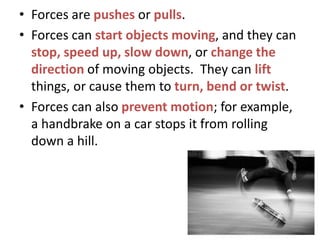
Forces can also prevent motion; for example, 
a handbrake on a car stops it from rolling 
down a hill. 
wall.alphacoders.com
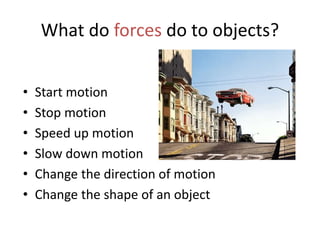
What do forces do to objects? 
• Start motion 
• Stop motion 
• Speed up motion 
• Slow down motion 
• Change the direction of motion 
• Change the shape of an object
Contact Forces 
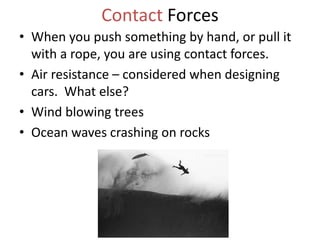
• When you push something by hand, or pull it 
with a rope, you are using contact forces. 
• Air resistance 
• Wind blowing trees 
• Ocean waves crashing on rocks
Non-contact Forces 
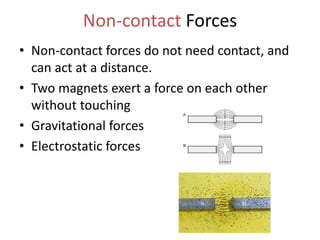
• Non-contact forces do not need contact, and 
can act at a distance. 
• Two magnets exert a force on each other 
without touching 
• Gravitational forces 
• Electrostatic forces
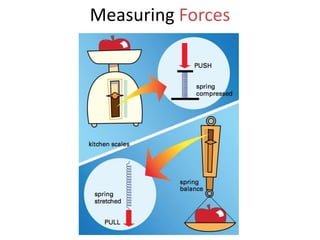
Measuring Forces
The unit used to measure force is the newton (N), 
named after Sir Isaac Newton.
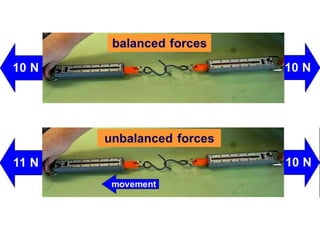
Balanced and Unbalanced Forces
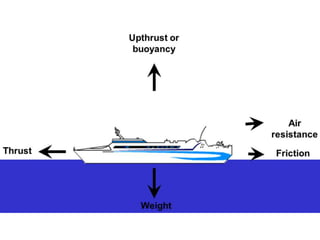
Drawing force diagrams
• Thrust – a forward push 
• Upthrust – the upwards force on a body in a 
liquid or a gas
Friction 
• Friction is an example of a contact force. 
• It occurs whenever two surfaces in contact 
move past each other. 
• Friction always opposes motion. 
htpoint.com
Mass and Weight 
• In the 17th century Sir Isaac Newton came to 
the conclusion that gravity is the force of 
attraction between objects, and that the size 
of this force depends on the mass of the 
objects. 
• The mass of an object 
is the amount of 
matter in it.
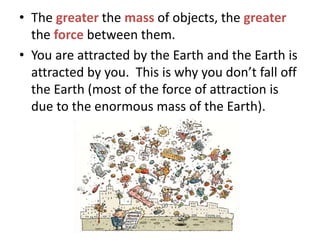
• The greater the mass of objects, the greater 
the force between them. 
• You are attracted by the Earth and the Earth is 
attracted by you. This is why you don’t fall off 
the Earth (most of the force of attraction is 
due to the enormous mass of the Earth).
• Mass is the amount of matter in an object 
and is measured in kilograms. Mass is not a 
force. 
• Mass will have the same value anywhere in 
the Universe. Including space.
Spring balances and scales actually measure 
the force of attraction between an object and 
the Earth. This is what weight is. Because it is 
a force it is measured in newtons.
• Weight is a force and is caused by the pull of 
gravity acting on a mass. Like other forces, 
weight is measured in newtons. 
• Weight has different values depending on 
where you are in the Universe.
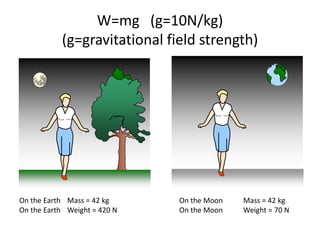
W=mg (g=10N/kg) 
(g=gravitational field strength) 
On the Earth Mass = 42 kg On the Moon Mass = 42 kg 
On the Earth Weight = 420 N On the Moon Weight = 70 N

Forces

  • 1.
    Forces Sarah Jones eastloshigh.com
  • 2.
    Forces around you When you lie in bed at night everything is so still it seems nothing moves. But your chest moves up and down as you breathe, and your heart is pumping blood throughout your body. While this is happening the Earth is hurtling through space at 100 000 kilometres per hour! All this motion is caused by forces, which affect you every moment of your life.
  • 3.
    • Forces arepushes or pulls. • Forces can start objects moving, and they can stop, speed up, slow down, or change the direction of moving objects. They can lift things, or cause them to turn, bend or twist.
  • 4.
    Forces can alsoprevent motion; for example, a handbrake on a car stops it from rolling down a hill. wall.alphacoders.com
  • 5.
    What do forcesdo to objects? • Start motion • Stop motion • Speed up motion • Slow down motion • Change the direction of motion • Change the shape of an object
  • 6.
    Contact Forces •When you push something by hand, or pull it with a rope, you are using contact forces. • Air resistance • Wind blowing trees • Ocean waves crashing on rocks
  • 7.
    Non-contact Forces •Non-contact forces do not need contact, and can act at a distance. • Two magnets exert a force on each other without touching • Gravitational forces • Electrostatic forces
  • 8.
  • 9.
    The unit usedto measure force is the newton (N), named after Sir Isaac Newton.
  • 10.
  • 13.
  • 14.
    • Thrust –a forward push • Upthrust – the upwards force on a body in a liquid or a gas
  • 16.
    Friction • Frictionis an example of a contact force. • It occurs whenever two surfaces in contact move past each other. • Friction always opposes motion. htpoint.com
  • 17.
    Mass and Weight • In the 17th century Sir Isaac Newton came to the conclusion that gravity is the force of attraction between objects, and that the size of this force depends on the mass of the objects. • The mass of an object is the amount of matter in it.
  • 18.
    • The greaterthe mass of objects, the greater the force between them. • You are attracted by the Earth and the Earth is attracted by you. This is why you don’t fall off the Earth (most of the force of attraction is due to the enormous mass of the Earth).
  • 19.
    • Mass isthe amount of matter in an object and is measured in kilograms. Mass is not a force. • Mass will have the same value anywhere in the Universe. Including space.
  • 20.
    Spring balances andscales actually measure the force of attraction between an object and the Earth. This is what weight is. Because it is a force it is measured in newtons.
  • 21.
    • Weight isa force and is caused by the pull of gravity acting on a mass. Like other forces, weight is measured in newtons. • Weight has different values depending on where you are in the Universe.
  • 22.
    W=mg (g=10N/kg) (g=gravitationalfield strength) On the Earth Mass = 42 kg On the Moon Mass = 42 kg On the Earth Weight = 420 N On the Moon Weight = 70 N