Reproduction & Development of Phylum
Nematoda & Phylum Kinorhyncha
CONTENTS
• Introduction to phylum Kinorhyncha
• Introduction to phylum Nematoda
1. Characteristics of phylum Nematoda
2. Locomotion in Nematodes
3. External and Internal features
4. Feeding and Digestive systems
5. Reproduction and development in Nematodes
6. Some other organ systems
Phylum Kinorhyncha
• Kinorhynchs are small [less than 1mm long], elongate, bilaterally
symmetrical worms found exclusively in marine environments, where
they live in mud and sand.
• Because they have no external cilia or locomotor appendages, they
simply burrow through the mud and sand with their snouts.
• Infact, the phylum takes its name[kinorhyncha, motion+rhynchos,
snout] from this method of locomotion. The phylum Kinorhyncha
contains about 150 known species.
Phylum Kinorhyncha
• The body surface of a kinorhynch is devoid of cilia and is
composed of 13 or 14 definite units called zonites.
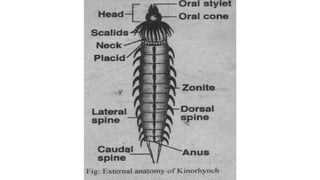
• The head, represented by zonite 1, bears the mouth, an oral cone,
and spines. The neck, represented by zonite 2, contains spines
called scalids and plates called placids.
Phylum Kinorhyncha
• The head can be re-tracted into the neck.
• The trunk consists of the remaining 11 or 12 zonites and terminates
with the anus.
• Each trunk zonite bears a pair of lateral spines and one dorsal spine.
• The body wall consists of a cuticle, epidermis, and two pairs of
muscles, dorsolateral and ventrolateral.
• The pseudocoelom is large and contains amoeboid cells.
Phylum Nematoda
• Nematodes (nem-a-todes) (Gr. nematos, thread) or roundworms
are some of the most abundant animals on earth—some five bil-
lion may be in every acre (4,046 square meters) of fertile garden
soil.
• Zoologists estimate that the number of roundworm species
ranges from 16,000 to 500,000. Roundworms feed on every con-
ceivable source of organic matter—from rotting substances to
the living tissues of other invertebrates, vertebrates, and plants.
• They range in size from microscopic to several meters long.
Phylum Nematoda
• Many nematodes are parasites of plants or animals; most others are
free-living in marine, freshwater, or soil habitats.
• Some nematodes play an important role in recycling nutrients in soils
and bottom sediments.
• Except in their sensory structures, nematodes lack cilia,a characteristic
they share with arthropods.
• Also in common with some arthropods, the sperms of nematodes is
amoeboid. Zoologists recognize two classes of nematodes.
Characters Of Phylum Nematoda
Characteristics of the phylum Nematoda include:
1. Triploblastic, bilateral, vermiform (resembling a worm in
shape; long and slender), unsegmented, pseudocoelomate.
2. Body round in cross section and covered by a layered cuticle;
molting usually accompanies growth in juveniles.
3. Complete digestive tract; mouth usually surrounded by lips
bearing sense organs.
4. Most with unique excretory system comprised of one or two
renette cells or a set of collecting tubules.
5. Body wall has only longitudinal muscles.
External Features
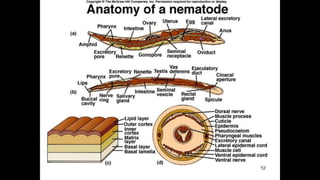
• A typical nematode body is slender, elongate, cylindrical, and
tapered at both ends. Much of the success of nematodes is due to their
outer, non-cellular, collagenous cuticle, that is continuous with the
foregut, hindgut, sense organs and other parts of the female
reproductive system.
• The cuticle may be smooth, or it may contain spines, bristles,
papillae (small, nipplelike projections), warts, or ridges, all of
which are of taxonomic significance. Three primary layers make
up the cuticle: cortex, matrix layer, and basal layer.
CONT...
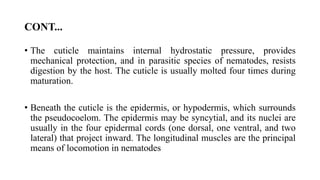
• The cuticle maintains internal hydrostatic pressure, provides
mechanical protection, and in parasitic species of nematodes, resists
digestion by the host. The cuticle is usually molted four times during
maturation.
• Beneath the cuticle is the epidermis, or hypodermis, which surrounds
the pseudocoelom. The epidermis may be syncytial, and its nuclei are
usually in the four epidermal cords (one dorsal, one ventral, and two
lateral) that project inward. The longitudinal muscles are the principal
means of locomotion in nematodes
Locomotion In Nematodes
• Contraction of these muscles results in undulatory waves that pass
from the anterior to posterior end of the animal, creating characteristic
thrashing movements.
• Nematodes lack circular muscles and therefore cannot crawl as do
worms with more complex musculature.
• Some nematodes have lips surrounding the mouth, and some species
bear spines or teeth on or near the lips, In others, the lips have
disappeared.
CONT...
• Some roundworms have head shields that afford protection sensory
organs include amphids, phasmids, or ocelli. Amphids are anterior
depressions in the cuticle that contain modified cilia and function in
chemoreception.Phasmids are near the anus and also function in
chemoreception.
• The presence or absence of these organs determines the taxonomic
class to which nematodes belong. Paired ocelli (eyes) are present in
aquatic nematodes.
Internal Features
• The nematode pseudocoelom is a spacious, fluid-filled cavity that
contains the visceral organs and forms a hydrostatic skeleton.
• All nematodes are round because the body muscles contracting
against the pseudocoelomic fluid generate an equal outward force in
all directions.
Feeding and the Digestive System
• Depending on the environment, nematodes are capable of feeding
on a wide variety of foods; they may be carnivores, herbivores, om-
nivores, or saprobes (saprotrophs) that consume decomposing or-
ganisms, or parasitic species that feed on blood and tissue fluids of
their hosts.
• Nematodes have a complete digestive system consisting of
a mouth, which may have teeth, jaws, or stylets (sharp, pointed
structures); buccal cavity; muscular pharynx; long, tubular intes-
tine where digestion and absorption occur; short rectum; and
anus. Hydrostatic pressure in the pseudocoelom and the pump-
ing action of the pharynx push food through the alimentary canal.
Reproduction and Development In Nematodes
• Most nematodes are dioecious and dimorphic, with the males being
smaller than the females. The long coiled gonads lie free in the
pseudocoelom.
• The female system consists of a pair of convoluted ovaries. Each
ovary is continuous with an oviduct whose proximal end is swollen to
form a seminal receptacle. Each oviduct becomes a tubular uterus; the
two uteri unite to form a vagina that opens to the outside through a
genital pore.
Reproduction and Development
• The male system consists of a single testis, which is continuous with a
vas deferens that eventually expands into a seminal vesicle. The
seminal vesicle connects to the cloaca.
• Males are commonly armed with a posterior flap of tissue called a
bursa. The bursa aids the male in the transfer of sperm to the female
genital pore during copulation.
• After copulation, hydrostatic forces in the pseudocoelom move each
fertilized egg to the gonopore[genital pore].
CONT...
• The number of eggs produced varies with the species; some nematodes
produce only several hundred, whereas others may produce hundreds
of thousands daily.
• Some nematodes give birth to larvae (ovoviviparity). External factors,
such as temperature and moisture, influence the development and
hatching of the eggs.
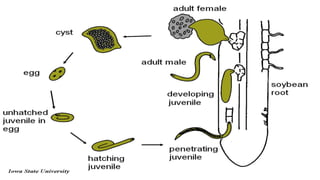
• Hatching produces a larva(some parasitologists refer to it as a
juvenile) that has most adult structures. The larva (juvenile) undergoes
four molts, although in some species, the first one or two molts may
occur before the eggs hatch.
Other Organ Systems
• Nematodes accomplish osmoregulation and excretion of nitrogenous
waste products (ammonia, urea) with two unique systems. The
glandular system is in aquatic species and consists of ventral gland
cells, called renettes, posterior to the pharynx.
• Each gland absorbs wastes from the pseuodocoelom and empties them
to the outside through an excretory pore. Parasitic nematodes have a
more advanced system, called the tubular system, that develops from
the renette system.
Other Organ Systems
• In this system, the renettes unite to form a large canal, which opens to
the outside via an excretory pore.
• The nervous system consists of an anterior nerve ring. Nerves extend
anteriorly and posteriorly; many connect to each other via
commissures. Certain neuroendocrine secretions are involved in
growth, molting, cuticle formation, and metamorphosis.
Thank You

Phylum nematoda & phylum kinorhyncha

  • 1.
    Reproduction & Developmentof Phylum Nematoda & Phylum Kinorhyncha
  • 2.
    CONTENTS • Introduction tophylum Kinorhyncha • Introduction to phylum Nematoda 1. Characteristics of phylum Nematoda 2. Locomotion in Nematodes 3. External and Internal features 4. Feeding and Digestive systems 5. Reproduction and development in Nematodes 6. Some other organ systems
  • 3.
    Phylum Kinorhyncha • Kinorhynchsare small [less than 1mm long], elongate, bilaterally symmetrical worms found exclusively in marine environments, where they live in mud and sand. • Because they have no external cilia or locomotor appendages, they simply burrow through the mud and sand with their snouts. • Infact, the phylum takes its name[kinorhyncha, motion+rhynchos, snout] from this method of locomotion. The phylum Kinorhyncha contains about 150 known species.
  • 4.
    Phylum Kinorhyncha • Thebody surface of a kinorhynch is devoid of cilia and is composed of 13 or 14 definite units called zonites. • The head, represented by zonite 1, bears the mouth, an oral cone, and spines. The neck, represented by zonite 2, contains spines called scalids and plates called placids.
  • 6.
    Phylum Kinorhyncha • Thehead can be re-tracted into the neck. • The trunk consists of the remaining 11 or 12 zonites and terminates with the anus. • Each trunk zonite bears a pair of lateral spines and one dorsal spine. • The body wall consists of a cuticle, epidermis, and two pairs of muscles, dorsolateral and ventrolateral. • The pseudocoelom is large and contains amoeboid cells.
  • 7.
    Phylum Nematoda • Nematodes(nem-a-todes) (Gr. nematos, thread) or roundworms are some of the most abundant animals on earth—some five bil- lion may be in every acre (4,046 square meters) of fertile garden soil. • Zoologists estimate that the number of roundworm species ranges from 16,000 to 500,000. Roundworms feed on every con- ceivable source of organic matter—from rotting substances to the living tissues of other invertebrates, vertebrates, and plants. • They range in size from microscopic to several meters long.
  • 8.
    Phylum Nematoda • Manynematodes are parasites of plants or animals; most others are free-living in marine, freshwater, or soil habitats. • Some nematodes play an important role in recycling nutrients in soils and bottom sediments. • Except in their sensory structures, nematodes lack cilia,a characteristic they share with arthropods. • Also in common with some arthropods, the sperms of nematodes is amoeboid. Zoologists recognize two classes of nematodes.
  • 9.
    Characters Of PhylumNematoda Characteristics of the phylum Nematoda include: 1. Triploblastic, bilateral, vermiform (resembling a worm in shape; long and slender), unsegmented, pseudocoelomate. 2. Body round in cross section and covered by a layered cuticle; molting usually accompanies growth in juveniles. 3. Complete digestive tract; mouth usually surrounded by lips bearing sense organs. 4. Most with unique excretory system comprised of one or two renette cells or a set of collecting tubules. 5. Body wall has only longitudinal muscles.
  • 10.
    External Features • Atypical nematode body is slender, elongate, cylindrical, and tapered at both ends. Much of the success of nematodes is due to their outer, non-cellular, collagenous cuticle, that is continuous with the foregut, hindgut, sense organs and other parts of the female reproductive system. • The cuticle may be smooth, or it may contain spines, bristles, papillae (small, nipplelike projections), warts, or ridges, all of which are of taxonomic significance. Three primary layers make up the cuticle: cortex, matrix layer, and basal layer.
  • 12.
    CONT... • The cuticlemaintains internal hydrostatic pressure, provides mechanical protection, and in parasitic species of nematodes, resists digestion by the host. The cuticle is usually molted four times during maturation. • Beneath the cuticle is the epidermis, or hypodermis, which surrounds the pseudocoelom. The epidermis may be syncytial, and its nuclei are usually in the four epidermal cords (one dorsal, one ventral, and two lateral) that project inward. The longitudinal muscles are the principal means of locomotion in nematodes
  • 13.
    Locomotion In Nematodes •Contraction of these muscles results in undulatory waves that pass from the anterior to posterior end of the animal, creating characteristic thrashing movements. • Nematodes lack circular muscles and therefore cannot crawl as do worms with more complex musculature. • Some nematodes have lips surrounding the mouth, and some species bear spines or teeth on or near the lips, In others, the lips have disappeared.
  • 14.
    CONT... • Some roundwormshave head shields that afford protection sensory organs include amphids, phasmids, or ocelli. Amphids are anterior depressions in the cuticle that contain modified cilia and function in chemoreception.Phasmids are near the anus and also function in chemoreception. • The presence or absence of these organs determines the taxonomic class to which nematodes belong. Paired ocelli (eyes) are present in aquatic nematodes.
  • 15.
    Internal Features • Thenematode pseudocoelom is a spacious, fluid-filled cavity that contains the visceral organs and forms a hydrostatic skeleton. • All nematodes are round because the body muscles contracting against the pseudocoelomic fluid generate an equal outward force in all directions.
  • 16.
    Feeding and theDigestive System • Depending on the environment, nematodes are capable of feeding on a wide variety of foods; they may be carnivores, herbivores, om- nivores, or saprobes (saprotrophs) that consume decomposing or- ganisms, or parasitic species that feed on blood and tissue fluids of their hosts. • Nematodes have a complete digestive system consisting of a mouth, which may have teeth, jaws, or stylets (sharp, pointed structures); buccal cavity; muscular pharynx; long, tubular intes- tine where digestion and absorption occur; short rectum; and anus. Hydrostatic pressure in the pseudocoelom and the pump- ing action of the pharynx push food through the alimentary canal.
  • 17.
    Reproduction and DevelopmentIn Nematodes • Most nematodes are dioecious and dimorphic, with the males being smaller than the females. The long coiled gonads lie free in the pseudocoelom. • The female system consists of a pair of convoluted ovaries. Each ovary is continuous with an oviduct whose proximal end is swollen to form a seminal receptacle. Each oviduct becomes a tubular uterus; the two uteri unite to form a vagina that opens to the outside through a genital pore.
  • 19.
    Reproduction and Development •The male system consists of a single testis, which is continuous with a vas deferens that eventually expands into a seminal vesicle. The seminal vesicle connects to the cloaca. • Males are commonly armed with a posterior flap of tissue called a bursa. The bursa aids the male in the transfer of sperm to the female genital pore during copulation. • After copulation, hydrostatic forces in the pseudocoelom move each fertilized egg to the gonopore[genital pore].
  • 20.
    CONT... • The numberof eggs produced varies with the species; some nematodes produce only several hundred, whereas others may produce hundreds of thousands daily. • Some nematodes give birth to larvae (ovoviviparity). External factors, such as temperature and moisture, influence the development and hatching of the eggs. • Hatching produces a larva(some parasitologists refer to it as a juvenile) that has most adult structures. The larva (juvenile) undergoes four molts, although in some species, the first one or two molts may occur before the eggs hatch.
  • 21.
    Other Organ Systems •Nematodes accomplish osmoregulation and excretion of nitrogenous waste products (ammonia, urea) with two unique systems. The glandular system is in aquatic species and consists of ventral gland cells, called renettes, posterior to the pharynx. • Each gland absorbs wastes from the pseuodocoelom and empties them to the outside through an excretory pore. Parasitic nematodes have a more advanced system, called the tubular system, that develops from the renette system.
  • 22.
    Other Organ Systems •In this system, the renettes unite to form a large canal, which opens to the outside via an excretory pore. • The nervous system consists of an anterior nerve ring. Nerves extend anteriorly and posteriorly; many connect to each other via commissures. Certain neuroendocrine secretions are involved in growth, molting, cuticle formation, and metamorphosis.
  • 23.