Phyla
Echinodermata
Sarah Doyle & Lauren Dombkoski
Echinoderms
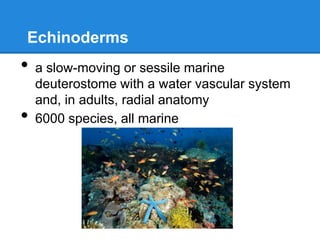
•   a slow-moving or sessile marine
    deuterostome with a water vascular system
    and, in adults, radial anatomy
•   6000 species, all marine
Living Echinoderms are divided
into six classes...
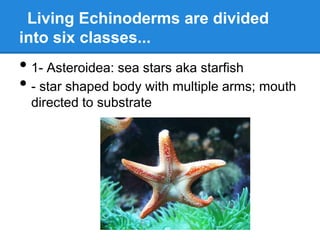
• 1- Asteroidea: sea stars aka starfish
• - star shaped body with multiple arms; mouth
 directed to substrate
Classes, continued
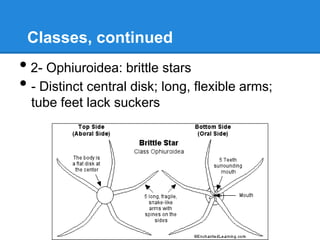
• 2- Ophiuroidea: brittle stars
• - Distinct central disk; long, flexible arms;
  tube feet lack suckers
Classes, continued
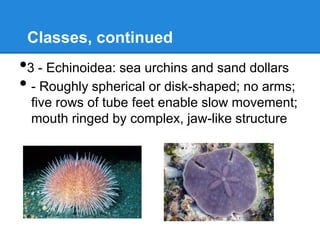
•3 - Echinoidea: sea urchins and sand dollars
• - Roughly spherical or disk-shaped; no arms;
 five rows of tube feet enable slow movement;
 mouth ringed by complex, jaw-like structure
Classes, continued
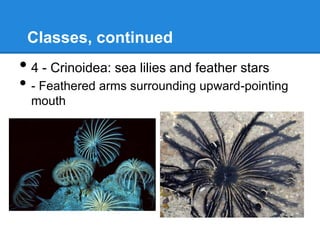
• 4 - Crinoidea: sea lilies and feather stars
• - Feathered arms surrounding upward-pointing
  mouth
Classes, continued
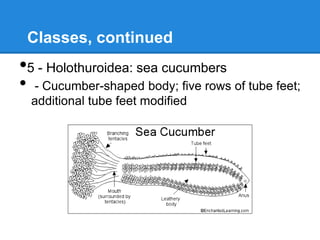
•5 - Holothuroidea: sea cucumbers
•   - Cucumber-shaped body; five rows of tube feet;
    additional tube feet modified
Classes, continued
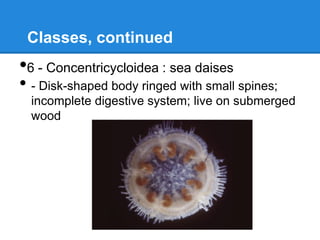
•6 - Concentricycloidea : sea daises
• - Disk-shaped body ringed with small spines;
  incomplete digestive system; live on submerged
  wood
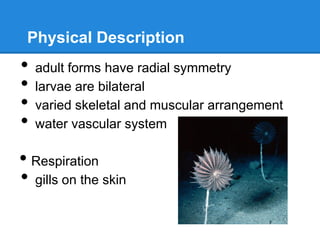
Physical Description
•   adult forms have radial symmetry
•   larvae are bilateral
•   varied skeletal and muscular arrangement
•   water vascular system

• Respiration
• gills on the skin
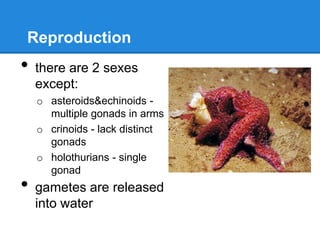
Reproduction
•   there are 2 sexes
    except:
    o asteroids&echinoids -
      multiple gonads in arms
    o crinoids - lack distinct
      gonads
    o holothurians - single
      gonad
•   gametes are released
    into water
Characteristics
•Behavior
• most are immobile
• water vascular system originally for food
    collection but now evolved for locomotion
•   Communication
•   non-central nervous system: movement is
    sense from all sides
•   Development
•   deuterostomes: anus forms first, then mouth
Food

• Crinoidea
• sit with arms out and collect passing food
• Asteroidea
• predators or scavengers; everts stomach
    and secretes digestive enzymes on prey;
    suspenson feeders, too
•   Ophuroidea
•   imcomplete digestive system; predators,
    deposit feeders, and scavengers
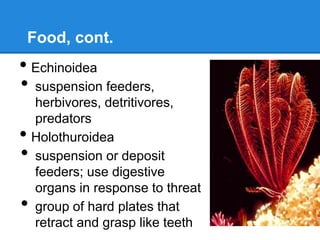
Food, cont.
• Echinoidea
• suspension feeders,
    herbivores, detritivores,
    predators
•   Holothuroidea
•   suspension or deposit
    feeders; use digestive
    organs in response to threat
•   group of hard plates that
    retract and grasp like teeth
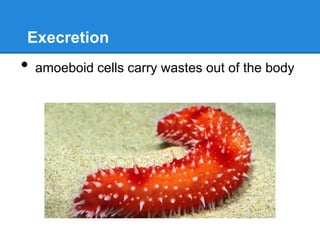
Execretion
•   amoeboid cells carry wastes out of the body
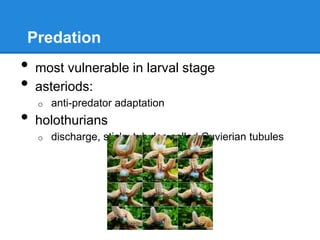
Predation
•   most vulnerable in larval stage
•   asteriods:
    o   anti-predator adaptation
•   holothurians
    o   discharge, sticky tubules called Cuvierian tubules
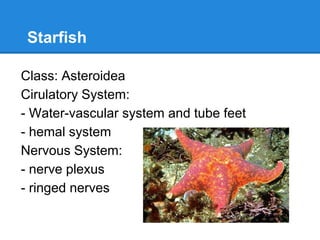
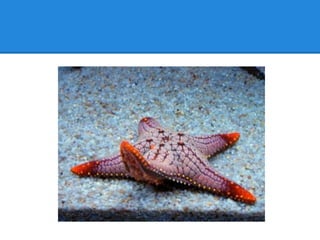
Starfish

Class: Asteroidea
Cirulatory System:
- Water-vascular system and tube feet
- hemal system
Nervous System:
- nerve plexus
- ringed nerves
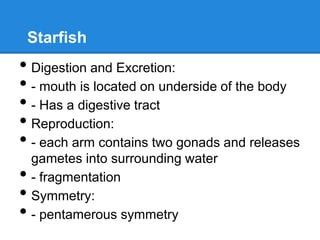
Starfish
• Digestion and Excretion:
• - mouth is located on underside of the body
• - Has a digestive tract
• Reproduction:
• - each arm contains two gonads and releases
    gametes into surrounding water
•   - fragmentation
•   Symmetry:
•   - pentamerous symmetry
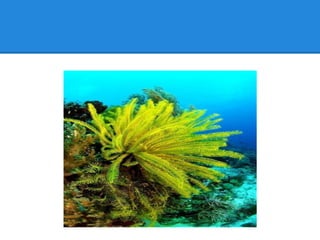
Feather Stars
• Class: Crinoidea
•Circulatory System:
• - Water-vascular system and tube feet
• - do not use tube feet for locomotion
• Nervous System:
•- Has small sensory cells throughout their skin
•- Central nervous ring around the mouth,
arms, and base
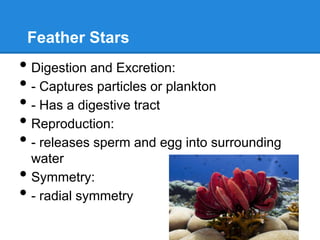
Feather Stars
• Digestion and Excretion:
• - Captures particles or plankton
• - Has a digestive tract
• Reproduction:
• - releases sperm and egg into surrounding
    water
•   Symmetry:
•   - radial symmetry
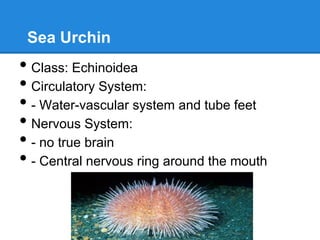
Sea Urchin
• Class: Echinoidea
• Circulatory System:
• - Water-vascular system and tube feet
• Nervous System:
• - no true brain
• - Central nervous ring around the mouth
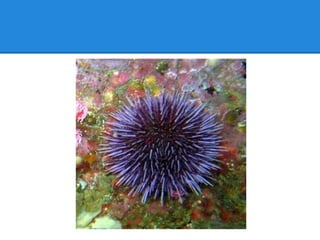
Sea Urchin
• Digestion and Excretion:
•- Has a mouth containing teeth, jaw, and
tongue like structure
• - Has a digestive tract
• Reproduction:
• - releases sperm and egg into surrounding
  water
• Symmetry:
• - radial symmetry
Phyla Echinodermata

Phyla Echinodermata

  • 1.
  • 2.
    Echinoderms • a slow-moving or sessile marine deuterostome with a water vascular system and, in adults, radial anatomy • 6000 species, all marine
  • 3.
    Living Echinoderms aredivided into six classes... • 1- Asteroidea: sea stars aka starfish • - star shaped body with multiple arms; mouth directed to substrate
  • 4.
    Classes, continued • 2-Ophiuroidea: brittle stars • - Distinct central disk; long, flexible arms; tube feet lack suckers
  • 5.
    Classes, continued •3 -Echinoidea: sea urchins and sand dollars • - Roughly spherical or disk-shaped; no arms; five rows of tube feet enable slow movement; mouth ringed by complex, jaw-like structure
  • 6.
    Classes, continued • 4- Crinoidea: sea lilies and feather stars • - Feathered arms surrounding upward-pointing mouth
  • 7.
    Classes, continued •5 -Holothuroidea: sea cucumbers • - Cucumber-shaped body; five rows of tube feet; additional tube feet modified
  • 8.
    Classes, continued •6 -Concentricycloidea : sea daises • - Disk-shaped body ringed with small spines; incomplete digestive system; live on submerged wood
  • 9.
    Physical Description • adult forms have radial symmetry • larvae are bilateral • varied skeletal and muscular arrangement • water vascular system • Respiration • gills on the skin
  • 10.
    Reproduction • there are 2 sexes except: o asteroids&echinoids - multiple gonads in arms o crinoids - lack distinct gonads o holothurians - single gonad • gametes are released into water
  • 11.
    Characteristics •Behavior • most areimmobile • water vascular system originally for food collection but now evolved for locomotion • Communication • non-central nervous system: movement is sense from all sides • Development • deuterostomes: anus forms first, then mouth
  • 12.
    Food • Crinoidea • sitwith arms out and collect passing food • Asteroidea • predators or scavengers; everts stomach and secretes digestive enzymes on prey; suspenson feeders, too • Ophuroidea • imcomplete digestive system; predators, deposit feeders, and scavengers
  • 13.
    Food, cont. • Echinoidea •suspension feeders, herbivores, detritivores, predators • Holothuroidea • suspension or deposit feeders; use digestive organs in response to threat • group of hard plates that retract and grasp like teeth
  • 14.
    Execretion • amoeboid cells carry wastes out of the body
  • 15.
    Predation • most vulnerable in larval stage • asteriods: o anti-predator adaptation • holothurians o discharge, sticky tubules called Cuvierian tubules
  • 16.
    Starfish Class: Asteroidea Cirulatory System: -Water-vascular system and tube feet - hemal system Nervous System: - nerve plexus - ringed nerves
  • 17.
    Starfish • Digestion andExcretion: • - mouth is located on underside of the body • - Has a digestive tract • Reproduction: • - each arm contains two gonads and releases gametes into surrounding water • - fragmentation • Symmetry: • - pentamerous symmetry
  • 19.
    Feather Stars • Class:Crinoidea •Circulatory System: • - Water-vascular system and tube feet • - do not use tube feet for locomotion • Nervous System: •- Has small sensory cells throughout their skin •- Central nervous ring around the mouth, arms, and base
  • 20.
    Feather Stars • Digestionand Excretion: • - Captures particles or plankton • - Has a digestive tract • Reproduction: • - releases sperm and egg into surrounding water • Symmetry: • - radial symmetry
  • 22.
    Sea Urchin • Class:Echinoidea • Circulatory System: • - Water-vascular system and tube feet • Nervous System: • - no true brain • - Central nervous ring around the mouth
  • 23.
    Sea Urchin • Digestionand Excretion: •- Has a mouth containing teeth, jaw, and tongue like structure • - Has a digestive tract • Reproduction: • - releases sperm and egg into surrounding water • Symmetry: • - radial symmetry