Basics of Algology
©Copyright to www.dna2life.com
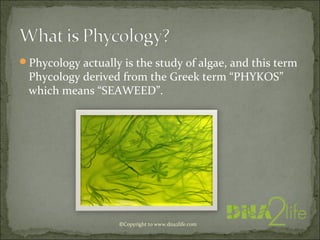
Phycology actually is the study of algae, and this term
Phycology derived from the Greek term “PHYKOS”
which means “SEAWEED”.
©Copyright to www.dna2life.com
•Algae are thallophytes.
•Algae are Eukaryotes.
•Algae belong to the kingdom Protista.
•Algae can range from microscopic algae to large seaweeds and are
mostly photosynthetic.
©Copyright to www.dna2life.com
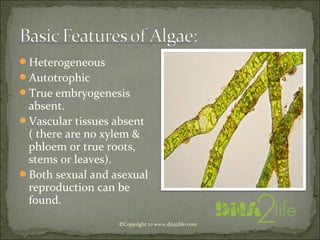
Heterogeneous
Autotrophic
True embryogenesis
absent.
Vascular tissues absent
( there are no xylem &
phloem or true roots,
stems or leaves).
Both sexual and asexual
reproduction can be
found.
Depending on main five characteristics algae can
be classified primarily as follows:
Presence of photosynthetic pigments,
On the basis of cell structure,
Character of cell wall constituent,
Type of food reserves,
Type of flagella.
©Copyright to www.dna2life.com
Some important systems of classification of Algae are…
Fritsch, F E, (1935); Smith, G.M. (1955); Bold & Wynne (1985); Lee, R.E. (1989).
There are various divisions and classes but we here discussing only on following some important phyla…
 Cyanophyta
 Prochlorophyta
 Glaucophyta
 Rhodophyta
 Chlorophyta
 Euglenophyta
 Dinophyta
 Cryptophyta
 Chrysophyta
 Prymnesiophyta
 Bacillariophyta
 Xanthophyta
 Eustigmatophyta
 Raphidophyta
 Pahaeophyta.
©Copyright to www.dna2life.com
Basic Visual Idea
©Copyright to www.dna2life.com
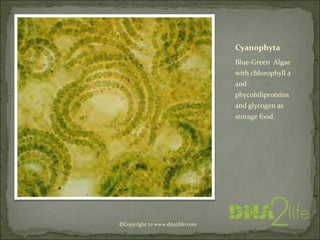
Cyanophyta
Blue-Green Algae
with chlorophyll a
and
phycobiliproteins
and glycogen as
storage food.
©Copyright to www.dna2life.com
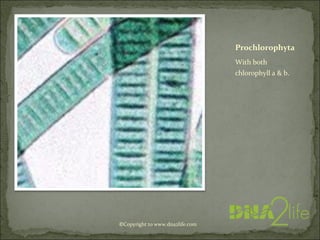
Prochlorophyta
With both
chlorophyll a & b.
©Copyright to www.dna2life.com
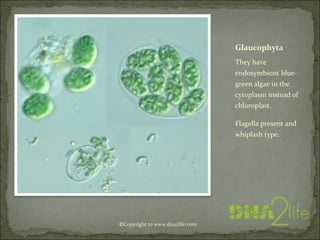
Glaucophyta
They have
endosymbiont blue-
green algae in the
cytoplasm instead of
chloroplast.
Flagella present and
whiplash type.
©Copyright to www.dna2life.com
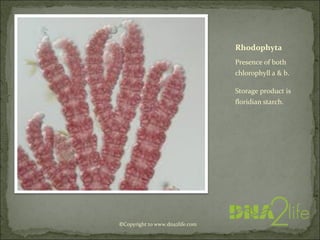
Rhodophyta
Presence of both
chlorophyll a & b.
Storage product is
floridian starch.
©Copyright to www.dna2life.com
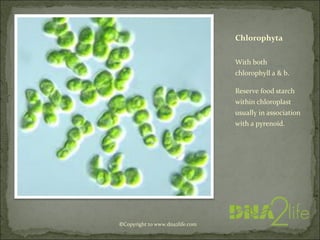
Chlorophyta
With both
chlorophyll a & b.
Reserve food starch
within chloroplast
usually in association
with a pyrenoid.
©Copyright to www.dna2life.com
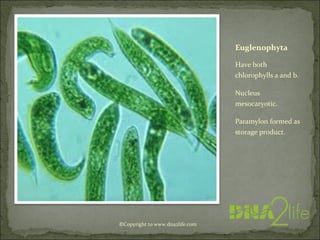
Euglenophyta
Have both
chlorophylls a and b.
Nucleus
mesocaryotic.
Paramylon formed as
storage product.
©Copyright to www.dna2life.com
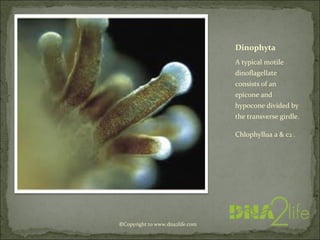
Dinophyta
A typical motile
dinoflagellate
consists of an
epicone and
hypocone divided by
the transverse girdle.
Chlophyllua a & c2 .
©Copyright to www.dna2life.com
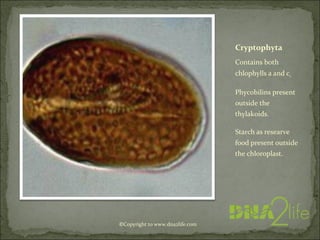
Cryptophyta
Contains both
chlophylls a and c2.
Phycobilins present
outside the
thylakoids.
Starch as researve
food present outside
the chloroplast.
©Copyright to www.dna2life.com
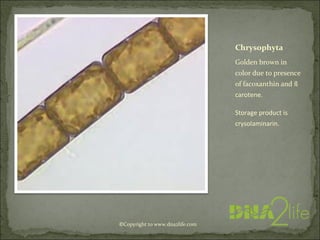
Chrysophyta
Golden brown in
color due to presence
of facoxanthin and ß
carotene.
Storage product is
crysolaminarin.
©Copyright to www.dna2life.com
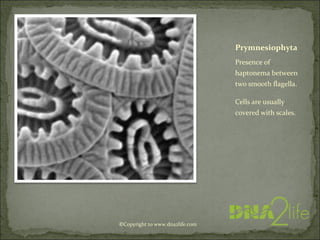
Prymnesiophyta
Presence of
haptonema between
two smooth flagella.
Cells are usually
covered with scales.
©Copyright to www.dna2life.com
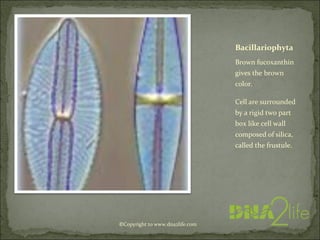
Bacillariophyta
Brown fucoxanthin
gives the brown
color.
Cell are surrounded
by a rigid two part
box like cell wall
composed of silica,
called the frustule.
©Copyright to www.dna2life.com
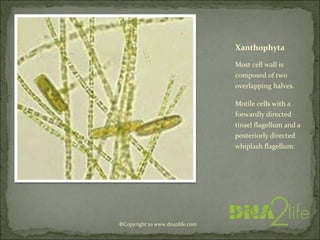
Xanthophyta
Most cell wall is
composed of two
overlapping halves.
Motile cells with a
forwardly directed
tinsel flagellum and a
posteriorly directed
whiplash flagellum.
©Copyright to www.dna2life.com
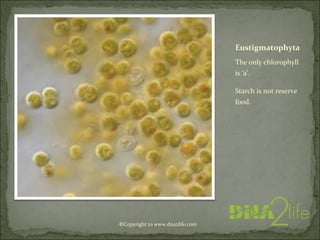
Eustigmatophyta
The only chlorophyll
is ‘a’.
Starch is not reserve
food.
©Copyright to www.dna2life.com
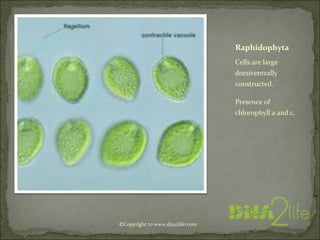
Raphidophyta
Cells are large
dorsiventrally
constructed.
Presence of
chlorophyll a and c.
©Copyright to www.dna2life.com
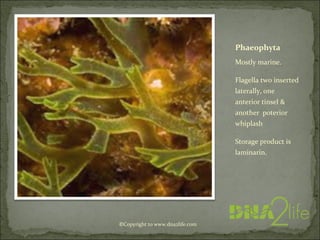
Phaeophyta
Mostly marine.
Flagella two inserted
laterally, one
anterior tinsel &
another poterior
whiplash
Storage product is
laminarin.
©Copyright to www.dna2life.com
Algae mainly differ from fungi in possessing chlorophyll and a
characteristically holophytic, photosynthetic mode of nutrition.
For further advanced study and information keep eyes on updates
from dna2life.com
©Copyright to www.dna2life.com

Phycology basic presentation