By :-
Aman Kumar
M.Sc. (P) Botany
Roll No. - 02
 INTRODUCTION
 CRITERIA OF CLASSIFICATION
 IMPORTANT SYSTEMS OF ALGAL
CLASSIFICATION
 REFERENCES
 Algae comprise a group of autotrophic,
chlorophyll containing thalloid plants of simplest
type having no true root, stem and leaves.
 On the basis of their colours 4 groups were
recognised :-
1. Myxophyceae or Cyanophyceae (Blue green
algae)
2. Chlorophyceae (Green algae)
3. Phaeophyceae (Brown algae)
4. Rhodophyceae (Red algae)
1. Algal pigments
2. Reserve foods
3. Flagellation
4. Chloroplast
5. Eye spot
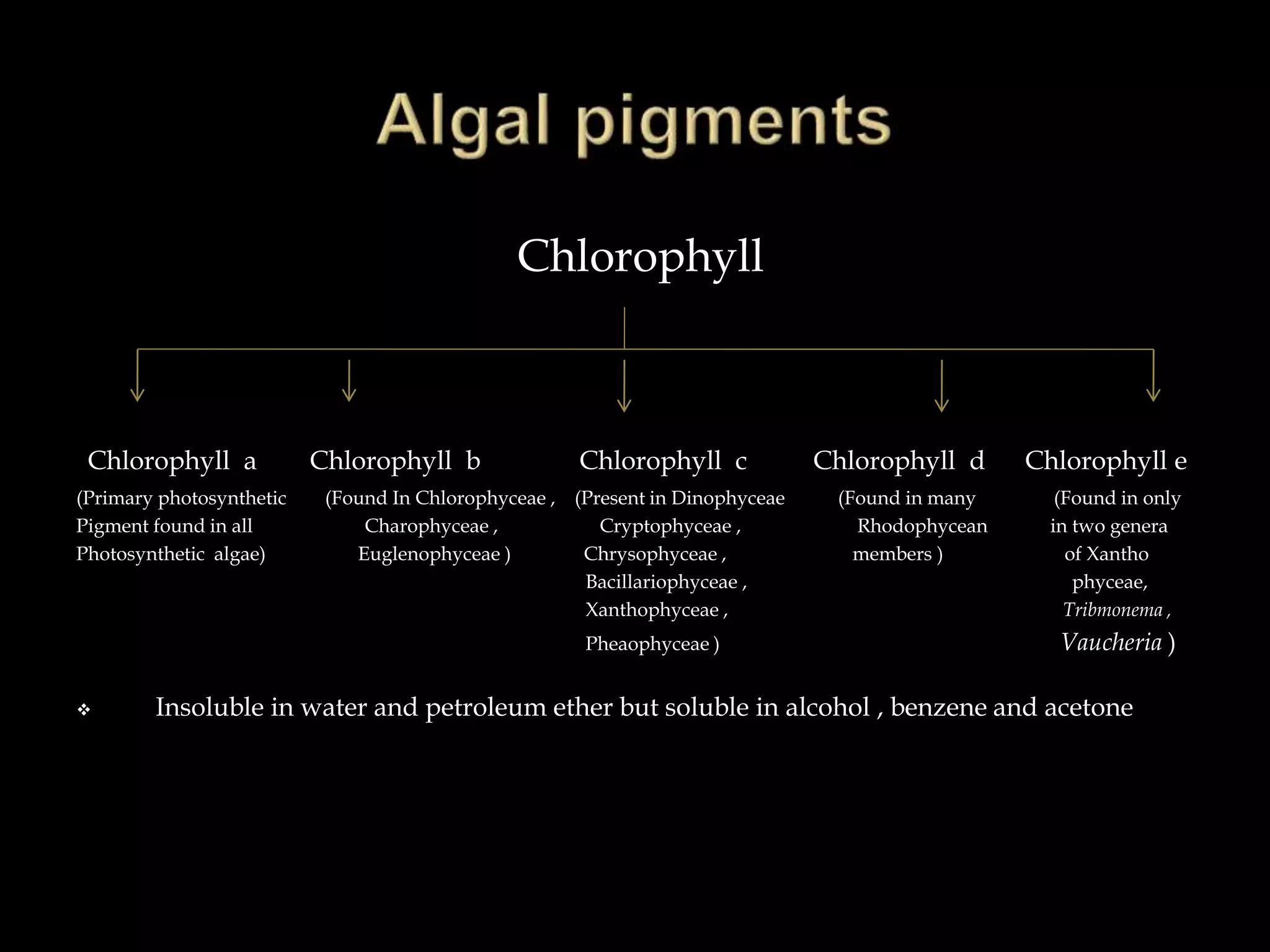
Chlorophyll
Chlorophyll a Chlorophyll b Chlorophyll c Chlorophyll d Chlorophyll e
(Primary photosynthetic (Found In Chlorophyceae , (Present in Dinophyceae (Found in many (Found in only
Pigment found in all Charophyceae , Cryptophyceae , Rhodophycean in two genera
Photosynthetic algae) Euglenophyceae ) Chrysophyceae , members ) of Xantho
Bacillariophyceae , phyceae,
Xanthophyceae , Tribmonema ,
Pheaophyceae ) Vaucheria )
 Insoluble in water and petroleum ether but soluble in alcohol , benzene and acetone
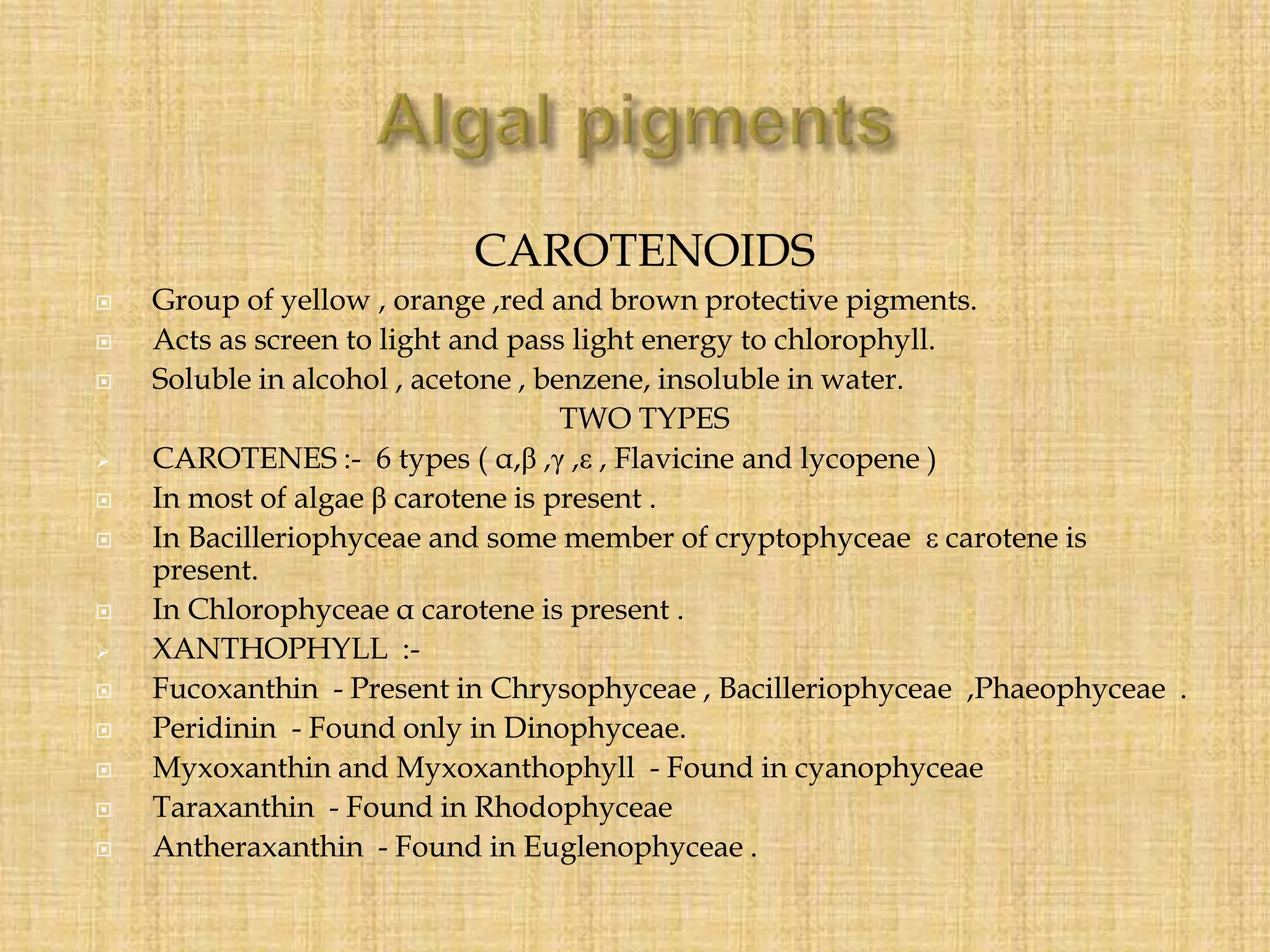
CAROTENOIDS
 Group of yellow , orange ,red and brown protective pigments.
 Acts as screen to light and pass light energy to chlorophyll.
 Soluble in alcohol , acetone , benzene, insoluble in water.
TWO TYPES
 CAROTENES :- 6 types ( α,β ,γ ,ε , Flavicine and lycopene )
 In most of algae β carotene is present .
 In Bacilleriophyceae and some member of cryptophyceae ε carotene is
present.
 In Chlorophyceae α carotene is present .
 XANTHOPHYLL :-
 Fucoxanthin - Present in Chrysophyceae , Bacilleriophyceae ,Phaeophyceae .
 Peridinin - Found only in Dinophyceae.
 Myxoxanthin and Myxoxanthophyll - Found in cyanophyceae
 Taraxanthin - Found in Rhodophyceae
 Antheraxanthin - Found in Euglenophyceae .
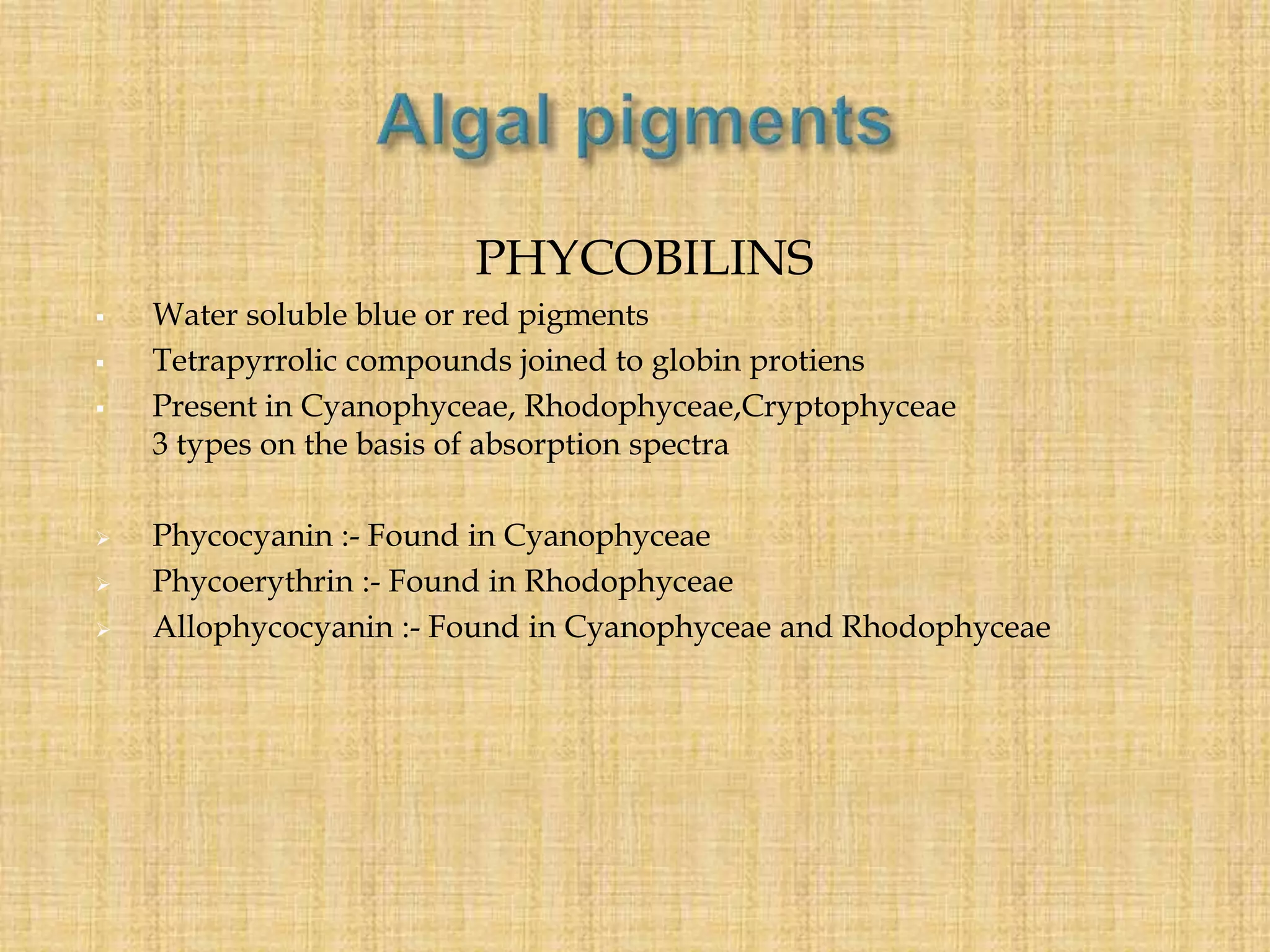
PHYCOBILINS
 Water soluble blue or red pigments
 Tetrapyrrolic compounds joined to globin protiens
 Present in Cyanophyceae, Rhodophyceae,Cryptophyceae
3 types on the basis of absorption spectra
 Phycocyanin :- Found in Cyanophyceae
 Phycoerythrin :- Found in Rhodophyceae
 Allophycocyanin :- Found in Cyanophyceae and Rhodophyceae
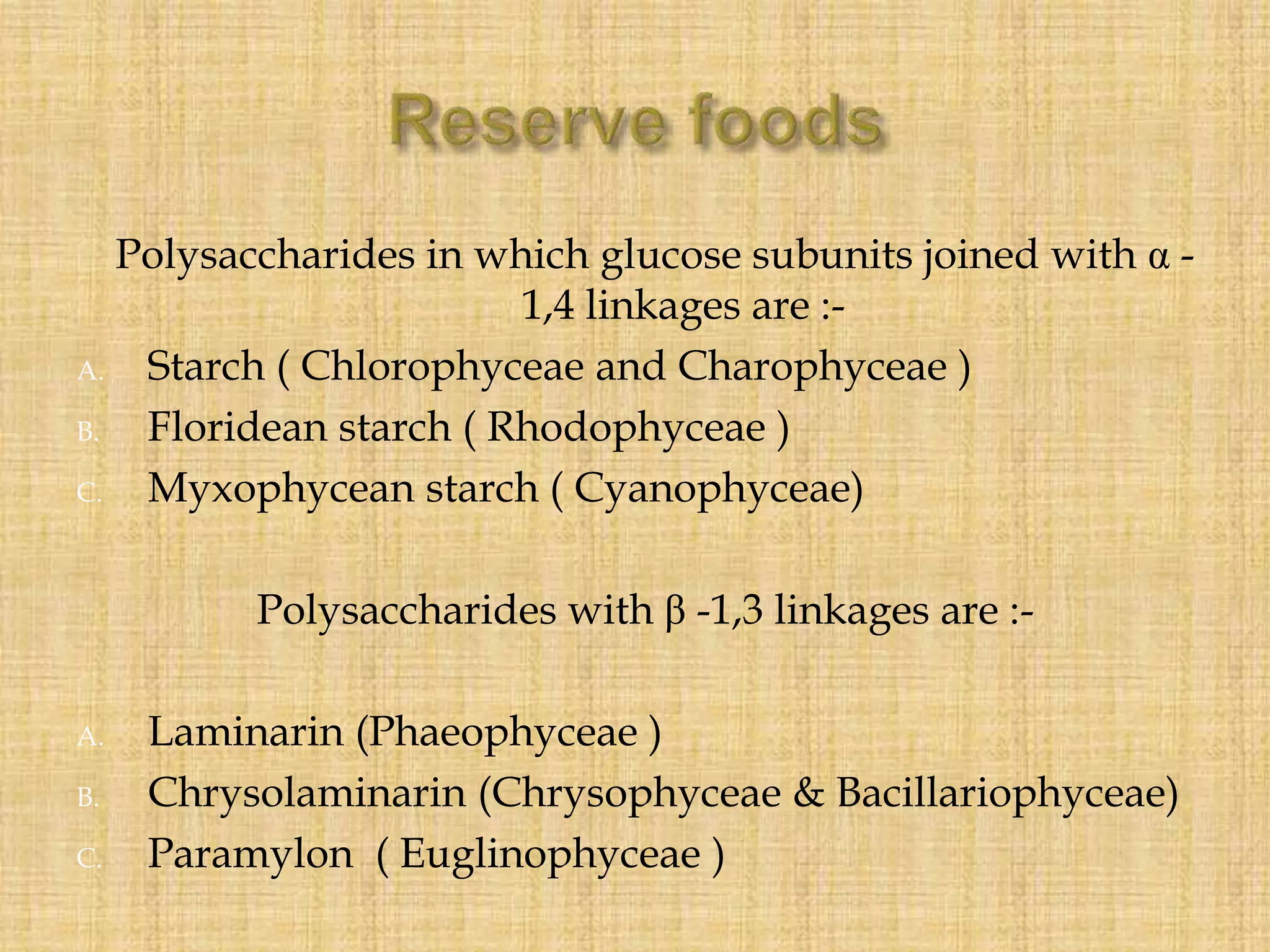
Polysaccharides in which glucose subunits joined with α -
1,4 linkages are :-
A. Starch ( Chlorophyceae and Charophyceae )
B. Floridean starch ( Rhodophyceae )
C. Myxophycean starch ( Cyanophyceae)
Polysaccharides with β -1,3 linkages are :-
A. Laminarin (Phaeophyceae )
B. Chrysolaminarin (Chrysophyceae & Bacillariophyceae)
C. Paramylon ( Euglinophyceae )
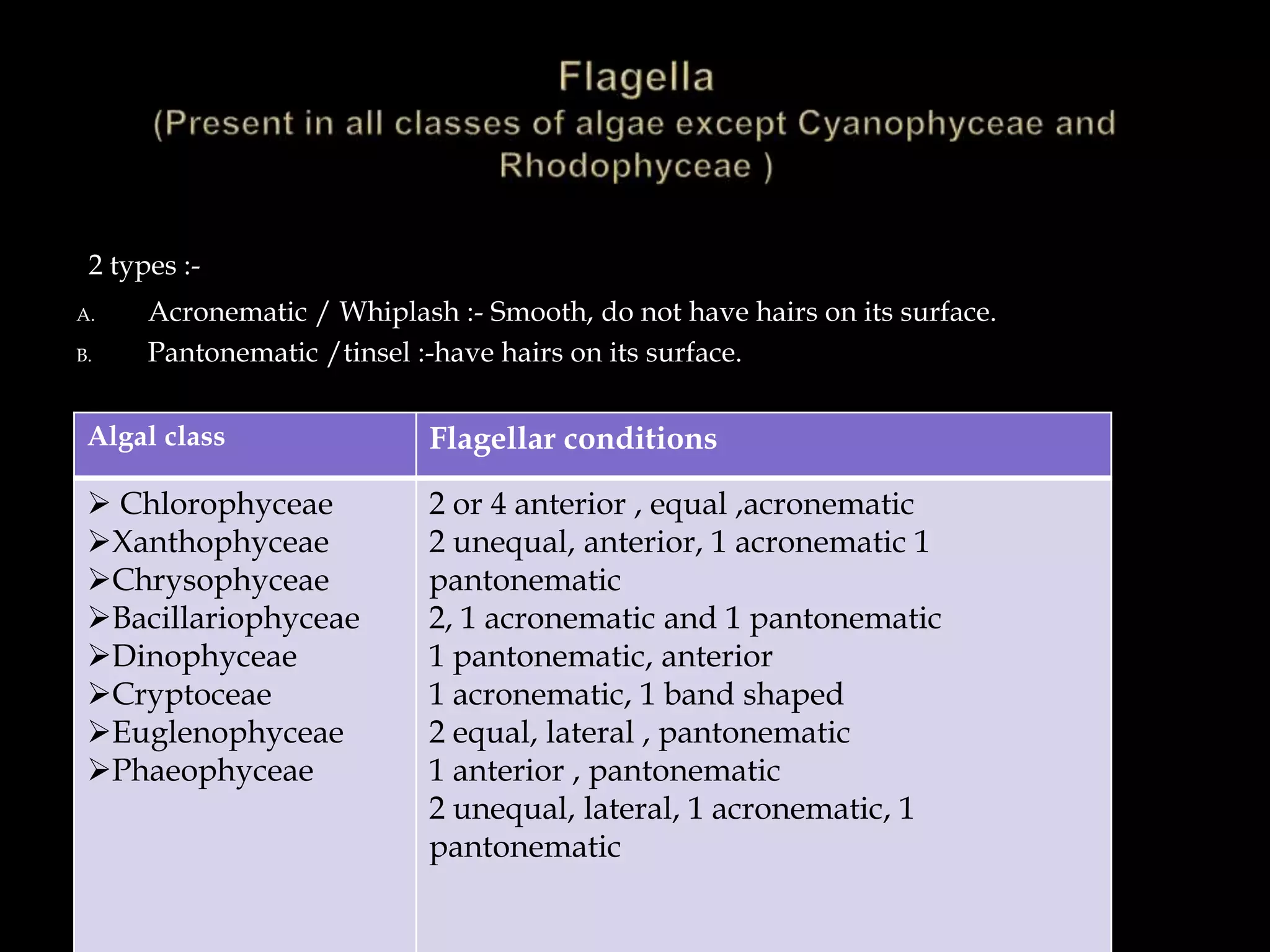
2 types :-
A. Acronematic / Whiplash :- Smooth, do not have hairs on its surface.
B. Pantonematic /tinsel :-have hairs on its surface.
Algal class Flagellar conditions
 Chlorophyceae
Xanthophyceae
Chrysophyceae
Bacillariophyceae
Dinophyceae
Cryptoceae
Euglenophyceae
Phaeophyceae
2 or 4 anterior , equal ,acronematic
2 unequal, anterior, 1 acronematic 1
pantonematic
2, 1 acronematic and 1 pantonematic
1 pantonematic, anterior
1 acronematic, 1 band shaped
2 equal, lateral , pantonematic
1 anterior , pantonematic
2 unequal, lateral, 1 acronematic, 1
pantonematic
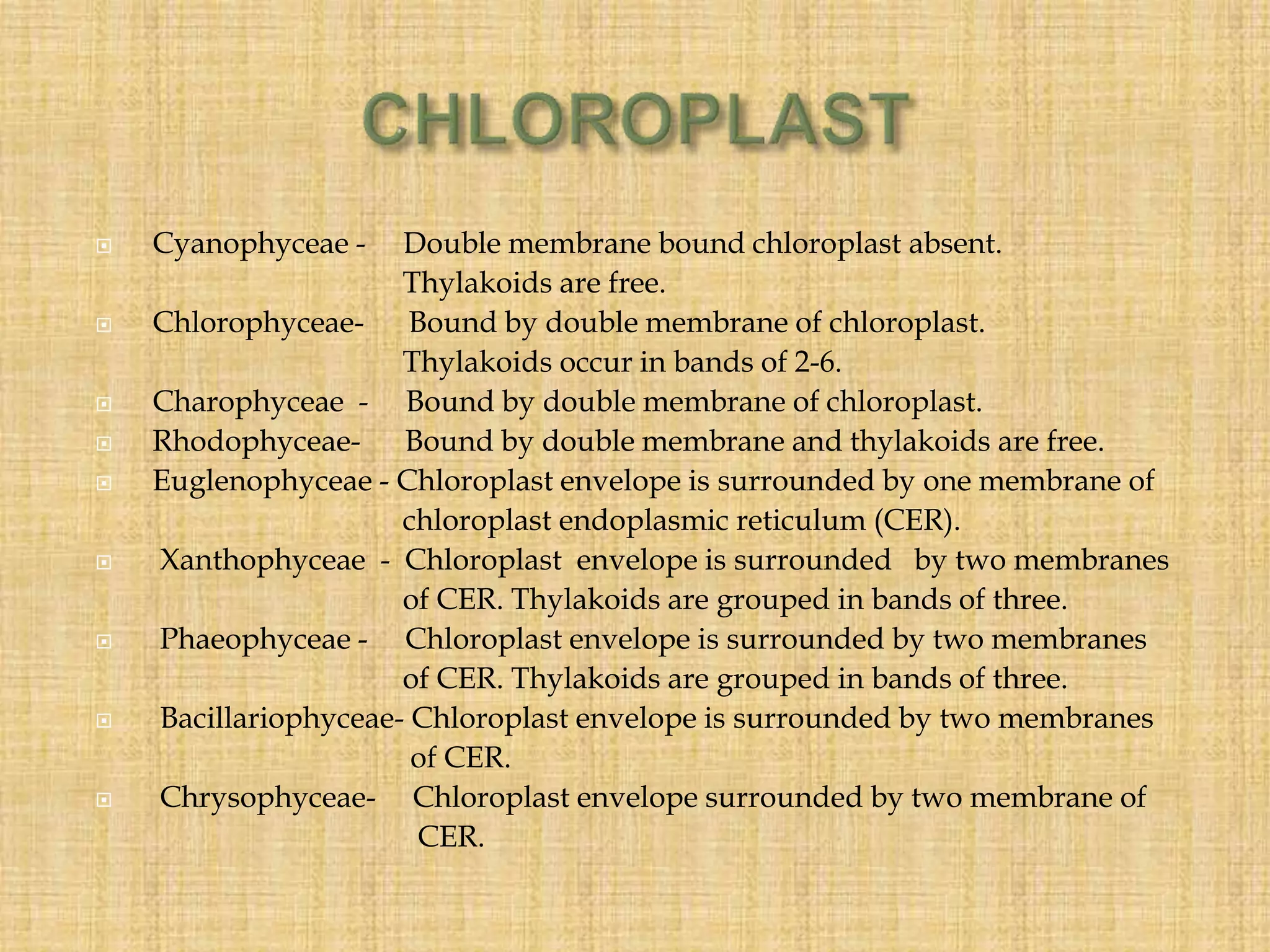
 Cyanophyceae - Double membrane bound chloroplast absent.
Thylakoids are free.
 Chlorophyceae- Bound by double membrane of chloroplast.
Thylakoids occur in bands of 2-6.
 Charophyceae - Bound by double membrane of chloroplast.
 Rhodophyceae- Bound by double membrane and thylakoids are free.
 Euglenophyceae - Chloroplast envelope is surrounded by one membrane of
chloroplast endoplasmic reticulum (CER).
 Xanthophyceae - Chloroplast envelope is surrounded by two membranes
of CER. Thylakoids are grouped in bands of three.
 Phaeophyceae - Chloroplast envelope is surrounded by two membranes
of CER. Thylakoids are grouped in bands of three.
 Bacillariophyceae- Chloroplast envelope is surrounded by two membranes
of CER.
 Chrysophyceae- Chloroplast envelope surrounded by two membrane of
CER.
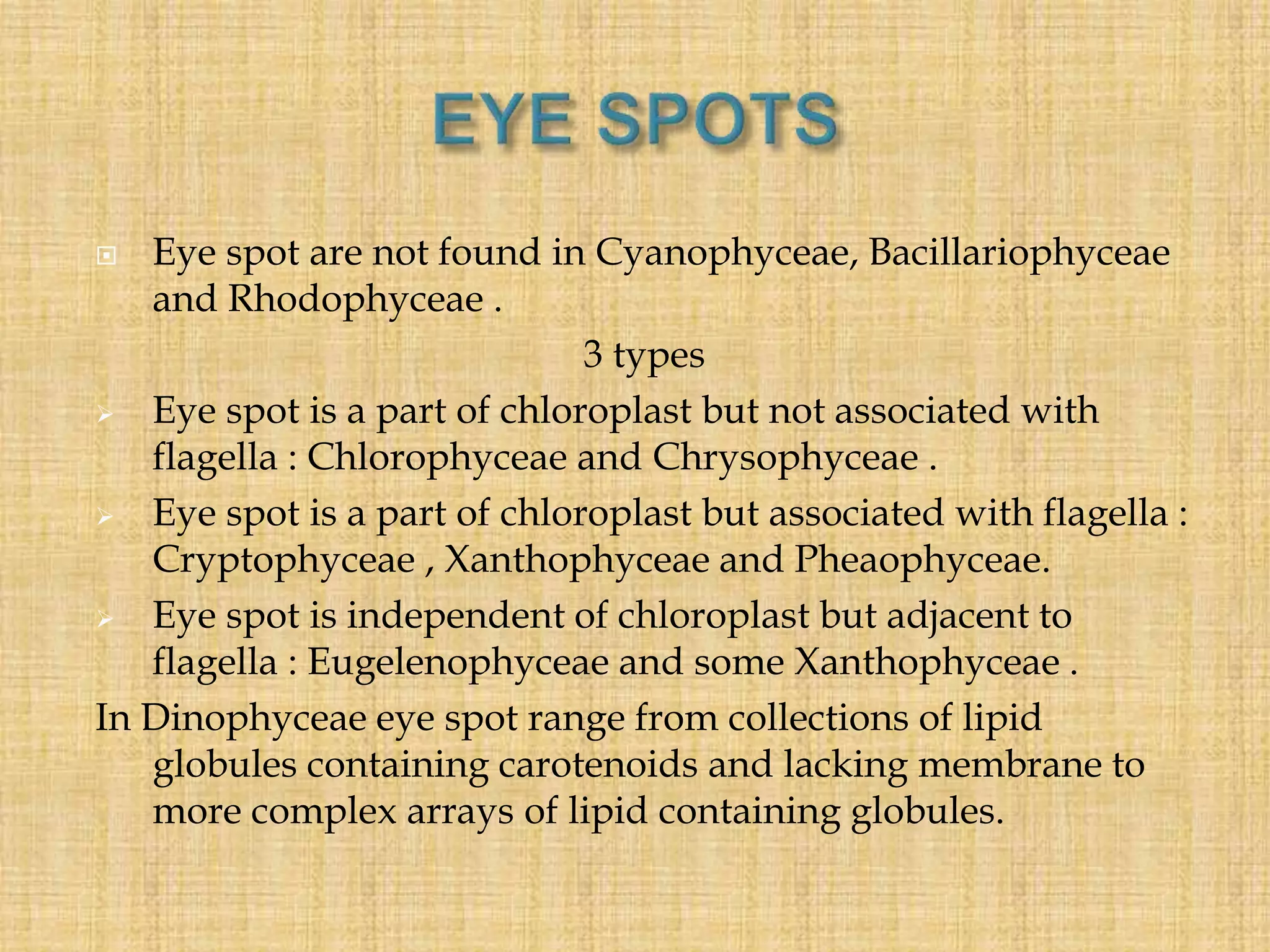
 Eye spot are not found in Cyanophyceae, Bacillariophyceae
and Rhodophyceae .
3 types
 Eye spot is a part of chloroplast but not associated with
flagella : Chlorophyceae and Chrysophyceae .
 Eye spot is a part of chloroplast but associated with flagella :
Cryptophyceae , Xanthophyceae and Pheaophyceae.
 Eye spot is independent of chloroplast but adjacent to
flagella : Eugelenophyceae and some Xanthophyceae .
In Dinophyceae eye spot range from collections of lipid
globules containing carotenoids and lacking membrane to
more complex arrays of lipid containing globules.
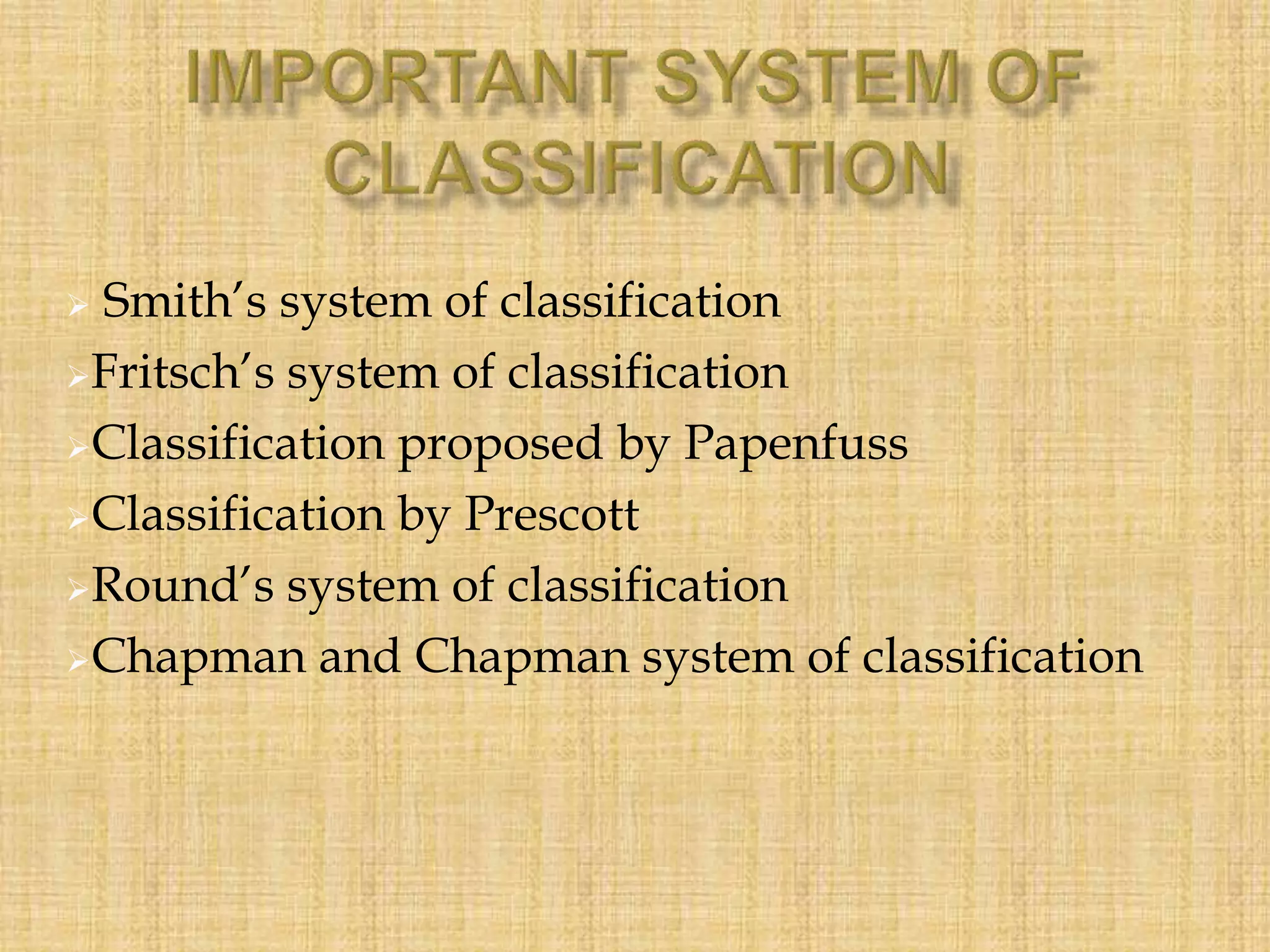
 Smith’s system of classification
Fritsch’s system of classification
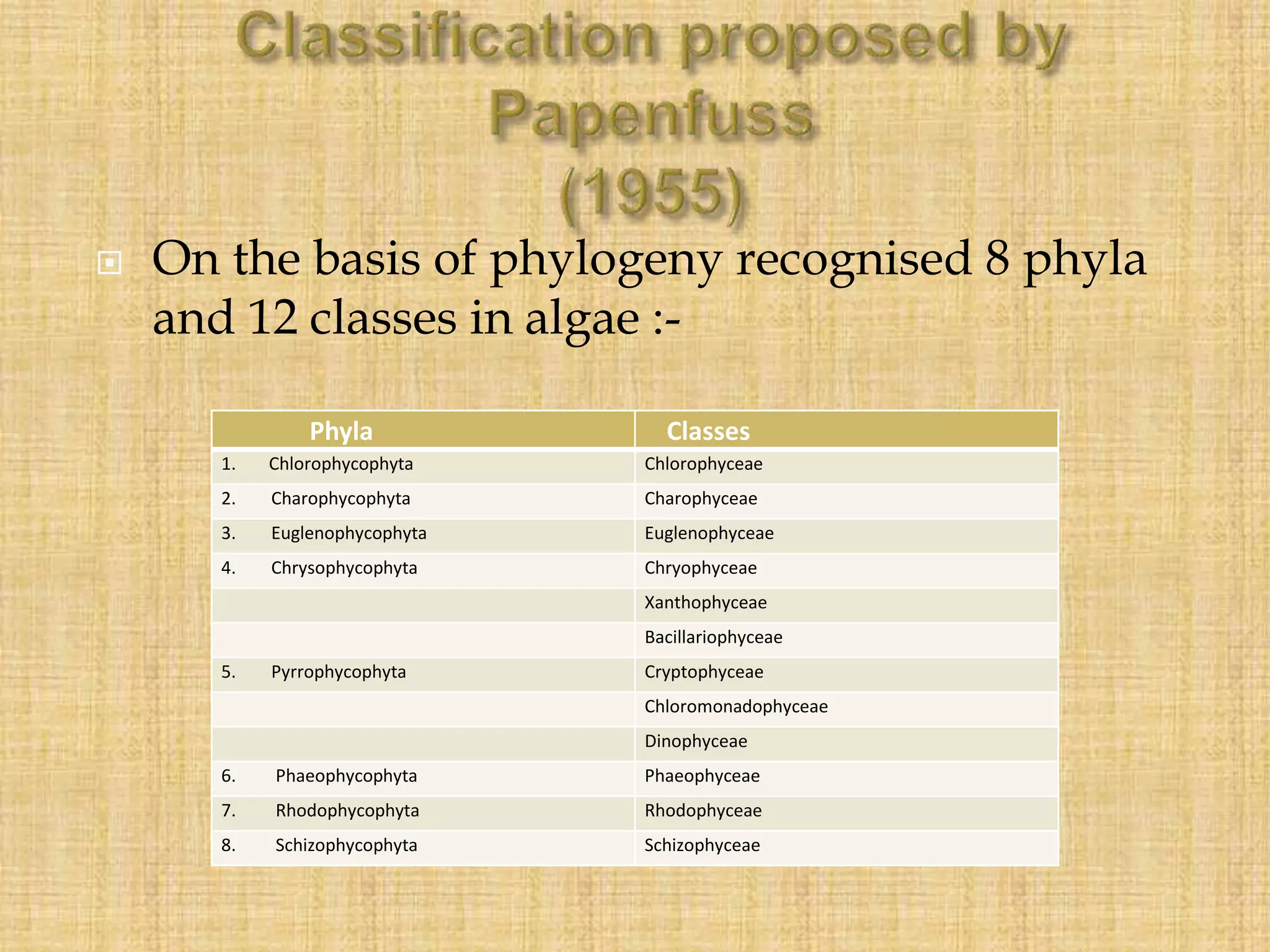
Classification proposed by Papenfuss
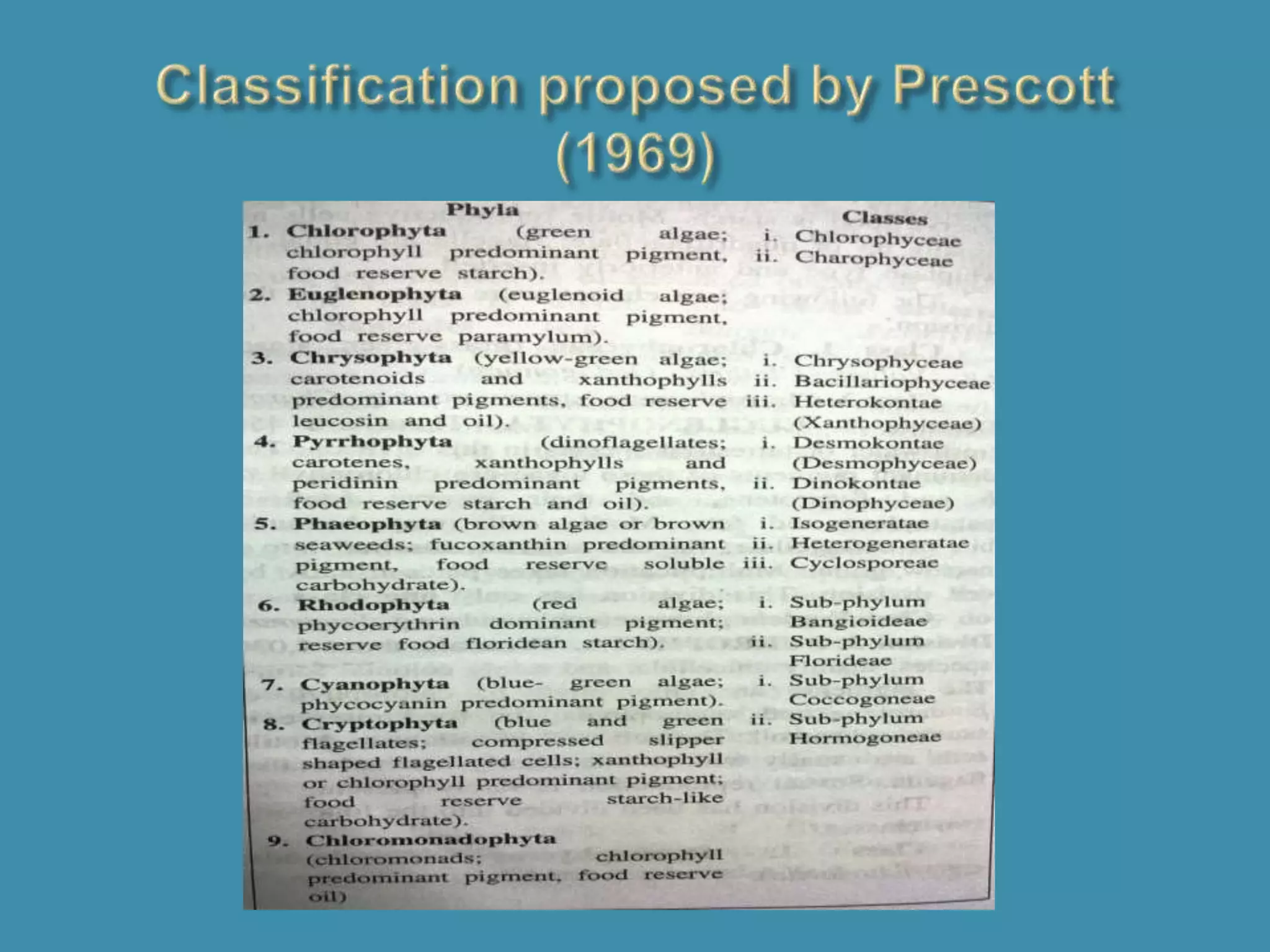
Classification by Prescott
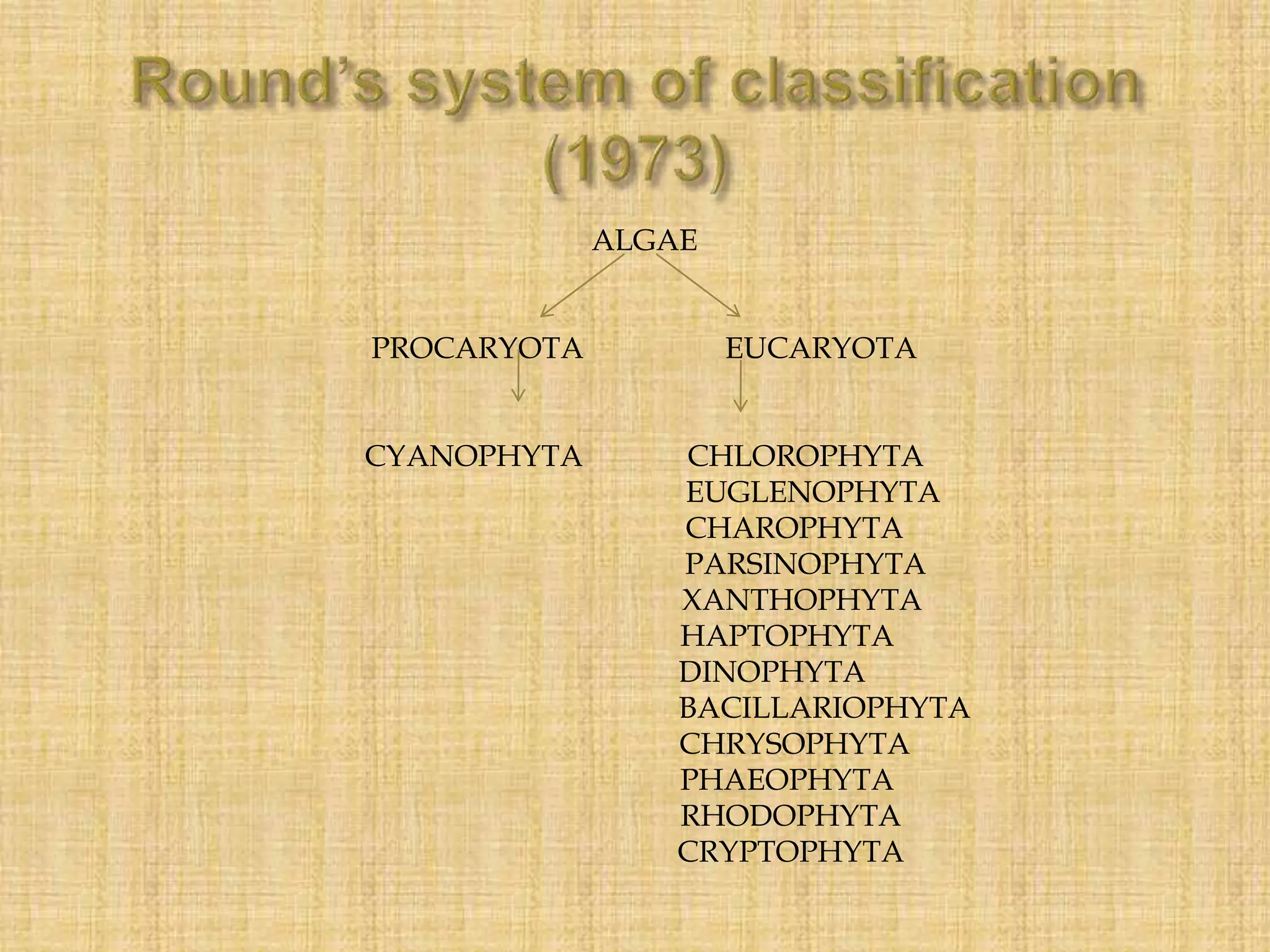
Round’s system of classification
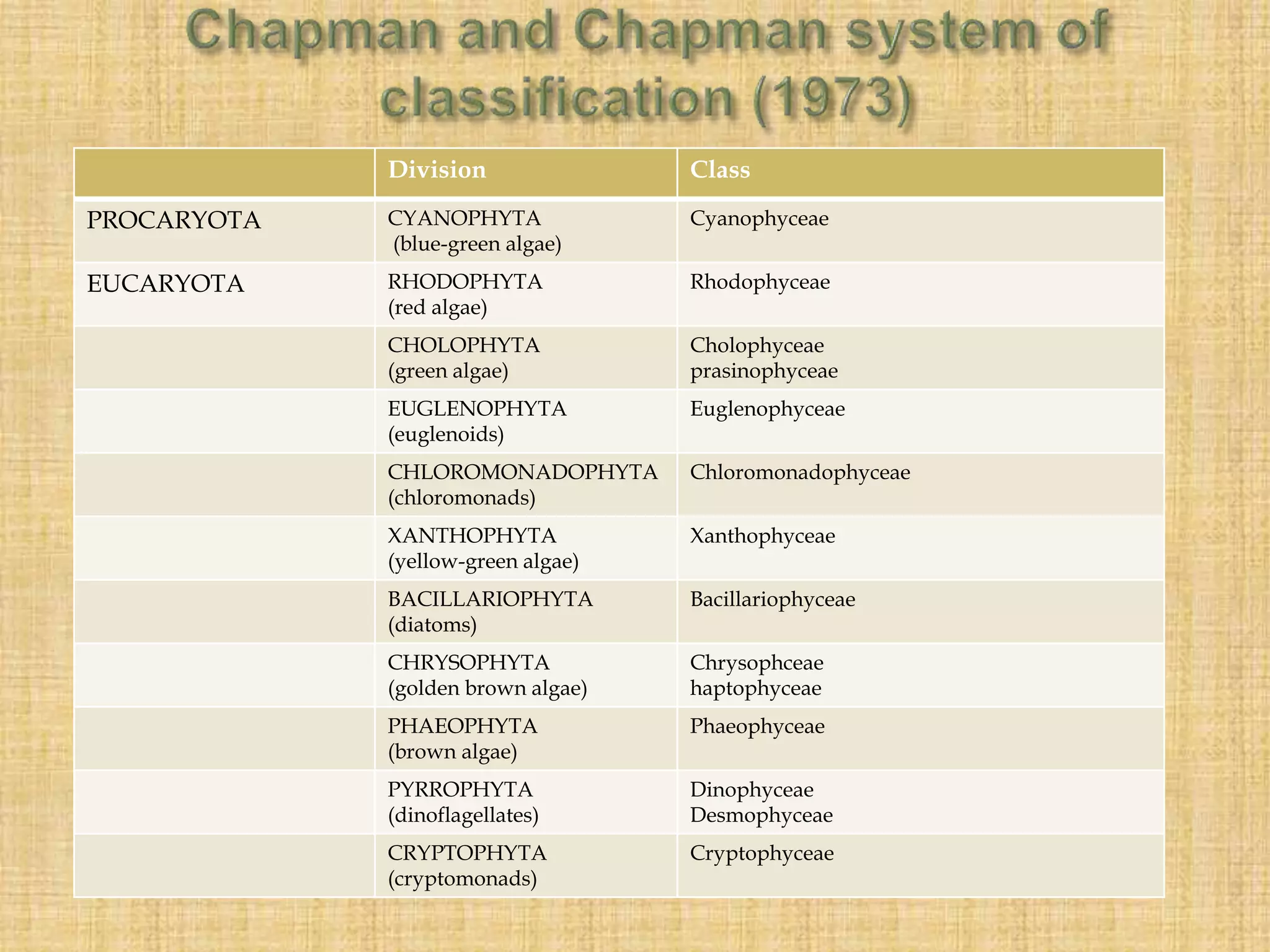
Chapman and Chapman system of classification
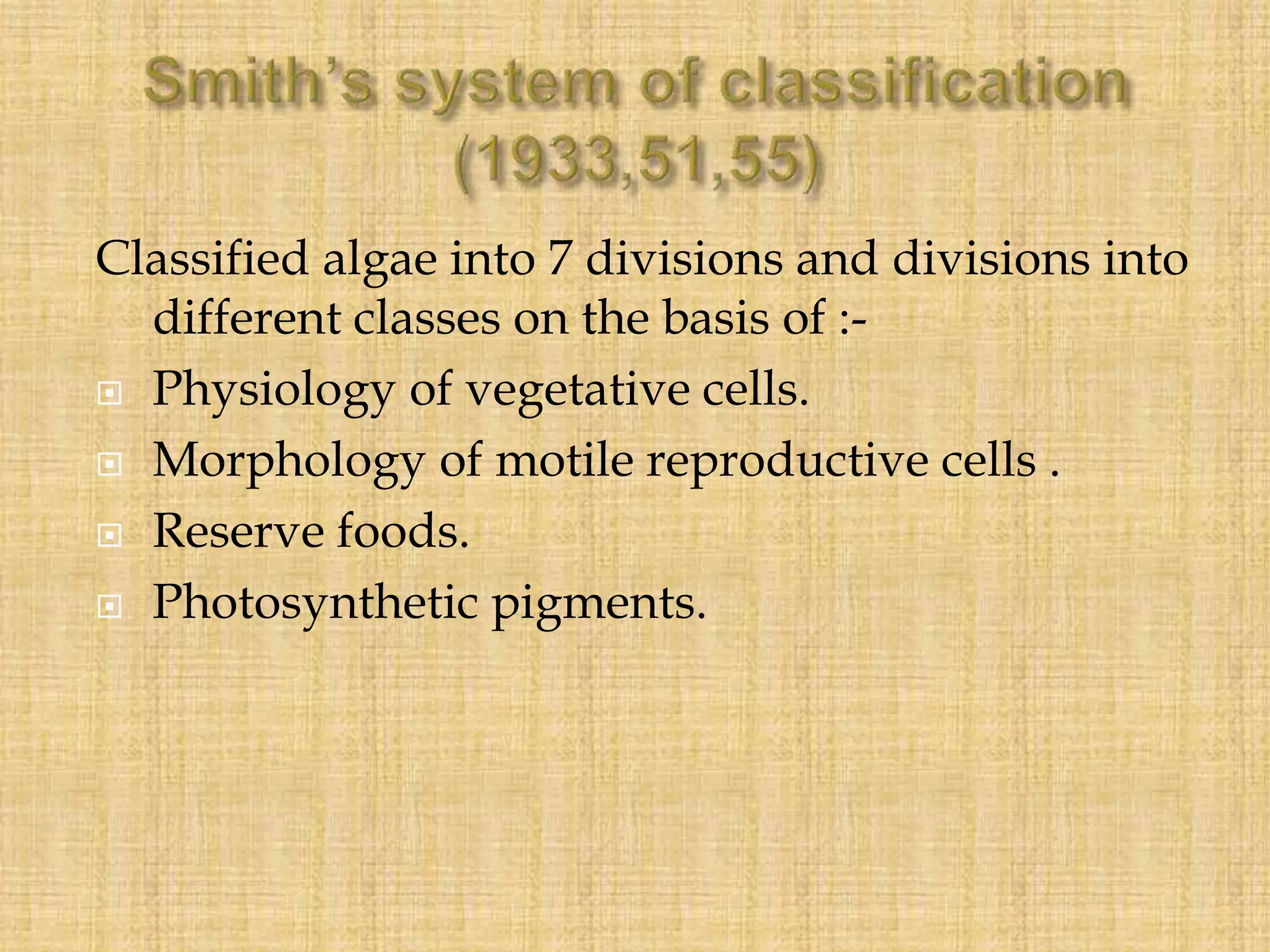
Classified algae into 7 divisions and divisions into
different classes on the basis of :-
 Physiology of vegetative cells.
 Morphology of motile reproductive cells .
 Reserve foods.
 Photosynthetic pigments.
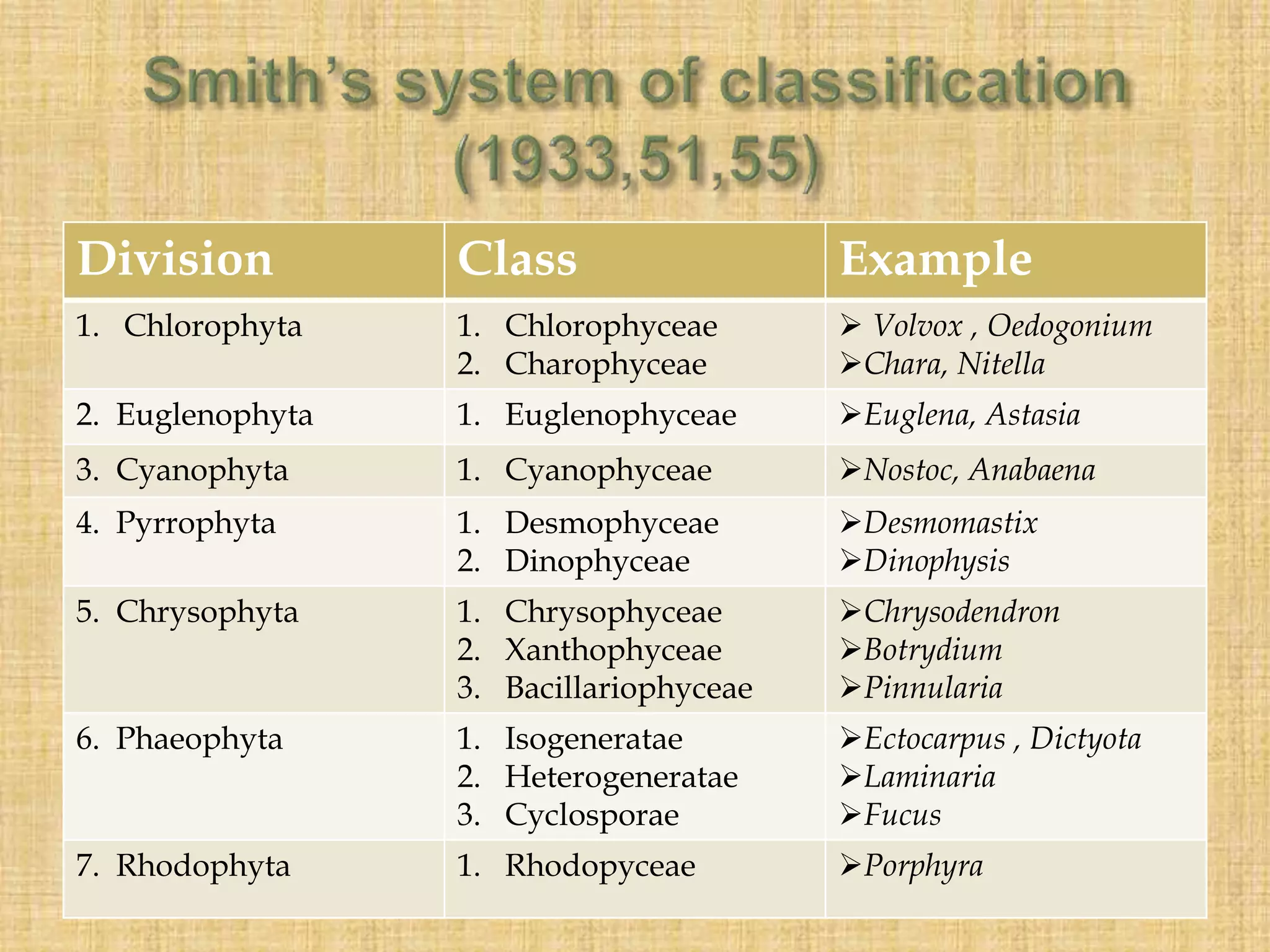
Division Class Example
1. Chlorophyta 1. Chlorophyceae
2. Charophyceae
 Volvox , Oedogonium
Chara, Nitella
2. Euglenophyta 1. Euglenophyceae Euglena, Astasia
3. Cyanophyta 1. Cyanophyceae Nostoc, Anabaena
4. Pyrrophyta 1. Desmophyceae
2. Dinophyceae
Desmomastix
Dinophysis
5. Chrysophyta 1. Chrysophyceae
2. Xanthophyceae
3. Bacillariophyceae
Chrysodendron
Botrydium
Pinnularia
6. Phaeophyta 1. Isogeneratae
2. Heterogeneratae
3. Cyclosporae
Ectocarpus , Dictyota
Laminaria
Fucus
7. Rhodophyta 1. Rhodopyceae Porphyra
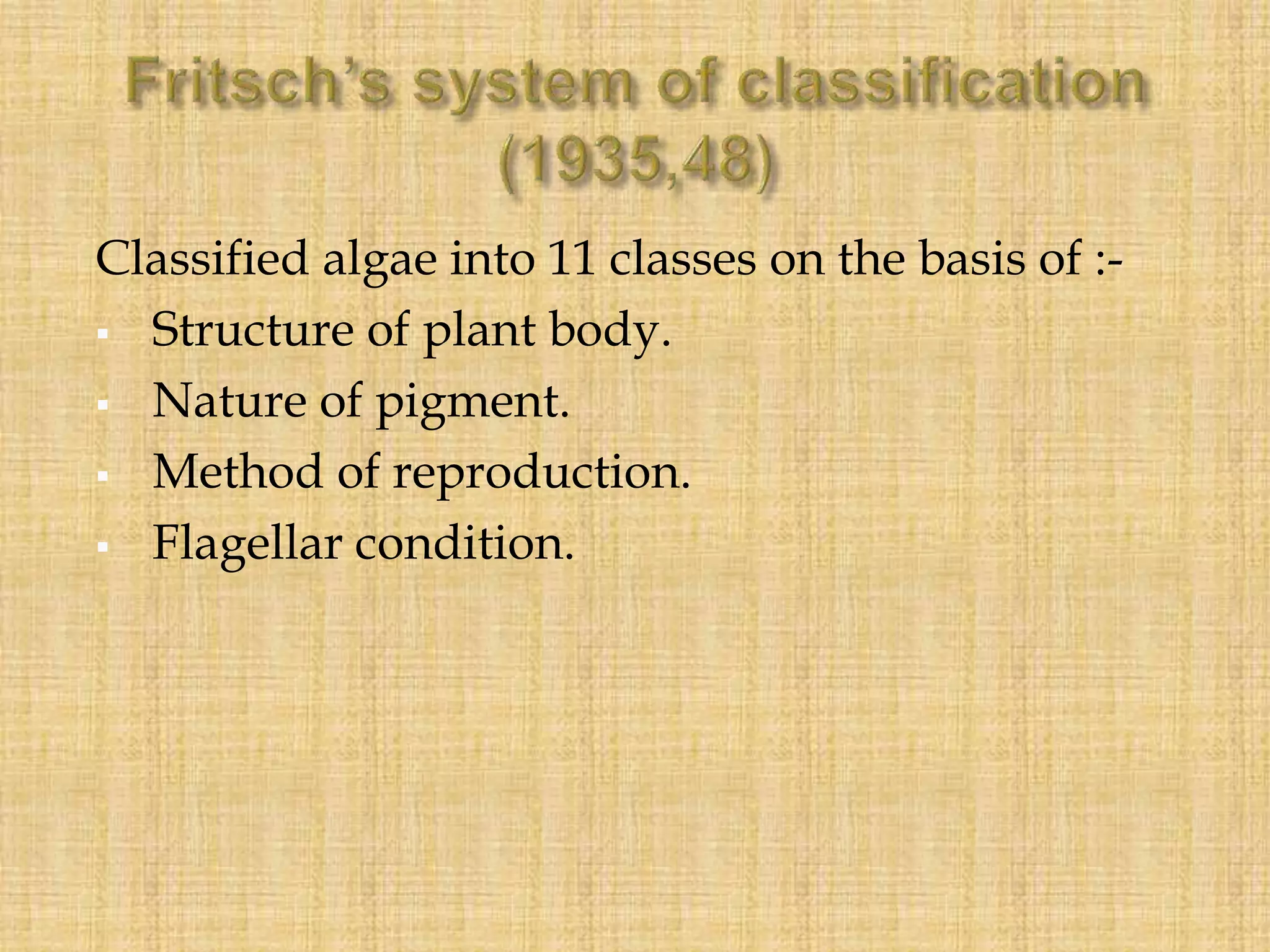
Classified algae into 11 classes on the basis of :-
 Structure of plant body.
 Nature of pigment.
 Method of reproduction.
 Flagellar condition.
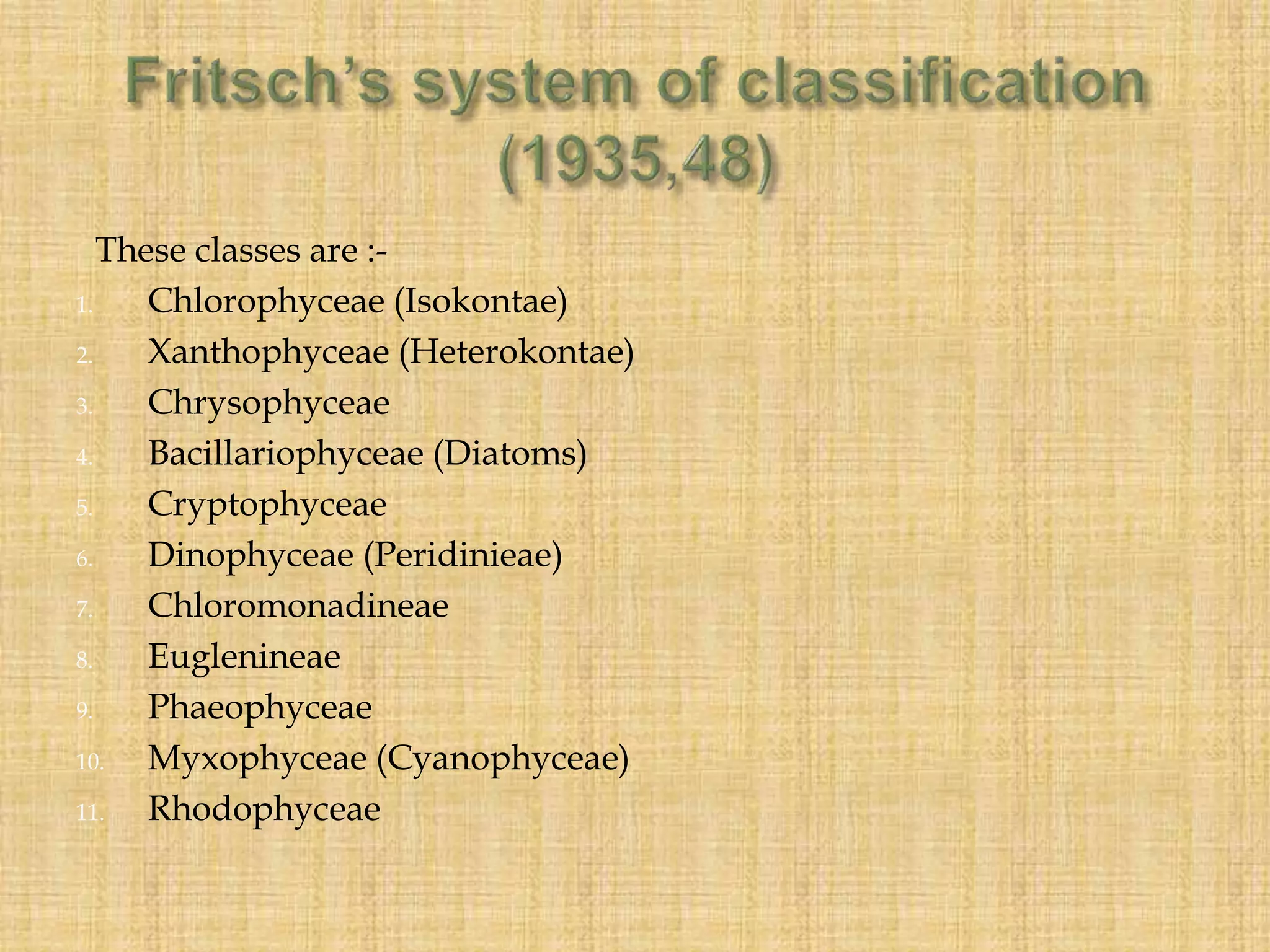
These classes are :-
1. Chlorophyceae (Isokontae)
2. Xanthophyceae (Heterokontae)
3. Chrysophyceae
4. Bacillariophyceae (Diatoms)
5. Cryptophyceae
6. Dinophyceae (Peridinieae)
7. Chloromonadineae
8. Euglenineae
9. Phaeophyceae
10. Myxophyceae (Cyanophyceae)
11. Rhodophyceae
 On the basis of phylogeny recognised 8 phyla
and 12 classes in algae :-
Phyla Classes
1. Chlorophycophyta Chlorophyceae
2. Charophycophyta Charophyceae
3. Euglenophycophyta Euglenophyceae
4. Chrysophycophyta Chryophyceae
Xanthophyceae
Bacillariophyceae
5. Pyrrophycophyta Cryptophyceae
Chloromonadophyceae
Dinophyceae
6. Phaeophycophyta Phaeophyceae
7. Rhodophycophyta Rhodophyceae
8. Schizophycophyta Schizophyceae
ALGAE
PROCARYOTA EUCARYOTA
CYANOPHYTA CHLOROPHYTA
EUGLENOPHYTA
CHAROPHYTA
PARSINOPHYTA
XANTHOPHYTA
HAPTOPHYTA
DINOPHYTA
BACILLARIOPHYTA
CHRYSOPHYTA
PHAEOPHYTA
RHODOPHYTA
CRYPTOPHYTA
Division Class
PROCARYOTA CYANOPHYTA
(blue-green algae)
Cyanophyceae
EUCARYOTA RHODOPHYTA
(red algae)
Rhodophyceae
CHOLOPHYTA
(green algae)
Cholophyceae
prasinophyceae
EUGLENOPHYTA
(euglenoids)
Euglenophyceae
CHLOROMONADOPHYTA
(chloromonads)
Chloromonadophyceae
XANTHOPHYTA
(yellow-green algae)
Xanthophyceae
BACILLARIOPHYTA
(diatoms)
Bacillariophyceae
CHRYSOPHYTA
(golden brown algae)
Chrysophceae
haptophyceae
PHAEOPHYTA
(brown algae)
Phaeophyceae
PYRROPHYTA
(dinoflagellates)
Dinophyceae
Desmophyceae
CRYPTOPHYTA
(cryptomonads)
Cryptophyceae
 Kumar, H.D. (1999): Introductory Phycology Affiliated East West
Press Ltd., New Delhi.
 Singh, V.(2013) :A text book of Botany, Rastogi Publications,
Meerut,India.
 Vashishta,B.R(1960) : Botany for degree students, Algae, S.Chand
Publishing , New Delhi.
Algal classification on the basis of chloroplast pigment

Algal classification on the basis of chloroplast pigment

  • 1.
    By :- Aman Kumar M.Sc.(P) Botany Roll No. - 02
  • 2.
     INTRODUCTION  CRITERIAOF CLASSIFICATION  IMPORTANT SYSTEMS OF ALGAL CLASSIFICATION  REFERENCES
  • 3.
     Algae comprisea group of autotrophic, chlorophyll containing thalloid plants of simplest type having no true root, stem and leaves.  On the basis of their colours 4 groups were recognised :- 1. Myxophyceae or Cyanophyceae (Blue green algae) 2. Chlorophyceae (Green algae) 3. Phaeophyceae (Brown algae) 4. Rhodophyceae (Red algae)
  • 4.
    1. Algal pigments 2.Reserve foods 3. Flagellation 4. Chloroplast 5. Eye spot
  • 5.
    Chlorophyll Chlorophyll a Chlorophyllb Chlorophyll c Chlorophyll d Chlorophyll e (Primary photosynthetic (Found In Chlorophyceae , (Present in Dinophyceae (Found in many (Found in only Pigment found in all Charophyceae , Cryptophyceae , Rhodophycean in two genera Photosynthetic algae) Euglenophyceae ) Chrysophyceae , members ) of Xantho Bacillariophyceae , phyceae, Xanthophyceae , Tribmonema , Pheaophyceae ) Vaucheria )  Insoluble in water and petroleum ether but soluble in alcohol , benzene and acetone
  • 6.
    CAROTENOIDS  Group ofyellow , orange ,red and brown protective pigments.  Acts as screen to light and pass light energy to chlorophyll.  Soluble in alcohol , acetone , benzene, insoluble in water. TWO TYPES  CAROTENES :- 6 types ( α,β ,γ ,ε , Flavicine and lycopene )  In most of algae β carotene is present .  In Bacilleriophyceae and some member of cryptophyceae ε carotene is present.  In Chlorophyceae α carotene is present .  XANTHOPHYLL :-  Fucoxanthin - Present in Chrysophyceae , Bacilleriophyceae ,Phaeophyceae .  Peridinin - Found only in Dinophyceae.  Myxoxanthin and Myxoxanthophyll - Found in cyanophyceae  Taraxanthin - Found in Rhodophyceae  Antheraxanthin - Found in Euglenophyceae .
  • 7.
    PHYCOBILINS  Water solubleblue or red pigments  Tetrapyrrolic compounds joined to globin protiens  Present in Cyanophyceae, Rhodophyceae,Cryptophyceae 3 types on the basis of absorption spectra  Phycocyanin :- Found in Cyanophyceae  Phycoerythrin :- Found in Rhodophyceae  Allophycocyanin :- Found in Cyanophyceae and Rhodophyceae
  • 8.
    Polysaccharides in whichglucose subunits joined with α - 1,4 linkages are :- A. Starch ( Chlorophyceae and Charophyceae ) B. Floridean starch ( Rhodophyceae ) C. Myxophycean starch ( Cyanophyceae) Polysaccharides with β -1,3 linkages are :- A. Laminarin (Phaeophyceae ) B. Chrysolaminarin (Chrysophyceae & Bacillariophyceae) C. Paramylon ( Euglinophyceae )
  • 9.
    2 types :- A.Acronematic / Whiplash :- Smooth, do not have hairs on its surface. B. Pantonematic /tinsel :-have hairs on its surface. Algal class Flagellar conditions  Chlorophyceae Xanthophyceae Chrysophyceae Bacillariophyceae Dinophyceae Cryptoceae Euglenophyceae Phaeophyceae 2 or 4 anterior , equal ,acronematic 2 unequal, anterior, 1 acronematic 1 pantonematic 2, 1 acronematic and 1 pantonematic 1 pantonematic, anterior 1 acronematic, 1 band shaped 2 equal, lateral , pantonematic 1 anterior , pantonematic 2 unequal, lateral, 1 acronematic, 1 pantonematic
  • 10.
     Cyanophyceae -Double membrane bound chloroplast absent. Thylakoids are free.  Chlorophyceae- Bound by double membrane of chloroplast. Thylakoids occur in bands of 2-6.  Charophyceae - Bound by double membrane of chloroplast.  Rhodophyceae- Bound by double membrane and thylakoids are free.  Euglenophyceae - Chloroplast envelope is surrounded by one membrane of chloroplast endoplasmic reticulum (CER).  Xanthophyceae - Chloroplast envelope is surrounded by two membranes of CER. Thylakoids are grouped in bands of three.  Phaeophyceae - Chloroplast envelope is surrounded by two membranes of CER. Thylakoids are grouped in bands of three.  Bacillariophyceae- Chloroplast envelope is surrounded by two membranes of CER.  Chrysophyceae- Chloroplast envelope surrounded by two membrane of CER.
  • 11.
     Eye spotare not found in Cyanophyceae, Bacillariophyceae and Rhodophyceae . 3 types  Eye spot is a part of chloroplast but not associated with flagella : Chlorophyceae and Chrysophyceae .  Eye spot is a part of chloroplast but associated with flagella : Cryptophyceae , Xanthophyceae and Pheaophyceae.  Eye spot is independent of chloroplast but adjacent to flagella : Eugelenophyceae and some Xanthophyceae . In Dinophyceae eye spot range from collections of lipid globules containing carotenoids and lacking membrane to more complex arrays of lipid containing globules.
  • 12.
     Smith’s systemof classification Fritsch’s system of classification Classification proposed by Papenfuss Classification by Prescott Round’s system of classification Chapman and Chapman system of classification
  • 13.
    Classified algae into7 divisions and divisions into different classes on the basis of :-  Physiology of vegetative cells.  Morphology of motile reproductive cells .  Reserve foods.  Photosynthetic pigments.
  • 14.
    Division Class Example 1.Chlorophyta 1. Chlorophyceae 2. Charophyceae  Volvox , Oedogonium Chara, Nitella 2. Euglenophyta 1. Euglenophyceae Euglena, Astasia 3. Cyanophyta 1. Cyanophyceae Nostoc, Anabaena 4. Pyrrophyta 1. Desmophyceae 2. Dinophyceae Desmomastix Dinophysis 5. Chrysophyta 1. Chrysophyceae 2. Xanthophyceae 3. Bacillariophyceae Chrysodendron Botrydium Pinnularia 6. Phaeophyta 1. Isogeneratae 2. Heterogeneratae 3. Cyclosporae Ectocarpus , Dictyota Laminaria Fucus 7. Rhodophyta 1. Rhodopyceae Porphyra
  • 15.
    Classified algae into11 classes on the basis of :-  Structure of plant body.  Nature of pigment.  Method of reproduction.  Flagellar condition.
  • 16.
    These classes are:- 1. Chlorophyceae (Isokontae) 2. Xanthophyceae (Heterokontae) 3. Chrysophyceae 4. Bacillariophyceae (Diatoms) 5. Cryptophyceae 6. Dinophyceae (Peridinieae) 7. Chloromonadineae 8. Euglenineae 9. Phaeophyceae 10. Myxophyceae (Cyanophyceae) 11. Rhodophyceae
  • 17.
     On thebasis of phylogeny recognised 8 phyla and 12 classes in algae :- Phyla Classes 1. Chlorophycophyta Chlorophyceae 2. Charophycophyta Charophyceae 3. Euglenophycophyta Euglenophyceae 4. Chrysophycophyta Chryophyceae Xanthophyceae Bacillariophyceae 5. Pyrrophycophyta Cryptophyceae Chloromonadophyceae Dinophyceae 6. Phaeophycophyta Phaeophyceae 7. Rhodophycophyta Rhodophyceae 8. Schizophycophyta Schizophyceae
  • 19.
  • 20.
    Division Class PROCARYOTA CYANOPHYTA (blue-greenalgae) Cyanophyceae EUCARYOTA RHODOPHYTA (red algae) Rhodophyceae CHOLOPHYTA (green algae) Cholophyceae prasinophyceae EUGLENOPHYTA (euglenoids) Euglenophyceae CHLOROMONADOPHYTA (chloromonads) Chloromonadophyceae XANTHOPHYTA (yellow-green algae) Xanthophyceae BACILLARIOPHYTA (diatoms) Bacillariophyceae CHRYSOPHYTA (golden brown algae) Chrysophceae haptophyceae PHAEOPHYTA (brown algae) Phaeophyceae PYRROPHYTA (dinoflagellates) Dinophyceae Desmophyceae CRYPTOPHYTA (cryptomonads) Cryptophyceae
  • 21.
     Kumar, H.D.(1999): Introductory Phycology Affiliated East West Press Ltd., New Delhi.  Singh, V.(2013) :A text book of Botany, Rastogi Publications, Meerut,India.  Vashishta,B.R(1960) : Botany for degree students, Algae, S.Chand Publishing , New Delhi.