Distribution, systematic position and life
cycle of Nostoc and Chara
Sankrita Gaonkar
Assistant Professor in Botany
sankrita002@gmail.com
Contents
• Nostoc
• Chara
• References
Nostoc
Systematic position:
• Division: Cyanophyta
• Class: Cyanophyceae
• Order: Nostocales
• Family: Nostocaeae
• Genus: Nostoc
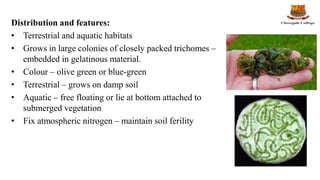
Distribution and features:
• Terrestrial and aquatic habitats
• Grows in large colonies of closely packed trichomes –
embedded in gelatinous material.
• Colour – olive green or blue-green
• Terrestrial – grows on damp soil
• Aquatic – free floating or lie at bottom attached to
submerged vegetation
• Fix atmospheric nitrogen – maintain soil ferility
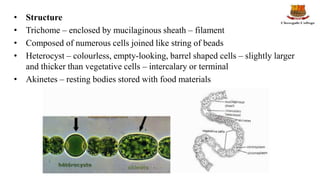
• Structure
• Trichome – enclosed by mucilaginous sheath – filament
• Composed of numerous cells joined like string of beads
• Heterocyst – colourless, empty-looking, barrel shaped cells – slightly larger
and thicker than vegetative cells – intercalary or terminal
• Akinetes – resting bodies stored with food materials
Life cycle:
1. Heterocystous phase - a) motile hormogonia; b) non
motile hormogonia with terminal heterocysts and
enveloped in a hyaline sheath; c) aseriate colonies
formed by several divisions occurring in different
planes. At the beginning the colony is elongated, then
it becomes spherical and contains a coiled filament
formed by vegetative cells and heterocysts; d)
reproduction of the colony by hormogonia or budding.
Buddings are more frequent in cultures grown on solid
medium. The hormogonia also are formed by a
breaking of the colonial filament at the junction of the
heterocysts and are released by rupture or dissolution
of the colony sheath; e) vesicles of transparent
mucillage containing numerous isolated hetercysts
after the release of the hormogonia.
2. Sporogenous phase – light exposure – 2 to 4 celled
fragments, grow to form long trichomes without
heterocysts, trichomes break into fragments,
intercalary cells develop into spores, spores germinate
– form 2-3 celled germlings
Chara
Systematic position:
• Division: Charophyta
• Class: Charophyceae
• Order: Charales
• Family: Characeae
• Genus: Chara
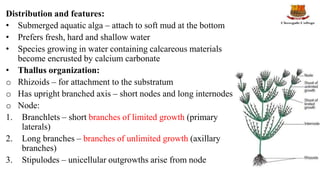
Distribution and features:
• Submerged aquatic alga – attach to soft mud at the bottom
• Prefers fresh, hard and shallow water
• Species growing in water containing calcareous materials
become encrusted by calcium carbonate
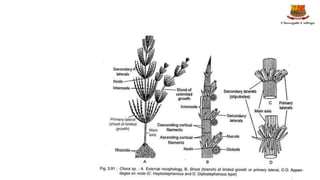
• Thallus organization:
o Rhizoids – for attachment to the substratum
o Has upright branched axis – short nodes and long internodes
o Node:
1. Branchlets – short branches of limited growth (primary
laterals)
2. Long branches – branches of unlimited growth (axillary
branches)
3. Stipulodes – unicellular outgrowths arise from node
• Life cycle:
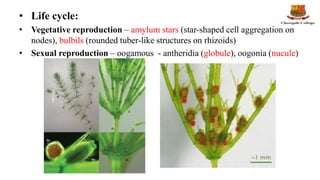
• Vegetative reproduction – amylum stars (star-shaped cell aggregation on
nodes), bulbils (rounded tuber-like structures on rhizoids)
• Sexual reproduction – oogamous - antheridia (globule), oogonia (nucule)
References
• Vashishta B.R., Sinha A.K. and Singh V.P. 2012. Botany for
degree students: Algae. S. Chand & company ltd.
• Fritsch, F.E.,(1956). The structure and reproduction of the
Algae; Volume I and II. Cambridge University Press.

Nostoc and chara

  • 1.
    Distribution, systematic positionand life cycle of Nostoc and Chara Sankrita Gaonkar Assistant Professor in Botany sankrita002@gmail.com
  • 2.
  • 3.
    Nostoc Systematic position: • Division:Cyanophyta • Class: Cyanophyceae • Order: Nostocales • Family: Nostocaeae • Genus: Nostoc
  • 4.
    Distribution and features: •Terrestrial and aquatic habitats • Grows in large colonies of closely packed trichomes – embedded in gelatinous material. • Colour – olive green or blue-green • Terrestrial – grows on damp soil • Aquatic – free floating or lie at bottom attached to submerged vegetation • Fix atmospheric nitrogen – maintain soil ferility
  • 5.
    • Structure • Trichome– enclosed by mucilaginous sheath – filament • Composed of numerous cells joined like string of beads • Heterocyst – colourless, empty-looking, barrel shaped cells – slightly larger and thicker than vegetative cells – intercalary or terminal • Akinetes – resting bodies stored with food materials
  • 6.
    Life cycle: 1. Heterocystousphase - a) motile hormogonia; b) non motile hormogonia with terminal heterocysts and enveloped in a hyaline sheath; c) aseriate colonies formed by several divisions occurring in different planes. At the beginning the colony is elongated, then it becomes spherical and contains a coiled filament formed by vegetative cells and heterocysts; d) reproduction of the colony by hormogonia or budding. Buddings are more frequent in cultures grown on solid medium. The hormogonia also are formed by a breaking of the colonial filament at the junction of the heterocysts and are released by rupture or dissolution of the colony sheath; e) vesicles of transparent mucillage containing numerous isolated hetercysts after the release of the hormogonia. 2. Sporogenous phase – light exposure – 2 to 4 celled fragments, grow to form long trichomes without heterocysts, trichomes break into fragments, intercalary cells develop into spores, spores germinate – form 2-3 celled germlings
  • 7.
    Chara Systematic position: • Division:Charophyta • Class: Charophyceae • Order: Charales • Family: Characeae • Genus: Chara
  • 8.
    Distribution and features: •Submerged aquatic alga – attach to soft mud at the bottom • Prefers fresh, hard and shallow water • Species growing in water containing calcareous materials become encrusted by calcium carbonate • Thallus organization: o Rhizoids – for attachment to the substratum o Has upright branched axis – short nodes and long internodes o Node: 1. Branchlets – short branches of limited growth (primary laterals) 2. Long branches – branches of unlimited growth (axillary branches) 3. Stipulodes – unicellular outgrowths arise from node
  • 10.
    • Life cycle: •Vegetative reproduction – amylum stars (star-shaped cell aggregation on nodes), bulbils (rounded tuber-like structures on rhizoids) • Sexual reproduction – oogamous - antheridia (globule), oogonia (nucule)
  • 13.
    References • Vashishta B.R.,Sinha A.K. and Singh V.P. 2012. Botany for degree students: Algae. S. Chand & company ltd. • Fritsch, F.E.,(1956). The structure and reproduction of the Algae; Volume I and II. Cambridge University Press.