Sem. I, Paper I
Chlorophyta
SPIROGYRA
Associate Prof. Dr. S. A. Gaikwad
Dept. of Botany, V. M. Sangola.
Unit 5 : Chlorophyta
Division Chlorophyta- General Characters
1. Div. Chlorophyta -1.Chlorophyceae 2. Charophyceae
• Includes both freshwater (90%) & marine Forms (10%).
• Chl.a & chl.b are important photosynthetic pigments.
• Reserved food material is starch.
• Motile reproductive cells are bi- or quadriflagellate.
• Flagella are equal in length & whiplash type.
• Commonly known as “Green algae”.
SPIROGYRA
*Systematic position / classification
Division : Chlorophyta
Class : Chlorophyceae
Order : Zygnematales
Family : Zygnemataceae
Genus : Spirogyra
Occurrence
• Spirogyra is a cosmopolitan, freshwater,
filamentous green alga, represented by about
300 species.
• Most of them are green floating in stagnant
ponds and pools, a few species are attached
and some occur in running water (S. adnata).
• It was discovered by Link.
• Spirogyra is commonly known as pond silk,
water silk, pond scum or mermaid’s trees
because of their bright green silky
appearance.
Structure of Thallus / Filament
• The plant body of Spirogyra is an un-branched multicelular
filamentous thallus measuring about 1 mt. in length.
• The Spirogyra filament is very slimy due to the presence of
mucilage sheath that lines the whole filament. The mucilage
often holds the filaments together in a matted blanket.
• Each un-branched filament of Spirogyra consists of a
number of elongated cylindrical cells of similar type joined
end to end.
• The terminal cell is dome-shaped.
• In attached species, the lower non-green cell is called
holdfast or hapteron (with irregular lobes, e.g., S.
fluviatilis). Presence of non-green rhizoids (branches)
reported by Jao (1936) in two species,S. rhizobra and S.
rhizopus.
Cell structure
• Each cell consists of a cell wall enclosing the protoplast.
• The cell wall consists of two concentric layers the inner is
cellulose in nature. The outer is a pectose layer covered
with a mucilage sheath.
• The protoplast is differentiated into a plasma membrane,
cytoplasm, nucleus, one or more chloroplast with pyrenoids
and a central vacuole.
• The single large nucleus surrounded by a tiny mass of
cytoplasm remains suspended in the center of the vacuole
by a number of cytoplasmic strand.
• The number of chloroplast varies from one to several. Each
chloroplast is a green spiral band and is parietal in position.
• Each chloroplast bears a number of pyrenoids.
Reproduction
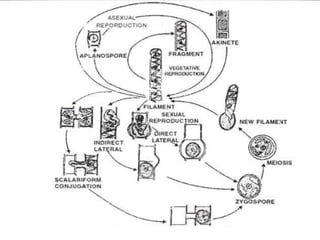
In the life cycle, the thalloid vegetative
filaments multiples by vegetative and
sexual reproductions are most common
while asexual reproduction occur only
occasionally.
Vegetative Reproduction
During the growing season, the vegetative
filament of Spirogyra undergoes fragmentation,
so that each fragment independently develops
into a new filament by repeated cell division and
elongation. In favorable conditions,
fragmentation is a most common method of
multiplication. The fragmentation is caused by
(i) mechanical injury (ii) dissolution of middle
lamella (Hi) development of H-shaped pieces
(e.g. in S. colligates).
Asexual Reproduction
Asexual life cycle is less common and reported only in
a few Spirogyra sp. Asexual cycles involve the
formation of aplanospores, akinetes, azygospores
Formation of aplanospores:
Under un-favourable conditions, the protoplast of each
vegetative cell shrinks and develops a wall around it to
form an aplanospore. Each non-motile aplanospore
germinates to form a new filament. For example, S.
articulate, S. mirabilis etc. In S. aplanospora the life
cycle involves the formation of aplanospores only.
Formation of akinetes:
Under unfavorable conditions, the vegetative
cells of S. farlowii develop thick-walled cells
called akinetes. On the return of favorable
conditions each akinete germinate into a new
filament.
Formation of azygospores or parthemspores:
In the life cycle of S. varians and S.
groenlandica, sometimes the gametes fail to
fuse and each get enclosed by thick cell wall to
become azygospore or parthenospore. Each
azygospore germinates in to a new filament.
Sexual reproduction
Sexual reproduction of Spirogyra involves
conjugation, which may be defined as a
primitive type of isogamy called aplanogametic
isogamy. In this type of isogamy, the entire
protoplasmic contents of vegetative cells (viz.,
Gametangia) function as gametes. It always
involves the gametangial contact. Conjugation
is of two type—Scalariform and Lateral
conjugation.
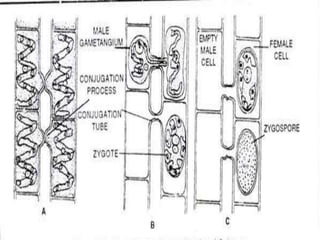
Scalariform Conjugation:- It is most common
method in most heterothallic species of
Spirogyra. It takes place when two filaments
come close and lie opposite and parallel to each
other. Now, opposite cells develop outgrowths
or protuberances called conjugation processes.
At the point of contact, the tips of these
processes dissolve to form conjugation tube
between opposite cells. This resembles ladder.
Hence, the conjugation is called scalariform (Gr.
scala = ladder; forma = shape) or H-shape
conjugation.
Scalariform Conjugation: When the
conjugation tube is forming, the protoplasts of
conjugating cells (gametangia) recede, round
up and function as gametes. The male gametes
transfer through the conjugation tube into the
opposite cell (female gametangia) and fuse
with female gamete to form zygote (2n). The
zygote secretes a thick wall to become
zygospore. Therefore, in the late stage of
conjugation, male gametangia remain empty
and the female gametangia contain zygospores
(2n)
Lateral Conjugation: - It is of rare occurrence and involves the
fusion of gametes from two adjacent cells of the same filament in
monoecious or homothallic species. It is of two types: Indirect and Direct
Lateral conjugation.
Indirect lateral conjugation:
Two outgrowths emerge on both side of a transverse septum of two
adjunct cells and after some growth the two protuberances unite to form
a conjugation tube. Of the two adjacent cells, one behaves as male
gametangium whiles the other as female gametangium. The content (now
behaving as gamete) from male gametangium passes through
conjugation tube and enters into female gametangium .By the fusion of
male and female gametes a diploid zygospore is formed. Thus, in each
second cell of a filament, a zygospore is formed, e.g., S. tenuissima,
Direct lateral conjugation:
In this type of conjugation, the male gametangium after
passing through an aperture in the transverse septum of
adjoining gametangium enters the female gametangium and
fuses with the female gamete, and a diploid zygospore is
formed, e.g., S .jogensis
Germination of Zygospore:
Zygospore is the only diploid phase in the sexual life cycle. The
decay of female gametangia causes the liberation of zygospore
which remains dormant in the pond bottom till the favorable
conditions return. Zygospore wall is thick and differentiated in to
3-layers. Outer exosporium (cellulose), middle mesosporium
(cellulose & chitin) and inner endosporium (cellulose).
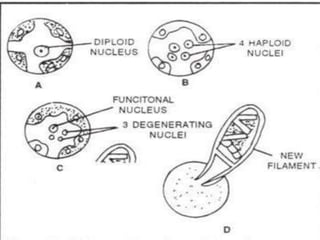
On return of favourable condition the diploid nucleus of zygospore
undergo meiosis to produce 4 haploid nuclei out of which 3
degenerate. The zygospore with one haploid nucleus gradually
enlarges and burst open to release a germ tube. The repeated
transverse divisions of germ tube form a new filament.
Spirogyra ppt.pptx
Spirogyra ppt.pptx