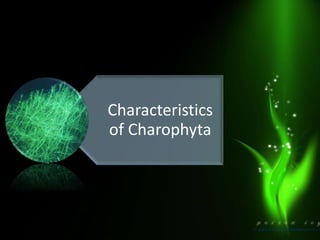
Characteristics
of Charophyta
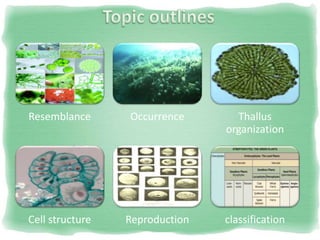
Resemblance Occurrence Thallus
organization
Cell structure Reproduction classification
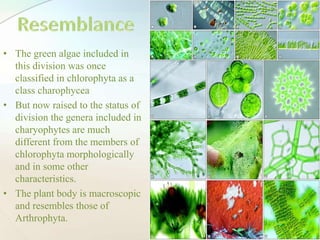
• The green algae included in
this division was once
classified in chlorophyta as a
class charophycea
• But now raised to the status of
division the genera included in
charyophytes are much
different from the members of
chlorophyta morphologically
and in some other
characteristics.
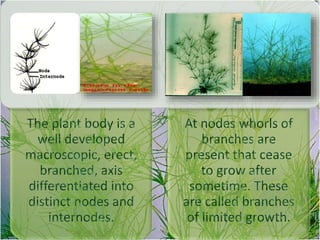
• The plant body is macroscopic
and resembles those of
Arthrophyta.
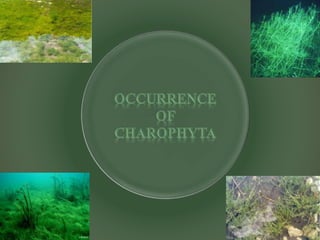
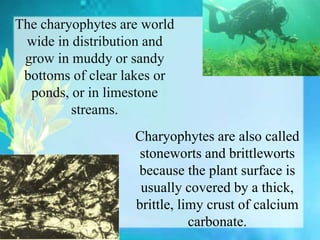
The charyophytes are world
wide in distribution and
grow in muddy or sandy
bottoms of clear lakes or
ponds, or in limestone
streams.
Charyophytes are also called
stoneworts and brittleworts
because the plant surface is
usually covered by a thick,
brittle, limy crust of calcium
carbonate.
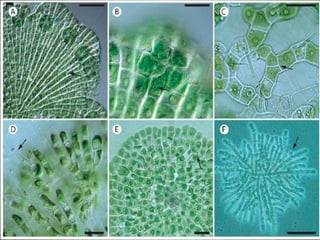
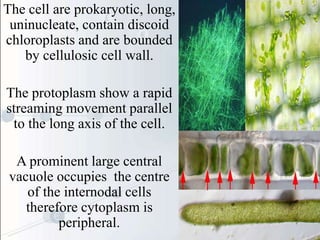
The cell are prokaryotic, long,
uninucleate, contain discoid
chloroplasts and are bounded
by cellulosic cell wall.
The protoplasm show a rapid
streaming movement parallel
to the long axis of the cell.
A prominent large central
vacuole occupies the centre
of the internodal cells
therefore cytoplasm is
peripheral.
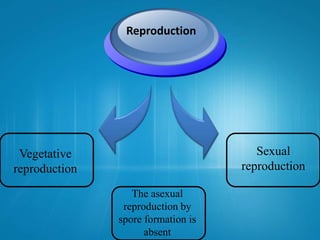
Reproduction
Vegetative
reproduction
Sexual
reproduction
The asexual
reproduction by
spore formation is
absent
Vegetative reproduction
Amylum
stars
Bulbils
Protonema
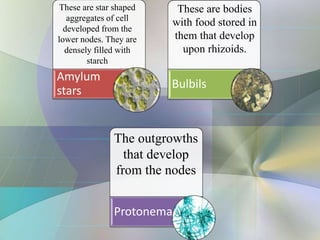
Amylum
stars
Bulbils
Protonema
These are star shaped
aggregates of cell
developed from the
lower nodes. They are
densely filled with
starch
These are bodies
with food stored in
them that develop
upon rhizoids.
The outgrowths
that develop
from the nodes
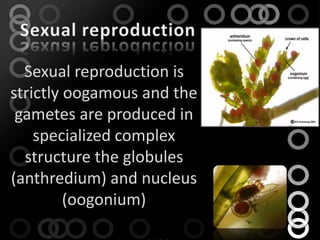
Sexual reproduction is
strictly oogamous and the
gametes are produced in
specialized complex
structure the globules
(anthredium) and nucleus
(oogonium)
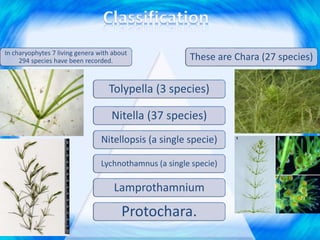
In charyophytes 7 living genera with about
294 species have been recorded. These are Chara (27 species)
Tolypella (3 species)
Nitella (37 species)
Nitellopsis (a single specie)
Lychnothamnus (a single specie)
Lamprothamnium
Protochara.
Charophytes

Charophytes

  • 2.
  • 3.
    Resemblance Occurrence Thallus organization Cellstructure Reproduction classification
  • 4.
    • The greenalgae included in this division was once classified in chlorophyta as a class charophycea • But now raised to the status of division the genera included in charyophytes are much different from the members of chlorophyta morphologically and in some other characteristics. • The plant body is macroscopic and resembles those of Arthrophyta.
  • 6.
    The charyophytes areworld wide in distribution and grow in muddy or sandy bottoms of clear lakes or ponds, or in limestone streams. Charyophytes are also called stoneworts and brittleworts because the plant surface is usually covered by a thick, brittle, limy crust of calcium carbonate.
  • 10.
    The cell areprokaryotic, long, uninucleate, contain discoid chloroplasts and are bounded by cellulosic cell wall. The protoplasm show a rapid streaming movement parallel to the long axis of the cell. A prominent large central vacuole occupies the centre of the internodal cells therefore cytoplasm is peripheral.
  • 11.
  • 12.
  • 13.
    Amylum stars Bulbils Protonema These are starshaped aggregates of cell developed from the lower nodes. They are densely filled with starch These are bodies with food stored in them that develop upon rhizoids. The outgrowths that develop from the nodes
  • 14.
    Sexual reproduction is strictlyoogamous and the gametes are produced in specialized complex structure the globules (anthredium) and nucleus (oogonium)
  • 15.
    In charyophytes 7living genera with about 294 species have been recorded. These are Chara (27 species) Tolypella (3 species) Nitella (37 species) Nitellopsis (a single specie) Lychnothamnus (a single specie) Lamprothamnium Protochara.