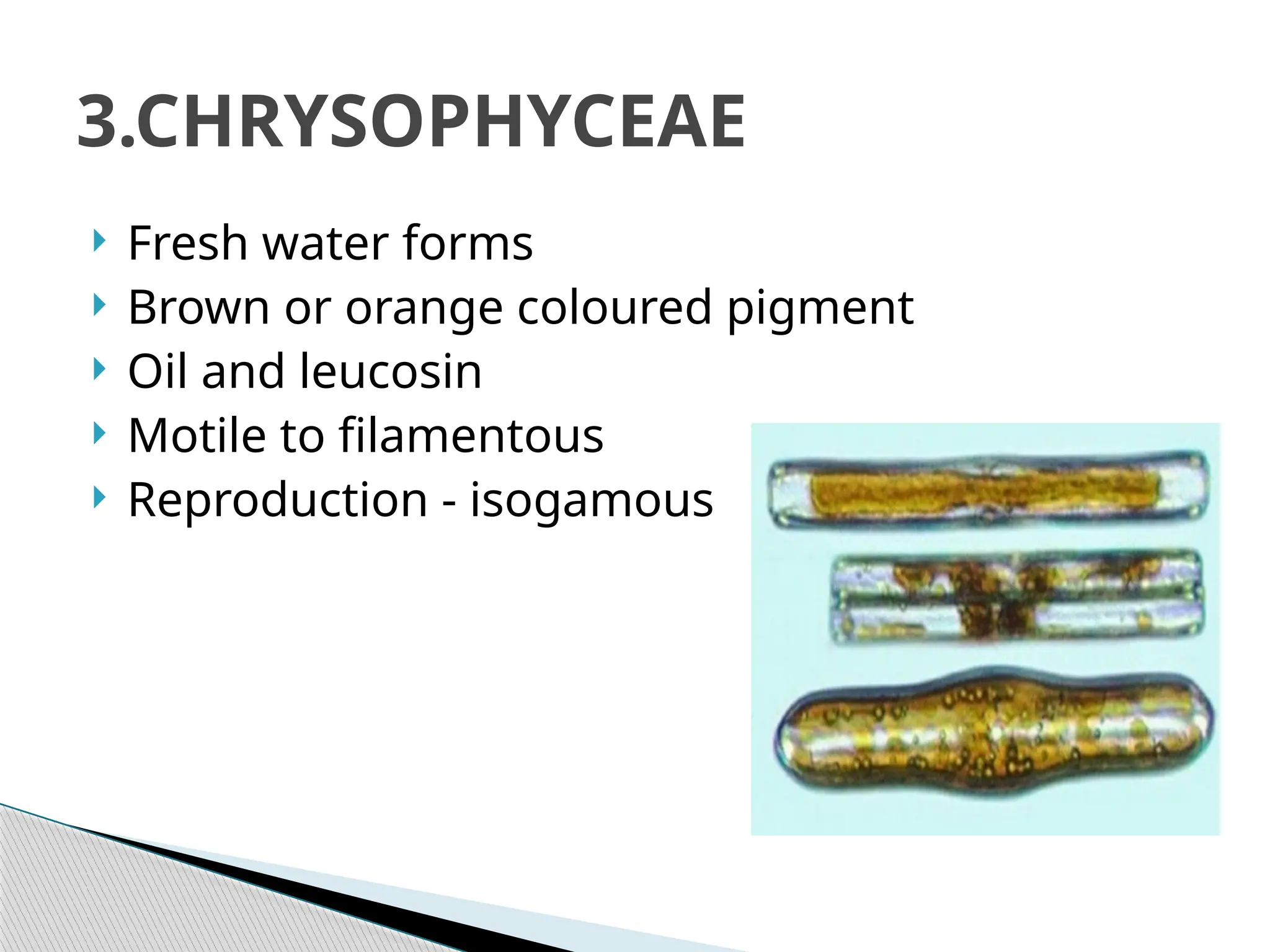
Fresh waterforms
Brown or orange coloured pigment
Oil and leucosin
Motile to filamentous
Reproduction - isogamous
3.CHRYSOPHYCEAE
5.
Fresh water,soil
Chromatophores are yellow green
Reserve food- fat and volutin
Unicellular or colonial
Cell wall composed of silica
Special type of reproduction
4. BACILLARIOPHYCEAE
6.
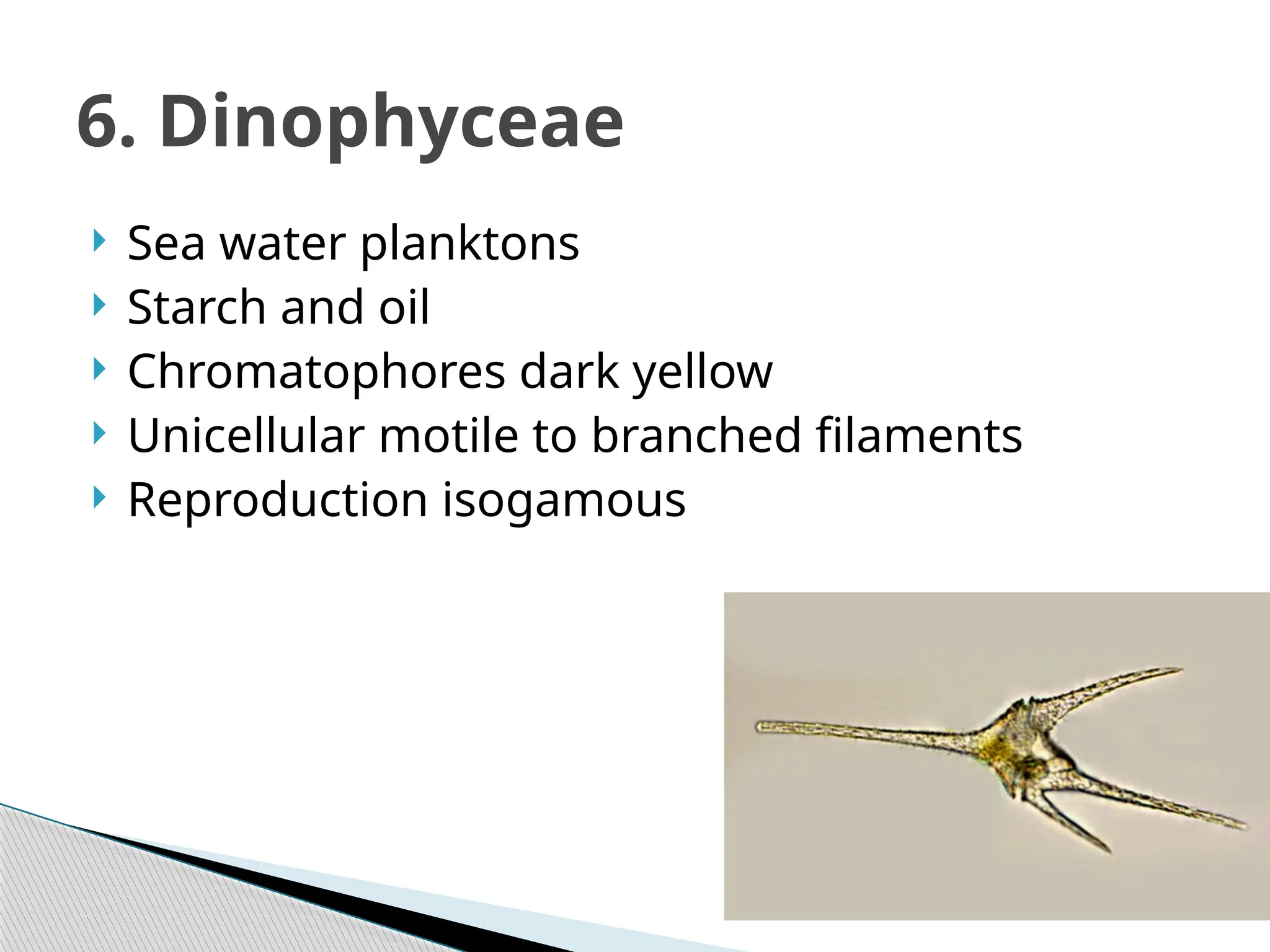
Fresh waterand marine
Diverse pigmentation
Presence of motile cells
5.CRYPTOPHYCEAE
7.
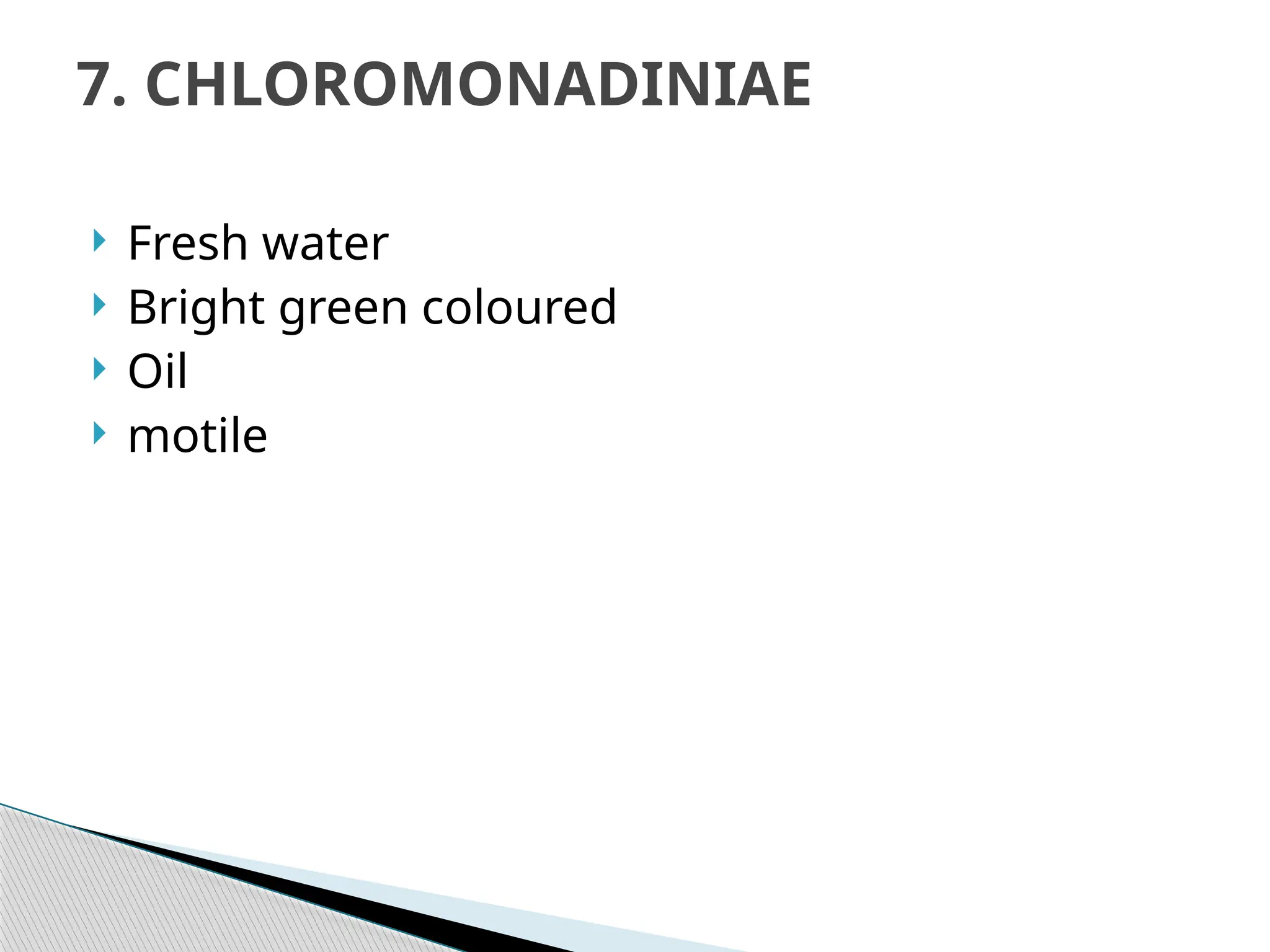
Sea waterplanktons
Starch and oil
Chromatophores dark yellow
Unicellular motile to branched filaments
Reproduction isogamous
6. Dinophyceae
8.
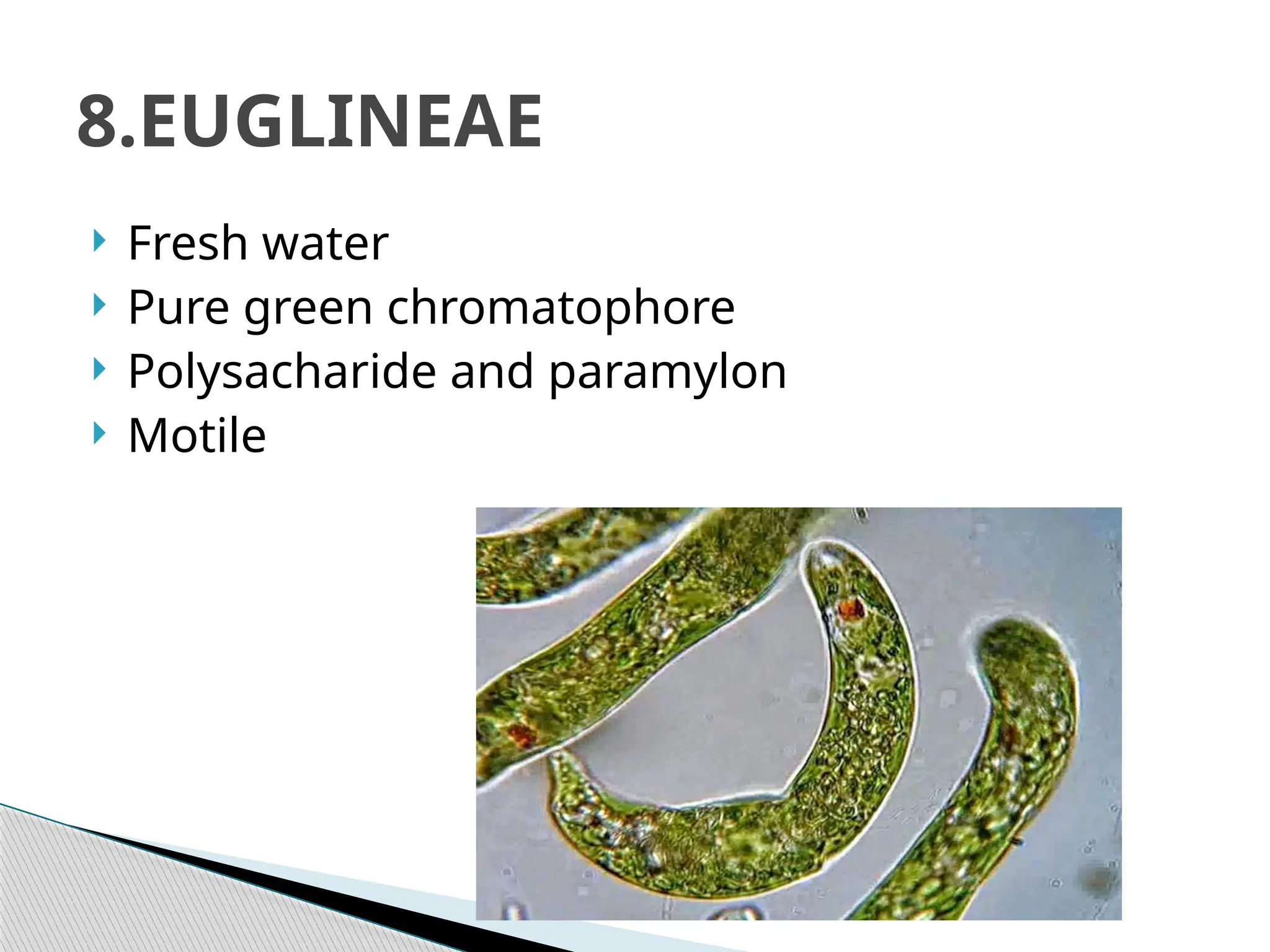
Fresh water
Bright green coloured
Oil
motile
7. CHLOROMONADINIAE
9.
Fresh water
Pure green chromatophore
Polysacharide and paramylon
Motile
8.EUGLINEAE
10.
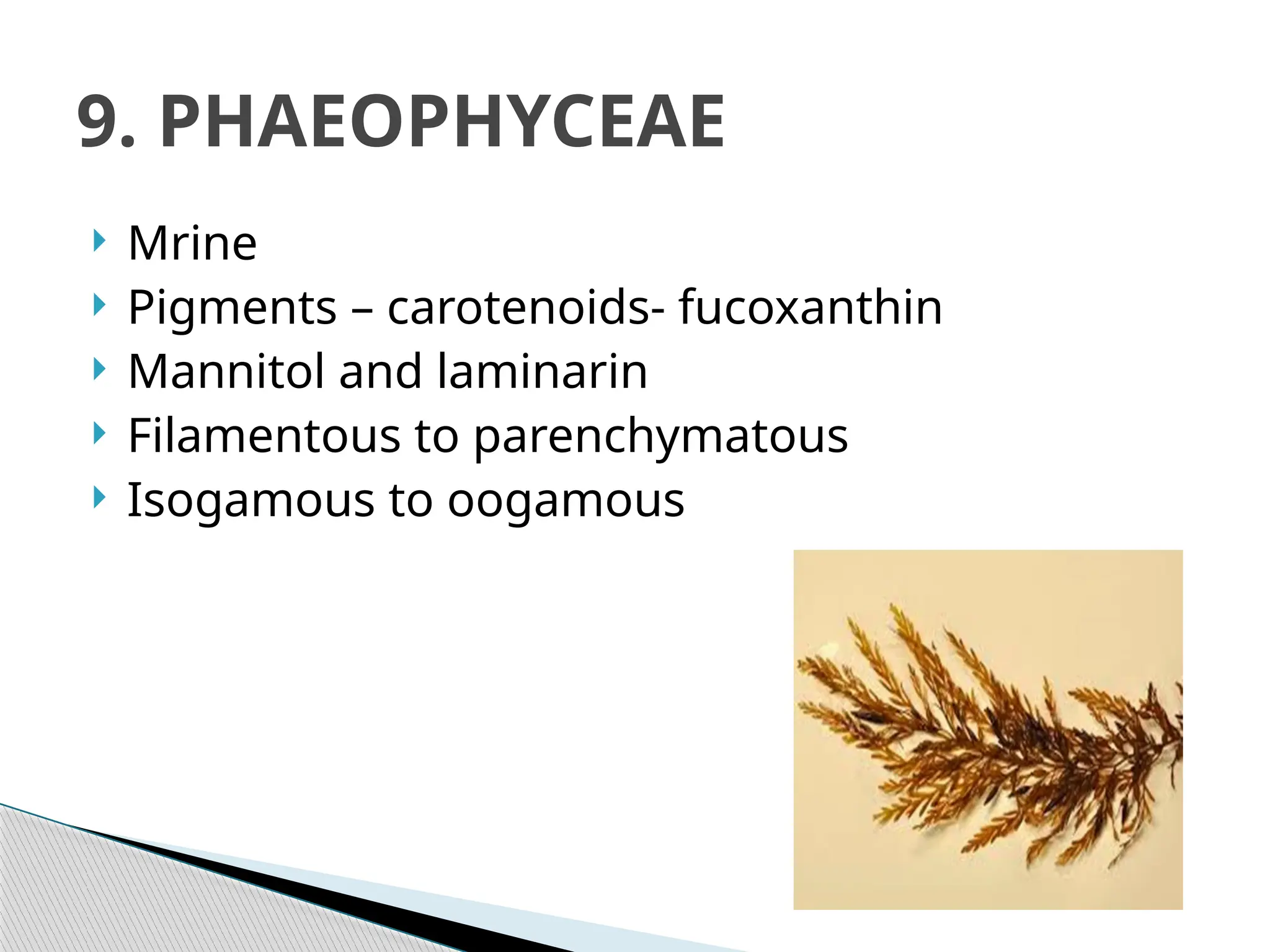
Mrine
Pigments– carotenoids- fucoxanthin
Mannitol and laminarin
Filamentous to parenchymatous
Isogamous to oogamous
9. PHAEOPHYCEAE
11.
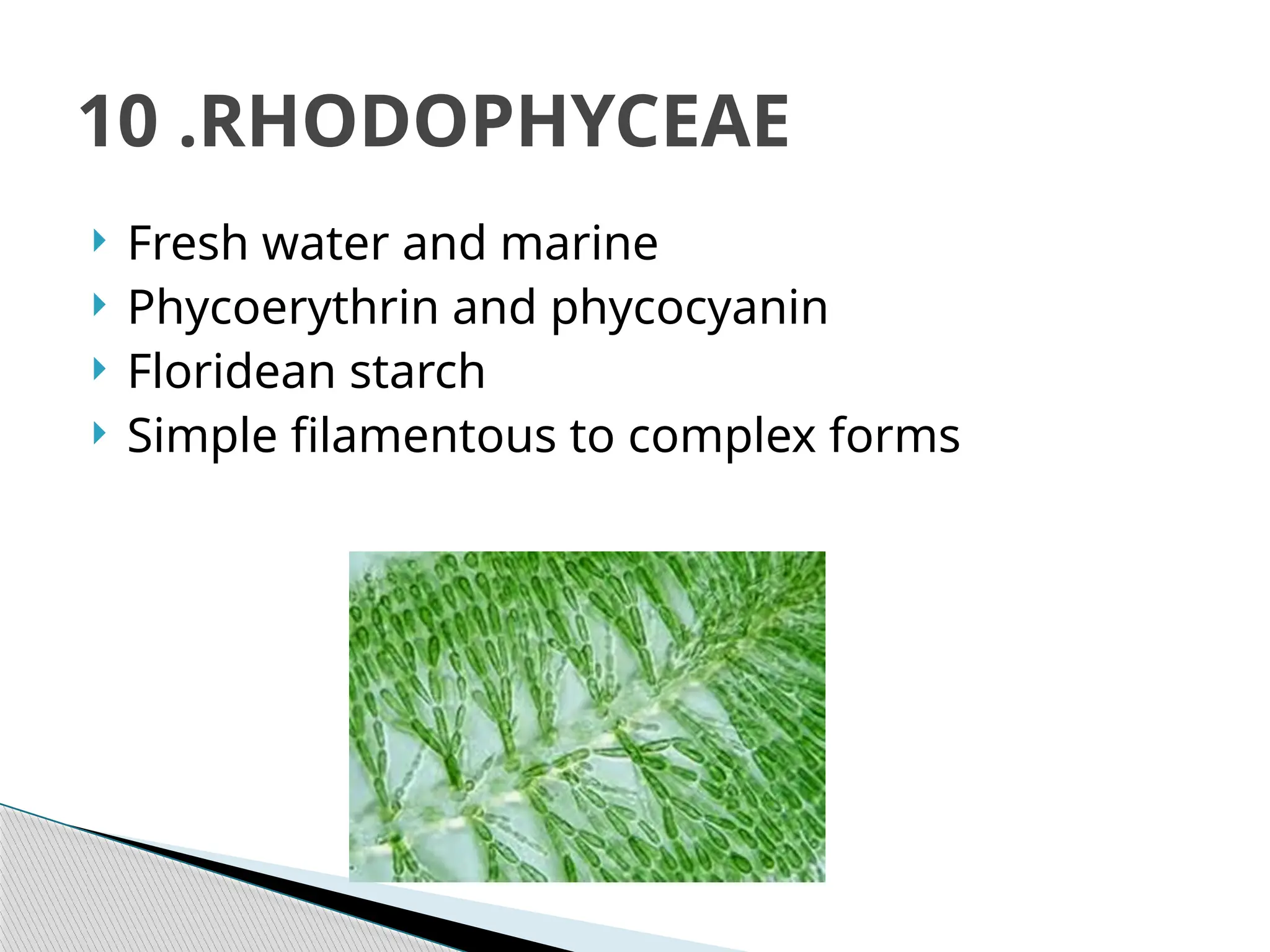
Fresh waterand marine
Phycoerythrin and phycocyanin
Floridean starch
Simple filamentous to complex forms
10 .RHODOPHYCEAE
12.
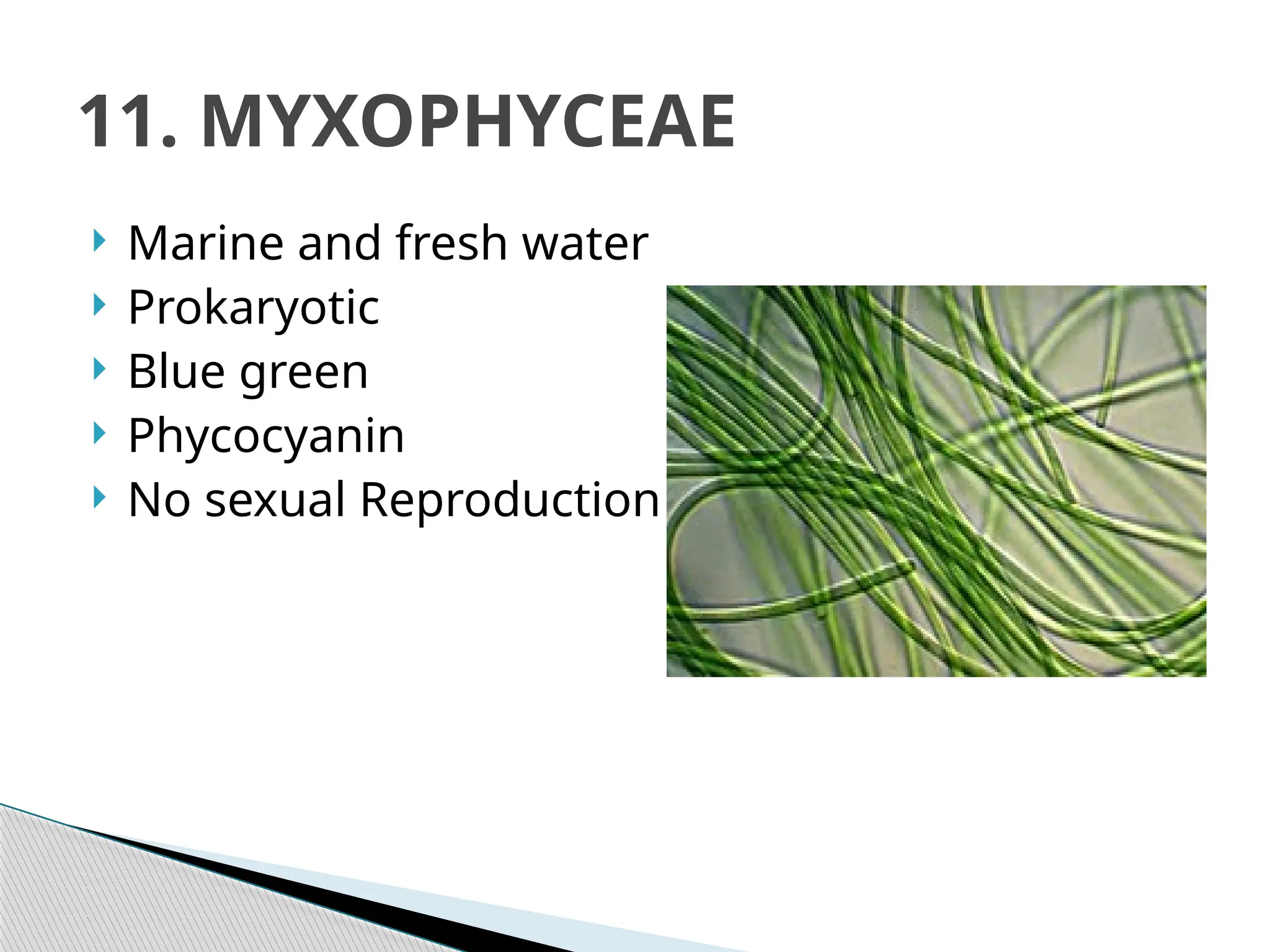
Marine andfresh water
Prokaryotic
Blue green
Phycocyanin
No sexual Reproduction
11. MYXOPHYCEAE
13.
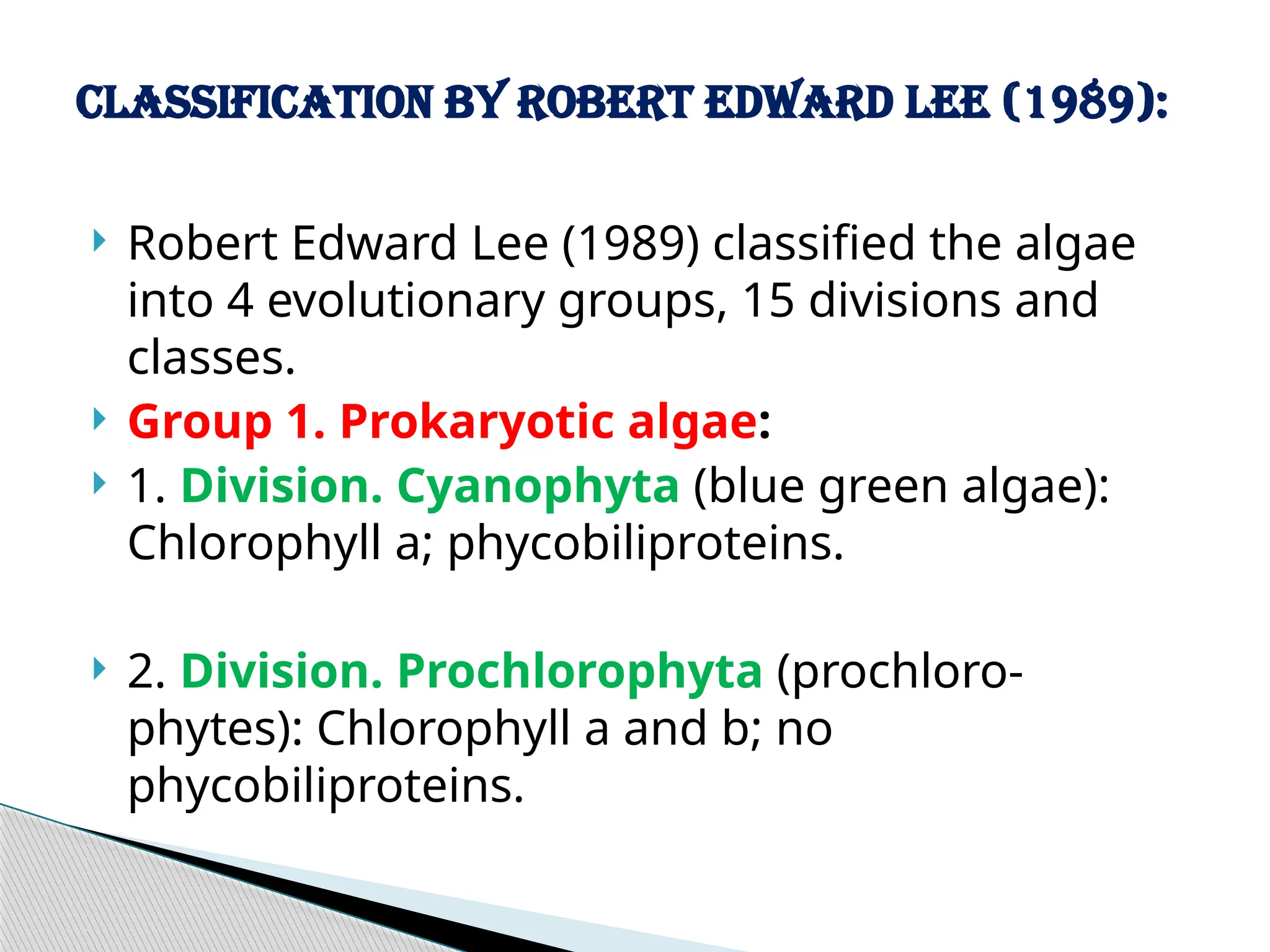
Robert EdwardLee (1989) classified the algae
into 4 evolutionary groups, 15 divisions and
classes.
Group 1. Prokaryotic algae:
1. Division. Cyanophyta (blue green algae):
Chlorophyll a; phycobiliproteins.
2. Division. Prochlorophyta (prochloro-
phytes): Chlorophyll a and b; no
phycobiliproteins.
Classification by Robert Edward Lee (1989):
14.
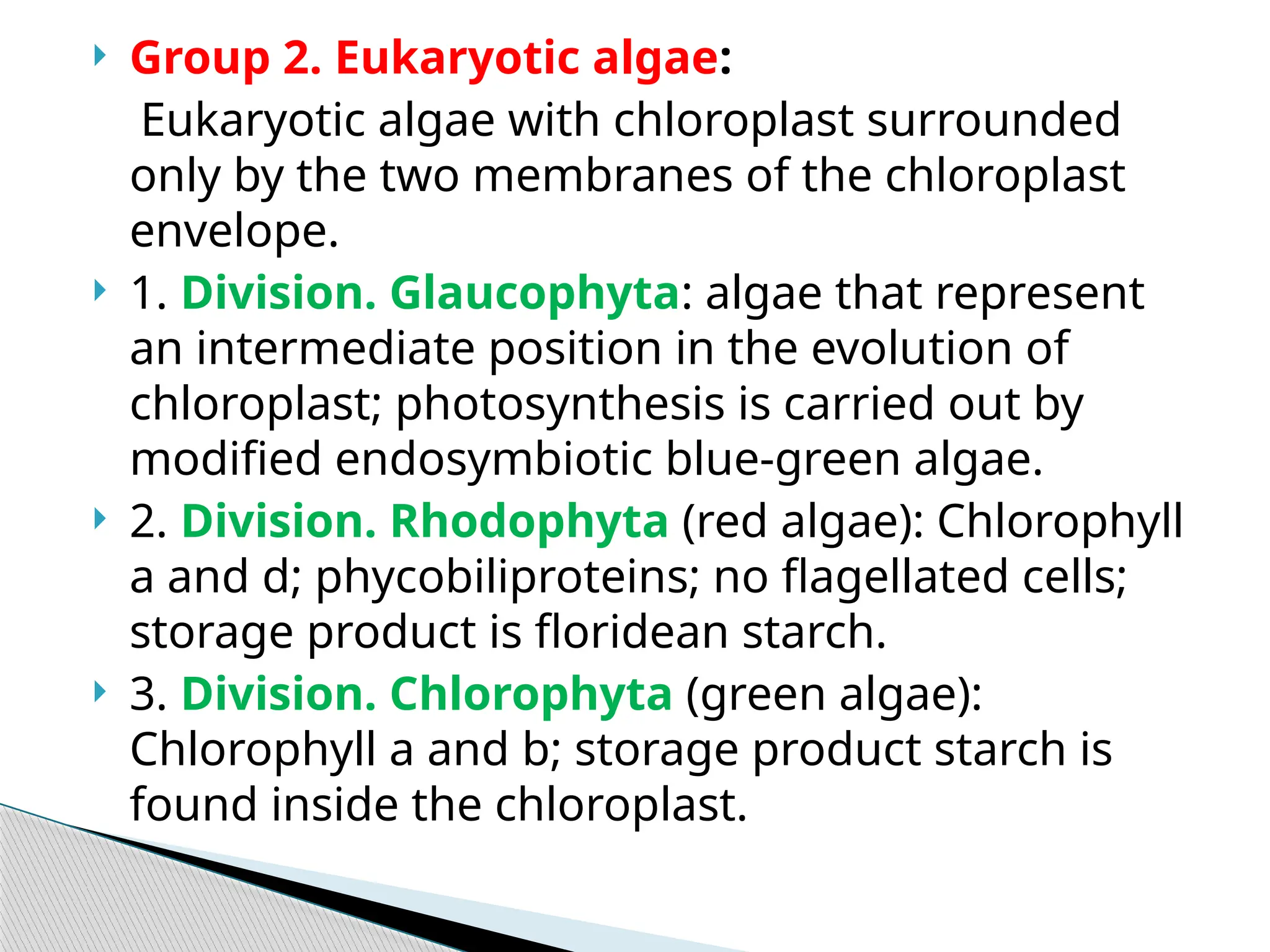
Group 2.Eukaryotic algae:
Eukaryotic algae with chloroplast surrounded
only by the two membranes of the chloroplast
envelope.
1. Division. Glaucophyta: algae that repre
sent
an intermediate position in the evolu
tion of
chloroplast; photosynthesis is carried out by
modified endosymbiotic blue-green algae.
2. Division. Rhodophyta (red algae): Chlorophyll
a and d; phycobiliproteins; no flagellated cells;
storage product is floridean starch.
3. Division. Chlorophyta (green algae):
Chlorophyll a and b; storage product starch is
found inside the chloroplast.
15.
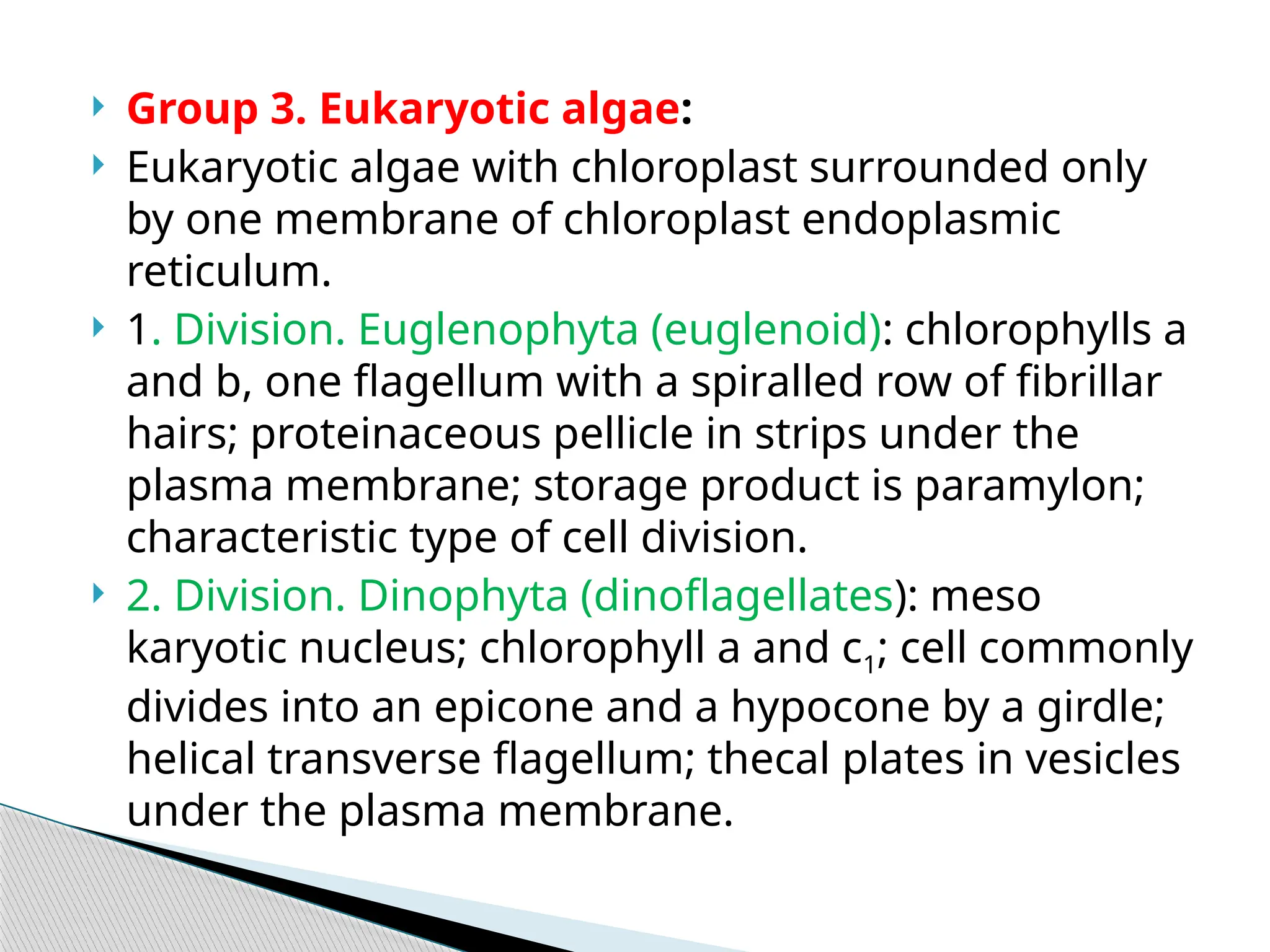
Group 3.Eukaryotic algae:
Eukaryotic algae with chloroplast surrounded only
by one membrane of chloro
plast endoplasmic
reticulum.
1. Division. Euglenophyta (euglenoid): chloro
phylls a
and b, one flagellum with a spiralled row of fibrillar
hairs; proteinaceous pellicle in strips under the
plasma membrane; storage product is paramylon;
characteristic type of cell division.
2. Division. Dinophyta (dinoflagellates): meso
karyotic nucleus; chlorophyll a and c1; cell commonly
divides into an epicone and a hypocone by a girdle;
helical transverse flagellum; thecal plates in vesicles
under the plasma membrane.
16.
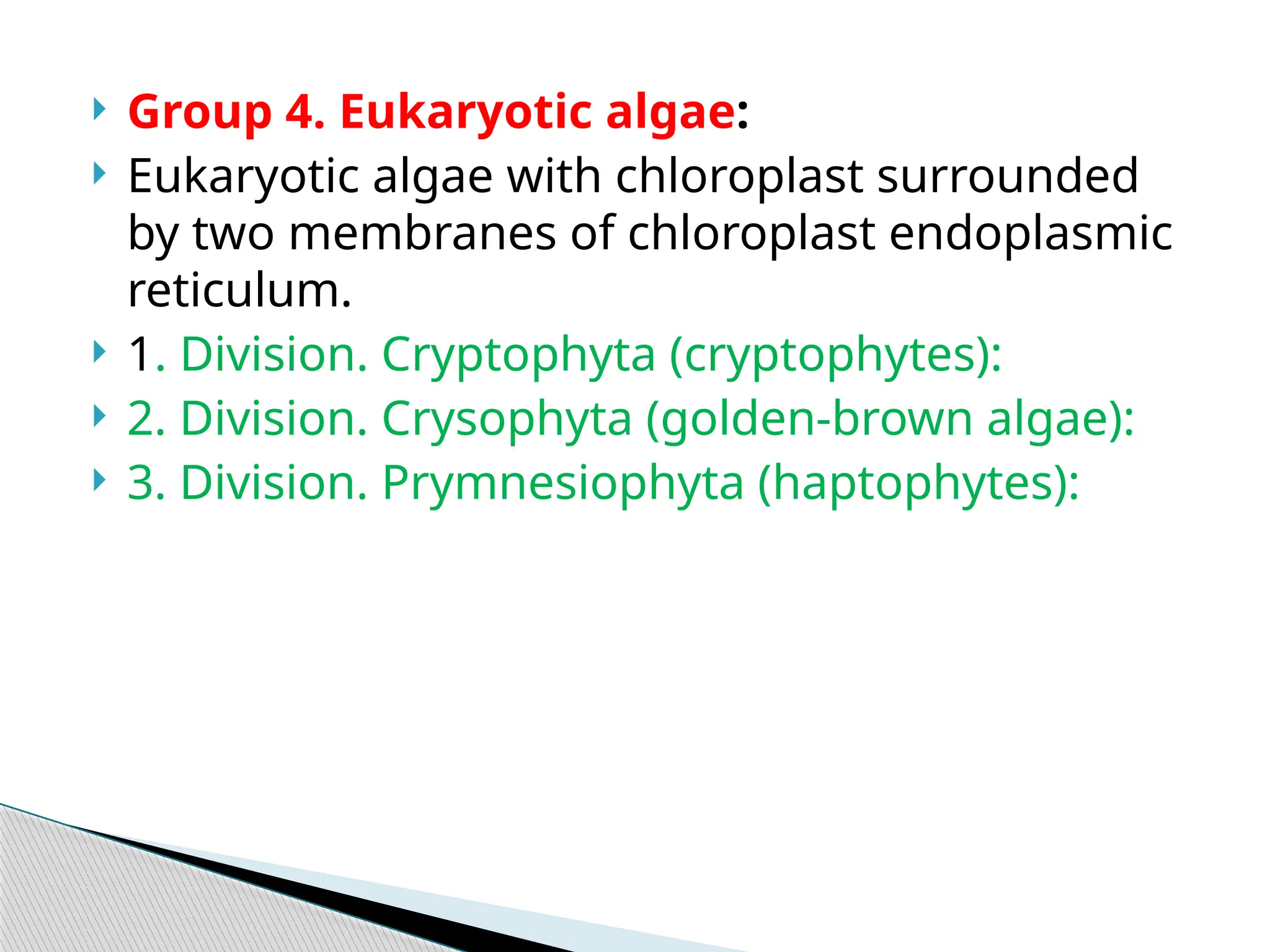
Group 4.Eukaryotic algae:
Eukaryotic algae with chloroplast surrounded
by two membranes of chloroplast endoplasmic
reticulum.
1. Division. Cryptophyta (cryptophytes):
2. Division. Crysophyta (golden-brown algae):
3. Division. Prymnesiophyta (haptophytes):
17.
4. Division-Bacillariophyta (diatom.
5. Division - Xanthophyta (yellow green algae
6. Division- Eustigmatophyta: eye-spot large
and outside chloroplast; chlorophyll a;
posterior whiplash flagellum (commonly
reduced) and anterior tinsel flagellum.
7. Division- Raphidophyta (chloromonads):
chlorophyll a and c; anterior tinsel flagellum
and posterior whiplash flagellum.
8. Division- Phaeophyta (brown algae
fucoxanthin, storage product chrysolaminarin
is found in vesicles in cytoplasm.