Downloaded 18 times
![PHOTOCHEMISTRY
Photochemistry is the branch of chemistry concerned with the chemical effects of light.
Generally, this term is used to describe a chemical reaction caused by absorption
of ultraviolet (wavelength from 100 to 400 nm), visible light (400 - 750 nm) or infrared radiation
(750 - 2500 nm).[1]
Photochemical reactions are valuable in organic and inorganic chemistry because they
proceed differently than thermal reactions. Many thermal reactions have their photochemical
counterpart. Photochemical paths offer the advantage over thermal methods of forming
thermodynamically disfavored products, overcoming large activation barriers in a short period of
time, and allowing reactivity otherwise inaccessible by thermal processes.
Everyday examples include photosynthesis, degradation of plastics or formation
of vitamin D with sunlight.
Photochemical immersion well reactor (50 mL) with a mercury-vapor lamp
Grotthuss–Draper law or first law of photochemistry
Photoexcitation is the first step in a photochemical process where the reactant is
elevated to a state of higher energy, an excited state. The first law of photochemistry, known as
the Grotthuss–Draper law (for chemists Theodor Grotthuss and John W. Draper), states that light
must be absorbed by a chemical substance in order for a photochemical reaction to take place.
For each photon of light absorbed by a chemical system, no more than one molecule is activated
for a photochemical reaction, as defined by the quantum yield.[2]](https://image.slidesharecdn.com/photochemistry-151121053741-lva1-app6892/85/Photochemistry-1-320.jpg)
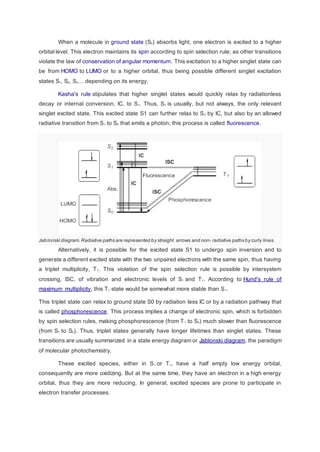
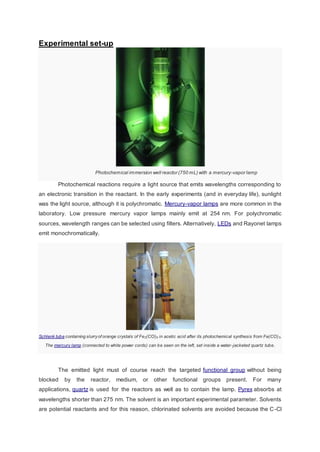
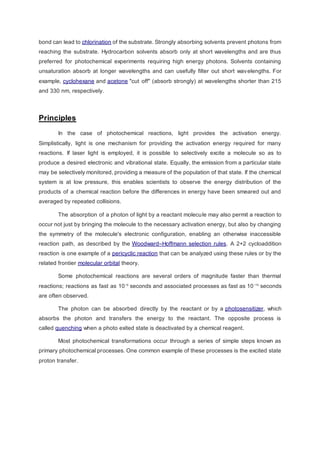

Photochemistry is the branch of chemistry concerned with chemical reactions caused by light absorption. Photochemical reactions proceed differently than thermal reactions and can form thermodynamically disfavored products or overcome large activation barriers. When a molecule absorbs light, it is elevated to an excited state. The Grotthuss–Draper law states that light must be absorbed for a photochemical reaction to occur. Absorbed light can excite a molecule to different singlet or triplet states, which can then relax through radiationless or radiative processes like fluorescence or phosphorescence. Experimental factors like light sources, reactors, solvents, and wavelength selection influence photochemical reactions.


