By
fariha un nisa
BS CHEMISTRY UOG
1
Alkylidyne complexes
2
History
 In early 1970’s Richard R. Schrock , former student of John Osborn
at Harvard made important discovery of first nucleophillic
alkylidyne complex
 In 1973, E.O Fischer synthesized first metal carbyne complex
3
Introduction :
 Definition:
 Transition metal carbyne complexes are organometallic
compounds with a triple bond between carbon and the transition
metal
 Triple bond consists of a σ-bond and two π-bonds.
4
Cont.
 Also called metal alkylidynes
 length of the M-C bond varies between 1.65 and 1.90 Ǻ depending
on the metal.
 Monomeric metal carbyne complexes exhibit linear M–C–R
linkages according to X-ray crystallography.
 M–C distances are typically shorter than the M–C bonds found in
metal carbenes.
 bond angle :170° to 180°.
5
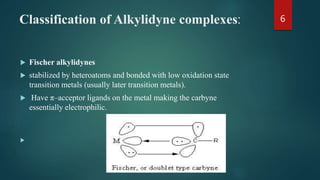
Classification of Alkylidyne complexes:
 Fischer alkylidynes
 stabilized by heteroatoms and bonded with low oxidation state
transition metals (usually later transition metals).
 Have π–acceptor ligands on the metal making the carbyne
essentially electrophilic.

6
Cont.
Tungsten is a very common metal used to make Fischer
carbynes. Fischer is very famous in the organometallic field, winning
the Nobel Prize in 1973.

7
Cont.
 Schrock alkylidynes:
 Have no heteroatoms, and are found with high oxidation state
metals (early transition metals).
 The other ligands on the metal are usually strong σ-donors, which
makes the carbon essentially nucleophilic.
 They usually form complexes with less than 18 electrons and the
metals tend to be d0.
8
cont.
 The Schrock carbyne is an example of a quartet carbyne. It forms 3
covalent bonds to the metal because it has 3 unpaired electron.
9
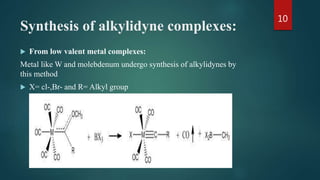
Synthesis of alkylidyne complexes:
 From low valent metal complexes:
Metal like W and molebdenum undergo synthesis of alkylidynes by
this method
 X= cl-,Br- and R= Alkyl group
10
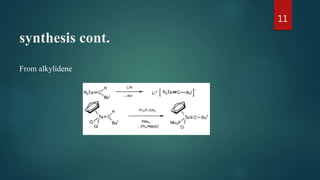
synthesis cont.
From alkylidene
11
Cont.
Other routes:
12
Cont.
From dichlorocarbene:
Highly reactive compound. Treatment with aryl lithium leads to double halide abstraction
13
References:
 Manfred bochmann, organometallics 1, alkylidene and alkylidyne
complexes , pg(84-87)
 Inorganic chemistry by Miessler and Tarr, 3rd edition, chapter
13,pg(510-512)
14

Alkylidyne complexes

  • 1.
    By fariha un nisa BSCHEMISTRY UOG 1
  • 2.
  • 3.
    History  In early1970’s Richard R. Schrock , former student of John Osborn at Harvard made important discovery of first nucleophillic alkylidyne complex  In 1973, E.O Fischer synthesized first metal carbyne complex 3
  • 4.
    Introduction :  Definition: Transition metal carbyne complexes are organometallic compounds with a triple bond between carbon and the transition metal  Triple bond consists of a σ-bond and two π-bonds. 4
  • 5.
    Cont.  Also calledmetal alkylidynes  length of the M-C bond varies between 1.65 and 1.90 Ǻ depending on the metal.  Monomeric metal carbyne complexes exhibit linear M–C–R linkages according to X-ray crystallography.  M–C distances are typically shorter than the M–C bonds found in metal carbenes.  bond angle :170° to 180°. 5
  • 6.
    Classification of Alkylidynecomplexes:  Fischer alkylidynes  stabilized by heteroatoms and bonded with low oxidation state transition metals (usually later transition metals).  Have π–acceptor ligands on the metal making the carbyne essentially electrophilic.  6
  • 7.
    Cont. Tungsten is avery common metal used to make Fischer carbynes. Fischer is very famous in the organometallic field, winning the Nobel Prize in 1973.  7
  • 8.
    Cont.  Schrock alkylidynes: Have no heteroatoms, and are found with high oxidation state metals (early transition metals).  The other ligands on the metal are usually strong σ-donors, which makes the carbon essentially nucleophilic.  They usually form complexes with less than 18 electrons and the metals tend to be d0. 8
  • 9.
    cont.  The Schrockcarbyne is an example of a quartet carbyne. It forms 3 covalent bonds to the metal because it has 3 unpaired electron. 9
  • 10.
    Synthesis of alkylidynecomplexes:  From low valent metal complexes: Metal like W and molebdenum undergo synthesis of alkylidynes by this method  X= cl-,Br- and R= Alkyl group 10
  • 11.
  • 12.
  • 13.
    Cont. From dichlorocarbene: Highly reactivecompound. Treatment with aryl lithium leads to double halide abstraction 13
  • 14.
    References:  Manfred bochmann,organometallics 1, alkylidene and alkylidyne complexes , pg(84-87)  Inorganic chemistry by Miessler and Tarr, 3rd edition, chapter 13,pg(510-512) 14