Fundamentals of Polymer Engineering
Polymerization Reactions
6/28/2020
1
Course Code: PE-3107
Credits: 3-0-3
Teacher: Engr. Asra Tariq
Email Id: asra.tariq@ntu.edu.pk
Polymerization Reactions
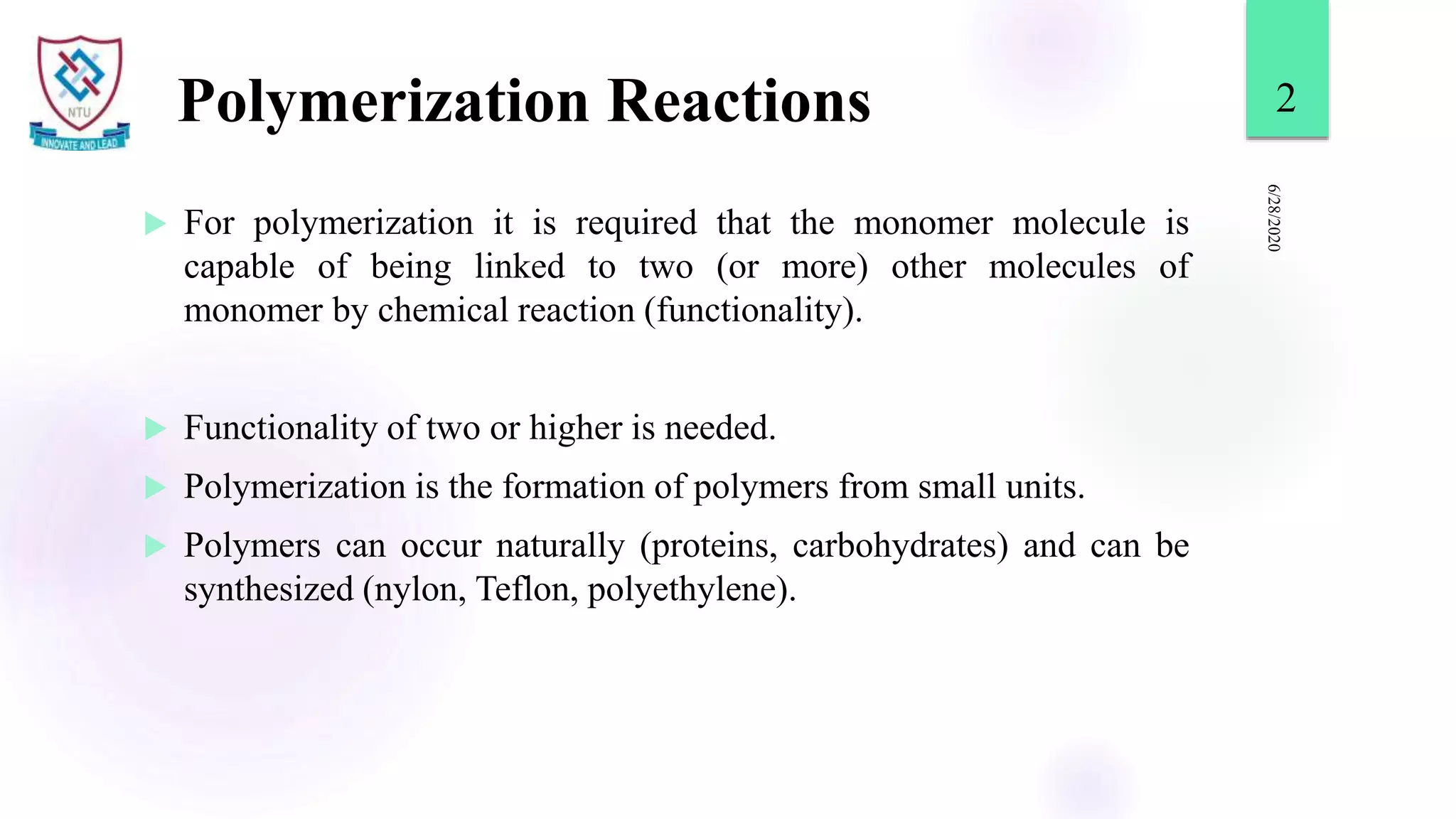
 For polymerization it is required that the monomer molecule is
capable of being linked to two (or more) other molecules of
monomer by chemical reaction (functionality).
 Functionality of two or higher is needed.
 Polymerization is the formation of polymers from small units.
 Polymers can occur naturally (proteins, carbohydrates) and can be
synthesized (nylon, Teflon, polyethylene).
6/28/2020
2
6/28/2020
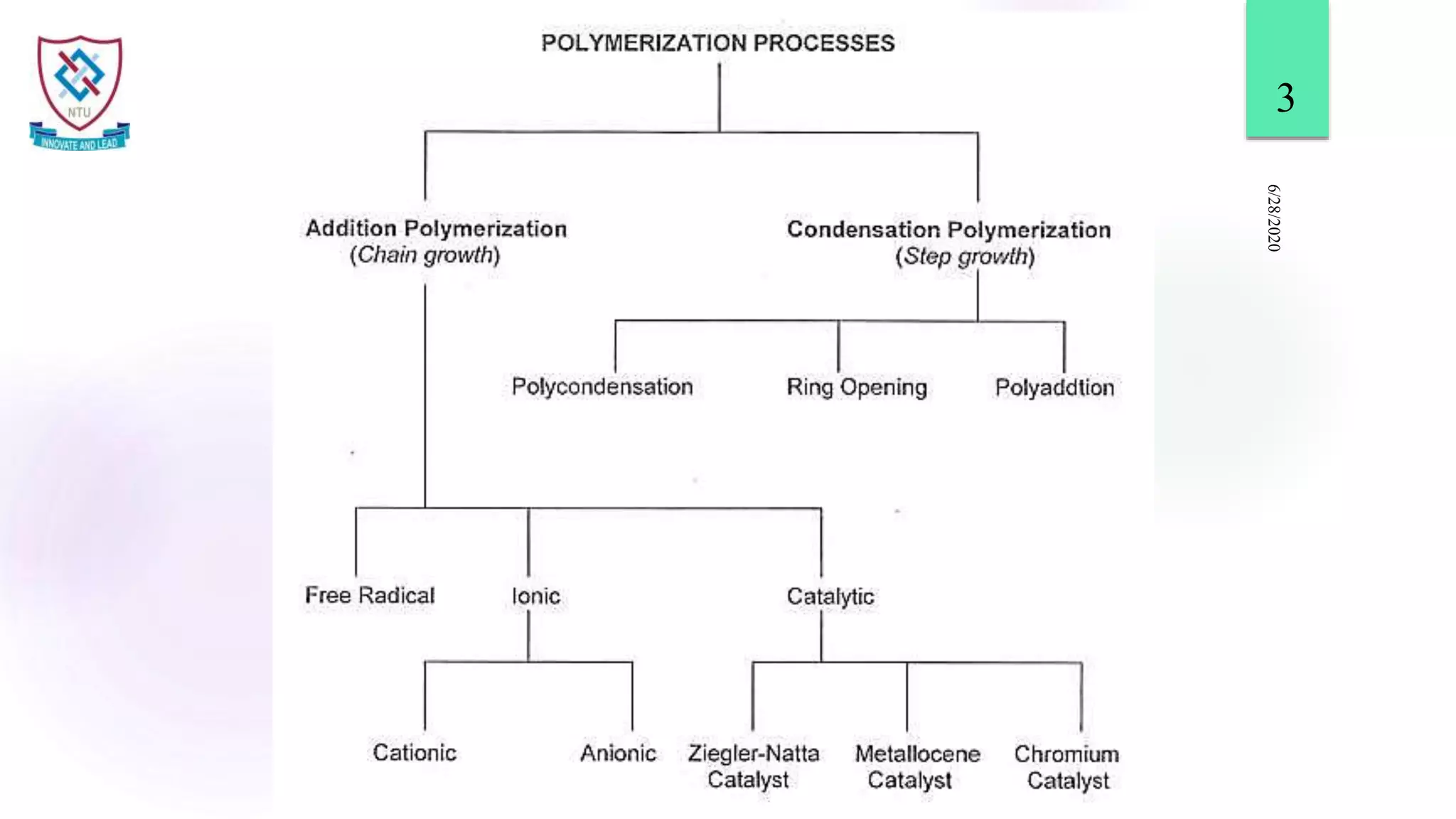
3
Chain Growth Polymerization
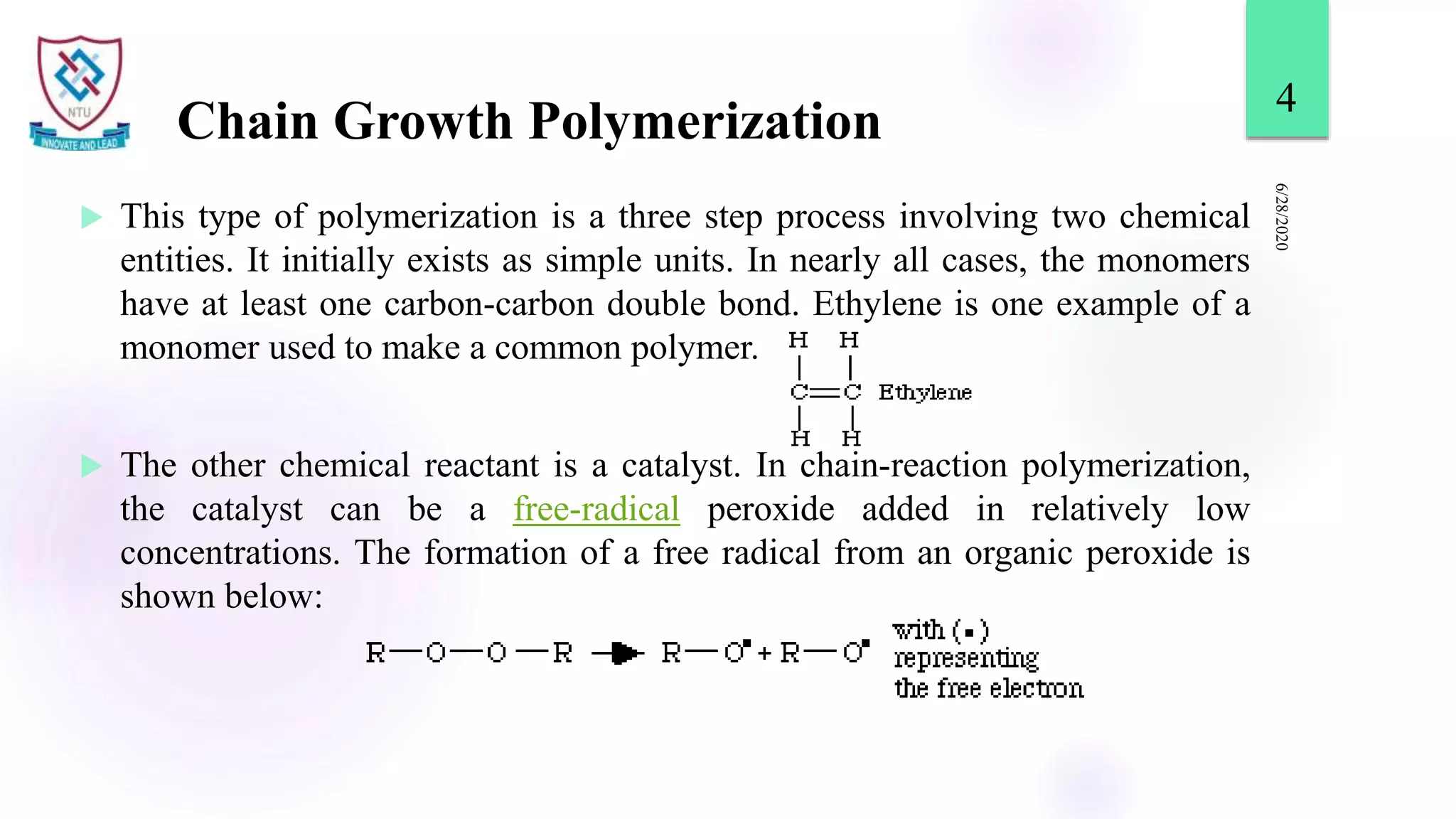
 This type of polymerization is a three step process involving two chemical
entities. It initially exists as simple units. In nearly all cases, the monomers
have at least one carbon-carbon double bond. Ethylene is one example of a
monomer used to make a common polymer.
 The other chemical reactant is a catalyst. In chain-reaction polymerization,
the catalyst can be a free-radical peroxide added in relatively low
concentrations. The formation of a free radical from an organic peroxide is
shown below:
6/28/2020
4
Chain Growth Polymerization
 Initiation
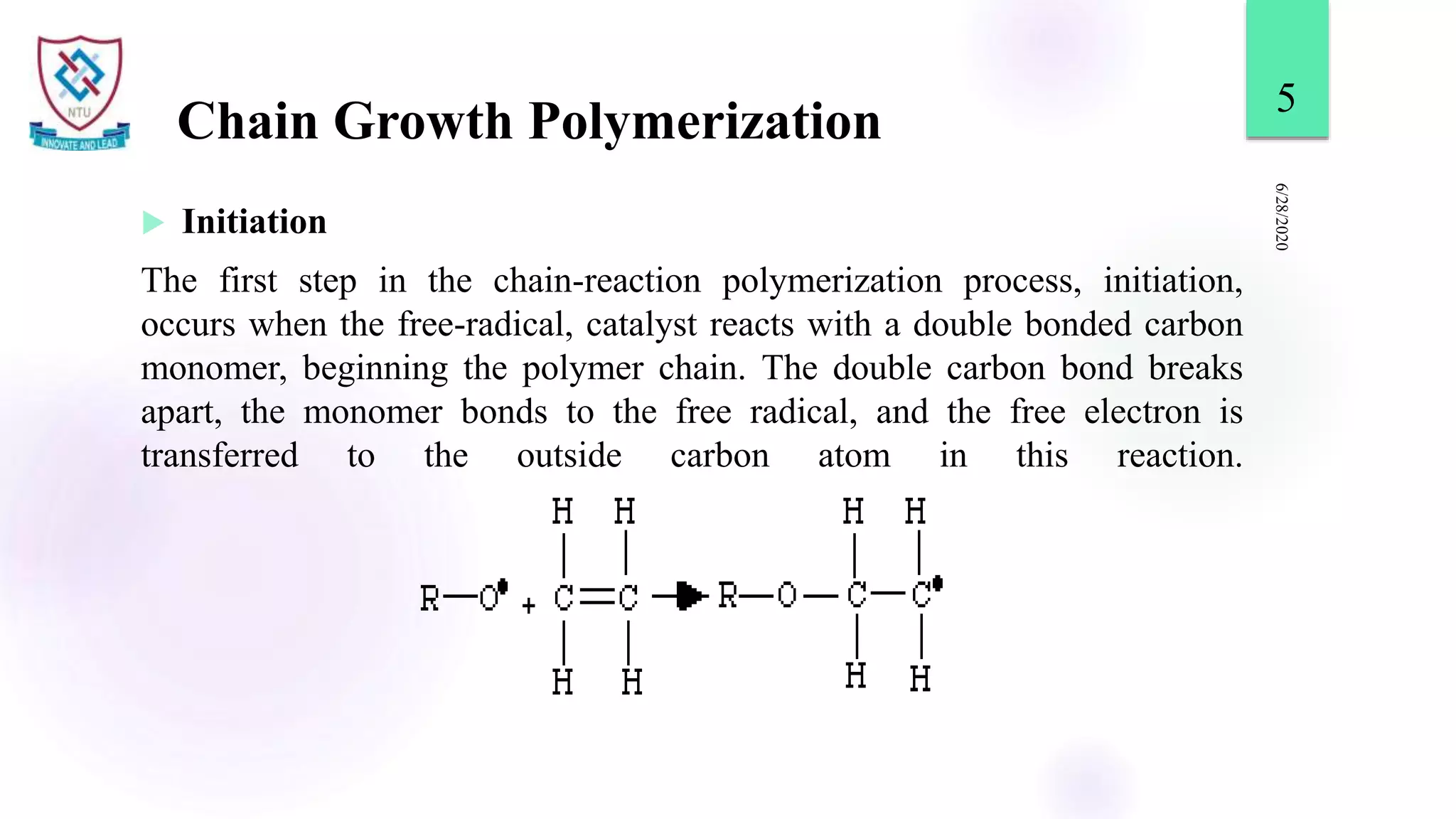
The first step in the chain-reaction polymerization process, initiation,
occurs when the free-radical, catalyst reacts with a double bonded carbon
monomer, beginning the polymer chain. The double carbon bond breaks
apart, the monomer bonds to the free radical, and the free electron is
transferred to the outside carbon atom in this reaction.
6/28/2020
5
Chain Growth Polymerization
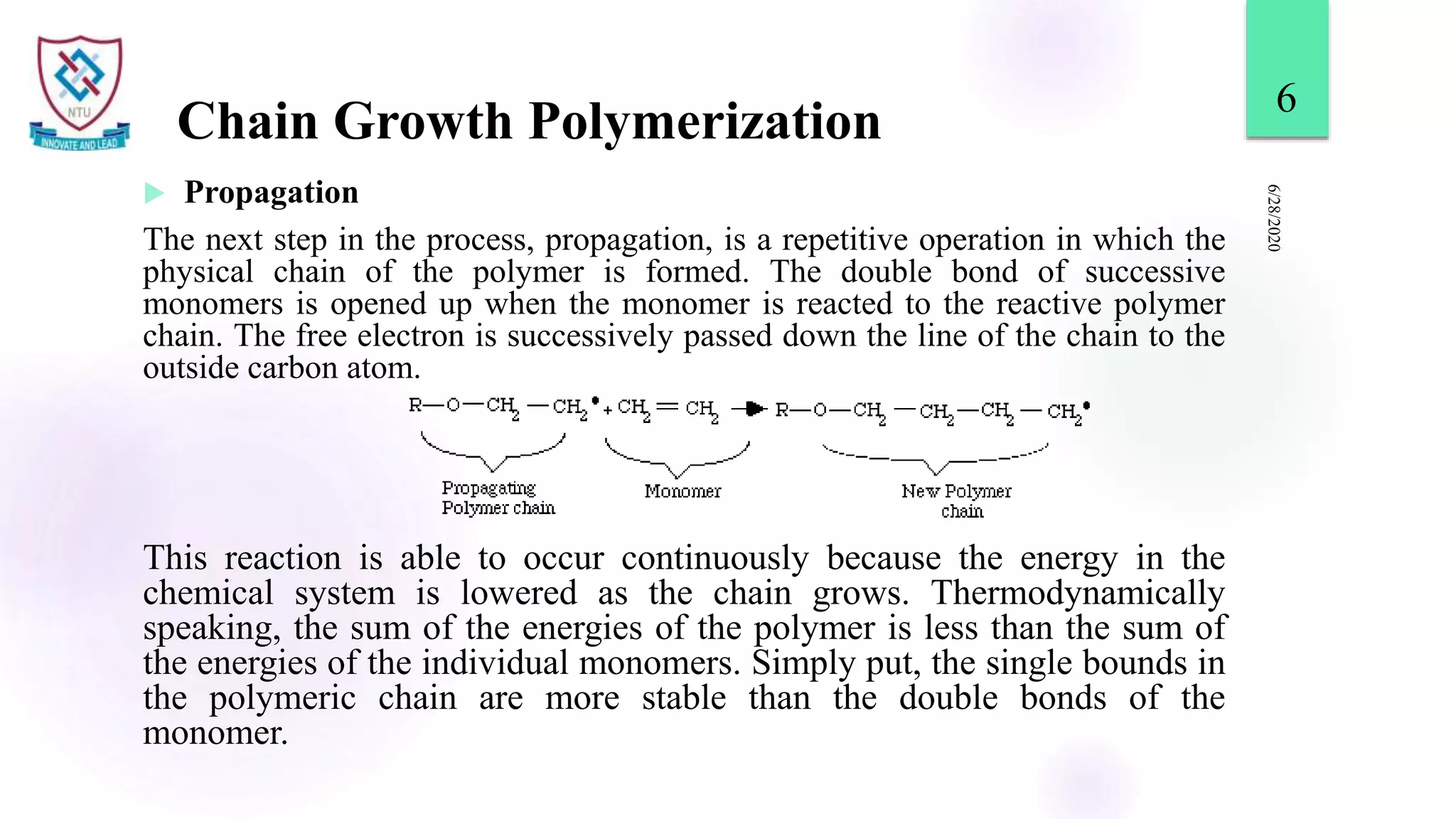
 Propagation
The next step in the process, propagation, is a repetitive operation in which the
physical chain of the polymer is formed. The double bond of successive
monomers is opened up when the monomer is reacted to the reactive polymer
chain. The free electron is successively passed down the line of the chain to the
outside carbon atom.
This reaction is able to occur continuously because the energy in the
chemical system is lowered as the chain grows. Thermodynamically
speaking, the sum of the energies of the polymer is less than the sum of
the energies of the individual monomers. Simply put, the single bounds in
the polymeric chain are more stable than the double bonds of the
monomer.
6/28/2020
6
Chain Growth Polymerization
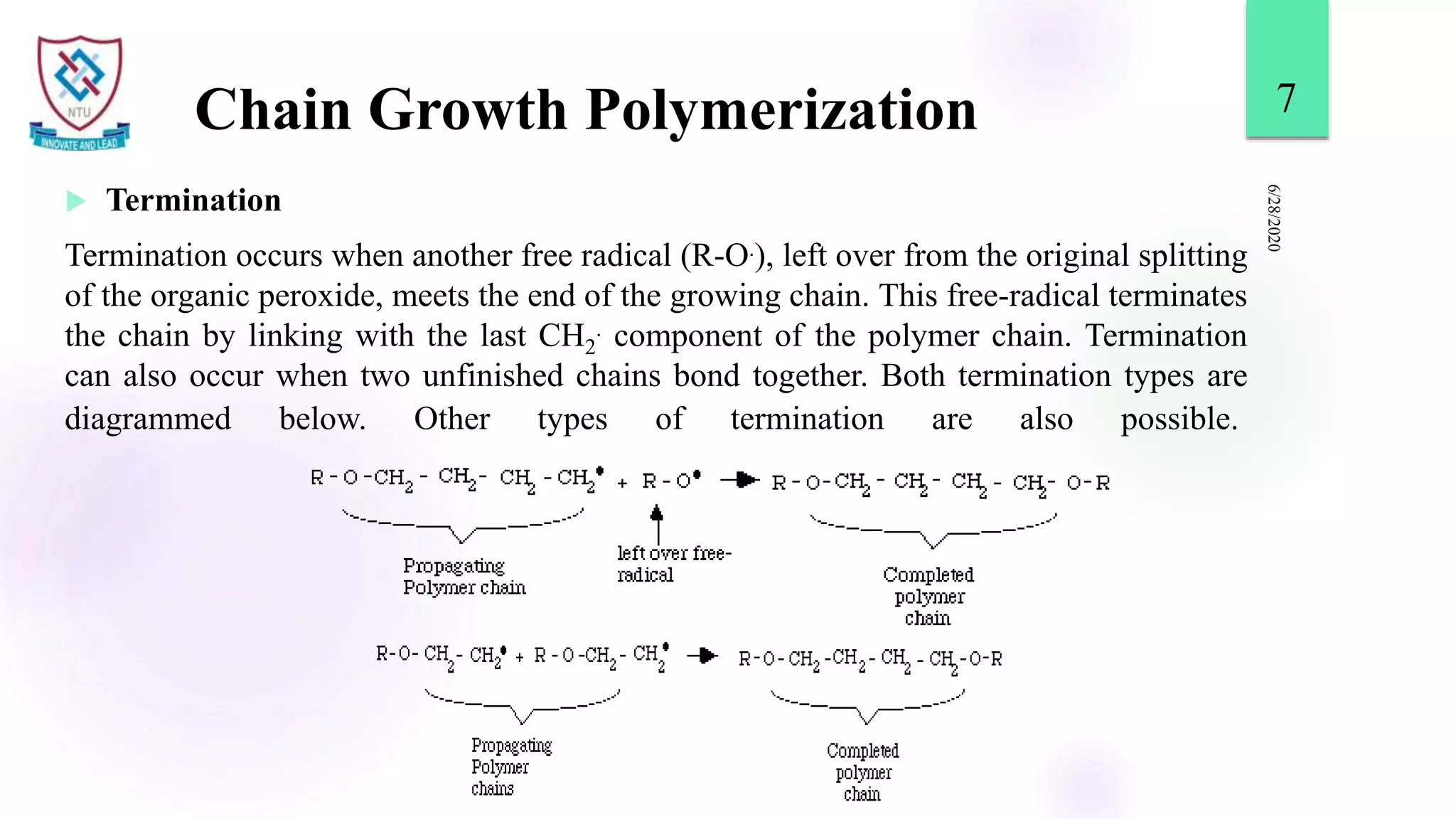
 Termination
Termination occurs when another free radical (R-O.), left over from the original splitting
of the organic peroxide, meets the end of the growing chain. This free-radical terminates
the chain by linking with the last CH2
. component of the polymer chain. Termination
can also occur when two unfinished chains bond together. Both termination types are
diagrammed below. Other types of termination are also possible.
6/28/2020
7
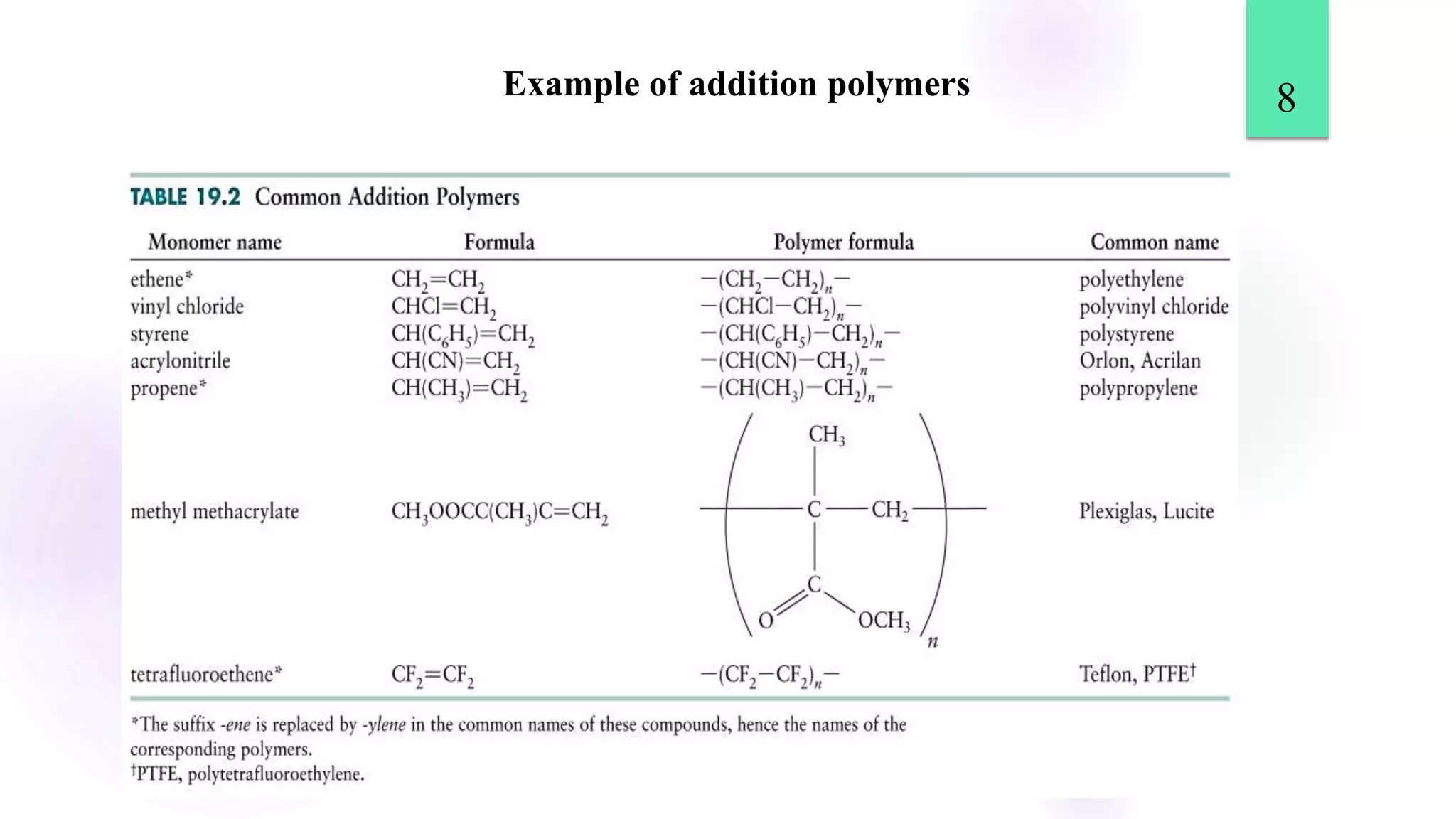
8Example of addition polymers
Ionic Polymerization
 Anionic Polymerization
 Cationic Polymerization
6/28/2020
9
Anionic Polymerization
 The mechanism of anionic polymerization is a kind of repetitive
conjugate addition reaction.
 This type of polymerization is often used to produce synthetic
polydiene rubbers, solution styrene-butadiene rubbers (SBR), and
thermoplastic styrenic elastomers.
 The electron donors (or initiators) are either electron transfer agents
or strong anions. The transfer of an electron from a donor molecule
to the vinyl monomer leads to the formation of an anion radical.
 Nucleophilic initiators include covalent or ionic metal amides,
alkoxides, hydroxides, amines, phosphines, cyanides, and
organometallic compounds such as alkyl lithium compounds and
Grignard reagents.
6/28/2020
10
Anionic Polymerization
6/28/2020
11
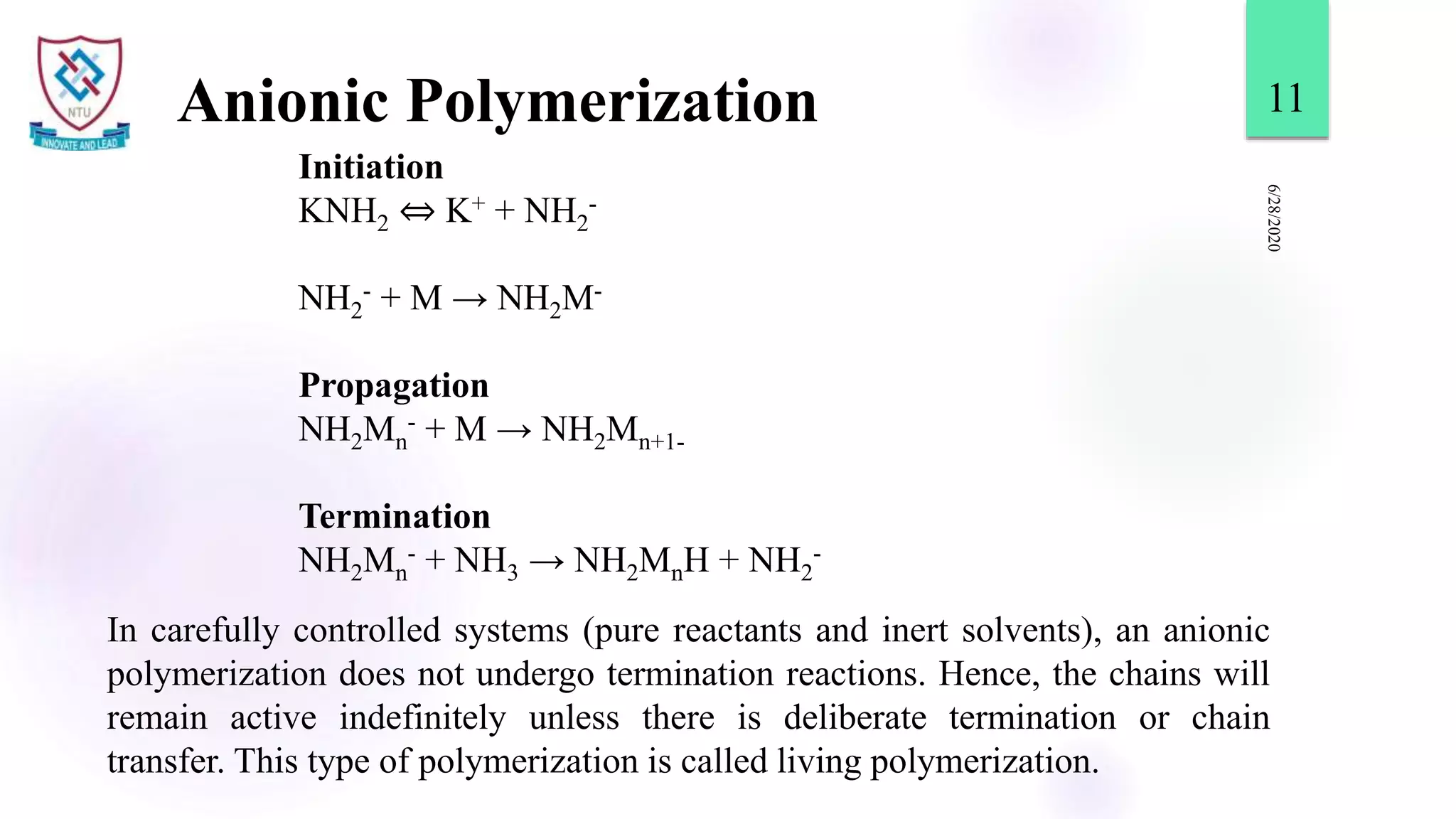
Initiation
KNH2 ⇔ K+ + NH2
-
NH2
- + M → NH2M-
Propagation
NH2Mn
- + M → NH2Mn+1-
Termination
NH2Mn
- + NH3 → NH2MnH + NH2
-
In carefully controlled systems (pure reactants and inert solvents), an anionic
polymerization does not undergo termination reactions. Hence, the chains will
remain active indefinitely unless there is deliberate termination or chain
transfer. This type of polymerization is called living polymerization.
Cationic Polymerization
 Cationic polymerization is a type of chain growth
polymerization in which a cationic initiator transfers charge to
a monomer which then becomes reactive. This reactive monomer
goes on to react similarly with other monomers to form a
polymer. The types of monomers necessary for cationic
polymerization are limited to olefins with electron-donating
substituents and heterocycles.
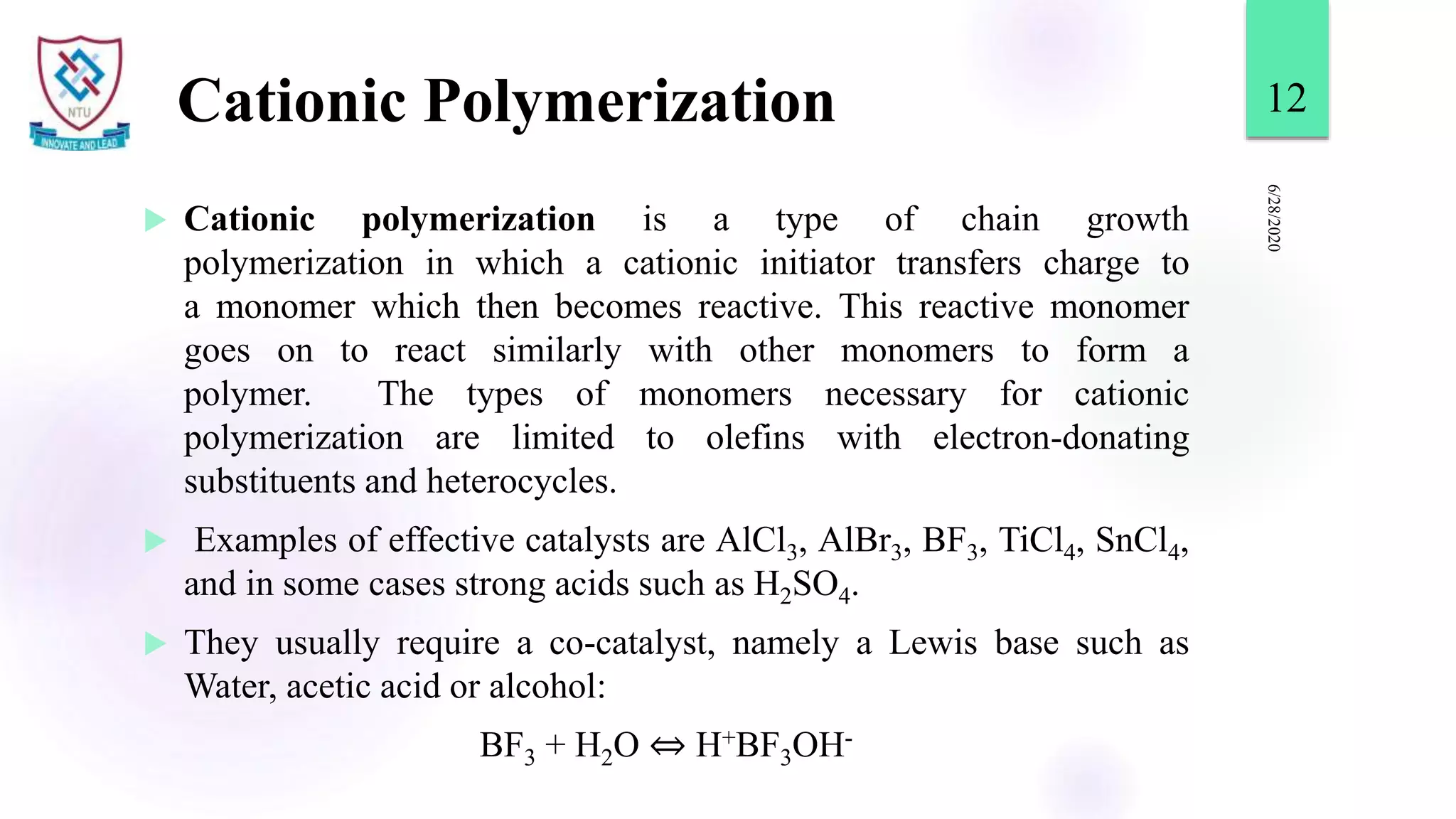
 Examples of effective catalysts are AlCl3, AlBr3, BF3, TiCl4, SnCl4,
and in some cases strong acids such as H2SO4.
 They usually require a co-catalyst, namely a Lewis base such as
Water, acetic acid or alcohol:
BF3 + H2O ⇔ H+BF3OH-
6/28/2020
12
Cationic Polymerization
6/28/2020
13
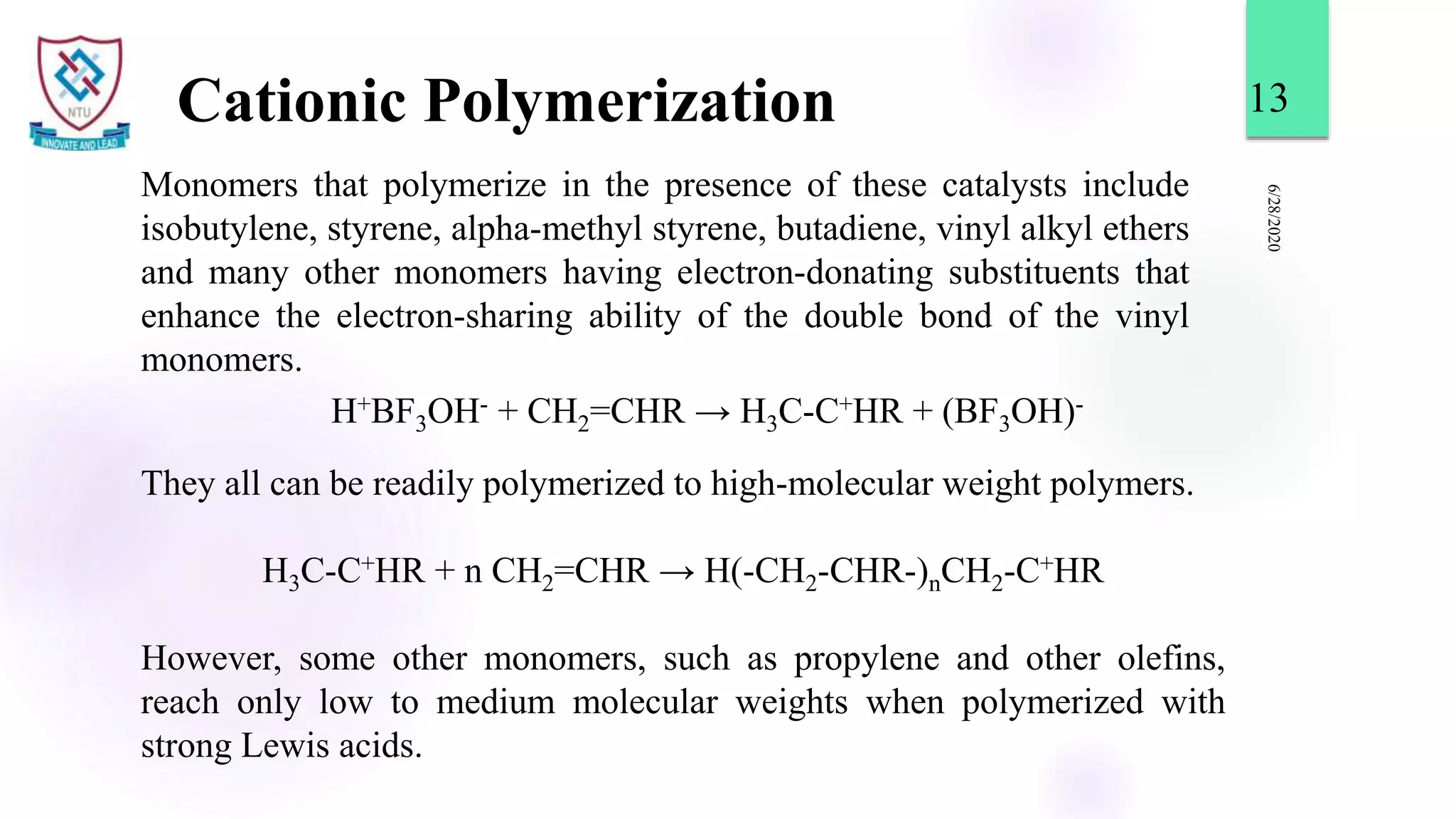
H+BF3OH- + CH2=CHR → H3C-C+HR + (BF3OH)-
Monomers that polymerize in the presence of these catalysts include
isobutylene, styrene, alpha-methyl styrene, butadiene, vinyl alkyl ethers
and many other monomers having electron-donating substituents that
enhance the electron-sharing ability of the double bond of the vinyl
monomers.
They all can be readily polymerized to high-molecular weight polymers.
H3C-C+HR + n CH2=CHR → H(-CH2-CHR-)nCH2-C+HR
However, some other monomers, such as propylene and other olefins,
reach only low to medium molecular weights when polymerized with
strong Lewis acids.
Ziegler–Natta Catalytic Polymerization
6/28/2020
14
Natta first used polymerization catalysts based on titanium chlorides to
polymerize propylene and other 1-alkenes. He discovered that these
polymers are crystalline materials. The structure of active centers in
Ziegler–Natta catalysts is well established only for metallocene
catalysts. It involves transition metal catalyst. Ziegler-Natta catalysis
is especially useful, because it can make polymers that can't be made
any other way, such as linear unbranched polyethylene and
isotactic polypropylene.
Ziegler–Natta Catalytic Polymerization
6/28/2020
15
Ziegler–Natta Catalytic Polymerization
6/28/2020
16
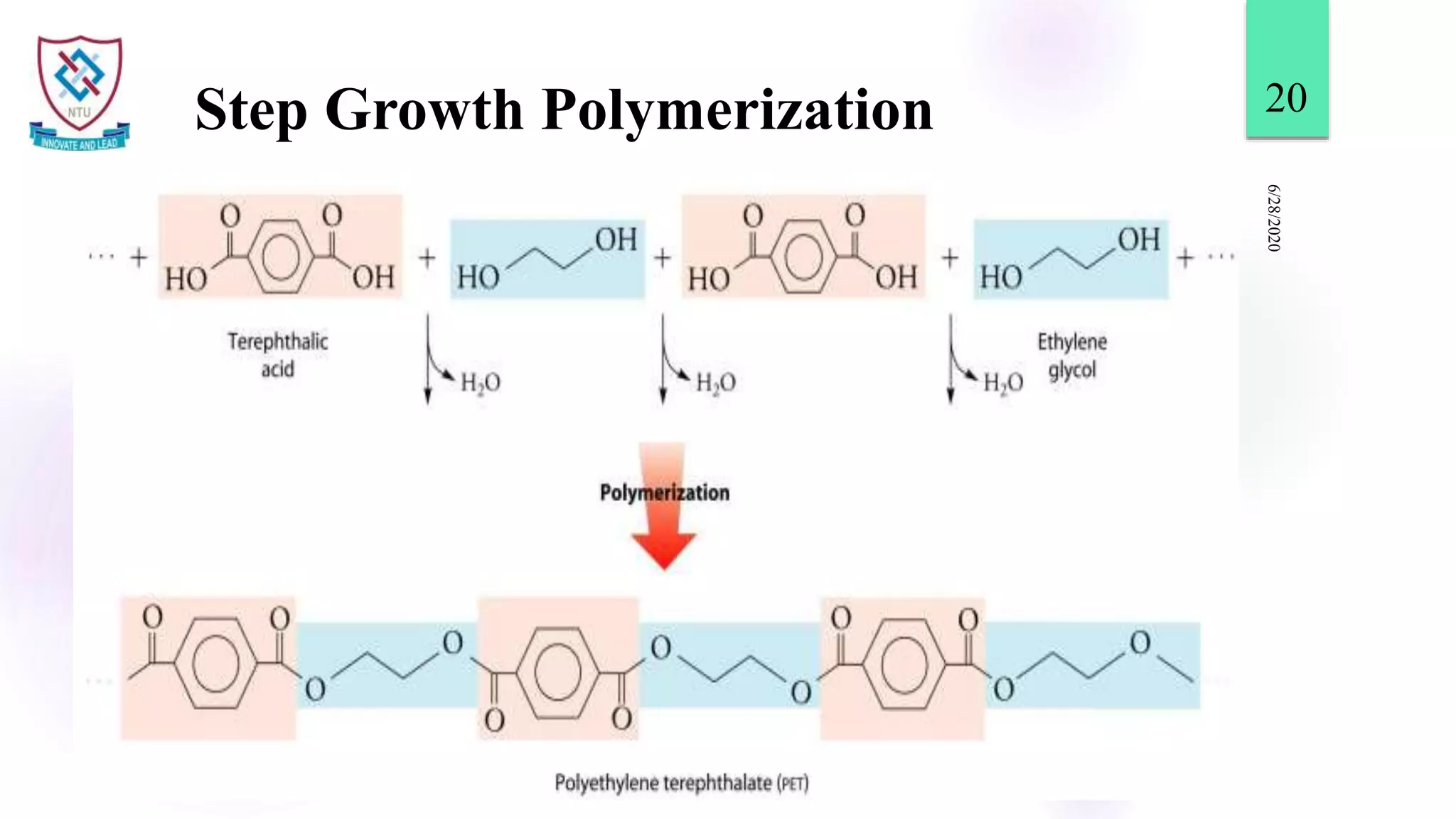
Step Growth Polymerization
 A condensation polymerization is a form of step-growth
polymerization. Small molecules react with each other to form larger
structural units while releasing smaller molecules as a by product, such
as water or methanol. A well-known example of a condensation reaction
is the esterification of carboxylic acids with alcohols. If both moieties
are difunctional, the condensation product is a linear polymer, and if at
least one of the moieties is tri- or tetra-functional, the resulting polymer
is a crosslinked polymer (i.e. a three-dimensional network). Adding
monomers with only one reactive group will terminate a growing chain,
and consequently lower the (average) molecular weight.
6/28/2020
17
Step Growth Polymerization
 Thus, the average molecular weight and the crosslink density will depend on
the functionality of each monomer involved in the condensation
polymerization and on its concentration in the mixture.
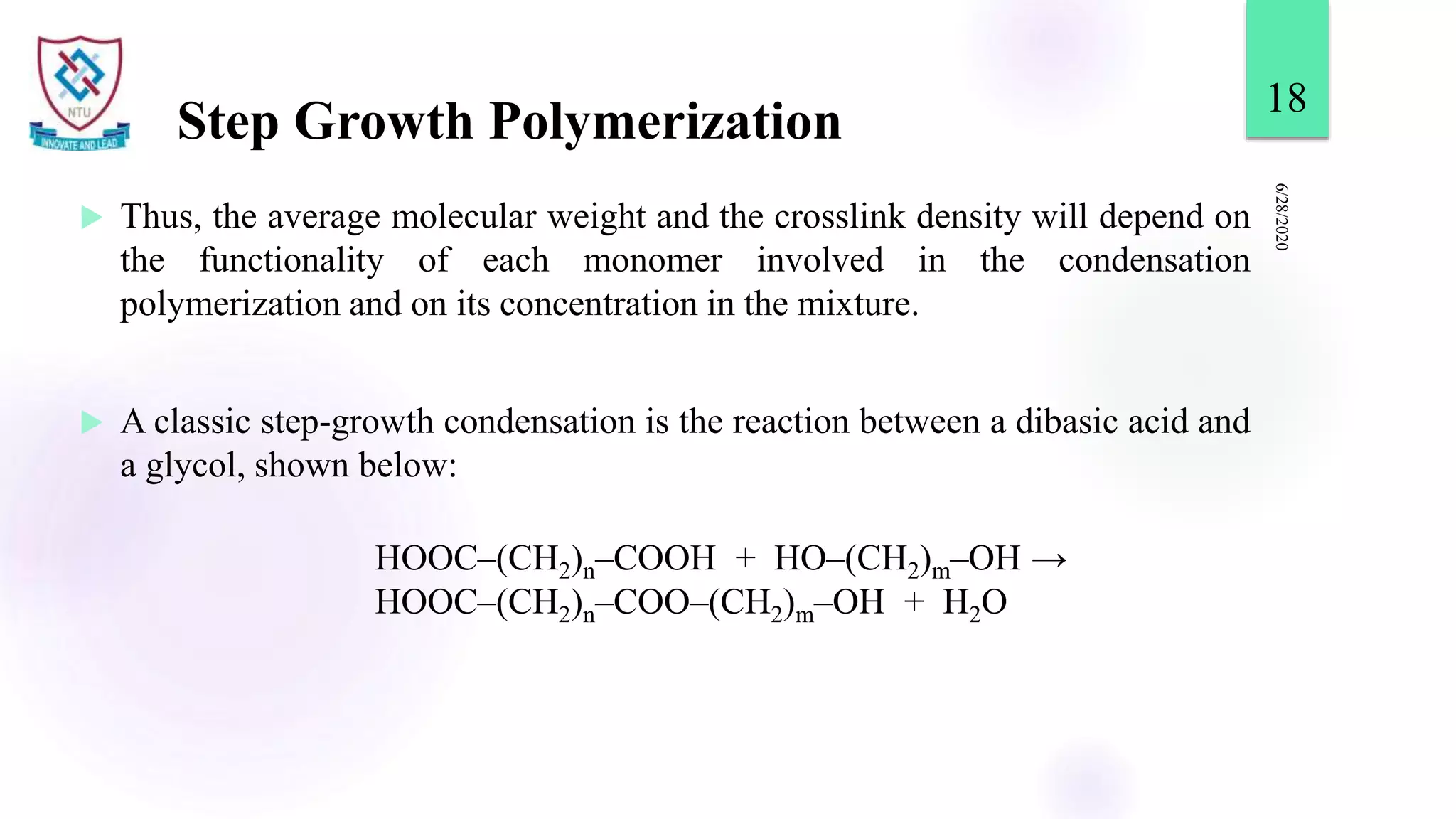
 A classic step-growth condensation is the reaction between a dibasic acid and
a glycol, shown below:
6/28/2020
18
HOOC–(CH2)n–COOH + HO–(CH2)m–OH →
HOOC–(CH2)n–COO–(CH2)m–OH + H2O
Step Growth Polymerization
6/28/2020
19
 Bonding occurs between them by elimination
of components of water
OH + H = H2O
 Lower temperature process than addition
polymerization
Step Growth Polymerization
6/28/2020
20
Step Growth Polymerization
 The terminal functional groups on a chain remain active, so that
groups of shorter chains combine into longer chains in the late stages
of polymerization. The presence of polar functional groups on the
chains often enhances chain-chain attractions, particularly if these
involve hydrogen bonding, and thereby crystallinity and tensile
strength.
6/28/2020
21
Step Growth Polymerization
6/28/2020
22

types of polymerization (Polymerization reaction

  • 1.
    Fundamentals of PolymerEngineering Polymerization Reactions 6/28/2020 1 Course Code: PE-3107 Credits: 3-0-3 Teacher: Engr. Asra Tariq Email Id: asra.tariq@ntu.edu.pk
  • 2.
    Polymerization Reactions  Forpolymerization it is required that the monomer molecule is capable of being linked to two (or more) other molecules of monomer by chemical reaction (functionality).  Functionality of two or higher is needed.  Polymerization is the formation of polymers from small units.  Polymers can occur naturally (proteins, carbohydrates) and can be synthesized (nylon, Teflon, polyethylene). 6/28/2020 2
  • 3.
  • 4.
    Chain Growth Polymerization This type of polymerization is a three step process involving two chemical entities. It initially exists as simple units. In nearly all cases, the monomers have at least one carbon-carbon double bond. Ethylene is one example of a monomer used to make a common polymer.  The other chemical reactant is a catalyst. In chain-reaction polymerization, the catalyst can be a free-radical peroxide added in relatively low concentrations. The formation of a free radical from an organic peroxide is shown below: 6/28/2020 4
  • 5.
    Chain Growth Polymerization Initiation The first step in the chain-reaction polymerization process, initiation, occurs when the free-radical, catalyst reacts with a double bonded carbon monomer, beginning the polymer chain. The double carbon bond breaks apart, the monomer bonds to the free radical, and the free electron is transferred to the outside carbon atom in this reaction. 6/28/2020 5
  • 6.
    Chain Growth Polymerization Propagation The next step in the process, propagation, is a repetitive operation in which the physical chain of the polymer is formed. The double bond of successive monomers is opened up when the monomer is reacted to the reactive polymer chain. The free electron is successively passed down the line of the chain to the outside carbon atom. This reaction is able to occur continuously because the energy in the chemical system is lowered as the chain grows. Thermodynamically speaking, the sum of the energies of the polymer is less than the sum of the energies of the individual monomers. Simply put, the single bounds in the polymeric chain are more stable than the double bonds of the monomer. 6/28/2020 6
  • 7.
    Chain Growth Polymerization Termination Termination occurs when another free radical (R-O.), left over from the original splitting of the organic peroxide, meets the end of the growing chain. This free-radical terminates the chain by linking with the last CH2 . component of the polymer chain. Termination can also occur when two unfinished chains bond together. Both termination types are diagrammed below. Other types of termination are also possible. 6/28/2020 7
  • 8.
  • 9.
    Ionic Polymerization  AnionicPolymerization  Cationic Polymerization 6/28/2020 9
  • 10.
    Anionic Polymerization  Themechanism of anionic polymerization is a kind of repetitive conjugate addition reaction.  This type of polymerization is often used to produce synthetic polydiene rubbers, solution styrene-butadiene rubbers (SBR), and thermoplastic styrenic elastomers.  The electron donors (or initiators) are either electron transfer agents or strong anions. The transfer of an electron from a donor molecule to the vinyl monomer leads to the formation of an anion radical.  Nucleophilic initiators include covalent or ionic metal amides, alkoxides, hydroxides, amines, phosphines, cyanides, and organometallic compounds such as alkyl lithium compounds and Grignard reagents. 6/28/2020 10
  • 11.
    Anionic Polymerization 6/28/2020 11 Initiation KNH2 ⇔K+ + NH2 - NH2 - + M → NH2M- Propagation NH2Mn - + M → NH2Mn+1- Termination NH2Mn - + NH3 → NH2MnH + NH2 - In carefully controlled systems (pure reactants and inert solvents), an anionic polymerization does not undergo termination reactions. Hence, the chains will remain active indefinitely unless there is deliberate termination or chain transfer. This type of polymerization is called living polymerization.
  • 12.
    Cationic Polymerization  Cationicpolymerization is a type of chain growth polymerization in which a cationic initiator transfers charge to a monomer which then becomes reactive. This reactive monomer goes on to react similarly with other monomers to form a polymer. The types of monomers necessary for cationic polymerization are limited to olefins with electron-donating substituents and heterocycles.  Examples of effective catalysts are AlCl3, AlBr3, BF3, TiCl4, SnCl4, and in some cases strong acids such as H2SO4.  They usually require a co-catalyst, namely a Lewis base such as Water, acetic acid or alcohol: BF3 + H2O ⇔ H+BF3OH- 6/28/2020 12
  • 13.
    Cationic Polymerization 6/28/2020 13 H+BF3OH- +CH2=CHR → H3C-C+HR + (BF3OH)- Monomers that polymerize in the presence of these catalysts include isobutylene, styrene, alpha-methyl styrene, butadiene, vinyl alkyl ethers and many other monomers having electron-donating substituents that enhance the electron-sharing ability of the double bond of the vinyl monomers. They all can be readily polymerized to high-molecular weight polymers. H3C-C+HR + n CH2=CHR → H(-CH2-CHR-)nCH2-C+HR However, some other monomers, such as propylene and other olefins, reach only low to medium molecular weights when polymerized with strong Lewis acids.
  • 14.
    Ziegler–Natta Catalytic Polymerization 6/28/2020 14 Nattafirst used polymerization catalysts based on titanium chlorides to polymerize propylene and other 1-alkenes. He discovered that these polymers are crystalline materials. The structure of active centers in Ziegler–Natta catalysts is well established only for metallocene catalysts. It involves transition metal catalyst. Ziegler-Natta catalysis is especially useful, because it can make polymers that can't be made any other way, such as linear unbranched polyethylene and isotactic polypropylene.
  • 15.
  • 16.
  • 17.
    Step Growth Polymerization A condensation polymerization is a form of step-growth polymerization. Small molecules react with each other to form larger structural units while releasing smaller molecules as a by product, such as water or methanol. A well-known example of a condensation reaction is the esterification of carboxylic acids with alcohols. If both moieties are difunctional, the condensation product is a linear polymer, and if at least one of the moieties is tri- or tetra-functional, the resulting polymer is a crosslinked polymer (i.e. a three-dimensional network). Adding monomers with only one reactive group will terminate a growing chain, and consequently lower the (average) molecular weight. 6/28/2020 17
  • 18.
    Step Growth Polymerization Thus, the average molecular weight and the crosslink density will depend on the functionality of each monomer involved in the condensation polymerization and on its concentration in the mixture.  A classic step-growth condensation is the reaction between a dibasic acid and a glycol, shown below: 6/28/2020 18 HOOC–(CH2)n–COOH + HO–(CH2)m–OH → HOOC–(CH2)n–COO–(CH2)m–OH + H2O
  • 19.
    Step Growth Polymerization 6/28/2020 19 Bonding occurs between them by elimination of components of water OH + H = H2O  Lower temperature process than addition polymerization
  • 20.
  • 21.
    Step Growth Polymerization The terminal functional groups on a chain remain active, so that groups of shorter chains combine into longer chains in the late stages of polymerization. The presence of polar functional groups on the chains often enhances chain-chain attractions, particularly if these involve hydrogen bonding, and thereby crystallinity and tensile strength. 6/28/2020 21
  • 22.