
WELCOME
DEAR FRIENDS 1
CONSCIENTIZATION
2
Paulo Freire
(1921-1997)
 Brazilian philosopher
 Father of critical
pedagogy
 Bring literacy to third
3
4
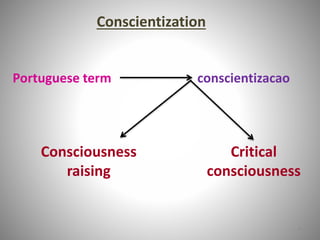
Conscientization
Portuguese term conscientizacao
Consciousness
raising
Critical
consciousness
What is Conscientization?
5
Ability to critically perceive the causes of
social, political and economic oppression
and to take action against the oppressive
elements of society.
 A state of in-depth understanding about the
world and resulting freedom from
oppression
 It is diffused in many countries, mainly in
South America, based on the trust in
oppressed “knowledge” and questioning
role of leader who educates and learn by
dialoguing
6
Freire’s Educational Views
 Education is a cultural tool for liberation
from oppression.
 Education is always a political act.
 Education is a communion between
participants in a dialogue.
 Knowledge is not a set commodity.
 Learning begins with action.
7
 Students should not be viewed as an empty
account
 Education is a phenomenon in which educator
and educatee each other through the act of
education
 Education is a critical understanding of reality
 The method of education must starts from the
life situation and reality of people
 Educational practice is not an extension,
but a communication.
8
Characteristics of
Freire’s Pedagogy
 Education for liberation
 Education for conscientization
 Problem posing education
 Dialogue as a pedagogical tool
9
Areas where Conscientization is needed
 Role of education in conscientization
 Role of conscientization in communicable diseases
 Role of conscientization in domestic waste
disposal
10
SUMMARY
Conscientization is the ability to critically
perceive the causes of social, political and
economic oppression and to take action against
the oppressive elements of society. The ultimate
aim of conscientization must forever be
humanization. The meaning, dignity and
worthiness of being-in-and-with-the-world as
human beings are all inscribed in a loving,
critical and creative spirit and endless cycles of
transformative praxis
11
12
Questions
1) Who is the father of Critical Pedagogy?
a. Paulo Freire
b. J. B. Watson
c. William James
d. Edward Lee Thorndike
2) State true or false
“conscientization is the state of in-depth
understanding about the world and
resulting freedom from oppression”
13
3) What are the characteristics of Freire’s
educational pedagogy?
4) Point out any three educational views of
Friere?
5) Find out any three areas where
conscientization is needed except the
three mentioned above?
References
1. Philosophical and Sociological Basis of Education;
Dr. N.K. Arjunan
2. Web site :- www.openuniclsu.edu
www.freire.org
14
Thank you all…
15

Philosophy

  • 1.
  • 2.
  • 3.
    Paulo Freire (1921-1997)  Brazilianphilosopher  Father of critical pedagogy  Bring literacy to third 3
  • 4.
  • 5.
  • 6.
    Ability to criticallyperceive the causes of social, political and economic oppression and to take action against the oppressive elements of society.  A state of in-depth understanding about the world and resulting freedom from oppression  It is diffused in many countries, mainly in South America, based on the trust in oppressed “knowledge” and questioning role of leader who educates and learn by dialoguing 6
  • 7.
    Freire’s Educational Views Education is a cultural tool for liberation from oppression.  Education is always a political act.  Education is a communion between participants in a dialogue.  Knowledge is not a set commodity.  Learning begins with action. 7
  • 8.
     Students shouldnot be viewed as an empty account  Education is a phenomenon in which educator and educatee each other through the act of education  Education is a critical understanding of reality  The method of education must starts from the life situation and reality of people  Educational practice is not an extension, but a communication. 8
  • 9.
    Characteristics of Freire’s Pedagogy Education for liberation  Education for conscientization  Problem posing education  Dialogue as a pedagogical tool 9
  • 10.
    Areas where Conscientizationis needed  Role of education in conscientization  Role of conscientization in communicable diseases  Role of conscientization in domestic waste disposal 10
  • 11.
    SUMMARY Conscientization is theability to critically perceive the causes of social, political and economic oppression and to take action against the oppressive elements of society. The ultimate aim of conscientization must forever be humanization. The meaning, dignity and worthiness of being-in-and-with-the-world as human beings are all inscribed in a loving, critical and creative spirit and endless cycles of transformative praxis 11
  • 12.
    12 Questions 1) Who isthe father of Critical Pedagogy? a. Paulo Freire b. J. B. Watson c. William James d. Edward Lee Thorndike 2) State true or false “conscientization is the state of in-depth understanding about the world and resulting freedom from oppression”
  • 13.
    13 3) What arethe characteristics of Freire’s educational pedagogy? 4) Point out any three educational views of Friere? 5) Find out any three areas where conscientization is needed except the three mentioned above?
  • 14.
    References 1. Philosophical andSociological Basis of Education; Dr. N.K. Arjunan 2. Web site :- www.openuniclsu.edu www.freire.org 14
  • 15.