SEMINAR ON
MSc I INORGANIC CHEMISTRY
THE INSTITUTE OF SCIENCE
15, MADAM CAMA ROAD
Contents
 Introduction
 Rice-Ramsperger-Kassel-Marcus (RRKM) Theory
 Energy scheme for RRKM theory
 Significance
 Applications
 Limitations
 Bibliography
Introduction
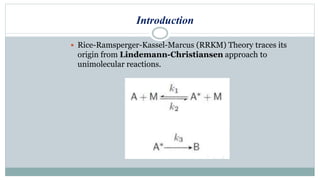
 Rice-Ramsperger-Kassel-Marcus (RRKM) Theory traces its
origin from Lindemann-Christiansen approach to
unimolecular reactions.
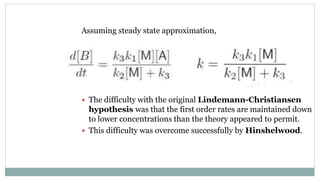
Assuming steady state approximation,
 The difficulty with the original Lindemann-Christiansen
hypothesis was that the first order rates are maintained down
to lower concentrations than the theory appeared to permit.
 This difficulty was overcome successfully by Hinshelwood.
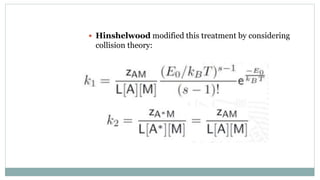
 Hinshelwood modified this treatment by considering
collision theory:
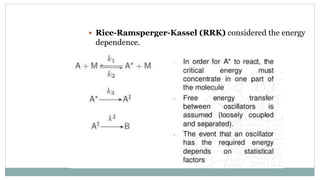
 Rice-Ramsperger-Kassel (RRK) considered the energy
dependence.
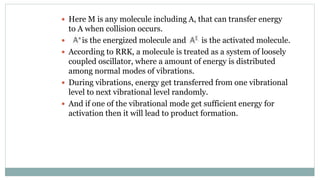
 Here M is any molecule including A, that can transfer energy
to A when collision occurs.
 is the energized molecule and is the activated molecule.
 According to RRK, a molecule is treated as a system of loosely
coupled oscillator, where a amount of energy is distributed
among normal modes of vibrations.
 During vibrations, energy get transferred from one vibrational
level to next vibrational level randomly.
 And if one of the vibrational mode get sufficient energy for
activation then it will lead to product formation.
Rice-Ramsperger-Kassel-Marcus (RRKM) Theory
 During 1951-52, R.A. Marcus merged Transition State Theory (TST) with
RRK theory and came up with Rice-Ramsperger-Kassel-Marcus
(RRKM) Theory.
 Marcus followed the same mechanism as that in RRK theory but considered the
energy to be distributed in active (vibrations) and in inactive (translations)
states.
 In RRKM theory, the individual vibrational frequencies of the energized species
and activated complexes are considered.
 Account is taken on the way various normal modes of
vibration and rotation contribute to reaction and allowance is
made for zero point energies.
 The total energy contained in the energized molecule is
classified as either active or inactive (also referred to as
adiabatic).
 The inactive energy is the energy that remains in the same
quantum state during the course of reaction and, therefore,
cannot contribute to the breaking of bonds.
 The zero point energy is inactive, as is the energy of overall
translation and rotation, since this energy is preserved as such
when the activated molecule A# is formed.
 Vibrational energy and the energy of internal rotations are
active.
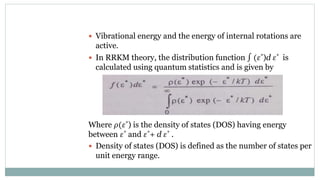
 In RRKM theory, the distribution function ∫ (𝜀*)d 𝜀* is
calculated using quantum statistics and is given by
Where 𝜌(𝜀*) is the density of states (DOS) having energy
between 𝜀* and 𝜀*+ d 𝜀* .
 Density of states (DOS) is defined as the number of states per
unit energy range.
 The denominator of this equation is the partition function
relating to the active energy contributions.
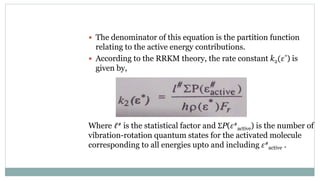
 According to the RRKM theory, the rate constant k2(𝜀*) is
given by,
Where 𝓁# is the statistical factor and ΣP(𝜀#
active) is the number of
vibration-rotation quantum states for the activated molecule
corresponding to all energies upto and including 𝜀#
active .
The factor Fr is introduced to correct for the fact that the
rotations may not be the same in the activated molecule as in the
energized molecule.
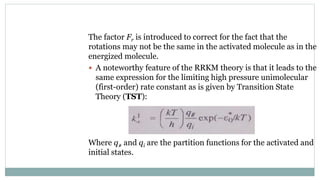
 A noteworthy feature of the RRKM theory is that it leads to the
same expression for the limiting high pressure unimolecular
(first-order) rate constant as is given by Transition State
Theory (TST):
Where q# and qi are the partition functions for the activated and
initial states.
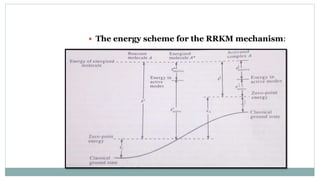
 The energy scheme for the RRKM mechanism:
Significance
 RRKM theory can explain the abnormally high pre-
exponential factors that are sometimes observed.
 In order to use RRKM theory for detailed calculations, we
must decide on models for energized and activated molecules.
 Vibrational frequencies for the various normal modes must be
estimated and decision made as to which energies are active
and which are inactive.
 Numerical methods are used to calculate the rate constants k1
at various concentrations.
Applications
 The reactions which have been successfully investigated using
RRKM theory include;
• Isomerization of cyclopropane
• Isomerization of cyclobutane
• Dissociation of cyclobutane into two ethylene molecules
 The Isomerization of cyclopropane to propylene was
the first unimolecular gaseous reaction investigated in the
1920s.
Limitations
 A major difficulty in applying RRKM theory is that the
vibrational frequencies of the activated complexes usually
cannot be estimated very reliably and there is evidence for
non-RRKM behavior.
 In nonthermal activated unimolecular reactions, it has been
found that the translational energy distribution of reaction
fragments is non-statistical, contrary to the predictions of the
RRKM theory.
 This implies that not all degrees of freedom participate in the
fragmentation of the complex.
Bibliography
 Physical Chemistry by Puri, Sharma, Pathania
THANKYOU
 I EXPRESS MY SINCERE
THANKS TO ALL MY
PROFESSORS , SENIORS AND MY
PARENTS.
 IMAGE

47rrkmtheory11 190428142321

  • 1.
    SEMINAR ON MSc IINORGANIC CHEMISTRY THE INSTITUTE OF SCIENCE 15, MADAM CAMA ROAD
  • 2.
    Contents  Introduction  Rice-Ramsperger-Kassel-Marcus(RRKM) Theory  Energy scheme for RRKM theory  Significance  Applications  Limitations  Bibliography
  • 3.
    Introduction  Rice-Ramsperger-Kassel-Marcus (RRKM)Theory traces its origin from Lindemann-Christiansen approach to unimolecular reactions.
  • 4.
    Assuming steady stateapproximation,  The difficulty with the original Lindemann-Christiansen hypothesis was that the first order rates are maintained down to lower concentrations than the theory appeared to permit.  This difficulty was overcome successfully by Hinshelwood.
  • 5.
     Hinshelwood modifiedthis treatment by considering collision theory:
  • 6.
     Rice-Ramsperger-Kassel (RRK)considered the energy dependence.
  • 7.
     Here Mis any molecule including A, that can transfer energy to A when collision occurs.  is the energized molecule and is the activated molecule.  According to RRK, a molecule is treated as a system of loosely coupled oscillator, where a amount of energy is distributed among normal modes of vibrations.  During vibrations, energy get transferred from one vibrational level to next vibrational level randomly.  And if one of the vibrational mode get sufficient energy for activation then it will lead to product formation.
  • 8.
    Rice-Ramsperger-Kassel-Marcus (RRKM) Theory During 1951-52, R.A. Marcus merged Transition State Theory (TST) with RRK theory and came up with Rice-Ramsperger-Kassel-Marcus (RRKM) Theory.  Marcus followed the same mechanism as that in RRK theory but considered the energy to be distributed in active (vibrations) and in inactive (translations) states.  In RRKM theory, the individual vibrational frequencies of the energized species and activated complexes are considered.
  • 9.
     Account istaken on the way various normal modes of vibration and rotation contribute to reaction and allowance is made for zero point energies.  The total energy contained in the energized molecule is classified as either active or inactive (also referred to as adiabatic).  The inactive energy is the energy that remains in the same quantum state during the course of reaction and, therefore, cannot contribute to the breaking of bonds.  The zero point energy is inactive, as is the energy of overall translation and rotation, since this energy is preserved as such when the activated molecule A# is formed.
  • 10.
     Vibrational energyand the energy of internal rotations are active.  In RRKM theory, the distribution function ∫ (𝜀*)d 𝜀* is calculated using quantum statistics and is given by Where 𝜌(𝜀*) is the density of states (DOS) having energy between 𝜀* and 𝜀*+ d 𝜀* .  Density of states (DOS) is defined as the number of states per unit energy range.
  • 11.
     The denominatorof this equation is the partition function relating to the active energy contributions.  According to the RRKM theory, the rate constant k2(𝜀*) is given by, Where 𝓁# is the statistical factor and ΣP(𝜀# active) is the number of vibration-rotation quantum states for the activated molecule corresponding to all energies upto and including 𝜀# active .
  • 12.
    The factor Fris introduced to correct for the fact that the rotations may not be the same in the activated molecule as in the energized molecule.  A noteworthy feature of the RRKM theory is that it leads to the same expression for the limiting high pressure unimolecular (first-order) rate constant as is given by Transition State Theory (TST): Where q# and qi are the partition functions for the activated and initial states.
  • 13.
     The energyscheme for the RRKM mechanism:
  • 14.
    Significance  RRKM theorycan explain the abnormally high pre- exponential factors that are sometimes observed.  In order to use RRKM theory for detailed calculations, we must decide on models for energized and activated molecules.  Vibrational frequencies for the various normal modes must be estimated and decision made as to which energies are active and which are inactive.  Numerical methods are used to calculate the rate constants k1 at various concentrations.
  • 15.
    Applications  The reactionswhich have been successfully investigated using RRKM theory include; • Isomerization of cyclopropane • Isomerization of cyclobutane • Dissociation of cyclobutane into two ethylene molecules  The Isomerization of cyclopropane to propylene was the first unimolecular gaseous reaction investigated in the 1920s.
  • 16.
    Limitations  A majordifficulty in applying RRKM theory is that the vibrational frequencies of the activated complexes usually cannot be estimated very reliably and there is evidence for non-RRKM behavior.  In nonthermal activated unimolecular reactions, it has been found that the translational energy distribution of reaction fragments is non-statistical, contrary to the predictions of the RRKM theory.  This implies that not all degrees of freedom participate in the fragmentation of the complex.
  • 17.
    Bibliography  Physical Chemistryby Puri, Sharma, Pathania
  • 18.
    THANKYOU  I EXPRESSMY SINCERE THANKS TO ALL MY PROFESSORS , SENIORS AND MY PARENTS.  IMAGE