TOPIC
"Photochemistry"
By
Dr. Gopalkrushna H. Murhekar
Agenda
• Introduction
• Quantum yield
• Experimental determination
of quantum yield
• Jablonski diagram
• Fluorescence
• phosphorescence
• Chemiluminescence
• Bioluminescence
• Applications
• Bibliography
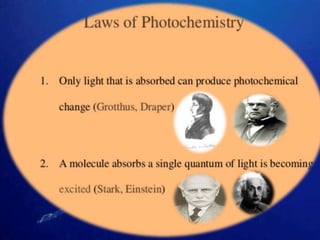
Deals with photochemical
reactions.
Caused by the abosobtion of light
radiations from visible and
ultraviolet region.
INTRODUCTION
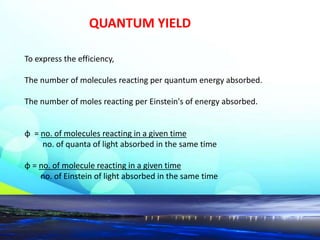
QUANTUM YIELD
To express the efficiency,
The number of molecules reacting per quantum energy absorbed.
The number of moles reacting per Einstein's of energy absorbed.
ɸ = no. of molecules reacting in a given time
no. of quanta of light absorbed in the same time
ɸ = no. of molecule reacting in a given time
no. of Einstein of light absorbed in the same time
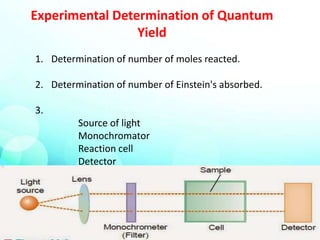
Experimental Determination of Quantum
Yield
1. Determination of number of moles reacted.
2. Determination of number of Einstein's absorbed.
3.
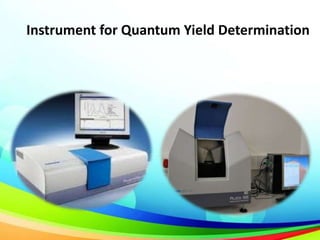
Source of light
Monochromator
Reaction cell
Detector
Instrument for Quantum Yield Determination
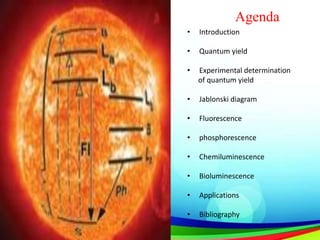
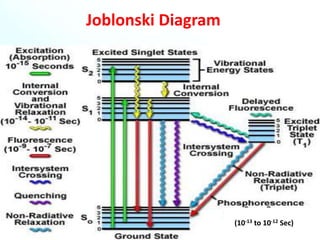
Joblonski Diagram
(10-13 to 10-12 Sec)
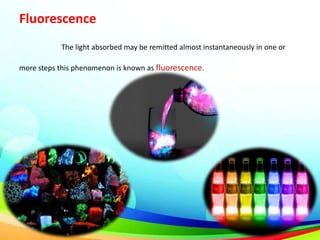
Fluorescence
The light absorbed may be remitted almost instantaneously in one or
more steps this phenomenon is known as fluorescence.
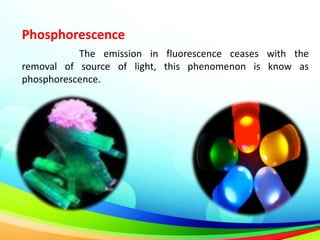
Phosphorescence
The emission in fluorescence ceases with the
removal of source of light, this phenomenon is know as
phosphorescence.
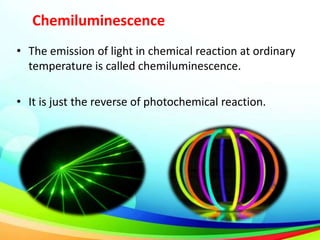
Chemiluminescence
• The emission of light in chemical reaction at ordinary
temperature is called chemiluminescence.
• It is just the reverse of photochemical reaction.
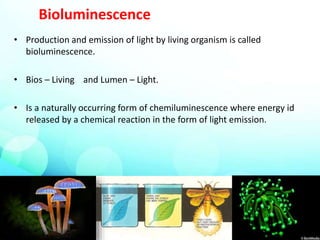
Bioluminescence
• Production and emission of light by living organism is called
bioluminescence.
• Bios – Living and Lumen – Light.
• Is a naturally occurring form of chemiluminescence where energy id
released by a chemical reaction in the form of light emission.
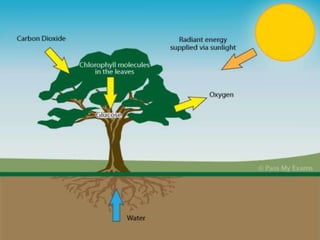
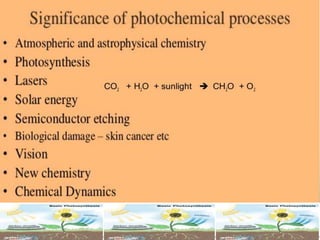
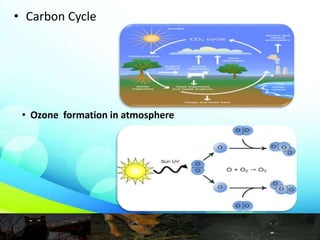
• Carbon Cycle
• Ozone formation in atmosphere
Bibliography
Photochemistry

Photochemistry