
Light source in
Photochemistry
FROM :SAIMA ALEEM.
MPHIL.
Course supervisor: Dr rafia
INTRODUCTION
Grotthuss-Draper law.
 the Grotthuss-Draper law, states that
“ light must be absorbed by a compound in order for a
photochemical reaction to take place”.
Stark-Einstein law
 the Stark-Einstein law, states that
“For each photon of light absorbed by a chemical system,
only one molecule is activated for subsequent reaction.
This "photo equivalence law" was derived by Albert
Einstein during his development of the quantum (photon)
theory of light”.
INTRODUCTION
 Photochemists, typically work in only a few sections of
the electromagnetic spectrum. Some of the most
widely used sections, and their wavelengths, are the
following:
 Ultraviolet: 200–400 nm.
 Visible Light: 400–800 nm.
Source of light
1. Sun.
2. High pressure mercury lamp.
3. Low pressure mercury lamp.
4. Medium pressure mercury lamp.
5. Low pressure mercury lamp.
6. High pressure mercury lamp.
7. Halogen lamp.
8. Laser.
(a). Light emitting diode.
Sun
 In the early experiments (and in everyday life),
sunlight was used as a light source.
 Sun light consist of wide range of radiation and in the
visible region, it comprises the violet, blue , green,
yellow, orange and red components.
 According to early investigators observation when the
photochemical sample is expose to sun light, after
some period of time few changed.
Sun
Examples
 The first example is photosynthesis, in which most
plants use solar energy to convert carbon dioxide and
water into glucose, disposing of oxygen as a side-
product.
 Humans rely on photochemistry for the formation of
vitamin D.
Ozone formation
 When oxygen is expose to sun light, it convert in to
ozone.
High pressure mercury lamp
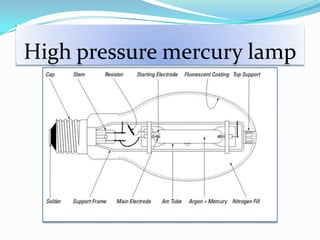
 A high mercury-vapor lamp is a gas discharge
lamp that uses an electric arc through vaporized
mercury to produce light.
 This lamp operate in high ( 100 atm).
High pressure mercury lamp
disadvantage
 It easily damage because it operate at very high
temperature so that quartz or glass envelope and
nitrogen gas for cooling purpose is necessary.
 It has short life time due to high temperature and
pressure.
 High pressure lamp are not commonly used in
commercial photochemical apparatus.
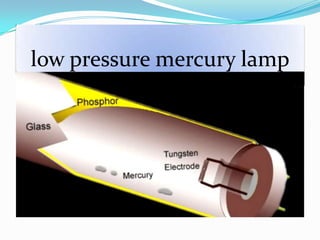
low pressure mercury lamp
Advantage
 It operate at very less temperature and low pressure.
 Low pressure mercury lamps are highly efficient in
providing short wavelength ultraviolet energy.
low pressure mercury lamp
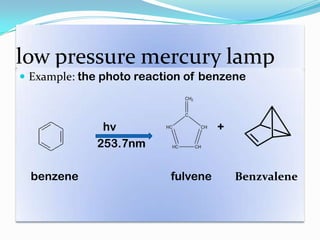
 Example: the photo reaction of benzene
hv +
253.7nm
benzene fulvene Benzvalene
Medium pressure mercury
lamp
 A medium mercury-vapor lamp is a gas discharge
lamp that uses an electric arc through vaporized mercury
to produce light.
 In this lamp a discharge is passed through mercury vapor
and the electrically excited mercury atoms emit radiation.
 It operate in medium pressure ( 5 atm).
 The wavelength range is 250 to 600 nm.
Medium pressure mercury lamp
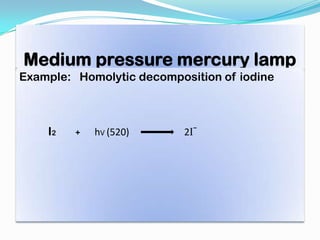
Example: Homolytic decomposition of iodine
I2 + hV (520) 2I-
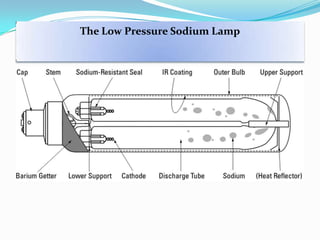
The Low Pressure Sodium Lamp
 Low pressure sodium lamps only give monochromatic
yellow light and so inhibit color vision at night.
 When the lamp is turned on it emits a dim red/pink
light to warm the sodium metal and within a few
minutes it turns into the common bright yellow as the
sodium metal vaporizes.
Low Pressure Sodium Lamp
Advantage
 It have a lowpressure, low–intensity discharge source and
a linear lamp shape.
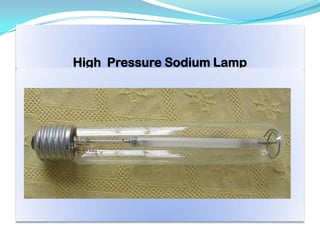
High Pressure Sodium Lamp
 A sodium-vapor lamp is a gas-discharge lamp that
uses sodium in an excited state to produce light.
 The sodium D-line is the main source of light from the
High-pressure sodium lamp.
 High-pressure sodium lamps are smaller and contain
additional elements such as mercury.
 It produce a dark pink glow when first struck, and an
intense pinkish orange light when sodium is warmed.
 Some bulbs also briefly produce a pure to bluish white
light in between if the mercury achieves its high pressure
arc discharge characteristic before the sodium is
completely warmed.
High Pressure Sodium Lamp
Disadvantage
 At high temperature sodium is loss because Sodium is
a highly reactive element and is easily lost by reacting
with the arc tube and form sodium oxide and
aluminum.
Halogen Lamp
 A halogen lamp, also known as a tungsten
halogen, quartz-halogen or quartz iodine lamp, is
an incandescent lamp , these measure most effectively
in the visible region.
 When Electric current is supplied to a filament.The
filament becomes hot, and light is emitted.
 The bulb in a halogen lamp is filled with inert gas and a
small amount of a halogen. While the tungsten used as
the filament evaporates due to the high temperature, the
halide causes the tungsten to return to the filament. This
helps create a bright light source with a long service life.
Halogen Lamp
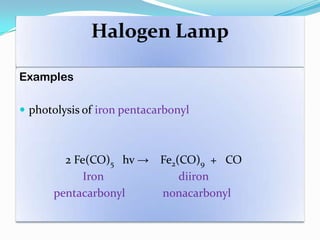
Examples
 photolysis of iron pentacarbonyl
2 Fe(CO)5 hv → Fe2(CO)9 + CO
Iron diiron
pentacarbonyl nonacarbonyl
laser
 It produce light in a narrow frequency and to focus it
in an extremely small area.
 Laser light is directional and monochromatic.
Light emitting diode
 In photochemistry Light emitting diode is used as a
light source.
 A light-emitting diode is a semiconductor device that
emits visible light when an electric current passes
through it.
 The output from an light-emitting diode can range
from red (at a wavelength of approximately 700
nanometers) to blue-violet (about 400 nanometers).
Light emitting diode
Advantage
 It produces light at a single wavelength, without the
need for a monochromator.
 Lamp life is almost infinite and Light emitting diode
sources are stable with little variation in bandwidth
making them an attractive, low cost solution for simple
applications.
Type of light emitting diode
 High-power light emitting diode can be driven at
currents from hundreds of milliampere.
 Light emitting diodes have been developed by Seoul
Semiconductor that can operate on AC power without
the need for a DC converter. For each half-cycle, part
of the Light emitting diode emits light and part is
dark, and this is reversed during the next half-cycle.
“THANKYOU”

LIGHT SOURCE IN PHOTO CHEMISTRY

  • 1.
    Light source in Photochemistry FROM:SAIMA ALEEM. MPHIL. Course supervisor: Dr rafia
  • 2.
    INTRODUCTION Grotthuss-Draper law.  theGrotthuss-Draper law, states that “ light must be absorbed by a compound in order for a photochemical reaction to take place”. Stark-Einstein law  the Stark-Einstein law, states that “For each photon of light absorbed by a chemical system, only one molecule is activated for subsequent reaction. This "photo equivalence law" was derived by Albert Einstein during his development of the quantum (photon) theory of light”.
  • 3.
    INTRODUCTION  Photochemists, typicallywork in only a few sections of the electromagnetic spectrum. Some of the most widely used sections, and their wavelengths, are the following:  Ultraviolet: 200–400 nm.  Visible Light: 400–800 nm.
  • 4.
    Source of light 1.Sun. 2. High pressure mercury lamp. 3. Low pressure mercury lamp. 4. Medium pressure mercury lamp. 5. Low pressure mercury lamp. 6. High pressure mercury lamp. 7. Halogen lamp. 8. Laser. (a). Light emitting diode.
  • 5.
    Sun  In theearly experiments (and in everyday life), sunlight was used as a light source.  Sun light consist of wide range of radiation and in the visible region, it comprises the violet, blue , green, yellow, orange and red components.  According to early investigators observation when the photochemical sample is expose to sun light, after some period of time few changed.
  • 6.
    Sun Examples  The firstexample is photosynthesis, in which most plants use solar energy to convert carbon dioxide and water into glucose, disposing of oxygen as a side- product.  Humans rely on photochemistry for the formation of vitamin D. Ozone formation  When oxygen is expose to sun light, it convert in to ozone.
  • 7.
    High pressure mercurylamp  A high mercury-vapor lamp is a gas discharge lamp that uses an electric arc through vaporized mercury to produce light.  This lamp operate in high ( 100 atm).
  • 8.
  • 9.
    High pressure mercurylamp disadvantage  It easily damage because it operate at very high temperature so that quartz or glass envelope and nitrogen gas for cooling purpose is necessary.  It has short life time due to high temperature and pressure.  High pressure lamp are not commonly used in commercial photochemical apparatus.
  • 10.
  • 11.
    low pressure mercurylamp Advantage  It operate at very less temperature and low pressure.  Low pressure mercury lamps are highly efficient in providing short wavelength ultraviolet energy.
  • 12.
    low pressure mercurylamp  Example: the photo reaction of benzene hv + 253.7nm benzene fulvene Benzvalene
  • 13.
    Medium pressure mercury lamp A medium mercury-vapor lamp is a gas discharge lamp that uses an electric arc through vaporized mercury to produce light.  In this lamp a discharge is passed through mercury vapor and the electrically excited mercury atoms emit radiation.  It operate in medium pressure ( 5 atm).  The wavelength range is 250 to 600 nm.
  • 14.
    Medium pressure mercurylamp Example: Homolytic decomposition of iodine I2 + hV (520) 2I-
  • 15.
    The Low PressureSodium Lamp
  • 16.
    The Low PressureSodium Lamp  Low pressure sodium lamps only give monochromatic yellow light and so inhibit color vision at night.  When the lamp is turned on it emits a dim red/pink light to warm the sodium metal and within a few minutes it turns into the common bright yellow as the sodium metal vaporizes.
  • 17.
    Low Pressure SodiumLamp Advantage  It have a lowpressure, low–intensity discharge source and a linear lamp shape.
  • 18.
  • 19.
    High Pressure SodiumLamp  A sodium-vapor lamp is a gas-discharge lamp that uses sodium in an excited state to produce light.  The sodium D-line is the main source of light from the High-pressure sodium lamp.  High-pressure sodium lamps are smaller and contain additional elements such as mercury.  It produce a dark pink glow when first struck, and an intense pinkish orange light when sodium is warmed.  Some bulbs also briefly produce a pure to bluish white light in between if the mercury achieves its high pressure arc discharge characteristic before the sodium is completely warmed.
  • 20.
    High Pressure SodiumLamp Disadvantage  At high temperature sodium is loss because Sodium is a highly reactive element and is easily lost by reacting with the arc tube and form sodium oxide and aluminum.
  • 21.
    Halogen Lamp  Ahalogen lamp, also known as a tungsten halogen, quartz-halogen or quartz iodine lamp, is an incandescent lamp , these measure most effectively in the visible region.  When Electric current is supplied to a filament.The filament becomes hot, and light is emitted.  The bulb in a halogen lamp is filled with inert gas and a small amount of a halogen. While the tungsten used as the filament evaporates due to the high temperature, the halide causes the tungsten to return to the filament. This helps create a bright light source with a long service life.
  • 22.
    Halogen Lamp Examples  photolysisof iron pentacarbonyl 2 Fe(CO)5 hv → Fe2(CO)9 + CO Iron diiron pentacarbonyl nonacarbonyl
  • 23.
    laser  It producelight in a narrow frequency and to focus it in an extremely small area.  Laser light is directional and monochromatic.
  • 24.
    Light emitting diode In photochemistry Light emitting diode is used as a light source.  A light-emitting diode is a semiconductor device that emits visible light when an electric current passes through it.  The output from an light-emitting diode can range from red (at a wavelength of approximately 700 nanometers) to blue-violet (about 400 nanometers).
  • 25.
    Light emitting diode Advantage It produces light at a single wavelength, without the need for a monochromator.  Lamp life is almost infinite and Light emitting diode sources are stable with little variation in bandwidth making them an attractive, low cost solution for simple applications.
  • 26.
    Type of lightemitting diode  High-power light emitting diode can be driven at currents from hundreds of milliampere.  Light emitting diodes have been developed by Seoul Semiconductor that can operate on AC power without the need for a DC converter. For each half-cycle, part of the Light emitting diode emits light and part is dark, and this is reversed during the next half-cycle.
  • 27.