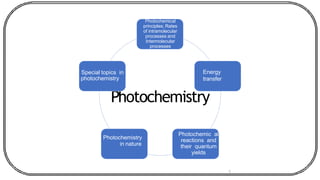
Photochemistry
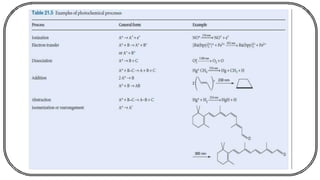
Photochemical
principles; Rates
of intramolecular
processes and
Intermolecular
processes
1
Energy
transfer
Photochemic al
reactions and
their quantum
yields
Photochemistry
in nature
Special topics in
photochemistry
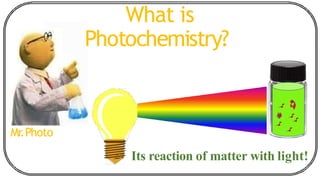
What is
Photochemistry?
Its reaction of matter with light!
Mr
.Photo
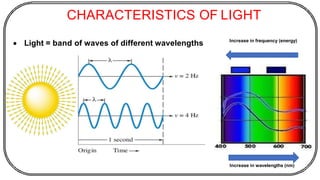
CHARACTERISTICS OF LIGHT
• Light = band of waves of different wavelengths
Increase in wavelengths (nm)
Increase in frequency (energy)
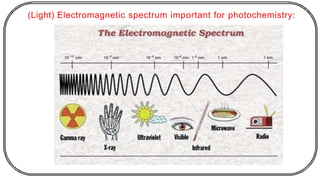
(Light) Electromagnetic spectrum important for photochemistry:
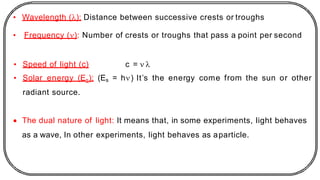
• Wavelength (): Distance between successive crests or troughs
• Frequency (): Number of crests or troughs that pass a point per second
• Speed of light (c) c =  
• Solar energy (Es): (Es = h) It’s the energy come from the sun or other
radiant source.
• The dual nature of light: It means that, in some experiments, light behaves
as a wave, In other experiments, light behaves as aparticle.
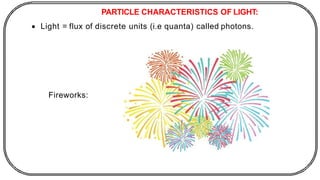
PARTICLE CHARACTERISTICS OF LIGHT:
• Light = flux of discrete units (i.e quanta) called photons.
Fireworks:
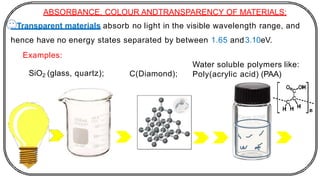
SiO2 (glass, quartz);
ABSORBANCE, COLOUR ANDTRANSPARENCY OF MATERIALS:
Transparent materials absorb no light in the visible wavelength range, and
hence have no energy states separated by between 1.65 and3.10eV.
Examples:
Water soluble polymers like:
Poly(acrylic acid) (PAA)
C(Diamond);
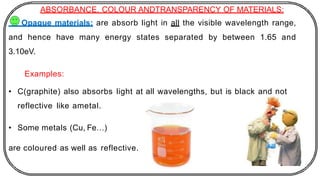
ABSORBANCE, COLOUR ANDTRANSPARENCY OF MATERIALS:
Opaque materials: are absorb light in all the visible wavelength range,
and hence have many energy states separated by between 1.65 and
3.10eV.
Examples:
• C(graphite) also absorbs light at all wavelengths, but is black and not
reflective like ametal.
• Some metals (Cu, Fe…)
are coloured as well as reflective.
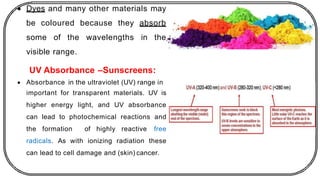
• Dyes and many other materials may
be coloured because they absorb
some of the wavelengths in the
visible range.
UV Absorbance –Sunscreens:
• Absorbance in the ultraviolet (UV) range in
important for transparent materials. UV is
higher energy light, and UV absorbance
can lead to photochemical reactions and
the formation of highly reactive free
radicals. As with ionizing radiation these
can lead to cell damage and (skin) cancer.
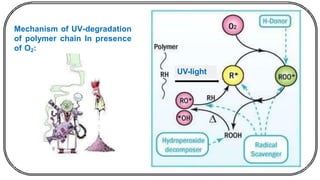
Mechanism of UV-degradation
of polymer chain In presence
of O2:
UV-light
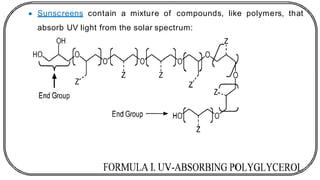
• Sunscreens contain a mixture of compounds, like polymers, that
absorb UV light from the solar spectrum:
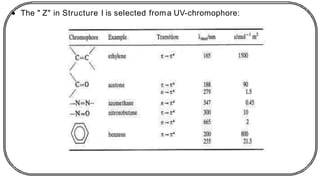
• The " Z" in Structure I is selected froma UV-chromophore:
5449 Lecture Notes (Dr Fateh Eltaboni) 19
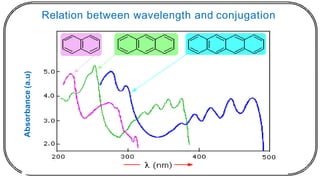
Relation between wavelength and conjugation
Absorbance
(a.u)
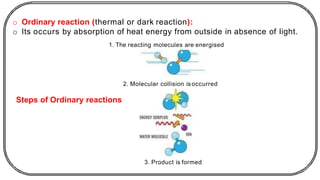
o Ordinary reaction (thermal or dark reaction):
o Its occurs by absorption of heat energy from outside in absence of light.
1. The reacting molecules are energised
3. Product is formed
2. Molecular collision isoccurred
Steps of Ordinary reactions
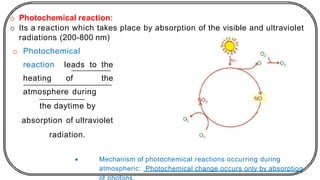
o Photochemical reaction:
o Its a reaction which takes place by absorption of the visible and ultraviolet
radiations (200-800 nm)
o Photochemical
reaction leads to the
heating of the
atmosphere during
the daytime by
absorption of ultraviolet
radiation.
• Mechanism of photochemical reactions occurring during
atmospheric: Photochemical change occurs only by absorption
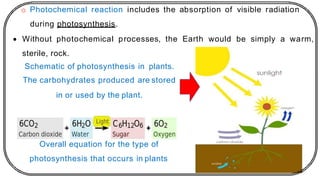
o Photochemical reaction includes the absorption of visible radiation
during photosynthesis.
• Without photochemical processes, the Earth would be simply a warm,
sterile, rock.
Schematic of photosynthesis in plants.
The carbohydrates produced are stored
in or used by the plant.
Overall equation for the type of
photosynthesis that occurs in plants
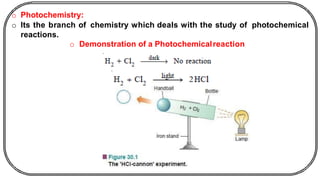
o Photochemistry:
o Its the branch of chemistry which deals with the study of photochemical
reactions.
o Demonstration of a Photochemicalreaction
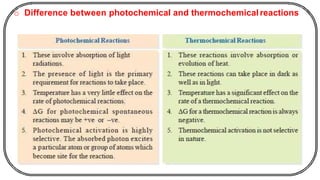
o Difference between photochemical and thermochemicalreactions
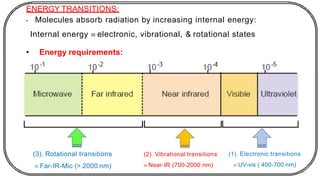
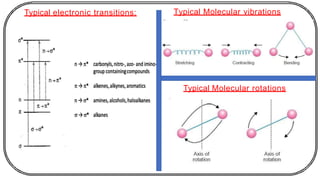
ENERGY TRANSITIONS:
• Molecules absorb radiation by increasing internal energy:
Internal energy  electronic, vibrational, & rotational states
• Energy requirements:
(1). Electronic transitions
 UV-vis ( 400-700 nm)
(2). Vibrational transitions
 Near-IR (700-2000 nm)
(3). Rotational transitions
 Far-IR-Mic (> 2000 nm)
Typical electronic transitions: Typical Molecular vibrations
Typical Molecular rotations
What Happens When Radiation Hits aMolecule?
Absorption and Emission:
• An electronic transition occurs when an electron changes from state to
another.
• The orbital it is leaving must be partly filled (it contains at least one
electron), and the orbital it is entering must be partly unfilled
(it contains less than two electrons).
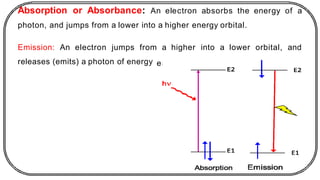
Absorption or Absorbance: An electron absorbs the energy of a
photon, and jumps from a lower into a higher energy orbital.
Emission: An electron jumps from a higher into a lower orbital, and
releases (emits) a photon of energy equal to the difference.
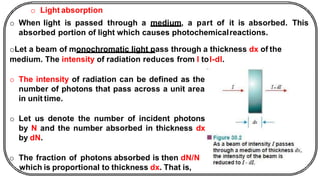
o Light absorption
o When light is passed through a medium, a part of it is absorbed. This
absorbed portion of light which causes photochemicalreactions.
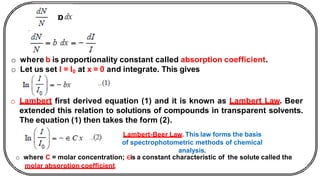
oLet a beam of monochromatic light pass through a thickness dx of the
medium. The intensity of radiation reduces from I toI-dI.
o The intensity of radiation can be defined as the
number of photons that pass across a unit area
in unit time.
o Let us denote the number of incident photons
by N and the number absorbed in thickness dx
by dN.
o The fraction of photons absorbed is then dN/N
which is proportional to thickness dx. That is,
o where b is proportionality constant called absorption coefficient.
o Let us set I = I0 at x = 0 and integrate. This gives
o Lambert first derived equation (1) and it is known as Lambert Law. Beer
extended this relation to solutions of compounds in transparent solvents.
The equation (1) then takes the form (2).
Lambert-Beer Law. This law forms the basis
of spectrophotometric methods of chemical
analysis.
o where C = molar concentration; ∈is a constant characteristic of the solute called the
molar absorption coefficient.
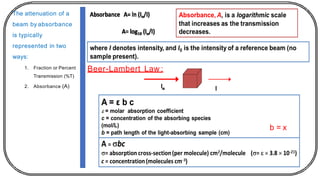
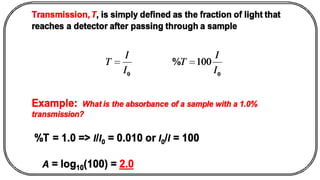
b = x
Beer-Lambert Law :
The attenuation of a
beam by absorbance
is typically
represented in two
ways:
1. Fraction or Percent
Transmission (%T)
2. Absorbance (A)
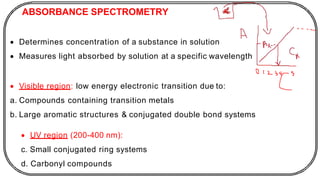
ABSORBANCE SPECTROMETRY
• Determines concentration of a substance in solution
• Measures light absorbed by solution at a specific wavelength
• Visible region: low energy electronic transition due to:
a. Compounds containing transition metals
b. Large aromatic structures & conjugated double bond systems
• UV region (200-400 nm):
c. Small conjugated ring systems
d. Carbonyl compounds
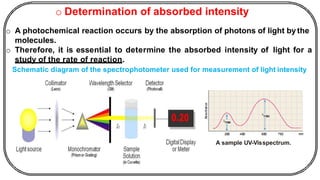
o Determination of absorbed intensity
o A photochemical reaction occurs by the absorption of photons of light bythe
molecules.
o Therefore, it is essential to determine the absorbed intensity of light for a
study of the rate of reaction.
Schematic diagram of the spectrophotometer used for measurement of light intensity
A sample UV-Visspectrum.
o Steps of absorbance measurements
1. Light beam from a suitable source (tungsten filament or mercury
vapour lamp) is rendered parallel by the lens.
2.The beam then passes through a ‘filter’ or monochrometer which yields
light of one wavelength only. The monochromatic light enters the reaction
cell made of quartz.
3.The part of light that is not absorbed strikes the detector. Thus the
intensity of light is measured first with the empty cell and then the cell
filled with the reactionsample.
4.The first reading gives the incident intensity, I0, and the second gives the
transmitted intensity, I. The difference, I0 – I = Ia, is the absorbed intensity.
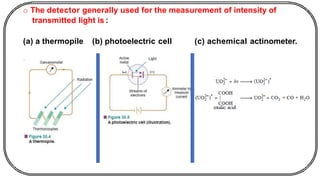
o The detector generally used for the measurement of intensity of
transmitted light is :
(a) a thermopile (b) photoelectric cell (c) achemical actinometer.
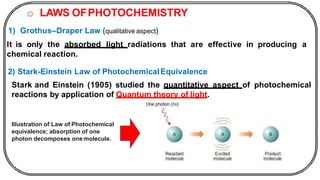
o LAWS OFPHOTOCHEMISTRY
1) Grothus–Draper Law (qualitative aspect)
It is only the absorbed light radiations that are effective in producing a
chemical reaction.
2) Stark-Einstein Law of PhotochemicalEquivalence
Stark and Einstein (1905) studied the quantitative aspect of photochemical
reactions by application of Quantum theory of light.
Illustration of Law of Photochemical
equivalence; absorption of one
photon decomposes one molecule.
o In a photochemical reaction, each molecule of the reacting
substance absorbs a single photon of radiation causing the
reaction and is activated to form the products.
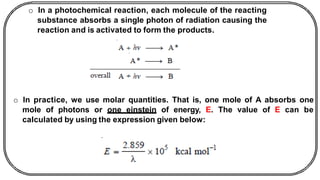
o In practice, we use molar quantities. That is, one mole of A absorbs one
mole of photons or one einstein of energy, E. The value of E can be
calculated by using the expression given below:
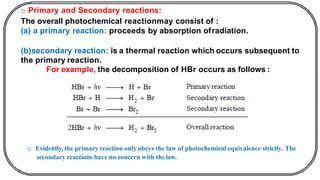
o Primary and Secondary reactions:
The overall photochemical reactionmay consist of :
(a) a primary reaction: proceeds by absorption ofradiation.
(b)secondary reaction: is a thermal reaction which occurs subsequent to
the primary reaction.
For example, the decomposition of HBr occurs as follows :
o Evidently, the primary reaction only obeys the law of photochemical equivalence strictly. The
secondary reactions have no concern with thelaw.
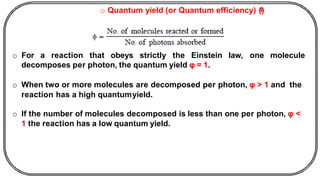
o Quantum yield (or Quantum efficiency) (
ᶲ
)
o For a reaction that obeys strictly the Einstein law, one molecule
decomposes per photon, the quantum yield φ = 1.
o When two or more molecules are decomposed per photon, φ > 1 and the
reaction has a high quantumyield.
o If the number of molecules decomposed is less than one per photon, φ <
1 the reaction has a low quantum yield.
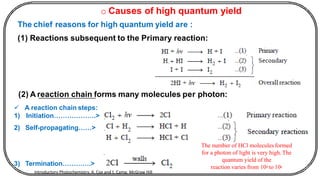
o Causes of high quantum yield
The chief reasons for high quantum yield are :
(1) Reactions subsequent to the Primary reaction:
(2) A reaction chain forms many molecules per photon:
✓ A reaction chain steps:
1) Initiation……………….>
2) Self-propagating……>
3) Termination………….>
The number of HCl molecules formed
for a photon of light is very high.The
quantum yield of the
reaction varies from 104 to 106
Introductory Photochemistry, A. Cox and t. Camp, McGraw Hill
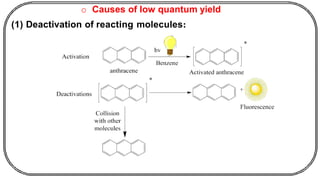
o Causes of low quantum yield
(1) Deactivation of reacting molecules:
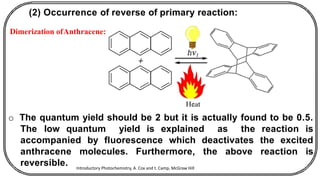
(2) Occurrence of reverse of primary reaction:
Dimerization ofAnthracene:
o The quantum yield should be 2 but it is actually found to be 0.5.
The low quantum yield is explained as the reaction is
accompanied by fluorescence which deactivates the excited
anthracene molecules. Furthermore, the above reaction is
reversible. Introductory Photochemistry, A. Cox and t. Camp, McGraw Hill
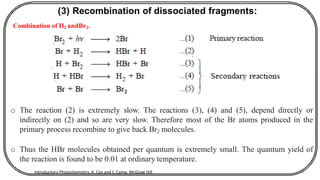
(3) Recombination of dissociated fragments:
Combination of H2 andBr2.
2
o The reaction (2) is extremely slow. The reactions (3), (4) and (5), depend directly or
indirectly on (2) and so are very slow. Therefore most of the Br atoms produced in the
primary process recombine to give back Br2 molecules.
o Thus the HBr molecules obtained per quantum is extremely small. The quantum yield of
the reaction is found to be 0.01 at ordinary temperature.
Introductory Photochemistry, A. Cox and t. Camp, McGraw Hill
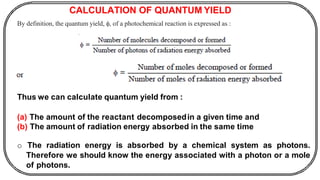
CALCULATION OF QUANTUM YIELD
By definition, the quantum yield, , of a photochemical reaction is expressed as :
Thus we can calculate quantum yield from :
(a) The amount of the reactant decomposedin a given time and
(b) The amount of radiation energy absorbed in the same time
o The radiation energy is absorbed by a chemical system as photons.
Therefore we should know the energy associated with a photon or a mole
of photons.
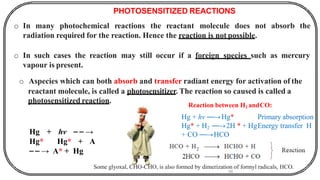
PHOTOSENSITIZED REACTIONS
o In many photochemical reactions the reactant molecule does not absorb the
radiation required for the reaction. Hence the reaction is not possible.
o In such cases the reaction may still occur if a foreign species such as mercury
vapour is present.
o Aspecies which can both absorb and transfer radiant energy for activation of the
reactant molecule, is called a photosensitizer. The reaction so caused is called a
photosensitized reaction.
Hg + hv ⎯ ⎯ →
Hg* Hg* + A
⎯ ⎯ → A* + Hg
Reaction between H2 andCO:
56
Hg + hv ⎯⎯→Hg* Primary absorption
Hg* + H2 ⎯⎯→2H * + HgEnergy transfer H
+ CO ⎯⎯→HCO
Some glyoxal, CHO-CHO, is also formed by dimerization of formyl radicals, HCO.
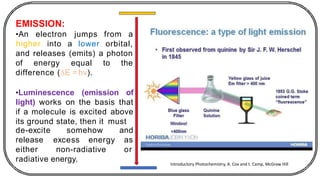
EMISSION:
•An electron from a
jumps
higher into a lower orbital,
and releases (emits) a photon
of energy equal to the
difference (∆E =hv).
•Luminescence (emission of
light) works on the basis that
if a molecule is excited above
its ground state, then it must
de-excite
release
either non-radiative
excess energy
somehow and
as
or
radiative energy. Introductory Photochemistry, A. Cox and t. Camp, McGraw Hill
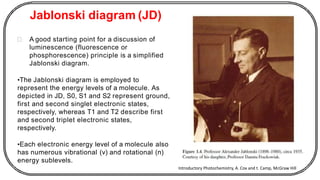
 A good starting point for a discussion of
luminescence (fluorescence or
phosphorescence) principle is a simplified
Jablonski diagram.
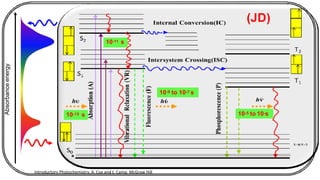
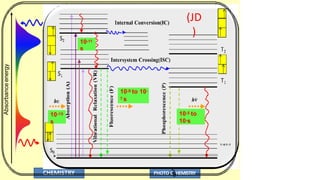
•The Jablonski diagram is employed to
represent the energy levels of a molecule. As
depicted in JD, S0, S1 and S2 represent ground,
first and second singlet electronic states,
respectively, whereas T1 and T2 describe first
and second triplet electronic states,
respectively.
•Each electronic energy level of a molecule also
has numerous vibrational (v) and rotational (n)
energy sublevels.
Jablonski diagram (JD)
Introductory Photochemistry, A. Cox and t. Camp, McGraw Hill
(JD)
10-15 s
10-11 s
10-9 to 10-7 s
10-5 to 10-s
Absorbance
energy
Introductory Photochemistry, A. Cox and t. Camp, McGraw Hill
PHOTOPHYSICAL PROCESSES:
o If the absorbed radiation is not used to cause a chemical change, it is re-emitted
as light of longer wavelength. The three such photophysical processes which can
occur are :
(1) Fluorescence (2) Phosphorescence (3) Chemiluminescence
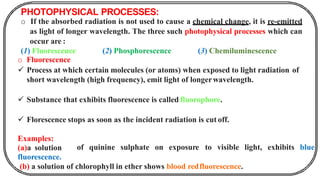
o Fluorescence
✓ Process at which certain molecules (or atoms) when exposed to light radiation of
short wavelength (high frequency), emit light of longerwavelength.
✓ Substance that exhibits fluorescence is called fluorophore.
✓ Florescence stops as soon as the incident radiation is cut off.
of quinine sulphate on exposure to visible light, exhibits blue
Examples:
(a)a solution
fluorescence.
(b) a solution of chlorophyll in ether shows blood redfluorescence.
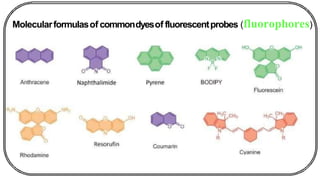
Molecularformulasof commondyesof fluorescentprobes (fluorophores)
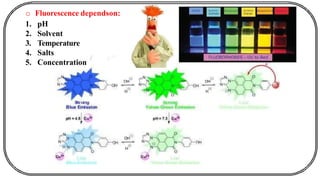
o Fluorescence dependson:
1. pH
2. Solvent
3. Temperature
4. Salts
5. Concentration
Fluorescent minerals, shown under ultraviolet light:
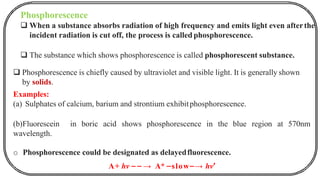
Phosphorescence
❑ When a substance absorbs radiation of high frequency and emits light even afterthe
incident radiation is cut off, the process is called phosphorescence.
❑ The substance which shows phosphorescence is called phosphorescent substance.
❑ Phosphorescence is chiefly caused by ultraviolet and visible light. It is generally shown
by solids.
Examples:
(a) Sulphates of calcium, barium and strontium exhibitphosphorescence.
(b)Fluorescein in boric acid shows phosphorescence in the blue region at 570nm
wavelength.
o Phosphorescence could be designated as delayedfluorescence.
A+ hv ⎯ ⎯ → A* ⎯slow⎯→ hv′
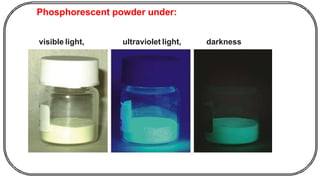
Phosphorescent powder under:
visible light, ultraviolet light, darkness
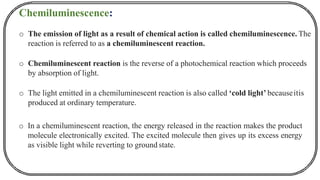
Chemiluminescence:
o The emission of light as a result of chemical action is called chemiluminescence. The
reaction is referred to as a chemiluminescent reaction.
o Chemiluminescent reaction is the reverse of a photochemical reaction which proceeds
by absorption of light.
o The light emitted in a chemiluminescent reaction is also called ‘cold light’ becauseitis
produced at ordinary temperature.
o In a chemiluminescent reaction, the energy released in the reaction makes the product
molecule electronically excited. The excited molecule then gives up its excess energy
as visible light while reverting to ground state.
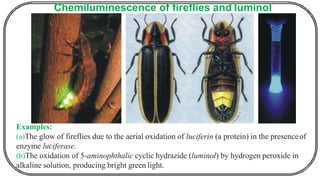
Chemiluminescence of fireflies and luminol
Examples:
(a)The glow of fireflies due to the aerial oxidation of luciferin (a protein) in the presenceof
enzyme luciferase.
(b)The oxidation of 5-aminophthalic cyclic hydrazide (luminol) by hydrogen peroxide in
alkaline solution, producing bright green light.
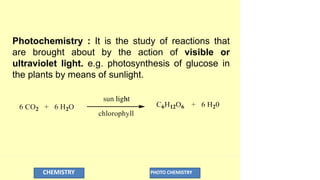
Photochemistry : It is the study of reactions that
are brought about by the action of visible or
ultraviolet light. e.g. photosynthesis of glucose in
the plants by means of sunlight.
CHEMISTRY PHOTO CHEMISTRY
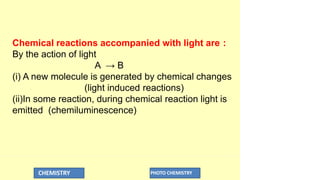
Chemical reactions accompanied with light are :
By the action of light
A → B
(i) A new molecule is generated by chemical changes
(light induced reactions)
(ii)In some reaction, during chemical reaction light is
emitted (chemiluminescence)
CHEMISTRY PHOTO CHEMISTRY
Luminescence
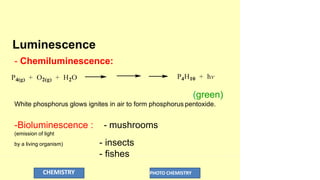
- Chemiluminescence:
(green)
White phosphorus glows ignites in air to form phosphorus pentoxide.
-Bioluminescence :
(emission of light
by a living organism)
- mushrooms
- insects
- fishes
CHEMISTRY PHOTO CHEMISTRY
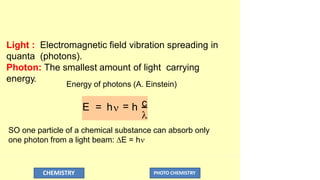
Light : Electromagnetic field vibration spreading in
quanta (photons).
Photon: The smallest amount of light carrying
energy.
Energy of photons (A. Einstein)

CHEMISTRY PHOTO CHEMISTRY
E = h = h c
SO one particle of a chemical substance can absorb only
one photon from a light beam: E = h
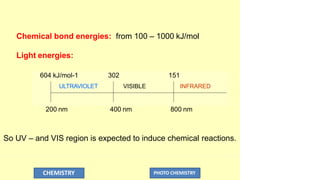
Chemical bond energies: from 100 – 1000 kJ/mol
Light energies:
302
CHEMISTRY PHOTO CHEMISTRY
151
200 nm 400 nm 800 nm
604 kJ/mol-1
ULTRAVIOLET VISIBLE INFRARED
So UV – and VIS region is expected to induce chemical reactions.
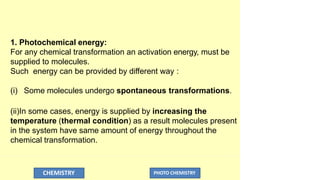
1. Photochemical energy:
For any chemical transformation an activation energy, must be
supplied to molecules.
Such energy can be provided by different way :
(i) Some molecules undergo spontaneous transformations.
(ii)In some cases, energy is supplied by increasing the
temperature (thermal condition) as a result molecules present
in the system have same amount of energy throughout the
chemical transformation.
CHEMISTRY PHOTO CHEMISTRY
(iii) In another method, molecules present in the system involve
the absorption of electromagnetic radiation in the visible or
ultraviolet region (photochemical condition).
Such absorption of light excites an individual molecule from
ground state to an excited electronic state without effecting the
surrounding molecules.
- selective excitation
-chemistry of excited molecules differs from the chemistry of
those in the ground state
- One can change the course of a reaction by activating the
reactants by light rather than by heat.
CHEMISTRY PHOTO CHEMISTRY
Infrared region is producing Vibrationally or rotationally
excited molecules,
While light in the visible and ultraviolet region has
sufficient energy to cover the range of chemical bond energies
and is able to induce chemical changes by exciting
molecules to higher electronic states.
CHEMISTRY PHOTO CHEMISTRY
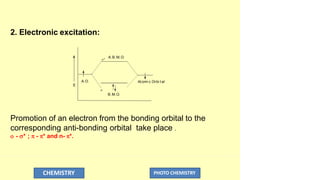
2. Electronic excitation:
A.B. M.O.
A.O. At omi c Orbi t al
E

B.M.O.
CHEMISTRY PHOTO CHEMISTRY
*
Promotion of an electron from the bonding orbital to the
corresponding anti-bonding orbital take place .
 - * ;  - * and n- *.
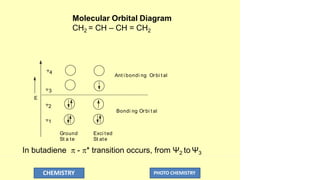
Molecular Orbital Diagram
CH2 = CH – CH = CH2
Ant i bondi ng Or bi t al
Bondi ng Orbi t al
Ground
St a te
CHEMISTRY PHOTO CHEMISTRY
Exci t ed
St ate
Ψ4
Ψ3
E
Ψ2
Ψ1
In butadiene  - * transition occurs, from Ψ2 to Ψ3
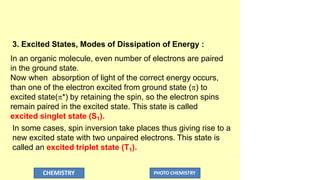
3. Excited States, Modes of Dissipation of Energy :
In an organic molecule, even number of electrons are paired
in the ground state.
Now when absorption of light of the correct energy occurs,
than one of the electron excited from ground state () to
excited state(*) by retaining the spin, so the electron spins
remain paired in the excited state. This state is called
excited singlet state (S1).
In some cases, spin inversion take places thus giving rise to a
new excited state with two unpaired electrons. This state is
called an excited triplet state (T1).
CHEMISTRY PHOTO CHEMISTRY
*
CHEMISTRY PHOTO CHEMISTRY

Ant i bondi ng
Bondi ng
E Ground
St ate
S0
Si nglet
St ate
S1
Tr i pl et
St ate
T1
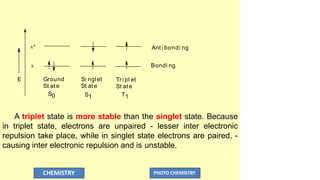
A triplet state is more stable than the singlet state. Because
in triplet state, electrons are unpaired - lesser inter electronic
repulsion take place, while in singlet state electrons are paired, -
causing inter electronic repulsion and is unstable.
CHEMISTRY
(JD
)
10-15
s
10-11
s
10-9 to 10-
7 s
10-5 to
10-s
Absorbance
energy
5
PHOTO C9HEMISTRY
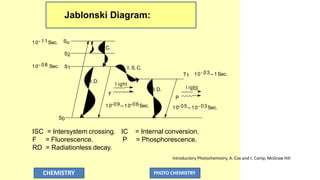
Jablonski Diagram:
10- 08 Sec.
10- 11Sec. Su
S1
S2
S0
I.C.
R.D.
I.S.C.
P
F
R.D.
l ight
10-09--10-06Sec.
T1 10- 03--1Sec.
l ight
10-05--10- 03Sec.
ISC = Intersystem crossing.
CHEMISTRY PHOTO CHEMISTRY
F = Fluorescence.
IC = Internal conversion.
P = Phosphorescence.
RD = Radiationless decay.
Introductory Photochemistry, A. Cox and t. Camp, McGraw Hill
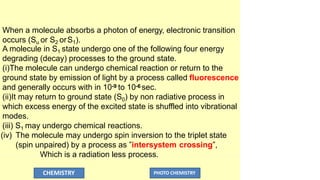
When a molecule absorbs a photon of energy, electronic transition
occurs (Su or S2 orS1).
A molecule in S1 state undergo one of the following four energy
degrading (decay) processes to the ground state.
(i)The molecule can undergo chemical reaction or return to the
ground state by emission of light by a process called fluorescence
and generally occurs with in 10-9 to 10-6 sec.
(ii)It may return to ground state (S0) by non radiative process in
which excess energy of the excited state is shuffled into vibrational
modes.
(iii) S1 may undergo chemical reactions.
(iv) The molecule may undergo spin inversion to the triplet state
(spin unpaired) by a process as ”intersystem crossing”,
Which is a radiation less process.
CHEMISTRY PHOTO CHEMISTRY
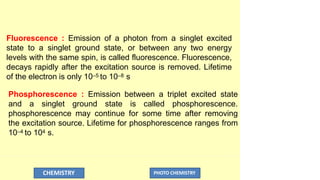
Fluorescence : Emission of a photon from a singlet excited
state to a singlet ground state, or between any two energy
levels with the same spin, is called fluorescence. Fluorescence,
decays rapidly after the excitation source is removed. Lifetime
of the electron is only 10–5 to 10–8 s
Phosphorescence : Emission between a triplet excited state
and a singlet ground state is called phosphorescence.
phosphorescence may continue for some time after removing
the excitation source. Lifetime for phosphorescence ranges from
10–4 to 104 s.
CHEMISTRY PHOTO CHEMISTRY
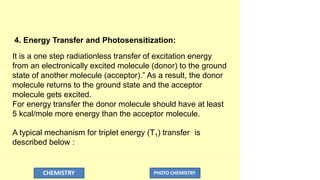
4. Energy Transfer and Photosensitization:
It is a one step radiationless transfer of excitation energy
from an electronically excited molecule (donor) to the ground
state of another molecule (acceptor).” As a result, the donor
molecule returns to the ground state and the acceptor
molecule gets excited.
For energy transfer the donor molecule should have at least
5 kcal/mole more energy than the acceptor molecule.
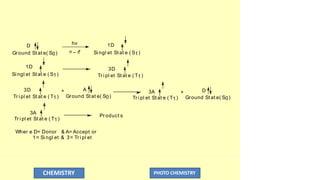
A typical mechanism for triplet energy (T1) transfer is
described below :
CHEMISTRY PHOTO CHEMISTRY
D 1D
Ground St at e( S0) Si ngl et St at e ( S1)
Tr i pl et St at e ( T1)
3D
A 3A
hv
n _ 
*
Si ngl et St at e ( S1)
1D
3D
Tr i pl et St at e ( T1) Ground St at e( S0)
+ +
Ground St at e( S0)
Tr i pl et St at e ( T1)
D
Tr i pl et St at e ( T1)
3A
CHEMISTRY PHOTO CHEMISTRY
Pr oduct s
Wher e D= Donor & A= Accept or
1= Si ngl et & 3= Tr i pl et
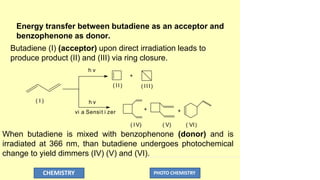
Energy transfer between butadiene as an acceptor and
benzophenone as donor.
( I ) h v
vi a Sensit i zer
( II) ( III)
Butadiene (I) (acceptor) upon direct irradiation leads to
produce product (II) and (III) via ring closure.
h v
+
+ +
( IV) ( V) ( VI)
When butadiene is mixed with benzophenone (donor) and is
irradiated at 366 nm, than butadiene undergoes photochemical
change to yield dimmers (IV) (V) and (VI).
CHEMISTRY PHOTO CHEMISTRY
In this process light is absorbed by benzophenone (donor)
but the reaction is taking place with butadiene (acceptor) .
Here benzophenone (donor) is functioning as a
photosensitizer, while butadiene is good acceptor as it has 9
kcal/mole less triplet energy than benzophenone.
hv ISC
( I V + V + VI )
Di mers
( C6H5) 2CO 1[ ( C6H5) 2CO]
D S0 D S1
6 5 2
3[ ( C H ) CO]
D T1
A S0
D S0
3
[ ]+
( C6H5) 2CO
A T1
CHEMISTRY PHOTO CHEMISTRY
S0
Benzophenone 1,3- But adi ene
Ener gy Tr ansf er
69 kcal / mol e
S1
S0
T1
120 kcal / mol e
60 kcal / mol e
S1
I SC T1
CHEMISTRY PHOTO CHEMISTRY
74 kcal / mol e
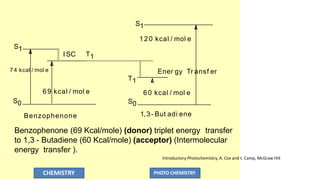
Benzophenone (69 Kcal/mole) (donor) triplet energy transfer
to 1,3 - Butadiene (60 Kcal/mole) (acceptor) (Intermolecular
energy transfer ).
Introductory Photochemistry, A. Cox and t. Camp, McGraw Hill
O
C
( CH2 )n
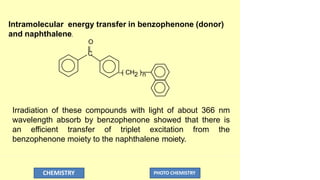
Intramolecular energy transfer in benzophenone (donor)
and naphthalene.
CHEMISTRY PHOTO CHEMISTRY
Irradiation of these compounds with light of about 366 nm
wavelength absorb by benzophenone showed that there is
an efficient transfer of triplet excitation from the
benzophenone moiety to the naphthalene moiety.
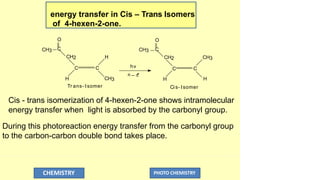
energy transfer in Cis – Trans Isomers
of 4-hexen-2-one.
CH3
H
O
C
hv
CH3 CH3
H
C
O
C
H
CH3
CH2
C
CH2
C C
H
Tr ans- Isomer
CHEMISTRY PHOTO CHEMISTRY
Cis- Isomer
n _ 
*
Cis - trans isomerization of 4-hexen-2-one shows intramolecular
energy transfer when light is absorbed by the carbonyl group.
During this photoreaction energy transfer from the carbonyl group
to the carbon-carbon double bond takes place.
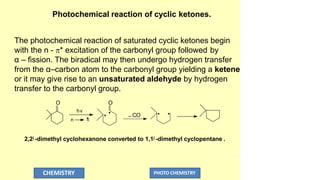
Photochemical reaction of cyclic ketones.
The photochemical reaction of saturated cyclic ketones begin
with the n - * excitation of the carbonyl group followed by
α – fission. The biradical may then undergo hydrogen transfer
from the α–carbon atom to the carbonyl group yielding a ketene
or it may give rise to an unsaturated aldehyde by hydrogen
transfer to the carbonyl group.
O O
_ CO

*
hv
n
CHEMISTRY PHOTO CHEMISTRY
2,2| -dimethyl cyclohexanone converted to 1,1| -dimethyl cyclopentane .
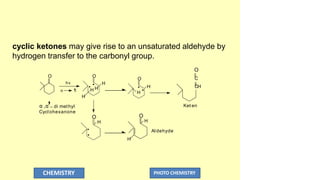
cyclic ketones may give rise to an unsaturated aldehyde by
hydrogen transfer to the carbonyl group.
O O
hv

*
n
H
H
H H H
O
O
H H
O
H
O
C
CH
H
CHEMISTRY PHOTO CHEMISTRY
Ket en
Aldehyde
α ,α _ di methyl
Cycl ohexanone
,
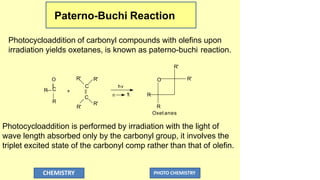
Paterno-Buchi Reaction
Photocycloaddition of carbonyl compounds with olefins upon
irradiation yields oxetanes, is known as paterno-buchi reaction.
n 
*
hv
R
R'
O
C
R
+
C
C
R'
R'
R' O
R
CHEMISTRY PHOTO CHEMISTRY
R'
R'
R
Oxet anes
Photocycloaddition is performed by irradiation with the light of
wave length absorbed only by the carbonyl group, it involves the
triplet excited state of the carbonyl comp rather than that of olefin.
Mechanism of pateron-buchi reaction
3
( C6H5) 2 C C CH
CH3
CH2
3[ ( C6H5) 2CO] + ( CH3) 2C
6 5 2
CO
hv 1[ ( C6H5) 2CO] I.S.C. 3[ ( C6H5) 2CO]
O CH2
( i ) ( C H )
CHEMISTRY PHOTO CHEMISTRY
( i i )
Unsymmetrical Olefins:
Since the olefin is unsymmetrical, two products will be obtained.
The product in which the most stable biradical intermediate
forms, will be the major and other will be minor.
Mechanism of pateron-buchi reaction
( C H )
6 5 2
3[ ( C6H5) 2CO] + ( CH3) 2C
O C CH3
CH3
3
CO
hv 1[ ( C6H5) 2CO] I.S.C. 3[ ( C6H5) 2CO]
O CH2
CH3
C CH2
C CH3
O
O
C
CH2
CH3
C6H5 C
CH3
C6H5
C6H5
CH2 ( C6H5) 2 C C CH
CH3
more st abl e
CHEMISTRY PHOTO CHEMISTRY
( C6H5) 2 C CH2
l ess st abl e
Major ( 90 %)
C6H5
Mi nor ( 10%)
(ii) Symmetrical Olefins:
Irradiation of benzophenone with either cis or trans-2-butene
yields the same mixture of both isomeric oxetanes.
CO
hv 1[ ( C6H5 ) 2CO] I.S.C. 3[ ( C6H5) 2CO]
C H
6 5
C
C6H5
CH3
O C
C
O C
C
CH3
C6H5
C
CH3
C6H5
O C
C
CH3
C H
6 5
C
CH3
C6H5
+
CH3 CH3
CH
CH
( i ) ( C6H5) 2
( i i )
3[ ( C6H5 ) 2CO] +
CH3
Ci s - Tr ans
2- But ene
CHEMISTRY PHOTO CHEMISTRY
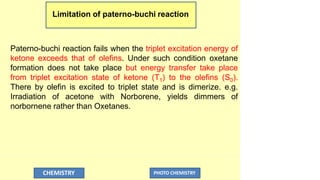
Limitation of paterno-buchi reaction
CHEMISTRY PHOTO CHEMISTRY
Paterno-buchi reaction fails when the triplet excitation energy of
ketone exceeds that of olefins. Under such condition oxetane
formation does not take place but energy transfer take place
from triplet excitation state of ketone (T1) to the olefins (S0).
There by olefin is excited to triplet state and is dimerize. e.g.
Irradiation of acetone with Norborene, yields dimmers of
norbornene rather than Oxetanes.
I.S.C. 3[ CH3 COCH3]
( i ) CH3COCH3
hv 1[ CH3COCH3 ]
+
( i i ) 3[ CH3COCH3]
3
[
CH3 COCH3 +
]
]
3
[
( i i i )
Di mer of Nor bor ene
CHEMISTRY PHOTO CHEMISTRY
When a ketone (Benzophenone) having less triplet energy is used
will leads to paterno – buchi reaction to form Oxctanes of a
nonrborene.
( i ) ( C H )
6 5 2
CO
hv 1[ ( C6H5) 2CO] I.S.C. 3[ ( C6H5) 2CO]
( i i ) 6 5 2
3[ ( C H ) CO] +
O
C6H5
CHEMISTRY PHOTO CHEMISTRY
C6H5
hv
Paterno – buchi reaction also fails to occur with
conjugated dienes.
( C6H5) 2CO
hv
C4H9
C
C
C4H9
C6H5
O
C6H5
3
C6H5
]+
[ C
T1
O C C4H9
C C C H
4 9
hv
O C C4H9
C C C4H9
C6H5
C6H5
O C C4H9
C C C4H9
CHEMISTRY PHOTO CHEMISTRY
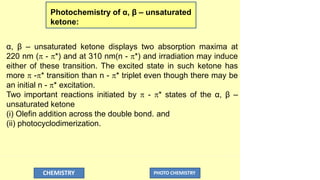
Photochemistry of α, β – unsaturated
ketone:
CHEMISTRY PHOTO CHEMISTRY
α, β – unsaturated ketone displays two absorption maxima at
220 nm ( - *) and at 310 nm(n - *) and irradiation may induce
either of these transition. The excited state in such ketone has
more  -* transition than n - * triplet even though there may be
an initial n - * excitation.
Two important reactions initiated by  - * states of the α, β –
unsaturated ketone
(i) Olefin addition across the double bond. and
(ii) photocyclodimerization.
(i) Olefin addition:
Photocycloaddition reaction involves, initial formation of a
carbon – carbon bond between the α–carbon of α, β–unsaturated
ketone and the olefin, followed by cyclization.
Cycl opent enone + Cycl opent ene
] ]
1
[ 3
[
O O O
O
] +
n 
*
hv
( i)
( i i ) 3
[
O O
n_*
CHEMISTRY PHOTO CHEMISTRY
Cycl opent ene
[ _ 
*
] T1
Cycl opent enone
[ _ 
*
] T1
Cycl ohexenenone +
O
+
CH2
CH3O
[ _ 
*
] T 1
OCH3
hv

*

1 , 4 , - di met hoxyet hyl ene
O H
H H
O H
OCH3 OCH3
OCH3 OCH3
1
O
3
[ ]
[ _ 
*
] T
CH3
C
C
CH3
+

hv

*
O
CH3
CHEMISTRY PHOTO CHEMISTRY
CH3
Cycl opent enone + Acet yl ene
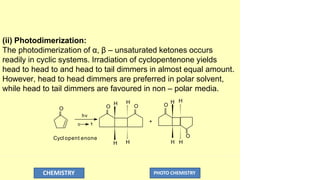
(ii) Photodimerization:
The photodimerization of α, β – unsaturated ketones occurs
readily in cyclic systems. Irradiation of cyclopentenone yields
head to head to and head to tail dimmers in almost equal amount.
However, head to head dimmers are preferred in polar solvent,
while head to tail dimmers are favoured in non – polar media.
O
O
H H
O
H H
H
H
O
H
O
H

*
hv

CHEMISTRY PHOTO CHEMISTRY
+
Cycl opent enone
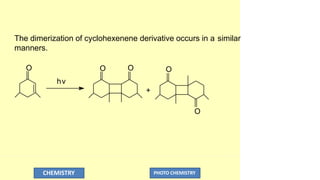
The dimerization of cyclohexenene derivative occurs in a similar
manners.
hv
CHEMISTRY PHOTO CHEMISTRY
O O O
+
O
O
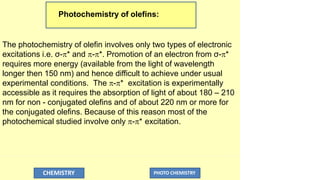
Photochemistry of olefins:
CHEMISTRY PHOTO CHEMISTRY
The photochemistry of olefin involves only two types of electronic
excitations i.e. σ-* and -*. Promotion of an electron from σ-*
requires more energy (available from the light of wavelength
longer then 150 nm) and hence difficult to achieve under usual
experimental conditions. The -* excitation is experimentally
accessible as it requires the absorption of light of about 180 – 210
nm for non - conjugated olefins and of about 220 nm or more for
the conjugated olefins. Because of this reason most of the
photochemical studied involve only -* excitation.
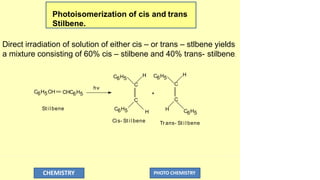
Photoisomerization of cis and trans
Stilbene.
Direct irradiation of solution of either cis – or trans – stlbene yields
a mixture consisting of 60% cis – stilbene and 40% trans- stilbene.
C6H5CH CHC6H5
C6H5
C
C
H
H
C6H5
hv
C6H5
CHEMISTRY PHOTO CHEMISTRY
H
H
C
C
C6H5
+
St i l bene
Cis- St i l bene Tr ans- St i l bene
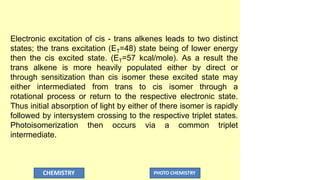
Electronic excitation of cis - trans alkenes leads to two distinct
states; the trans excitation (ET=48) state being of lower energy
then the cis excited state. (ET=57 kcal/mole). As a result the
trans alkene is more heavily populated either by direct or
through sensitization than cis isomer these excited state may
either intermediated from trans to cis isomer through a
rotational process or return to the respective electronic state.
Thus initial absorption of light by either of there isomer is rapidly
followed by intersystem crossing to the respective triplet states.
Photoisomerization then occurs via a common triplet
intermediate.
CHEMISTRY PHOTO CHEMISTRY
Cis- St i l bene
Tr ans- St i l bene
hv 1[ Cis- St i l bene] 3[ Cis- St i l bene]
3[ Tr ans- St i l bene]
1[ Tr ans- St i l bene]
hv
CHC6H5
C6H5CH +
CHEMISTRY PHOTO CHEMISTRY
Cis- St i l bene
( 60%)
Tr ans- St i l bene
( 40%)
The intermediates either interconverts to the triplet of the other or goes to a
common triplet intermediate called the phantom triplet or photostalionary state.
Which leads finally to the cis isomer.
Br 2 Br Br
+
C C
H
Br +
H H
R R R
H
R
C C
Br
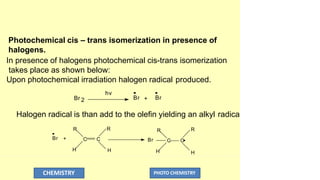
Photochemical cis – trans isomerization in presence of
halogens.
In presence of halogens photochemical cis-trans isomerization
takes place as shown below:
CHEMISTRY PHOTO CHEMISTRY
Upon photochemical irradiation halogen radical produced.
hv
Halogen radical is than add to the olefin yielding an alkyl radica
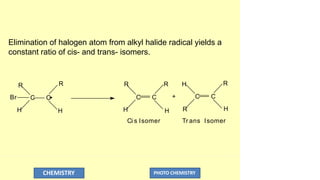
Elimination of halogen atom from alkyl halide radical yields a
constant ratio of cis- and trans- isomers.
R
H
R H R
H
R
C C
Br C C
R
H
R
H
+
CHEMISTRY PHOTO CHEMISTRY
C C
H
Ci s Isomer Tr ans Isomer
Cyclic olefins may undergo addition reactions, instead of
dimerization upon irradiation in methanol. The reaction of
4-isopropyl-1-methyl cyclohexene with methanol is sensitized
by xylene as shown below.
+ 3
CH OH
hv
CHEMISTRY PHOTO CHEMISTRY
Xyl ene
CH3
OCH3
CH3O
CH3
+
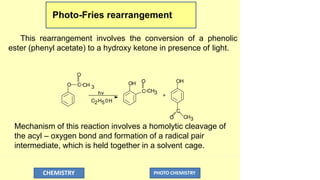
Photo-Fries rearrangement
This rearrangement involves the conversion of a phenolic
ester (phenyl acetate) to a hydroxy ketone in presence of light.
O
O
C CH 3
hv
C2H50H
OH O
C CH3
+
OH
C
O CH3
Mechanism of this reaction involves a homolytic cleavage of
the acyl – oxygen bond and formation of a radical pair
intermediate, which is held together in a solvent cage.
CHEMISTRY PHOTO CHEMISTRY
O
C CH3
hv
C2H50 H
O
[
O
O
C
] [
O
C
O
CH3 CH3 CH3
O
C
O
]
The coupling of radical pair then yields the stable products.
During photo-fries rearrangement a small amount of phenol
is also formed.
This might be due to the abstraction of hydrogen atom from
the solvent by the phenoxy radical.
O
+ C2 H5 O H
OH
+ OC2H5
CHEMISTRY PHOTO CHEMISTRY
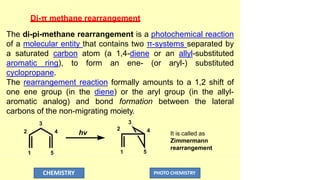
Di-π methane rearrangement
CHEMISTRY PHOTO CHEMISTRY
The di-pi-methane rearrangement is a photochemical reaction
of a molecular entity that contains two π-systems separated by
a saturated carbon atom (a 1,4-diene or an allyl-substituted
aromatic ring), to form an ene- (or aryl-) substituted
cyclopropane.
The rearrangement reaction formally amounts to a 1,2 shift of
one ene group (in the diene) or the aryl group (in the allyl-
aromatic analog) and bond formation between the lateral
carbons of the non-migrating moiety.
It is called as
Zimmermann
rearrangement
CHEMISTRY PHOTO CHMISTRY
Reference Books:
•Fundamentals of photo chemistry, K.K. Rothagi-Mukheriji, Wiley-
Eastern.
•Essentials of Molecular Photochemistry, a Gilbert and J. Baggott,
Blackwell Scientific Publication.
•Molecular Photochemistry, N. J. Turro, W.A. Benjamin.
•Introductory Photochemistry, A. Cox and t. Camp, McGraw Hill.

A presentation on Photochemistry- pdf version

  • 1.
    Photochemistry Photochemical principles; Rates of intramolecular processesand Intermolecular processes 1 Energy transfer Photochemic al reactions and their quantum yields Photochemistry in nature Special topics in photochemistry
  • 2.
    What is Photochemistry? Its reactionof matter with light! Mr .Photo
  • 3.
    CHARACTERISTICS OF LIGHT •Light = band of waves of different wavelengths Increase in wavelengths (nm) Increase in frequency (energy)
  • 4.
    (Light) Electromagnetic spectrumimportant for photochemistry:
  • 5.
    • Wavelength ():Distance between successive crests or troughs • Frequency (): Number of crests or troughs that pass a point per second • Speed of light (c) c =   • Solar energy (Es): (Es = h) It’s the energy come from the sun or other radiant source. • The dual nature of light: It means that, in some experiments, light behaves as a wave, In other experiments, light behaves as aparticle.
  • 6.
    PARTICLE CHARACTERISTICS OFLIGHT: • Light = flux of discrete units (i.e quanta) called photons. Fireworks:
  • 7.
    SiO2 (glass, quartz); ABSORBANCE,COLOUR ANDTRANSPARENCY OF MATERIALS: Transparent materials absorb no light in the visible wavelength range, and hence have no energy states separated by between 1.65 and3.10eV. Examples: Water soluble polymers like: Poly(acrylic acid) (PAA) C(Diamond);
  • 8.
    ABSORBANCE, COLOUR ANDTRANSPARENCYOF MATERIALS: Opaque materials: are absorb light in all the visible wavelength range, and hence have many energy states separated by between 1.65 and 3.10eV. Examples: • C(graphite) also absorbs light at all wavelengths, but is black and not reflective like ametal. • Some metals (Cu, Fe…) are coloured as well as reflective.
  • 9.
    • Dyes andmany other materials may be coloured because they absorb some of the wavelengths in the visible range. UV Absorbance –Sunscreens: • Absorbance in the ultraviolet (UV) range in important for transparent materials. UV is higher energy light, and UV absorbance can lead to photochemical reactions and the formation of highly reactive free radicals. As with ionizing radiation these can lead to cell damage and (skin) cancer.
  • 10.
    Mechanism of UV-degradation ofpolymer chain In presence of O2: UV-light
  • 11.
    • Sunscreens containa mixture of compounds, like polymers, that absorb UV light from the solar spectrum:
  • 12.
    • The "Z" in Structure I is selected froma UV-chromophore:
  • 13.
    5449 Lecture Notes(Dr Fateh Eltaboni) 19 Relation between wavelength and conjugation Absorbance (a.u)
  • 14.
    o Ordinary reaction(thermal or dark reaction): o Its occurs by absorption of heat energy from outside in absence of light. 1. The reacting molecules are energised 3. Product is formed 2. Molecular collision isoccurred Steps of Ordinary reactions
  • 15.
    o Photochemical reaction: oIts a reaction which takes place by absorption of the visible and ultraviolet radiations (200-800 nm) o Photochemical reaction leads to the heating of the atmosphere during the daytime by absorption of ultraviolet radiation. • Mechanism of photochemical reactions occurring during atmospheric: Photochemical change occurs only by absorption
  • 16.
    o Photochemical reactionincludes the absorption of visible radiation during photosynthesis. • Without photochemical processes, the Earth would be simply a warm, sterile, rock. Schematic of photosynthesis in plants. The carbohydrates produced are stored in or used by the plant. Overall equation for the type of photosynthesis that occurs in plants
  • 17.
    o Photochemistry: o Itsthe branch of chemistry which deals with the study of photochemical reactions. o Demonstration of a Photochemicalreaction
  • 18.
    o Difference betweenphotochemical and thermochemicalreactions
  • 20.
    ENERGY TRANSITIONS: • Moleculesabsorb radiation by increasing internal energy: Internal energy  electronic, vibrational, & rotational states • Energy requirements: (1). Electronic transitions  UV-vis ( 400-700 nm) (2). Vibrational transitions  Near-IR (700-2000 nm) (3). Rotational transitions  Far-IR-Mic (> 2000 nm)
  • 21.
    Typical electronic transitions:Typical Molecular vibrations Typical Molecular rotations
  • 22.
    What Happens WhenRadiation Hits aMolecule?
  • 23.
    Absorption and Emission: •An electronic transition occurs when an electron changes from state to another. • The orbital it is leaving must be partly filled (it contains at least one electron), and the orbital it is entering must be partly unfilled (it contains less than two electrons).
  • 24.
    Absorption or Absorbance:An electron absorbs the energy of a photon, and jumps from a lower into a higher energy orbital. Emission: An electron jumps from a higher into a lower orbital, and releases (emits) a photon of energy equal to the difference.
  • 25.
    o Light absorption oWhen light is passed through a medium, a part of it is absorbed. This absorbed portion of light which causes photochemicalreactions. oLet a beam of monochromatic light pass through a thickness dx of the medium. The intensity of radiation reduces from I toI-dI. o The intensity of radiation can be defined as the number of photons that pass across a unit area in unit time. o Let us denote the number of incident photons by N and the number absorbed in thickness dx by dN. o The fraction of photons absorbed is then dN/N which is proportional to thickness dx. That is,
  • 26.
    o where bis proportionality constant called absorption coefficient. o Let us set I = I0 at x = 0 and integrate. This gives o Lambert first derived equation (1) and it is known as Lambert Law. Beer extended this relation to solutions of compounds in transparent solvents. The equation (1) then takes the form (2). Lambert-Beer Law. This law forms the basis of spectrophotometric methods of chemical analysis. o where C = molar concentration; ∈is a constant characteristic of the solute called the molar absorption coefficient.
  • 27.
    b = x Beer-LambertLaw : The attenuation of a beam by absorbance is typically represented in two ways: 1. Fraction or Percent Transmission (%T) 2. Absorbance (A)
  • 29.
    ABSORBANCE SPECTROMETRY • Determinesconcentration of a substance in solution • Measures light absorbed by solution at a specific wavelength • Visible region: low energy electronic transition due to: a. Compounds containing transition metals b. Large aromatic structures & conjugated double bond systems • UV region (200-400 nm): c. Small conjugated ring systems d. Carbonyl compounds
  • 30.
    o Determination ofabsorbed intensity o A photochemical reaction occurs by the absorption of photons of light bythe molecules. o Therefore, it is essential to determine the absorbed intensity of light for a study of the rate of reaction. Schematic diagram of the spectrophotometer used for measurement of light intensity A sample UV-Visspectrum.
  • 31.
    o Steps ofabsorbance measurements 1. Light beam from a suitable source (tungsten filament or mercury vapour lamp) is rendered parallel by the lens. 2.The beam then passes through a ‘filter’ or monochrometer which yields light of one wavelength only. The monochromatic light enters the reaction cell made of quartz. 3.The part of light that is not absorbed strikes the detector. Thus the intensity of light is measured first with the empty cell and then the cell filled with the reactionsample. 4.The first reading gives the incident intensity, I0, and the second gives the transmitted intensity, I. The difference, I0 – I = Ia, is the absorbed intensity.
  • 32.
    o The detectorgenerally used for the measurement of intensity of transmitted light is : (a) a thermopile (b) photoelectric cell (c) achemical actinometer.
  • 33.
    o LAWS OFPHOTOCHEMISTRY 1)Grothus–Draper Law (qualitative aspect) It is only the absorbed light radiations that are effective in producing a chemical reaction. 2) Stark-Einstein Law of PhotochemicalEquivalence Stark and Einstein (1905) studied the quantitative aspect of photochemical reactions by application of Quantum theory of light. Illustration of Law of Photochemical equivalence; absorption of one photon decomposes one molecule.
  • 34.
    o In aphotochemical reaction, each molecule of the reacting substance absorbs a single photon of radiation causing the reaction and is activated to form the products. o In practice, we use molar quantities. That is, one mole of A absorbs one mole of photons or one einstein of energy, E. The value of E can be calculated by using the expression given below:
  • 35.
    o Primary andSecondary reactions: The overall photochemical reactionmay consist of : (a) a primary reaction: proceeds by absorption ofradiation. (b)secondary reaction: is a thermal reaction which occurs subsequent to the primary reaction. For example, the decomposition of HBr occurs as follows : o Evidently, the primary reaction only obeys the law of photochemical equivalence strictly. The secondary reactions have no concern with thelaw.
  • 36.
    o Quantum yield(or Quantum efficiency) ( ᶲ ) o For a reaction that obeys strictly the Einstein law, one molecule decomposes per photon, the quantum yield φ = 1. o When two or more molecules are decomposed per photon, φ > 1 and the reaction has a high quantumyield. o If the number of molecules decomposed is less than one per photon, φ < 1 the reaction has a low quantum yield.
  • 37.
    o Causes ofhigh quantum yield The chief reasons for high quantum yield are : (1) Reactions subsequent to the Primary reaction: (2) A reaction chain forms many molecules per photon: ✓ A reaction chain steps: 1) Initiation……………….> 2) Self-propagating……> 3) Termination………….> The number of HCl molecules formed for a photon of light is very high.The quantum yield of the reaction varies from 104 to 106 Introductory Photochemistry, A. Cox and t. Camp, McGraw Hill
  • 38.
    o Causes oflow quantum yield (1) Deactivation of reacting molecules:
  • 39.
    (2) Occurrence ofreverse of primary reaction: Dimerization ofAnthracene: o The quantum yield should be 2 but it is actually found to be 0.5. The low quantum yield is explained as the reaction is accompanied by fluorescence which deactivates the excited anthracene molecules. Furthermore, the above reaction is reversible. Introductory Photochemistry, A. Cox and t. Camp, McGraw Hill
  • 40.
    (3) Recombination ofdissociated fragments: Combination of H2 andBr2. 2 o The reaction (2) is extremely slow. The reactions (3), (4) and (5), depend directly or indirectly on (2) and so are very slow. Therefore most of the Br atoms produced in the primary process recombine to give back Br2 molecules. o Thus the HBr molecules obtained per quantum is extremely small. The quantum yield of the reaction is found to be 0.01 at ordinary temperature. Introductory Photochemistry, A. Cox and t. Camp, McGraw Hill
  • 41.
    CALCULATION OF QUANTUMYIELD By definition, the quantum yield, , of a photochemical reaction is expressed as : Thus we can calculate quantum yield from : (a) The amount of the reactant decomposedin a given time and (b) The amount of radiation energy absorbed in the same time o The radiation energy is absorbed by a chemical system as photons. Therefore we should know the energy associated with a photon or a mole of photons.
  • 42.
    PHOTOSENSITIZED REACTIONS o Inmany photochemical reactions the reactant molecule does not absorb the radiation required for the reaction. Hence the reaction is not possible. o In such cases the reaction may still occur if a foreign species such as mercury vapour is present. o Aspecies which can both absorb and transfer radiant energy for activation of the reactant molecule, is called a photosensitizer. The reaction so caused is called a photosensitized reaction. Hg + hv ⎯ ⎯ → Hg* Hg* + A ⎯ ⎯ → A* + Hg Reaction between H2 andCO: 56 Hg + hv ⎯⎯→Hg* Primary absorption Hg* + H2 ⎯⎯→2H * + HgEnergy transfer H + CO ⎯⎯→HCO Some glyoxal, CHO-CHO, is also formed by dimerization of formyl radicals, HCO.
  • 43.
    EMISSION: •An electron froma jumps higher into a lower orbital, and releases (emits) a photon of energy equal to the difference (∆E =hv). •Luminescence (emission of light) works on the basis that if a molecule is excited above its ground state, then it must de-excite release either non-radiative excess energy somehow and as or radiative energy. Introductory Photochemistry, A. Cox and t. Camp, McGraw Hill
  • 44.
     A goodstarting point for a discussion of luminescence (fluorescence or phosphorescence) principle is a simplified Jablonski diagram. •The Jablonski diagram is employed to represent the energy levels of a molecule. As depicted in JD, S0, S1 and S2 represent ground, first and second singlet electronic states, respectively, whereas T1 and T2 describe first and second triplet electronic states, respectively. •Each electronic energy level of a molecule also has numerous vibrational (v) and rotational (n) energy sublevels. Jablonski diagram (JD) Introductory Photochemistry, A. Cox and t. Camp, McGraw Hill
  • 45.
    (JD) 10-15 s 10-11 s 10-9to 10-7 s 10-5 to 10-s Absorbance energy Introductory Photochemistry, A. Cox and t. Camp, McGraw Hill
  • 46.
    PHOTOPHYSICAL PROCESSES: o Ifthe absorbed radiation is not used to cause a chemical change, it is re-emitted as light of longer wavelength. The three such photophysical processes which can occur are : (1) Fluorescence (2) Phosphorescence (3) Chemiluminescence o Fluorescence ✓ Process at which certain molecules (or atoms) when exposed to light radiation of short wavelength (high frequency), emit light of longerwavelength. ✓ Substance that exhibits fluorescence is called fluorophore. ✓ Florescence stops as soon as the incident radiation is cut off. of quinine sulphate on exposure to visible light, exhibits blue Examples: (a)a solution fluorescence. (b) a solution of chlorophyll in ether shows blood redfluorescence.
  • 47.
  • 48.
    o Fluorescence dependson: 1.pH 2. Solvent 3. Temperature 4. Salts 5. Concentration
  • 49.
    Fluorescent minerals, shownunder ultraviolet light:
  • 50.
    Phosphorescence ❑ When asubstance absorbs radiation of high frequency and emits light even afterthe incident radiation is cut off, the process is called phosphorescence. ❑ The substance which shows phosphorescence is called phosphorescent substance. ❑ Phosphorescence is chiefly caused by ultraviolet and visible light. It is generally shown by solids. Examples: (a) Sulphates of calcium, barium and strontium exhibitphosphorescence. (b)Fluorescein in boric acid shows phosphorescence in the blue region at 570nm wavelength. o Phosphorescence could be designated as delayedfluorescence. A+ hv ⎯ ⎯ → A* ⎯slow⎯→ hv′
  • 51.
    Phosphorescent powder under: visiblelight, ultraviolet light, darkness
  • 52.
    Chemiluminescence: o The emissionof light as a result of chemical action is called chemiluminescence. The reaction is referred to as a chemiluminescent reaction. o Chemiluminescent reaction is the reverse of a photochemical reaction which proceeds by absorption of light. o The light emitted in a chemiluminescent reaction is also called ‘cold light’ becauseitis produced at ordinary temperature. o In a chemiluminescent reaction, the energy released in the reaction makes the product molecule electronically excited. The excited molecule then gives up its excess energy as visible light while reverting to ground state.
  • 53.
    Chemiluminescence of firefliesand luminol Examples: (a)The glow of fireflies due to the aerial oxidation of luciferin (a protein) in the presenceof enzyme luciferase. (b)The oxidation of 5-aminophthalic cyclic hydrazide (luminol) by hydrogen peroxide in alkaline solution, producing bright green light.
  • 54.
    Photochemistry : Itis the study of reactions that are brought about by the action of visible or ultraviolet light. e.g. photosynthesis of glucose in the plants by means of sunlight. CHEMISTRY PHOTO CHEMISTRY
  • 55.
    Chemical reactions accompaniedwith light are : By the action of light A → B (i) A new molecule is generated by chemical changes (light induced reactions) (ii)In some reaction, during chemical reaction light is emitted (chemiluminescence) CHEMISTRY PHOTO CHEMISTRY
  • 56.
    Luminescence - Chemiluminescence: (green) White phosphorusglows ignites in air to form phosphorus pentoxide. -Bioluminescence : (emission of light by a living organism) - mushrooms - insects - fishes CHEMISTRY PHOTO CHEMISTRY
  • 57.
    Light : Electromagneticfield vibration spreading in quanta (photons). Photon: The smallest amount of light carrying energy. Energy of photons (A. Einstein)  CHEMISTRY PHOTO CHEMISTRY E = h = h c SO one particle of a chemical substance can absorb only one photon from a light beam: E = h
  • 58.
    Chemical bond energies:from 100 – 1000 kJ/mol Light energies: 302 CHEMISTRY PHOTO CHEMISTRY 151 200 nm 400 nm 800 nm 604 kJ/mol-1 ULTRAVIOLET VISIBLE INFRARED So UV – and VIS region is expected to induce chemical reactions.
  • 59.
    1. Photochemical energy: Forany chemical transformation an activation energy, must be supplied to molecules. Such energy can be provided by different way : (i) Some molecules undergo spontaneous transformations. (ii)In some cases, energy is supplied by increasing the temperature (thermal condition) as a result molecules present in the system have same amount of energy throughout the chemical transformation. CHEMISTRY PHOTO CHEMISTRY
  • 60.
    (iii) In anothermethod, molecules present in the system involve the absorption of electromagnetic radiation in the visible or ultraviolet region (photochemical condition). Such absorption of light excites an individual molecule from ground state to an excited electronic state without effecting the surrounding molecules. - selective excitation -chemistry of excited molecules differs from the chemistry of those in the ground state - One can change the course of a reaction by activating the reactants by light rather than by heat. CHEMISTRY PHOTO CHEMISTRY
  • 61.
    Infrared region isproducing Vibrationally or rotationally excited molecules, While light in the visible and ultraviolet region has sufficient energy to cover the range of chemical bond energies and is able to induce chemical changes by exciting molecules to higher electronic states. CHEMISTRY PHOTO CHEMISTRY
  • 62.
    2. Electronic excitation: A.B.M.O. A.O. At omi c Orbi t al E  B.M.O. CHEMISTRY PHOTO CHEMISTRY * Promotion of an electron from the bonding orbital to the corresponding anti-bonding orbital take place .  - * ;  - * and n- *.
  • 63.
    Molecular Orbital Diagram CH2= CH – CH = CH2 Ant i bondi ng Or bi t al Bondi ng Orbi t al Ground St a te CHEMISTRY PHOTO CHEMISTRY Exci t ed St ate Ψ4 Ψ3 E Ψ2 Ψ1 In butadiene  - * transition occurs, from Ψ2 to Ψ3
  • 64.
    3. Excited States,Modes of Dissipation of Energy : In an organic molecule, even number of electrons are paired in the ground state. Now when absorption of light of the correct energy occurs, than one of the electron excited from ground state () to excited state(*) by retaining the spin, so the electron spins remain paired in the excited state. This state is called excited singlet state (S1). In some cases, spin inversion take places thus giving rise to a new excited state with two unpaired electrons. This state is called an excited triplet state (T1). CHEMISTRY PHOTO CHEMISTRY
  • 65.
    * CHEMISTRY PHOTO CHEMISTRY  Anti bondi ng Bondi ng E Ground St ate S0 Si nglet St ate S1 Tr i pl et St ate T1 A triplet state is more stable than the singlet state. Because in triplet state, electrons are unpaired - lesser inter electronic repulsion take place, while in singlet state electrons are paired, - causing inter electronic repulsion and is unstable.
  • 66.
    CHEMISTRY (JD ) 10-15 s 10-11 s 10-9 to 10- 7s 10-5 to 10-s Absorbance energy 5 PHOTO C9HEMISTRY
  • 67.
    Jablonski Diagram: 10- 08Sec. 10- 11Sec. Su S1 S2 S0 I.C. R.D. I.S.C. P F R.D. l ight 10-09--10-06Sec. T1 10- 03--1Sec. l ight 10-05--10- 03Sec. ISC = Intersystem crossing. CHEMISTRY PHOTO CHEMISTRY F = Fluorescence. IC = Internal conversion. P = Phosphorescence. RD = Radiationless decay. Introductory Photochemistry, A. Cox and t. Camp, McGraw Hill
  • 68.
    When a moleculeabsorbs a photon of energy, electronic transition occurs (Su or S2 orS1). A molecule in S1 state undergo one of the following four energy degrading (decay) processes to the ground state. (i)The molecule can undergo chemical reaction or return to the ground state by emission of light by a process called fluorescence and generally occurs with in 10-9 to 10-6 sec. (ii)It may return to ground state (S0) by non radiative process in which excess energy of the excited state is shuffled into vibrational modes. (iii) S1 may undergo chemical reactions. (iv) The molecule may undergo spin inversion to the triplet state (spin unpaired) by a process as ”intersystem crossing”, Which is a radiation less process. CHEMISTRY PHOTO CHEMISTRY
  • 69.
    Fluorescence : Emissionof a photon from a singlet excited state to a singlet ground state, or between any two energy levels with the same spin, is called fluorescence. Fluorescence, decays rapidly after the excitation source is removed. Lifetime of the electron is only 10–5 to 10–8 s Phosphorescence : Emission between a triplet excited state and a singlet ground state is called phosphorescence. phosphorescence may continue for some time after removing the excitation source. Lifetime for phosphorescence ranges from 10–4 to 104 s. CHEMISTRY PHOTO CHEMISTRY
  • 70.
    4. Energy Transferand Photosensitization: It is a one step radiationless transfer of excitation energy from an electronically excited molecule (donor) to the ground state of another molecule (acceptor).” As a result, the donor molecule returns to the ground state and the acceptor molecule gets excited. For energy transfer the donor molecule should have at least 5 kcal/mole more energy than the acceptor molecule. A typical mechanism for triplet energy (T1) transfer is described below : CHEMISTRY PHOTO CHEMISTRY
  • 71.
    D 1D Ground Stat e( S0) Si ngl et St at e ( S1) Tr i pl et St at e ( T1) 3D A 3A hv n _  * Si ngl et St at e ( S1) 1D 3D Tr i pl et St at e ( T1) Ground St at e( S0) + + Ground St at e( S0) Tr i pl et St at e ( T1) D Tr i pl et St at e ( T1) 3A CHEMISTRY PHOTO CHEMISTRY Pr oduct s Wher e D= Donor & A= Accept or 1= Si ngl et & 3= Tr i pl et
  • 72.
    Energy transfer betweenbutadiene as an acceptor and benzophenone as donor. ( I ) h v vi a Sensit i zer ( II) ( III) Butadiene (I) (acceptor) upon direct irradiation leads to produce product (II) and (III) via ring closure. h v + + + ( IV) ( V) ( VI) When butadiene is mixed with benzophenone (donor) and is irradiated at 366 nm, than butadiene undergoes photochemical change to yield dimmers (IV) (V) and (VI). CHEMISTRY PHOTO CHEMISTRY
  • 73.
    In this processlight is absorbed by benzophenone (donor) but the reaction is taking place with butadiene (acceptor) . Here benzophenone (donor) is functioning as a photosensitizer, while butadiene is good acceptor as it has 9 kcal/mole less triplet energy than benzophenone. hv ISC ( I V + V + VI ) Di mers ( C6H5) 2CO 1[ ( C6H5) 2CO] D S0 D S1 6 5 2 3[ ( C H ) CO] D T1 A S0 D S0 3 [ ]+ ( C6H5) 2CO A T1 CHEMISTRY PHOTO CHEMISTRY
  • 74.
    S0 Benzophenone 1,3- Butadi ene Ener gy Tr ansf er 69 kcal / mol e S1 S0 T1 120 kcal / mol e 60 kcal / mol e S1 I SC T1 CHEMISTRY PHOTO CHEMISTRY 74 kcal / mol e Benzophenone (69 Kcal/mole) (donor) triplet energy transfer to 1,3 - Butadiene (60 Kcal/mole) (acceptor) (Intermolecular energy transfer ). Introductory Photochemistry, A. Cox and t. Camp, McGraw Hill
  • 75.
    O C ( CH2 )n Intramolecularenergy transfer in benzophenone (donor) and naphthalene. CHEMISTRY PHOTO CHEMISTRY Irradiation of these compounds with light of about 366 nm wavelength absorb by benzophenone showed that there is an efficient transfer of triplet excitation from the benzophenone moiety to the naphthalene moiety.
  • 76.
    energy transfer inCis – Trans Isomers of 4-hexen-2-one. CH3 H O C hv CH3 CH3 H C O C H CH3 CH2 C CH2 C C H Tr ans- Isomer CHEMISTRY PHOTO CHEMISTRY Cis- Isomer n _  * Cis - trans isomerization of 4-hexen-2-one shows intramolecular energy transfer when light is absorbed by the carbonyl group. During this photoreaction energy transfer from the carbonyl group to the carbon-carbon double bond takes place.
  • 77.
    Photochemical reaction ofcyclic ketones. The photochemical reaction of saturated cyclic ketones begin with the n - * excitation of the carbonyl group followed by α – fission. The biradical may then undergo hydrogen transfer from the α–carbon atom to the carbonyl group yielding a ketene or it may give rise to an unsaturated aldehyde by hydrogen transfer to the carbonyl group. O O _ CO  * hv n CHEMISTRY PHOTO CHEMISTRY 2,2| -dimethyl cyclohexanone converted to 1,1| -dimethyl cyclopentane .
  • 78.
    cyclic ketones maygive rise to an unsaturated aldehyde by hydrogen transfer to the carbonyl group. O O hv  * n H H H H H O O H H O H O C CH H CHEMISTRY PHOTO CHEMISTRY Ket en Aldehyde α ,α _ di methyl Cycl ohexanone ,
  • 79.
    Paterno-Buchi Reaction Photocycloaddition ofcarbonyl compounds with olefins upon irradiation yields oxetanes, is known as paterno-buchi reaction. n  * hv R R' O C R + C C R' R' R' O R CHEMISTRY PHOTO CHEMISTRY R' R' R Oxet anes Photocycloaddition is performed by irradiation with the light of wave length absorbed only by the carbonyl group, it involves the triplet excited state of the carbonyl comp rather than that of olefin.
  • 80.
    Mechanism of pateron-buchireaction 3 ( C6H5) 2 C C CH CH3 CH2 3[ ( C6H5) 2CO] + ( CH3) 2C 6 5 2 CO hv 1[ ( C6H5) 2CO] I.S.C. 3[ ( C6H5) 2CO] O CH2 ( i ) ( C H ) CHEMISTRY PHOTO CHEMISTRY ( i i ) Unsymmetrical Olefins: Since the olefin is unsymmetrical, two products will be obtained. The product in which the most stable biradical intermediate forms, will be the major and other will be minor.
  • 81.
    Mechanism of pateron-buchireaction ( C H ) 6 5 2 3[ ( C6H5) 2CO] + ( CH3) 2C O C CH3 CH3 3 CO hv 1[ ( C6H5) 2CO] I.S.C. 3[ ( C6H5) 2CO] O CH2 CH3 C CH2 C CH3 O O C CH2 CH3 C6H5 C CH3 C6H5 C6H5 CH2 ( C6H5) 2 C C CH CH3 more st abl e CHEMISTRY PHOTO CHEMISTRY ( C6H5) 2 C CH2 l ess st abl e Major ( 90 %) C6H5 Mi nor ( 10%)
  • 82.
    (ii) Symmetrical Olefins: Irradiationof benzophenone with either cis or trans-2-butene yields the same mixture of both isomeric oxetanes. CO hv 1[ ( C6H5 ) 2CO] I.S.C. 3[ ( C6H5) 2CO] C H 6 5 C C6H5 CH3 O C C O C C CH3 C6H5 C CH3 C6H5 O C C CH3 C H 6 5 C CH3 C6H5 + CH3 CH3 CH CH ( i ) ( C6H5) 2 ( i i ) 3[ ( C6H5 ) 2CO] + CH3 Ci s - Tr ans 2- But ene CHEMISTRY PHOTO CHEMISTRY
  • 83.
    Limitation of paterno-buchireaction CHEMISTRY PHOTO CHEMISTRY Paterno-buchi reaction fails when the triplet excitation energy of ketone exceeds that of olefins. Under such condition oxetane formation does not take place but energy transfer take place from triplet excitation state of ketone (T1) to the olefins (S0). There by olefin is excited to triplet state and is dimerize. e.g. Irradiation of acetone with Norborene, yields dimmers of norbornene rather than Oxetanes.
  • 84.
    I.S.C. 3[ CH3COCH3] ( i ) CH3COCH3 hv 1[ CH3COCH3 ] + ( i i ) 3[ CH3COCH3] 3 [ CH3 COCH3 + ] ] 3 [ ( i i i ) Di mer of Nor bor ene CHEMISTRY PHOTO CHEMISTRY
  • 85.
    When a ketone(Benzophenone) having less triplet energy is used will leads to paterno – buchi reaction to form Oxctanes of a nonrborene. ( i ) ( C H ) 6 5 2 CO hv 1[ ( C6H5) 2CO] I.S.C. 3[ ( C6H5) 2CO] ( i i ) 6 5 2 3[ ( C H ) CO] + O C6H5 CHEMISTRY PHOTO CHEMISTRY C6H5 hv
  • 86.
    Paterno – buchireaction also fails to occur with conjugated dienes. ( C6H5) 2CO hv C4H9 C C C4H9 C6H5 O C6H5 3 C6H5 ]+ [ C T1 O C C4H9 C C C H 4 9 hv O C C4H9 C C C4H9 C6H5 C6H5 O C C4H9 C C C4H9 CHEMISTRY PHOTO CHEMISTRY
  • 87.
    Photochemistry of α,β – unsaturated ketone: CHEMISTRY PHOTO CHEMISTRY α, β – unsaturated ketone displays two absorption maxima at 220 nm ( - *) and at 310 nm(n - *) and irradiation may induce either of these transition. The excited state in such ketone has more  -* transition than n - * triplet even though there may be an initial n - * excitation. Two important reactions initiated by  - * states of the α, β – unsaturated ketone (i) Olefin addition across the double bond. and (ii) photocyclodimerization.
  • 88.
    (i) Olefin addition: Photocycloadditionreaction involves, initial formation of a carbon – carbon bond between the α–carbon of α, β–unsaturated ketone and the olefin, followed by cyclization. Cycl opent enone + Cycl opent ene ] ] 1 [ 3 [ O O O O ] + n  * hv ( i) ( i i ) 3 [ O O n_* CHEMISTRY PHOTO CHEMISTRY Cycl opent ene [ _  * ] T1 Cycl opent enone [ _  * ] T1
  • 89.
    Cycl ohexenenone + O + CH2 CH3O [_  * ] T 1 OCH3 hv  *  1 , 4 , - di met hoxyet hyl ene O H H H O H OCH3 OCH3 OCH3 OCH3 1 O 3 [ ] [ _  * ] T CH3 C C CH3 +  hv  * O CH3 CHEMISTRY PHOTO CHEMISTRY CH3 Cycl opent enone + Acet yl ene
  • 90.
    (ii) Photodimerization: The photodimerizationof α, β – unsaturated ketones occurs readily in cyclic systems. Irradiation of cyclopentenone yields head to head to and head to tail dimmers in almost equal amount. However, head to head dimmers are preferred in polar solvent, while head to tail dimmers are favoured in non – polar media. O O H H O H H H H O H O H  * hv  CHEMISTRY PHOTO CHEMISTRY + Cycl opent enone
  • 91.
    The dimerization ofcyclohexenene derivative occurs in a similar manners. hv CHEMISTRY PHOTO CHEMISTRY O O O + O O
  • 92.
    Photochemistry of olefins: CHEMISTRYPHOTO CHEMISTRY The photochemistry of olefin involves only two types of electronic excitations i.e. σ-* and -*. Promotion of an electron from σ-* requires more energy (available from the light of wavelength longer then 150 nm) and hence difficult to achieve under usual experimental conditions. The -* excitation is experimentally accessible as it requires the absorption of light of about 180 – 210 nm for non - conjugated olefins and of about 220 nm or more for the conjugated olefins. Because of this reason most of the photochemical studied involve only -* excitation.
  • 93.
    Photoisomerization of cisand trans Stilbene. Direct irradiation of solution of either cis – or trans – stlbene yields a mixture consisting of 60% cis – stilbene and 40% trans- stilbene. C6H5CH CHC6H5 C6H5 C C H H C6H5 hv C6H5 CHEMISTRY PHOTO CHEMISTRY H H C C C6H5 + St i l bene Cis- St i l bene Tr ans- St i l bene
  • 94.
    Electronic excitation ofcis - trans alkenes leads to two distinct states; the trans excitation (ET=48) state being of lower energy then the cis excited state. (ET=57 kcal/mole). As a result the trans alkene is more heavily populated either by direct or through sensitization than cis isomer these excited state may either intermediated from trans to cis isomer through a rotational process or return to the respective electronic state. Thus initial absorption of light by either of there isomer is rapidly followed by intersystem crossing to the respective triplet states. Photoisomerization then occurs via a common triplet intermediate. CHEMISTRY PHOTO CHEMISTRY
  • 95.
    Cis- St il bene Tr ans- St i l bene hv 1[ Cis- St i l bene] 3[ Cis- St i l bene] 3[ Tr ans- St i l bene] 1[ Tr ans- St i l bene] hv CHC6H5 C6H5CH + CHEMISTRY PHOTO CHEMISTRY Cis- St i l bene ( 60%) Tr ans- St i l bene ( 40%) The intermediates either interconverts to the triplet of the other or goes to a common triplet intermediate called the phantom triplet or photostalionary state. Which leads finally to the cis isomer.
  • 96.
    Br 2 BrBr + C C H Br + H H R R R H R C C Br Photochemical cis – trans isomerization in presence of halogens. In presence of halogens photochemical cis-trans isomerization takes place as shown below: CHEMISTRY PHOTO CHEMISTRY Upon photochemical irradiation halogen radical produced. hv Halogen radical is than add to the olefin yielding an alkyl radica
  • 97.
    Elimination of halogenatom from alkyl halide radical yields a constant ratio of cis- and trans- isomers. R H R H R H R C C Br C C R H R H + CHEMISTRY PHOTO CHEMISTRY C C H Ci s Isomer Tr ans Isomer
  • 98.
    Cyclic olefins mayundergo addition reactions, instead of dimerization upon irradiation in methanol. The reaction of 4-isopropyl-1-methyl cyclohexene with methanol is sensitized by xylene as shown below. + 3 CH OH hv CHEMISTRY PHOTO CHEMISTRY Xyl ene CH3 OCH3 CH3O CH3 +
  • 99.
    Photo-Fries rearrangement This rearrangementinvolves the conversion of a phenolic ester (phenyl acetate) to a hydroxy ketone in presence of light. O O C CH 3 hv C2H50H OH O C CH3 + OH C O CH3 Mechanism of this reaction involves a homolytic cleavage of the acyl – oxygen bond and formation of a radical pair intermediate, which is held together in a solvent cage. CHEMISTRY PHOTO CHEMISTRY
  • 100.
    O C CH3 hv C2H50 H O [ O O C ][ O C O CH3 CH3 CH3 O C O ] The coupling of radical pair then yields the stable products. During photo-fries rearrangement a small amount of phenol is also formed. This might be due to the abstraction of hydrogen atom from the solvent by the phenoxy radical. O + C2 H5 O H OH + OC2H5 CHEMISTRY PHOTO CHEMISTRY
  • 101.
    Di-π methane rearrangement CHEMISTRYPHOTO CHEMISTRY The di-pi-methane rearrangement is a photochemical reaction of a molecular entity that contains two π-systems separated by a saturated carbon atom (a 1,4-diene or an allyl-substituted aromatic ring), to form an ene- (or aryl-) substituted cyclopropane. The rearrangement reaction formally amounts to a 1,2 shift of one ene group (in the diene) or the aryl group (in the allyl- aromatic analog) and bond formation between the lateral carbons of the non-migrating moiety. It is called as Zimmermann rearrangement
  • 102.
    CHEMISTRY PHOTO CHMISTRY ReferenceBooks: •Fundamentals of photo chemistry, K.K. Rothagi-Mukheriji, Wiley- Eastern. •Essentials of Molecular Photochemistry, a Gilbert and J. Baggott, Blackwell Scientific Publication. •Molecular Photochemistry, N. J. Turro, W.A. Benjamin. •Introductory Photochemistry, A. Cox and t. Camp, McGraw Hill.