Photochemistry
Introduction
Heat Electricity Electromagnetic
irradiation (light)
ENERGY
Photochemistry
Chemical reactions accompanied with light.
1.Action of light → chemical change
(light induced reactions)
2. Chemical reaction → light emission
(chemiluminescence)
4
The Electromagnetic Spectrum
• Names of the regions are historical.
• There is no abrupt or fundamental change in going
from one region to the next.
• Visible light represents only a very small fraction of the
electromagnetic spectrum.
1020
1018
1016
1014
1012
108
γ-rays X-rays UV IR
Micro-
wave
Frequency (Hz)
Wavelength (m)
10-11
10-8
10-6
10-3
Visible
400 500 600 700 800 nm
Photon a particle of light.
Electromagnetic radiation
ALL light. Visible AND invisible
visible light , x-rays, gamma rays, radio
waves, microwaves, ultraviolet rays,
infrared.
Photon a particle of light
Laser
Electromagnetic
radiation
A prism bends light.
Different Colors are bent
by different amounts.
White Light
- Chemiluminescence:
P4 (g) + O2 (g)+H2O (g) → → → P4 O10 + hν
green
- Bioluminescence: - mushrooms
- insects
- fishes
Luminescence:
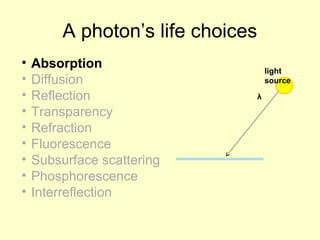
A photon’s life choices
• Absorption
• Diffusion
• Reflection
• Transparency
• Refraction
• Fluorescence
• Subsurface scattering
• Phosphorescence
• Interreflection
λ
light
source
?
A photon’s life choices
• Absorption
• Diffusion
• Reflection
• Transparency
• Refraction
• Fluorescence
• Subsurface scattering
• Phosphorescence
• Interreflection
λ
light
source
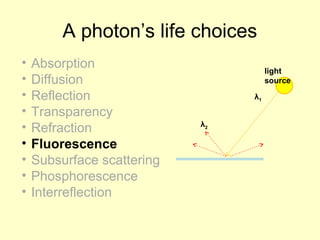
A photon’s life choices
• Absorption
• Diffusion
• Reflection
• Transparency
• Refraction
• Fluorescence
• Subsurface scattering
• Phosphorescence
• Interreflection
λ1
light
source
λ2
A photon’s life choices
• Absorption
• Diffusion
• Reflection
• Transparency
• Refraction
• Fluorescence
• Subsurface scattering
• Phosphorescence
• Interreflection
λ
light
source
A photon’s life choices
• Absorption
• Diffusion
• Reflection
• Transparency
• Refraction
• Fluorescence
• Subsurface scattering
• Phosphorescence
• Interreflection
t=1
light
source
t=n
Definitions and terms
Light: electromagnetic field vibration
spreading in quanta
(photons)
Photon: the smallest amount of light
carrying energy
Energy of photons (A. Einstein)
E = c
λ
hν h=
h = Planck’s constant (6.6 · 10-34
Js)
c = speed of light (3 · 108
ms-1
)
λ = wavelength
ν = frequency
Einstein’s Equivalency Principle
One particle of a chemical substance can absorb only
one photon from a light beam: ∆E = hν
For one mole: ∆E = Nhν
N = Avogadro’s number (6.02 · 1023
)
Chemical bond energies:
from 100 – 1000 kJ/mol
Light energies:
604 kJ/mol-1 302 151
200 nm 400 nm 800 nm
ULTRAVIOLET VISIBLE INFRARED
So UV – and VIS region is expected to induce chemical
reactions.
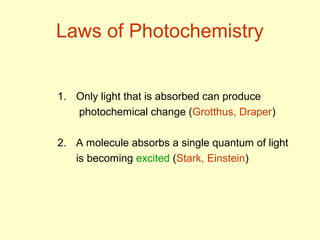
Laws of Photochemistry
1. Only light that is absorbed can produce
photochemical change (Grotthus, Draper)
2. A molecule absorbs a single quantum of light
is becoming excited (Stark, Einstein)
Mechanisms of Light Absorption
Excitation:
X2
hν *X2
A bonding electron is lifted to a higher energy level
(higher orbital)
INTERACTION OF LIGHT AND MATERIALS:
a) X2* → X2 + M* (excess energy transferred to
the surrounding)
b) X2* → X2 + hν (fluorescence or phosphorescence)
c) X2* + Y → chemical reaction (excess energy
supplies the activation energy of the
reaction)
hνX2 X + X (photodissociation)
2.
2.
(energy of the photon supplies the „dissociation heat”)
Types of photochemical reactions:
a) Photodissociation
b) Photosynthesis: when a larger molecule is
formed from simple ones
c) Photosensitized reactions: when an excited
molecule supplies activation energy for the reactants
Photodissociation
Photolysis of hydrogen bromide
HBr
νh
H + Br (photochemical reaction)
H + HBr H2 + Br
Br + Br Br2
(dark reactions)
Overall:
2HBr
hν H2
+
Br2
Note:
1 photon absorbed, 2 molecules of HBr dissociated:
QUANTUM YIELD =
2
1
= 2
number of molecules undergoing the process
number of quanta absorbedΦ=
Ozone formation in the atmosphere
(at about 25 km altitude)
O2 O + O (λ<240 nm)
νh
2O2 + 2O (+M) 2O3 (+M*)
Notes: M absorbs energy released in the reaction
QUANTUM YIELD =
2
1 = 2
Ozone formed in the reaction above absorbs UV
light as well:
O3 O2 + O (λ<340 nm)
νh
O + O3 2O2
Notes:
1.Ozone shield protects the Earth surface from
high energy UV radiation (of the Sun)
2.Air pollution (freons: fully halogenated hydrocarbons;
nitrogen oxides emitted by aeroplanes etc.) may
accelerate the decomposition of ozone  ozone hole
Photosynthesis
The photosynthesis of hydrogen chloride
Overall reaction:
Cl2 + H2 2HCl [no reaction in darkness]
Mechanism:
hν
Cl2 < 500 nm
2Cl Photochem. initiation
Cl + H2 HCl + H Dark reactions
H + Cl2 HCl + Cl
Chain reaction
H + H + M H2 + M*
Cl2 + M*Cl + Cl + M
Recombination
reactions (chain
is terminated)
Note:
Quantum yield is about 106
(explosion)
Photosensitized reactions
Photosynthesis in plants
Overall reaction:
6CO2 + 6H2O C6H12O6+6O2
carbohydrate
hν; chlorophyll
several steps
Notes:
1. Chlorophyll acts as a catalyst absorbing and
transferring the photon energy for reduction of
carbon dioxide to carbohydrate
2. This reaction maintains the life on the Earth:
sunlight carbohydrateCO2; H2O
Fossile energy
(coal, oil, natural gas)
Food
Photography
a) Photographic film: colloidal suspension of finely
powdered silver halogenide in gelatine
b) When exposed to light AgBr granuli become
activated according to the intensity of light:
AgBr AgBr*hν
Ago
AgBr*
developer
reduction
Unactivated granuli will be unaffected (but
photosensitive!)
d) Fixation: Unaffected (photosensitive) AgBr should
be removed:
AgBr + 2S2O3
2- [Ag(S2O3)2]3- + Br -
c) Development: Treating the exposed film with a
mild reducing agent the activated granuli will
accelerate the reduction to metallic silver (black)
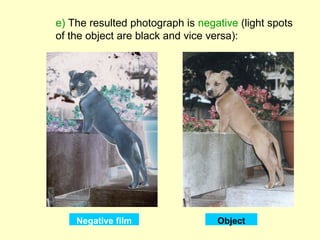
e) The resulted photograph is negative (light spots
of the object are black and vice versa):
ObjectNegative film
f) The negative film should be inversed placing it onto a new
non-exposed sheet, illuminating, and repeating the
development + fixation procedure
Misike
THANKS

Photochemistry s.y

  • 1.
  • 2.
  • 3.
    Photochemistry Chemical reactions accompaniedwith light. 1.Action of light → chemical change (light induced reactions) 2. Chemical reaction → light emission (chemiluminescence)
  • 4.
    4 The Electromagnetic Spectrum •Names of the regions are historical. • There is no abrupt or fundamental change in going from one region to the next. • Visible light represents only a very small fraction of the electromagnetic spectrum. 1020 1018 1016 1014 1012 108 γ-rays X-rays UV IR Micro- wave Frequency (Hz) Wavelength (m) 10-11 10-8 10-6 10-3 Visible 400 500 600 700 800 nm
  • 5.
    Photon a particleof light. Electromagnetic radiation ALL light. Visible AND invisible visible light , x-rays, gamma rays, radio waves, microwaves, ultraviolet rays, infrared.
  • 6.
    Photon a particleof light Laser
  • 7.
  • 8.
    A prism bendslight. Different Colors are bent by different amounts. White Light
  • 9.
    - Chemiluminescence: P4 (g)+ O2 (g)+H2O (g) → → → P4 O10 + hν green - Bioluminescence: - mushrooms - insects - fishes Luminescence:
  • 10.
    A photon’s lifechoices • Absorption • Diffusion • Reflection • Transparency • Refraction • Fluorescence • Subsurface scattering • Phosphorescence • Interreflection λ light source ?
  • 11.
    A photon’s lifechoices • Absorption • Diffusion • Reflection • Transparency • Refraction • Fluorescence • Subsurface scattering • Phosphorescence • Interreflection λ light source
  • 12.
    A photon’s lifechoices • Absorption • Diffusion • Reflection • Transparency • Refraction • Fluorescence • Subsurface scattering • Phosphorescence • Interreflection λ1 light source λ2
  • 13.
    A photon’s lifechoices • Absorption • Diffusion • Reflection • Transparency • Refraction • Fluorescence • Subsurface scattering • Phosphorescence • Interreflection λ light source
  • 14.
    A photon’s lifechoices • Absorption • Diffusion • Reflection • Transparency • Refraction • Fluorescence • Subsurface scattering • Phosphorescence • Interreflection t=1 light source t=n
  • 15.
    Definitions and terms Light:electromagnetic field vibration spreading in quanta (photons) Photon: the smallest amount of light carrying energy
  • 16.
    Energy of photons(A. Einstein) E = c λ hν h= h = Planck’s constant (6.6 · 10-34 Js) c = speed of light (3 · 108 ms-1 ) λ = wavelength ν = frequency
  • 17.
    Einstein’s Equivalency Principle Oneparticle of a chemical substance can absorb only one photon from a light beam: ∆E = hν For one mole: ∆E = Nhν N = Avogadro’s number (6.02 · 1023 )
  • 18.
    Chemical bond energies: from100 – 1000 kJ/mol Light energies: 604 kJ/mol-1 302 151 200 nm 400 nm 800 nm ULTRAVIOLET VISIBLE INFRARED So UV – and VIS region is expected to induce chemical reactions.
  • 19.
    Laws of Photochemistry 1.Only light that is absorbed can produce photochemical change (Grotthus, Draper) 2. A molecule absorbs a single quantum of light is becoming excited (Stark, Einstein)
  • 20.
    Mechanisms of LightAbsorption Excitation: X2 hν *X2 A bonding electron is lifted to a higher energy level (higher orbital)
  • 21.
    INTERACTION OF LIGHTAND MATERIALS: a) X2* → X2 + M* (excess energy transferred to the surrounding) b) X2* → X2 + hν (fluorescence or phosphorescence) c) X2* + Y → chemical reaction (excess energy supplies the activation energy of the reaction)
  • 22.
    hνX2 X +X (photodissociation) 2. 2. (energy of the photon supplies the „dissociation heat”) Types of photochemical reactions: a) Photodissociation b) Photosynthesis: when a larger molecule is formed from simple ones c) Photosensitized reactions: when an excited molecule supplies activation energy for the reactants
  • 23.
    Photodissociation Photolysis of hydrogenbromide HBr νh H + Br (photochemical reaction) H + HBr H2 + Br Br + Br Br2 (dark reactions) Overall: 2HBr hν H2 + Br2
  • 24.
    Note: 1 photon absorbed,2 molecules of HBr dissociated: QUANTUM YIELD = 2 1 = 2 number of molecules undergoing the process number of quanta absorbedΦ=
  • 25.
    Ozone formation inthe atmosphere (at about 25 km altitude) O2 O + O (λ<240 nm) νh 2O2 + 2O (+M) 2O3 (+M*) Notes: M absorbs energy released in the reaction QUANTUM YIELD = 2 1 = 2
  • 26.
    Ozone formed inthe reaction above absorbs UV light as well: O3 O2 + O (λ<340 nm) νh O + O3 2O2 Notes: 1.Ozone shield protects the Earth surface from high energy UV radiation (of the Sun) 2.Air pollution (freons: fully halogenated hydrocarbons; nitrogen oxides emitted by aeroplanes etc.) may accelerate the decomposition of ozone  ozone hole
  • 27.
    Photosynthesis The photosynthesis ofhydrogen chloride Overall reaction: Cl2 + H2 2HCl [no reaction in darkness]
  • 28.
    Mechanism: hν Cl2 < 500nm 2Cl Photochem. initiation Cl + H2 HCl + H Dark reactions H + Cl2 HCl + Cl Chain reaction H + H + M H2 + M* Cl2 + M*Cl + Cl + M Recombination reactions (chain is terminated) Note: Quantum yield is about 106 (explosion)
  • 29.
    Photosensitized reactions Photosynthesis inplants Overall reaction: 6CO2 + 6H2O C6H12O6+6O2 carbohydrate hν; chlorophyll several steps
  • 30.
    Notes: 1. Chlorophyll actsas a catalyst absorbing and transferring the photon energy for reduction of carbon dioxide to carbohydrate 2. This reaction maintains the life on the Earth: sunlight carbohydrateCO2; H2O Fossile energy (coal, oil, natural gas) Food
  • 31.
    Photography a) Photographic film:colloidal suspension of finely powdered silver halogenide in gelatine b) When exposed to light AgBr granuli become activated according to the intensity of light: AgBr AgBr*hν
  • 32.
    Ago AgBr* developer reduction Unactivated granuli willbe unaffected (but photosensitive!) d) Fixation: Unaffected (photosensitive) AgBr should be removed: AgBr + 2S2O3 2- [Ag(S2O3)2]3- + Br - c) Development: Treating the exposed film with a mild reducing agent the activated granuli will accelerate the reduction to metallic silver (black)
  • 33.
    e) The resultedphotograph is negative (light spots of the object are black and vice versa): ObjectNegative film
  • 35.
    f) The negativefilm should be inversed placing it onto a new non-exposed sheet, illuminating, and repeating the development + fixation procedure Misike
  • 36.