UNIT 2
TOPIC
PHENOLS
PHENOLS
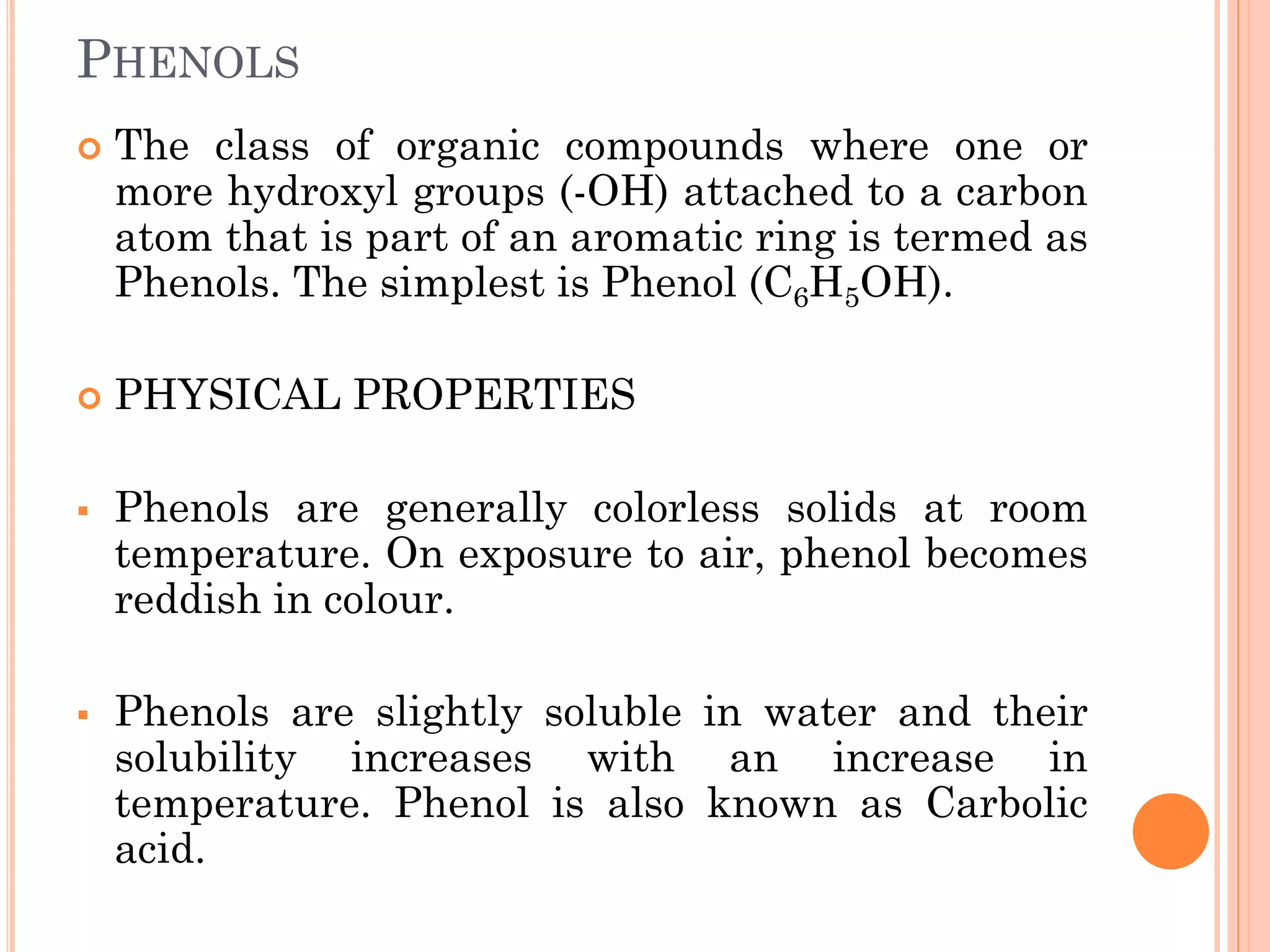
 The class of organic compounds where one or
more hydroxyl groups (-OH) attached to a carbon
atom that is part of an aromatic ring is termed as
Phenols. The simplest is Phenol (C6H5OH).
 PHYSICAL PROPERTIES
▪ Phenols are generally colorless solids at room
temperature. On exposure to air, phenol becomes
reddish in colour.
▪ Phenols are slightly soluble in water and their
solubility increases with an increase in
temperature. Phenol is also known as Carbolic
acid.
PREPARATION OF PHENOLS
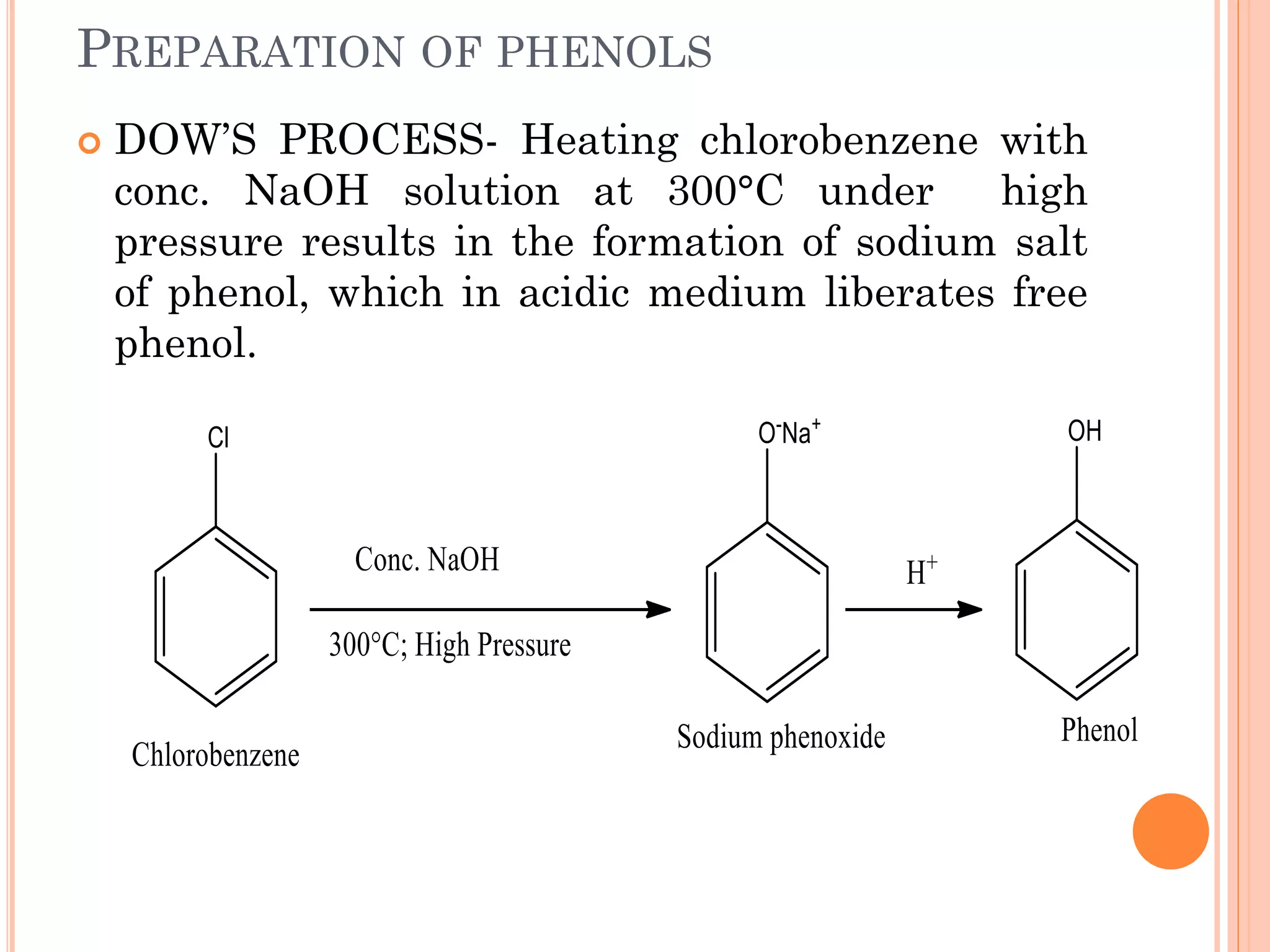
 DOW’S PROCESS- Heating chlorobenzene with
conc. NaOH solution at 300°C under high
pressure results in the formation of sodium salt
of phenol, which in acidic medium liberates free
phenol.
 FROM AROMATIC AMINES
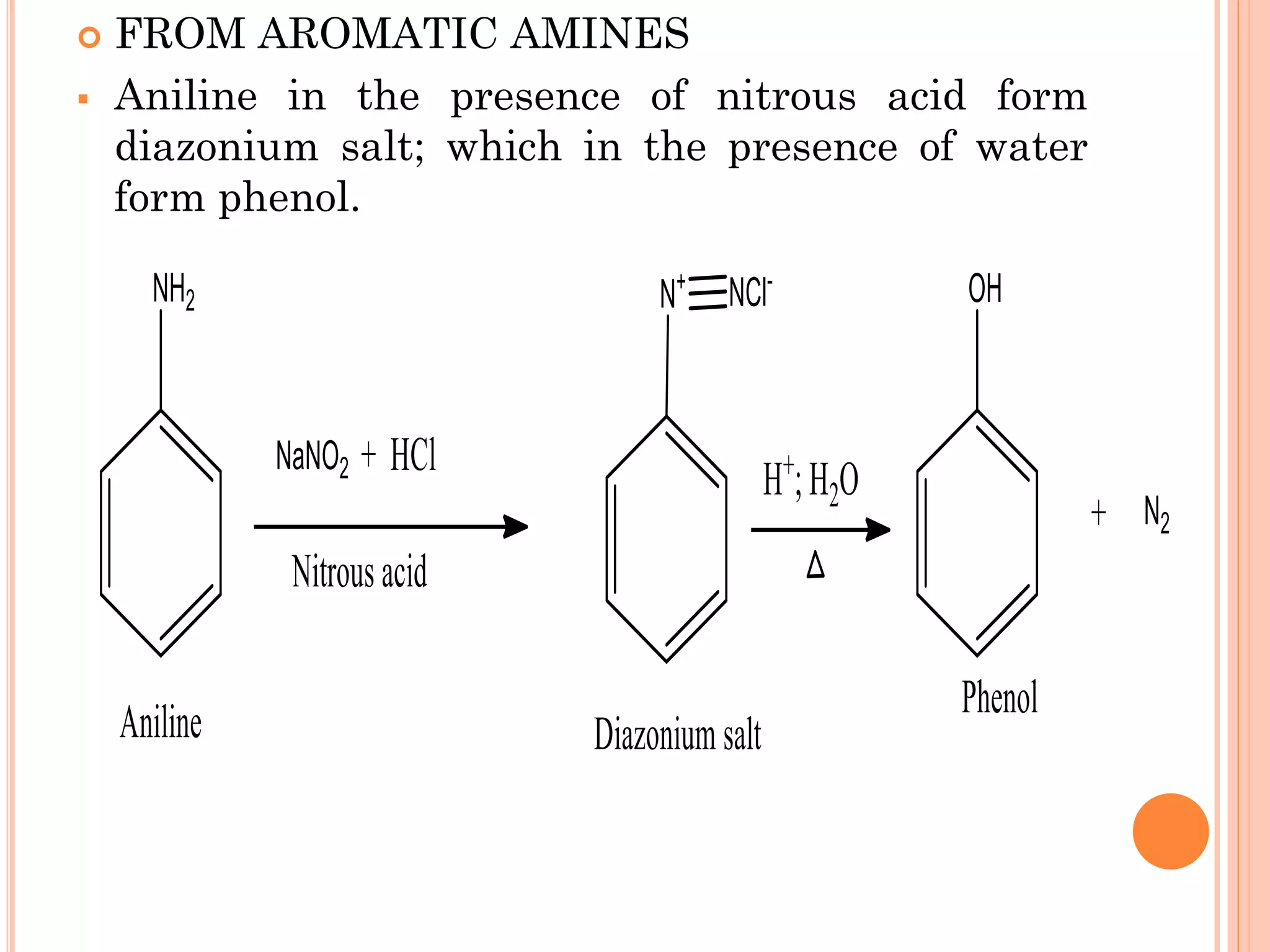
▪ Aniline in the presence of nitrous acid form
diazonium salt; which in the presence of water
form phenol.
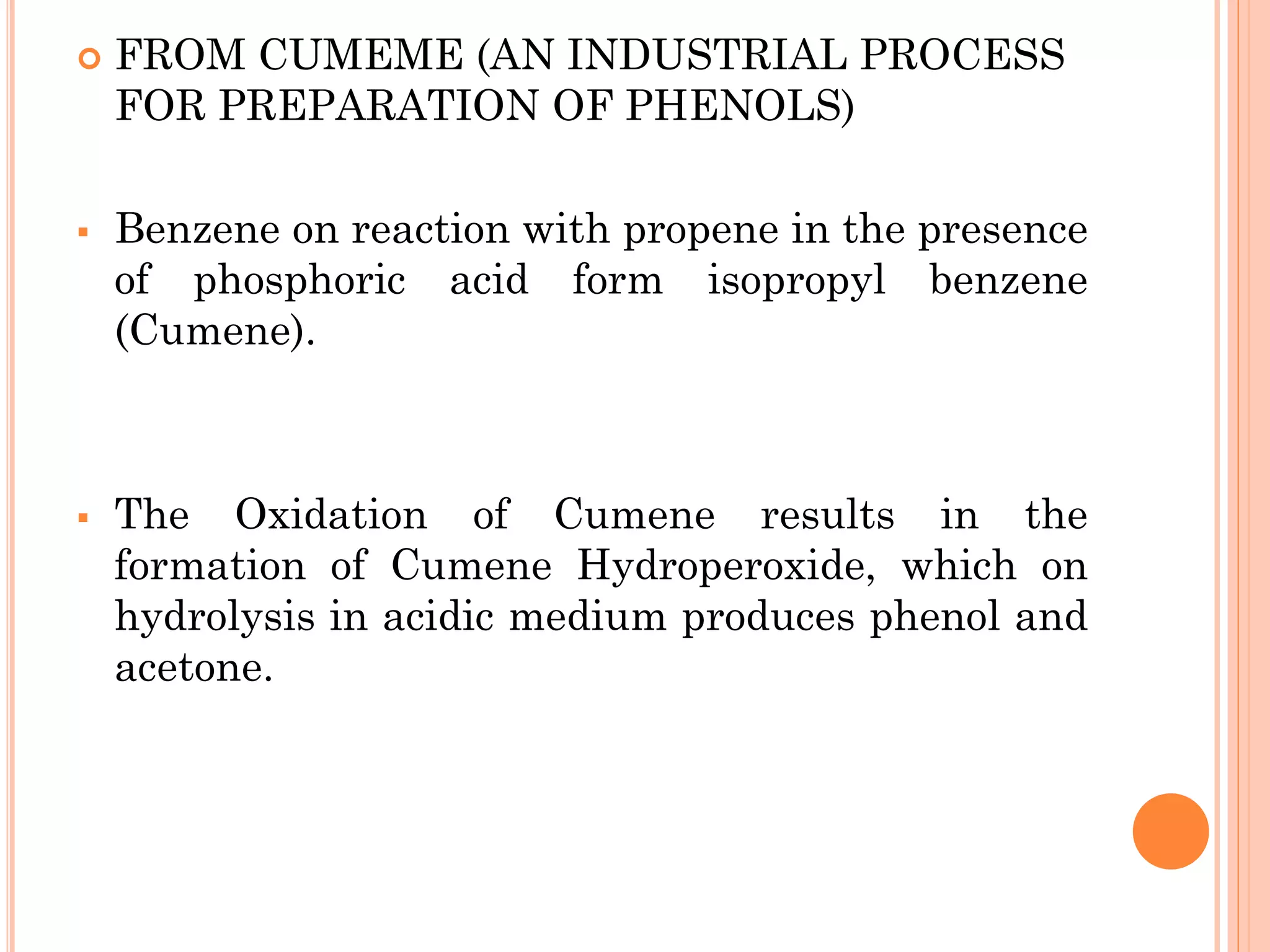
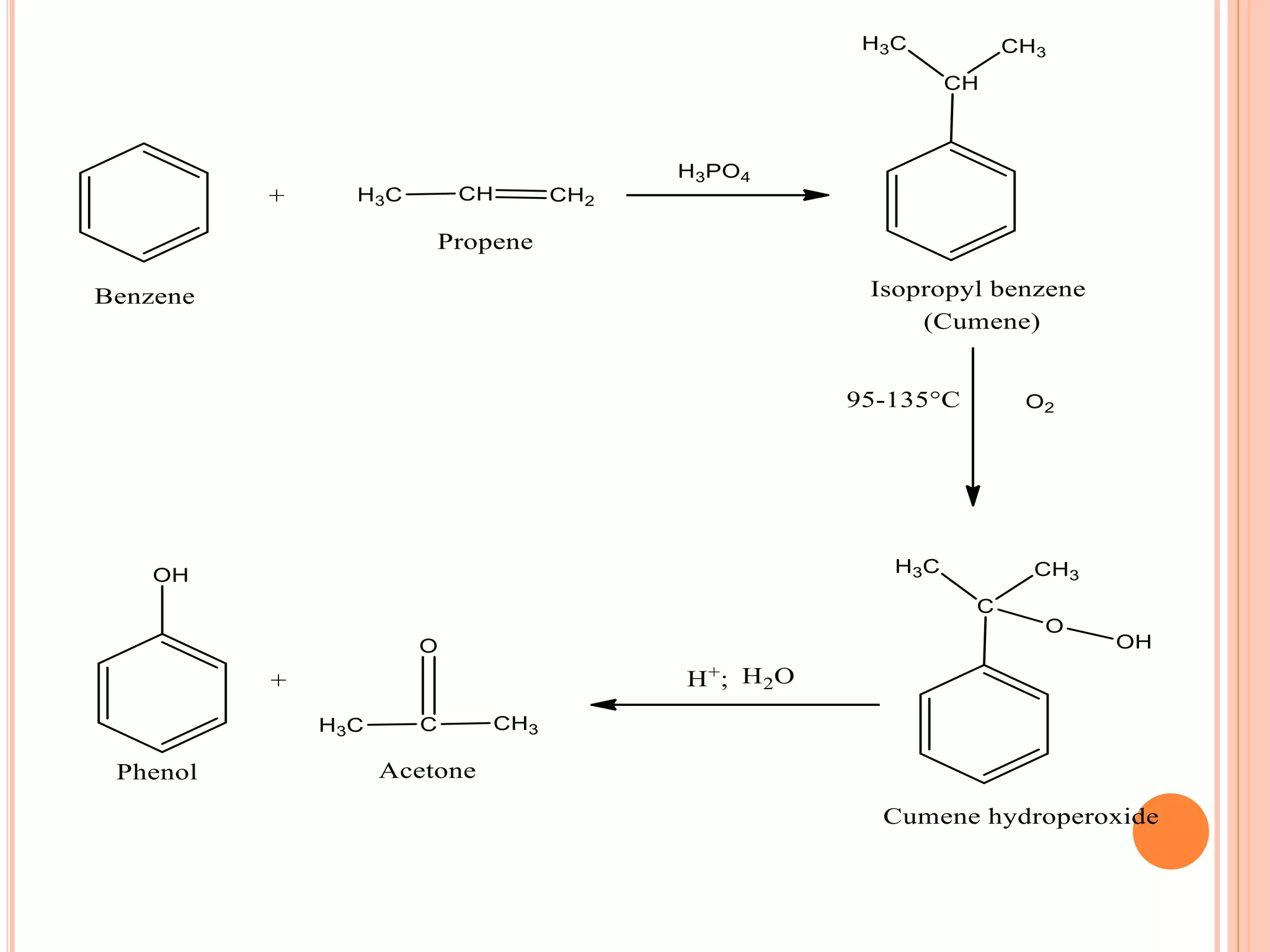
 FROM CUMEME (AN INDUSTRIAL PROCESS
FOR PREPARATION OF PHENOLS)
▪ Benzene on reaction with propene in the presence
of phosphoric acid form isopropyl benzene
(Cumene).
▪ The Oxidation of Cumene results in the
formation of Cumene Hydroperoxide, which on
hydrolysis in acidic medium produces phenol and
acetone.
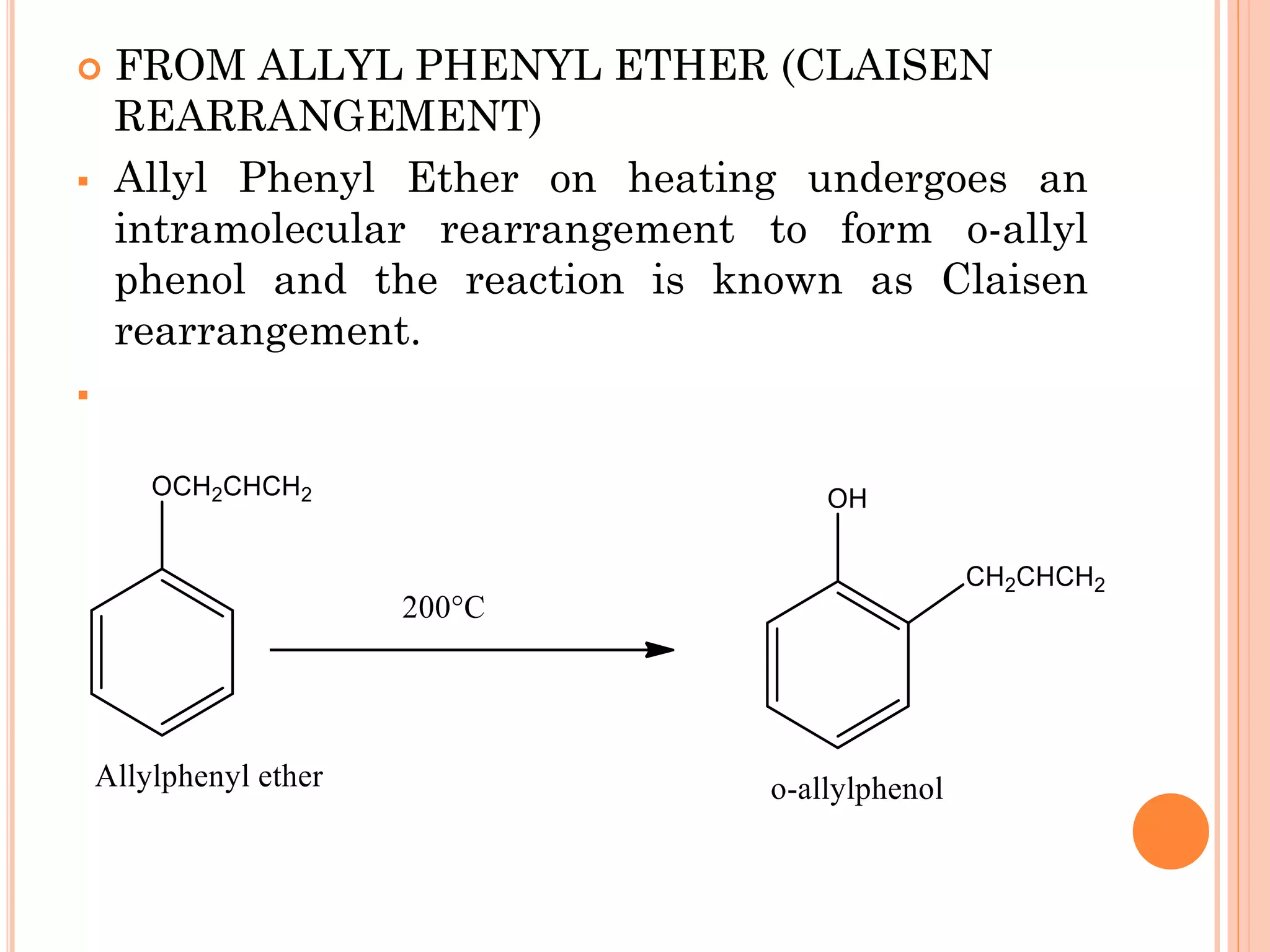
 FROM ALLYL PHENYL ETHER (CLAISEN
REARRANGEMENT)
▪ Allyl Phenyl Ether on heating undergoes an
intramolecular rearrangement to form o-allyl
phenol and the reaction is known as Claisen
rearrangement.
▪
CHEMICAL PROPERTIES
 REACTIONS OF –OH GROUP
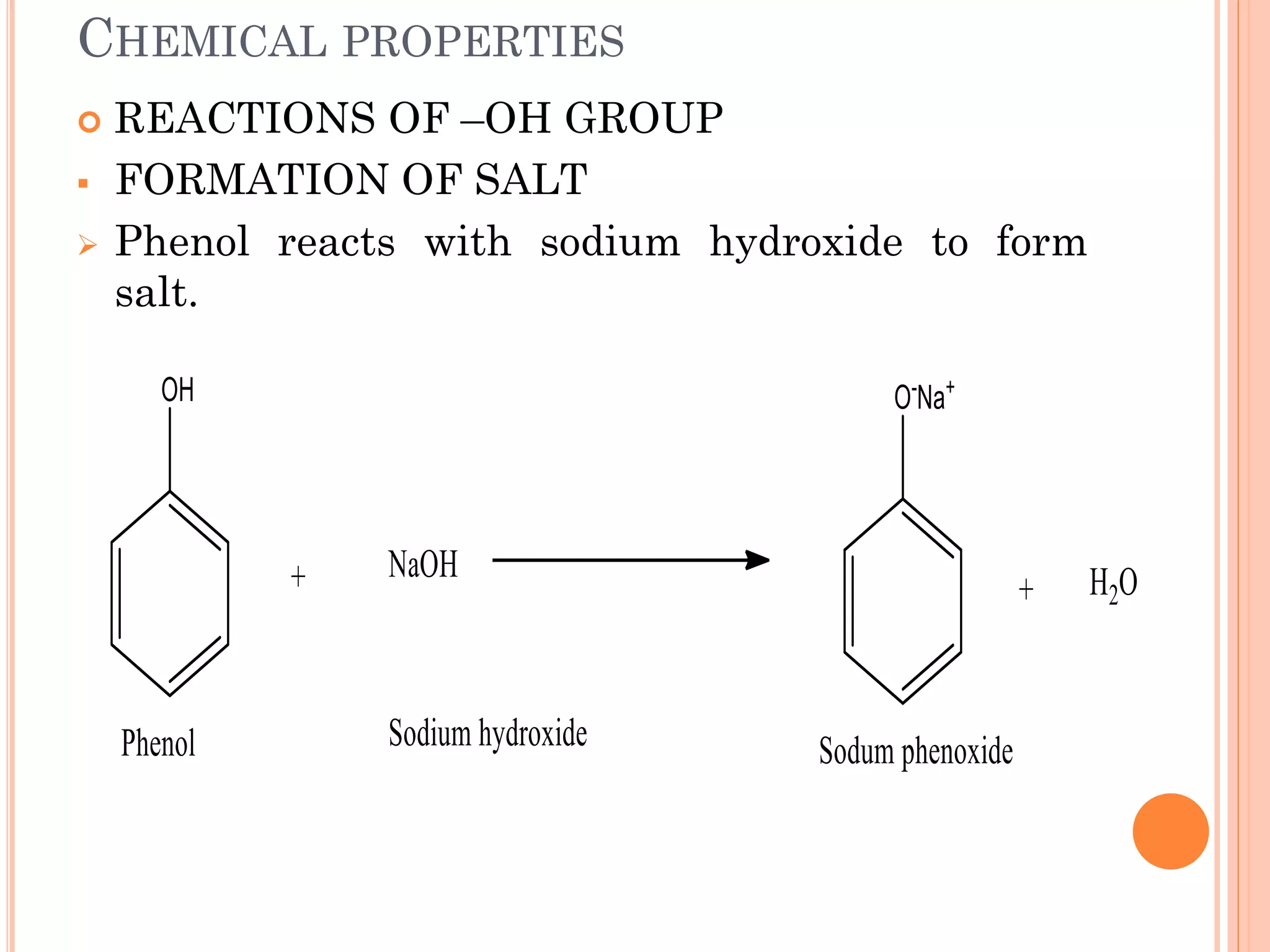
▪ FORMATION OF SALT
➢ Phenol reacts with sodium hydroxide to form
salt.
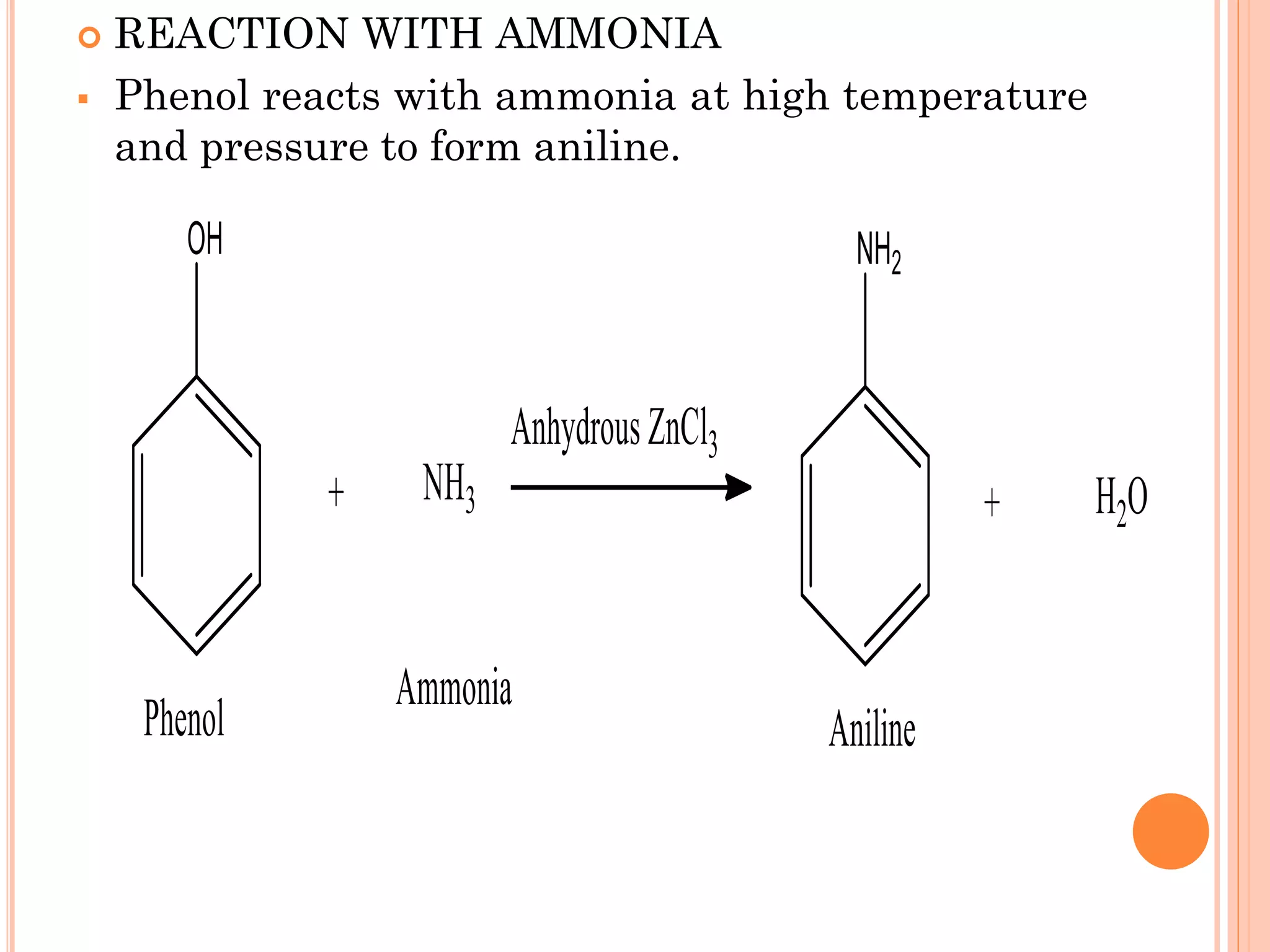
 REACTION WITH AMMONIA
▪ Phenol reacts with ammonia at high temperature
and pressure to form aniline.
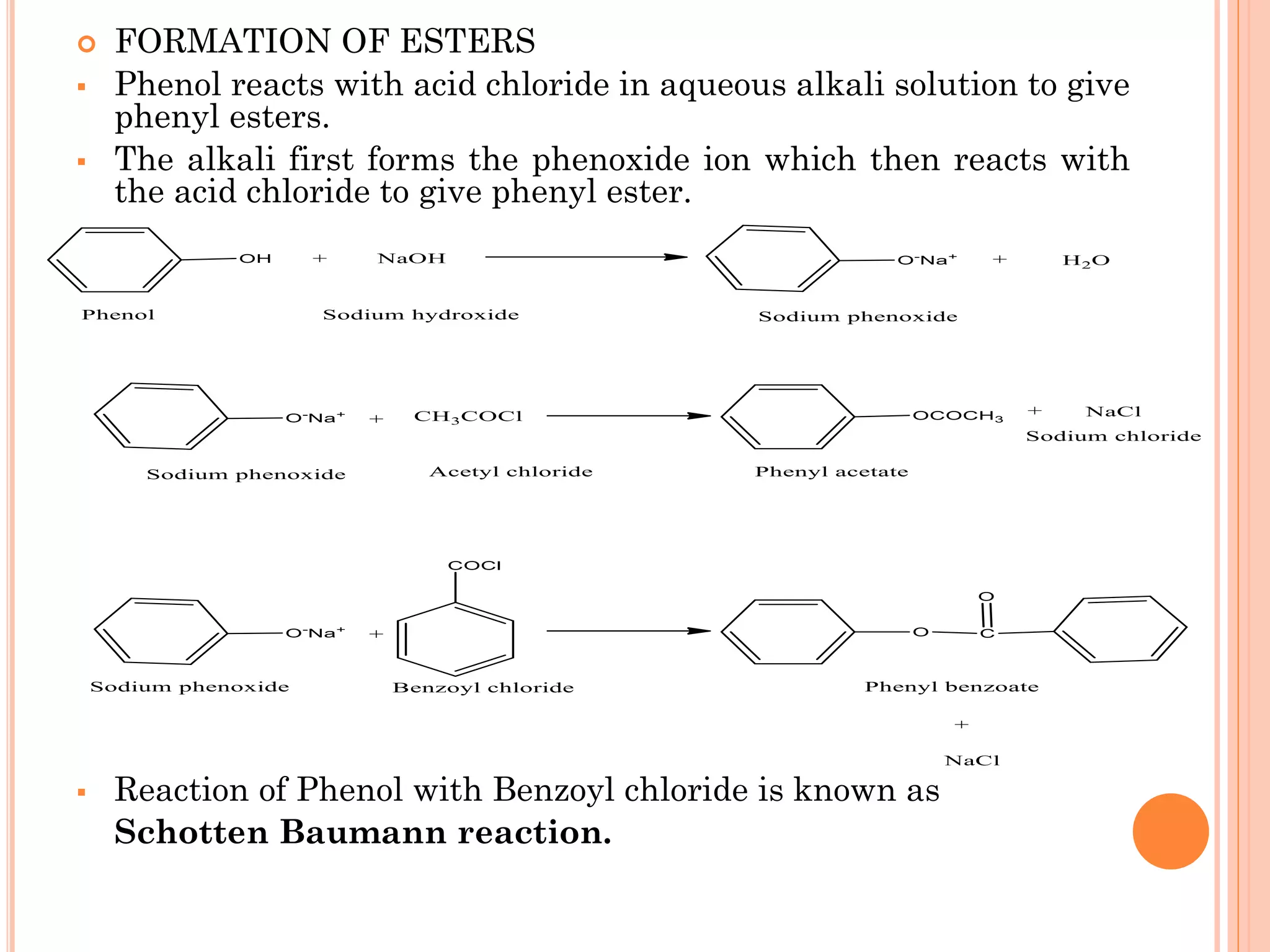
 FORMATION OF ESTERS
▪ Phenol reacts with acid chloride in aqueous alkali solution to give
phenyl esters.
▪ The alkali first forms the phenoxide ion which then reacts with
the acid chloride to give phenyl ester.
▪ Reaction of Phenol with Benzoyl chloride is known as
Schotten Baumann reaction.
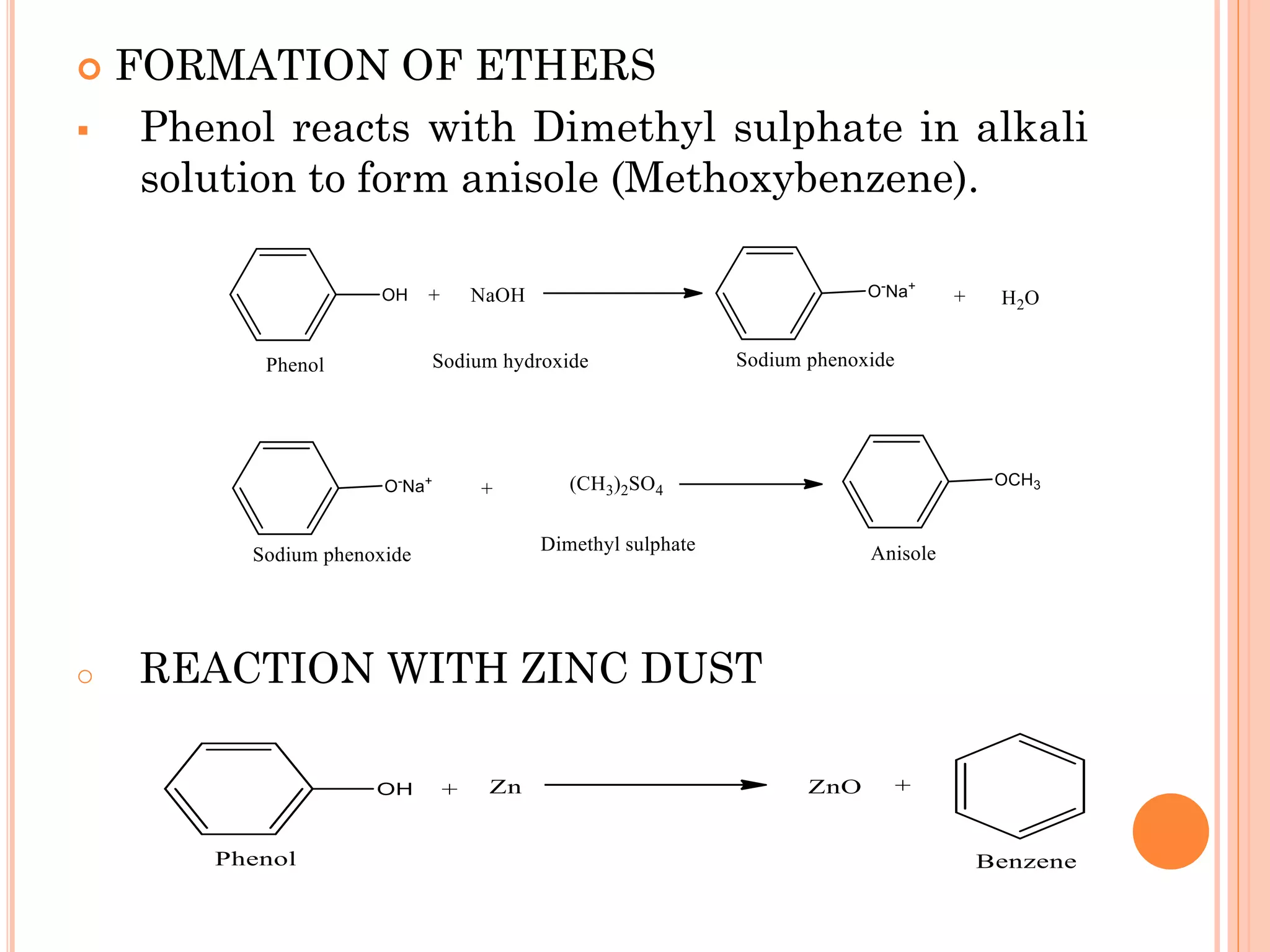
 FORMATION OF ETHERS
▪ Phenol reacts with Dimethyl sulphate in alkali
solution to form anisole (Methoxybenzene).
o REACTION WITH ZINC DUST
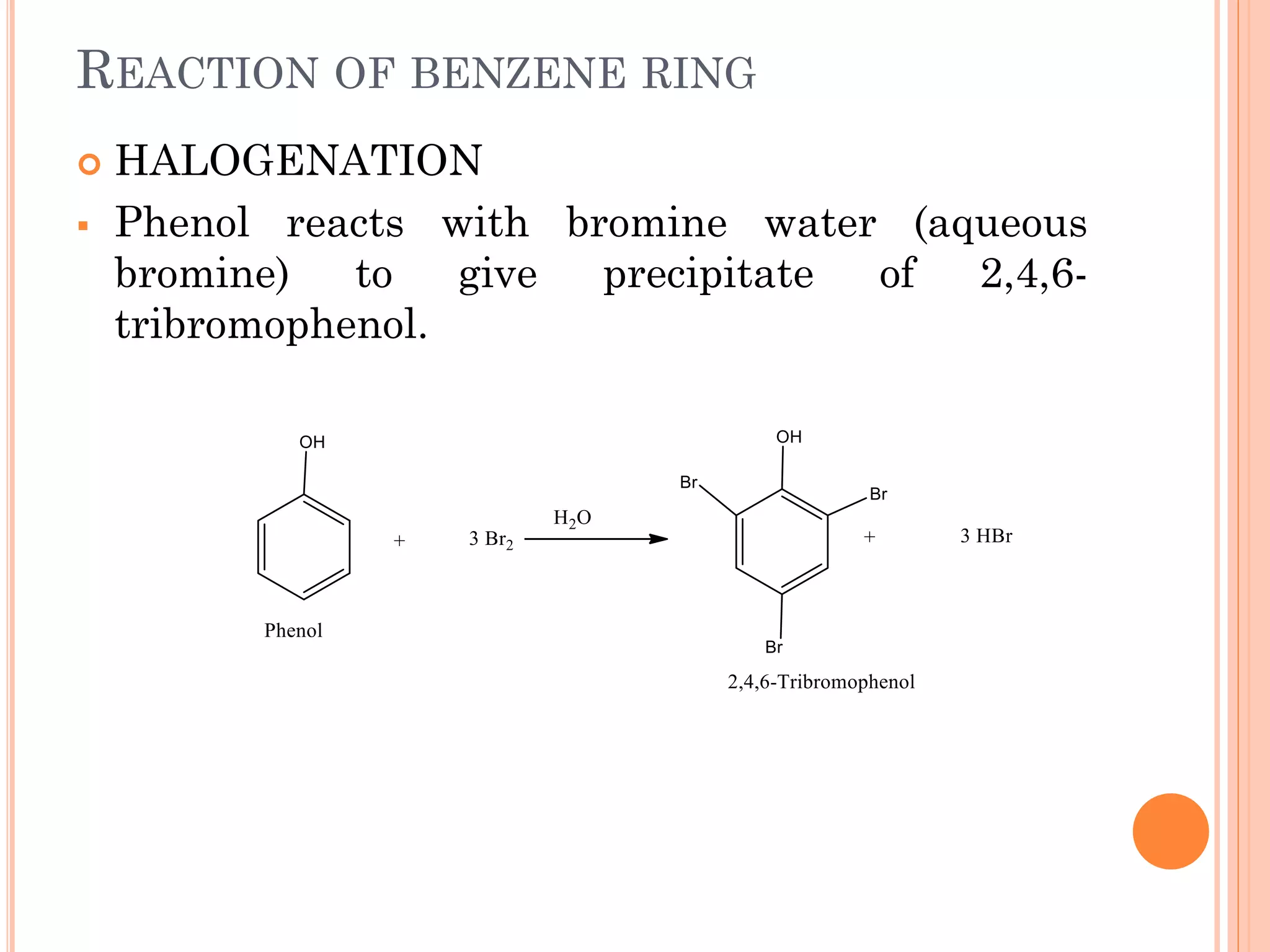
REACTION OF BENZENE RING
 HALOGENATION
▪ Phenol reacts with bromine water (aqueous
bromine) to give precipitate of 2,4,6-
tribromophenol.
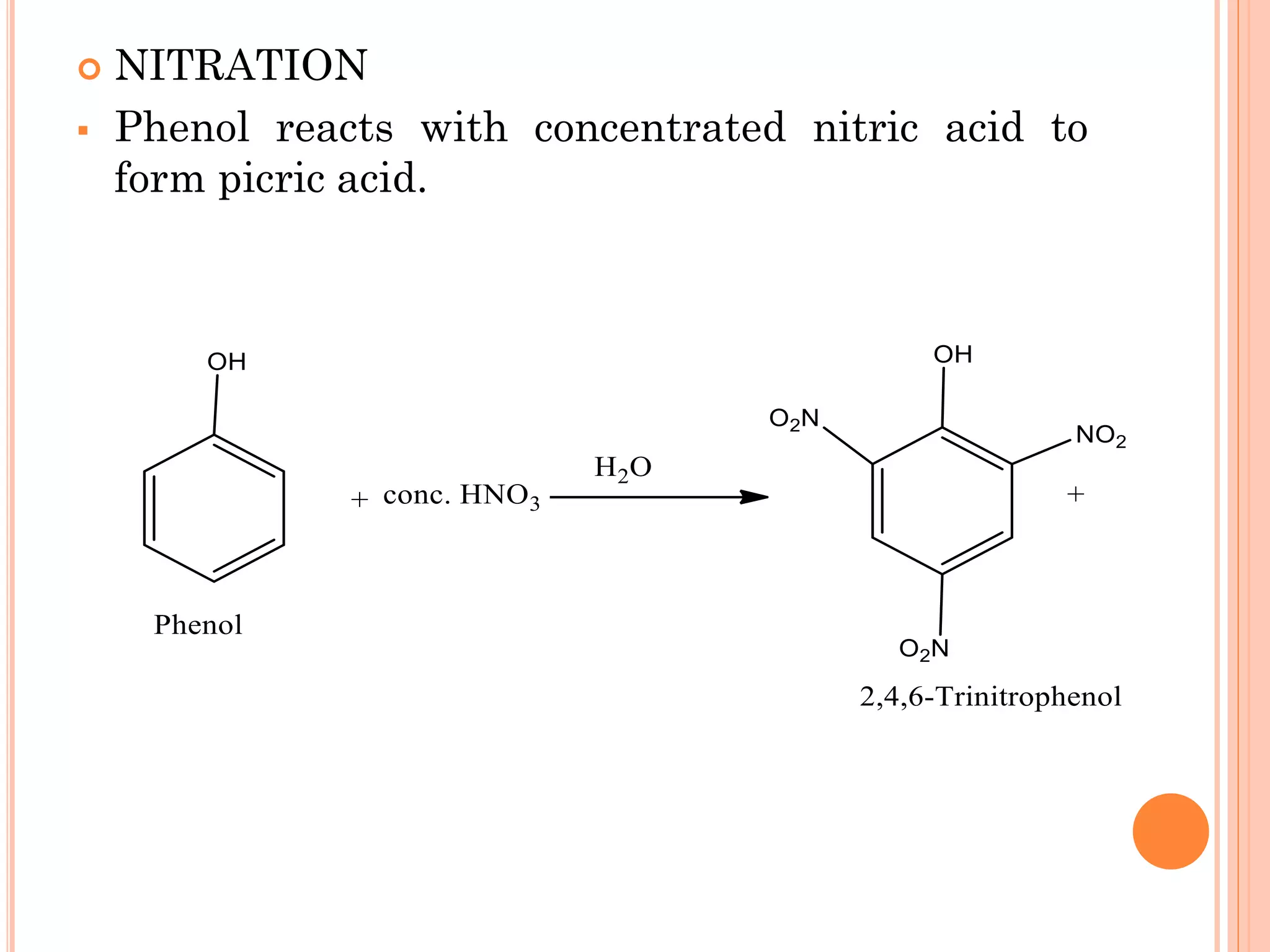
 NITRATION
▪ Phenol reacts with concentrated nitric acid to
form picric acid.
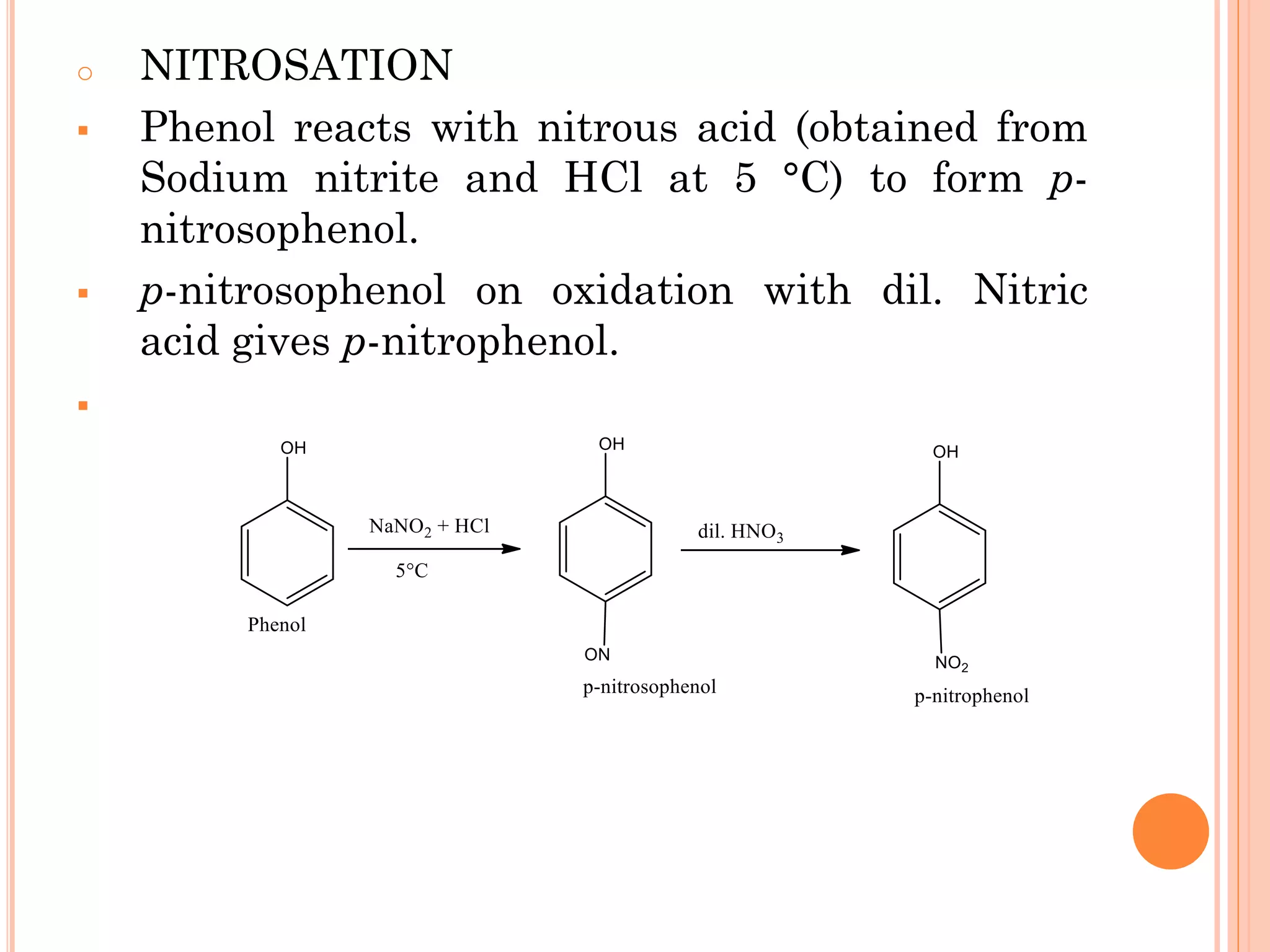
o NITROSATION
▪ Phenol reacts with nitrous acid (obtained from
Sodium nitrite and HCl at 5 °C) to form p-
nitrosophenol.
▪ p-nitrosophenol on oxidation with dil. Nitric
acid gives p-nitrophenol.
▪
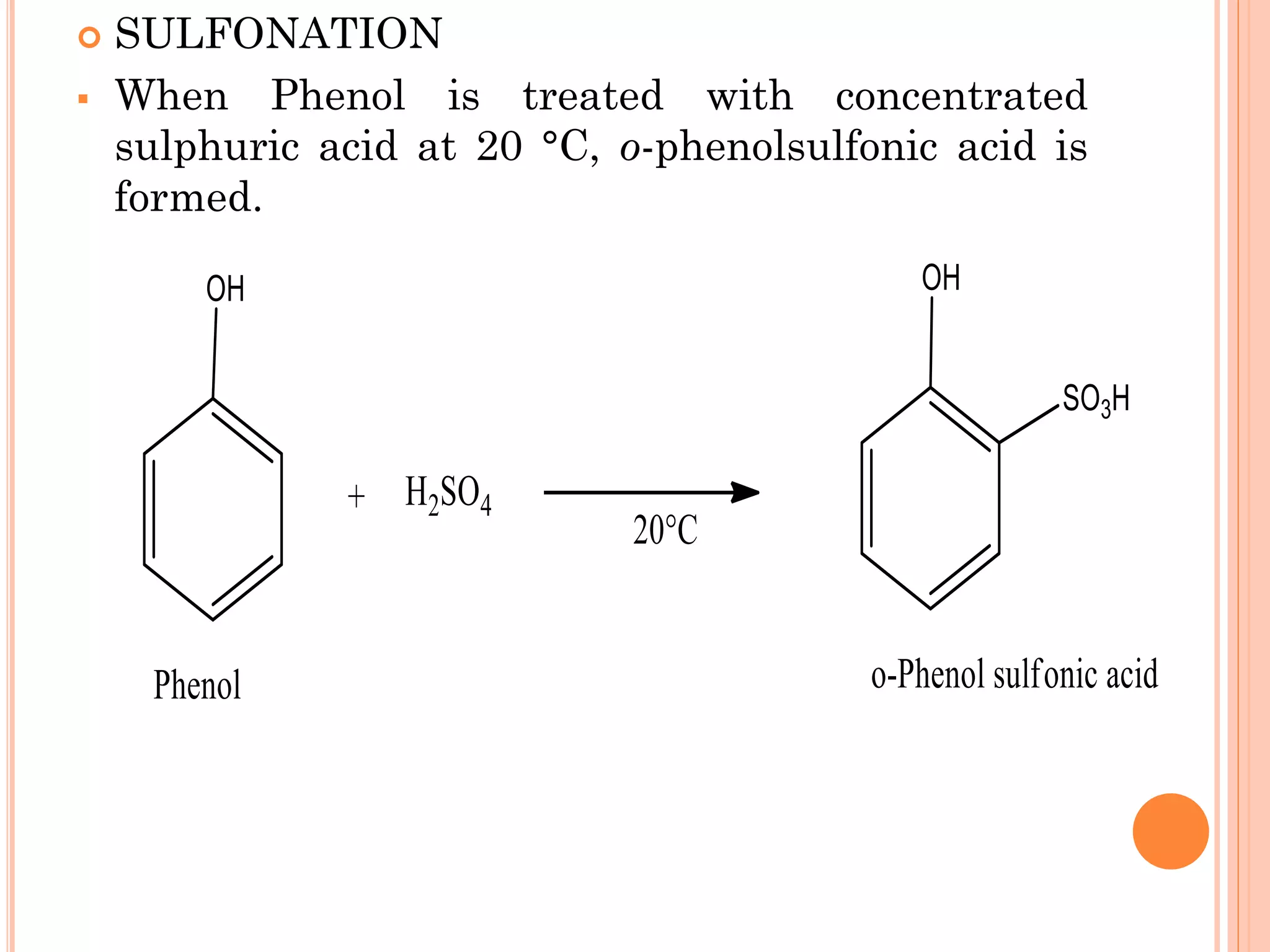
 SULFONATION
▪ When Phenol is treated with concentrated
sulphuric acid at 20 °C, o-phenolsulfonic acid is
formed.
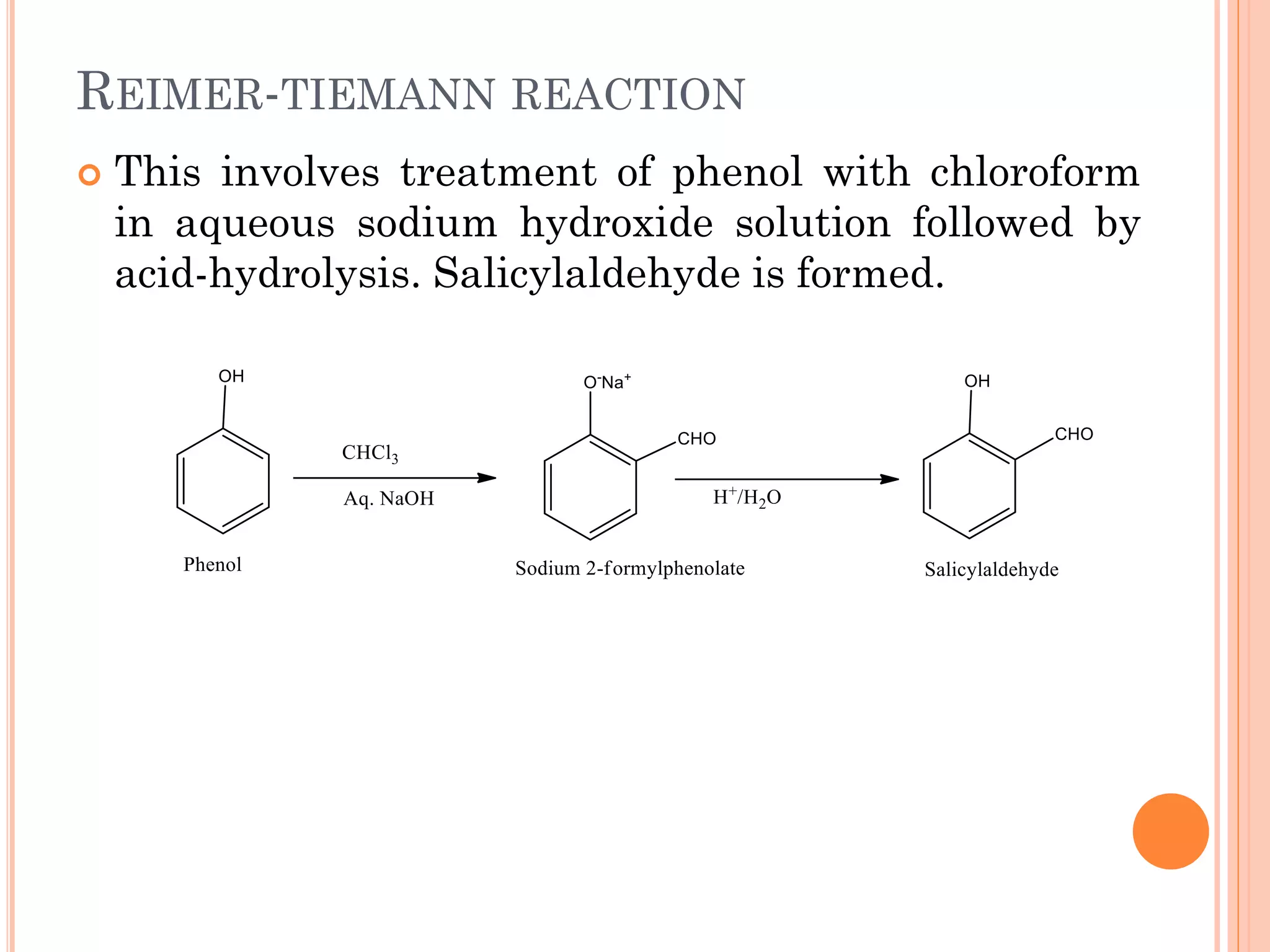
REIMER-TIEMANN REACTION
 This involves treatment of phenol with chloroform
in aqueous sodium hydroxide solution followed by
acid-hydrolysis. Salicylaldehyde is formed.
KOLBE REACTION
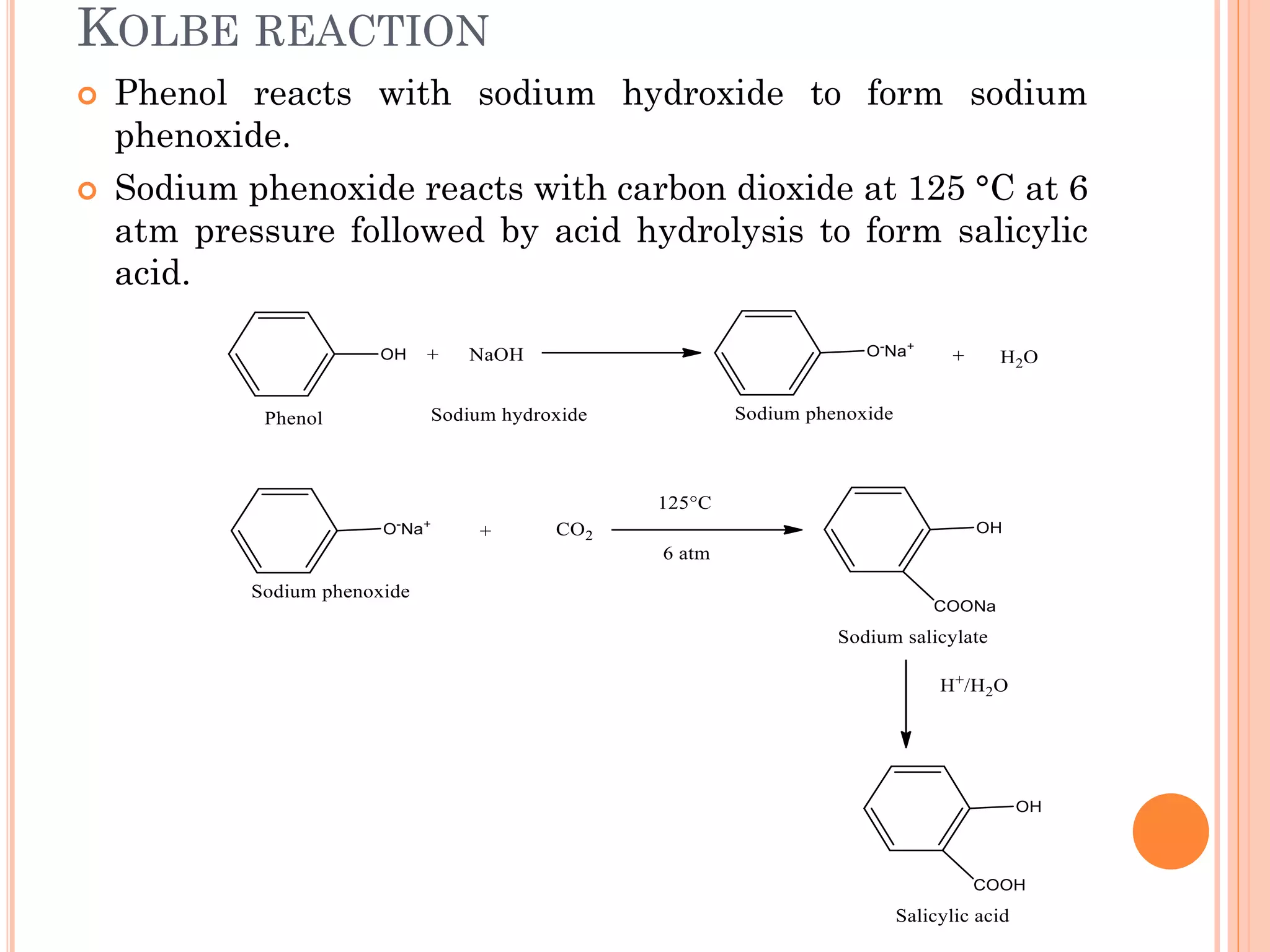
 Phenol reacts with sodium hydroxide to form sodium
phenoxide.
 Sodium phenoxide reacts with carbon dioxide at 125 °C at 6
atm pressure followed by acid hydrolysis to form salicylic
acid.
FRIES REARRANGEMENT
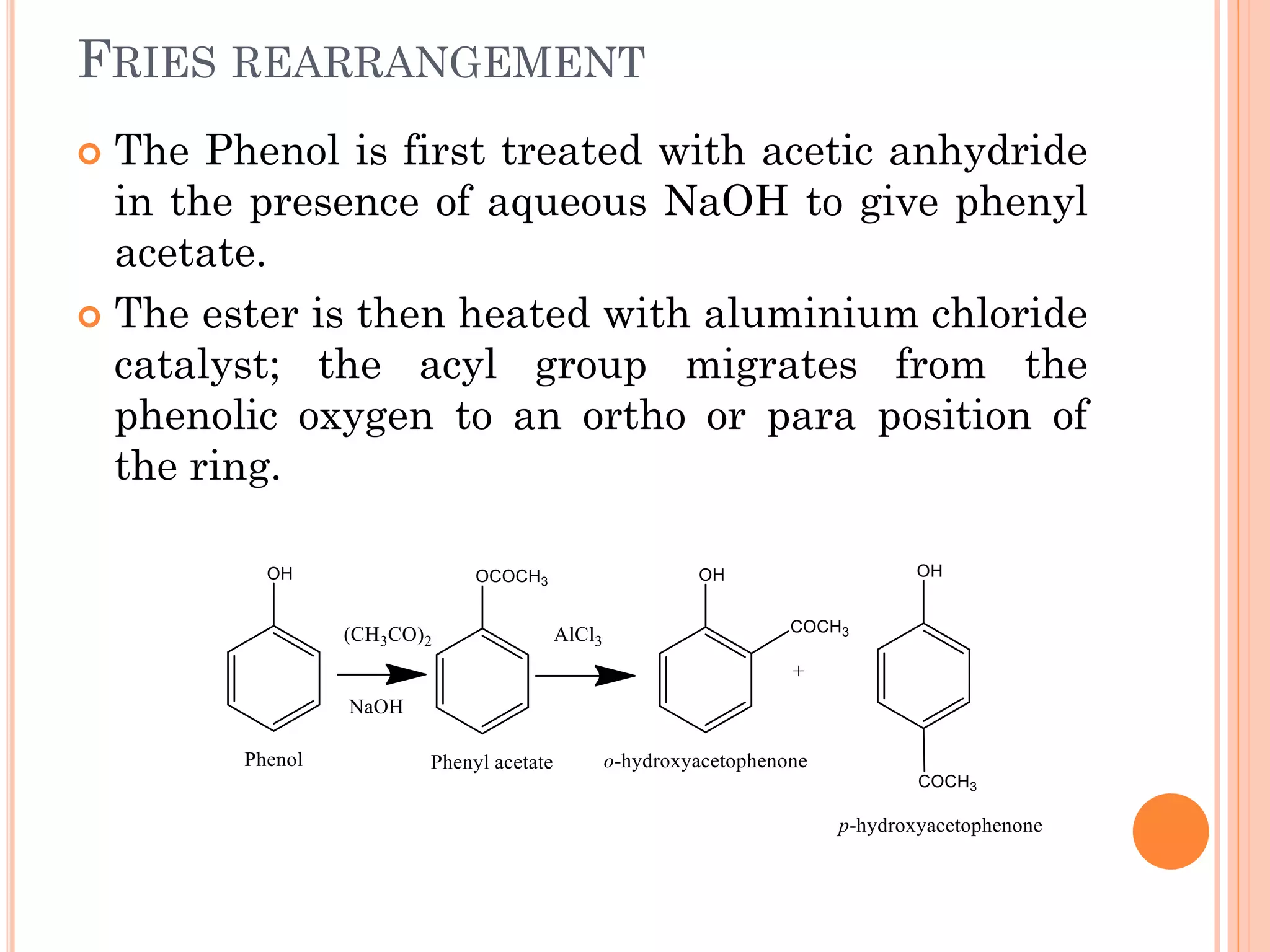
 The Phenol is first treated with acetic anhydride
in the presence of aqueous NaOH to give phenyl
acetate.
 The ester is then heated with aluminium chloride
catalyst; the acyl group migrates from the
phenolic oxygen to an ortho or para position of
the ring.
REACTION WITH FORMALDEHYDE
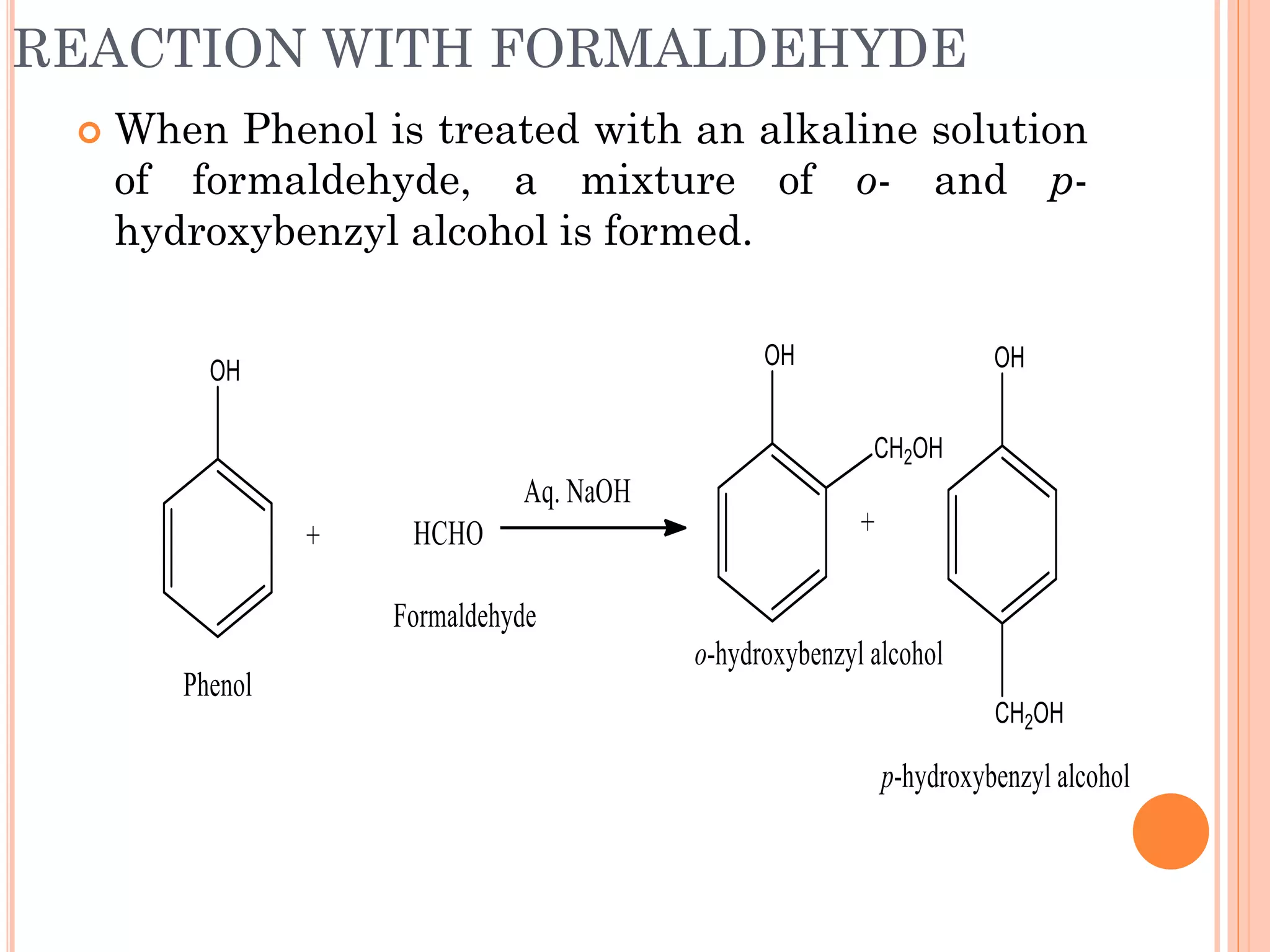
 When Phenol is treated with an alkaline solution
of formaldehyde, a mixture of o- and p-
hydroxybenzyl alcohol is formed.
OXIDATION
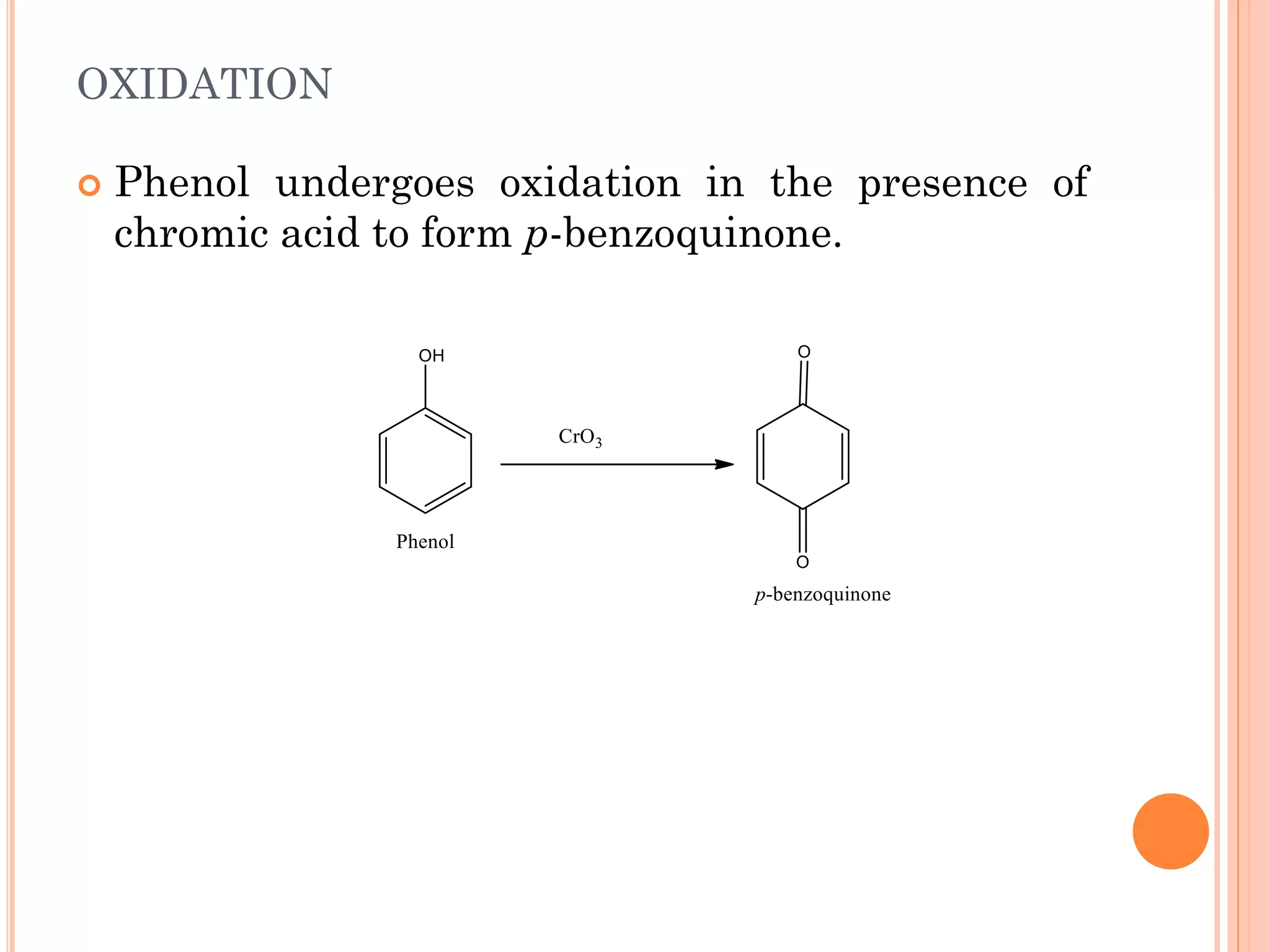
 Phenol undergoes oxidation in the presence of
chromic acid to form p-benzoquinone.
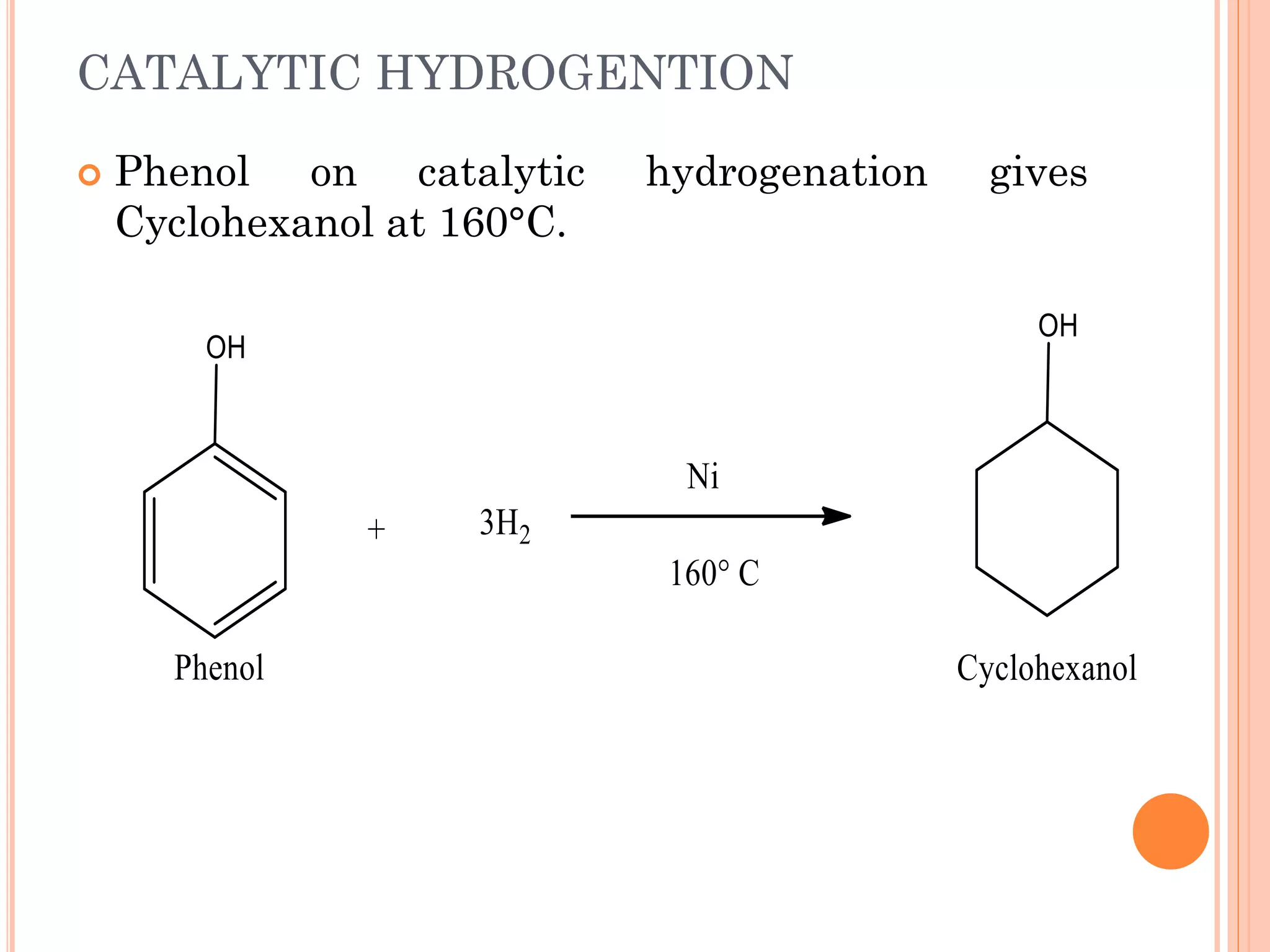
CATALYTIC HYDROGENTION
 Phenol on catalytic hydrogenation gives
Cyclohexanol at 160°C.
ACIDIC NATURE OF PHENOL: A GENERAL
DISCUSSION
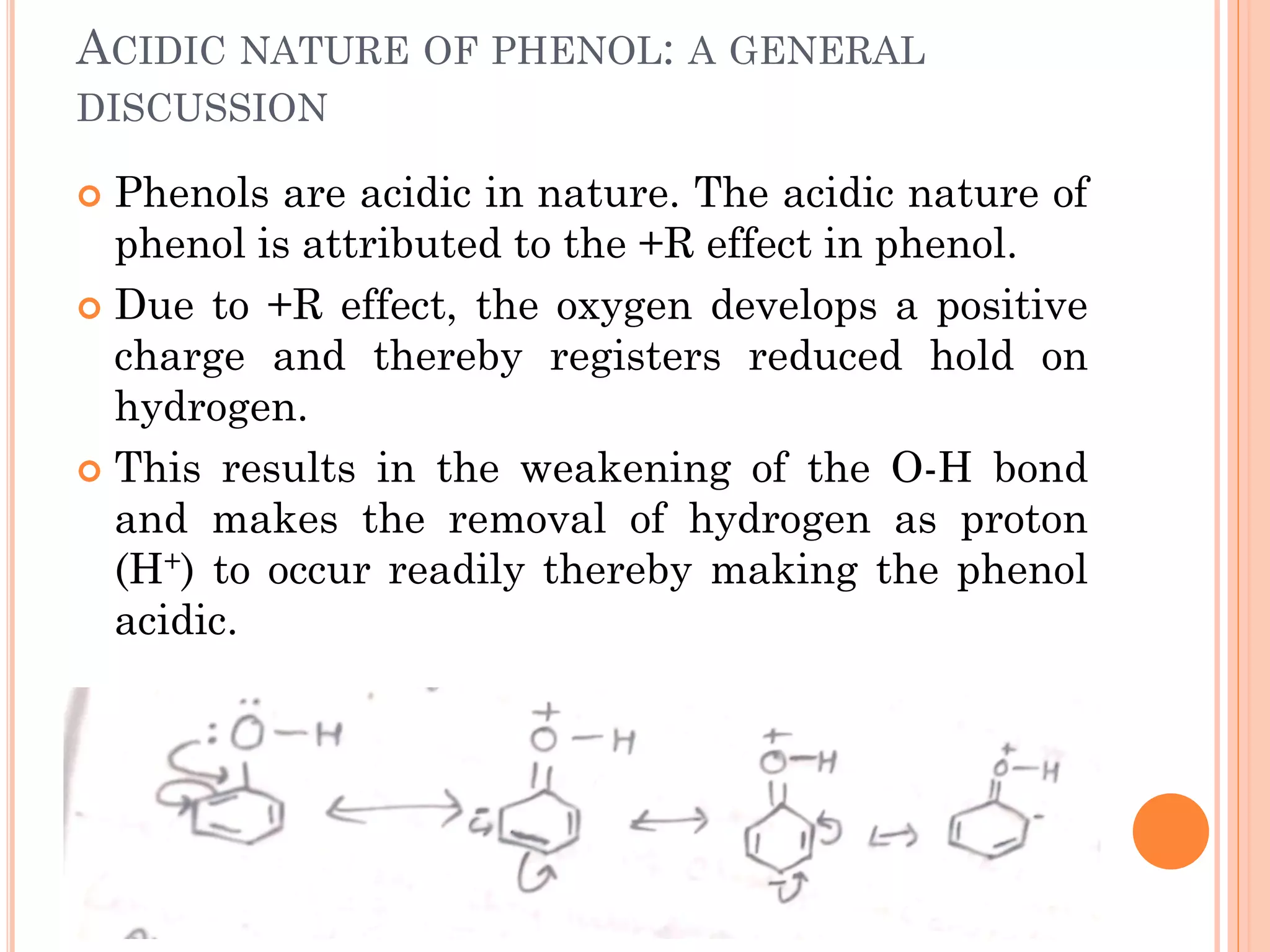
 Phenols are acidic in nature. The acidic nature of
phenol is attributed to the +R effect in phenol.
 Due to +R effect, the oxygen develops a positive
charge and thereby registers reduced hold on
hydrogen.
 This results in the weakening of the O-H bond
and makes the removal of hydrogen as proton
(H+) to occur readily thereby making the phenol
acidic.
 Phenols are much more acidic than alcohols but
less than carboxylic acids.
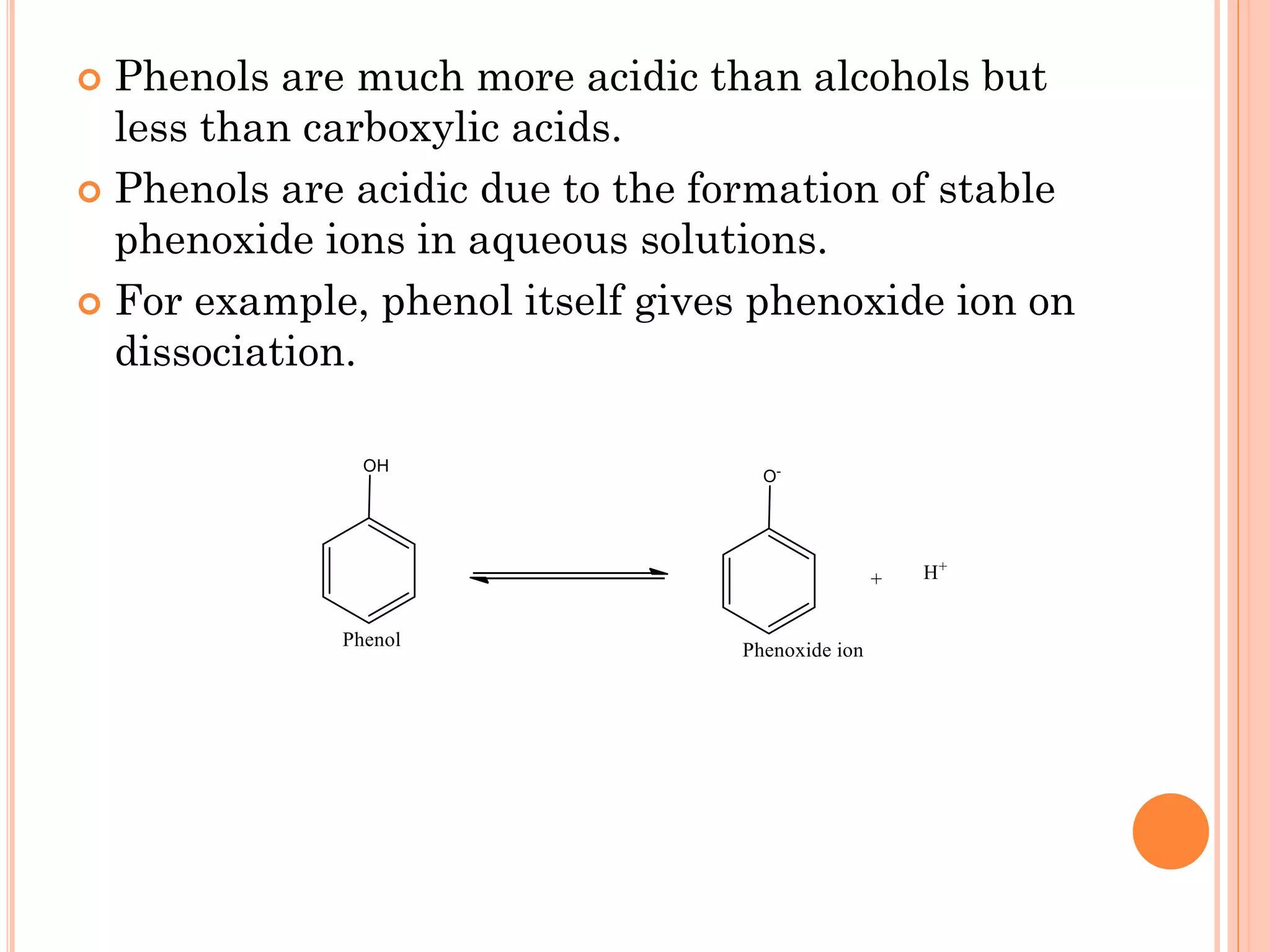
 Phenols are acidic due to the formation of stable
phenoxide ions in aqueous solutions.
 For example, phenol itself gives phenoxide ion on
dissociation.
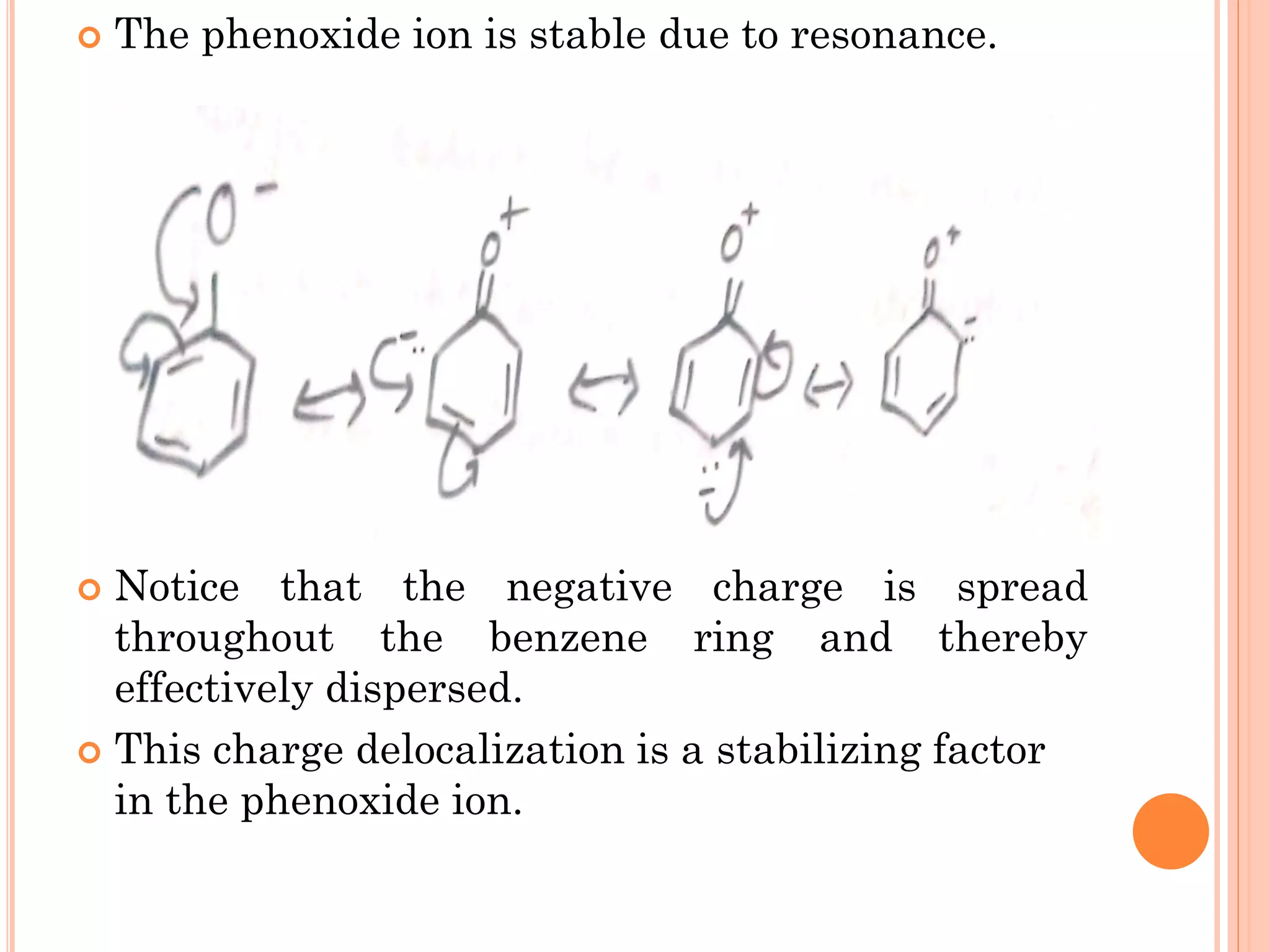
 The phenoxide ion is stable due to resonance.
 Notice that the negative charge is spread
throughout the benzene ring and thereby
effectively dispersed.
 This charge delocalization is a stabilizing factor
in the phenoxide ion.
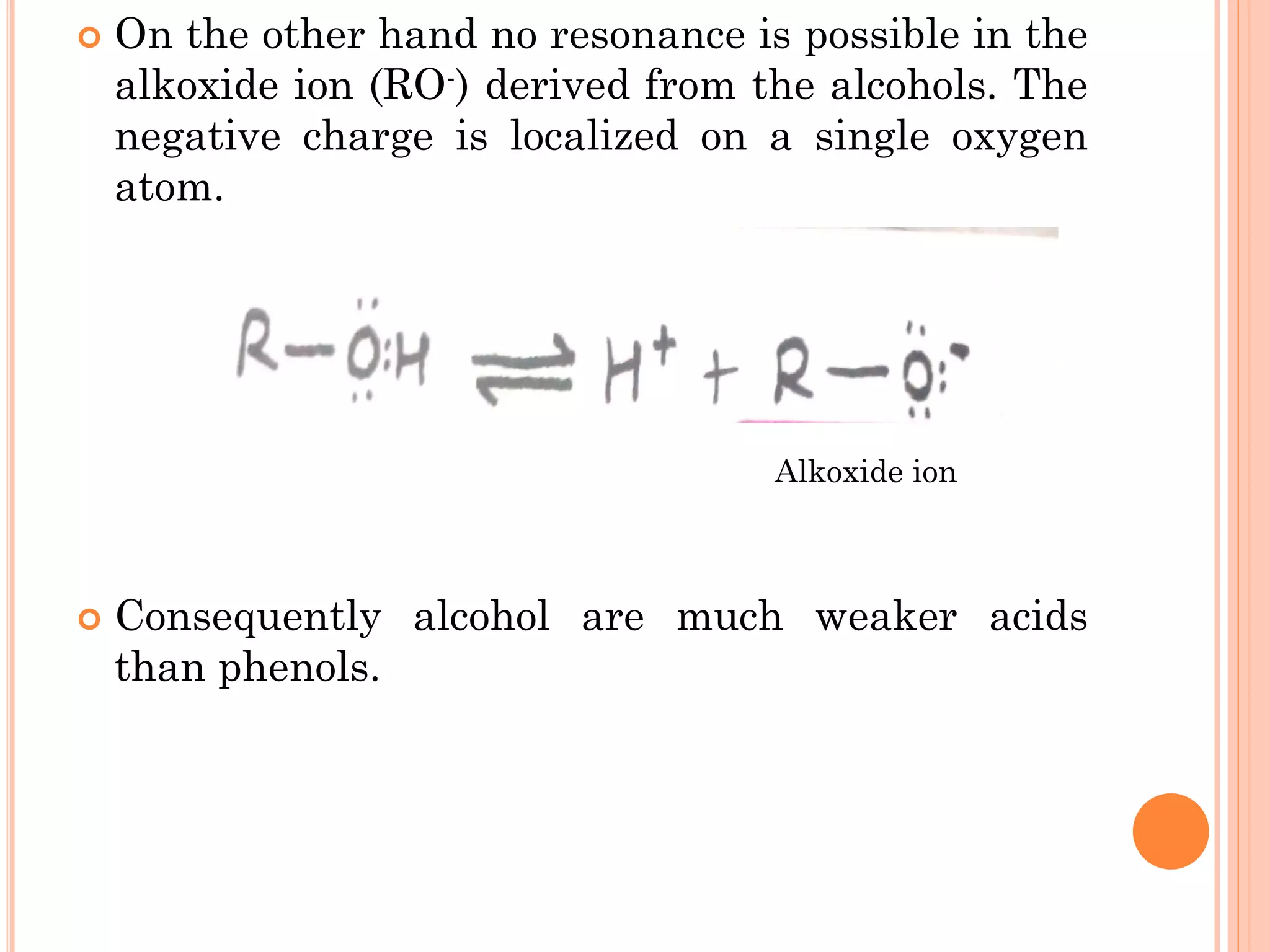
 On the other hand no resonance is possible in the
alkoxide ion (RO-) derived from the alcohols. The
negative charge is localized on a single oxygen
atom.
 Consequently alcohol are much weaker acids
than phenols.
Alkoxide ion
EFFECT OF SUBSTITUENTS ON ACIDIC
STRENGTH OF PHENOL
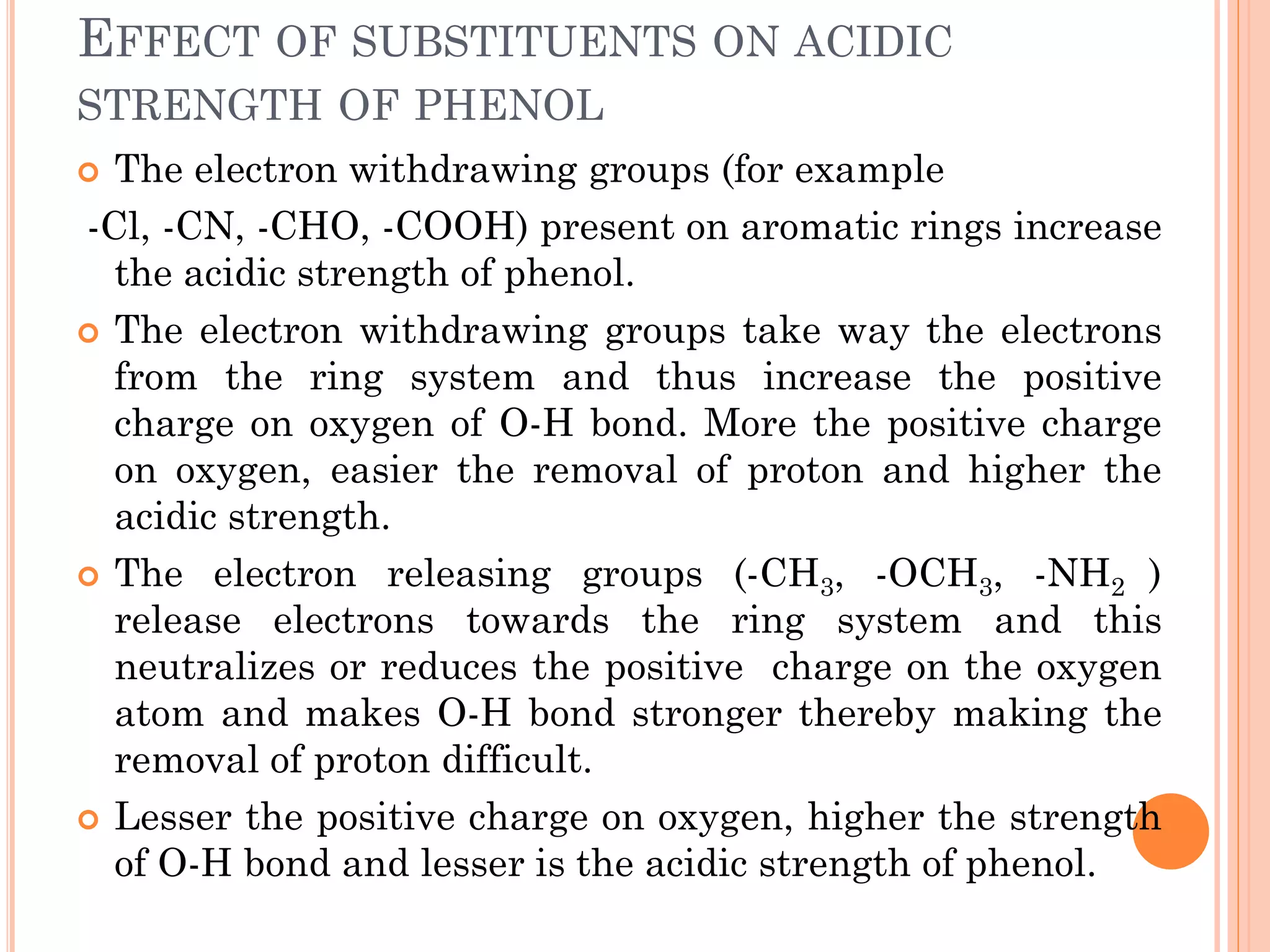
 The electron withdrawing groups (for example
-Cl, -CN, -CHO, -COOH) present on aromatic rings increase
the acidic strength of phenol.
 The electron withdrawing groups take way the electrons
from the ring system and thus increase the positive
charge on oxygen of O-H bond. More the positive charge
on oxygen, easier the removal of proton and higher the
acidic strength.
 The electron releasing groups (-CH3, -OCH3, -NH2 )
release electrons towards the ring system and this
neutralizes or reduces the positive charge on the oxygen
atom and makes O-H bond stronger thereby making the
removal of proton difficult.
 Lesser the positive charge on oxygen, higher the strength
of O-H bond and lesser is the acidic strength of phenol.
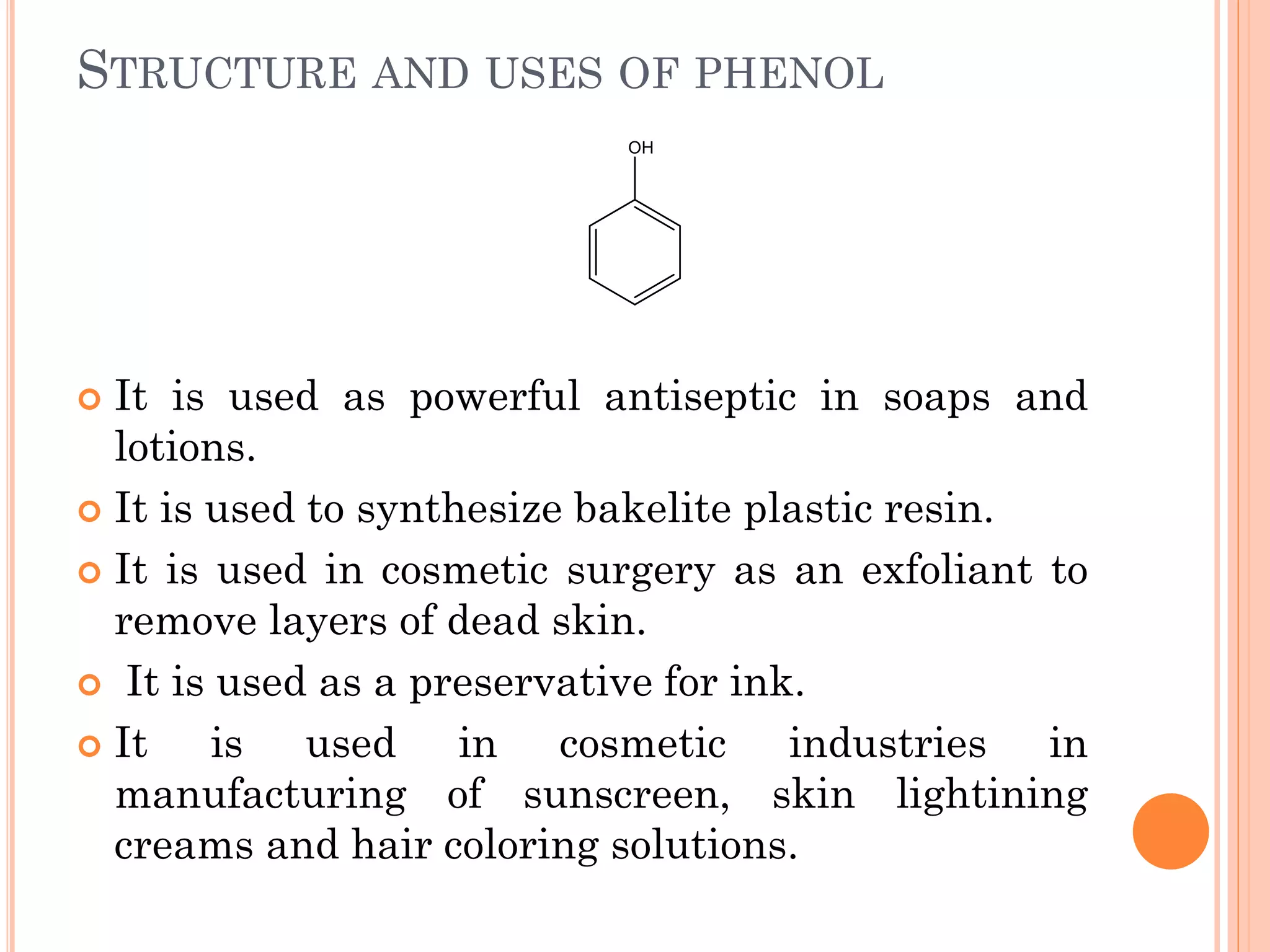
STRUCTURE AND USES OF PHENOL
 It is used as powerful antiseptic in soaps and
lotions.
 It is used to synthesize bakelite plastic resin.
 It is used in cosmetic surgery as an exfoliant to
remove layers of dead skin.
 It is used as a preservative for ink.
 It is used in cosmetic industries in
manufacturing of sunscreen, skin lightining
creams and hair coloring solutions.
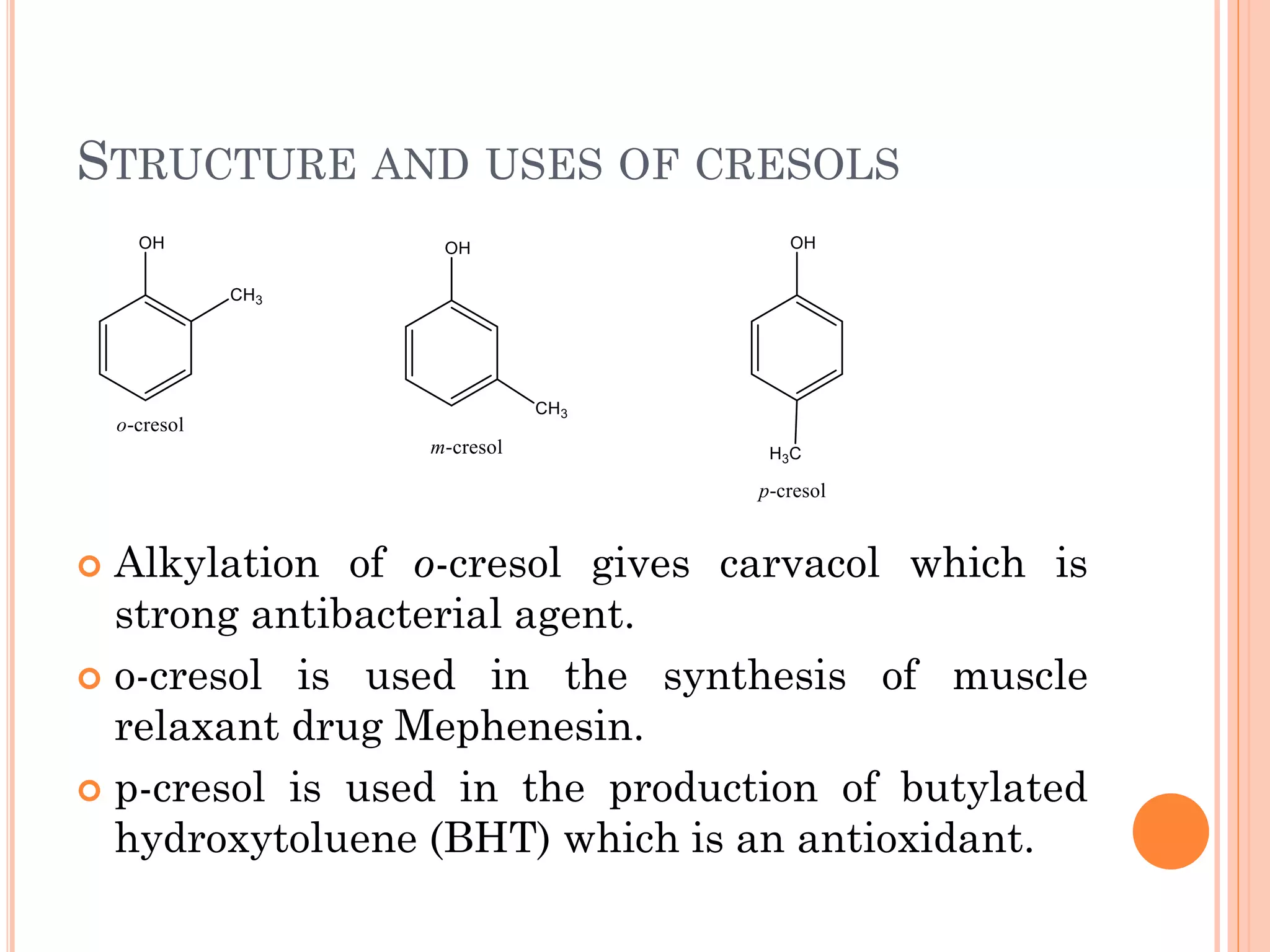
STRUCTURE AND USES OF CRESOLS
 Alkylation of o-cresol gives carvacol which is
strong antibacterial agent.
 o-cresol is used in the synthesis of muscle
relaxant drug Mephenesin.
 p-cresol is used in the production of butylated
hydroxytoluene (BHT) which is an antioxidant.
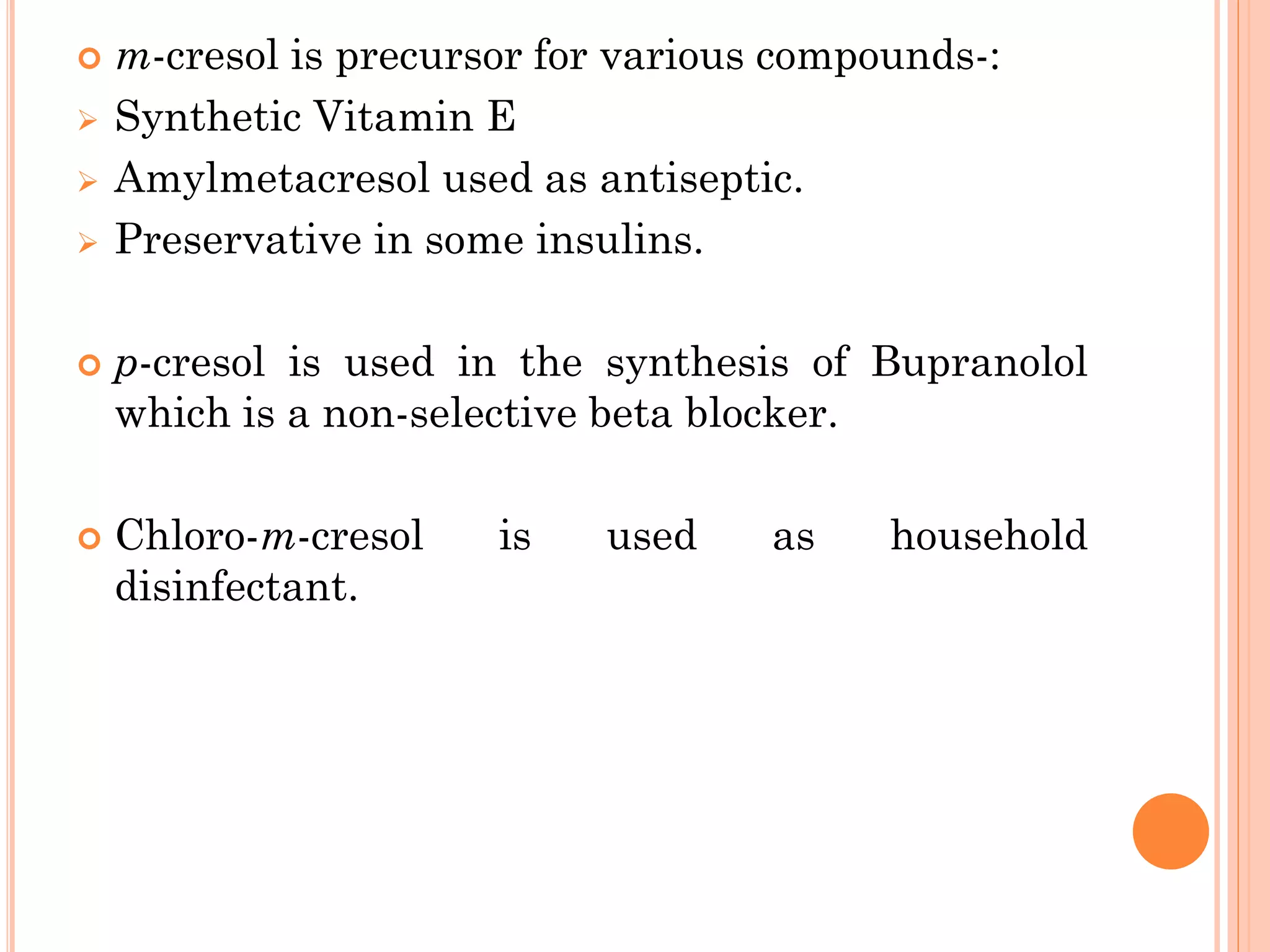
 m-cresol is precursor for various compounds-:
➢ Synthetic Vitamin E
➢ Amylmetacresol used as antiseptic.
➢ Preservative in some insulins.
 p-cresol is used in the synthesis of Bupranolol
which is a non-selective beta blocker.
 Chloro-m-cresol is used as household
disinfectant.
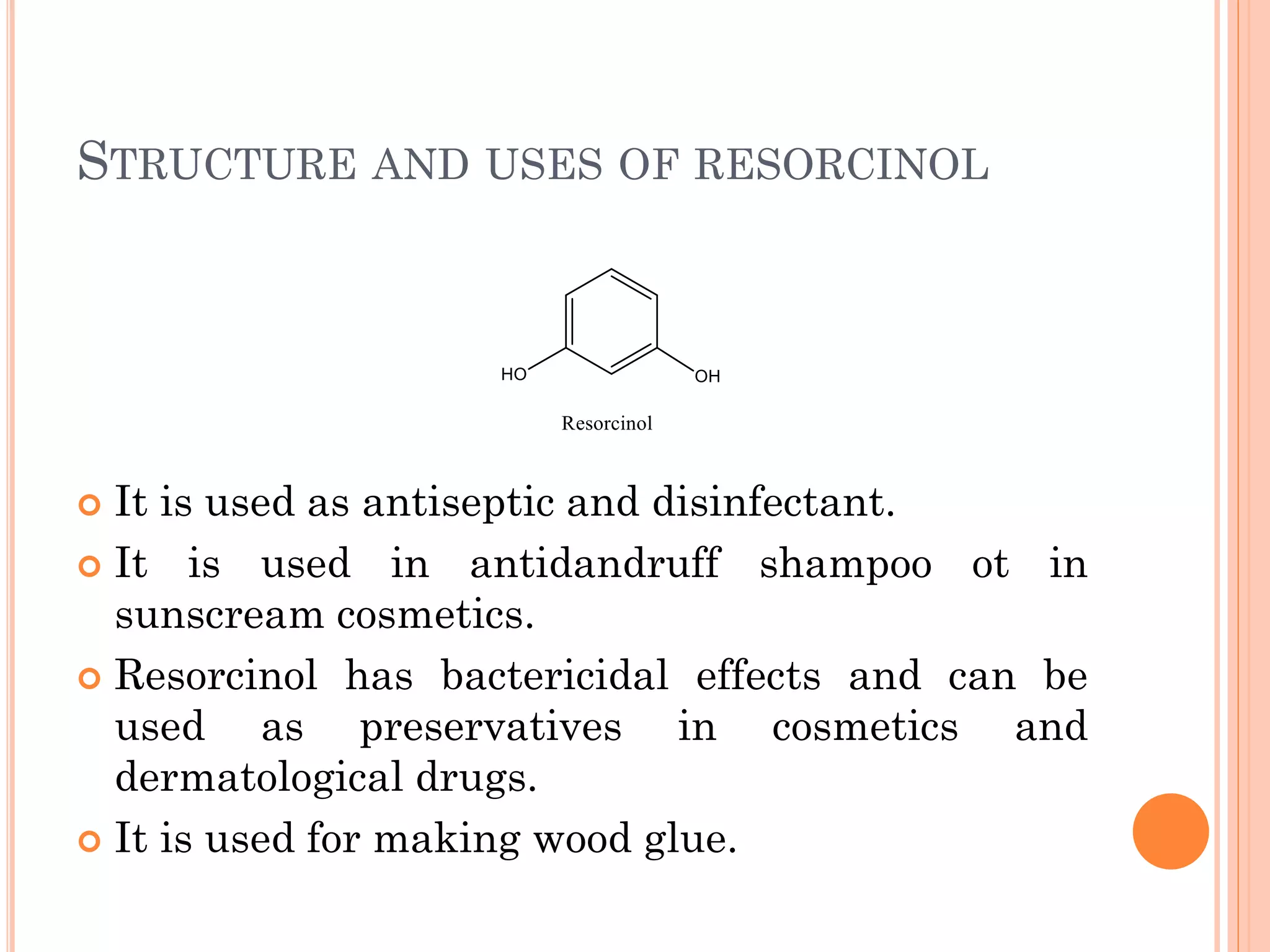
STRUCTURE AND USES OF RESORCINOL
 It is used as antiseptic and disinfectant.
 It is used in antidandruff shampoo ot in
sunscream cosmetics.
 Resorcinol has bactericidal effects and can be
used as preservatives in cosmetics and
dermatological drugs.
 It is used for making wood glue.
 It is used as analytical reagent for determination
of ketoses sugar.
 It’s ointment (5 to 10 %) is used in the treatment
of psoriasis, eczema.
 It is used in the production of plasticizers.
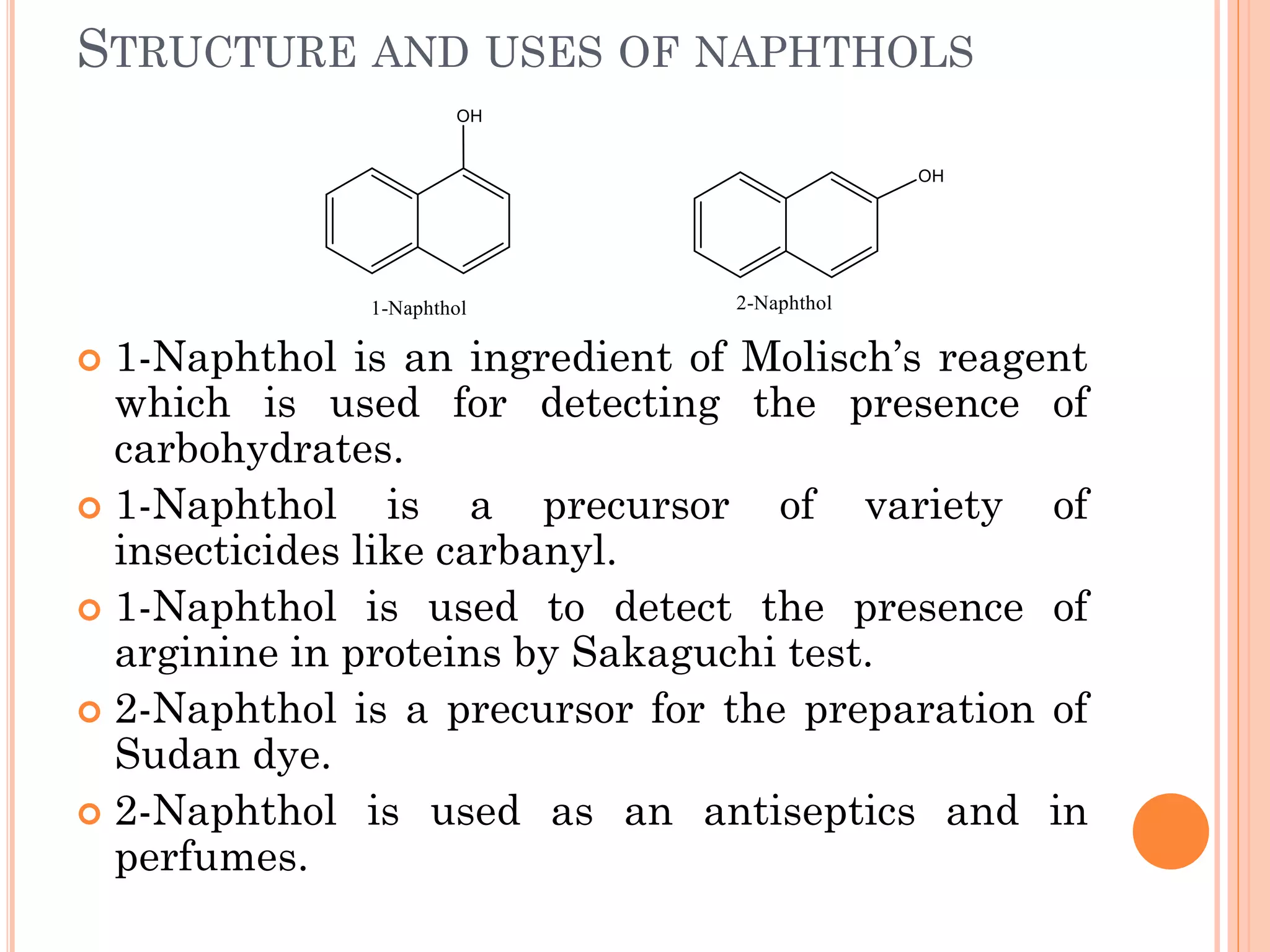
STRUCTURE AND USES OF NAPHTHOLS
 1-Naphthol is an ingredient of Molisch’s reagent
which is used for detecting the presence of
carbohydrates.
 1-Naphthol is a precursor of variety of
insecticides like carbanyl.
 1-Naphthol is used to detect the presence of
arginine in proteins by Sakaguchi test.
 2-Naphthol is a precursor for the preparation of
Sudan dye.
 2-Naphthol is used as an antiseptics and in
perfumes.
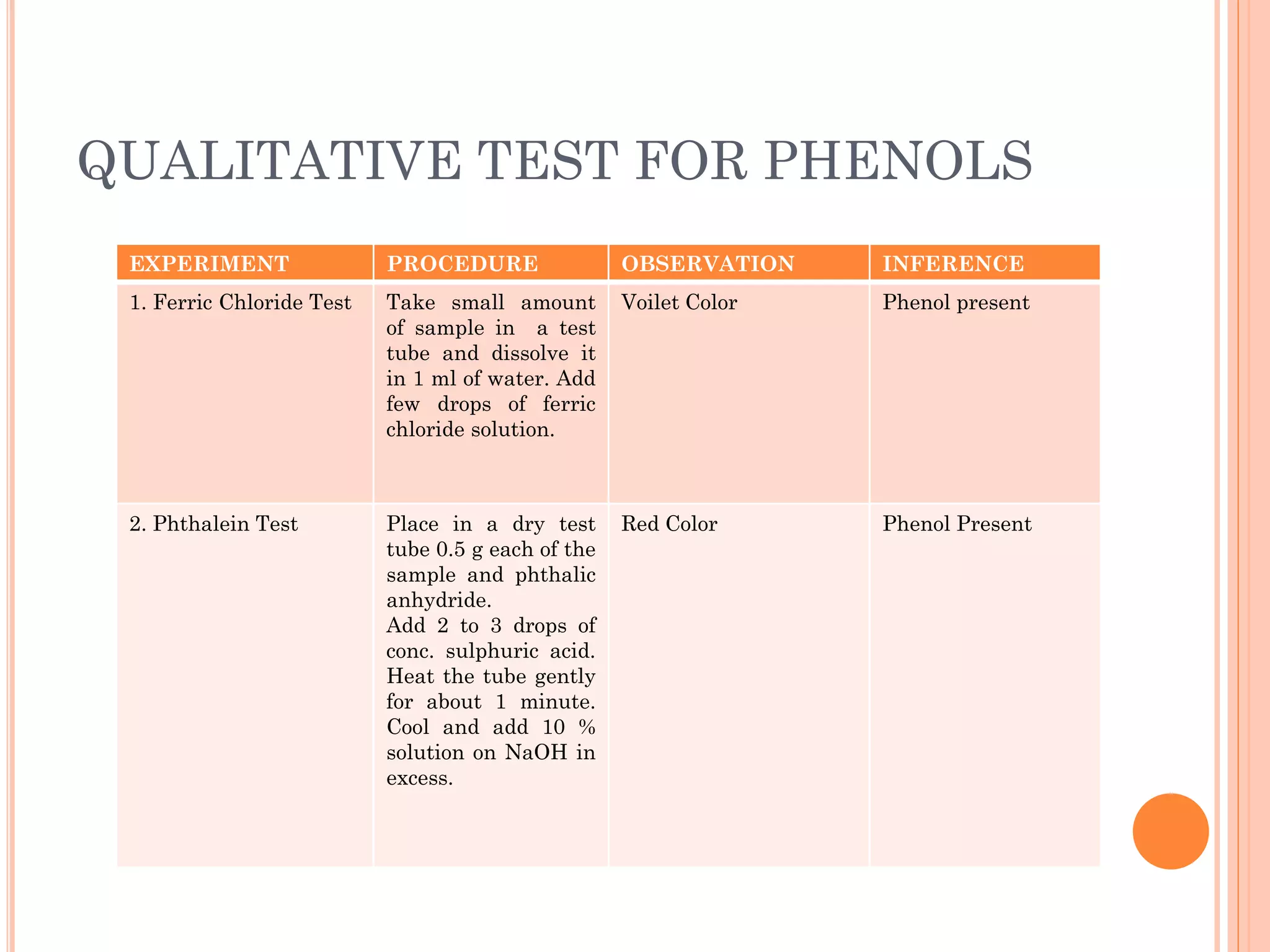
QUALITATIVE TEST FOR PHENOLS
EXPERIMENT PROCEDURE OBSERVATION INFERENCE
1. Ferric Chloride Test Take small amount
of sample in a test
tube and dissolve it
in 1 ml of water. Add
few drops of ferric
chloride solution.
Voilet Color Phenol present
2. Phthalein Test Place in a dry test
tube 0.5 g each of the
sample and phthalic
anhydride.
Add 2 to 3 drops of
conc. sulphuric acid.
Heat the tube gently
for about 1 minute.
Cool and add 10 %
solution on NaOH in
excess.
Red Color Phenol Present
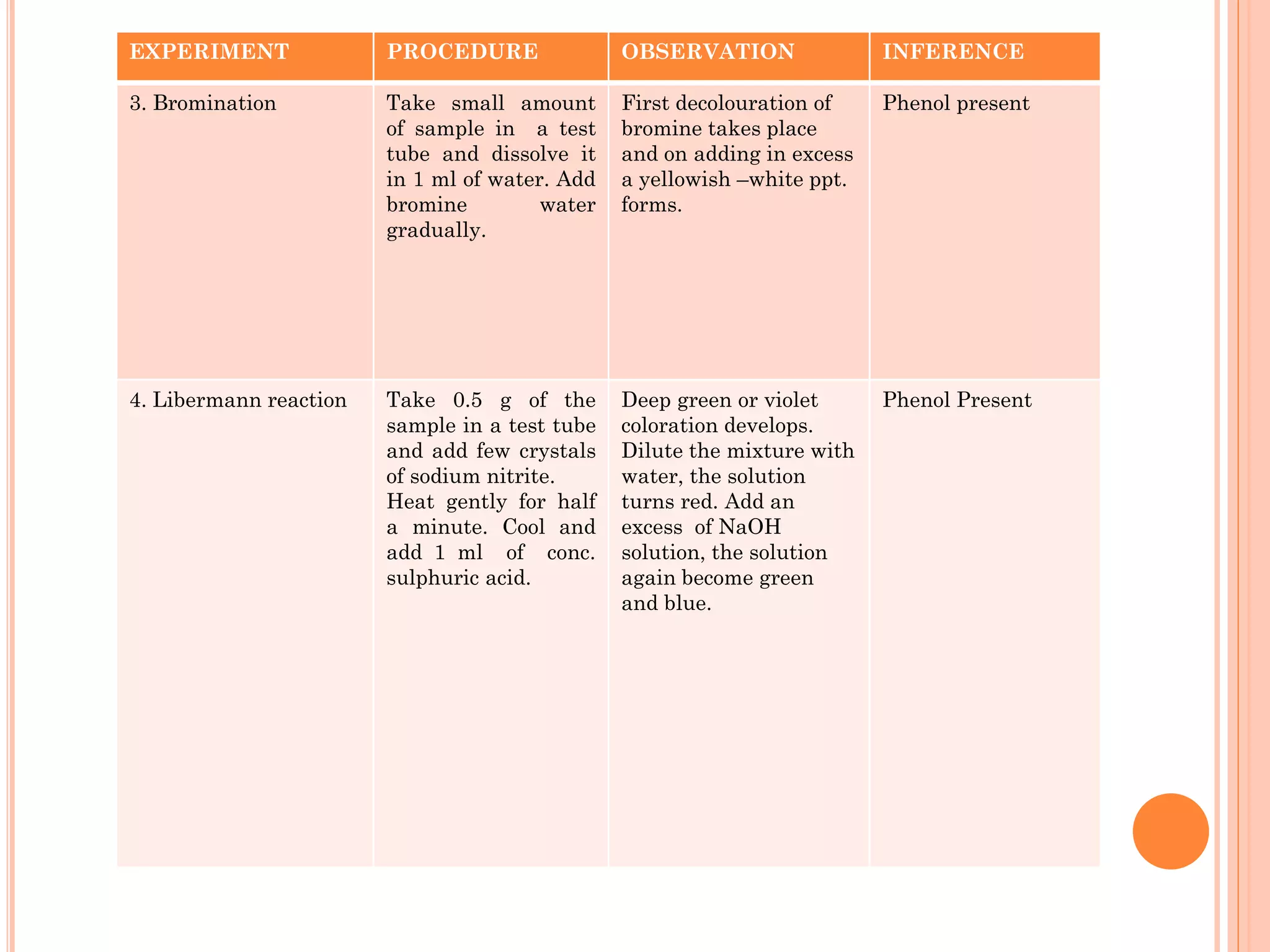
EXPERIMENT PROCEDURE OBSERVATION INFERENCE
3. Bromination Take small amount
of sample in a test
tube and dissolve it
in 1 ml of water. Add
bromine water
gradually.
First decolouration of
bromine takes place
and on adding in excess
a yellowish –white ppt.
forms.
Phenol present
4. Libermann reaction Take 0.5 g of the
sample in a test tube
and add few crystals
of sodium nitrite.
Heat gently for half
a minute. Cool and
add 1 ml of conc.
sulphuric acid.
Deep green or violet
coloration develops.
Dilute the mixture with
water, the solution
turns red. Add an
excess of NaOH
solution, the solution
again become green
and blue.
Phenol Present
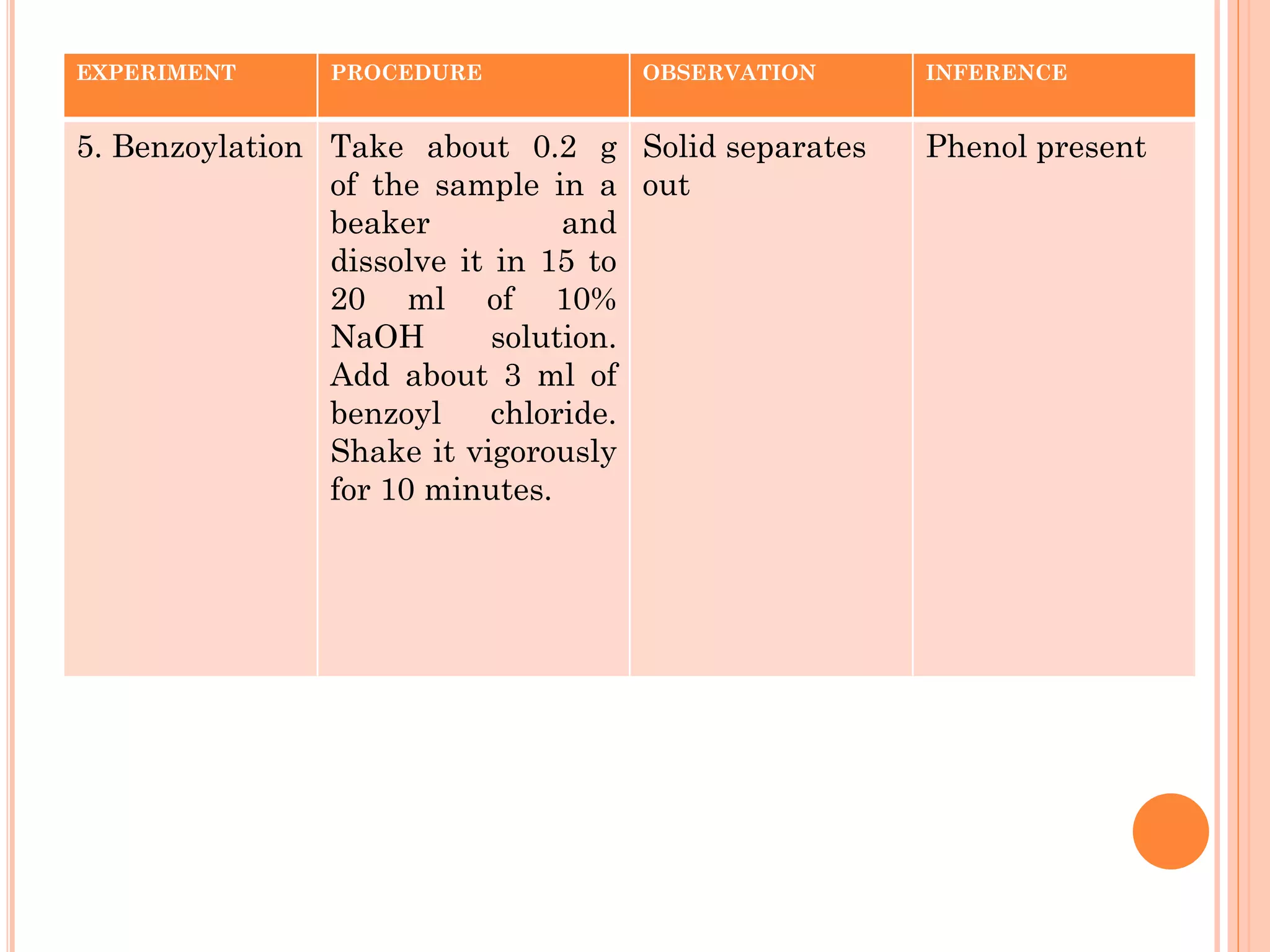
EXPERIMENT PROCEDURE OBSERVATION INFERENCE
5. Benzoylation Take about 0.2 g
of the sample in a
beaker and
dissolve it in 15 to
20 ml of 10%
NaOH solution.
Add about 3 ml of
benzoyl chloride.
Shake it vigorously
for 10 minutes.
Solid separates
out
Phenol present
THANK YOU

UNIT 2 TOPIC - PHENOLS (1).pdf

  • 1.
  • 2.
    PHENOLS  The classof organic compounds where one or more hydroxyl groups (-OH) attached to a carbon atom that is part of an aromatic ring is termed as Phenols. The simplest is Phenol (C6H5OH).  PHYSICAL PROPERTIES ▪ Phenols are generally colorless solids at room temperature. On exposure to air, phenol becomes reddish in colour. ▪ Phenols are slightly soluble in water and their solubility increases with an increase in temperature. Phenol is also known as Carbolic acid.
  • 3.
    PREPARATION OF PHENOLS DOW’S PROCESS- Heating chlorobenzene with conc. NaOH solution at 300°C under high pressure results in the formation of sodium salt of phenol, which in acidic medium liberates free phenol.
  • 4.
     FROM AROMATICAMINES ▪ Aniline in the presence of nitrous acid form diazonium salt; which in the presence of water form phenol.
  • 5.
     FROM CUMEME(AN INDUSTRIAL PROCESS FOR PREPARATION OF PHENOLS) ▪ Benzene on reaction with propene in the presence of phosphoric acid form isopropyl benzene (Cumene). ▪ The Oxidation of Cumene results in the formation of Cumene Hydroperoxide, which on hydrolysis in acidic medium produces phenol and acetone.
  • 7.
     FROM ALLYLPHENYL ETHER (CLAISEN REARRANGEMENT) ▪ Allyl Phenyl Ether on heating undergoes an intramolecular rearrangement to form o-allyl phenol and the reaction is known as Claisen rearrangement. ▪
  • 8.
    CHEMICAL PROPERTIES  REACTIONSOF –OH GROUP ▪ FORMATION OF SALT ➢ Phenol reacts with sodium hydroxide to form salt.
  • 9.
     REACTION WITHAMMONIA ▪ Phenol reacts with ammonia at high temperature and pressure to form aniline.
  • 10.
     FORMATION OFESTERS ▪ Phenol reacts with acid chloride in aqueous alkali solution to give phenyl esters. ▪ The alkali first forms the phenoxide ion which then reacts with the acid chloride to give phenyl ester. ▪ Reaction of Phenol with Benzoyl chloride is known as Schotten Baumann reaction.
  • 11.
     FORMATION OFETHERS ▪ Phenol reacts with Dimethyl sulphate in alkali solution to form anisole (Methoxybenzene). o REACTION WITH ZINC DUST
  • 12.
    REACTION OF BENZENERING  HALOGENATION ▪ Phenol reacts with bromine water (aqueous bromine) to give precipitate of 2,4,6- tribromophenol.
  • 13.
     NITRATION ▪ Phenolreacts with concentrated nitric acid to form picric acid.
  • 14.
    o NITROSATION ▪ Phenolreacts with nitrous acid (obtained from Sodium nitrite and HCl at 5 °C) to form p- nitrosophenol. ▪ p-nitrosophenol on oxidation with dil. Nitric acid gives p-nitrophenol. ▪
  • 15.
     SULFONATION ▪ WhenPhenol is treated with concentrated sulphuric acid at 20 °C, o-phenolsulfonic acid is formed.
  • 16.
    REIMER-TIEMANN REACTION  Thisinvolves treatment of phenol with chloroform in aqueous sodium hydroxide solution followed by acid-hydrolysis. Salicylaldehyde is formed.
  • 17.
    KOLBE REACTION  Phenolreacts with sodium hydroxide to form sodium phenoxide.  Sodium phenoxide reacts with carbon dioxide at 125 °C at 6 atm pressure followed by acid hydrolysis to form salicylic acid.
  • 18.
    FRIES REARRANGEMENT  ThePhenol is first treated with acetic anhydride in the presence of aqueous NaOH to give phenyl acetate.  The ester is then heated with aluminium chloride catalyst; the acyl group migrates from the phenolic oxygen to an ortho or para position of the ring.
  • 19.
    REACTION WITH FORMALDEHYDE When Phenol is treated with an alkaline solution of formaldehyde, a mixture of o- and p- hydroxybenzyl alcohol is formed.
  • 20.
    OXIDATION  Phenol undergoesoxidation in the presence of chromic acid to form p-benzoquinone.
  • 21.
    CATALYTIC HYDROGENTION  Phenolon catalytic hydrogenation gives Cyclohexanol at 160°C.
  • 22.
    ACIDIC NATURE OFPHENOL: A GENERAL DISCUSSION  Phenols are acidic in nature. The acidic nature of phenol is attributed to the +R effect in phenol.  Due to +R effect, the oxygen develops a positive charge and thereby registers reduced hold on hydrogen.  This results in the weakening of the O-H bond and makes the removal of hydrogen as proton (H+) to occur readily thereby making the phenol acidic.
  • 23.
     Phenols aremuch more acidic than alcohols but less than carboxylic acids.  Phenols are acidic due to the formation of stable phenoxide ions in aqueous solutions.  For example, phenol itself gives phenoxide ion on dissociation.
  • 24.
     The phenoxideion is stable due to resonance.  Notice that the negative charge is spread throughout the benzene ring and thereby effectively dispersed.  This charge delocalization is a stabilizing factor in the phenoxide ion.
  • 25.
     On theother hand no resonance is possible in the alkoxide ion (RO-) derived from the alcohols. The negative charge is localized on a single oxygen atom.  Consequently alcohol are much weaker acids than phenols. Alkoxide ion
  • 26.
    EFFECT OF SUBSTITUENTSON ACIDIC STRENGTH OF PHENOL  The electron withdrawing groups (for example -Cl, -CN, -CHO, -COOH) present on aromatic rings increase the acidic strength of phenol.  The electron withdrawing groups take way the electrons from the ring system and thus increase the positive charge on oxygen of O-H bond. More the positive charge on oxygen, easier the removal of proton and higher the acidic strength.  The electron releasing groups (-CH3, -OCH3, -NH2 ) release electrons towards the ring system and this neutralizes or reduces the positive charge on the oxygen atom and makes O-H bond stronger thereby making the removal of proton difficult.  Lesser the positive charge on oxygen, higher the strength of O-H bond and lesser is the acidic strength of phenol.
  • 27.
    STRUCTURE AND USESOF PHENOL  It is used as powerful antiseptic in soaps and lotions.  It is used to synthesize bakelite plastic resin.  It is used in cosmetic surgery as an exfoliant to remove layers of dead skin.  It is used as a preservative for ink.  It is used in cosmetic industries in manufacturing of sunscreen, skin lightining creams and hair coloring solutions.
  • 28.
    STRUCTURE AND USESOF CRESOLS  Alkylation of o-cresol gives carvacol which is strong antibacterial agent.  o-cresol is used in the synthesis of muscle relaxant drug Mephenesin.  p-cresol is used in the production of butylated hydroxytoluene (BHT) which is an antioxidant.
  • 29.
     m-cresol isprecursor for various compounds-: ➢ Synthetic Vitamin E ➢ Amylmetacresol used as antiseptic. ➢ Preservative in some insulins.  p-cresol is used in the synthesis of Bupranolol which is a non-selective beta blocker.  Chloro-m-cresol is used as household disinfectant.
  • 30.
    STRUCTURE AND USESOF RESORCINOL  It is used as antiseptic and disinfectant.  It is used in antidandruff shampoo ot in sunscream cosmetics.  Resorcinol has bactericidal effects and can be used as preservatives in cosmetics and dermatological drugs.  It is used for making wood glue.
  • 31.
     It isused as analytical reagent for determination of ketoses sugar.  It’s ointment (5 to 10 %) is used in the treatment of psoriasis, eczema.  It is used in the production of plasticizers.
  • 32.
    STRUCTURE AND USESOF NAPHTHOLS  1-Naphthol is an ingredient of Molisch’s reagent which is used for detecting the presence of carbohydrates.  1-Naphthol is a precursor of variety of insecticides like carbanyl.  1-Naphthol is used to detect the presence of arginine in proteins by Sakaguchi test.  2-Naphthol is a precursor for the preparation of Sudan dye.  2-Naphthol is used as an antiseptics and in perfumes.
  • 33.
    QUALITATIVE TEST FORPHENOLS EXPERIMENT PROCEDURE OBSERVATION INFERENCE 1. Ferric Chloride Test Take small amount of sample in a test tube and dissolve it in 1 ml of water. Add few drops of ferric chloride solution. Voilet Color Phenol present 2. Phthalein Test Place in a dry test tube 0.5 g each of the sample and phthalic anhydride. Add 2 to 3 drops of conc. sulphuric acid. Heat the tube gently for about 1 minute. Cool and add 10 % solution on NaOH in excess. Red Color Phenol Present
  • 34.
    EXPERIMENT PROCEDURE OBSERVATIONINFERENCE 3. Bromination Take small amount of sample in a test tube and dissolve it in 1 ml of water. Add bromine water gradually. First decolouration of bromine takes place and on adding in excess a yellowish –white ppt. forms. Phenol present 4. Libermann reaction Take 0.5 g of the sample in a test tube and add few crystals of sodium nitrite. Heat gently for half a minute. Cool and add 1 ml of conc. sulphuric acid. Deep green or violet coloration develops. Dilute the mixture with water, the solution turns red. Add an excess of NaOH solution, the solution again become green and blue. Phenol Present
  • 35.
    EXPERIMENT PROCEDURE OBSERVATIONINFERENCE 5. Benzoylation Take about 0.2 g of the sample in a beaker and dissolve it in 15 to 20 ml of 10% NaOH solution. Add about 3 ml of benzoyl chloride. Shake it vigorously for 10 minutes. Solid separates out Phenol present
  • 36.