ORGANIC CHEMISTRY ASSIGNMENT
HETEROCYCLIC CHEMISTRY:
Heterocyclic chemistry is the branch of organic chemistry dealing
with the synthesis, properties, and applications of these heterocycles.
HETEROCYCLIC COMOUNDS:
A heterocyclic compound or ring structure is a cyclic compound
that has atoms of at least two different elements as members of its ring.
Example:
Nucleic acids, the majority of drugs, most biomass and many natural and
synthetic dyes.
FURAN
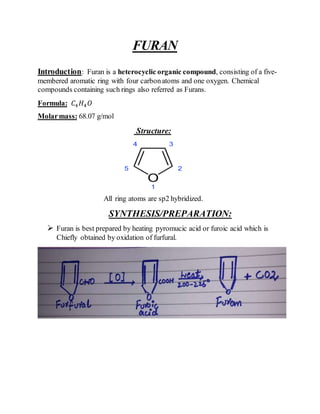
Introduction: Furan is a heterocyclic organic compound, consisting of a five-
membered aromatic ring with four carbonatoms and one oxygen. Chemical
compounds containing such rings also referred as Furans.
Formula: 𝐶4 𝐻4 𝑂
Molarmass: 68.07 g/mol
Structure:
All ring atoms are sp2 hybridized.
SYNTHESIS/PREPARATION:
 Furan is best prepared by heating pyromucic acid or furoic acid which is
Chiefly obtained by oxidation of furfural.
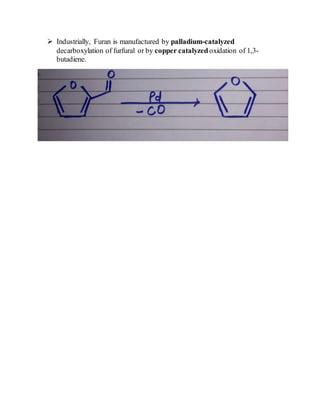
 Industrially, Furan is manufactured by palladium-catalyzed
decarboxylation of furfural or by copper catalyzedoxidation of 1,3-
butadiene.
CHEMICAL PROPERTIES:
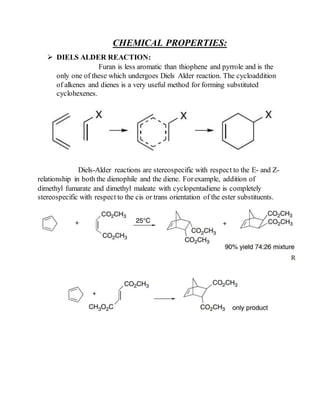
 DIELS ALDER REACTION:
Furan is less aromatic than thiophene and pyrrole and is the
only one of these which undergoes Diels Alder reaction. The cycloaddition
of alkenes and dienes is a very useful method for forming substituted
cyclohexenes.
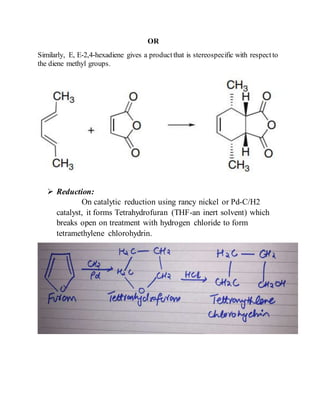
Diels-Alder reactions are stereospecific with respect to the E- and Z-
relationship in both the dienophile and the diene. Forexample, addition of
dimethyl fumarate and dimethyl maleate with cyclopentadiene is completely
stereospecific with respect to the cis or trans orientation of the ester substituents.
OR
Similarly, E, E-2,4-hexadiene gives a productthat is stereospecific with respectto
the diene methyl groups.
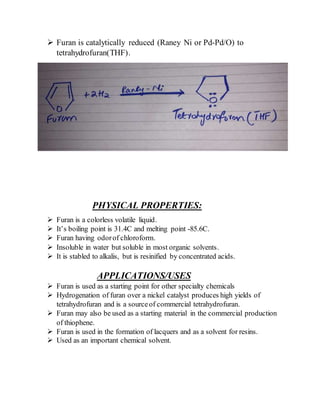
 Reduction:
On catalytic reduction using rancy nickel or Pd-C/H2
catalyst, it forms Tetrahydrofuran (THF-an inert solvent) which
breaks open on treatment with hydrogen chloride to form
tetramethylene chlorohydrin.
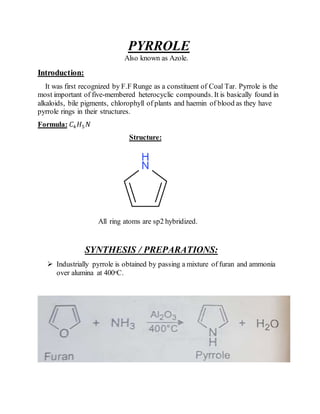
 Furan is catalytically reduced (Raney Ni or Pd-Pd/O) to
tetrahydrofuran(THF).
PHYSICAL PROPERTIES:
 Furan is a colorless volatile liquid.
 It’s boiling point is 31.4C and melting point -85.6C.
 Furan having odorof chloroform.
 Insoluble in water but soluble in most organic solvents.
 It is stabled to alkalis, but is resinified by concentrated acids.
APPLICATIONS/USES
 Furan is used as a starting point for other specialty chemicals
 Hydrogenation of furan over a nickel catalyst produces high yields of
tetrahydrofuran and is a sourceof commercial tetrahydrofuran.
 Furan may also be used as a starting material in the commercial production
of thiophene.
 Furan is used in the formation of lacquers and as a solvent for resins.
 Used as an important chemical solvent.
PYRROLE
Also known as Azole.
Introduction:
It was first recognized by F.F Runge as a constituent of Coal Tar. Pyrrole is the
most important of five-membered heterocyclic compounds. It is basically found in
alkaloids, bile pigments, chlorophyll of plants and haemin of blood as they have
pyrrole rings in their structures.
Formula: 𝐶4 𝐻5 𝑁
Structure:
All ring atoms are sp2 hybridized.
SYNTHESIS / PREPARATIONS:
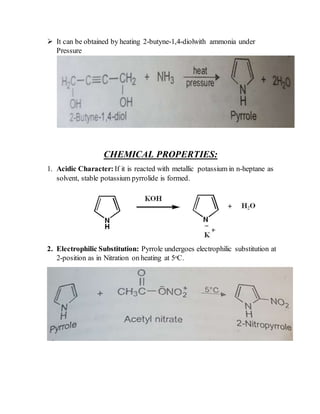
 Industrially pyrrole is obtained by passing a mixture of furan and ammonia
over alumina at 400ᵒC.
 It can be obtained by heating 2-butyne-1,4-diolwith ammonia under
Pressure
CHEMICAL PROPERTIES:
1. Acidic Character: If it is reacted with metallic potassium in n-heptane as
solvent, stable potassium pyrrolide is formed.
2. Electrophilic Substitution: Pyrrole undergoes electrophilic substitution at
2-position as in Nitration on heating at 5ᵒC.
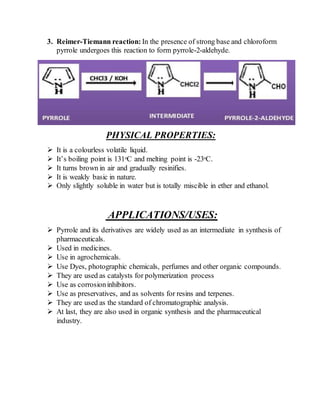
3. Reimer-Tiemann reaction: In the presence of strong base and chloroform
pyrrole undergoes this reaction to form pyrrole-2-aldehyde.
PHYSICAL PROPERTIES:
 It is a colourless volatile liquid.
 It’s boiling point is 131ᵒC and melting point is -23ᵒC.
 It turns brown in air and gradually resinifies.
 It is weakly basic in nature.
 Only slightly soluble in water but is totally miscible in ether and ethanol.
APPLICATIONS/USES:
 Pyrrole and its derivatives are widely used as an intermediate in synthesis of
pharmaceuticals.
 Used in medicines.
 Use in agrochemicals.
 Use Dyes, photographic chemicals, perfumes and other organic compounds.
 They are used as catalysts for polymerization process
 Use as corrosioninhibitors.
 Use as preservatives, and as solvents for resins and terpenes.
 They are used as the standard of chromatographic analysis.
 At last, they are also used in organic synthesis and the pharmaceutical
industry.
INDOLE
Introduction:
Indole is an aromatic heterocyclic compound. It has a bicyclic structure,
consists of six-membered benzene Ring fused with five-membered pyrrole ring. It
is widely distributed in natural environment and can be produced by a variety of
bacteria.
Structure:
 Indole is actually 2,3-Benzopyrrole
 Its formula is 𝐶8 𝐻7 𝑁
SYNTHESIS/PREPARATION:
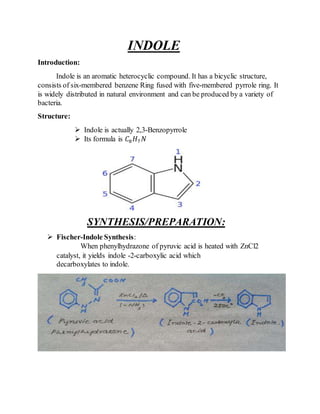
 Fischer-Indole Synthesis:
When phenylhydrazone of pyruvic acid is heated with ZnCl2
catalyst, it yields indole -2-carboxylic acid which
decarboxylates to indole.
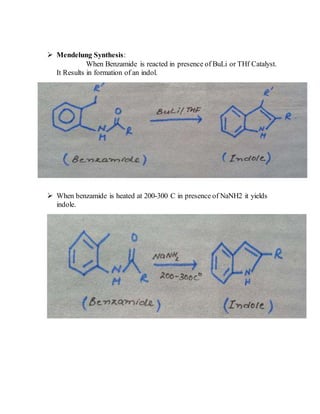
 Mendelung Synthesis:
When Benzamide is reacted in presence of BuLi or THf Catalyst.
It Results in formation of an indol.
 When benzamide is heated at 200-300 C in presence of NaNH2 it yields
indole.
CHEMICAL PROPERTIES:
Chemically, it resembles pyrrole. It is Basic and gives Electrophilic substitution
reactions such as nitration, halogenation at 3-position. Its derivatives Indoxyl
exhibits tautomerism and behave as phenol.
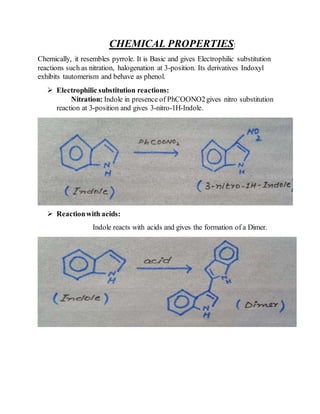
 Electrophilic substitution reactions:
Nitration: Indole in presence of PhCOONO2gives nitro substitution
reaction at 3-position and gives 3-nitro-1H-Indole.
 Reactionwith acids:
Indole reacts with acids and gives the formation of a Dimer.
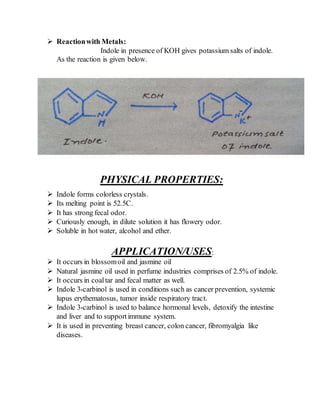
 Reactionwith Metals:
Indole in presence of KOH gives potassium salts of indole.
As the reaction is given below.
PHYSICAL PROPERTIES:
 Indole forms colorless crystals.
 Its melting point is 52.5C.
 It has strong fecal odor.
 Curiously enough, in dilute solution it has flowery odor.
 Soluble in hot water, alcohol and ether.
APPLICATION/USES:
 It occurs in blossomoil and jasmine oil
 Natural jasmine oil used in perfume industries comprises of 2.5% of indole.
 It occurs in coaltar and fecal matter as well.
 Indole 3-carbinol is used in conditions such as cancer prevention, systemic
lupus erythematosus, tumor inside respiratory tract.
 Indole 3-carbinol is used to balance hormonal levels, detoxify the intestine
and liver and to supportimmune system.
 It is used in preventing breast cancer, colon cancer, fibromyalgia like
diseases.
THIOPENE
Introduction:
Thiophene is a heterocyclic compound consisting of a planar five-
membered ring, it is aromatic as indicated by its extensive substitution reactions. It
is a colorless liquid with a benzene-like odor. In most of its reactions, it resembles
benzene.
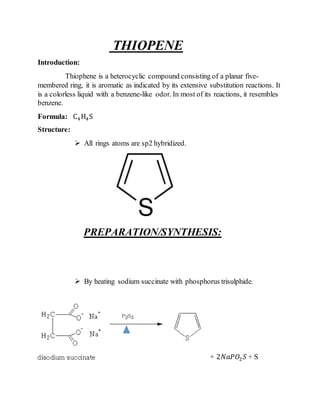
Formula: C4H4S
Structure:
 All rings atoms are sp2 hybridized.
PREPARATION/SYNTHESIS:
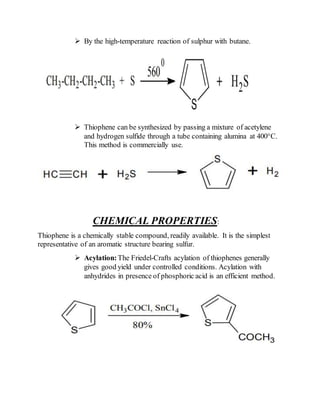
 By heating sodium succinate with phosphorus trisulphide.
+ 2𝑁𝑎𝑃𝑂2 𝑆 + S
 By the high-temperature reaction of sulphur with butane.
 Thiophene can be synthesized by passing a mixture of acetylene
and hydrogen sulfide through a tube containing alumina at 400°C.
This method is commercially use.
CHEMICAL PROPERTIES:
Thiophene is a chemically stable compound, readily available. It is the simplest
representative of an aromatic structure bearing sulfur.
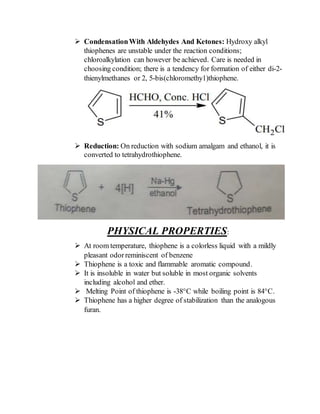
 Acylation:The Friedel-Crafts acylation of thiophenes generally
gives good yield under controlled conditions. Acylation with
anhydrides in presence of phosphoric acid is an efficient method.
 CondensationWith Aldehydes And Ketones: Hydroxy alkyl
thiophenes are unstable under the reaction conditions;
chloroalkylation can however be achieved. Care is needed in
choosing condition; there is a tendency for formation of either di-2-
thienylmethanes or 2, 5-bis(chloromethy1)thiophene.
 Reduction: On reduction with sodium amalgam and ethanol, it is
converted to tetrahydrothiophene.
PHYSICAL PROPERTIES:
 At room temperature, thiophene is a colorless liquid with a mildly
pleasant odorreminiscent of benzene
 Thiophene is a toxic and flammable aromatic compound.
 It is insoluble in water but soluble in most organic solvents
including alcohol and ether.
 Melting Point of thiophene is -38°C while boiling point is 84°C.
 Thiophene has a higher degree of stabilization than the analogous
furan.
APPLICATION/USES:
 It is used for the production of dyes, synthetic resins, solvents, etc.
 It is used for making drugs and plasticizers.
 It is mainly used as the intermediates of pharmaceutical industry
used for preparing thiophene acetic pyridine, and pyrantel.
 It is used as a solvent.
 Used for the manufacture of color films and trick photography.
 Used for the synthesis of some complex reagent
 It is an important intermediate in the synthesis of Bakelite.
 Other derivatives can also be used as insecticides, fungicides, and
animal and plant growth-promoting agent.
 In addition, some derivatives of thiophene are also the component
of organic semiconductors.
PYRIDINE
Also known as Azabezene.
Introduction:
Pyridine is a clear liquid with an odorthat is sour, putrid, and fish-like. It is a
relatively simple heterocyclic aromatic organic compound that is structurally related
to benzene, with one CH group in the six-membered ring replaced by a nitrogen
atom.
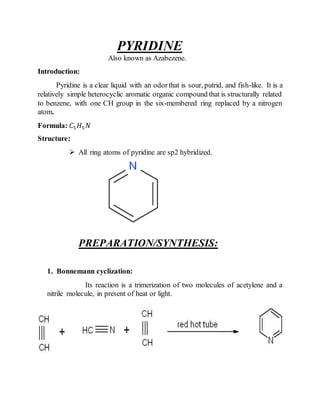
Formula: 𝐶5 𝐻5 𝑁
Structure:
 All ring atoms of pyridine are sp2 hybridized.
PREPARATION/SYNTHESIS:
1. Bonnemann cyclization:
Its reaction is a trimerization of two molecules of acetylene and a
nitrile molecule, in present of heat or light.
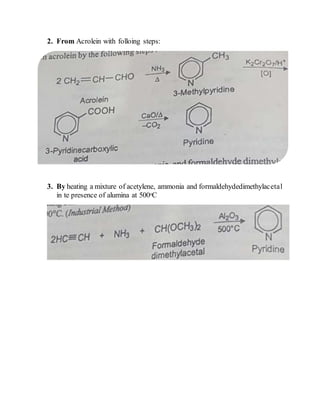
2. From Acrolein with folloing steps:
3. By heating a mixture of acetylene, ammonia and formaldehydedimethylacetal
in te presence of alumina at 500ᵒC
CHEMICAL PRPERTIES:
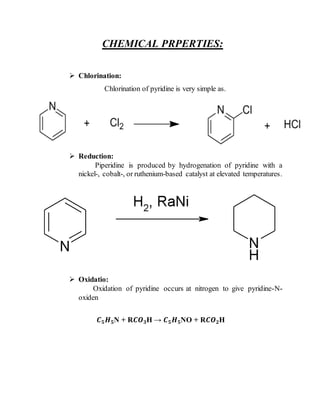
 Chlorination:
Chlorination of pyridine is very simple as.
 Reduction:
Piperidine is produced by hydrogenation of pyridine with a
nickel-, cobalt-, or ruthenium-based catalyst at elevated temperatures.
 Oxidatio:
Oxidation of pyridine occurs at nitrogen to give pyridine-N-
oxiden
𝑪 𝟓 𝑯 𝟓N + R𝑪𝑶 𝟑H → 𝑪 𝟓 𝑯 𝟓NO + R𝑪𝑶 𝟐H
PHYSICAL PROPERTIES:
 Pyridine is a colorless liquid.
 It boils at 115 degrees Celsius (239 F) and freezes at -42 degrees
Celsius (-43.6 F).
 Its density is very close to that of water, at 0.982 g/cm3 (water's
density is 1).
 It is able to mix easily with water and most other organic solvents.
 Pyridine is diamagnetic and has a diamagnetic susceptibility.
APPLICATIONS/USES:
 Pyridine is used to dissolve other substances.
 It is also used to make many different products such as medicines.
 Vitamins.
 Food flavorings.
 Paints, dyes.
 Rubber products, adhesives.
 Insecticides, and herbicides.
PYRIMIDINE
Introduction:
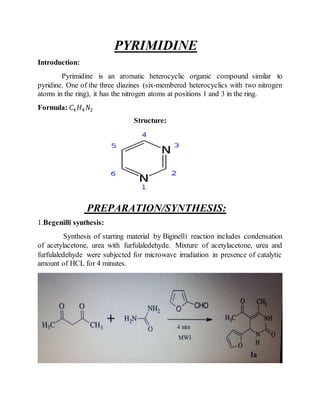
Pyrimidine is an aromatic heterocyclic organic compound similar to
pyridine. One of the three diazines (six-membered heterocyclics with two nitrogen
atoms in the ring), it has the nitrogen atoms at positions 1 and 3 in the ring.
Formula: 𝐶4 𝐻4 𝑁2
Structure:
PREPARATION/SYNTHESIS:
1.Begenilli synthesis:
Synthesis of starting material by Biginelli reaction includes condensation
of acetylacetone, urea with furfulaledehyde. Mixture of acetylacetone, urea and
furfulaledehyde were subjected for microwave irradiation in presence of catalytic
amount of HCL for 4 minutes.
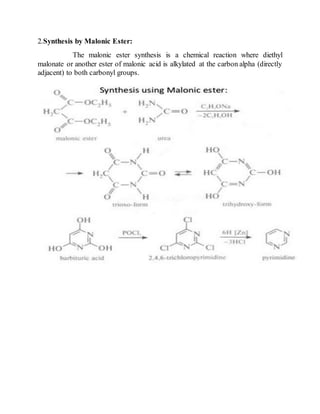
2.Synthesis by Malonic Ester:
The malonic ester synthesis is a chemical reaction where diethyl
malonate or another ester of malonic acid is alkylated at the carbon alpha (directly
adjacent) to both carbonyl groups.
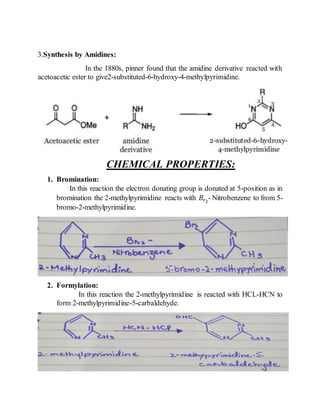
3.Synthesis by Amidines:
In the 1880s, pinner found that the amidine derivative reacted with
acetoacetic ester to give2-substituted-6-hydroxy-4-methylpyrimidine.
CHEMICAL PROPERTIES:
1. Bromination:
In this reaction the electron donating group is donated at 5-position as in
bromination the 2-methylpyrimidine reacts with 𝐵𝑟2
- Nitrobenzene to from 5-
bromo-2-methylpyrimidine.
2. Formylation:
In this reaction the 2-methylpyrimidine is reacted with HCL-HCN to
form 2-methylpyrimidine-5-carbaldehyde.
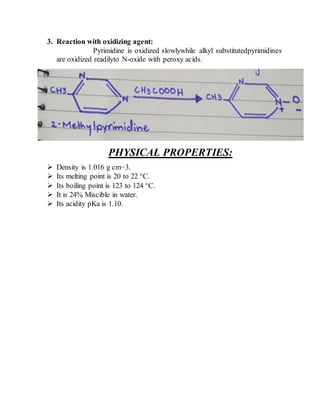
3. Reaction with oxidizing agent:
Pyrimidine is oxidized slowlywhile alkyl substitutedpyrimidines
are oxidized readilyto N-oxide with peroxy acids.
PHYSICAL PROPERTIES:
 Density is 1.016 g cm−3.
 Its melting point is 20 to 22 °C.
 Its boiling point is 123 to 124 °C.
 It is 24% Miscible in water.
 Its acidity pKa is 1.10.
APPLICATIONS/USES:
 In medicinal chemistry pyrimidine derivatives have been very well known for
their therapeutic applications.
 The presence of a pyrimidine base in thymine, cytosine and uracil, which are
the essential binding blocks of nucleic acids, DNA and RNA is one possible
reason for their activity.
 Use as anticancer, antiviral, anti-HIV, antibacterial, antihypertensive,
barbiturates e.g. phenobarbitone as sedative, hypnotics and anticonvulsant,
antibiotics.
 Most drugs in the pyrimidine series fall in to four categories; the barbiturates,
the sulphonamide; the antimicrobials and antitumor agents.
𝑷𝒀𝑹𝑨𝒁𝑰𝑵𝑬
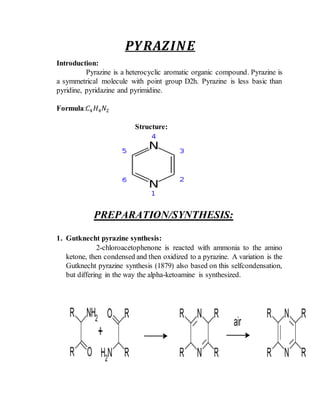
Introduction:
Pyrazine is a heterocyclic aromatic organic compound. Pyrazine is
a symmetrical molecule with point group D2h. Pyrazine is less basic than
pyridine, pyridazine and pyrimidine.
Formula:𝐶4 𝐻4 𝑁2
Structure:
PREPARATION/SYNTHESIS:
1. Gutknecht pyrazine synthesis:
2-chloroacetophenone is reacted with ammonia to the amino
ketone, then condensed and then oxidized to a pyrazine. A variation is the
Gutknecht pyrazine synthesis (1879) also based on this selfcondensation,
but differing in the way the alpha-ketoamine is synthesized.
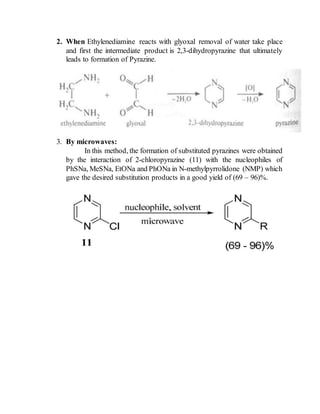
2. When Ethylenediamine reacts with glyoxal removal of water take place
and first the intermediate product is 2,3-dihydropyrazine that ultimately
leads to formation of Pyrazine.
3. By microwaves:
In this method, the formation of substituted pyrazines were obtained
by the interaction of 2-chloropyrazine (11) with the nucleophiles of
PhSNa, MeSNa, EtONa and PhONa in N-methylpyrrolidone (NMP) which
gave the desired substitution products in a good yield of (69 – 96)%.
CHEMICAL PROPERTIES:
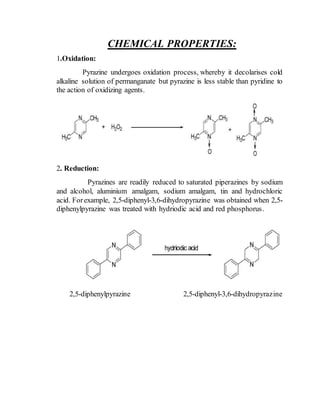
1.Oxidation:
Pyrazine undergoes oxidation process, whereby it decolarises cold
alkaline solution of permanganate but pyrazine is less stable than pyridine to
the action of oxidizing agents.
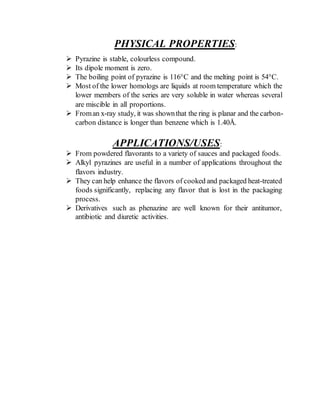
2. Reduction:
Pyrazines are readily reduced to saturated piperazines by sodium
and alcohol, aluminium amalgam, sodium amalgam, tin and hydrochloric
acid. Forexample, 2,5-diphenyl-3,6-dihydropyrazine was obtained when 2,5-
diphenylpyrazine was treated with hydriodic acid and red phosphorus.
2,5-diphenylpyrazine 2,5-diphenyl-3,6-dihydropyrazine
PHYSICAL PROPERTIES:
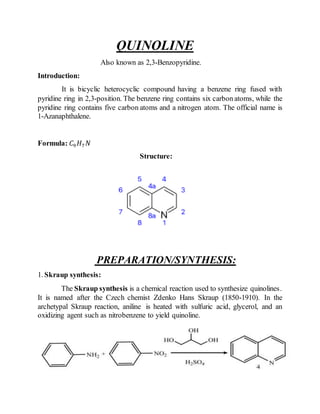
 Pyrazine is stable, colourless compound.
 Its dipole moment is zero.
 The boiling point of pyrazine is 116°C and the melting point is 54°C.
 Most of the lower homologs are liquids at room temperature which the
lower members of the series are very soluble in water whereas several
are miscible in all proportions.
 Froman x-ray study, it was shownthat the ring is planar and the carbon-
carbon distance is longer than benzene which is 1.40Å.
APPLICATIONS/USES:
 From powdered flavorants to a variety of sauces and packaged foods.
 Alkyl pyrazines are useful in a number of applications throughout the
flavors industry.
 They can help enhance the flavors of cooked and packaged heat-treated
foods significantly, replacing any flavor that is lost in the packaging
process.
 Derivatives such as phenazine are well known for their antitumor,
antibiotic and diuretic activities.
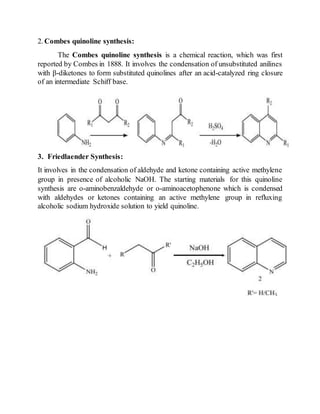
QUINOLINE
Also known as 2,3-Benzopyridine.
Introduction:
It is bicyclic heterocyclic compound having a benzene ring fused with
pyridine ring in 2,3-position. The benzene ring contains six carbon atoms, while the
pyridine ring contains five carbon atoms and a nitrogen atom. The official name is
1-Azanaphthalene.
Formula: 𝐶9 𝐻7 𝑁
Structure:
PREPARATION/SYNTHESIS:
1. Skraup synthesis:
The Skraup synthesis is a chemical reaction used to synthesize quinolines.
It is named after the Czech chemist Zdenko Hans Skraup (1850-1910). In the
archetypal Skraup reaction, aniline is heated with sulfuric acid, glycerol, and an
oxidizing agent such as nitrobenzene to yield quinoline.
2. Combes quinoline synthesis:
The Combes quinoline synthesis is a chemical reaction, which was first
reported by Combes in 1888. It involves the condensation of unsubstituted anilines
with β-diketones to form substituted quinolines after an acid-catalyzed ring closure
of an intermediate Schiff base.
3. Friedlaender Synthesis:
It involves in the condensation of aldehyde and ketone containing active methylene
group in presence of alcoholic NaOH. The starting materials for this quinoline
synthesis are o-aminobenzaldehyde or o-aminoacetophenone which is condensed
with aldehydes or ketones containing an active methylene group in refluxing
alcoholic sodium hydroxide solution to yield quinoline.
CHEMICAL PROPERTIES:
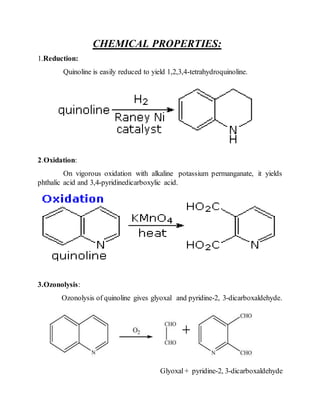
1.Reduction:
Quinoline is easily reduced to yield 1,2,3,4-tetrahydroquinoline.
2.Oxidation:
On vigorous oxidation with alkaline potassium permanganate, it yields
phthalic acid and 3,4-pyridinedicarboxylic acid.
3.Ozonolysis:
Ozonolysis of quinoline gives glyoxal and pyridine-2, 3-dicarboxaldehyde.
Glyoxal+ pyridine-2, 3-dicarboxaldehyde
PHYSICAL PROPERTIES:
 It has Boiling Point 238ᵒC and Melting Point -15ᵒC.
 Its Density/Specific Gravity is 1.0899.
 Quinoline is a hygroscopic liquid with a penetrating odor.
 Quinoline is slightly soluble in cold water, more easily in hot water; and
miscible with alcohol, ether, and carbon disulfide.
 Quinoline will exist in the atmosphere in the gas phase.
APPLICATIONS/USES:
 Quinoline is used in the manufacture of dyes.
 The preparation of hydroxyquinoline sulfate and niacin.
 It is also used as a solvent for resins and terpenes.
 Quinoline yellow is used to give food a greenish-yellow/lemon-lime colour
 It may be found in products like juices or sorbet.
 Quinoline is mainly used as in the production of other specialty chemical.
ISOQUINOLINE
Introduction:
Isoquinoline is a heterocyclic aromatic organic compound. It is a structural
isomer of quinoline. Isoquinoline and quinoline are benzopyridines, which are
composed of a benzene ring fused to a pyridine ring.
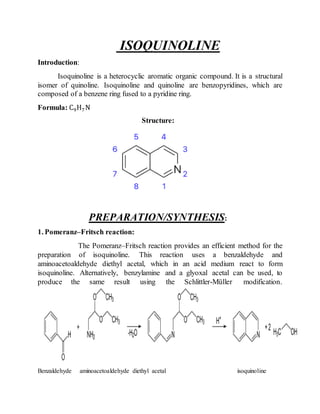
Formula: C9H7N
Structure:
PREPARATION/SYNTHESIS:
1. Pomeranz–Fritsch reaction:
The Pomeranz–Fritsch reaction provides an efficient method for the
preparation of isoquinoline. This reaction uses a benzaldehyde and
aminoacetoaldehyde diethyl acetal, which in an acid medium react to form
isoquinoline. Alternatively, benzylamine and a glyoxal acetal can be used, to
produce the same result using the Schlittler-Müller modification.
Benzaldehyde aminoacetoaldehyde diethyl acetal isoquinoline
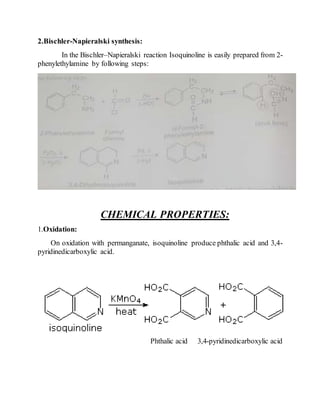
2.Bischler-Napieralski synthesis:
In the Bischler–Napieralski reaction Isoquinoline is easily prepared from 2-
phenylethylamine by following steps:
CHEMICAL PROPERTIES:
1.Oxidation:
On oxidation with permanganate, isoquinoline produce phthalic acid and 3,4-
pyridinedicarboxylic acid.
Phthalic acid 3,4-pyridinedicarboxylic acid
2. Reduction:
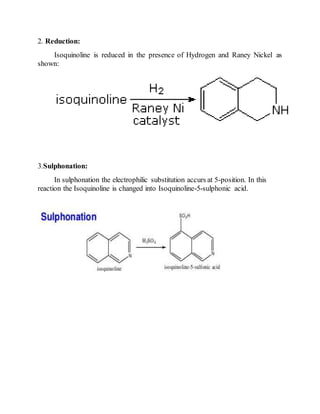
Isoquinoline is reduced in the presence of Hydrogen and Raney Nickel as
shown:
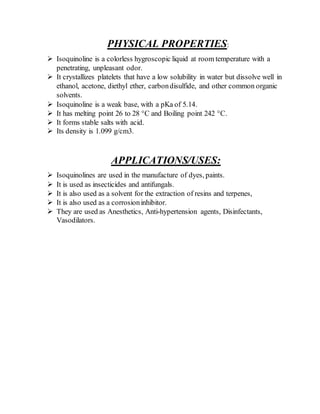
3.Sulphonation:
In sulphonation the electrophilic substitution accurs at 5-position. In this
reaction the Isoquinoline is changed into Isoquinoline-5-sulphonic acid.
PHYSICAL PROPERTIES:
 Isoquinoline is a colorless hygroscopic liquid at room temperature with a
penetrating, unpleasant odor.
 It crystallizes platelets that have a low solubility in water but dissolve well in
ethanol, acetone, diethyl ether, carbondisulfide, and other common organic
solvents.
 Isoquinoline is a weak base, with a pKa of 5.14.
 It has melting point 26 to 28 °C and Boiling point 242 °C.
 It forms stable salts with acid.
 Its density is 1.099 g/cm3.
APPLICATIONS/USES:
 Isoquinolines are used in the manufacture of dyes, paints.
 It is used as insecticides and antifungals.
 It is also used as a solvent for the extraction of resins and terpenes,
 It is also used as a corrosioninhibitor.
 They are used as Anesthetics, Anti-hypertension agents, Disinfectants,
Vasodilators.

A complete guide to Hetero-cyclic Compounds

  • 1.
    ORGANIC CHEMISTRY ASSIGNMENT HETEROCYCLICCHEMISTRY: Heterocyclic chemistry is the branch of organic chemistry dealing with the synthesis, properties, and applications of these heterocycles. HETEROCYCLIC COMOUNDS: A heterocyclic compound or ring structure is a cyclic compound that has atoms of at least two different elements as members of its ring. Example: Nucleic acids, the majority of drugs, most biomass and many natural and synthetic dyes.
  • 2.
    FURAN Introduction: Furan isa heterocyclic organic compound, consisting of a five- membered aromatic ring with four carbonatoms and one oxygen. Chemical compounds containing such rings also referred as Furans. Formula: 𝐶4 𝐻4 𝑂 Molarmass: 68.07 g/mol Structure: All ring atoms are sp2 hybridized. SYNTHESIS/PREPARATION:  Furan is best prepared by heating pyromucic acid or furoic acid which is Chiefly obtained by oxidation of furfural.
  • 3.
     Industrially, Furanis manufactured by palladium-catalyzed decarboxylation of furfural or by copper catalyzedoxidation of 1,3- butadiene.
  • 4.
    CHEMICAL PROPERTIES:  DIELSALDER REACTION: Furan is less aromatic than thiophene and pyrrole and is the only one of these which undergoes Diels Alder reaction. The cycloaddition of alkenes and dienes is a very useful method for forming substituted cyclohexenes. Diels-Alder reactions are stereospecific with respect to the E- and Z- relationship in both the dienophile and the diene. Forexample, addition of dimethyl fumarate and dimethyl maleate with cyclopentadiene is completely stereospecific with respect to the cis or trans orientation of the ester substituents.
  • 5.
    OR Similarly, E, E-2,4-hexadienegives a productthat is stereospecific with respectto the diene methyl groups.  Reduction: On catalytic reduction using rancy nickel or Pd-C/H2 catalyst, it forms Tetrahydrofuran (THF-an inert solvent) which breaks open on treatment with hydrogen chloride to form tetramethylene chlorohydrin.
  • 6.
     Furan iscatalytically reduced (Raney Ni or Pd-Pd/O) to tetrahydrofuran(THF). PHYSICAL PROPERTIES:  Furan is a colorless volatile liquid.  It’s boiling point is 31.4C and melting point -85.6C.  Furan having odorof chloroform.  Insoluble in water but soluble in most organic solvents.  It is stabled to alkalis, but is resinified by concentrated acids. APPLICATIONS/USES  Furan is used as a starting point for other specialty chemicals  Hydrogenation of furan over a nickel catalyst produces high yields of tetrahydrofuran and is a sourceof commercial tetrahydrofuran.  Furan may also be used as a starting material in the commercial production of thiophene.  Furan is used in the formation of lacquers and as a solvent for resins.  Used as an important chemical solvent.
  • 7.
    PYRROLE Also known asAzole. Introduction: It was first recognized by F.F Runge as a constituent of Coal Tar. Pyrrole is the most important of five-membered heterocyclic compounds. It is basically found in alkaloids, bile pigments, chlorophyll of plants and haemin of blood as they have pyrrole rings in their structures. Formula: 𝐶4 𝐻5 𝑁 Structure: All ring atoms are sp2 hybridized. SYNTHESIS / PREPARATIONS:  Industrially pyrrole is obtained by passing a mixture of furan and ammonia over alumina at 400ᵒC.
  • 8.
     It canbe obtained by heating 2-butyne-1,4-diolwith ammonia under Pressure CHEMICAL PROPERTIES: 1. Acidic Character: If it is reacted with metallic potassium in n-heptane as solvent, stable potassium pyrrolide is formed. 2. Electrophilic Substitution: Pyrrole undergoes electrophilic substitution at 2-position as in Nitration on heating at 5ᵒC.
  • 9.
    3. Reimer-Tiemann reaction:In the presence of strong base and chloroform pyrrole undergoes this reaction to form pyrrole-2-aldehyde. PHYSICAL PROPERTIES:  It is a colourless volatile liquid.  It’s boiling point is 131ᵒC and melting point is -23ᵒC.  It turns brown in air and gradually resinifies.  It is weakly basic in nature.  Only slightly soluble in water but is totally miscible in ether and ethanol. APPLICATIONS/USES:  Pyrrole and its derivatives are widely used as an intermediate in synthesis of pharmaceuticals.  Used in medicines.  Use in agrochemicals.  Use Dyes, photographic chemicals, perfumes and other organic compounds.  They are used as catalysts for polymerization process  Use as corrosioninhibitors.  Use as preservatives, and as solvents for resins and terpenes.  They are used as the standard of chromatographic analysis.  At last, they are also used in organic synthesis and the pharmaceutical industry.
  • 10.
    INDOLE Introduction: Indole is anaromatic heterocyclic compound. It has a bicyclic structure, consists of six-membered benzene Ring fused with five-membered pyrrole ring. It is widely distributed in natural environment and can be produced by a variety of bacteria. Structure:  Indole is actually 2,3-Benzopyrrole  Its formula is 𝐶8 𝐻7 𝑁 SYNTHESIS/PREPARATION:  Fischer-Indole Synthesis: When phenylhydrazone of pyruvic acid is heated with ZnCl2 catalyst, it yields indole -2-carboxylic acid which decarboxylates to indole.
  • 11.
     Mendelung Synthesis: WhenBenzamide is reacted in presence of BuLi or THf Catalyst. It Results in formation of an indol.  When benzamide is heated at 200-300 C in presence of NaNH2 it yields indole.
  • 12.
    CHEMICAL PROPERTIES: Chemically, itresembles pyrrole. It is Basic and gives Electrophilic substitution reactions such as nitration, halogenation at 3-position. Its derivatives Indoxyl exhibits tautomerism and behave as phenol.  Electrophilic substitution reactions: Nitration: Indole in presence of PhCOONO2gives nitro substitution reaction at 3-position and gives 3-nitro-1H-Indole.  Reactionwith acids: Indole reacts with acids and gives the formation of a Dimer.
  • 13.
     Reactionwith Metals: Indolein presence of KOH gives potassium salts of indole. As the reaction is given below. PHYSICAL PROPERTIES:  Indole forms colorless crystals.  Its melting point is 52.5C.  It has strong fecal odor.  Curiously enough, in dilute solution it has flowery odor.  Soluble in hot water, alcohol and ether. APPLICATION/USES:  It occurs in blossomoil and jasmine oil  Natural jasmine oil used in perfume industries comprises of 2.5% of indole.  It occurs in coaltar and fecal matter as well.  Indole 3-carbinol is used in conditions such as cancer prevention, systemic lupus erythematosus, tumor inside respiratory tract.  Indole 3-carbinol is used to balance hormonal levels, detoxify the intestine and liver and to supportimmune system.  It is used in preventing breast cancer, colon cancer, fibromyalgia like diseases.
  • 14.
    THIOPENE Introduction: Thiophene is aheterocyclic compound consisting of a planar five- membered ring, it is aromatic as indicated by its extensive substitution reactions. It is a colorless liquid with a benzene-like odor. In most of its reactions, it resembles benzene. Formula: C4H4S Structure:  All rings atoms are sp2 hybridized. PREPARATION/SYNTHESIS:  By heating sodium succinate with phosphorus trisulphide. + 2𝑁𝑎𝑃𝑂2 𝑆 + S
  • 15.
     By thehigh-temperature reaction of sulphur with butane.  Thiophene can be synthesized by passing a mixture of acetylene and hydrogen sulfide through a tube containing alumina at 400°C. This method is commercially use. CHEMICAL PROPERTIES: Thiophene is a chemically stable compound, readily available. It is the simplest representative of an aromatic structure bearing sulfur.  Acylation:The Friedel-Crafts acylation of thiophenes generally gives good yield under controlled conditions. Acylation with anhydrides in presence of phosphoric acid is an efficient method.
  • 16.
     CondensationWith AldehydesAnd Ketones: Hydroxy alkyl thiophenes are unstable under the reaction conditions; chloroalkylation can however be achieved. Care is needed in choosing condition; there is a tendency for formation of either di-2- thienylmethanes or 2, 5-bis(chloromethy1)thiophene.  Reduction: On reduction with sodium amalgam and ethanol, it is converted to tetrahydrothiophene. PHYSICAL PROPERTIES:  At room temperature, thiophene is a colorless liquid with a mildly pleasant odorreminiscent of benzene  Thiophene is a toxic and flammable aromatic compound.  It is insoluble in water but soluble in most organic solvents including alcohol and ether.  Melting Point of thiophene is -38°C while boiling point is 84°C.  Thiophene has a higher degree of stabilization than the analogous furan.
  • 17.
    APPLICATION/USES:  It isused for the production of dyes, synthetic resins, solvents, etc.  It is used for making drugs and plasticizers.  It is mainly used as the intermediates of pharmaceutical industry used for preparing thiophene acetic pyridine, and pyrantel.  It is used as a solvent.  Used for the manufacture of color films and trick photography.  Used for the synthesis of some complex reagent  It is an important intermediate in the synthesis of Bakelite.  Other derivatives can also be used as insecticides, fungicides, and animal and plant growth-promoting agent.  In addition, some derivatives of thiophene are also the component of organic semiconductors.
  • 18.
    PYRIDINE Also known asAzabezene. Introduction: Pyridine is a clear liquid with an odorthat is sour, putrid, and fish-like. It is a relatively simple heterocyclic aromatic organic compound that is structurally related to benzene, with one CH group in the six-membered ring replaced by a nitrogen atom. Formula: 𝐶5 𝐻5 𝑁 Structure:  All ring atoms of pyridine are sp2 hybridized. PREPARATION/SYNTHESIS: 1. Bonnemann cyclization: Its reaction is a trimerization of two molecules of acetylene and a nitrile molecule, in present of heat or light.
  • 19.
    2. From Acroleinwith folloing steps: 3. By heating a mixture of acetylene, ammonia and formaldehydedimethylacetal in te presence of alumina at 500ᵒC
  • 20.
    CHEMICAL PRPERTIES:  Chlorination: Chlorinationof pyridine is very simple as.  Reduction: Piperidine is produced by hydrogenation of pyridine with a nickel-, cobalt-, or ruthenium-based catalyst at elevated temperatures.  Oxidatio: Oxidation of pyridine occurs at nitrogen to give pyridine-N- oxiden 𝑪 𝟓 𝑯 𝟓N + R𝑪𝑶 𝟑H → 𝑪 𝟓 𝑯 𝟓NO + R𝑪𝑶 𝟐H
  • 21.
    PHYSICAL PROPERTIES:  Pyridineis a colorless liquid.  It boils at 115 degrees Celsius (239 F) and freezes at -42 degrees Celsius (-43.6 F).  Its density is very close to that of water, at 0.982 g/cm3 (water's density is 1).  It is able to mix easily with water and most other organic solvents.  Pyridine is diamagnetic and has a diamagnetic susceptibility. APPLICATIONS/USES:  Pyridine is used to dissolve other substances.  It is also used to make many different products such as medicines.  Vitamins.  Food flavorings.  Paints, dyes.  Rubber products, adhesives.  Insecticides, and herbicides.
  • 22.
    PYRIMIDINE Introduction: Pyrimidine is anaromatic heterocyclic organic compound similar to pyridine. One of the three diazines (six-membered heterocyclics with two nitrogen atoms in the ring), it has the nitrogen atoms at positions 1 and 3 in the ring. Formula: 𝐶4 𝐻4 𝑁2 Structure: PREPARATION/SYNTHESIS: 1.Begenilli synthesis: Synthesis of starting material by Biginelli reaction includes condensation of acetylacetone, urea with furfulaledehyde. Mixture of acetylacetone, urea and furfulaledehyde were subjected for microwave irradiation in presence of catalytic amount of HCL for 4 minutes.
  • 23.
    2.Synthesis by MalonicEster: The malonic ester synthesis is a chemical reaction where diethyl malonate or another ester of malonic acid is alkylated at the carbon alpha (directly adjacent) to both carbonyl groups.
  • 24.
    3.Synthesis by Amidines: Inthe 1880s, pinner found that the amidine derivative reacted with acetoacetic ester to give2-substituted-6-hydroxy-4-methylpyrimidine. CHEMICAL PROPERTIES: 1. Bromination: In this reaction the electron donating group is donated at 5-position as in bromination the 2-methylpyrimidine reacts with 𝐵𝑟2 - Nitrobenzene to from 5- bromo-2-methylpyrimidine. 2. Formylation: In this reaction the 2-methylpyrimidine is reacted with HCL-HCN to form 2-methylpyrimidine-5-carbaldehyde.
  • 25.
    3. Reaction withoxidizing agent: Pyrimidine is oxidized slowlywhile alkyl substitutedpyrimidines are oxidized readilyto N-oxide with peroxy acids. PHYSICAL PROPERTIES:  Density is 1.016 g cm−3.  Its melting point is 20 to 22 °C.  Its boiling point is 123 to 124 °C.  It is 24% Miscible in water.  Its acidity pKa is 1.10.
  • 26.
    APPLICATIONS/USES:  In medicinalchemistry pyrimidine derivatives have been very well known for their therapeutic applications.  The presence of a pyrimidine base in thymine, cytosine and uracil, which are the essential binding blocks of nucleic acids, DNA and RNA is one possible reason for their activity.  Use as anticancer, antiviral, anti-HIV, antibacterial, antihypertensive, barbiturates e.g. phenobarbitone as sedative, hypnotics and anticonvulsant, antibiotics.  Most drugs in the pyrimidine series fall in to four categories; the barbiturates, the sulphonamide; the antimicrobials and antitumor agents.
  • 27.
    𝑷𝒀𝑹𝑨𝒁𝑰𝑵𝑬 Introduction: Pyrazine is aheterocyclic aromatic organic compound. Pyrazine is a symmetrical molecule with point group D2h. Pyrazine is less basic than pyridine, pyridazine and pyrimidine. Formula:𝐶4 𝐻4 𝑁2 Structure: PREPARATION/SYNTHESIS: 1. Gutknecht pyrazine synthesis: 2-chloroacetophenone is reacted with ammonia to the amino ketone, then condensed and then oxidized to a pyrazine. A variation is the Gutknecht pyrazine synthesis (1879) also based on this selfcondensation, but differing in the way the alpha-ketoamine is synthesized.
  • 28.
    2. When Ethylenediaminereacts with glyoxal removal of water take place and first the intermediate product is 2,3-dihydropyrazine that ultimately leads to formation of Pyrazine. 3. By microwaves: In this method, the formation of substituted pyrazines were obtained by the interaction of 2-chloropyrazine (11) with the nucleophiles of PhSNa, MeSNa, EtONa and PhONa in N-methylpyrrolidone (NMP) which gave the desired substitution products in a good yield of (69 – 96)%.
  • 29.
    CHEMICAL PROPERTIES: 1.Oxidation: Pyrazine undergoesoxidation process, whereby it decolarises cold alkaline solution of permanganate but pyrazine is less stable than pyridine to the action of oxidizing agents. 2. Reduction: Pyrazines are readily reduced to saturated piperazines by sodium and alcohol, aluminium amalgam, sodium amalgam, tin and hydrochloric acid. Forexample, 2,5-diphenyl-3,6-dihydropyrazine was obtained when 2,5- diphenylpyrazine was treated with hydriodic acid and red phosphorus. 2,5-diphenylpyrazine 2,5-diphenyl-3,6-dihydropyrazine
  • 30.
    PHYSICAL PROPERTIES:  Pyrazineis stable, colourless compound.  Its dipole moment is zero.  The boiling point of pyrazine is 116°C and the melting point is 54°C.  Most of the lower homologs are liquids at room temperature which the lower members of the series are very soluble in water whereas several are miscible in all proportions.  Froman x-ray study, it was shownthat the ring is planar and the carbon- carbon distance is longer than benzene which is 1.40Å. APPLICATIONS/USES:  From powdered flavorants to a variety of sauces and packaged foods.  Alkyl pyrazines are useful in a number of applications throughout the flavors industry.  They can help enhance the flavors of cooked and packaged heat-treated foods significantly, replacing any flavor that is lost in the packaging process.  Derivatives such as phenazine are well known for their antitumor, antibiotic and diuretic activities.
  • 31.
    QUINOLINE Also known as2,3-Benzopyridine. Introduction: It is bicyclic heterocyclic compound having a benzene ring fused with pyridine ring in 2,3-position. The benzene ring contains six carbon atoms, while the pyridine ring contains five carbon atoms and a nitrogen atom. The official name is 1-Azanaphthalene. Formula: 𝐶9 𝐻7 𝑁 Structure: PREPARATION/SYNTHESIS: 1. Skraup synthesis: The Skraup synthesis is a chemical reaction used to synthesize quinolines. It is named after the Czech chemist Zdenko Hans Skraup (1850-1910). In the archetypal Skraup reaction, aniline is heated with sulfuric acid, glycerol, and an oxidizing agent such as nitrobenzene to yield quinoline.
  • 32.
    2. Combes quinolinesynthesis: The Combes quinoline synthesis is a chemical reaction, which was first reported by Combes in 1888. It involves the condensation of unsubstituted anilines with β-diketones to form substituted quinolines after an acid-catalyzed ring closure of an intermediate Schiff base. 3. Friedlaender Synthesis: It involves in the condensation of aldehyde and ketone containing active methylene group in presence of alcoholic NaOH. The starting materials for this quinoline synthesis are o-aminobenzaldehyde or o-aminoacetophenone which is condensed with aldehydes or ketones containing an active methylene group in refluxing alcoholic sodium hydroxide solution to yield quinoline.
  • 33.
    CHEMICAL PROPERTIES: 1.Reduction: Quinoline iseasily reduced to yield 1,2,3,4-tetrahydroquinoline. 2.Oxidation: On vigorous oxidation with alkaline potassium permanganate, it yields phthalic acid and 3,4-pyridinedicarboxylic acid. 3.Ozonolysis: Ozonolysis of quinoline gives glyoxal and pyridine-2, 3-dicarboxaldehyde. Glyoxal+ pyridine-2, 3-dicarboxaldehyde
  • 34.
    PHYSICAL PROPERTIES:  Ithas Boiling Point 238ᵒC and Melting Point -15ᵒC.  Its Density/Specific Gravity is 1.0899.  Quinoline is a hygroscopic liquid with a penetrating odor.  Quinoline is slightly soluble in cold water, more easily in hot water; and miscible with alcohol, ether, and carbon disulfide.  Quinoline will exist in the atmosphere in the gas phase. APPLICATIONS/USES:  Quinoline is used in the manufacture of dyes.  The preparation of hydroxyquinoline sulfate and niacin.  It is also used as a solvent for resins and terpenes.  Quinoline yellow is used to give food a greenish-yellow/lemon-lime colour  It may be found in products like juices or sorbet.  Quinoline is mainly used as in the production of other specialty chemical.
  • 35.
    ISOQUINOLINE Introduction: Isoquinoline is aheterocyclic aromatic organic compound. It is a structural isomer of quinoline. Isoquinoline and quinoline are benzopyridines, which are composed of a benzene ring fused to a pyridine ring. Formula: C9H7N Structure: PREPARATION/SYNTHESIS: 1. Pomeranz–Fritsch reaction: The Pomeranz–Fritsch reaction provides an efficient method for the preparation of isoquinoline. This reaction uses a benzaldehyde and aminoacetoaldehyde diethyl acetal, which in an acid medium react to form isoquinoline. Alternatively, benzylamine and a glyoxal acetal can be used, to produce the same result using the Schlittler-Müller modification. Benzaldehyde aminoacetoaldehyde diethyl acetal isoquinoline
  • 36.
    2.Bischler-Napieralski synthesis: In theBischler–Napieralski reaction Isoquinoline is easily prepared from 2- phenylethylamine by following steps: CHEMICAL PROPERTIES: 1.Oxidation: On oxidation with permanganate, isoquinoline produce phthalic acid and 3,4- pyridinedicarboxylic acid. Phthalic acid 3,4-pyridinedicarboxylic acid
  • 37.
    2. Reduction: Isoquinoline isreduced in the presence of Hydrogen and Raney Nickel as shown: 3.Sulphonation: In sulphonation the electrophilic substitution accurs at 5-position. In this reaction the Isoquinoline is changed into Isoquinoline-5-sulphonic acid.
  • 38.
    PHYSICAL PROPERTIES:  Isoquinolineis a colorless hygroscopic liquid at room temperature with a penetrating, unpleasant odor.  It crystallizes platelets that have a low solubility in water but dissolve well in ethanol, acetone, diethyl ether, carbondisulfide, and other common organic solvents.  Isoquinoline is a weak base, with a pKa of 5.14.  It has melting point 26 to 28 °C and Boiling point 242 °C.  It forms stable salts with acid.  Its density is 1.099 g/cm3. APPLICATIONS/USES:  Isoquinolines are used in the manufacture of dyes, paints.  It is used as insecticides and antifungals.  It is also used as a solvent for the extraction of resins and terpenes,  It is also used as a corrosioninhibitor.  They are used as Anesthetics, Anti-hypertension agents, Disinfectants, Vasodilators.