1
What is Soap ?
SOAP AND
DETERGENT
2
What is Soap?
• Soaps are sodium or potassium salts of long-chain fatty
acids. The general formula of a soap can be written as:
RCOO-
K+
or RCOO-
Na+
.
• Where R is alkyl group, can be saturated or unsaturated
which is consist of 12 to 18 carbons atom.
Example:
Sodium palmitate, CH3(CH2)14 COO-
Na+
Potassium stearate,CH3(CH2)16COO-
K+
Note: State several types of alkyl group
3
Soap Preparation
Process
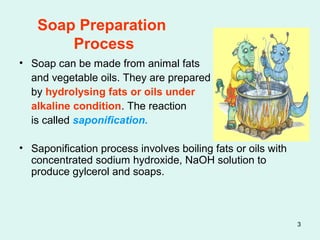
• Soap can be made from animal fats
and vegetable oils. They are prepared
by hydrolysing fats or oils under
alkaline condition. The reaction
is called saponification.
• Saponification process involves boiling fats or oils with
concentrated sodium hydroxide, NaOH solution to
produce gylcerol and soaps.
4
General Equation
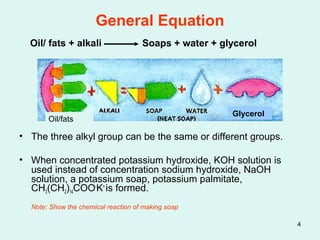
Oil/ fats + alkali Soaps + water + glycerol
• The three alkyl group can be the same or different groups.
• When concentrated potassium hydroxide, KOH solution is
used instead of concentration sodium hydroxide, NaOH
solution, a potassium soap, potassium palmitate,
CH3(CH2)14COO-
K+
is formed.
Note: Show the chemical reaction of making soap
Glycerol
Oil/fats
5
What is Detergent
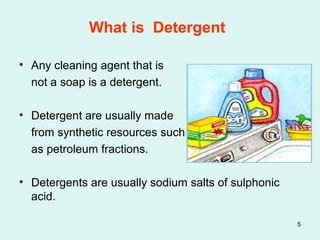
• Any cleaning agent that is
not a soap is a detergent.
• Detergent are usually made
from synthetic resources such
as petroleum fractions.
• Detergents are usually sodium salts of sulphonic
acid.
6
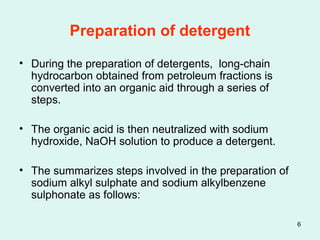
Preparation of detergent
• During the preparation of detergents, long-chain
hydrocarbon obtained from petroleum fractions is
converted into an organic aid through a series of
steps.
• The organic acid is then neutralized with sodium
hydroxide, NaOH solution to produce a detergent.
• The summarizes steps involved in the preparation of
sodium alkyl sulphate and sodium alkylbenzene
sulphonate as follows:
7
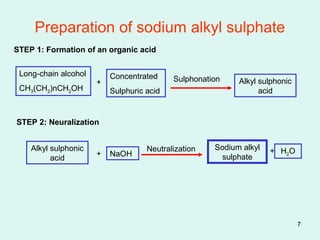
Preparation of sodium alkyl sulphate
Long-chain alcohol
CH3(CH2)nCH2OH
Sulphonation Alkyl sulphonic
acid
+
Concentrated
Sulphuric acid
STEP 1: Formation of an organic acid
STEP 2: Neuralization
Alkyl sulphonic
acid
+ NaOH
Neutralization Sodium alkyl
sulphate
H2O+
8
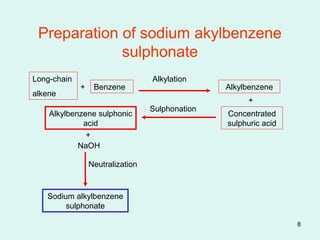
Preparation of sodium akylbenzene
sulphonate
Long-chain
alkene
+ Benzene Alkylbenzene
Alkylation
+
Concentrated
sulphuric acid
Sulphonation
Alkylbenzene sulphonic
acid
Neutralization
Sodium alkylbenzene
sulphonate
+
NaOH
9
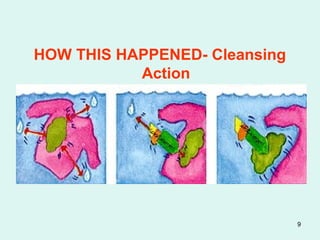
HOW THIS HAPPENED- Cleansing
Action
10
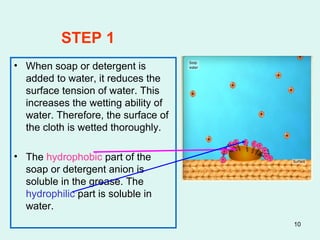
STEP 1
• When soap or detergent is
added to water, it reduces the
surface tension of water. This
increases the wetting ability of
water. Therefore, the surface of
the cloth is wetted thoroughly.
• The hydrophobic part of the
soap or detergent anion is
soluble in the grease. The
hydrophilic part is soluble in
water.
11
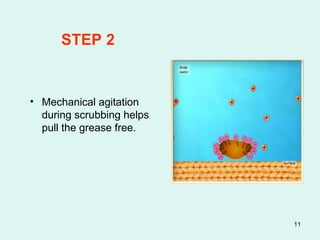
STEP 2
• Mechanical agitation
during scrubbing helps
pull the grease free.
12
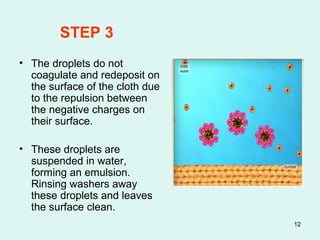
STEP 3
• The droplets do not
coagulate and redeposit on
the surface of the cloth due
to the repulsion between
the negative charges on
their surface.
• These droplets are
suspended in water,
forming an emulsion.
Rinsing washers away
these droplets and leaves
the surface clean.
13
How Water Hardness
Affects Cleaning Action
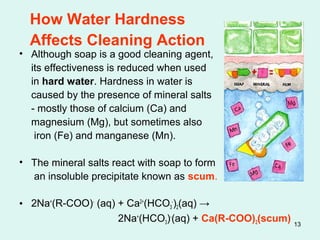
• Although soap is a good cleaning agent,
its effectiveness is reduced when used
in hard water. Hardness in water is
caused by the presence of mineral salts
- mostly those of calcium (Ca) and
magnesium (Mg), but sometimes also
iron (Fe) and manganese (Mn).
• The mineral salts react with soap to form
an insoluble precipitate known as scum.
• 2Na+
(R-COO)-
(aq) + Ca2+
(HCO3
-
)2(aq) →
2Na+
(HCO3)-
(aq) + Ca(R-COO)2(scum)
14
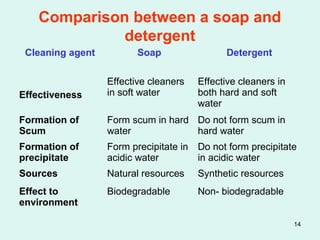
Comparison between a soap and
detergent
Cleaning agent Soap Detergent
Effectiveness
Effective cleaners
in soft water
Effective cleaners in
both hard and soft
water
Formation of
Scum
Form scum in hard
water
Do not form scum in
hard water
Formation of
precipitate
Form precipitate in
acidic water
Do not form precipitate
in acidic water
Sources Natural resources Synthetic resources
Effect to
environment
Biodegradable Non- biodegradable

Soap and detegents

  • 1.
    1 What is Soap? SOAP AND DETERGENT
  • 2.
    2 What is Soap? •Soaps are sodium or potassium salts of long-chain fatty acids. The general formula of a soap can be written as: RCOO- K+ or RCOO- Na+ . • Where R is alkyl group, can be saturated or unsaturated which is consist of 12 to 18 carbons atom. Example: Sodium palmitate, CH3(CH2)14 COO- Na+ Potassium stearate,CH3(CH2)16COO- K+ Note: State several types of alkyl group
  • 3.
    3 Soap Preparation Process • Soapcan be made from animal fats and vegetable oils. They are prepared by hydrolysing fats or oils under alkaline condition. The reaction is called saponification. • Saponification process involves boiling fats or oils with concentrated sodium hydroxide, NaOH solution to produce gylcerol and soaps.
  • 4.
    4 General Equation Oil/ fats+ alkali Soaps + water + glycerol • The three alkyl group can be the same or different groups. • When concentrated potassium hydroxide, KOH solution is used instead of concentration sodium hydroxide, NaOH solution, a potassium soap, potassium palmitate, CH3(CH2)14COO- K+ is formed. Note: Show the chemical reaction of making soap Glycerol Oil/fats
  • 5.
    5 What is Detergent •Any cleaning agent that is not a soap is a detergent. • Detergent are usually made from synthetic resources such as petroleum fractions. • Detergents are usually sodium salts of sulphonic acid.
  • 6.
    6 Preparation of detergent •During the preparation of detergents, long-chain hydrocarbon obtained from petroleum fractions is converted into an organic aid through a series of steps. • The organic acid is then neutralized with sodium hydroxide, NaOH solution to produce a detergent. • The summarizes steps involved in the preparation of sodium alkyl sulphate and sodium alkylbenzene sulphonate as follows:
  • 7.
    7 Preparation of sodiumalkyl sulphate Long-chain alcohol CH3(CH2)nCH2OH Sulphonation Alkyl sulphonic acid + Concentrated Sulphuric acid STEP 1: Formation of an organic acid STEP 2: Neuralization Alkyl sulphonic acid + NaOH Neutralization Sodium alkyl sulphate H2O+
  • 8.
    8 Preparation of sodiumakylbenzene sulphonate Long-chain alkene + Benzene Alkylbenzene Alkylation + Concentrated sulphuric acid Sulphonation Alkylbenzene sulphonic acid Neutralization Sodium alkylbenzene sulphonate + NaOH
  • 9.
    9 HOW THIS HAPPENED-Cleansing Action
  • 10.
    10 STEP 1 • Whensoap or detergent is added to water, it reduces the surface tension of water. This increases the wetting ability of water. Therefore, the surface of the cloth is wetted thoroughly. • The hydrophobic part of the soap or detergent anion is soluble in the grease. The hydrophilic part is soluble in water.
  • 11.
    11 STEP 2 • Mechanicalagitation during scrubbing helps pull the grease free.
  • 12.
    12 STEP 3 • Thedroplets do not coagulate and redeposit on the surface of the cloth due to the repulsion between the negative charges on their surface. • These droplets are suspended in water, forming an emulsion. Rinsing washers away these droplets and leaves the surface clean.
  • 13.
    13 How Water Hardness AffectsCleaning Action • Although soap is a good cleaning agent, its effectiveness is reduced when used in hard water. Hardness in water is caused by the presence of mineral salts - mostly those of calcium (Ca) and magnesium (Mg), but sometimes also iron (Fe) and manganese (Mn). • The mineral salts react with soap to form an insoluble precipitate known as scum. • 2Na+ (R-COO)- (aq) + Ca2+ (HCO3 - )2(aq) → 2Na+ (HCO3)- (aq) + Ca(R-COO)2(scum)
  • 14.
    14 Comparison between asoap and detergent Cleaning agent Soap Detergent Effectiveness Effective cleaners in soft water Effective cleaners in both hard and soft water Formation of Scum Form scum in hard water Do not form scum in hard water Formation of precipitate Form precipitate in acidic water Do not form precipitate in acidic water Sources Natural resources Synthetic resources Effect to environment Biodegradable Non- biodegradable