
CONTENT:CONTENT:
ORES AND MINERALSORES AND MINERALS
EXTRACTIONEXTRACTION
OF MINERALSOF MINERALS
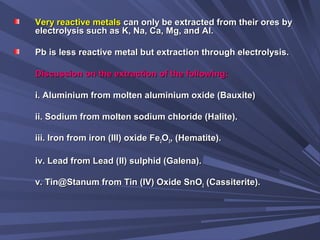
Very reactive metalsVery reactive metals can only be extracted from their ores bycan only be extracted from their ores by
electrolysis such as K, Na, Ca, Mg, and Al.electrolysis such as K, Na, Ca, Mg, and Al.
Pb is less reactive metal but extraction through electrolysis.Pb is less reactive metal but extraction through electrolysis.
Discussion on the extraction of the following:Discussion on the extraction of the following:
i. Aluminium from molten aluminium oxide (Bauxite)i. Aluminium from molten aluminium oxide (Bauxite)
ii. Sodium from molten sodium chloride (Halite).ii. Sodium from molten sodium chloride (Halite).
iii. Iron from iron (III) oxide Feiii. Iron from iron (III) oxide Fe22OO33, (Hematite)., (Hematite).
iv. Lead from Lead (II) sulphid (Galena).iv. Lead from Lead (II) sulphid (Galena).
v. Tin@Stanum from Tin (IV) Oxide SnOv. Tin@Stanum from Tin (IV) Oxide SnO22 (Cassiterite).(Cassiterite).
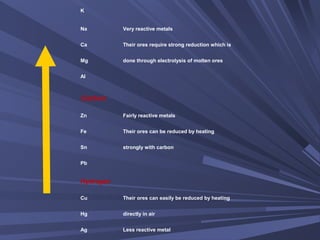
K
Na Very reactive metals
Ca Their ores require strong reduction which is
Mg done through electrolysis of molten ores
Al
Carbon
Zn Fairly reactive metals
Fe Their ores can be reduced by heating
Sn strongly with carbon
Pb
Hydrogen
Cu Their ores can easily be reduced by heating
Hg directly in air
Ag Less reactive metal
EXTRACTION OFEXTRACTION OF
TIN@STANUM, SnTIN@STANUM, Sn
RoastedRoasted
Heated with
coke and
limestone in
blast furnace
Heated with
coke and
limestone in
blast furnace
Molten tin is
drawn off and
moulded
Molten tin is
drawn off and
moulded
Tin block
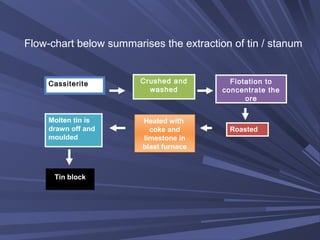
Cassiterite Crushed and
washed
Crushed and
washed
Flotation to
concentrate the
ore
Flotation to
concentrate the
ore
Flow-chart below summarises the extraction of tin / stanum
The main ore of tin is cassiterite which contains tinThe main ore of tin is cassiterite which contains tin
(IV) oxide, SnO(IV) oxide, SnO22..
The ore is first crushed, grounded and washed.The ore is first crushed, grounded and washed.
Then the ore is concentrated by mixing it with oilThen the ore is concentrated by mixing it with oil
and water. In this flotation method, the tinand water. In this flotation method, the tin
minerals, which are less dense, are trapped in theminerals, which are less dense, are trapped in the
floating form.floating form.
The impurities such as soil and sand which areThe impurities such as soil and sand which are
denser, sink to the bottom.denser, sink to the bottom.
The concentrated ore is then roasted in theThe concentrated ore is then roasted in the
air. This converts the sulphide of tin toair. This converts the sulphide of tin to
oxide. At the same time, impurities such asoxide. At the same time, impurities such as
sulphur and oil are burnt off.sulphur and oil are burnt off.
The reduction of tin (IV) oxide to extractedThe reduction of tin (IV) oxide to extracted
tin takes place in the blast furnace bytin takes place in the blast furnace by
carbon monoxide and coke.carbon monoxide and coke.
SnOSnO22 + 2CO → Sn + 2CO+ 2CO → Sn + 2CO22
SnOSnO22 + 2C → Sn + 2CO+ 2C → Sn + 2CO
SnOSnO22 + C → Sn + CO+ C → Sn + CO22
The molten tin is drained off into moulds toThe molten tin is drained off into moulds to
become blocks.become blocks.
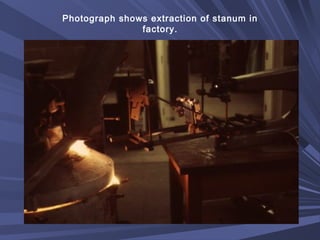
Photograph shows extraction of stanum in
factory.
Properties of Stanum, SnProperties of Stanum, Sn
– Melting point 232Melting point 232oo
CC
– Boiling point 2603Boiling point 2603oo
CC
– Silvery in colourSilvery in colour
– Highly ductile and malleable atHighly ductile and malleable at
temperature 100temperature 100oo
CC
Uses of Stanum, Sn in daily lifeUses of Stanum, Sn in daily life
Stanum/tin is widely used in alloy making forStanum/tin is widely used in alloy making for
example:example:
i.i. Produce bronze as alloy (70% Cu + 30% Sn).Produce bronze as alloy (70% Cu + 30% Sn).
ii.ii. Industrial processes as in the form of:Industrial processes as in the form of:
Tinplate, pewter (96% Sn + 3 % Cu and 1% Sb) andTinplate, pewter (96% Sn + 3 % Cu and 1% Sb) and
solders (70% Pb + 30% Sn)solders (70% Pb + 30% Sn)
iii. In aerospace industry ( Stanum +Titanium ).iii. In aerospace industry ( Stanum +Titanium ).
iv. Ingredients in some insecticides.iv. Ingredients in some insecticides.
EXTRACTION OFEXTRACTION OF
ALUMINIUMALUMINIUM
Aluminium is extracted from its ore, bauxite whichAluminium is extracted from its ore, bauxite which
contains aluminium oxide Alcontains aluminium oxide Al22OO33 but not frombut not from
aluminium chloride because aluminium chloridealuminium chloride because aluminium chloride
does not melt when heated.does not melt when heated.
Aluminium oxide is mixed with cryolite, NaAluminium oxide is mixed with cryolite, Na33AlFAlF66
to lower the melting point of aluminium oxide fromto lower the melting point of aluminium oxide from
20452045oo
C to about 900C to about 900oo
CC..
4000A current is used to keep the temperature of4000A current is used to keep the temperature of
the electrolysis cell at 900the electrolysis cell at 900oo
C.C.
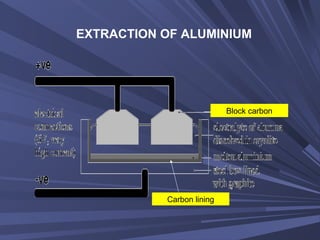
Block of carbon act as anodesBlock of carbon act as anodes
Carbon lining act as cathode.Carbon lining act as cathode.
EXTRACTION OF ALUMINIUM
Block carbon
Carbon lining
CCathodeathode, the aluminium ions are discharged to, the aluminium ions are discharged to
form aluminium metal.form aluminium metal.
AlAl3+3+
+ 3e → Al+ 3e → Al
AAnodenode, the oxide ions are discharged to form, the oxide ions are discharged to form
oxygen gas.oxygen gas.
2O2O2-2-
→ O→ O22 + 4e+ 4e--
The overall chemical reaction is:The overall chemical reaction is:
2Al2Al22OO33 → 4Al + 3O→ 4Al + 3O22
The oxygen liberated at the anode will reactThe oxygen liberated at the anode will react
with the carbon electrode to produce carbonwith the carbon electrode to produce carbon
dioxide gas.dioxide gas.
The anode is corroded slowly and must beThe anode is corroded slowly and must be
replaced form time to time.replaced form time to time.
Physical Properties of AluminiumPhysical Properties of Aluminium
1) Is strong.1) Is strong.
2)2) malleablemalleable ..
3) Low3) Low densitydensity..
4) Resistant to4) Resistant to corrosioncorrosion because the presencebecause the presence
of an impervious oxide layer on the surface ofof an impervious oxide layer on the surface of
aluminium.aluminium.
5) G5) Good conductorood conductor of heat and electricity.of heat and electricity.
6) Can be polished to give a highly reflective6) Can be polished to give a highly reflective
surface.surface.
Chemical properties of aluminiumChemical properties of aluminium
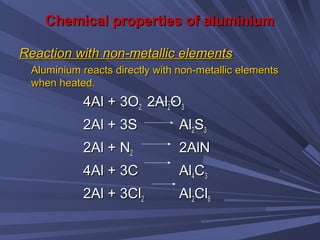
Reaction with non-metallic elementsReaction with non-metallic elements
Aluminium reacts directly with non-metallic elementsAluminium reacts directly with non-metallic elements
when heated.when heated.
4Al + 3O4Al + 3O22 2Al2Al22OO33
2Al + 3S2Al + 3S AlAl22SS33
2Al + N2Al + N22 2AlN2AlN
4Al + 3C4Al + 3C AlAl44CC33
2Al + 3Cl2Al + 3Cl22 AlAl22ClCl66
Chemical properties of AluminiumChemical properties of Aluminium
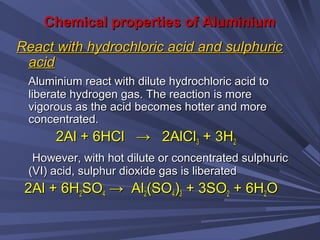
React with hydrochloric acid and sulphuricReact with hydrochloric acid and sulphuric
acidacid
Aluminium react with dilute hydrochloric acid toAluminium react with dilute hydrochloric acid to
liberate hydrogen gas. The reaction is moreliberate hydrogen gas. The reaction is more
vigorous as the acid becomes hotter and morevigorous as the acid becomes hotter and more
concentrated.concentrated.
2Al + 6HCl → 2AlCl2Al + 6HCl → 2AlCl33 + 3H+ 3H22
However, with hot dilute or concentrated sulphuricHowever, with hot dilute or concentrated sulphuric
(VI) acid, sulphur dioxide gas is liberated(VI) acid, sulphur dioxide gas is liberated
2Al + 6H2Al + 6H22SOSO44 → Al→ Al22(SO(SO44))33 + 3SO+ 3SO22 + 6H+ 6H22OO
Chemical properties of aluminiumChemical properties of aluminium
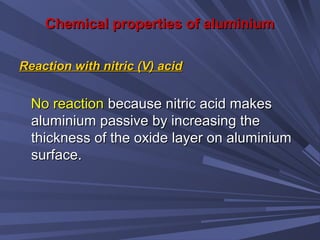
Reaction with nitric (V) acidReaction with nitric (V) acid
No reactionNo reaction because nitric acid makesbecause nitric acid makes
aluminium passive by increasing thealuminium passive by increasing the
thickness of the oxide layer on aluminiumthickness of the oxide layer on aluminium
surface.surface.
Chemical properties of aluminiumChemical properties of aluminium
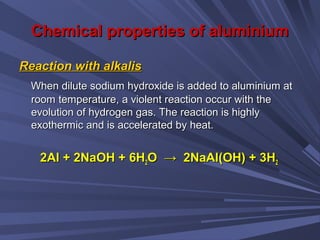
Reaction with alkalisReaction with alkalis
When dilute sodium hydroxide is added to aluminium atWhen dilute sodium hydroxide is added to aluminium at
room temperature, a violent reaction occur with theroom temperature, a violent reaction occur with the
evolution of hydrogen gas. The reaction is highlyevolution of hydrogen gas. The reaction is highly
exothermic and is accelerated by heat.exothermic and is accelerated by heat.
2Al + 2NaOH + 6H2Al + 2NaOH + 6H22O → 2NaAl(OH) + 3HO → 2NaAl(OH) + 3H22
Uses of AluminiumUses of Aluminium
Low density and strength make it ideal forLow density and strength make it ideal for
construction of aircraft, lightweight vehicles, andconstruction of aircraft, lightweight vehicles, and
ladders.ladders.
An alloy of aluminium calledAn alloy of aluminium called duraluminduralumin andand
magnaliummagnalium is often used instead of pureis often used instead of pure
aluminium because of its improved properties.aluminium because of its improved properties.
Easy shaping and corrosion resistance make it aEasy shaping and corrosion resistance make it a
good material for drink cans and roofinggood material for drink cans and roofing
materialsmaterials
EXTRACTION OF IRONEXTRACTION OF IRON
Two important ores used in extracting iron areTwo important ores used in extracting iron are
hematite, Fehematite, Fe22OO33 and magnetite, Feand magnetite, Fe33OO44..
First, these ores undergo several processes toFirst, these ores undergo several processes to
remove the impurities.remove the impurities.
Then, the concentrated ores are reduced byThen, the concentrated ores are reduced by
carbon in the form of coke in a very large andcarbon in the form of coke in a very large and
hot furnace called blast furnace. Itshot furnace called blast furnace. Its
temperature can reach up 2000temperature can reach up 2000oo
C.C.
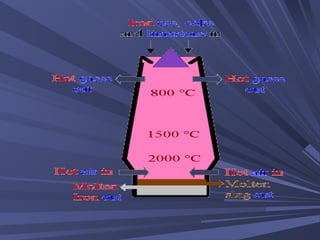
A small charge is introduced from theA small charge is introduced from the
top of the blast furnace at intervals oftop of the blast furnace at intervals of
10 to 15 minutes.10 to 15 minutes.
The charge consists of concentratedThe charge consists of concentrated
iron ores, coke and limestone.iron ores, coke and limestone.
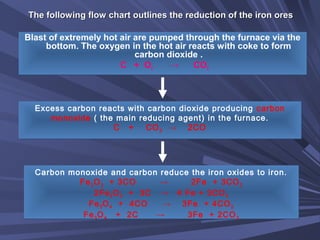
Blast of extremely hot air are pumped through the furnace via the
bottom. The oxygen in the hot air reacts with coke to form
carbon dioxide .
C + O2 → CO2
Blast of extremely hot air are pumped through the furnace via the
bottom. The oxygen in the hot air reacts with coke to form
carbon dioxide .
C + O2 → CO2
Excess carbon reacts with carbon dioxide producing carbon
monoxide ( the main reducing agent) in the furnace.
C + CO2 → 2CO
Excess carbon reacts with carbon dioxide producing carbon
monoxide ( the main reducing agent) in the furnace.
C + CO2 → 2CO
Carbon monoxide and carbon reduce the iron oxides to iron.
Fe2O3 + 3CO → 2Fe + 3CO2
2Fe2O3 + 3C → 4 Fe + 3CO2
Fe3O4 + 4CO → 3Fe + 4CO2
Fe3O4 + 2C → 3Fe + 2CO2
Carbon monoxide and carbon reduce the iron oxides to iron.
Fe2O3 + 3CO → 2Fe + 3CO2
2Fe2O3 + 3C → 4 Fe + 3CO2
Fe3O4 + 4CO → 3Fe + 4CO2
Fe3O4 + 2C → 3Fe + 2CO2
The following flow chart outlines the reduction of the iron oresThe following flow chart outlines the reduction of the iron ores
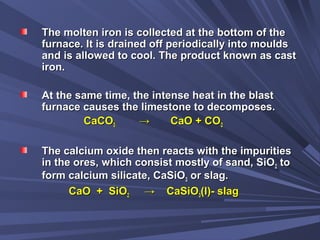
The molten iron is collected at the bottom of theThe molten iron is collected at the bottom of the
furnace. It is drained off periodically into mouldsfurnace. It is drained off periodically into moulds
and is allowed to cool. The product known as castand is allowed to cool. The product known as cast
iron.iron.
At the same time, the intense heat in the blastAt the same time, the intense heat in the blast
furnace causes the limestone to decomposes.furnace causes the limestone to decomposes.
CaCOCaCO33 → CaO + CO→ CaO + CO22
The calcium oxide then reacts with the impuritiesThe calcium oxide then reacts with the impurities
in the ores, which consist mostly of sand, SiOin the ores, which consist mostly of sand, SiO22 toto
form calcium silicate, CaSiOform calcium silicate, CaSiO33 or slag.or slag.
CaO + SiOCaO + SiO22 → CaSiO→ CaSiO33(l)- slag(l)- slag
Properties and Uses of IronProperties and Uses of Iron
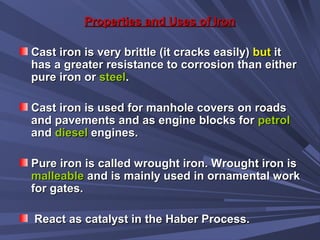
Cast iron is very brittle (it cracks easily)Cast iron is very brittle (it cracks easily) butbut itit
has a greater resistance to corrosion than eitherhas a greater resistance to corrosion than either
pure iron orpure iron or steelsteel..
Cast iron is used for manhole covers on roadsCast iron is used for manhole covers on roads
and pavements and as engine blocks forand pavements and as engine blocks for petrolpetrol
andand dieseldiesel engines.engines.
Pure iron is called wrought iron. Wrought iron isPure iron is called wrought iron. Wrought iron is
malleablemalleable and is mainly used in ornamental workand is mainly used in ornamental work
for gates.for gates.
React as catalyst in the Haber Process.React as catalyst in the Haber Process.
EXTRACTION OF LEAD, PbEXTRACTION OF LEAD, Pb
Main source of Lead metal is the oreMain source of Lead metal is the ore
galena.galena.
Lead is a soft metal.Lead is a soft metal.
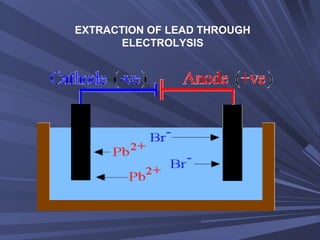
Lead bromide must be heated until it isLead bromide must be heated until it is
molten before it will conduct electricity.molten before it will conduct electricity.
Electrolysis separates the molten ionicElectrolysis separates the molten ionic
compound into its elementscompound into its elements
EXTRACTION OF LEAD THROUGH
ELECTROLYSIS
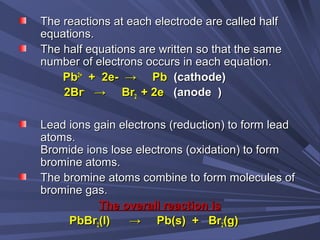
The reactions at each electrode are called halfThe reactions at each electrode are called half
equations.equations.
The half equations are written so that the sameThe half equations are written so that the same
number of electrons occurs in each equation.number of electrons occurs in each equation.
PbPb2+2+
+ 2e- → Pb+ 2e- → Pb (cathode)(cathode)
2Br2Br--
→ Br→ Br22 + 2e+ 2e (anode )(anode )
Lead ions gain electrons (reduction) to form leadLead ions gain electrons (reduction) to form lead
atoms.atoms.
Bromide ions lose electrons (oxidation) to formBromide ions lose electrons (oxidation) to form
bromine atoms.bromine atoms.
The bromine atoms combine to form molecules ofThe bromine atoms combine to form molecules of
bromine gas.bromine gas.
The overall reaction isThe overall reaction is
PbBrPbBr22(l) → Pb(s) + Br(l) → Pb(s) + Br22(g)(g)
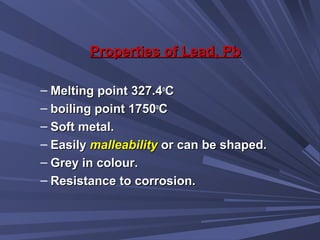
Properties of Lead, PbProperties of Lead, Pb
– Melting point 327.4Melting point 327.4oo
CC
– boiling point 1750boiling point 1750oo
CC
– Soft metal.Soft metal.
– EasilyEasily malleabilitymalleability or can be shaped.or can be shaped.
– Grey in colour.Grey in colour.
– Resistance to corrosion.Resistance to corrosion.
THANK YOUTHANK YOU

Ores and minerals

  • 1.
  • 2.
  • 3.
    Very reactive metalsVeryreactive metals can only be extracted from their ores bycan only be extracted from their ores by electrolysis such as K, Na, Ca, Mg, and Al.electrolysis such as K, Na, Ca, Mg, and Al. Pb is less reactive metal but extraction through electrolysis.Pb is less reactive metal but extraction through electrolysis. Discussion on the extraction of the following:Discussion on the extraction of the following: i. Aluminium from molten aluminium oxide (Bauxite)i. Aluminium from molten aluminium oxide (Bauxite) ii. Sodium from molten sodium chloride (Halite).ii. Sodium from molten sodium chloride (Halite). iii. Iron from iron (III) oxide Feiii. Iron from iron (III) oxide Fe22OO33, (Hematite)., (Hematite). iv. Lead from Lead (II) sulphid (Galena).iv. Lead from Lead (II) sulphid (Galena). v. Tin@Stanum from Tin (IV) Oxide SnOv. Tin@Stanum from Tin (IV) Oxide SnO22 (Cassiterite).(Cassiterite).
  • 4.
    K Na Very reactivemetals Ca Their ores require strong reduction which is Mg done through electrolysis of molten ores Al Carbon Zn Fairly reactive metals Fe Their ores can be reduced by heating Sn strongly with carbon Pb Hydrogen Cu Their ores can easily be reduced by heating Hg directly in air Ag Less reactive metal
  • 5.
  • 6.
    RoastedRoasted Heated with coke and limestonein blast furnace Heated with coke and limestone in blast furnace Molten tin is drawn off and moulded Molten tin is drawn off and moulded Tin block Cassiterite Crushed and washed Crushed and washed Flotation to concentrate the ore Flotation to concentrate the ore Flow-chart below summarises the extraction of tin / stanum
  • 7.
    The main oreof tin is cassiterite which contains tinThe main ore of tin is cassiterite which contains tin (IV) oxide, SnO(IV) oxide, SnO22.. The ore is first crushed, grounded and washed.The ore is first crushed, grounded and washed. Then the ore is concentrated by mixing it with oilThen the ore is concentrated by mixing it with oil and water. In this flotation method, the tinand water. In this flotation method, the tin minerals, which are less dense, are trapped in theminerals, which are less dense, are trapped in the floating form.floating form. The impurities such as soil and sand which areThe impurities such as soil and sand which are denser, sink to the bottom.denser, sink to the bottom.
  • 8.
    The concentrated oreis then roasted in theThe concentrated ore is then roasted in the air. This converts the sulphide of tin toair. This converts the sulphide of tin to oxide. At the same time, impurities such asoxide. At the same time, impurities such as sulphur and oil are burnt off.sulphur and oil are burnt off. The reduction of tin (IV) oxide to extractedThe reduction of tin (IV) oxide to extracted tin takes place in the blast furnace bytin takes place in the blast furnace by carbon monoxide and coke.carbon monoxide and coke. SnOSnO22 + 2CO → Sn + 2CO+ 2CO → Sn + 2CO22 SnOSnO22 + 2C → Sn + 2CO+ 2C → Sn + 2CO SnOSnO22 + C → Sn + CO+ C → Sn + CO22 The molten tin is drained off into moulds toThe molten tin is drained off into moulds to become blocks.become blocks.
  • 9.
    Photograph shows extractionof stanum in factory.
  • 10.
    Properties of Stanum,SnProperties of Stanum, Sn – Melting point 232Melting point 232oo CC – Boiling point 2603Boiling point 2603oo CC – Silvery in colourSilvery in colour – Highly ductile and malleable atHighly ductile and malleable at temperature 100temperature 100oo CC
  • 11.
    Uses of Stanum,Sn in daily lifeUses of Stanum, Sn in daily life Stanum/tin is widely used in alloy making forStanum/tin is widely used in alloy making for example:example: i.i. Produce bronze as alloy (70% Cu + 30% Sn).Produce bronze as alloy (70% Cu + 30% Sn). ii.ii. Industrial processes as in the form of:Industrial processes as in the form of: Tinplate, pewter (96% Sn + 3 % Cu and 1% Sb) andTinplate, pewter (96% Sn + 3 % Cu and 1% Sb) and solders (70% Pb + 30% Sn)solders (70% Pb + 30% Sn) iii. In aerospace industry ( Stanum +Titanium ).iii. In aerospace industry ( Stanum +Titanium ). iv. Ingredients in some insecticides.iv. Ingredients in some insecticides.
  • 12.
  • 13.
    Aluminium is extractedfrom its ore, bauxite whichAluminium is extracted from its ore, bauxite which contains aluminium oxide Alcontains aluminium oxide Al22OO33 but not frombut not from aluminium chloride because aluminium chloridealuminium chloride because aluminium chloride does not melt when heated.does not melt when heated. Aluminium oxide is mixed with cryolite, NaAluminium oxide is mixed with cryolite, Na33AlFAlF66 to lower the melting point of aluminium oxide fromto lower the melting point of aluminium oxide from 20452045oo C to about 900C to about 900oo CC.. 4000A current is used to keep the temperature of4000A current is used to keep the temperature of the electrolysis cell at 900the electrolysis cell at 900oo C.C. Block of carbon act as anodesBlock of carbon act as anodes Carbon lining act as cathode.Carbon lining act as cathode.
  • 14.
    EXTRACTION OF ALUMINIUM Blockcarbon Carbon lining
  • 15.
    CCathodeathode, the aluminiumions are discharged to, the aluminium ions are discharged to form aluminium metal.form aluminium metal. AlAl3+3+ + 3e → Al+ 3e → Al AAnodenode, the oxide ions are discharged to form, the oxide ions are discharged to form oxygen gas.oxygen gas. 2O2O2-2- → O→ O22 + 4e+ 4e-- The overall chemical reaction is:The overall chemical reaction is: 2Al2Al22OO33 → 4Al + 3O→ 4Al + 3O22 The oxygen liberated at the anode will reactThe oxygen liberated at the anode will react with the carbon electrode to produce carbonwith the carbon electrode to produce carbon dioxide gas.dioxide gas. The anode is corroded slowly and must beThe anode is corroded slowly and must be replaced form time to time.replaced form time to time.
  • 16.
    Physical Properties ofAluminiumPhysical Properties of Aluminium 1) Is strong.1) Is strong. 2)2) malleablemalleable .. 3) Low3) Low densitydensity.. 4) Resistant to4) Resistant to corrosioncorrosion because the presencebecause the presence of an impervious oxide layer on the surface ofof an impervious oxide layer on the surface of aluminium.aluminium. 5) G5) Good conductorood conductor of heat and electricity.of heat and electricity. 6) Can be polished to give a highly reflective6) Can be polished to give a highly reflective surface.surface.
  • 17.
    Chemical properties ofaluminiumChemical properties of aluminium Reaction with non-metallic elementsReaction with non-metallic elements Aluminium reacts directly with non-metallic elementsAluminium reacts directly with non-metallic elements when heated.when heated. 4Al + 3O4Al + 3O22 2Al2Al22OO33 2Al + 3S2Al + 3S AlAl22SS33 2Al + N2Al + N22 2AlN2AlN 4Al + 3C4Al + 3C AlAl44CC33 2Al + 3Cl2Al + 3Cl22 AlAl22ClCl66
  • 18.
    Chemical properties ofAluminiumChemical properties of Aluminium React with hydrochloric acid and sulphuricReact with hydrochloric acid and sulphuric acidacid Aluminium react with dilute hydrochloric acid toAluminium react with dilute hydrochloric acid to liberate hydrogen gas. The reaction is moreliberate hydrogen gas. The reaction is more vigorous as the acid becomes hotter and morevigorous as the acid becomes hotter and more concentrated.concentrated. 2Al + 6HCl → 2AlCl2Al + 6HCl → 2AlCl33 + 3H+ 3H22 However, with hot dilute or concentrated sulphuricHowever, with hot dilute or concentrated sulphuric (VI) acid, sulphur dioxide gas is liberated(VI) acid, sulphur dioxide gas is liberated 2Al + 6H2Al + 6H22SOSO44 → Al→ Al22(SO(SO44))33 + 3SO+ 3SO22 + 6H+ 6H22OO
  • 19.
    Chemical properties ofaluminiumChemical properties of aluminium Reaction with nitric (V) acidReaction with nitric (V) acid No reactionNo reaction because nitric acid makesbecause nitric acid makes aluminium passive by increasing thealuminium passive by increasing the thickness of the oxide layer on aluminiumthickness of the oxide layer on aluminium surface.surface.
  • 20.
    Chemical properties ofaluminiumChemical properties of aluminium Reaction with alkalisReaction with alkalis When dilute sodium hydroxide is added to aluminium atWhen dilute sodium hydroxide is added to aluminium at room temperature, a violent reaction occur with theroom temperature, a violent reaction occur with the evolution of hydrogen gas. The reaction is highlyevolution of hydrogen gas. The reaction is highly exothermic and is accelerated by heat.exothermic and is accelerated by heat. 2Al + 2NaOH + 6H2Al + 2NaOH + 6H22O → 2NaAl(OH) + 3HO → 2NaAl(OH) + 3H22
  • 21.
    Uses of AluminiumUsesof Aluminium Low density and strength make it ideal forLow density and strength make it ideal for construction of aircraft, lightweight vehicles, andconstruction of aircraft, lightweight vehicles, and ladders.ladders. An alloy of aluminium calledAn alloy of aluminium called duraluminduralumin andand magnaliummagnalium is often used instead of pureis often used instead of pure aluminium because of its improved properties.aluminium because of its improved properties. Easy shaping and corrosion resistance make it aEasy shaping and corrosion resistance make it a good material for drink cans and roofinggood material for drink cans and roofing materialsmaterials
  • 22.
  • 23.
    Two important oresused in extracting iron areTwo important ores used in extracting iron are hematite, Fehematite, Fe22OO33 and magnetite, Feand magnetite, Fe33OO44.. First, these ores undergo several processes toFirst, these ores undergo several processes to remove the impurities.remove the impurities. Then, the concentrated ores are reduced byThen, the concentrated ores are reduced by carbon in the form of coke in a very large andcarbon in the form of coke in a very large and hot furnace called blast furnace. Itshot furnace called blast furnace. Its temperature can reach up 2000temperature can reach up 2000oo C.C.
  • 25.
    A small chargeis introduced from theA small charge is introduced from the top of the blast furnace at intervals oftop of the blast furnace at intervals of 10 to 15 minutes.10 to 15 minutes. The charge consists of concentratedThe charge consists of concentrated iron ores, coke and limestone.iron ores, coke and limestone.
  • 26.
    Blast of extremelyhot air are pumped through the furnace via the bottom. The oxygen in the hot air reacts with coke to form carbon dioxide . C + O2 → CO2 Blast of extremely hot air are pumped through the furnace via the bottom. The oxygen in the hot air reacts with coke to form carbon dioxide . C + O2 → CO2 Excess carbon reacts with carbon dioxide producing carbon monoxide ( the main reducing agent) in the furnace. C + CO2 → 2CO Excess carbon reacts with carbon dioxide producing carbon monoxide ( the main reducing agent) in the furnace. C + CO2 → 2CO Carbon monoxide and carbon reduce the iron oxides to iron. Fe2O3 + 3CO → 2Fe + 3CO2 2Fe2O3 + 3C → 4 Fe + 3CO2 Fe3O4 + 4CO → 3Fe + 4CO2 Fe3O4 + 2C → 3Fe + 2CO2 Carbon monoxide and carbon reduce the iron oxides to iron. Fe2O3 + 3CO → 2Fe + 3CO2 2Fe2O3 + 3C → 4 Fe + 3CO2 Fe3O4 + 4CO → 3Fe + 4CO2 Fe3O4 + 2C → 3Fe + 2CO2 The following flow chart outlines the reduction of the iron oresThe following flow chart outlines the reduction of the iron ores
  • 27.
    The molten ironis collected at the bottom of theThe molten iron is collected at the bottom of the furnace. It is drained off periodically into mouldsfurnace. It is drained off periodically into moulds and is allowed to cool. The product known as castand is allowed to cool. The product known as cast iron.iron. At the same time, the intense heat in the blastAt the same time, the intense heat in the blast furnace causes the limestone to decomposes.furnace causes the limestone to decomposes. CaCOCaCO33 → CaO + CO→ CaO + CO22 The calcium oxide then reacts with the impuritiesThe calcium oxide then reacts with the impurities in the ores, which consist mostly of sand, SiOin the ores, which consist mostly of sand, SiO22 toto form calcium silicate, CaSiOform calcium silicate, CaSiO33 or slag.or slag. CaO + SiOCaO + SiO22 → CaSiO→ CaSiO33(l)- slag(l)- slag
  • 28.
    Properties and Usesof IronProperties and Uses of Iron Cast iron is very brittle (it cracks easily)Cast iron is very brittle (it cracks easily) butbut itit has a greater resistance to corrosion than eitherhas a greater resistance to corrosion than either pure iron orpure iron or steelsteel.. Cast iron is used for manhole covers on roadsCast iron is used for manhole covers on roads and pavements and as engine blocks forand pavements and as engine blocks for petrolpetrol andand dieseldiesel engines.engines. Pure iron is called wrought iron. Wrought iron isPure iron is called wrought iron. Wrought iron is malleablemalleable and is mainly used in ornamental workand is mainly used in ornamental work for gates.for gates. React as catalyst in the Haber Process.React as catalyst in the Haber Process.
  • 29.
    EXTRACTION OF LEAD,PbEXTRACTION OF LEAD, Pb
  • 30.
    Main source ofLead metal is the oreMain source of Lead metal is the ore galena.galena. Lead is a soft metal.Lead is a soft metal. Lead bromide must be heated until it isLead bromide must be heated until it is molten before it will conduct electricity.molten before it will conduct electricity. Electrolysis separates the molten ionicElectrolysis separates the molten ionic compound into its elementscompound into its elements
  • 31.
    EXTRACTION OF LEADTHROUGH ELECTROLYSIS
  • 32.
    The reactions ateach electrode are called halfThe reactions at each electrode are called half equations.equations. The half equations are written so that the sameThe half equations are written so that the same number of electrons occurs in each equation.number of electrons occurs in each equation. PbPb2+2+ + 2e- → Pb+ 2e- → Pb (cathode)(cathode) 2Br2Br-- → Br→ Br22 + 2e+ 2e (anode )(anode ) Lead ions gain electrons (reduction) to form leadLead ions gain electrons (reduction) to form lead atoms.atoms. Bromide ions lose electrons (oxidation) to formBromide ions lose electrons (oxidation) to form bromine atoms.bromine atoms. The bromine atoms combine to form molecules ofThe bromine atoms combine to form molecules of bromine gas.bromine gas. The overall reaction isThe overall reaction is PbBrPbBr22(l) → Pb(s) + Br(l) → Pb(s) + Br22(g)(g)
  • 33.
    Properties of Lead,PbProperties of Lead, Pb – Melting point 327.4Melting point 327.4oo CC – boiling point 1750boiling point 1750oo CC – Soft metal.Soft metal. – EasilyEasily malleabilitymalleability or can be shaped.or can be shaped. – Grey in colour.Grey in colour. – Resistance to corrosion.Resistance to corrosion.
  • 34.