Antenna
Arrays
Abhishek Pachhain (078BEI001)
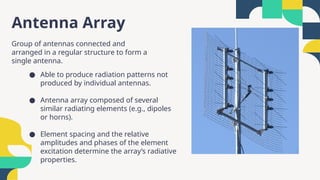
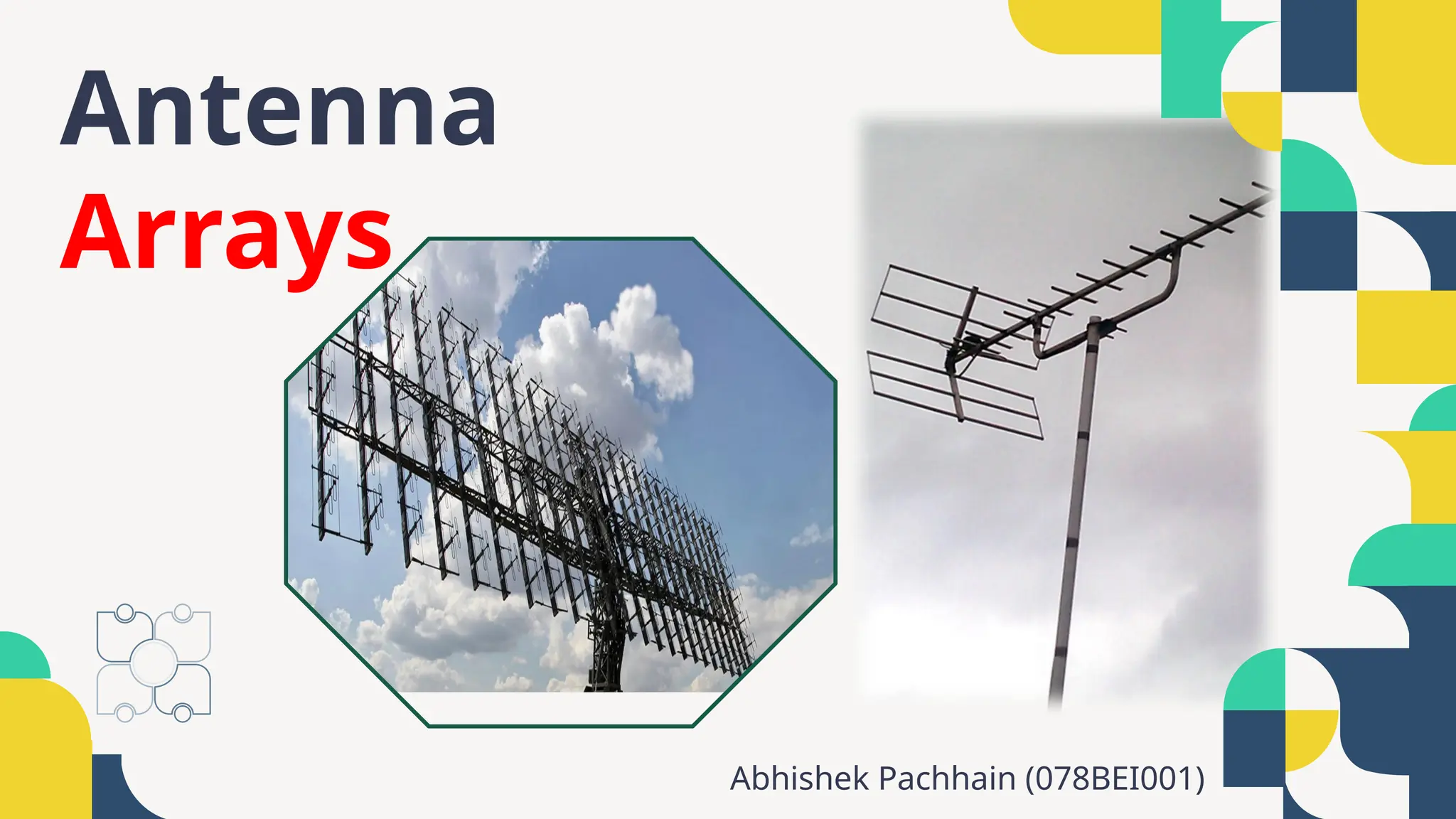
Antenna Array
Group of antennas connected and
arranged in a regular structure to form a
single antenna.
● Able to produce radiation patterns not
produced by individual antennas.
● Antenna array composed of several
similar radiating elements (e.g., dipoles
or horns).
● Element spacing and the relative
amplitudes and phases of the element
excitation determine the array’s radiative
properties.
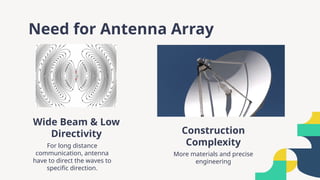
Need for Antenna Array
More materials and precise
engineering
For long distance
communication, antenna
have to direct the waves to
specific direction.
Wide Beam & Low
Directivity Construction
Complexity
Need for Antenna Array
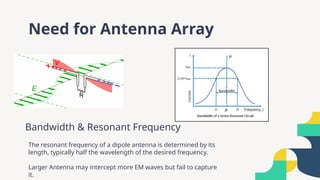
The resonant frequency of a dipole antenna is determined by its
length, typically half the wavelength of the desired frequency.
Larger Antenna may intercept more EM waves but fail to capture
it.
Bandwidth & Resonant Frequency
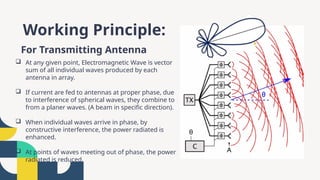
Working Principle:
 At any given point, Electromagnetic Wave is vector
sum of all individual waves produced by each
antenna in array.
 If current are fed to antennas at proper phase, due
to interference of spherical waves, they combine to
from a planer waves. (A beam in specific direction).
 When individual waves arrive in phase, by
constructive interference, the power radiated is
enhanced.
 At points of waves meeting out of phase, the power
radiated is reduced.
For Transmitting Antenna
Working Principle:
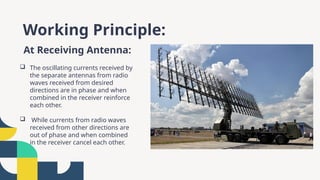
 The oscillating currents received by
the separate antennas from radio
waves received from desired
directions are in phase and when
combined in the receiver reinforce
each other.
 While currents from radio waves
received from other directions are
out of phase and when combined
in the receiver cancel each other.
At Receiving Antenna:
Advantages
Higher Gain
They can focus energy more
effectively in a specific
direction, improving signal
strength and range.
Better Directivity
They provide better control over the
direction of the signal, allowing for
more precise targeting and reduced
interference
Scalability
They can be scaled to meet
different requirements by
adding more elements.
Beamforming
Array antennas can electronically
steer the beam without physically
moving the antenna, providing
greater flexibility and control over
the coverage area.
Examples
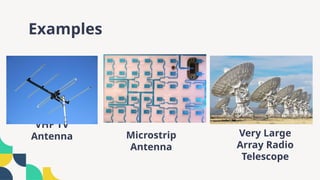
VHF TV
Antenna Microstrip
Antenna
Very Large
Array Radio
Telescope
CREDITS: This presentation template was created by Slidesgo,
and includes icons by Flaticon, and infographics & images by
Freepik
Thanks
!
Please keep this slide for attribution

Antenna Array : Introduction, Working Principles

  • 1.
  • 2.
    Antenna Array Group ofantennas connected and arranged in a regular structure to form a single antenna. ● Able to produce radiation patterns not produced by individual antennas. ● Antenna array composed of several similar radiating elements (e.g., dipoles or horns). ● Element spacing and the relative amplitudes and phases of the element excitation determine the array’s radiative properties.
  • 3.
    Need for AntennaArray More materials and precise engineering For long distance communication, antenna have to direct the waves to specific direction. Wide Beam & Low Directivity Construction Complexity
  • 4.
    Need for AntennaArray The resonant frequency of a dipole antenna is determined by its length, typically half the wavelength of the desired frequency. Larger Antenna may intercept more EM waves but fail to capture it. Bandwidth & Resonant Frequency
  • 5.
    Working Principle:  Atany given point, Electromagnetic Wave is vector sum of all individual waves produced by each antenna in array.  If current are fed to antennas at proper phase, due to interference of spherical waves, they combine to from a planer waves. (A beam in specific direction).  When individual waves arrive in phase, by constructive interference, the power radiated is enhanced.  At points of waves meeting out of phase, the power radiated is reduced. For Transmitting Antenna
  • 6.
    Working Principle:  Theoscillating currents received by the separate antennas from radio waves received from desired directions are in phase and when combined in the receiver reinforce each other.  While currents from radio waves received from other directions are out of phase and when combined in the receiver cancel each other. At Receiving Antenna:
  • 7.
    Advantages Higher Gain They canfocus energy more effectively in a specific direction, improving signal strength and range. Better Directivity They provide better control over the direction of the signal, allowing for more precise targeting and reduced interference Scalability They can be scaled to meet different requirements by adding more elements. Beamforming Array antennas can electronically steer the beam without physically moving the antenna, providing greater flexibility and control over the coverage area.
  • 8.
  • 9.
    CREDITS: This presentationtemplate was created by Slidesgo, and includes icons by Flaticon, and infographics & images by Freepik Thanks ! Please keep this slide for attribution