EC6602 ANTENNA AND WAVE
PROPAGATION
M.KRISHNAMOORTHY
Asst.Professor/ECE
GOJAN SCHOOL OF BUSINESS AND
TECHNOLOGY
UNIT-II
WIRE ANTENNAS AND
ANTENNA ARRAYS
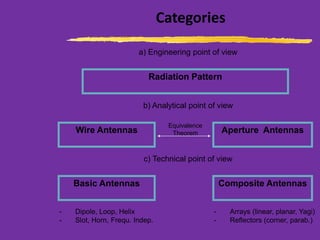
Categories
Radiation Pattern
a) Engineering point of view
Wire Antennas
b) Analytical point of view
Aperture Antennas
Equivalence
Theorem
Basic Antennas
c) Technical point of view
Composite Antennas
- Dipole, Loop, Helix
- Slot, Horn, Frequ. Indep.
- Arrays (linear, planar, Yagi)
- Reflectors (corner, parab.)
Basic Structures
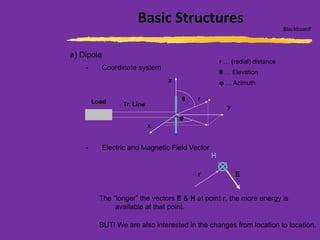
a) Dipole
- Coordinate system
Blackboard!
x
y
z
Load Tr. Line
r
r … (radial) distance
θ
θ … Elevation
φ
φ … Azimuth
- Electric and Magnetic Field Vector
H
Er
The “longer” the vectors E & H at point r, the more energy is
available at that point.
BUT! We are also interested in the changes from location to location.
Basic Structures
a) Dipole
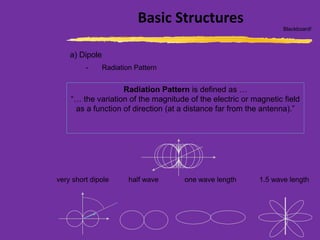
- Radiation Pattern
Blackboard!
Radiation Pattern is defined as …
“… the variation of the magnitude of the electric or magnetic field
as a function of direction (at a distance far from the antenna).”
half wave one wave length 1.5 wave lengthvery short dipole
Basics of
Antenna Arrays
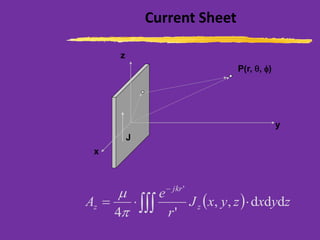
Current Sheet
x
y
z
P(r, , )
J
( ) =
−
zyxzyxJ
r
e
A z
jkr
z ddd,,
'4
'


Linear Antenna Arrays
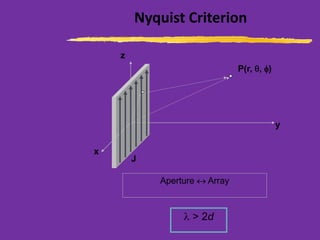
Nyquist Criterion
x
y
z
P(r, , )
J
Aperture  Array
 > 2d
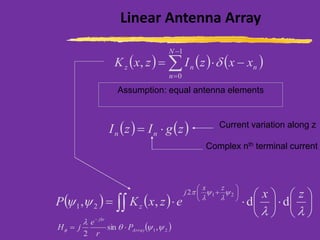
Linear Antenna Array
Assumption: equal antenna elements
Current variation along z
( ) ( ) ( )
−
=
−=
1
0
,
N
n
nnz xxzIzxK 
( ) ( )zgIzI nn =
Complex nth terminal current
( ) ( ) 











=






+






 zx
ezxKP
zx
j
z dd,,
212
21
( )21,sin
2


 Array
jkr
P
r
e
jH =
−
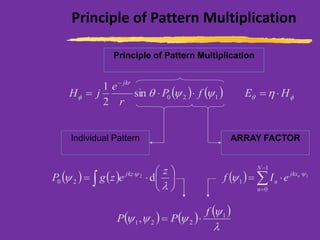
Principle of Pattern Multiplication
Individual Pattern
( ) ( )120sin
2
1
 fP
r
e
jH
jkr
=
−
  HE =
Principle of Pattern Multiplication
ARRAY FACTOR
( ) ( ) 





= 

  z
ezgP jkz
d2
20 ( ) 1
1
0
1

 
−
=
=  njkx
N
n
n eIf
( ) ( ) ( )


 1
221,
f
PP =
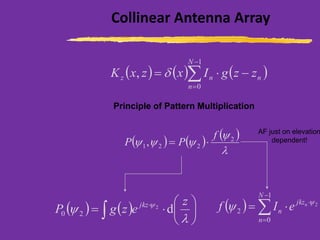
Collinear Antenna Array
( ) ( ) ( )
−
=
−=
1
0
,
N
n
nnz zzgIxzxK 
( ) ( ) 





= 

  z
ezgP jkz
d2
20
( ) 2
1
0
2

 
−
=
=  njkz
N
n
n eIf
( ) ( ) ( )


 2
221,
f
PP =
Principle of Pattern Multiplication
AF just on elevation
dependent!
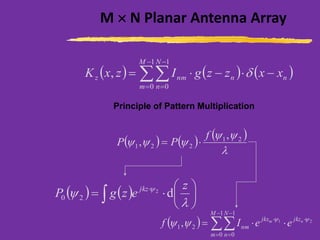
M  N Planar Antenna Array
( ) ( ) ( )
−
=
−
=
−−=
1
0
1
0
,
M
m
N
n
nnnmz xxzzgIzxK 
( ) ( ) 





= 

  z
ezgP jkz
d2
20
( ) 
−
=

−
=
=
1
0
1
0
21
21
,
M
m
jkzjkx
N
n
nm
nm
eeIf 

( ) ( ) ( )


 21
221
,
,
f
PP =
Principle of Pattern Multiplication
Uniformly Spaced
Antenna Arrays
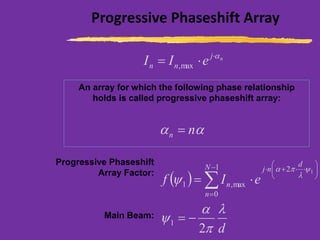
Progressive Phaseshift Array
nj
nn eII 
= max,
An array for which the following phase relationship
holds is called progressive phaseshift array:
 nn =
( )






+−
=
= 
121
0
max,1




d
njN
n
n eIf
Progressive Phaseshift
Array Factor:
Main Beam:
d




2
1 −=
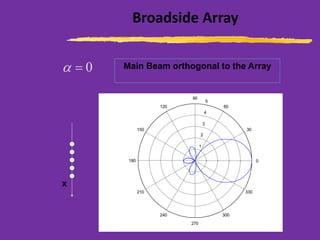
Broadside Array
0=
1
2
3
4
5
30
210
60
240
90
270
120
300
150
330
180 0
x
Main Beam orthogonal to the Array
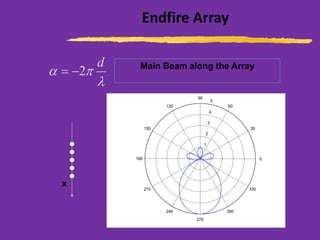
Endfire Array


d
2−= Main Beam along the Array
1
2
3
4
5
30
210
60
240
90
270
120
300
150
330
180 0
x
Uniform Array
Uniform Array
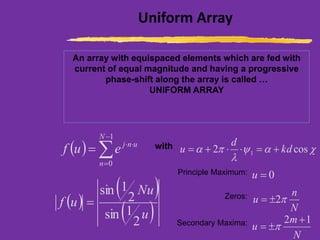
An array with equispaced elements which are fed with
current of equal magnitude and having a progressive
phase-shift along the array is called …
UNIFORM ARRAY
( ) 
−
=

=
1
0
N
n
unj
euf with 

 cos2 1 kd
d
u +=+=
( )
( )
( )u
Nu
uf
2
1sin
2
1sin
=
Principle Maximum:
Zeros:
Secondary Maxima:
0=u
N
n
u 2=
N
m
u
12 +
= 
Uniform Array
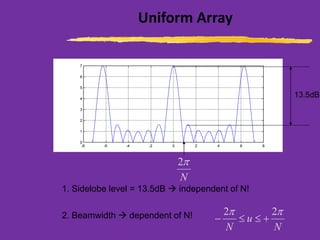
1. Sidelobe level = 13.5dB → independent of N!
N
2
N
u
N
 22
+−
-8 -6 -4 -2 0 2 4 6 8
0
1
2
3
4
5
6
7
13.5dB
2. Beamwidth → dependent of N!
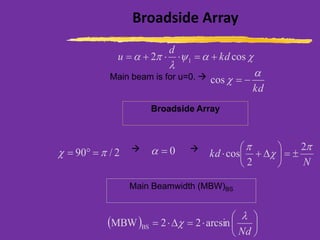
Broadside Array
Main beam is for u=0. →
N
kd


 2
2
cos =





+
Broadside Array


 cos2 1 kd
d
u +=+=
kd

 −=cos
2/90  == → 0=
Main Beamwidth (MBW)BS
( ) 





==
Nd

 arcsin22MBW BS
→
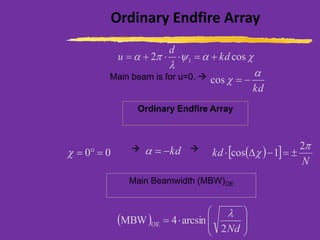
Ordinary Endfire Array
Main beam is for u=0. →
( ) 
N
kd


2
1cos =−
Ordinary Endfire Array


 cos2 1 kd
d
u +=+=
kd

 −=cos
00 == → kd−=
Main Beamwidth (MBW)OE
( ) 







=
Nd2
arcsin4MBW OE

→
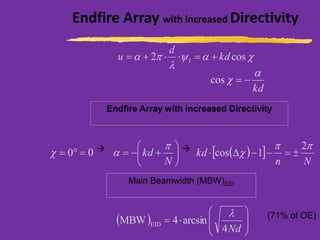
Endfire Array with increased Directivity
(71% of OE)
( ) 
Nn
kd


2
1cos =−−
Endfire Array with increased Directivity


 cos2 1 kd
d
u +=+=
kd

 −=cos
00 == →






+−=
N
kd


Main Beamwidth (MBW)EID
( ) 







=
Nd4
arcsin4MBW EID

→
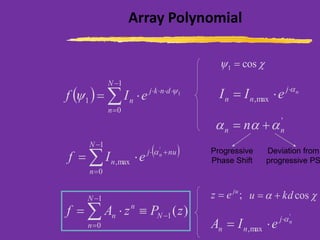
Pattern Analysis
Array Polynomial
 cos1 =
( ) 1
1
0
1

 
−
=
=  dnkj
N
n
n eIf nj
nn eII 
= max,
'
nn n  +=
Progressive
Phase Shift
Deviation from
progressive PS
( )nuj
N
n
n
n
eIf +
−
=
= 
'
1
0
max,

)(1
1
0
zPzAf N
n
N
n
n −
−
=
= 
;ju
ez =
'
max,
nj
nn eIA 
=
 coskdu +=
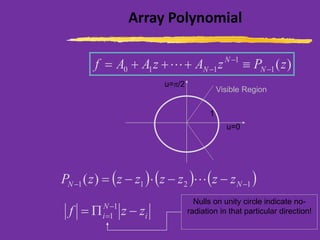
Array Polynomial
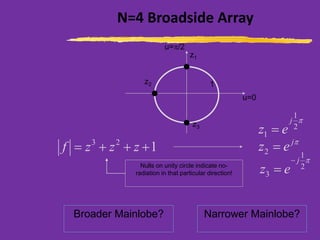
Nulls on unity circle indicate no-
radiation in that particular direction!
)(1
1
110 zPzAzAAf N
N
N −
−
− +++= 
( ) ( ) ( )1211 )( −− −−−= NN zzzzzzzP 
i
N
i zzf −= −
=
1
1
u=0
u=/2
1
Visible Region
N=4 Broadside Array
Nulls on unity circle indicate no-
radiation in that particular direction!
123
+++= zzzf
u=0
u=/2
1
z1
z2
z3

2
1
1
j
ez =
j
ez =2

2
1
3
j
ez
−
=
Broader Mainlobe? Narrower Mainlobe?
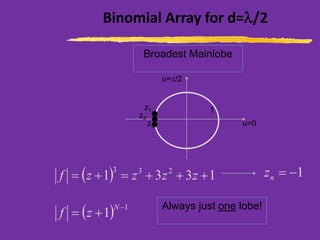
Binomial Array for d=/2
( ) 1331 233
+++=+= zzzzf
u=0
u=/2
1z1
z2
z3
1−=nz
Broadest Mainlobe
Always just one lobe!
( ) 1
1
−
+=
N
zf
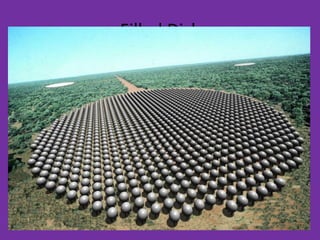
Filled Disk
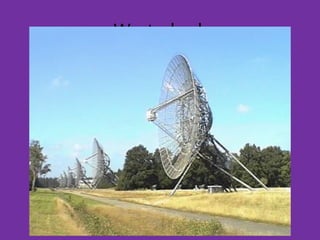
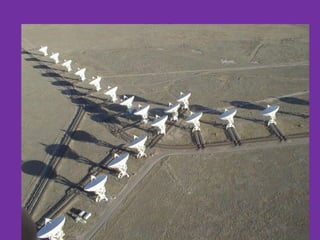
Westerbork
VLA
EC6602 - AWP UNIT-2

EC6602 - AWP UNIT-2

  • 1.
    EC6602 ANTENNA ANDWAVE PROPAGATION M.KRISHNAMOORTHY Asst.Professor/ECE GOJAN SCHOOL OF BUSINESS AND TECHNOLOGY
  • 2.
  • 3.
    Categories Radiation Pattern a) Engineeringpoint of view Wire Antennas b) Analytical point of view Aperture Antennas Equivalence Theorem Basic Antennas c) Technical point of view Composite Antennas - Dipole, Loop, Helix - Slot, Horn, Frequ. Indep. - Arrays (linear, planar, Yagi) - Reflectors (corner, parab.)
  • 4.
    Basic Structures a) Dipole -Coordinate system Blackboard! x y z Load Tr. Line r r … (radial) distance θ θ … Elevation φ φ … Azimuth - Electric and Magnetic Field Vector H Er The “longer” the vectors E & H at point r, the more energy is available at that point. BUT! We are also interested in the changes from location to location.
  • 5.
    Basic Structures a) Dipole -Radiation Pattern Blackboard! Radiation Pattern is defined as … “… the variation of the magnitude of the electric or magnetic field as a function of direction (at a distance far from the antenna).” half wave one wave length 1.5 wave lengthvery short dipole
  • 6.
  • 7.
    Current Sheet x y z P(r, ,) J ( ) = − zyxzyxJ r e A z jkr z ddd,, '4 '  
  • 8.
  • 9.
    Nyquist Criterion x y z P(r, ,) J Aperture  Array  > 2d
  • 10.
    Linear Antenna Array Assumption:equal antenna elements Current variation along z ( ) ( ) ( ) − = −= 1 0 , N n nnz xxzIzxK  ( ) ( )zgIzI nn = Complex nth terminal current ( ) ( )             =       +        zx ezxKP zx j z dd,, 212 21 ( )21,sin 2    Array jkr P r e jH = −
  • 11.
    Principle of PatternMultiplication Individual Pattern ( ) ( )120sin 2 1  fP r e jH jkr = −   HE = Principle of Pattern Multiplication ARRAY FACTOR ( ) ( )       =     z ezgP jkz d2 20 ( ) 1 1 0 1    − = =  njkx N n n eIf ( ) ( ) ( )    1 221, f PP =
  • 12.
    Collinear Antenna Array () ( ) ( ) − = −= 1 0 , N n nnz zzgIxzxK  ( ) ( )       =     z ezgP jkz d2 20 ( ) 2 1 0 2    − = =  njkz N n n eIf ( ) ( ) ( )    2 221, f PP = Principle of Pattern Multiplication AF just on elevation dependent!
  • 13.
    M  NPlanar Antenna Array ( ) ( ) ( ) − = − = −−= 1 0 1 0 , M m N n nnnmz xxzzgIzxK  ( ) ( )       =     z ezgP jkz d2 20 ( )  − =  − = = 1 0 1 0 21 21 , M m jkzjkx N n nm nm eeIf   ( ) ( ) ( )    21 221 , , f PP = Principle of Pattern Multiplication
  • 14.
  • 15.
    Progressive Phaseshift Array nj nneII  = max, An array for which the following phase relationship holds is called progressive phaseshift array:  nn = ( )       +− = =  121 0 max,1     d njN n n eIf Progressive Phaseshift Array Factor: Main Beam: d     2 1 −=
  • 16.
  • 17.
    Endfire Array   d 2−= MainBeam along the Array 1 2 3 4 5 30 210 60 240 90 270 120 300 150 330 180 0 x
  • 18.
  • 19.
    Uniform Array An arraywith equispaced elements which are fed with current of equal magnitude and having a progressive phase-shift along the array is called … UNIFORM ARRAY ( )  − =  = 1 0 N n unj euf with    cos2 1 kd d u +=+= ( ) ( ) ( )u Nu uf 2 1sin 2 1sin = Principle Maximum: Zeros: Secondary Maxima: 0=u N n u 2= N m u 12 + = 
  • 20.
    Uniform Array 1. Sidelobelevel = 13.5dB → independent of N! N 2 N u N  22 +− -8 -6 -4 -2 0 2 4 6 8 0 1 2 3 4 5 6 7 13.5dB 2. Beamwidth → dependent of N!
  • 21.
    Broadside Array Main beamis for u=0. → N kd    2 2 cos =      + Broadside Array    cos2 1 kd d u +=+= kd   −=cos 2/90  == → 0= Main Beamwidth (MBW)BS ( )       == Nd   arcsin22MBW BS →
  • 22.
    Ordinary Endfire Array Mainbeam is for u=0. → ( )  N kd   2 1cos =− Ordinary Endfire Array    cos2 1 kd d u +=+= kd   −=cos 00 == → kd−= Main Beamwidth (MBW)OE ( )         = Nd2 arcsin4MBW OE  →
  • 23.
    Endfire Array withincreased Directivity (71% of OE) ( )  Nn kd   2 1cos =−− Endfire Array with increased Directivity    cos2 1 kd d u +=+= kd   −=cos 00 == →       +−= N kd   Main Beamwidth (MBW)EID ( )         = Nd4 arcsin4MBW EID  →
  • 24.
  • 25.
    Array Polynomial  cos1= ( ) 1 1 0 1    − = =  dnkj N n n eIf nj nn eII  = max, ' nn n  += Progressive Phase Shift Deviation from progressive PS ( )nuj N n n n eIf + − = =  ' 1 0 max,  )(1 1 0 zPzAf N n N n n − − = =  ;ju ez = ' max, nj nn eIA  =  coskdu +=
  • 26.
    Array Polynomial Nulls onunity circle indicate no- radiation in that particular direction! )(1 1 110 zPzAzAAf N N N − − − +++=  ( ) ( ) ( )1211 )( −− −−−= NN zzzzzzzP  i N i zzf −= − = 1 1 u=0 u=/2 1 Visible Region
  • 27.
    N=4 Broadside Array Nullson unity circle indicate no- radiation in that particular direction! 123 +++= zzzf u=0 u=/2 1 z1 z2 z3  2 1 1 j ez = j ez =2  2 1 3 j ez − = Broader Mainlobe? Narrower Mainlobe?
  • 28.
    Binomial Array ford=/2 ( ) 1331 233 +++=+= zzzzf u=0 u=/2 1z1 z2 z3 1−=nz Broadest Mainlobe Always just one lobe! ( ) 1 1 − += N zf
  • 29.
  • 30.
  • 31.