Antenna Arrays
Introduction
• An antenna, when individually can radiate an amount of energy,
in a particular direction, resulting in better transmission.
• If few more elements are added it, to produce more efficient
output.
• It is exactly this idea, which led to the invention of Antenna
arrays.
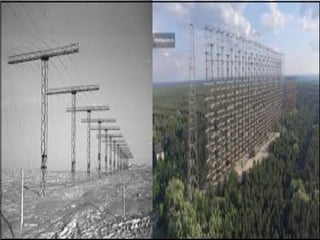
• An antenna array can be better understood by observing the
following images. Observe how the antenna arrays are
connected.
• An antenna array is a radiating system, which
consists of individual radiators and elements.
• Each of this radiator, while functioning has its
own induction field.
• The elements are placed so closely that each
one lies in the neighboring one’s induction
field.
• Therefore, the radiation pattern produced by
them, would be the vector sum of the
individual ones.
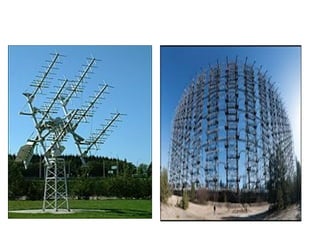
• The following image shows another example
of an antenna array.
• The spacing between the elements and the
length of the elements according to the
wavelength are also to be kept in mind while
designing these antennas.
• The antennas radiate individually and while in
array, the radiation of all the elements sum up,
to form the radiation beam, which has high
gain, high directivity and better performance,
with minimum losses.
Advantages
• The signal strength increases
• High directivity is obtained
• Minor lobes are reduced much
• High Signal-to-noise ratio is achieved
• High gain is obtained
• Power wastage is reduced
• Better performance is obtained
Disadvantages
• Resistive losses are increased
• Mounting and maintenance is difficult
• Huge external space is required
Applications
• Used in satellite communications
• Used in wireless communications
• Used in military radar communications
• Used in the astronomical study
Array Configuration
• Broadside array
• End fire array
• Parasitic array
• Collinear array
Broadside array
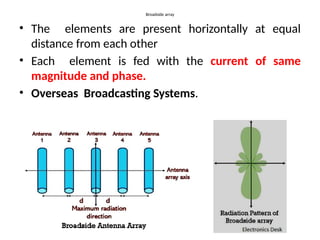
• The elements are present horizontally at equal
distance from each other
• Each element is fed with the current of same
magnitude and phase.
• Overseas Broadcasting Systems.
End fire array
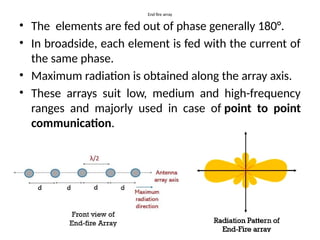
• The elements are fed out of phase generally 180°.
• In broadside, each element is fed with the current of
the same phase.
• Maximum radiation is obtained along the array axis.
• These arrays suit low, medium and high-frequency
ranges and majorly used in case of point to point
communication.
Collinear Antenna Array
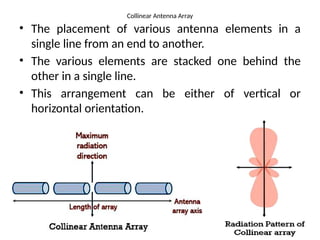
• The placement of various antenna elements in a
single line from an end to another.
• The various elements are stacked one behind the
other in a single line.
• This arrangement can be either of vertical or
horizontal orientation.
• Like broadside array, this also offers radiation
in the direction normal to the axis of the array.
• Hence its radiation pattern is somewhat
similar to the broadside array.
• This array offers circular symmetry across the
major lobe and thus facilitates omnidirectional
radiation from itself.
• An increase in the length of the array the
directivity also increases.
• Generally, 2 elements collinear array is mostly
used as it supports multi-band operation.
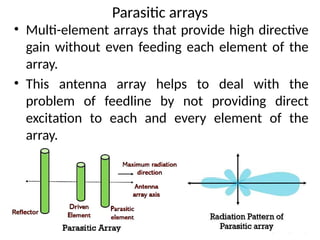
Parasitic arrays
• Multi-element arrays that provide high directive
gain without even feeding each element of the
array.
• This antenna array helps to deal with the
problem of feedline by not providing direct
excitation to each and every element of the
array.
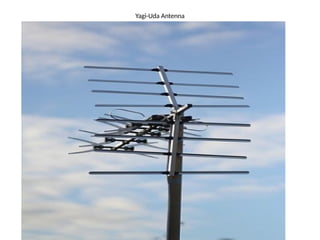
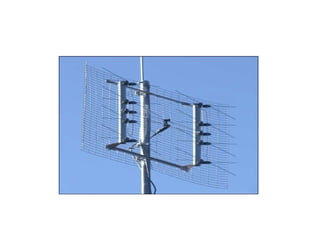
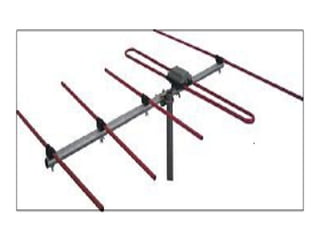
Yagi-Uda Antenna
Antenna Array
• An antenna array is the radiating system in
which several antennas are spaced properly to
get greater directivity at a far distance from
the radiating system.
• The total field produced by the antenna array
at a far distance is the vector sum of the fields
produced by the individual antenna of the
array.
• The individual antenna is called element of an
antenna array
Linear Array
• If the elements of the antenna array are
equally spaced along a straight line is called
linear array.
• Uniform Linear Array- If the elements of the
antenna array are equally spaced along a
straight line and all the elements are fed with a
current of equal magnitude with progressive
uniform phase shift along the line is called
linear array.
Array of Point Sources
• Isotropic radiators are called as point sources
because it occupies zero volume.
• If number of point sources are more, then the
analysis becomes complicated and time
consuming.
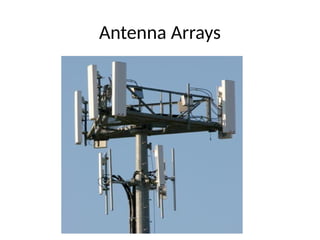
Antenna array advantages and disadvantages and application

  • 1.
  • 2.
    Introduction • An antenna,when individually can radiate an amount of energy, in a particular direction, resulting in better transmission. • If few more elements are added it, to produce more efficient output. • It is exactly this idea, which led to the invention of Antenna arrays. • An antenna array can be better understood by observing the following images. Observe how the antenna arrays are connected.
  • 4.
    • An antennaarray is a radiating system, which consists of individual radiators and elements. • Each of this radiator, while functioning has its own induction field. • The elements are placed so closely that each one lies in the neighboring one’s induction field. • Therefore, the radiation pattern produced by them, would be the vector sum of the individual ones. • The following image shows another example of an antenna array.
  • 6.
    • The spacingbetween the elements and the length of the elements according to the wavelength are also to be kept in mind while designing these antennas. • The antennas radiate individually and while in array, the radiation of all the elements sum up, to form the radiation beam, which has high gain, high directivity and better performance, with minimum losses.
  • 7.
    Advantages • The signalstrength increases • High directivity is obtained • Minor lobes are reduced much • High Signal-to-noise ratio is achieved • High gain is obtained • Power wastage is reduced • Better performance is obtained
  • 8.
    Disadvantages • Resistive lossesare increased • Mounting and maintenance is difficult • Huge external space is required
  • 9.
    Applications • Used insatellite communications • Used in wireless communications • Used in military radar communications • Used in the astronomical study
  • 10.
    Array Configuration • Broadsidearray • End fire array • Parasitic array • Collinear array
  • 11.
    Broadside array • Theelements are present horizontally at equal distance from each other • Each element is fed with the current of same magnitude and phase. • Overseas Broadcasting Systems.
  • 12.
    End fire array •The elements are fed out of phase generally 180°. • In broadside, each element is fed with the current of the same phase. • Maximum radiation is obtained along the array axis. • These arrays suit low, medium and high-frequency ranges and majorly used in case of point to point communication.
  • 13.
    Collinear Antenna Array •The placement of various antenna elements in a single line from an end to another. • The various elements are stacked one behind the other in a single line. • This arrangement can be either of vertical or horizontal orientation.
  • 14.
    • Like broadsidearray, this also offers radiation in the direction normal to the axis of the array. • Hence its radiation pattern is somewhat similar to the broadside array. • This array offers circular symmetry across the major lobe and thus facilitates omnidirectional radiation from itself. • An increase in the length of the array the directivity also increases. • Generally, 2 elements collinear array is mostly used as it supports multi-band operation.
  • 15.
    Parasitic arrays • Multi-elementarrays that provide high directive gain without even feeding each element of the array. • This antenna array helps to deal with the problem of feedline by not providing direct excitation to each and every element of the array.
  • 16.
  • 19.
    Antenna Array • Anantenna array is the radiating system in which several antennas are spaced properly to get greater directivity at a far distance from the radiating system. • The total field produced by the antenna array at a far distance is the vector sum of the fields produced by the individual antenna of the array. • The individual antenna is called element of an antenna array
  • 20.
    Linear Array • Ifthe elements of the antenna array are equally spaced along a straight line is called linear array. • Uniform Linear Array- If the elements of the antenna array are equally spaced along a straight line and all the elements are fed with a current of equal magnitude with progressive uniform phase shift along the line is called linear array.
  • 21.
    Array of PointSources • Isotropic radiators are called as point sources because it occupies zero volume. • If number of point sources are more, then the analysis becomes complicated and time consuming.