Broadside, End Fire &
binomial array antennas
by
Sushant Burde (B-48)
Vaibhav Deshmukh(B-52)
Rohit Dhongde(B-41)
Pratik Suryavanshi(B-40)
Driven Arrays: Broadside
Antenna
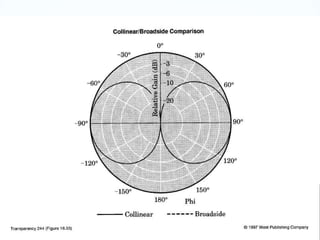
 A broadside array is a stacked collinear antenna
consisting of half-wave dipoles spaced from one another
by one-half wavelengths.
 This antenna produces a highly directional radiation
pattern that is broadside or perpendicular to the plane of
the array.
 The broadside antenna is bidirectional in radiation, but
the radiation pattern has a very narrow beam width and
high gain.
Broadside Array
 Bidirectional Array
 Uses Dipoles fed in phase and separated by 1/2
wavelength
 Broadside arrays may also b e formed from other types
of elements, such as horns, slots, helixes and polyrods
O. Kilic EE 542
4
Radiation Pattern for Arrays
Depends on:
 The type of the individual elements
 Their orientation
 Their position in space
 The amplitude and phase of the current feeding them
 The total number of elements
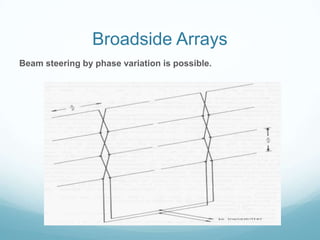
Broadside Arrays
Beam steering by phase variation is possible.
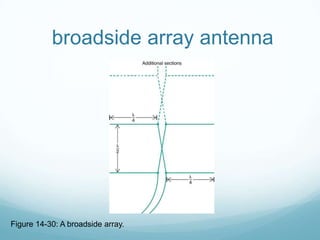
broadside array antenna
Figure 14-30: A broadside array.
Driven Arrays: End-Fire
Antenna
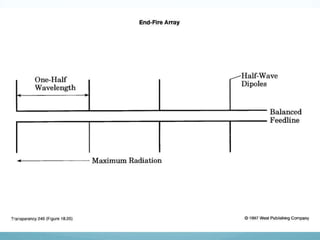
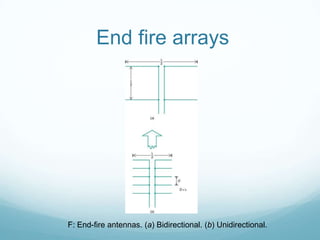
 The end-fire array uses two half-wave dipoles spaced
one-half wavelength apart.
 The end-fire array has a bidirectional radiation pattern,
but with narrower beam widths and lower gain.
 The radiation is in the plane of the driven elements.
 A highly unidirectional antenna can be created by careful
selection of the optimal number of elements with the
appropriately related spacing.
End-Fire Array
 Similar to broadside array except dipoles are fed 180
degrees out of phase
 Radiation max. off the ends
End-fire Arrays
 Higher directivity.
 Provide increased directivity in elevation and azimuth
planes.
 Generally used for reception.
 Impedance match difficulty in high power transmissions.
 Variants are:
 Horizontal Array of Dipoles
 RCA Fishborne Antenna
 Series Phase Array
End fire arrays
F: End-fire antennas. (a) Bidirectional. (b) Unidirectional.
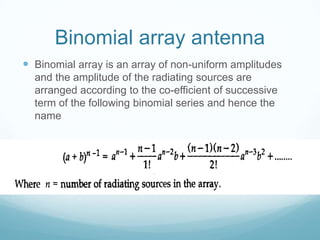
Binomial array antenna
 Binomial array is an array of non-uniform amplitudes
and the amplitude of the radiating sources are
arranged according to the co-efficient of successive
term of the following binomial series and hence the
name
Advantages
 To reduce secondary lobes
 2. to optimize them.
 As we increase the array length the directivity
increases and side lobes appear.
Pattern multiplication
 Multiplication pattern is the total field pattern of an array
of non-isotropic but similar source
 It is the multiplication of the individual source pattern
and the pattern of an array of isotropic point source
each located at the phase centre of individual sources
having the relative amplitude and phase T
 The total phase pattern is the addition of the phase
pattern of ‘the individual source and that of the array of
isotropic point sources.
Principle
 The total field pattern of an array of non-isotropic but
similar sources is the product of the individual source
&The array pattern of isotropic point sources each
located at the phase centre of the individual source and
the array pattern of isotropic point sources each located
at the phase centre of the individual sources having the
same amplitude and phase.

Array antennas

  • 1.
    Broadside, End Fire& binomial array antennas by Sushant Burde (B-48) Vaibhav Deshmukh(B-52) Rohit Dhongde(B-41) Pratik Suryavanshi(B-40)
  • 2.
    Driven Arrays: Broadside Antenna A broadside array is a stacked collinear antenna consisting of half-wave dipoles spaced from one another by one-half wavelengths.  This antenna produces a highly directional radiation pattern that is broadside or perpendicular to the plane of the array.  The broadside antenna is bidirectional in radiation, but the radiation pattern has a very narrow beam width and high gain.
  • 3.
    Broadside Array  BidirectionalArray  Uses Dipoles fed in phase and separated by 1/2 wavelength  Broadside arrays may also b e formed from other types of elements, such as horns, slots, helixes and polyrods
  • 4.
    O. Kilic EE542 4 Radiation Pattern for Arrays Depends on:  The type of the individual elements  Their orientation  Their position in space  The amplitude and phase of the current feeding them  The total number of elements
  • 5.
    Broadside Arrays Beam steeringby phase variation is possible.
  • 7.
    broadside array antenna Figure14-30: A broadside array.
  • 8.
    Driven Arrays: End-Fire Antenna The end-fire array uses two half-wave dipoles spaced one-half wavelength apart.  The end-fire array has a bidirectional radiation pattern, but with narrower beam widths and lower gain.  The radiation is in the plane of the driven elements.  A highly unidirectional antenna can be created by careful selection of the optimal number of elements with the appropriately related spacing.
  • 9.
    End-Fire Array  Similarto broadside array except dipoles are fed 180 degrees out of phase  Radiation max. off the ends
  • 10.
    End-fire Arrays  Higherdirectivity.  Provide increased directivity in elevation and azimuth planes.  Generally used for reception.  Impedance match difficulty in high power transmissions.  Variants are:  Horizontal Array of Dipoles  RCA Fishborne Antenna  Series Phase Array
  • 12.
    End fire arrays F:End-fire antennas. (a) Bidirectional. (b) Unidirectional.
  • 13.
    Binomial array antenna Binomial array is an array of non-uniform amplitudes and the amplitude of the radiating sources are arranged according to the co-efficient of successive term of the following binomial series and hence the name
  • 14.
    Advantages  To reducesecondary lobes  2. to optimize them.  As we increase the array length the directivity increases and side lobes appear.
  • 15.
    Pattern multiplication  Multiplicationpattern is the total field pattern of an array of non-isotropic but similar source  It is the multiplication of the individual source pattern and the pattern of an array of isotropic point source each located at the phase centre of individual sources having the relative amplitude and phase T  The total phase pattern is the addition of the phase pattern of ‘the individual source and that of the array of isotropic point sources.
  • 16.
    Principle  The totalfield pattern of an array of non-isotropic but similar sources is the product of the individual source &The array pattern of isotropic point sources each located at the phase centre of the individual source and the array pattern of isotropic point sources each located at the phase centre of the individual sources having the same amplitude and phase.