Enhancement in phased
array antenna
NAME : ASHISH S. PATIL
M.E.1ST YR (MICROWAVE)
ROLL NO. :14MV009
GUIDE NAME : PROF. S.P.BHOSALE
PRESENTATION FLOW
 Introduction
 Literature Survey
 Objective
 Technique
 Methodology
 Simulation in Matlab
 Application
 Reference
2AISSMS COE,PUNE
Introduction
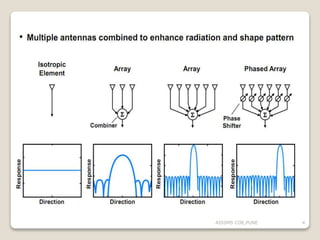
 What is antenna array ?
 What is Phased antenna array ?
directive antenna made with individual
radiating sources
shape and direction of pattern is determined by relative
phases amplitudes applied to each radiating element.
3AISSMS COE,PUNE
4AISSMS COE,PUNE
Introduction
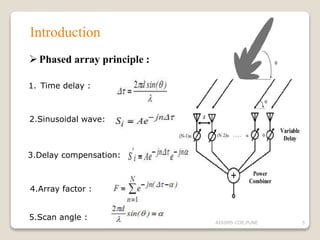
Phased array principle :
1. Time delay :
2.Sinusoidal wave:
3.Delay compensation:
4.Array factor :
5.Scan angle :
5AISSMS COE,PUNE
Literature Survey :
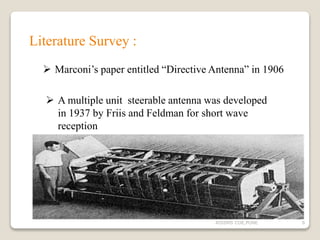
 Marconi’s paper entitled “Directive Antenna” in 1906
 A multiple unit steerable antenna was developed
in 1937 by Friis and Feldman for short wave
reception
6AISSMS COE,PUNE
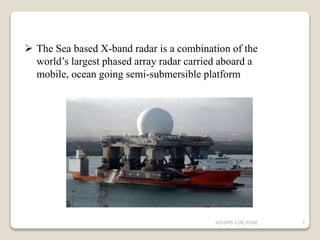
 The Sea based X-band radar is a combination of the
world’s largest phased array radar carried aboard a
mobile, ocean going semi-submersible platform
7AISSMS COE,PUNE
Objective :
 Power dividing and phase shifting tasks are performed
using the same circuitry.
 Less phase shift from phase shifters compared to any of
the conventional designs of phased arrays.
 Configurations for enhancing size and radiation properties
of phased array systems.
8AISSMS COE,PUNE
Technique :
 Phased Array Based on Extended
Resonance Technique
 Bi-Directional Series-Fed Phased Array
 Phased array using staggered array configuration
9AISSMS COE,PUNE
Methodology :
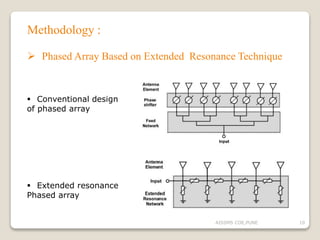
 Phased Array Based on Extended Resonance Technique
 Conventional design
of phased array
 Extended resonance
Phased array
10AISSMS COE,PUNE
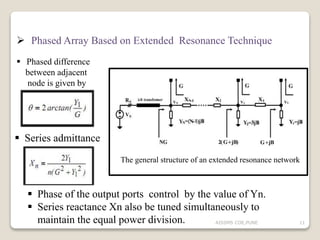
 Phased Array Based on Extended Resonance Technique
The general structure of an extended resonance network
 Phased difference
between adjacent
node is given by
 Series admittance
 Phase of the output ports control by the value of Yn.
 Series reactance Xn also be tuned simultaneously to
maintain the equal power division. 11AISSMS COE,PUNE
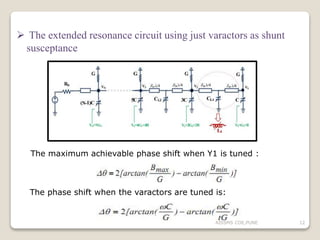
 The extended resonance circuit using just varactors as shunt
susceptance
The phase shift when the varactors are tuned is:
The maximum achievable phase shift when Y1 is tuned :
12AISSMS COE,PUNE
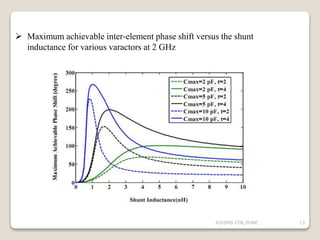
 Maximum achievable inter-element phase shift versus the shunt
inductance for various varactors at 2 GHz
13AISSMS COE,PUNE
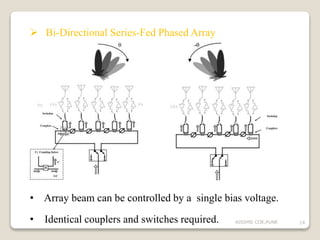
 Bi-Directional Series-Fed Phased Array
• Array beam can be controlled by a single bias voltage.
• Identical couplers and switches required. 14AISSMS COE,PUNE
To reduces the required amount of phase shifting :
 Placing the phase shifters in series rather than in parallel.
 arrays can be bi-directionally fed.
1] 2]
3]
4]
15AISSMS COE,PUNE
 Phased array using staggered array configuration
 Two staggered array configurations are used to
enhancing size and radiation properties phased array
systems.
1. Rotating each element 45 degree
2. Inserting additional rows in the middle which are
shifted by half the distance between elements.
16AISSMS COE,PUNE
2] staggered configuration 1
3] staggered configuration 2
1] Regular configuration
17AISSMS COE,PUNE
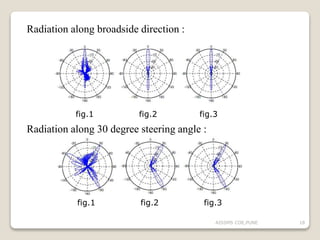
fig.1 fig.2 fig.3
fig.1 fig.2 fig.3
Radiation along broadside direction :
Radiation along 30 degree steering angle :
18AISSMS COE,PUNE
 Simulation on MATLAB
=N = 20; % Number of elements
=D = 0.5; % Element spacing (m)
=ha = phased.ULA(N,D);
=ViewArray(ha,'Title','Uniform Linear
Array (ULA)')
set(gca,'CameraViewAngle',4.4);
=N = 24; % Number of elements
= R = 1; % Radius (m)
=azang = (0:N-1)*360/N-180;
=ha = phased.ConformalArray(...
'ElementPosition',[R*cosd(azang);
R*sind(azang);zeros(1,N)],...
ElementNormal', [azang;zeros(1,N)]);
= viewArray(ha,'ShowNormals',true,
'Title','Uniform Circular Array (UCA)')
view(0,90)
19AISSMS COE,PUNE
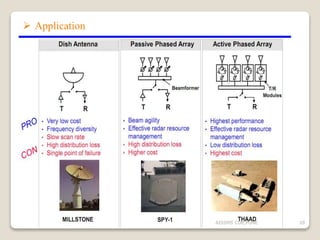
 Application
20AISSMS COE,PUNE
 Application
 On Applications of Self-Phased Array Antennas to
Mobile Communications.
 Advances in Phased Array Systems for Radio
Astronomy
21AISSMS COE,PUNE
 REFEREANCE
[1] Abdelnasser A. Eldek , “Enhancement of phased array size and radiation
properties using staggered array configuration ”, IEEE Trans.Vol. 39,2013
[2] Danial Ehyaie , “Novel Approaches to the Design of Phased Array Antennas”
Prentice-hall,Inc,2011
[3] Stefan J. Wijnholds, Wim A. van Cappellen and Jan Geralt bij de Vaate ,
“Advances in Phased Array Systems for Radio Astronomy” , IEEE Trans,
Vol . 59,2013
[4] S.L.Karode, “Self-phasing antenna array techniques for mobile communications
applications ”,IEEE Trans, Dec 2000
[5] Ali Tombak and Amir Mortazawi, “Novel Low-Cost Beam-Steering Technique
Based on the Extended-Resonance Power-Dividing Method ”, IEEE Trans,
vol.52,no.2,Feb 2004
[6] Danial Ehyaie , “A 24-GHz Modular Transmit Phased Array”,IEEE vol.59,
no.6,June 2011
[7]www.mathworks.com/R2015/phased antenna array toolbox.html
22AISSMS COE,PUNE
23AISSMS COE,PUNE

Enhancement in phased array antenna

  • 1.
    Enhancement in phased arrayantenna NAME : ASHISH S. PATIL M.E.1ST YR (MICROWAVE) ROLL NO. :14MV009 GUIDE NAME : PROF. S.P.BHOSALE
  • 2.
    PRESENTATION FLOW  Introduction Literature Survey  Objective  Technique  Methodology  Simulation in Matlab  Application  Reference 2AISSMS COE,PUNE
  • 3.
    Introduction  What isantenna array ?  What is Phased antenna array ? directive antenna made with individual radiating sources shape and direction of pattern is determined by relative phases amplitudes applied to each radiating element. 3AISSMS COE,PUNE
  • 4.
  • 5.
    Introduction Phased array principle: 1. Time delay : 2.Sinusoidal wave: 3.Delay compensation: 4.Array factor : 5.Scan angle : 5AISSMS COE,PUNE
  • 6.
    Literature Survey : Marconi’s paper entitled “Directive Antenna” in 1906  A multiple unit steerable antenna was developed in 1937 by Friis and Feldman for short wave reception 6AISSMS COE,PUNE
  • 7.
     The Seabased X-band radar is a combination of the world’s largest phased array radar carried aboard a mobile, ocean going semi-submersible platform 7AISSMS COE,PUNE
  • 8.
    Objective :  Powerdividing and phase shifting tasks are performed using the same circuitry.  Less phase shift from phase shifters compared to any of the conventional designs of phased arrays.  Configurations for enhancing size and radiation properties of phased array systems. 8AISSMS COE,PUNE
  • 9.
    Technique :  PhasedArray Based on Extended Resonance Technique  Bi-Directional Series-Fed Phased Array  Phased array using staggered array configuration 9AISSMS COE,PUNE
  • 10.
    Methodology :  PhasedArray Based on Extended Resonance Technique  Conventional design of phased array  Extended resonance Phased array 10AISSMS COE,PUNE
  • 11.
     Phased ArrayBased on Extended Resonance Technique The general structure of an extended resonance network  Phased difference between adjacent node is given by  Series admittance  Phase of the output ports control by the value of Yn.  Series reactance Xn also be tuned simultaneously to maintain the equal power division. 11AISSMS COE,PUNE
  • 12.
     The extendedresonance circuit using just varactors as shunt susceptance The phase shift when the varactors are tuned is: The maximum achievable phase shift when Y1 is tuned : 12AISSMS COE,PUNE
  • 13.
     Maximum achievableinter-element phase shift versus the shunt inductance for various varactors at 2 GHz 13AISSMS COE,PUNE
  • 14.
     Bi-Directional Series-FedPhased Array • Array beam can be controlled by a single bias voltage. • Identical couplers and switches required. 14AISSMS COE,PUNE
  • 15.
    To reduces therequired amount of phase shifting :  Placing the phase shifters in series rather than in parallel.  arrays can be bi-directionally fed. 1] 2] 3] 4] 15AISSMS COE,PUNE
  • 16.
     Phased arrayusing staggered array configuration  Two staggered array configurations are used to enhancing size and radiation properties phased array systems. 1. Rotating each element 45 degree 2. Inserting additional rows in the middle which are shifted by half the distance between elements. 16AISSMS COE,PUNE
  • 17.
    2] staggered configuration1 3] staggered configuration 2 1] Regular configuration 17AISSMS COE,PUNE
  • 18.
    fig.1 fig.2 fig.3 fig.1fig.2 fig.3 Radiation along broadside direction : Radiation along 30 degree steering angle : 18AISSMS COE,PUNE
  • 19.
     Simulation onMATLAB =N = 20; % Number of elements =D = 0.5; % Element spacing (m) =ha = phased.ULA(N,D); =ViewArray(ha,'Title','Uniform Linear Array (ULA)') set(gca,'CameraViewAngle',4.4); =N = 24; % Number of elements = R = 1; % Radius (m) =azang = (0:N-1)*360/N-180; =ha = phased.ConformalArray(... 'ElementPosition',[R*cosd(azang); R*sind(azang);zeros(1,N)],... ElementNormal', [azang;zeros(1,N)]); = viewArray(ha,'ShowNormals',true, 'Title','Uniform Circular Array (UCA)') view(0,90) 19AISSMS COE,PUNE
  • 20.
  • 21.
     Application  OnApplications of Self-Phased Array Antennas to Mobile Communications.  Advances in Phased Array Systems for Radio Astronomy 21AISSMS COE,PUNE
  • 22.
     REFEREANCE [1] AbdelnasserA. Eldek , “Enhancement of phased array size and radiation properties using staggered array configuration ”, IEEE Trans.Vol. 39,2013 [2] Danial Ehyaie , “Novel Approaches to the Design of Phased Array Antennas” Prentice-hall,Inc,2011 [3] Stefan J. Wijnholds, Wim A. van Cappellen and Jan Geralt bij de Vaate , “Advances in Phased Array Systems for Radio Astronomy” , IEEE Trans, Vol . 59,2013 [4] S.L.Karode, “Self-phasing antenna array techniques for mobile communications applications ”,IEEE Trans, Dec 2000 [5] Ali Tombak and Amir Mortazawi, “Novel Low-Cost Beam-Steering Technique Based on the Extended-Resonance Power-Dividing Method ”, IEEE Trans, vol.52,no.2,Feb 2004 [6] Danial Ehyaie , “A 24-GHz Modular Transmit Phased Array”,IEEE vol.59, no.6,June 2011 [7]www.mathworks.com/R2015/phased antenna array toolbox.html 22AISSMS COE,PUNE
  • 23.