Introduction to AntennaArrays
• - Definition: An antenna array is a set of
multiple connected antennas that work
together to transmit or receive
electromagnetic waves.
• - Purpose: Enhances gain, directivity, and
beam steering.
• - Applications: Radar systems, wireless
communications, satellite systems.
3.
Need for AntennaArrays
• - Increased Directivity: Helps focus energy in a
specific direction.
• - Beam Steering: Direction of the main lobe
can be controlled electronically.
• - Improved Signal-to-Noise Ratio (SNR)
• - Array Gain: Multiple antennas increase
power reception.
4.
Basic Concepts
• -Element: Single antenna in an array.
• - Spacing: Distance between elements (usually
λ/2).
• - Array Factor: Mathematical function
representing the array's radiation pattern.
5.
Types of AntennaArrays
• 1. Linear Array
• 2. Planar Array
• 3. Circular Array
• 4. Phased Array
• 5. Broadside and Endfire Arrays
6.
Linear Array
• -Description: Elements arranged in a straight
line.
• - Advantages: Simple design, good
beamforming.
• - Applications: Radio and radar systems.
• - Types:
• - Uniform Linear Array (ULA)
• - Non-uniform Linear Array
7.
Planar Array
• -Description: Elements arranged in a two-
dimensional plane.
• - Benefits: 2D beam steering and higher gain.
• - Applications: Satellite and airborne radar.
8.
Circular Array
• -Description: Elements placed on the
circumference of a circle.
• - Features: 360-degree coverage.
• - Use Case: Direction finding, surveillance.
9.
Phased Array
• -Description: Beam direction is changed by
adjusting the phase of individual elements.
• - Key Feature: Electronic beam steering.
• - Application: Military radar, 5G systems.
10.
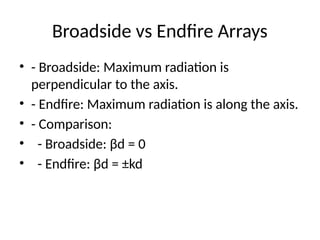
Broadside vs EndfireArrays
• - Broadside: Maximum radiation is
perpendicular to the axis.
• - Endfire: Maximum radiation is along the axis.
• - Comparison:
• - Broadside: βd = 0
• - Endfire: βd = ±kd
11.
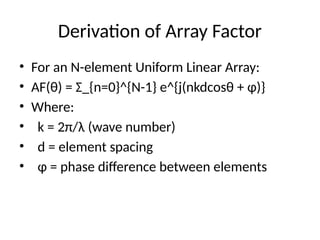
Derivation of ArrayFactor
• For an N-element Uniform Linear Array:
• AF(θ) = Σ_{n=0}^{N-1} e^{j(nkdcosθ + φ)}
• Where:
• k = 2π/λ (wave number)
• d = element spacing
• φ = phase difference between elements
12.
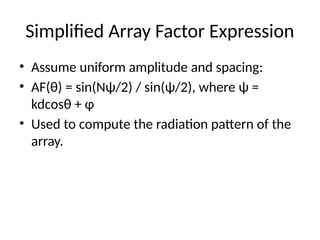
Simplified Array FactorExpression
• Assume uniform amplitude and spacing:
• AF(θ) = sin(Nψ/2) / sin(ψ/2), where ψ =
kdcosθ + φ
• Used to compute the radiation pattern of the
array.
13.
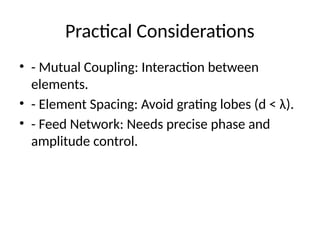
Practical Considerations
• -Mutual Coupling: Interaction between
elements.
• - Element Spacing: Avoid grating lobes (d < λ).
• - Feed Network: Needs precise phase and
amplitude control.
14.
Applications Recap
• -Wireless communication (MIMO)
• - Radar and sonar systems
• - Satellite communication
• - Direction finding
15.
Conclusion
• - Antennaarrays offer flexibility, increased
gain, and directional control.
• - Understanding types and principles is
essential for modern communication systems.
![Antenna Array and Its Types
• Presentation for Interview
• [Your Name] | [Date]](https://image.slidesharecdn.com/antennaarraypresentation-250518084725-ca080700/85/Antenna-array-antenna-engineering-microwave-ppt-1-320.jpg)
![Antenna Array and Its Types
• Presentation for Interview
• [Your Name] | [Date]](https://image.slidesharecdn.com/antennaarraypresentation-250518084725-ca080700/75/Antenna-array-antenna-engineering-microwave-ppt-1-2048.jpg)