Mehak Shabbir
BS-chemistry
E1 reactions can be stereoselective
q For some eliminations only one product is possible
q For others may be a choice of two (or more) alkene products
§ Differ either in the location or stereochemistry of the double bond
q Factors that control the stereochemistry and regiochemistry of the alkenes
q Starting with E1 reactions
v For steric reasons
q E-alkenes are lower in energy than Z-alkenes
§ Substituents can get farther apart from one another
q Reaction that can choose which it forms is likely to favour the formation of E-alkenes
q For alkenes formed by E1 elimination, less hindered E-alkene is favoured
q Geometry of the product is determined when the proton is lost from intermediate carbocation
q New p bond only form if vacant p orbital of carbocation and breaking C–H bond are aligned
parallel
q Two possible conformations of the carbocation with parallel orientations, one is more stable
than the other
§ Suffers less steric hindrance
q Transition states on the route to the alkenes
§ E-alkene is lower in energy and more E-alkene than Z-alkene is formed
q Stereoselective, reaction chooses to form predominantly one of two possible stereoisomeric
products
q Tamoxifen, important drug in the fight against breast cancer, one of the most common forms
of cancer
q Works by blocking the action of the female sex hormone estrogen
q Tetrasubstituted double bond can be introduced by an E1 elimination
E1 reactions can be regioselective
q E1 eliminations that can give more than one regio isomeric alkene
q Major product is the alkene that has the more substituents, more stable of two possible products
q More substituted alkenes are more stable
§ Stabilized when empty p* antibonding orbital can interact with filled orbitals of parallel C–H
and C–C bonds
§ More C–C or C–H bonds there are, more stable the alkene
q More substituted alkene is more stable, does not explain why it one forms faster
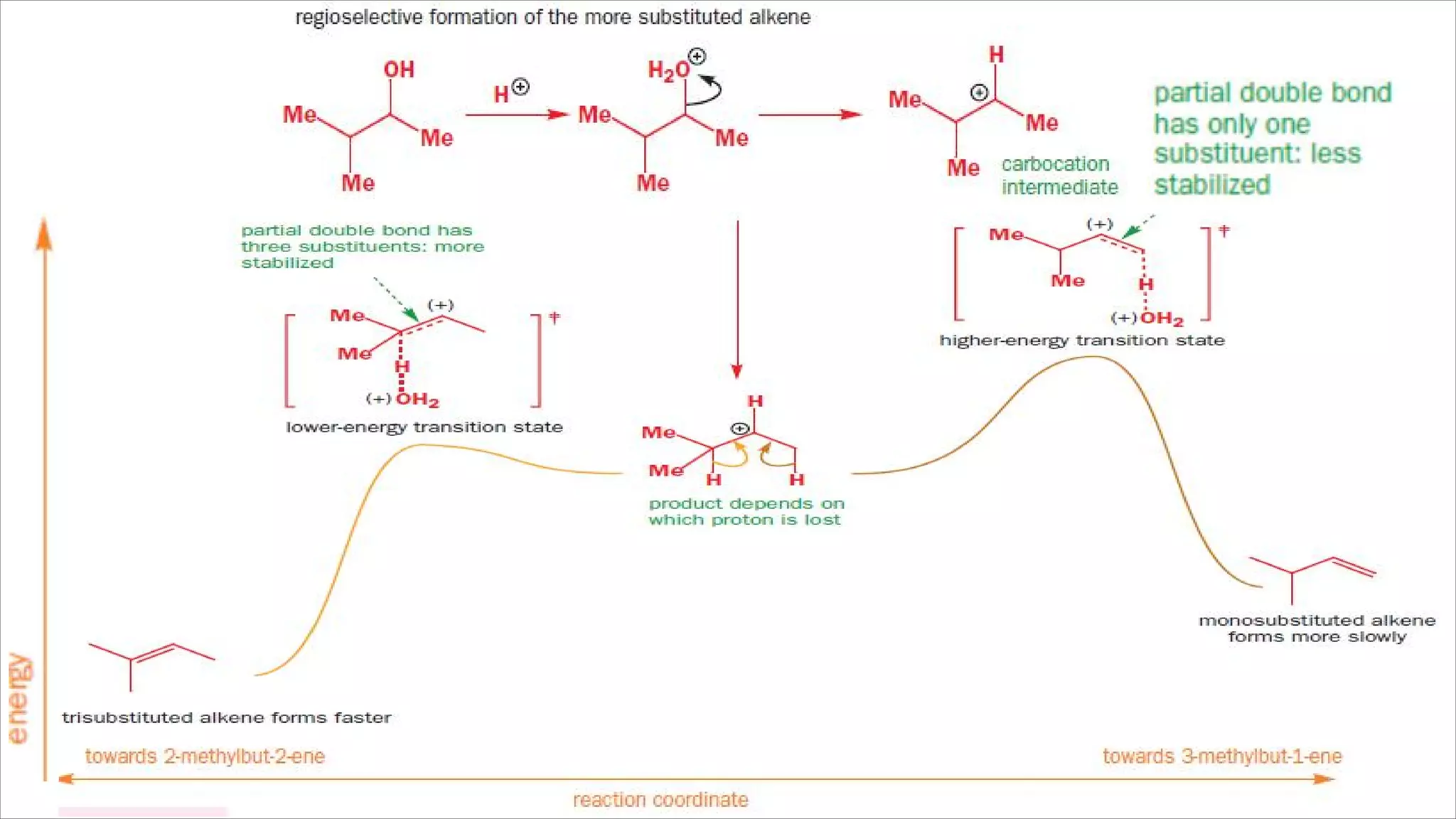
Ø Transition states leading to the two alkenes
q Both form from the same carbocation, which one depends on which proton is lost
q Removal of the proton on the right leads to a transition state in which there is a
monosubstituted double bond partly formed
q Removal of the proton on the left leads to a partial double bond that is trisubstituted
q More stable—the transition state is lower in energy, more substituted alkene forms faster
E2 eliminations have anti-periplanar transition states
q New p bond is formed by the overlap of C–H s bond with C–X s* antibonding orbital
q Two orbitals have to lie in same plane for best overlap
q Two conformations that allow this
§ One has H and X syn-periplanar
§ Other anti-periplanar
q Anti-periplanar conformation more stable, staggered
q Syn-periplanar conformation is eclipsed but,
q Only in the anti-periplanar conformation are the bonds (and therefore the orbitals) truly
parallel
q E2 eliminations take place from the anti-periplanar conformation
q E2 elimination gives mainly one of two possible stereoisomers
q 2-Bromobutane has two conformations with H and Br anti-periplanar
§ One that is less hindered leads to more of the product, and the E-alkene
predominates
q There is a choice of protons to be eliminated
• Stereochemistry of the product results from which proton is anti-periplanar to the
leaving group
• when the reaction takes place, and the reaction is stereoselective as a result
E2 eliminations can be stereospecific
q Next example, one proton take part in the elimination
q No choice of anti-periplanar transition states
q Whether the product is E or Z, E2 reaction has only one course to follow
q Outcome depends on which diastereoisomer of starting material is used
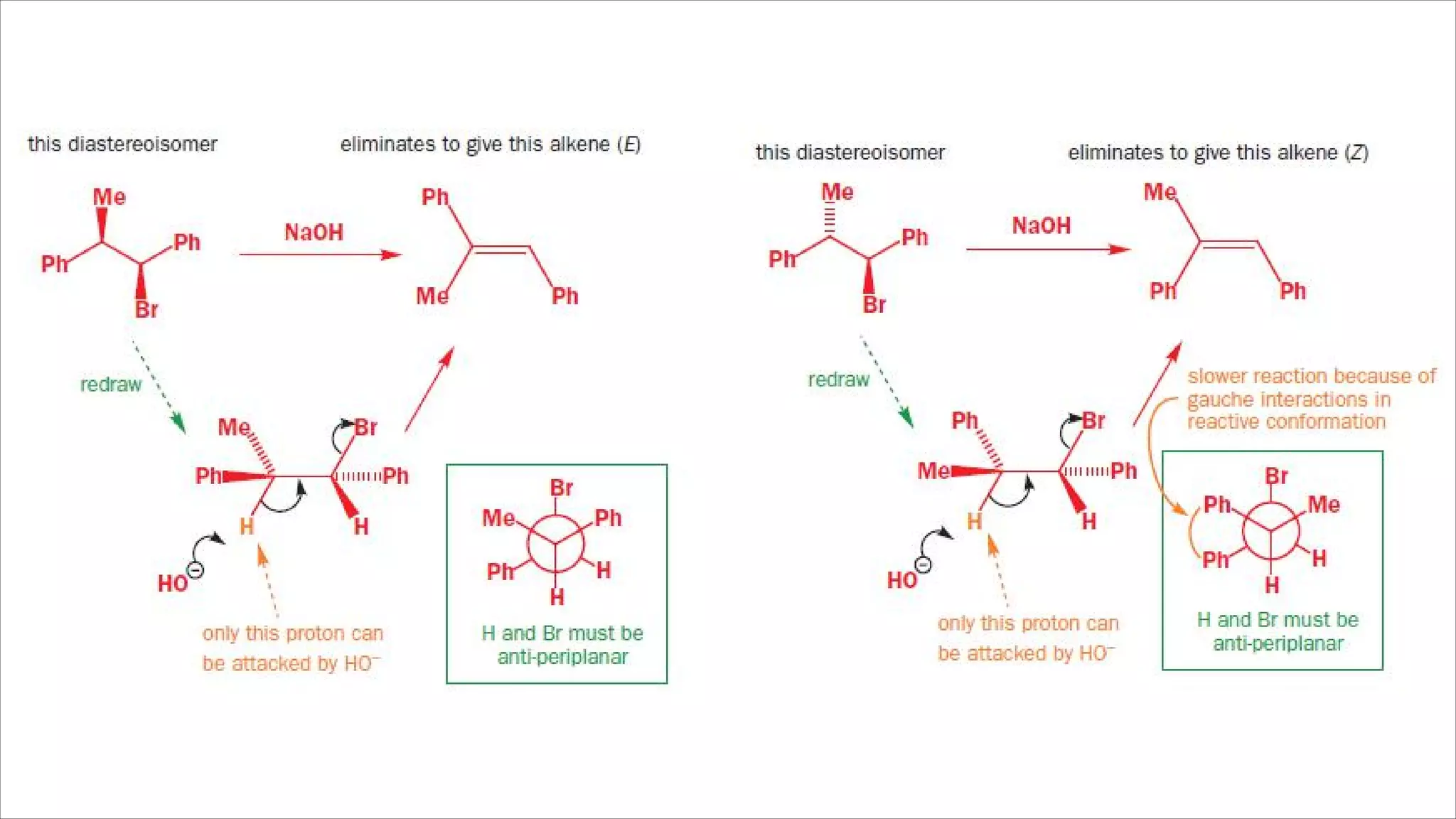
q When first diastereoisomer is drawn with the proton
• Bromine anti-periplanar, as required, in the plane of the page,
• Two phenyl groups have to lie one in front and one behind the plane of the paper
q As hydroxide attacks the C–H bond and eliminates Br
• this arrangement is preserved and the two phenyl groups end up trans (the alkene is E)
q Second dia-stereoisomer forms Z-alkene for the same reasons:
• Two phenyl groups are on the same side of H–C–C–Br plane in reactive anti-
periplanar conformation, end up cis in the product
• Each diastereoisomer gives a different alkene geometry at different rates
q First reaction is about ten times as fast as the second
• Anti-periplanar conformation only reactive one, not necessarily the most stable
q Newman projection for second reaction shows that two phenyl groups have to lie synclinal
(gauche) to one another:
• Steric interaction between these large groups at any time
• Relatively small proportion of molecules adopt the right conformation for elimination,
slowing the process down
q Reactions in which the stereochemistry of the product is determined by the stereochemistry
of the starting material are called stereospecific
q Stereoselective reactions give one predominant product because the reaction pathway has a
choice.
q Either pathway of lower activation energy is preferred (kinetic control) or more stable
product (thermodynamic control)
q Stereospecific reactions lead to the production of a single isomer as a direct result of
mechanism of reaction and the stereochemistry of the starting material
q There is no choice
q Reaction gives a different dia-stereoisomer of the product from each stereoisomer of the
starting material

Stereochemistry of Elimination Reactions

  • 1.
  • 2.
    E1 reactions canbe stereoselective q For some eliminations only one product is possible q For others may be a choice of two (or more) alkene products § Differ either in the location or stereochemistry of the double bond q Factors that control the stereochemistry and regiochemistry of the alkenes q Starting with E1 reactions
  • 4.
    v For stericreasons q E-alkenes are lower in energy than Z-alkenes § Substituents can get farther apart from one another q Reaction that can choose which it forms is likely to favour the formation of E-alkenes q For alkenes formed by E1 elimination, less hindered E-alkene is favoured
  • 5.
    q Geometry ofthe product is determined when the proton is lost from intermediate carbocation q New p bond only form if vacant p orbital of carbocation and breaking C–H bond are aligned parallel q Two possible conformations of the carbocation with parallel orientations, one is more stable than the other § Suffers less steric hindrance q Transition states on the route to the alkenes § E-alkene is lower in energy and more E-alkene than Z-alkene is formed q Stereoselective, reaction chooses to form predominantly one of two possible stereoisomeric products
  • 7.
    q Tamoxifen, importantdrug in the fight against breast cancer, one of the most common forms of cancer q Works by blocking the action of the female sex hormone estrogen q Tetrasubstituted double bond can be introduced by an E1 elimination
  • 8.
    E1 reactions canbe regioselective q E1 eliminations that can give more than one regio isomeric alkene q Major product is the alkene that has the more substituents, more stable of two possible products q More substituted alkenes are more stable § Stabilized when empty p* antibonding orbital can interact with filled orbitals of parallel C–H and C–C bonds § More C–C or C–H bonds there are, more stable the alkene
  • 10.
    q More substitutedalkene is more stable, does not explain why it one forms faster Ø Transition states leading to the two alkenes q Both form from the same carbocation, which one depends on which proton is lost q Removal of the proton on the right leads to a transition state in which there is a monosubstituted double bond partly formed q Removal of the proton on the left leads to a partial double bond that is trisubstituted q More stable—the transition state is lower in energy, more substituted alkene forms faster
  • 12.
    E2 eliminations haveanti-periplanar transition states q New p bond is formed by the overlap of C–H s bond with C–X s* antibonding orbital q Two orbitals have to lie in same plane for best overlap q Two conformations that allow this § One has H and X syn-periplanar § Other anti-periplanar q Anti-periplanar conformation more stable, staggered q Syn-periplanar conformation is eclipsed but, q Only in the anti-periplanar conformation are the bonds (and therefore the orbitals) truly parallel
  • 13.
    q E2 eliminationstake place from the anti-periplanar conformation q E2 elimination gives mainly one of two possible stereoisomers q 2-Bromobutane has two conformations with H and Br anti-periplanar § One that is less hindered leads to more of the product, and the E-alkene predominates
  • 14.
    q There isa choice of protons to be eliminated • Stereochemistry of the product results from which proton is anti-periplanar to the leaving group • when the reaction takes place, and the reaction is stereoselective as a result
  • 15.
    E2 eliminations canbe stereospecific q Next example, one proton take part in the elimination q No choice of anti-periplanar transition states q Whether the product is E or Z, E2 reaction has only one course to follow q Outcome depends on which diastereoisomer of starting material is used q When first diastereoisomer is drawn with the proton • Bromine anti-periplanar, as required, in the plane of the page, • Two phenyl groups have to lie one in front and one behind the plane of the paper q As hydroxide attacks the C–H bond and eliminates Br • this arrangement is preserved and the two phenyl groups end up trans (the alkene is E)
  • 17.
    q Second dia-stereoisomerforms Z-alkene for the same reasons: • Two phenyl groups are on the same side of H–C–C–Br plane in reactive anti- periplanar conformation, end up cis in the product • Each diastereoisomer gives a different alkene geometry at different rates q First reaction is about ten times as fast as the second • Anti-periplanar conformation only reactive one, not necessarily the most stable q Newman projection for second reaction shows that two phenyl groups have to lie synclinal (gauche) to one another: • Steric interaction between these large groups at any time • Relatively small proportion of molecules adopt the right conformation for elimination, slowing the process down
  • 18.
    q Reactions inwhich the stereochemistry of the product is determined by the stereochemistry of the starting material are called stereospecific q Stereoselective reactions give one predominant product because the reaction pathway has a choice. q Either pathway of lower activation energy is preferred (kinetic control) or more stable product (thermodynamic control) q Stereospecific reactions lead to the production of a single isomer as a direct result of mechanism of reaction and the stereochemistry of the starting material q There is no choice q Reaction gives a different dia-stereoisomer of the product from each stereoisomer of the starting material