APPLIED CHEMISTRY
Paper Code: BS103/ BS104
Lecture 7
PHASE RULE
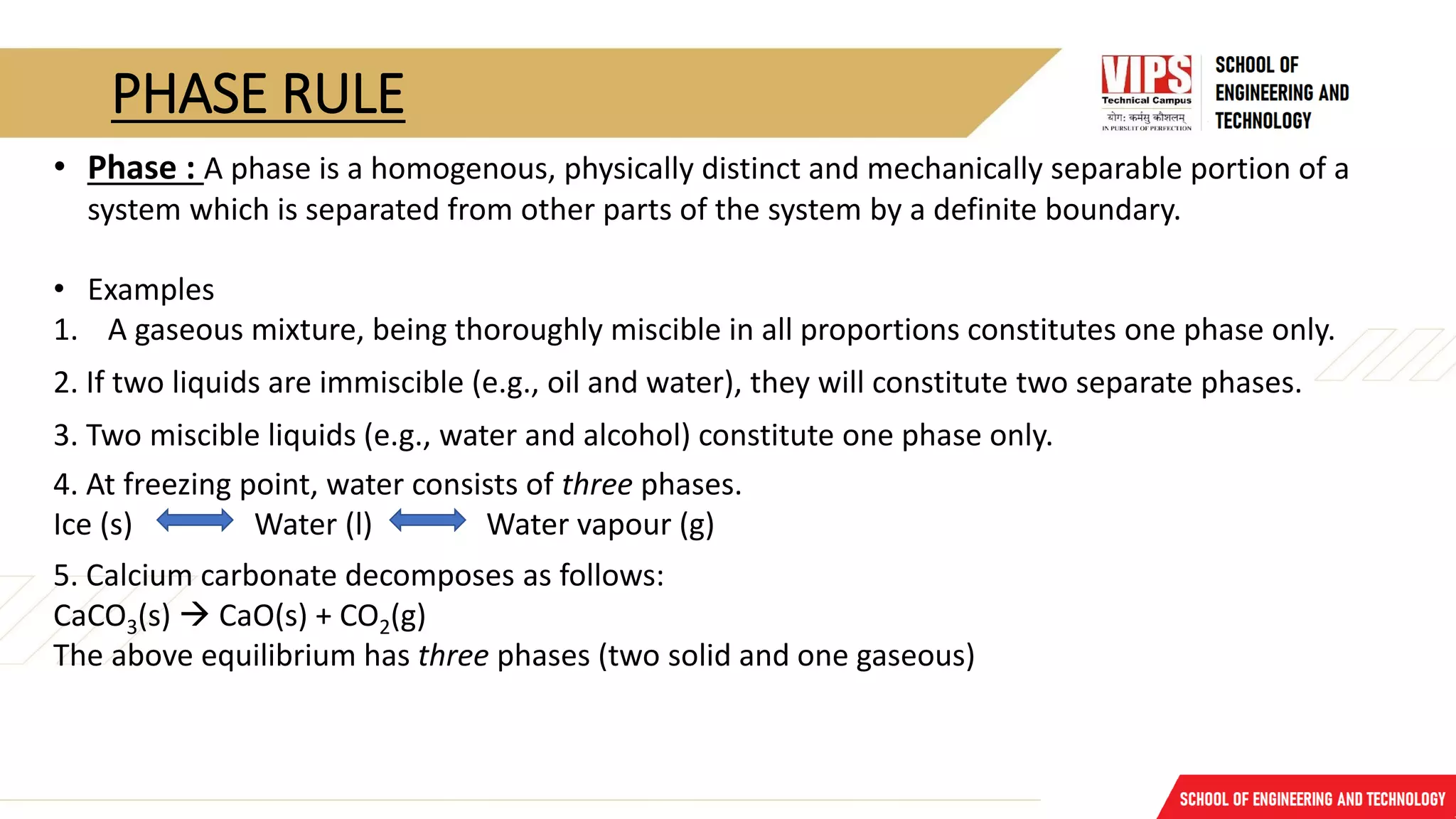
• Phase : A phase is a homogenous, physically distinct and mechanically separable portion of a
system which is separated from other parts of the system by a definite boundary.
• Examples
1. A gaseous mixture, being thoroughly miscible in all proportions constitutes one phase only.
2. If two liquids are immiscible (e.g., oil and water), they will constitute two separate phases.
3. Two miscible liquids (e.g., water and alcohol) constitute one phase only.
4. At freezing point, water consists of three phases.
Ice (s) Water (l) Water vapour (g)
5. Calcium carbonate decomposes as follows:
CaCO3(s) → CaO(s) + CO2(g)
The above equilibrium has three phases (two solid and one gaseous)
• Components: The number of components of a system at equilibrium is the smallest number of
independently variable constituents by means of which the composition of each phase present can be
expressed either directly or in the form of a chemical equation.
• Examples
1. Water system has three phases.
Ice (s) Water (l) Water vapour (g)
Each of these phases is a different physical form of the same chemical compound represented by H2O.
Hence, it is a one-component system.
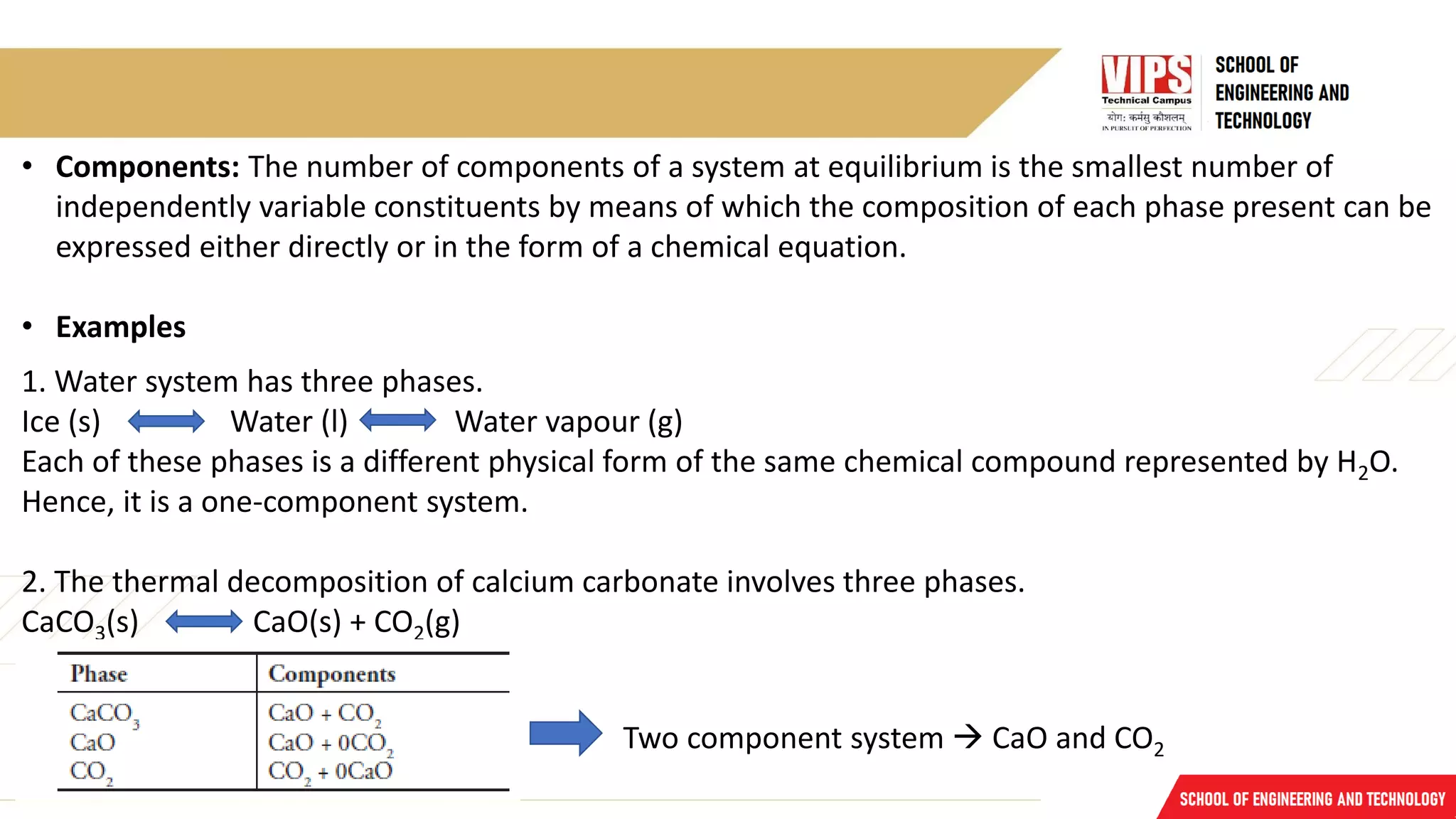
2. The thermal decomposition of calcium carbonate involves three phases.
CaCO3(s) CaO(s) + CO2(g)
Two component system → CaO and CO2
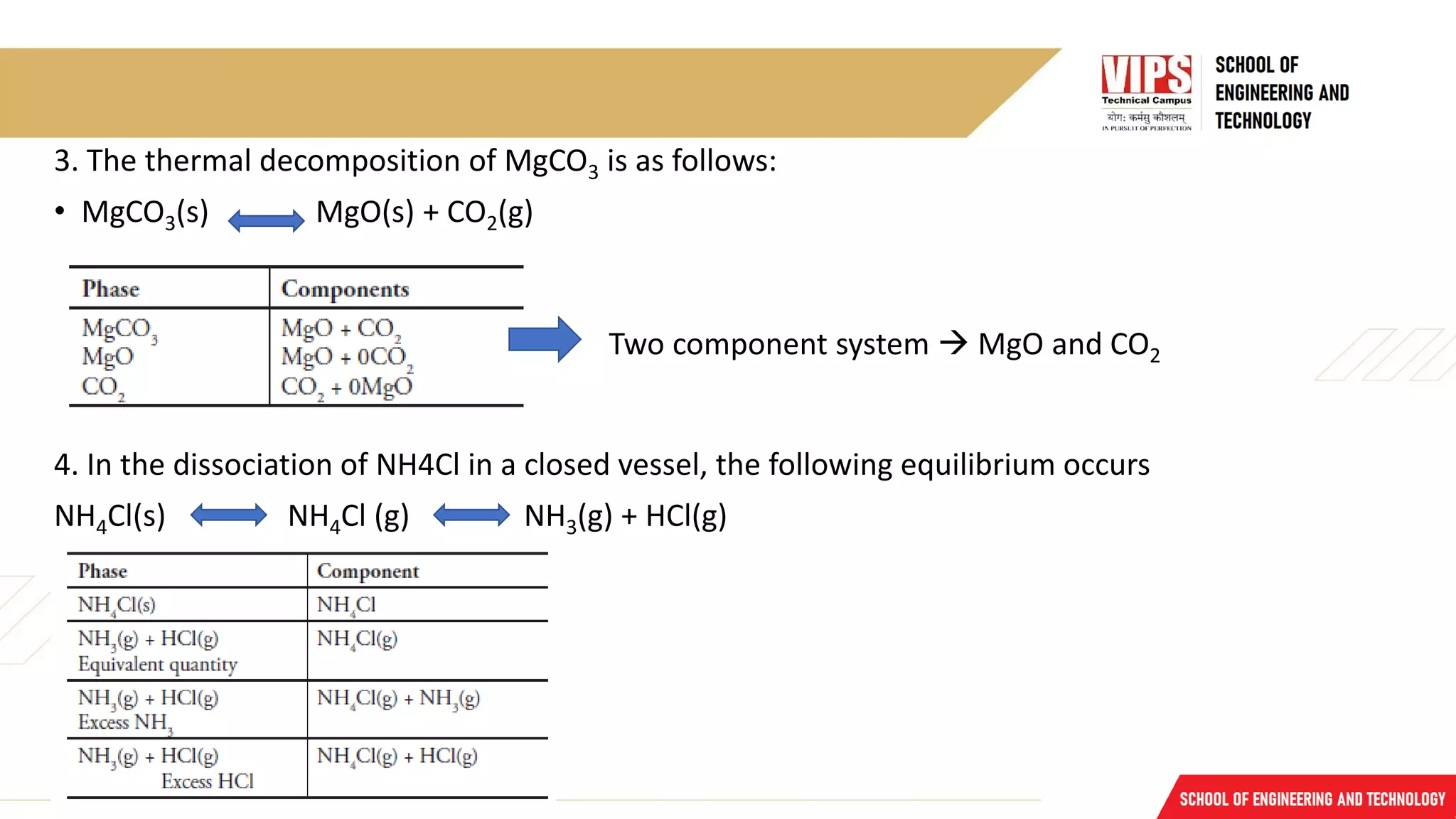
3. The thermal decomposition of MgCO3 is as follows:
• MgCO3(s) MgO(s) + CO2(g)
4. In the dissociation of NH4Cl in a closed vessel, the following equilibrium occurs
NH4Cl(s) NH4Cl (g) NH3(g) + HCl(g)
Two component system → MgO and CO2
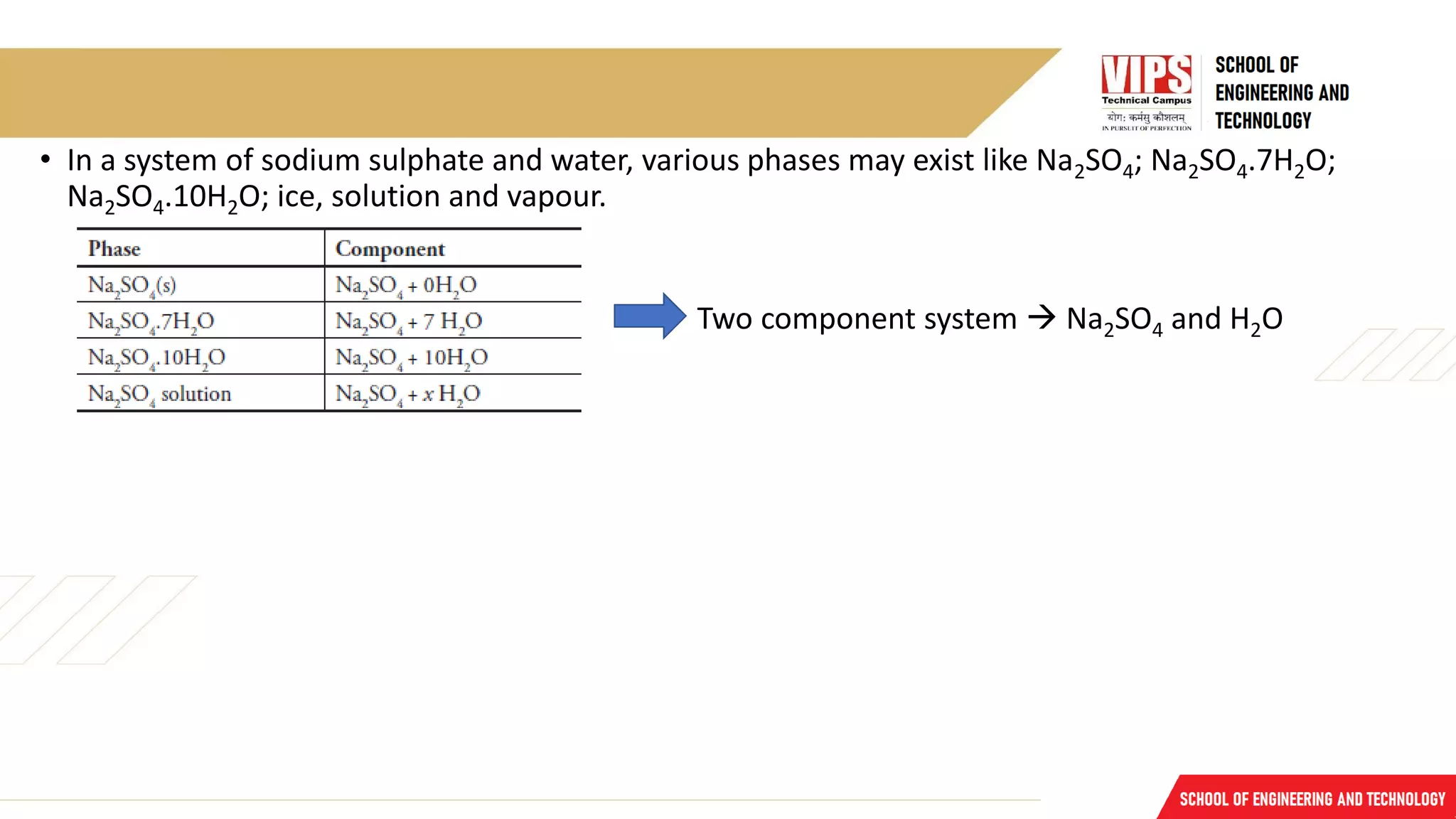
• In a system of sodium sulphate and water, various phases may exist like Na2SO4; Na2SO4.7H2O;
Na2SO4.10H2O; ice, solution and vapour.
Two component system → Na2SO4 and H2O
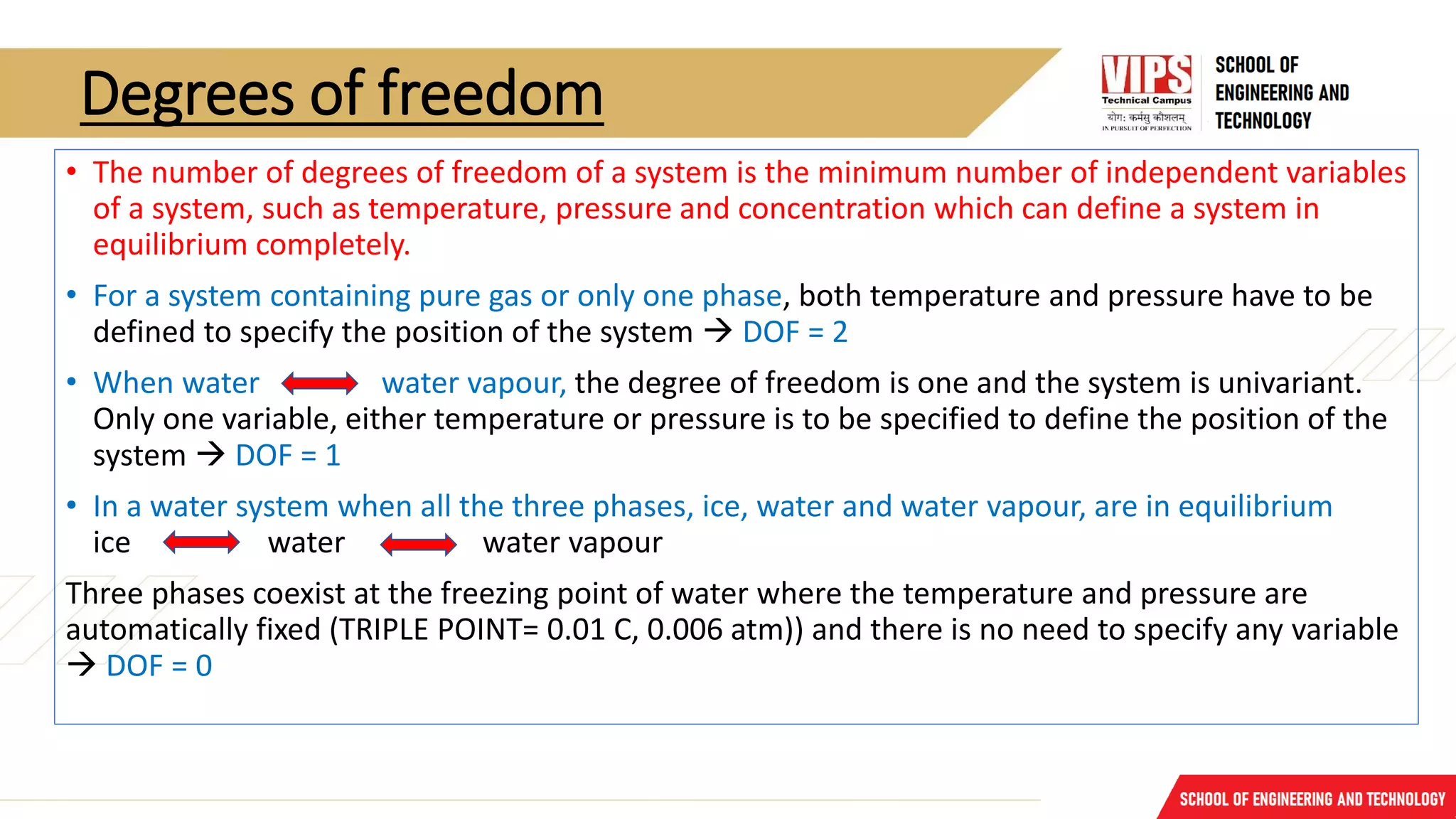
Degrees of freedom
• The number of degrees of freedom of a system is the minimum number of independent variables
of a system, such as temperature, pressure and concentration which can define a system in
equilibrium completely.
• For a system containing pure gas or only one phase, both temperature and pressure have to be
defined to specify the position of the system → DOF = 2
• When water water vapour, the degree of freedom is one and the system is univariant.
Only one variable, either temperature or pressure is to be specified to define the position of the
system → DOF = 1
• In a water system when all the three phases, ice, water and water vapour, are in equilibrium
ice water water vapour
Three phases coexist at the freezing point of water where the temperature and pressure are
automatically fixed (TRIPLE POINT= 0.01 C, 0.006 atm)) and there is no need to specify any variable
→ DOF = 0
Problems
1. Calculate the number of phases
i. CaCO3(s) CaO(s) + CO2(g).
ii. MgCO3(s) MgO(s) + CO2(g).
iii. Rhombic sulphur(s) Monoclinic sulphur(s).
iv. Ice (s) Water (l) Water vapour (g)
v. A system consisting of benzene and water.
vi. Closed beaker partially filled with benzene and water.
vii. Acetone and water.
viii. Fe(s) + H2O(g) FeO(s) + H2(g) equilibria.
ix. Solution of Mohr’s salt [FeSO4.(NH4)2SO4.6H2O].
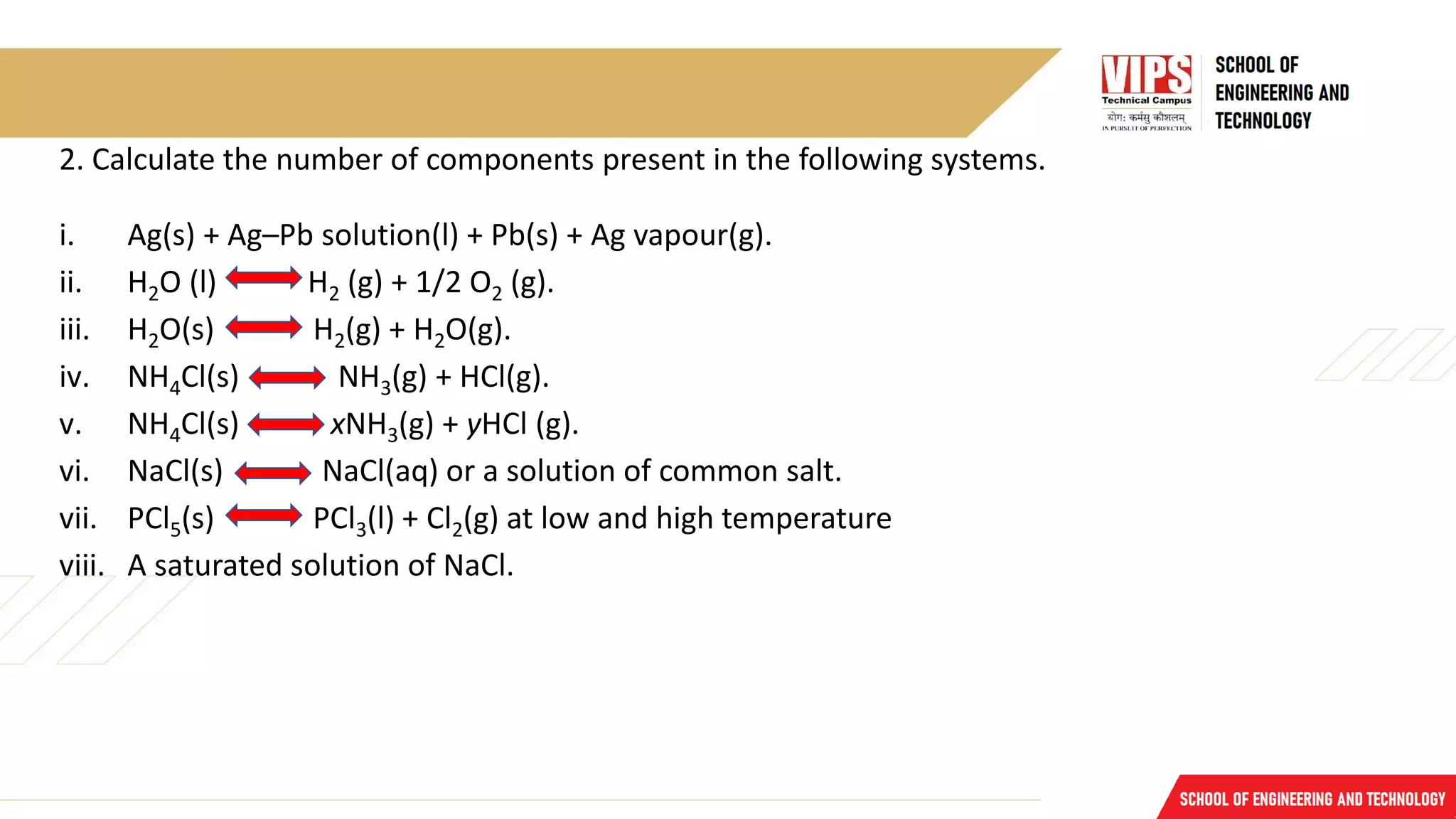
2. Calculate the number of components present in the following systems.
i. Ag(s) + Ag–Pb solution(l) + Pb(s) + Ag vapour(g).
ii. H2O (l) H2 (g) + 1/2 O2 (g).
iii. H2O(s) H2(g) + H2O(g).
iv. NH4Cl(s) NH3(g) + HCl(g).
v. NH4Cl(s) xNH3(g) + yHCl (g).
vi. NaCl(s) NaCl(aq) or a solution of common salt.
vii. PCl5(s) PCl3(l) + Cl2(g) at low and high temperature
viii. A saturated solution of NaCl.
Phase Rule
• The phase rule was given by Gibbs, which explains the equilibrium existing in heterogeneous
systems.
• It states that the equilibrium between different phases is influenced by temperature, pressure and
concentration only and not gravity, electrical or magnetic forces.
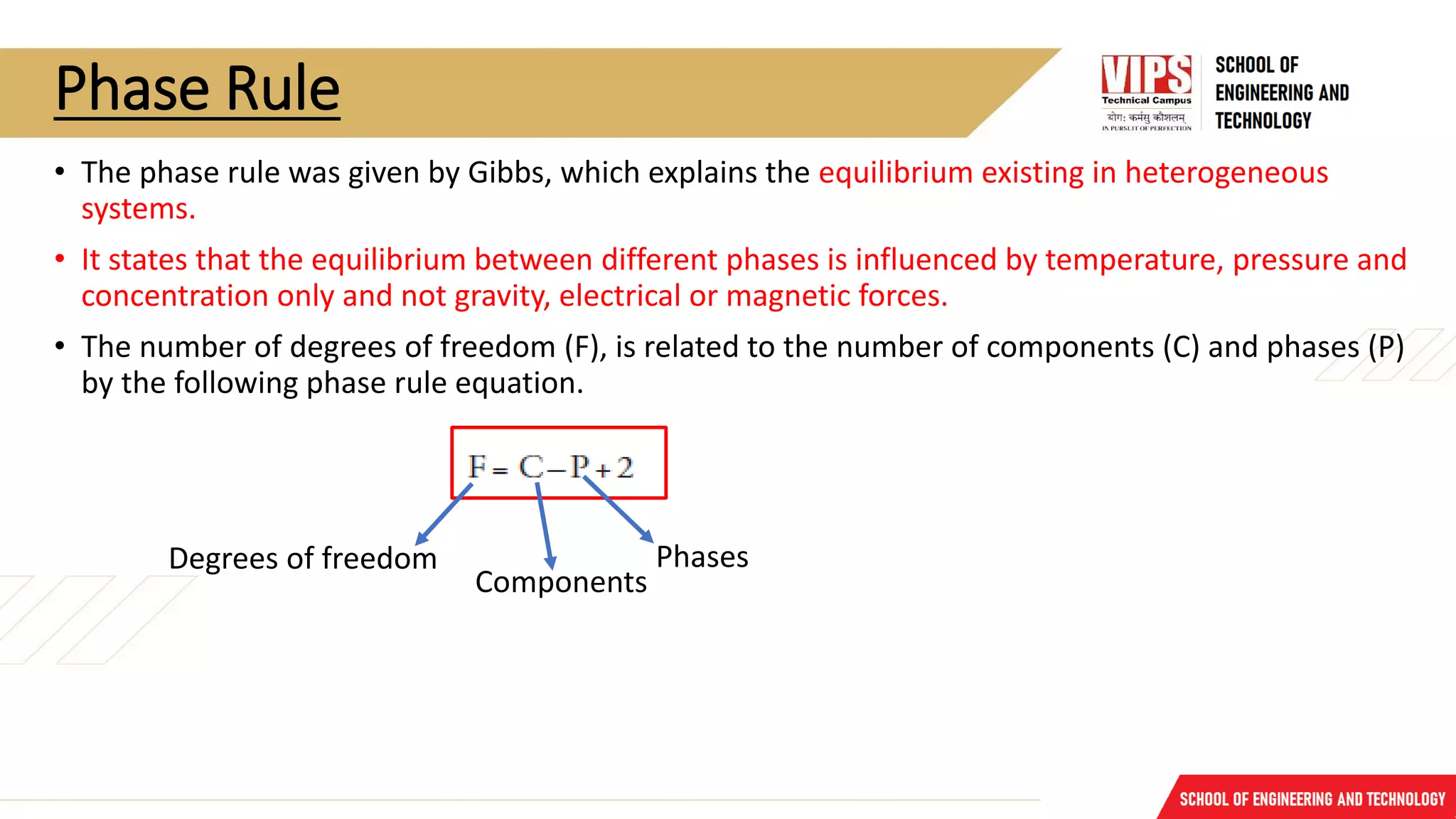
• The number of degrees of freedom (F), is related to the number of components (C) and phases (P)
by the following phase rule equation.
Degrees of freedom
Components
Phases
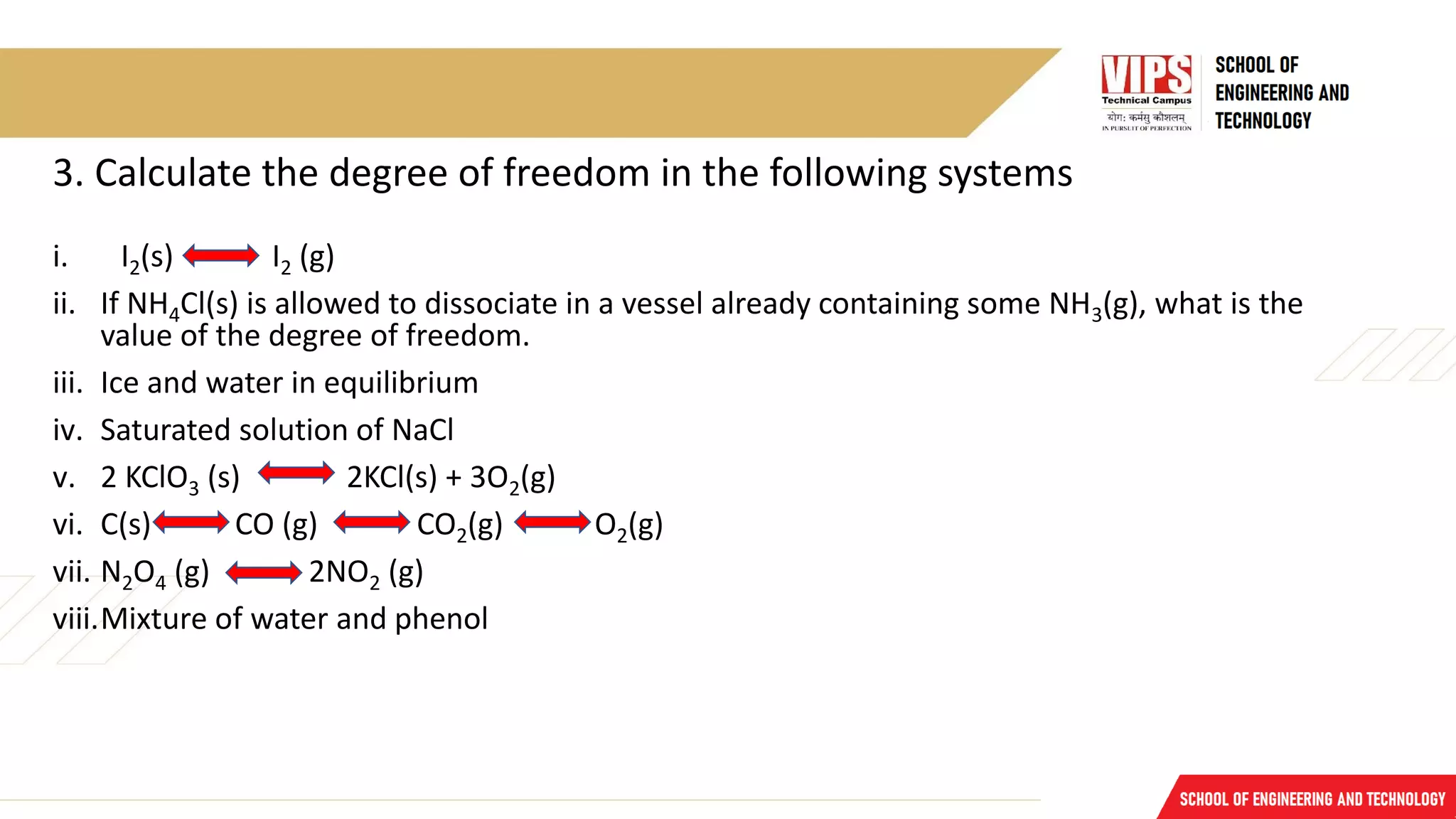
3. Calculate the degree of freedom in the following systems
i. I2(s) I2 (g)
ii. If NH4Cl(s) is allowed to dissociate in a vessel already containing some NH3(g), what is the
value of the degree of freedom.
iii. Ice and water in equilibrium
iv. Saturated solution of NaCl
v. 2 KClO3 (s) 2KCl(s) + 3O2(g)
vi. C(s) CO (g) CO2(g) O2(g)
vii. N2O4 (g) 2NO2 (g)
viii.Mixture of water and phenol
Solution for Q3
i. C =1; P =2
F = C – P + 2; F = 1 – 2 + 2 = 1
ii. F = C – P + 2
C = 2 (NH4Cl + NH3); P = 2 [NH4Cl(s) + {NH4Cl(g) & NH3(g) } ]
F = 2 – 2 + 2 = 2
iii. P = 2; C = 1; F = C – P + 2; F = 1 – 2 + 2 = 1
iv. C = 2, P = 3; F = C – P + 2; F = 2 – 3 + 2 = 1
v. P = 3, C = 2; F = C – P + 2; F = 2 – 3 + 2 = 1
vi. Phases = 2 (solid phase due to carbon + gaseous phase due to CO2 + CO + O2
C = 2 (carbon + oxygen)
F = C – P + 2; 2 – 2 + 2 = 2
vii. P = 1, C = 1; F = C – P + 2 = 1 – 1 + 2 = 2
viii. P = 2, C = 2; F= C – P + 2 = 2 – 2 + 2 = 2
Lecture 11.pdf

Lecture 11.pdf

  • 1.
    APPLIED CHEMISTRY Paper Code:BS103/ BS104 Lecture 7
  • 2.
    PHASE RULE • Phase: A phase is a homogenous, physically distinct and mechanically separable portion of a system which is separated from other parts of the system by a definite boundary. • Examples 1. A gaseous mixture, being thoroughly miscible in all proportions constitutes one phase only. 2. If two liquids are immiscible (e.g., oil and water), they will constitute two separate phases. 3. Two miscible liquids (e.g., water and alcohol) constitute one phase only. 4. At freezing point, water consists of three phases. Ice (s) Water (l) Water vapour (g) 5. Calcium carbonate decomposes as follows: CaCO3(s) → CaO(s) + CO2(g) The above equilibrium has three phases (two solid and one gaseous)
  • 3.
    • Components: Thenumber of components of a system at equilibrium is the smallest number of independently variable constituents by means of which the composition of each phase present can be expressed either directly or in the form of a chemical equation. • Examples 1. Water system has three phases. Ice (s) Water (l) Water vapour (g) Each of these phases is a different physical form of the same chemical compound represented by H2O. Hence, it is a one-component system. 2. The thermal decomposition of calcium carbonate involves three phases. CaCO3(s) CaO(s) + CO2(g) Two component system → CaO and CO2
  • 4.
    3. The thermaldecomposition of MgCO3 is as follows: • MgCO3(s) MgO(s) + CO2(g) 4. In the dissociation of NH4Cl in a closed vessel, the following equilibrium occurs NH4Cl(s) NH4Cl (g) NH3(g) + HCl(g) Two component system → MgO and CO2
  • 5.
    • In asystem of sodium sulphate and water, various phases may exist like Na2SO4; Na2SO4.7H2O; Na2SO4.10H2O; ice, solution and vapour. Two component system → Na2SO4 and H2O
  • 6.
    Degrees of freedom •The number of degrees of freedom of a system is the minimum number of independent variables of a system, such as temperature, pressure and concentration which can define a system in equilibrium completely. • For a system containing pure gas or only one phase, both temperature and pressure have to be defined to specify the position of the system → DOF = 2 • When water water vapour, the degree of freedom is one and the system is univariant. Only one variable, either temperature or pressure is to be specified to define the position of the system → DOF = 1 • In a water system when all the three phases, ice, water and water vapour, are in equilibrium ice water water vapour Three phases coexist at the freezing point of water where the temperature and pressure are automatically fixed (TRIPLE POINT= 0.01 C, 0.006 atm)) and there is no need to specify any variable → DOF = 0
  • 7.
    Problems 1. Calculate thenumber of phases i. CaCO3(s) CaO(s) + CO2(g). ii. MgCO3(s) MgO(s) + CO2(g). iii. Rhombic sulphur(s) Monoclinic sulphur(s). iv. Ice (s) Water (l) Water vapour (g) v. A system consisting of benzene and water. vi. Closed beaker partially filled with benzene and water. vii. Acetone and water. viii. Fe(s) + H2O(g) FeO(s) + H2(g) equilibria. ix. Solution of Mohr’s salt [FeSO4.(NH4)2SO4.6H2O].
  • 8.
    2. Calculate thenumber of components present in the following systems. i. Ag(s) + Ag–Pb solution(l) + Pb(s) + Ag vapour(g). ii. H2O (l) H2 (g) + 1/2 O2 (g). iii. H2O(s) H2(g) + H2O(g). iv. NH4Cl(s) NH3(g) + HCl(g). v. NH4Cl(s) xNH3(g) + yHCl (g). vi. NaCl(s) NaCl(aq) or a solution of common salt. vii. PCl5(s) PCl3(l) + Cl2(g) at low and high temperature viii. A saturated solution of NaCl.
  • 9.
    Phase Rule • Thephase rule was given by Gibbs, which explains the equilibrium existing in heterogeneous systems. • It states that the equilibrium between different phases is influenced by temperature, pressure and concentration only and not gravity, electrical or magnetic forces. • The number of degrees of freedom (F), is related to the number of components (C) and phases (P) by the following phase rule equation. Degrees of freedom Components Phases
  • 10.
    3. Calculate thedegree of freedom in the following systems i. I2(s) I2 (g) ii. If NH4Cl(s) is allowed to dissociate in a vessel already containing some NH3(g), what is the value of the degree of freedom. iii. Ice and water in equilibrium iv. Saturated solution of NaCl v. 2 KClO3 (s) 2KCl(s) + 3O2(g) vi. C(s) CO (g) CO2(g) O2(g) vii. N2O4 (g) 2NO2 (g) viii.Mixture of water and phenol
  • 11.
    Solution for Q3 i.C =1; P =2 F = C – P + 2; F = 1 – 2 + 2 = 1 ii. F = C – P + 2 C = 2 (NH4Cl + NH3); P = 2 [NH4Cl(s) + {NH4Cl(g) & NH3(g) } ] F = 2 – 2 + 2 = 2 iii. P = 2; C = 1; F = C – P + 2; F = 1 – 2 + 2 = 1 iv. C = 2, P = 3; F = C – P + 2; F = 2 – 3 + 2 = 1 v. P = 3, C = 2; F = C – P + 2; F = 2 – 3 + 2 = 1 vi. Phases = 2 (solid phase due to carbon + gaseous phase due to CO2 + CO + O2 C = 2 (carbon + oxygen) F = C – P + 2; 2 – 2 + 2 = 2 vii. P = 1, C = 1; F = C – P + 2 = 1 – 1 + 2 = 2 viii. P = 2, C = 2; F= C – P + 2 = 2 – 2 + 2 = 2