Topic:
Ø Diazo-coupling
Ø Formylation
Ø Carboxylation
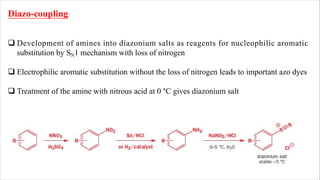
q Development of amines into diazonium salts as reagents for nucleophilic aromatic
substitution by SN1 mechanism with loss of nitrogen
q Electrophilic aromatic substitution without the loss of nitrogen leads to important azo dyes
q Treatment of the amine with nitrous acid at 0 °C gives diazonium salt
Diazo-coupling
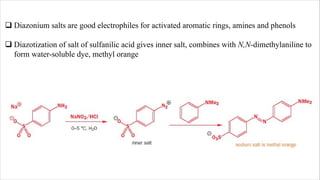
q Diazonium salts are good electrophiles for activated aromatic rings, amines and phenols
q Diazotization of salt of sulfanilic acid gives inner salt, combines with N,N-dimethylaniline to
form water-soluble dye, methyl orange
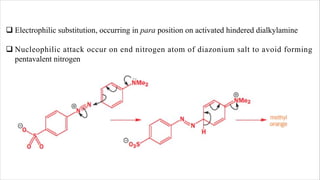
q Electrophilic substitution, occurring in para position on activated hindered dialkylamine
q Nucleophilic attack occur on end nitrogen atom of diazonium salt to avoid forming
pentavalent nitrogen
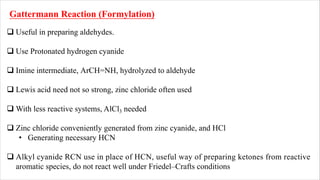
Gattermann Reaction (Formylation)
q Useful in preparing aldehydes.
q Use Protonated hydrogen cyanide
q Imine intermediate, ArCH=NH, hydrolyzed to aldehyde
q Lewis acid need not so strong, zinc chloride often used
q With less reactive systems, AlCl3 needed
q Zinc chloride conveniently generated from zinc cyanide, and HCl
• Generating necessary HCN
q Alkyl cyanide RCN use in place of HCN, useful way of preparing ketones from reactive
aromatic species, do not react well under Friedel–Crafts conditions
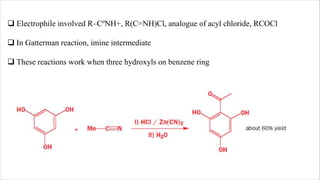
q Electrophile involved R–CºNH+, R(C=NH)Cl, analogue of acyl chloride, RCOCl
q In Gatterman reaction, imine intermediate
q These reactions work when three hydroxyls on benzene ring
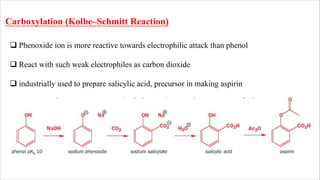
Carboxylation (Kolbe–Schmitt Reaction)
q Phenoxide ion is more reactive towards electrophilic attack than phenol
q React with such weak electrophiles as carbon dioxide
q industrially used to prepare salicylic acid, precursor in making aspirin
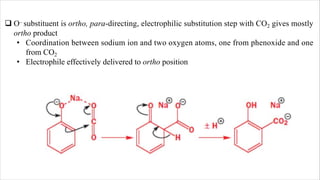
q O– substituent is ortho, para-directing, electrophilic substitution step with CO2 gives mostly
ortho product
• Coordination between sodium ion and two oxygen atoms, one from phenoxide and one
from CO2
• Electrophile effectively delivered to ortho position

Diazo coupling, formylation,carboxylation

  • 1.
  • 2.
    q Development ofamines into diazonium salts as reagents for nucleophilic aromatic substitution by SN1 mechanism with loss of nitrogen q Electrophilic aromatic substitution without the loss of nitrogen leads to important azo dyes q Treatment of the amine with nitrous acid at 0 °C gives diazonium salt Diazo-coupling
  • 3.
    q Diazonium saltsare good electrophiles for activated aromatic rings, amines and phenols q Diazotization of salt of sulfanilic acid gives inner salt, combines with N,N-dimethylaniline to form water-soluble dye, methyl orange
  • 4.
    q Electrophilic substitution,occurring in para position on activated hindered dialkylamine q Nucleophilic attack occur on end nitrogen atom of diazonium salt to avoid forming pentavalent nitrogen
  • 5.
    Gattermann Reaction (Formylation) qUseful in preparing aldehydes. q Use Protonated hydrogen cyanide q Imine intermediate, ArCH=NH, hydrolyzed to aldehyde q Lewis acid need not so strong, zinc chloride often used q With less reactive systems, AlCl3 needed q Zinc chloride conveniently generated from zinc cyanide, and HCl • Generating necessary HCN q Alkyl cyanide RCN use in place of HCN, useful way of preparing ketones from reactive aromatic species, do not react well under Friedel–Crafts conditions
  • 6.
    q Electrophile involvedR–CºNH+, R(C=NH)Cl, analogue of acyl chloride, RCOCl q In Gatterman reaction, imine intermediate q These reactions work when three hydroxyls on benzene ring
  • 7.
    Carboxylation (Kolbe–Schmitt Reaction) qPhenoxide ion is more reactive towards electrophilic attack than phenol q React with such weak electrophiles as carbon dioxide q industrially used to prepare salicylic acid, precursor in making aspirin
  • 8.
    q O– substituentis ortho, para-directing, electrophilic substitution step with CO2 gives mostly ortho product • Coordination between sodium ion and two oxygen atoms, one from phenoxide and one from CO2 • Electrophile effectively delivered to ortho position