“ Judging a Person Does not define who
they were ……..
Actually !
It defines who you are . ”
Assignment Presentation Topic:
Fluidization
Presenting to you by the Dashing Personalities
Mr. Sarfaraz Jalbani {14 CH 48}.
and
Mr. Rahat Inayat Ali {14 CH 23}.
What Is Fluidization …….???
The Operation by which Fine Solids are
Transformed into Fluid-Like State,
through Contact with the Gas or Liquid.
 Fluidization refers to those Gas-Solids and
Liquid-Solids system in which the solid
phase is subjected to behave more or less
like a Fluid by the upwelling current of gas or
liquid stream moving through the bed of solid
particles.
 Fluidized bed combustion and Catalytic
cracking of heavy crude-oil fractions of
petroleum are the two good examples of
Fluidization.
Some Size Reduction Processes used in
Fluidization Process
 Attrition
 Compression
 Impact
 Shear
Types
When Fluidizing Sand with Water, the
particles move further apart and their
motion becomes more vigorous as the
velocity is increased, but the bed
density at a given velocity is same in
all sections of the bed. This is
called Particulate Fluidization and is
characterized by a large but uniform
expansion of the bed at high
velocities.
And if …..
Beds of solids fluidized with Air usually
exhibit what is called
Aggregative or Bubbling Fluidization.
At superficial velocities much greater
than Vmf most of the gas passes
through the bed as bubbles or voids
which are almost free of solids, and
only a small fraction of the gas flows in
the channels between the particles.
How Fluidization ..?
PROCESS
 When a gas flow is introduced through the
bottom of a bed of solid particles, it will
move upwards through the bed via the
empty spaces between the particles. At low
gas velocities, aerodynamic drag on each
particle is also low, and thus the bed
remains in a fixed state. Increasing the
velocity, the aerodynamic drag forces will
begin to counteract the gravitational
forces, causing the bed to expand in
volume as the particles move away from
each other.
 Further increasing the velocity, it will reach
a critical value at which the upward drag
forces will exactly equal the downward
gravitational forces, causing the particles
to become suspended within the fluid. At
this critical value, the bed is said to be
fluidized and will exhibit fluidic behavior. By
further increasing gas velocity, the bulk
density of the bed will continue to
decrease, and its fluidization becomes
more violent, until the particles no longer
form a bed and are "conveyed" upwards by
the gas flow.
 When fluidized, a bed of solid particles will
behave as a fluid, like a liquid or gas. Like
water in a bucket: the bed will conform to
the volume of the chamber, its surface
remaining perpendicular to gravity;
objects with a lower density than the bed
density will float on its surface, bobbing up
and down if pushed downwards, while
objects with a higher density sink to the
bottom of the bed. The fluidic behavior
allows the particles to be transported like a
fluid, channeled through pipes, not
requiring mechanical transport (e.g.
conveyor belt).
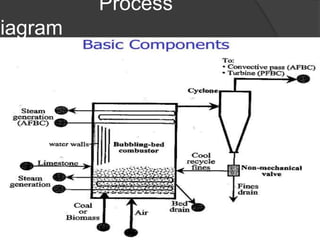
Process
Diagram
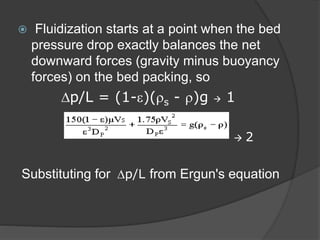
 Fluidization starts at a point when the bed
pressure drop exactly balances the net
downward forces (gravity minus buoyancy
forces) on the bed packing, so
Dp/L = (1-e)(rs - r)g  1
 2
Substituting for Dp/L from Ergun's equation
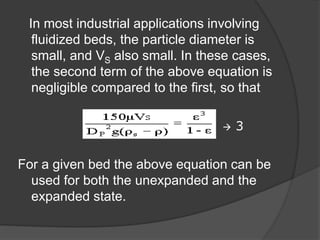
In most industrial applications involving
fluidized beds, the particle diameter is
small, and VS also small. In these cases,
the second term of the above equation is
negligible compared to the first, so that
 3
For a given bed the above equation can be
used for both the unexpanded and the
expanded state.
Why Fluidization ..?
Application of Fluidization
 Fluidized solids can be easily transferred
between reactors.
 The intense mixing within a fluidized bed
means that its temperature is uniform.
 There is excellent heat transfer between a
fluidized bed and heat exchangers
immersed in the bed.
 To avoid particles to flow in air.
Example
 A simplified every-day-life example of a
gas-solid fluidized bed would be a hot-air
popcorn popper. The popcorn kernels, all
being fairly uniform in size and shape, are
suspended in the hot air rising from the
bottom chamber. Because of the intense
mixing of the particles, akin to that of a
boiling liquid, this allows for a uniform
temperature of the kernels throughout the
chamber, minimizing the amount of burnt
popcorn. After popping, the now larger
popcorn particles encounter increased
aerodynamic drag which pushes them out
of the chamber and into a bowl.
Fluidized bed,
Used for Fluidization
 A fluidized bed is formed when a quantity
of a solid particulate substance (usually
present in a holding vessel) is placed
under appropriate conditions to cause a
solid/fluid mixture to behave as a fluid.
This is usually achieved by the introduction
of pressurized fluid through the particulate
medium. This results in the medium then
having many properties and characteristics
of normal fluids, such as the ability to
free-flow under gravity, or to be pumped
using fluid type technologies. The resulting
phenomenon is called fluidization.
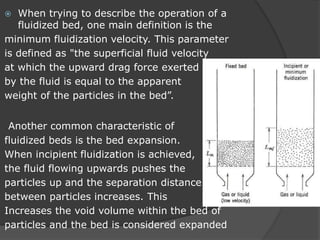
 When trying to describe the operation of a
fluidized bed, one main definition is the
minimum fluidization velocity. This parameter
is defined as "the superficial fluid velocity
at which the upward drag force exerted
by the fluid is equal to the apparent
weight of the particles in the bed”.
Another common characteristic of
fluidized beds is the bed expansion.
When incipient fluidization is achieved,
the fluid flowing upwards pushes the
particles up and the separation distance
between particles increases. This
Increases the void volume within the bed of
particles and the bed is considered expanded
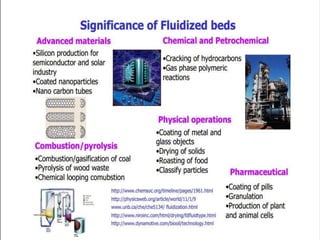
Uses of Fluidized bed
 Fluidized beds are used for several
purposes, such as fluidized bed reactors
(types of chemical reactors), fluid
catalytic cracking, fluidized bed
combustion, heat or mass transfer or
interface modification, such as applying
a coating onto solid items.
Advantages n Disadvantages of
Fluidized bed
 Compact, simple in construction and easily
scalable.
 Thermal efficiency
 Continuous operation
 Ease of process control due to stable conditions
 Non-uniform flow patterns (difficult to predict).
 Agglomeration of particle decrease effective
surface area.
 Possible breakage of fine particles.
 Bed walls erosion
Thank You ………
Special Thanks to:
Ma’am Khadija
Qureshi

Fluidization and fluidized bed

  • 2.
    “ Judging aPerson Does not define who they were …….. Actually ! It defines who you are . ”
  • 3.
    Assignment Presentation Topic: Fluidization Presentingto you by the Dashing Personalities Mr. Sarfaraz Jalbani {14 CH 48}. and Mr. Rahat Inayat Ali {14 CH 23}.
  • 4.
    What Is Fluidization…….??? The Operation by which Fine Solids are Transformed into Fluid-Like State, through Contact with the Gas or Liquid.
  • 5.
     Fluidization refersto those Gas-Solids and Liquid-Solids system in which the solid phase is subjected to behave more or less like a Fluid by the upwelling current of gas or liquid stream moving through the bed of solid particles.  Fluidized bed combustion and Catalytic cracking of heavy crude-oil fractions of petroleum are the two good examples of Fluidization.
  • 6.
    Some Size ReductionProcesses used in Fluidization Process  Attrition  Compression  Impact  Shear
  • 7.
    Types When Fluidizing Sandwith Water, the particles move further apart and their motion becomes more vigorous as the velocity is increased, but the bed density at a given velocity is same in all sections of the bed. This is called Particulate Fluidization and is characterized by a large but uniform expansion of the bed at high velocities.
  • 8.
    And if ….. Bedsof solids fluidized with Air usually exhibit what is called Aggregative or Bubbling Fluidization. At superficial velocities much greater than Vmf most of the gas passes through the bed as bubbles or voids which are almost free of solids, and only a small fraction of the gas flows in the channels between the particles.
  • 9.
    How Fluidization ..? PROCESS When a gas flow is introduced through the bottom of a bed of solid particles, it will move upwards through the bed via the empty spaces between the particles. At low gas velocities, aerodynamic drag on each particle is also low, and thus the bed remains in a fixed state. Increasing the velocity, the aerodynamic drag forces will begin to counteract the gravitational forces, causing the bed to expand in volume as the particles move away from each other.
  • 10.
     Further increasingthe velocity, it will reach a critical value at which the upward drag forces will exactly equal the downward gravitational forces, causing the particles to become suspended within the fluid. At this critical value, the bed is said to be fluidized and will exhibit fluidic behavior. By further increasing gas velocity, the bulk density of the bed will continue to decrease, and its fluidization becomes more violent, until the particles no longer form a bed and are "conveyed" upwards by the gas flow.
  • 11.
     When fluidized,a bed of solid particles will behave as a fluid, like a liquid or gas. Like water in a bucket: the bed will conform to the volume of the chamber, its surface remaining perpendicular to gravity; objects with a lower density than the bed density will float on its surface, bobbing up and down if pushed downwards, while objects with a higher density sink to the bottom of the bed. The fluidic behavior allows the particles to be transported like a fluid, channeled through pipes, not requiring mechanical transport (e.g. conveyor belt).
  • 12.
  • 13.
     Fluidization startsat a point when the bed pressure drop exactly balances the net downward forces (gravity minus buoyancy forces) on the bed packing, so Dp/L = (1-e)(rs - r)g  1  2 Substituting for Dp/L from Ergun's equation
  • 14.
    In most industrialapplications involving fluidized beds, the particle diameter is small, and VS also small. In these cases, the second term of the above equation is negligible compared to the first, so that  3 For a given bed the above equation can be used for both the unexpanded and the expanded state.
  • 15.
    Why Fluidization ..? Applicationof Fluidization  Fluidized solids can be easily transferred between reactors.  The intense mixing within a fluidized bed means that its temperature is uniform.  There is excellent heat transfer between a fluidized bed and heat exchangers immersed in the bed.  To avoid particles to flow in air.
  • 16.
    Example  A simplifiedevery-day-life example of a gas-solid fluidized bed would be a hot-air popcorn popper. The popcorn kernels, all being fairly uniform in size and shape, are suspended in the hot air rising from the bottom chamber. Because of the intense mixing of the particles, akin to that of a boiling liquid, this allows for a uniform temperature of the kernels throughout the chamber, minimizing the amount of burnt popcorn. After popping, the now larger popcorn particles encounter increased aerodynamic drag which pushes them out of the chamber and into a bowl.
  • 17.
    Fluidized bed, Used forFluidization  A fluidized bed is formed when a quantity of a solid particulate substance (usually present in a holding vessel) is placed under appropriate conditions to cause a solid/fluid mixture to behave as a fluid. This is usually achieved by the introduction of pressurized fluid through the particulate medium. This results in the medium then having many properties and characteristics of normal fluids, such as the ability to free-flow under gravity, or to be pumped using fluid type technologies. The resulting phenomenon is called fluidization.
  • 18.
     When tryingto describe the operation of a fluidized bed, one main definition is the minimum fluidization velocity. This parameter is defined as "the superficial fluid velocity at which the upward drag force exerted by the fluid is equal to the apparent weight of the particles in the bed”. Another common characteristic of fluidized beds is the bed expansion. When incipient fluidization is achieved, the fluid flowing upwards pushes the particles up and the separation distance between particles increases. This Increases the void volume within the bed of particles and the bed is considered expanded
  • 20.
    Uses of Fluidizedbed  Fluidized beds are used for several purposes, such as fluidized bed reactors (types of chemical reactors), fluid catalytic cracking, fluidized bed combustion, heat or mass transfer or interface modification, such as applying a coating onto solid items.
  • 21.
    Advantages n Disadvantagesof Fluidized bed  Compact, simple in construction and easily scalable.  Thermal efficiency  Continuous operation  Ease of process control due to stable conditions  Non-uniform flow patterns (difficult to predict).  Agglomeration of particle decrease effective surface area.  Possible breakage of fine particles.  Bed walls erosion
  • 22.
    Thank You ……… SpecialThanks to: Ma’am Khadija Qureshi