.
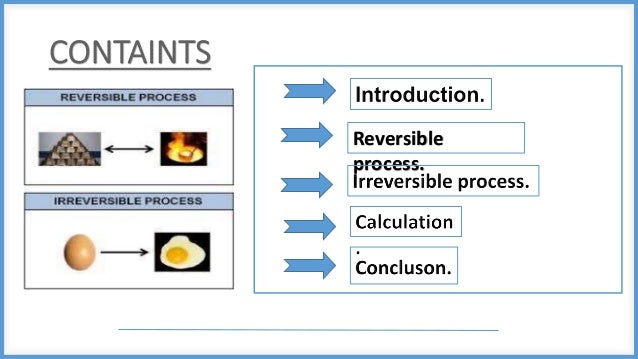
Reversible
process.
• The branch of physical science that
deals with the relations between heat and
other forms of energy (such as mechanical,
electrical, or chemical energy), and, by
extension, of the relationships between all
forms of energy.
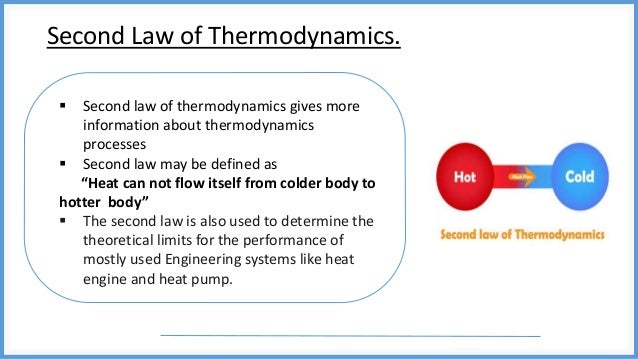
 Second law of thermodynamics gives more
information about thermodynamics
processes
 Second law may be defined as
“Heat can not flow itself from colder body to
hotter body”
 The second law is also used to determine the
theoretical limits for the performance of
mostly used Engineering systems like heat
engine and heat pump.
Second Law of Thermodynamics.
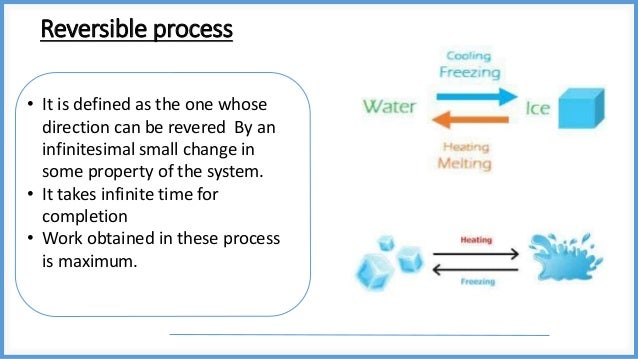
Reversible process
• It is defined as the one whose
direction can be revered By an
infinitesimal small change in
some property of the system.
• It takes infinite time for
completion
• Work obtained in these process
is maximum.
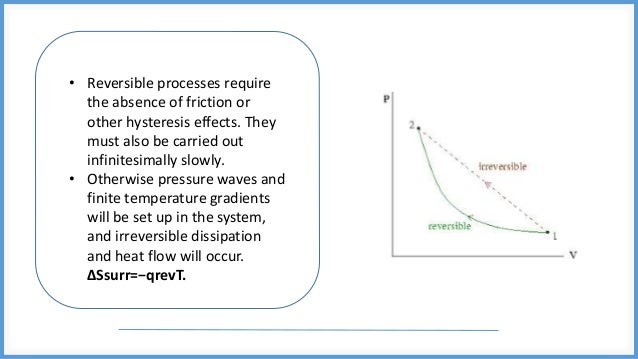
• Reversible processes require
the absence of friction or
other hysteresis effects. They
must also be carried out
infinitesimally slowly.
• Otherwise pressure waves and
finite temperature gradients
will be set up in the system,
and irreversible dissipation
and heat flow will occur.
ΔSsurr=−qrevT.
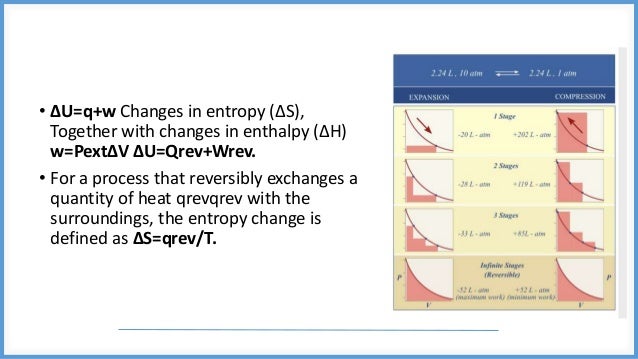
• ΔU=q+w Changes in entropy (ΔS),
Together with changes in enthalpy (ΔH)
w=PextΔV ΔU=Qrev+Wrev.
• For a process that reversibly exchanges a
quantity of heat qrevqrev with the
surroundings, the entropy change is
defined as ΔS=qrev/T.
Irreversible process.
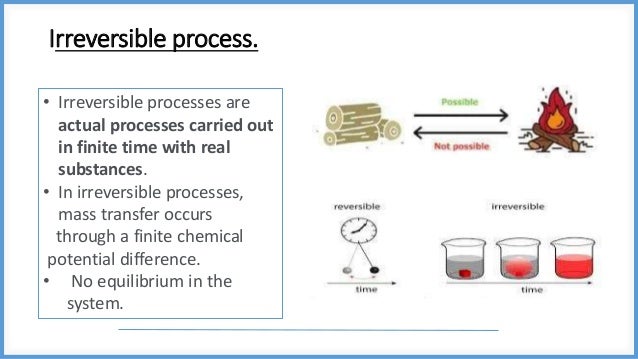
• Irreversible processes are
actual processes carried out
in finite time with real
substances.
• In irreversible processes,
mass transfer occurs
through a finite chemical
potential difference.
• No equilibrium in the
system.
• Sound of thse future
ADVERTISATION:
Handpan software instrument for
Ableton Live
• 15 Samples for each sound recorded
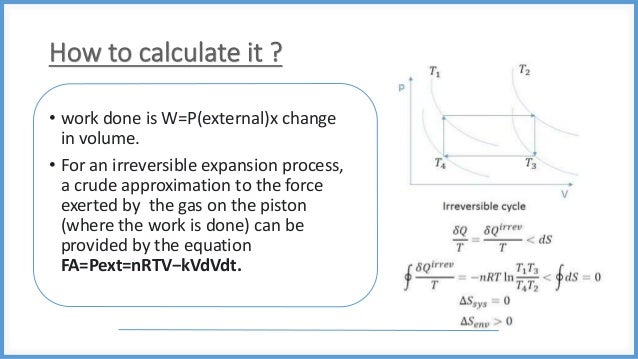
• work done is W=P(external)x change
in volume.
• For an irreversible expansion process,
a crude approximation to the force
exerted by the gas on the piston
(where the work is done) can be
provided by the equation
FA=Pext=nRTV−kVdVdt.
• A reversible process is one in which both the
system and its environment can return to exactly
the states they were in by following the reverse
path. An irreversible process is one in which the
system and its environment cannot return
to exactly the states that they were in.
Click

Reversible and Irreversible process.pptx

  • 1.
  • 2.
  • 3.
    • The branchof physical science that deals with the relations between heat and other forms of energy (such as mechanical, electrical, or chemical energy), and, by extension, of the relationships between all forms of energy.
  • 4.
     Second lawof thermodynamics gives more information about thermodynamics processes  Second law may be defined as “Heat can not flow itself from colder body to hotter body”  The second law is also used to determine the theoretical limits for the performance of mostly used Engineering systems like heat engine and heat pump. Second Law of Thermodynamics.
  • 5.
    Reversible process • Itis defined as the one whose direction can be revered By an infinitesimal small change in some property of the system. • It takes infinite time for completion • Work obtained in these process is maximum.
  • 6.
    • Reversible processesrequire the absence of friction or other hysteresis effects. They must also be carried out infinitesimally slowly. • Otherwise pressure waves and finite temperature gradients will be set up in the system, and irreversible dissipation and heat flow will occur. ΔSsurr=−qrevT.
  • 7.
    • ΔU=q+w Changesin entropy (ΔS), Together with changes in enthalpy (ΔH) w=PextΔV ΔU=Qrev+Wrev. • For a process that reversibly exchanges a quantity of heat qrevqrev with the surroundings, the entropy change is defined as ΔS=qrev/T.
  • 8.
    Irreversible process. • Irreversibleprocesses are actual processes carried out in finite time with real substances. • In irreversible processes, mass transfer occurs through a finite chemical potential difference. • No equilibrium in the system.
  • 9.
    • Sound ofthse future ADVERTISATION: Handpan software instrument for Ableton Live • 15 Samples for each sound recorded
  • 10.
    • work doneis W=P(external)x change in volume. • For an irreversible expansion process, a crude approximation to the force exerted by the gas on the piston (where the work is done) can be provided by the equation FA=Pext=nRTV−kVdVdt.
  • 11.
    • A reversibleprocess is one in which both the system and its environment can return to exactly the states they were in by following the reverse path. An irreversible process is one in which the system and its environment cannot return to exactly the states that they were in.
  • 12.