Topic:
 Inertial and Non-Inertial Frame of References
 Why do we need Pseudo Force?
 Statement of Pseudo Force
 Types of Pseudo Force
 Scenarios Regarding Pseudo Force
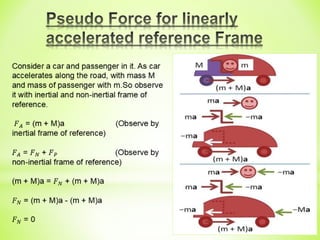
 Pseudo Force For Linearly Accelerated Frame of
Reference
 Pseudo Force as an example of Centrifugal Force
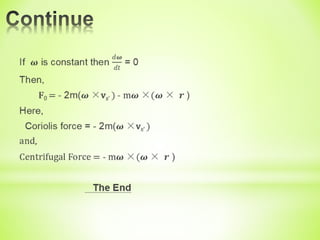
 Coriolis Force
 Coriolis Force Effect
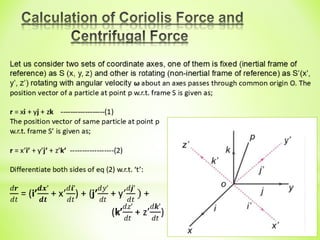
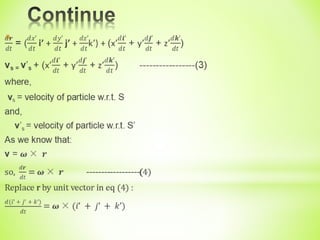
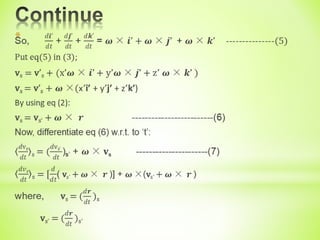
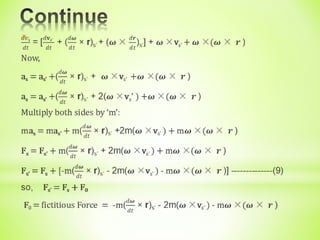
 Calculation of Coriolis Force
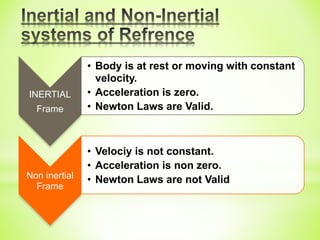
INERTIAL
Frame
• Body is at rest or moving with constant
velocity.
• Acceleration is zero.
• Newton Laws are Valid.
Non inertial
Frame
• Velociy is not constant.
• Acceleration is non zero.
• Newton Laws are not Valid
Newton's second law F = ma holds true only in
inertial Frame of reference.
However, there are many noninertial (that is,
accelerating) frames that one needs to consider,
such as elevators, merry-go-rounds, and so on.
So, Is there any possible way to modify Newton’s
laws so that they hold in noninertial frames?
 So, in this case, a new concept Pseudo force
is came into account.
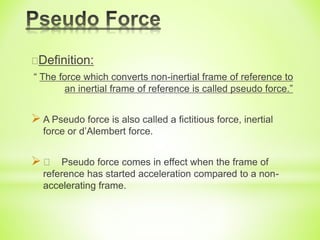
Definition:
“ The force which converts non-inertial frame of reference to
an inertial frame of reference is called pseudo force.”
 A Pseudo force is also called a fictitious force, inertial
force or d’Alembert force.
 Pseudo force comes in effect when the frame of
reference has started acceleration compared to a non-
accelerating frame.
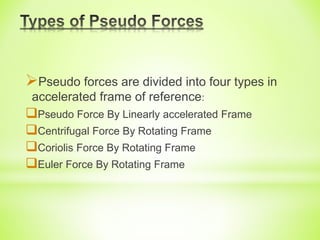
Pseudo forces are divided into four types in
accelerated frame of reference:
Pseudo Force By Linearly accelerated Frame
Centrifugal Force By Rotating Frame
Coriolis Force By Rotating Frame
Euler Force By Rotating Frame
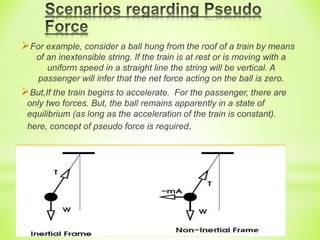
For example, consider a ball hung from the roof of a train by means
of an inextensible string. If the train is at rest or is moving with a
uniform speed in a straight line the string will be vertical. A
passenger will infer that the net force acting on the ball is zero.
But,If the train begins to accelerate. For the passenger, there are
only two forces. But, the ball remains apparently in a state of
equilibrium (as long as the acceleration of the train is constant).
here, concept of pseudo force is required.
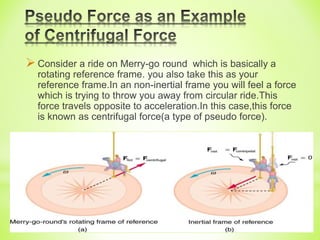
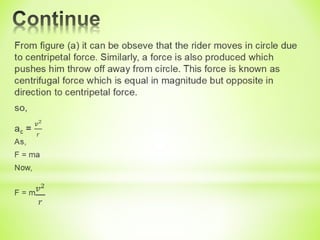
 Consider a ride on Merry-go round which is basically a
rotating reference frame. you also take this as your
reference frame.In an non-inertial frame you will feel a force
which is trying to throw you away from circular ride.This
force travels opposite to acceleration.In this case,this force
is known as centrifugal force(a type of pseudo force).
Definition:
“Coriolis Force is an fictitious
force(pseudo force) that acts on objects
that are in motion relative to rotating
reference frame.”
Deflection of an object due to the Coriolis
force is called the Coriolis effect.It is
caused by rotation of rotating body.
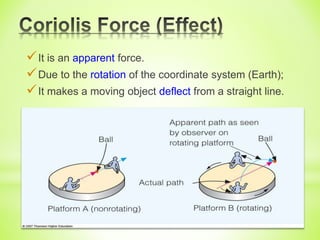
It is an apparent force.
Due to the rotation of the coordinate system (Earth);
It makes a moving object deflect from a straight line.
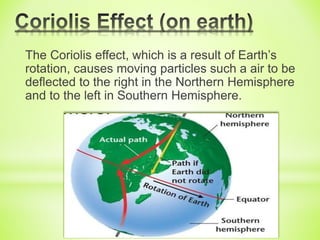
The Coriolis effect, which is a result of Earth’s
rotation, causes moving particles such a air to be
deflected to the right in the Northern Hemisphere
and to the left in Southern Hemisphere.
*
*
*
Pseudo forces, coriolis force,centrifugal force (mechanics)

Pseudo forces, coriolis force,centrifugal force (mechanics)

  • 2.
  • 3.
     Inertial andNon-Inertial Frame of References  Why do we need Pseudo Force?  Statement of Pseudo Force  Types of Pseudo Force  Scenarios Regarding Pseudo Force  Pseudo Force For Linearly Accelerated Frame of Reference  Pseudo Force as an example of Centrifugal Force  Coriolis Force  Coriolis Force Effect  Calculation of Coriolis Force
  • 4.
    INERTIAL Frame • Body isat rest or moving with constant velocity. • Acceleration is zero. • Newton Laws are Valid. Non inertial Frame • Velociy is not constant. • Acceleration is non zero. • Newton Laws are not Valid
  • 5.
    Newton's second lawF = ma holds true only in inertial Frame of reference. However, there are many noninertial (that is, accelerating) frames that one needs to consider, such as elevators, merry-go-rounds, and so on. So, Is there any possible way to modify Newton’s laws so that they hold in noninertial frames?  So, in this case, a new concept Pseudo force is came into account.
  • 6.
    Definition: “ The forcewhich converts non-inertial frame of reference to an inertial frame of reference is called pseudo force.”  A Pseudo force is also called a fictitious force, inertial force or d’Alembert force.  Pseudo force comes in effect when the frame of reference has started acceleration compared to a non- accelerating frame.
  • 7.
    Pseudo forces aredivided into four types in accelerated frame of reference: Pseudo Force By Linearly accelerated Frame Centrifugal Force By Rotating Frame Coriolis Force By Rotating Frame Euler Force By Rotating Frame
  • 8.
    For example, considera ball hung from the roof of a train by means of an inextensible string. If the train is at rest or is moving with a uniform speed in a straight line the string will be vertical. A passenger will infer that the net force acting on the ball is zero. But,If the train begins to accelerate. For the passenger, there are only two forces. But, the ball remains apparently in a state of equilibrium (as long as the acceleration of the train is constant). here, concept of pseudo force is required.
  • 10.
     Consider aride on Merry-go round which is basically a rotating reference frame. you also take this as your reference frame.In an non-inertial frame you will feel a force which is trying to throw you away from circular ride.This force travels opposite to acceleration.In this case,this force is known as centrifugal force(a type of pseudo force).
  • 12.
    Definition: “Coriolis Force isan fictitious force(pseudo force) that acts on objects that are in motion relative to rotating reference frame.” Deflection of an object due to the Coriolis force is called the Coriolis effect.It is caused by rotation of rotating body.
  • 13.
    It is anapparent force. Due to the rotation of the coordinate system (Earth); It makes a moving object deflect from a straight line.
  • 14.
    The Coriolis effect,which is a result of Earth’s rotation, causes moving particles such a air to be deflected to the right in the Northern Hemisphere and to the left in Southern Hemisphere.
  • 16.
  • 17.
  • 18.