


Md. Kamruzzaman
Siam
CreatedBy:
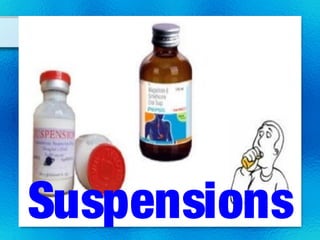
Suspensions
Points of Presentation Topic
Suspension02/21/18
DISPERSE SYSTEM
 The term "Disperse System" refers to a system in
which one substance (The Dispersed Phase) is
distributed, in discrete units, throughout a second
substance (thecontinuous Phase ).
 Each phase can exist in solid, liquid, or gaseous
state .
 Suspensions are heterogenous system consisting of
2 phases.
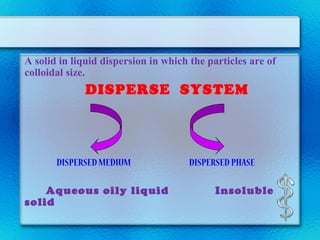
A solid in liquid dispersion in which the particles are of
colloidal size.
DISPERSE SYSTEM
DISPERSEDMEDIUM DISPERSEDPHASE
Aqueous oily liquid Insoluble
solid
What is Suspension?
Suspension
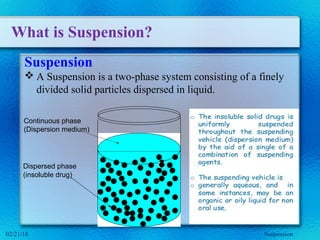
 A Suspension is a two-phase system consisting of a finely
divided solid particles dispersed in liquid.
Suspension02/21/18
Dispersed phase
(insoluble drug)
Continuous phase
(Dispersion medium)
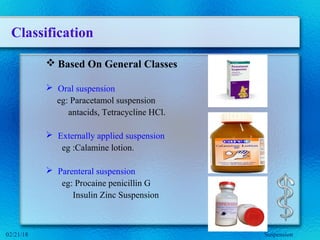
Classification
 Based On General Classes
 Oral suspension
eg: Paracetamol suspension
antacids, Tetracycline HCl.
 Externally applied suspension
eg :Calamine lotion.
 Parenteral suspension
eg: Procaine penicillin G
Insulin Zinc Suspension
Suspension02/21/18
Cont…
 On basis of size of solid particles:
 Colloidal suspension:
Suspensions having dispersed particle size less than 1
micron.It can be seen by electron microscope.
 Coarse suspension:
Suspension having particle size of greater than 1
micron,can be seen by microscope.
 Nano suspension:
Suspension having nanosized drug particles i.e less than
1mm.
Suspension02/21/18
Features Desired In Pharmaceutical
Suspensions
Ø The suspended particles should not settle rapidly and sediment produced,
must be easily re-suspended by the use of moderate amount of shaking.
Ø It should be easy to pour yet not watery and no grittiness.
Ø It should have pleasing odour , colour and palatability.
Ø Good syringeability.
Ø It should be physically, chemically and microbiologically stable.
Ø Parenteral /Ophthalmic suspension should be sterilizable.
Suspension02/21/18
Reasons for Suspension
 If patient has a difficulty of swallowing solid dosage forms (a need for
oral liquid dosage form).
 Faster rate of dissolution and oral absorption than solid dosage forms,
yet slower than solutions.
 Drugs that have very low solubility are usefully formulated as
suspensions.
 To mask the bitter taste of the drug.
 To increase drug stability.
Suspension02/21/18
1. Sedimentation - Properties
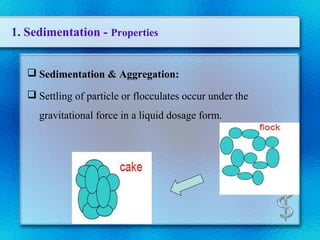
 Sedimentation & Aggregation:
 Settling of particle or flocculates occur under the
gravitational force in a liquid dosage form.
Sedimentation & aggregation
Settling and aggregation may result in formation of cakes
(e.g., in suspension) that is difficult to re suspend or phase
separation (e.g., in emulsion)
• So, suspensions are physically unstable due to particle-
particle interactions and ultimately caking (compaction)
 Possible interactions:
1. van der waals attaction .
2. Electrostatic repulsion
Cont…
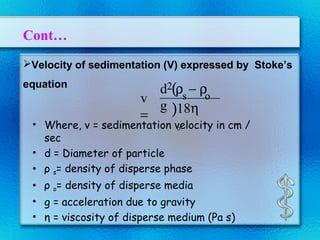
Velocity of sedimentation (V) expressed by Stoke’s
equation
• Where, v = sedimentation velocity in cm /
sec
• d = Diameter of particle
• ρ s= density of disperse phase
• ρ o= density of disperse media
• g = acceleration due to gravity
• η = viscosity of disperse medium (Pa s)
v
=
2
s o
(
)
d ρ − ρ
g 18η
o
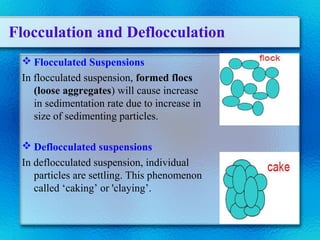
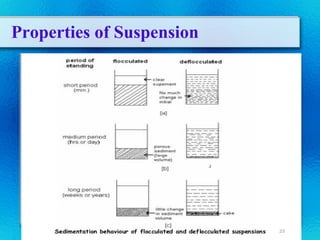
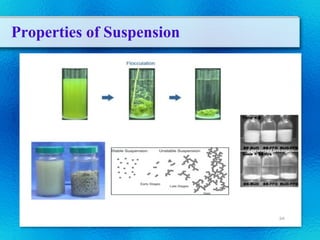
Flocculation and Deflocculation
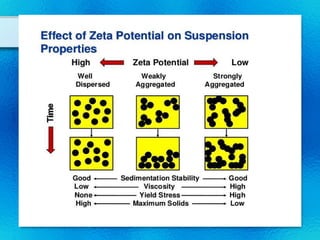
 Flocculated Suspensions
In flocculated suspension, formed flocs
(loose aggregates) will cause increase
in sedimentation rate due to increase in
size of sedimenting particles.
 Deflocculated suspensions
In deflocculated suspension, individual
particles are settling. This phenomenon
called ‘caking’ or 'claying’.
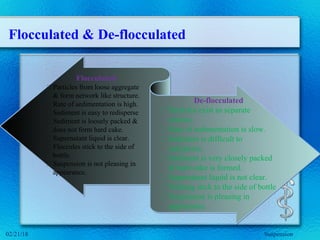
Flocculated & De-flocculated
Flocculated
 Particles from loose aggregate
& form network like structure.
 Rate of sedimentation is high.
 Sediment is easy to redisperse
 Sediment is loosely packed &
does not form hard cake.
 Supernatant liquid is clear.
 Floccules stick to the side of
bottle.
 Suspension is not pleasing in
appearance.
De-flocculated
 Particles exist as separate
entities.
 Rate of sedimentation is slow.
 Sediment is difficult to
redisperse.
 Sediment is very closely packed
& hard cake is formed.
 Supernatant liquid is not clear.
 Nothing stick to the side of bottle
 Suspension is pleasing in
appearance.
02/21/18 Suspension
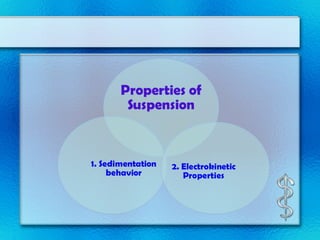
Properties of Suspension
2.Electrokinetic Properties - Zeta potential
 Zeta potential: is defined as "the difference in potential between the
surface of tightly bound layer."
 Zeta potential has practical application in stability of systems containing
dispersed particles .
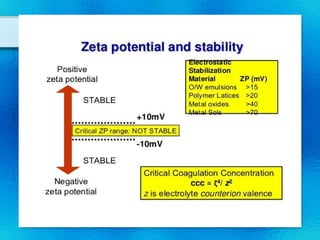
 If the zeta potential is reduced below a certain value, the attractive forces exceed
the repulsive forces, and the particles come together.
 This phenomenon is known as flocculation
 The flocculated suspension is one in which zeta potential of particle is -20 to +20
mV
 Thus the phenomenon of flocculation and deflocculation depends on zeta
potential carried by particles.
Properties of good Suspension
It should settle slowly, readily re-dispersed on gentle
shaking of the container
It should pour readily and evenly from its container.
The suspended particles should not form a cake.
Suspended particles should be small and uniformly
sized.
Viscosity must not so high.
It should be chemically inert.
Suspension02/21/18
BENIFITS and LIMITATIONS
 Suspension can improve chemical stability of certain drug.
E.g. Procaine penicillin G.
 Drug in suspension exhibits higher rate of bioavailability than other
dosage forms
Solution > Suspension > Capsule > Compressed Tablet > Coated
tablet
 Duration and onset of action can be controlled.
E.g. Protamine Zinc-Insulin suspension.
 Suspension can mask the unpleasant/ bitter taste of drug.
E.g. Chloramphenicol
BENIFITS
Suspension02/21/18
BENIFITS and LIMITATIONS
 Physical stability , sedimentation and compaction can
causes problems.
 It is bulky sufficient care must be taken during handling
and transport.
 It is difficult to formulate.
 Uniform and accurate dose can not be achieved unless
suspension are packed in unit dosage form.
LIMITATIONS
Suspension02/21/18
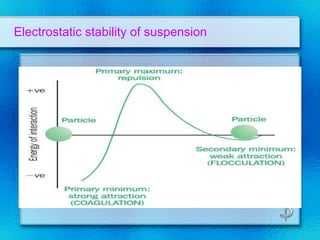
Electrostatic stability of suspension
DLVO Theory
 The scientists Deryaguin, Landau, Vervey and Overbeek
developed a theory in the 1940s which dealt with the stability of
colloidal systems.
 DVLO theory suggests that, the stability of a colloidal system is
determined by the sum of the Vander Waals attractive (VA) and
electrical double layer repulsive (VR) forces that exist between
particles as they approach each other due to the Brownian motion
they are undergoing.
 The Vander waal forces depend on chemical nature and size of
particle. The electrostatic repulsive forces depend on density,
surface charge and thickness of double layer.
Methods for stabilizing suspension
Physical Stability can be achieved by maintaining the particle in
Brownian motion
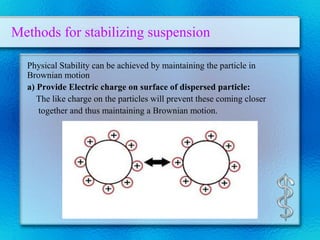
a) Provide Electric charge on surface of dispersed particle:
The like charge on the particles will prevent these coming closer
together and thus maintaining a Brownian motion.
Cont…
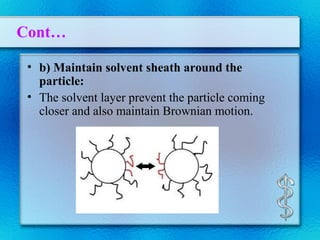
• b) Maintain solvent sheath around the
particle:
• The solvent layer prevent the particle coming
closer and also maintain Brownian motion.
FORMULATION OF SUSPENSIONS
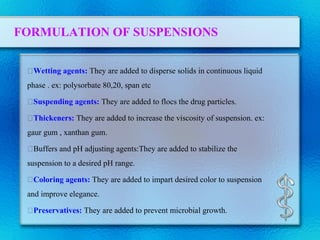
Wetting agents: They are added to disperse solids in continuous liquid
phase . ex: polysorbate 80,20, span etc
Suspending agents: They are added to flocs the drug particles.
Thickeners: They are added to increase the viscosity of suspension. ex:
gaur gum , xanthan gum.
Buffers and pH adjusting agents:They are added to stabilize the
suspension to a desired pH range.
Coloring agents: They are added to impart desired color to suspension
and improve elegance.
Preservatives: They are added to prevent microbial growth.
FORMULATION OF SUSPENSION
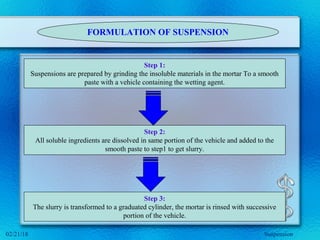
Step 1:
Suspensions are prepared by grinding the insoluble materials in the mortar To a smooth
paste with a vehicle containing the wetting agent.
Step 2:
All soluble ingredients are dissolved in same portion of the vehicle and added to the
smooth paste to step1 to get slurry.
Step 3:
The slurry is transformed to a graduated cylinder, the mortar is rinsed with successive
portion of the vehicle.
Suspension02/21/18
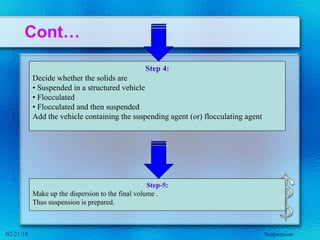
Step 4:
Decide whether the solids are
• Suspended in a structured vehicle
• Flocculated
• Flocculated and then suspended
Add the vehicle containing the suspending agent (or) flocculating agent
Step-5:
Make up the dispersion to the final volume .
Thus suspension is prepared.
Suspension02/21/18
Cont…
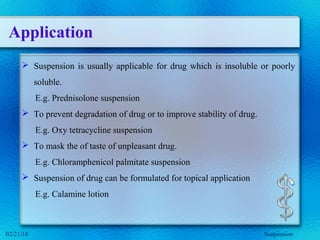
Application
 Suspension is usually applicable for drug which is insoluble or poorly
soluble.
E.g. Prednisolone suspension
 To prevent degradation of drug or to improve stability of drug.
E.g. Oxy tetracycline suspension
 To mask the of taste of unpleasant drug.
E.g. Chloramphenicol palmitate suspension
 Suspension of drug can be formulated for topical application
E.g. Calamine lotion
02/21/18 Suspension
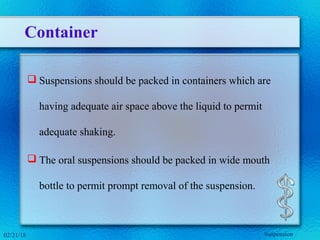
Container
 Suspensions should be packed in containers which are
having adequate air space above the liquid to permit
adequate shaking.
 The oral suspensions should be packed in wide mouth
bottle to permit prompt removal of the suspension.
02/21/18 Suspension
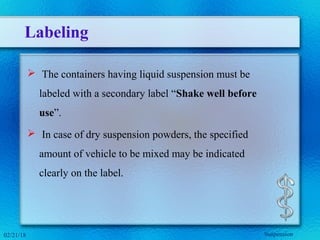
Labeling
 The containers having liquid suspension must be
labeled with a secondary label “Shake well before
use”.
 In case of dry suspension powders, the specified
amount of vehicle to be mixed may be indicated
clearly on the label.
02/21/18 Suspension
Storage
§ Suspensions should be stored in a cool place but
should not be kept in refrigerator.
§ Freezing at a very low temperatures should be
avoided which may lead to aggregation of suspended
particles
02/21/18 Suspension
02/21/18 Suspension

Suspension.siam

  • 1.
  • 2.
  • 3.
    Points of PresentationTopic Suspension02/21/18
  • 4.
    DISPERSE SYSTEM  Theterm "Disperse System" refers to a system in which one substance (The Dispersed Phase) is distributed, in discrete units, throughout a second substance (thecontinuous Phase ).  Each phase can exist in solid, liquid, or gaseous state .  Suspensions are heterogenous system consisting of 2 phases.
  • 5.
    A solid inliquid dispersion in which the particles are of colloidal size. DISPERSE SYSTEM DISPERSEDMEDIUM DISPERSEDPHASE Aqueous oily liquid Insoluble solid
  • 6.
    What is Suspension? Suspension A Suspension is a two-phase system consisting of a finely divided solid particles dispersed in liquid. Suspension02/21/18 Dispersed phase (insoluble drug) Continuous phase (Dispersion medium)
  • 7.
    Classification  Based OnGeneral Classes  Oral suspension eg: Paracetamol suspension antacids, Tetracycline HCl.  Externally applied suspension eg :Calamine lotion.  Parenteral suspension eg: Procaine penicillin G Insulin Zinc Suspension Suspension02/21/18
  • 8.
    Cont…  On basisof size of solid particles:  Colloidal suspension: Suspensions having dispersed particle size less than 1 micron.It can be seen by electron microscope.  Coarse suspension: Suspension having particle size of greater than 1 micron,can be seen by microscope.  Nano suspension: Suspension having nanosized drug particles i.e less than 1mm. Suspension02/21/18
  • 9.
    Features Desired InPharmaceutical Suspensions Ø The suspended particles should not settle rapidly and sediment produced, must be easily re-suspended by the use of moderate amount of shaking. Ø It should be easy to pour yet not watery and no grittiness. Ø It should have pleasing odour , colour and palatability. Ø Good syringeability. Ø It should be physically, chemically and microbiologically stable. Ø Parenteral /Ophthalmic suspension should be sterilizable. Suspension02/21/18
  • 10.
    Reasons for Suspension If patient has a difficulty of swallowing solid dosage forms (a need for oral liquid dosage form).  Faster rate of dissolution and oral absorption than solid dosage forms, yet slower than solutions.  Drugs that have very low solubility are usefully formulated as suspensions.  To mask the bitter taste of the drug.  To increase drug stability. Suspension02/21/18
  • 12.
    1. Sedimentation -Properties  Sedimentation & Aggregation:  Settling of particle or flocculates occur under the gravitational force in a liquid dosage form.
  • 13.
    Sedimentation & aggregation Settlingand aggregation may result in formation of cakes (e.g., in suspension) that is difficult to re suspend or phase separation (e.g., in emulsion) • So, suspensions are physically unstable due to particle- particle interactions and ultimately caking (compaction)  Possible interactions: 1. van der waals attaction . 2. Electrostatic repulsion
  • 14.
    Cont… Velocity of sedimentation(V) expressed by Stoke’s equation • Where, v = sedimentation velocity in cm / sec • d = Diameter of particle • ρ s= density of disperse phase • ρ o= density of disperse media • g = acceleration due to gravity • η = viscosity of disperse medium (Pa s) v = 2 s o ( ) d ρ − ρ g 18η o
  • 15.
    Flocculation and Deflocculation Flocculated Suspensions In flocculated suspension, formed flocs (loose aggregates) will cause increase in sedimentation rate due to increase in size of sedimenting particles.  Deflocculated suspensions In deflocculated suspension, individual particles are settling. This phenomenon called ‘caking’ or 'claying’.
  • 16.
    Flocculated & De-flocculated Flocculated Particles from loose aggregate & form network like structure.  Rate of sedimentation is high.  Sediment is easy to redisperse  Sediment is loosely packed & does not form hard cake.  Supernatant liquid is clear.  Floccules stick to the side of bottle.  Suspension is not pleasing in appearance. De-flocculated  Particles exist as separate entities.  Rate of sedimentation is slow.  Sediment is difficult to redisperse.  Sediment is very closely packed & hard cake is formed.  Supernatant liquid is not clear.  Nothing stick to the side of bottle  Suspension is pleasing in appearance. 02/21/18 Suspension
  • 17.
  • 18.
  • 19.
    2.Electrokinetic Properties -Zeta potential  Zeta potential: is defined as "the difference in potential between the surface of tightly bound layer."  Zeta potential has practical application in stability of systems containing dispersed particles .  If the zeta potential is reduced below a certain value, the attractive forces exceed the repulsive forces, and the particles come together.  This phenomenon is known as flocculation  The flocculated suspension is one in which zeta potential of particle is -20 to +20 mV  Thus the phenomenon of flocculation and deflocculation depends on zeta potential carried by particles.
  • 22.
    Properties of goodSuspension It should settle slowly, readily re-dispersed on gentle shaking of the container It should pour readily and evenly from its container. The suspended particles should not form a cake. Suspended particles should be small and uniformly sized. Viscosity must not so high. It should be chemically inert. Suspension02/21/18
  • 23.
    BENIFITS and LIMITATIONS Suspension can improve chemical stability of certain drug. E.g. Procaine penicillin G.  Drug in suspension exhibits higher rate of bioavailability than other dosage forms Solution > Suspension > Capsule > Compressed Tablet > Coated tablet  Duration and onset of action can be controlled. E.g. Protamine Zinc-Insulin suspension.  Suspension can mask the unpleasant/ bitter taste of drug. E.g. Chloramphenicol BENIFITS Suspension02/21/18
  • 24.
    BENIFITS and LIMITATIONS Physical stability , sedimentation and compaction can causes problems.  It is bulky sufficient care must be taken during handling and transport.  It is difficult to formulate.  Uniform and accurate dose can not be achieved unless suspension are packed in unit dosage form. LIMITATIONS Suspension02/21/18
  • 25.
  • 26.
    DLVO Theory  Thescientists Deryaguin, Landau, Vervey and Overbeek developed a theory in the 1940s which dealt with the stability of colloidal systems.  DVLO theory suggests that, the stability of a colloidal system is determined by the sum of the Vander Waals attractive (VA) and electrical double layer repulsive (VR) forces that exist between particles as they approach each other due to the Brownian motion they are undergoing.  The Vander waal forces depend on chemical nature and size of particle. The electrostatic repulsive forces depend on density, surface charge and thickness of double layer.
  • 27.
    Methods for stabilizingsuspension Physical Stability can be achieved by maintaining the particle in Brownian motion a) Provide Electric charge on surface of dispersed particle: The like charge on the particles will prevent these coming closer together and thus maintaining a Brownian motion.
  • 28.
    Cont… • b) Maintainsolvent sheath around the particle: • The solvent layer prevent the particle coming closer and also maintain Brownian motion.
  • 29.
    FORMULATION OF SUSPENSIONS Wettingagents: They are added to disperse solids in continuous liquid phase . ex: polysorbate 80,20, span etc Suspending agents: They are added to flocs the drug particles. Thickeners: They are added to increase the viscosity of suspension. ex: gaur gum , xanthan gum. Buffers and pH adjusting agents:They are added to stabilize the suspension to a desired pH range. Coloring agents: They are added to impart desired color to suspension and improve elegance. Preservatives: They are added to prevent microbial growth.
  • 30.
    FORMULATION OF SUSPENSION Step1: Suspensions are prepared by grinding the insoluble materials in the mortar To a smooth paste with a vehicle containing the wetting agent. Step 2: All soluble ingredients are dissolved in same portion of the vehicle and added to the smooth paste to step1 to get slurry. Step 3: The slurry is transformed to a graduated cylinder, the mortar is rinsed with successive portion of the vehicle. Suspension02/21/18
  • 31.
    Step 4: Decide whetherthe solids are • Suspended in a structured vehicle • Flocculated • Flocculated and then suspended Add the vehicle containing the suspending agent (or) flocculating agent Step-5: Make up the dispersion to the final volume . Thus suspension is prepared. Suspension02/21/18 Cont…
  • 32.
    Application  Suspension isusually applicable for drug which is insoluble or poorly soluble. E.g. Prednisolone suspension  To prevent degradation of drug or to improve stability of drug. E.g. Oxy tetracycline suspension  To mask the of taste of unpleasant drug. E.g. Chloramphenicol palmitate suspension  Suspension of drug can be formulated for topical application E.g. Calamine lotion 02/21/18 Suspension
  • 33.
    Container  Suspensions shouldbe packed in containers which are having adequate air space above the liquid to permit adequate shaking.  The oral suspensions should be packed in wide mouth bottle to permit prompt removal of the suspension. 02/21/18 Suspension
  • 34.
    Labeling  The containershaving liquid suspension must be labeled with a secondary label “Shake well before use”.  In case of dry suspension powders, the specified amount of vehicle to be mixed may be indicated clearly on the label. 02/21/18 Suspension
  • 35.
    Storage § Suspensions shouldbe stored in a cool place but should not be kept in refrigerator. § Freezing at a very low temperatures should be avoided which may lead to aggregation of suspended particles 02/21/18 Suspension
  • 36.