Overview of Clustering
Rong Jin
Outline
 K means for clustering
 Expectation Maximization algorithm for clustering
 Spectrum clustering (if time is permitted)
Clustering
$$$
age
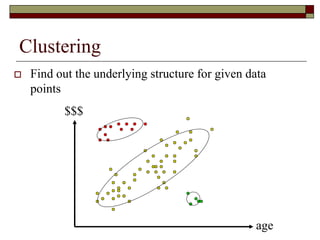
 Find out the underlying structure for given data
points
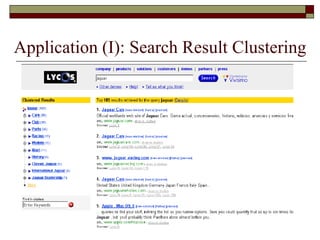
Application (I): Search Result Clustering
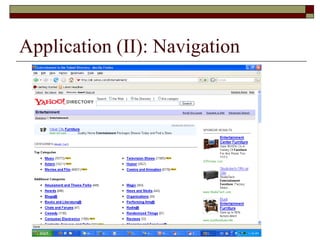
Application (II): Navigation
Application (III): Google News
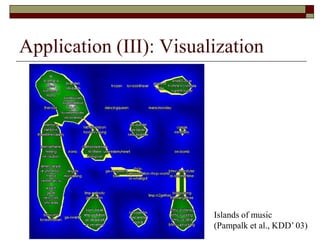
Application (III): Visualization
Islands of music
(Pampalk et al., KDD’ 03)
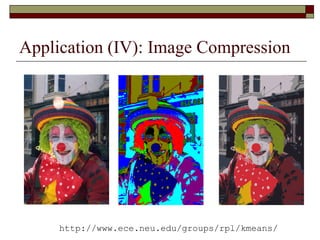
Application (IV): Image Compression
http://www.ece.neu.edu/groups/rpl/kmeans/
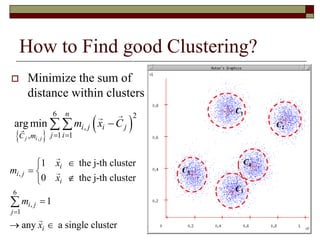
How to Find good Clustering?
 Minimize the sum of
distance within clusters
C1
C2
C3
C4
C5
 
 
,
6 2
,
1 1,
arg min
j i j
n
i j i j
j iC m
m x C
 
 
,
6
,
1
1 the j-th cluster
0 the j-th cluster
1
any a single cluster
i
i j
i
i j
j
i
x
m
x
m
x


 


 

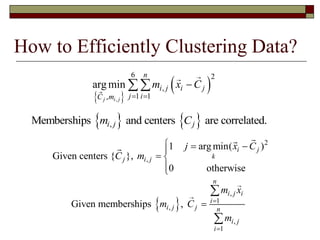
How to Efficiently Clustering Data?
 
 
,
6 2
,
1 1,
arg min
j i j
n
i j i j
j iC m
m x C
 
 
   ,Memberships and centers are correlated.i j jm C
 
,
1
,
,
1
Given memberships ,
n
i j i
i
i j j n
i j
i
m x
m C
m





2
,
1 arg min( )
Given centers { },
0 otherwise
i j
kj i j
j x C
C m
  
 

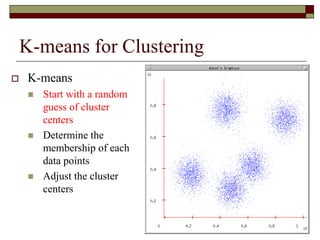
K-means for Clustering
 K-means
 Start with a random
guess of cluster
centers
 Determine the
membership of each
data points
 Adjust the cluster
centers
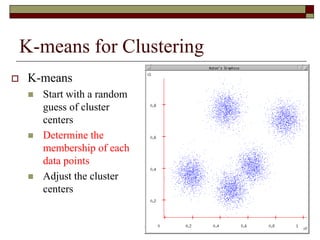
K-means for Clustering
 K-means
 Start with a random
guess of cluster
centers
 Determine the
membership of each
data points
 Adjust the cluster
centers
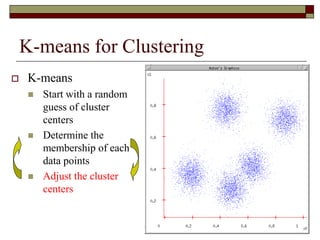
K-means for Clustering
 K-means
 Start with a random
guess of cluster
centers
 Determine the
membership of each
data points
 Adjust the cluster
centers
K-means
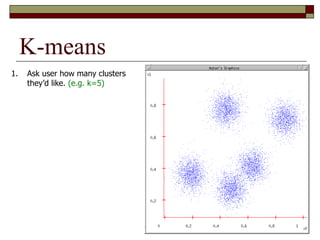
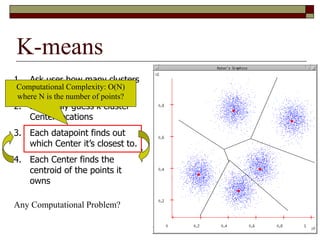
1. Ask user how many clusters
they’d like. (e.g. k=5)
K-means
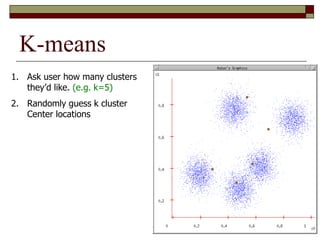
1. Ask user how many clusters
they’d like. (e.g. k=5)
2. Randomly guess k cluster
Center locations
K-means
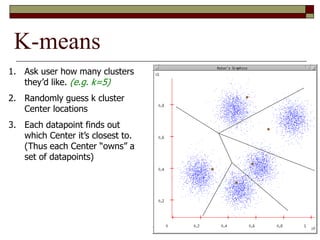
1. Ask user how many clusters
they’d like. (e.g. k=5)
2. Randomly guess k cluster
Center locations
3. Each datapoint finds out
which Center it’s closest to.
(Thus each Center “owns” a
set of datapoints)
K-means
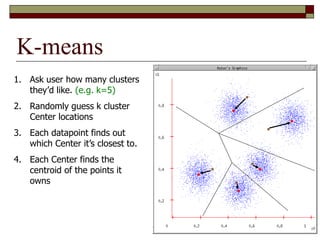
1. Ask user how many clusters
they’d like. (e.g. k=5)
2. Randomly guess k cluster
Center locations
3. Each datapoint finds out
which Center it’s closest to.
4. Each Center finds the
centroid of the points it
owns
K-means
1. Ask user how many clusters
they’d like. (e.g. k=5)
2. Randomly guess k cluster
Center locations
3. Each datapoint finds out
which Center it’s closest to.
4. Each Center finds the
centroid of the points it
owns
Any Computational Problem?
Computational Complexity: O(N)
where N is the number of points?
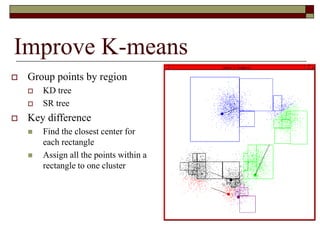
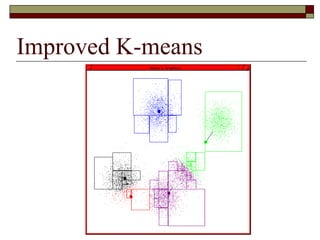
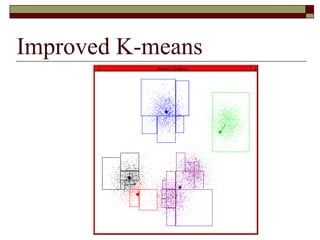
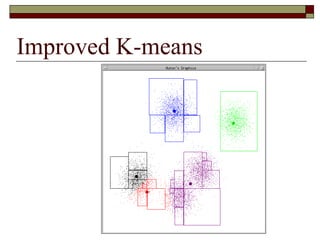
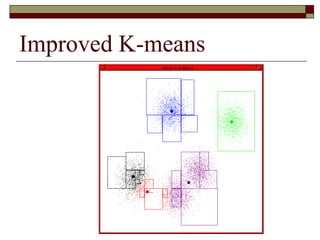
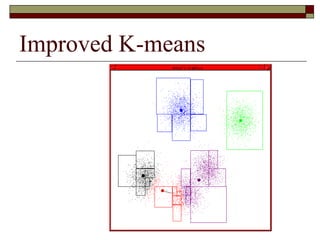
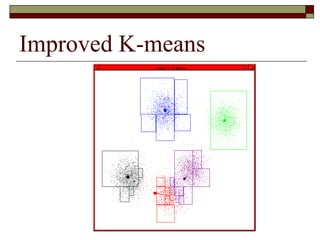
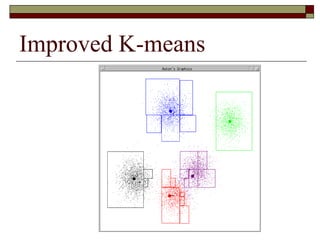
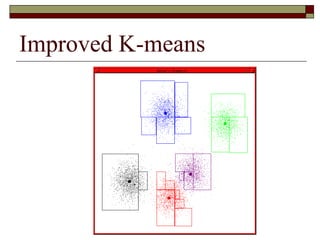
Improve K-means
 Group points by region
 KD tree
 SR tree
 Key difference
 Find the closest center for
each rectangle
 Assign all the points within a
rectangle to one cluster
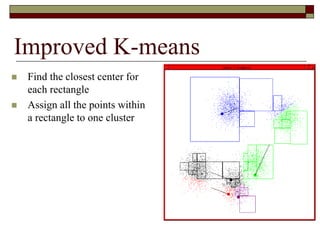
Improved K-means
 Find the closest center for
each rectangle
 Assign all the points within
a rectangle to one cluster
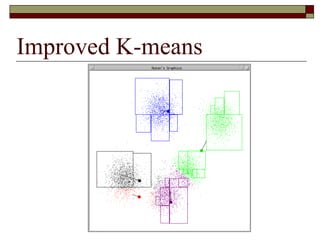
Improved K-means
Improved K-means
Improved K-means
Improved K-means
Improved K-means
Improved K-means
Improved K-means
Improved K-means
Improved K-means
A Gaussian Mixture Model for Clustering
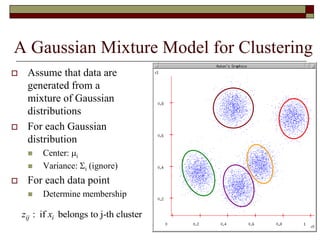
 Assume that data are
generated from a
mixture of Gaussian
distributions
 For each Gaussian
distribution
 Center: i
 Variance: i (ignore)
 For each data point
 Determine membership
: if belongs to j-th clusterij iz x
Learning a Gaussian Mixture
(with known covariance)
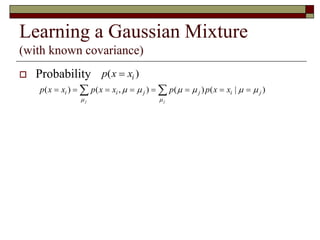
 Probability ( )ip x x
 
2
/ 2 2
2
( ) ( , ) ( ) ( | )
1
( ) exp
22
j j
j
i i j j i j
i j
j d
p x x p x x p p x x
x
p
 

     

 

       
 
   
 
 
 

Learning a Gaussian Mixture
(with known covariance)
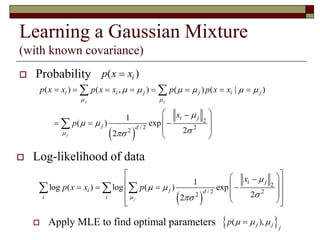
 Probability ( )ip x x
 
2
/ 2 2
2
( ) ( , ) ( ) ( | )
1
( ) exp
22
j j
j
i i j j i j
i j
j d
p x x p x x p p x x
x
p
 

     

 

       
 
   
 
 
 

 Log-likelihood of data
 Apply MLE to find optimal parameters
 
2
/ 2 2
2
1
log ( ) log ( ) exp
22j
i j
i j d
i i
x
p x x p


 

         
   
  
 ( ),j j j
p   
Learning a Gaussian Mixture
(with known covariance)
2
2
2
2
1
( )
2
1
( )
2
1
( )
( )
i j
i n
x
j
k x
n
n
e p
e p




 
 
 
 




[ ] ( | )ij j iE z p x x   E-Step
1
( | ) ( )
( | ) ( )
i j j
k
i n j
n
p x x p
p x x p
   
   

  

  
Learning a Gaussian Mixture
(with known covariance)
1
1
1
[ ]
[ ]
m
j ij im
i
ij
i
E z x
E z



 

M-Step
1
1
( ) [ ]
m
j ij
i
p E z
m
 

  
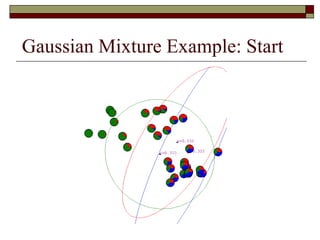
Gaussian Mixture Example: Start
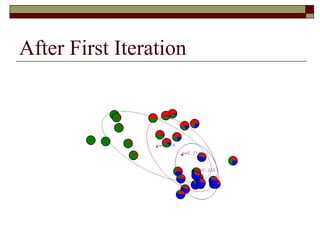
After First Iteration
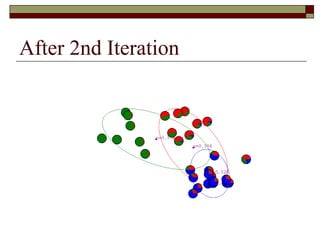
After 2nd Iteration
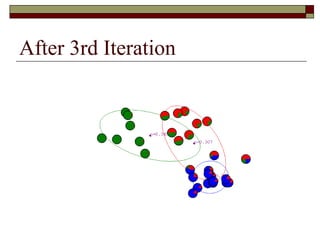
After 3rd Iteration
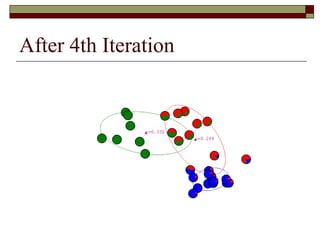
After 4th Iteration
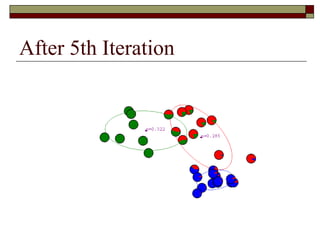
After 5th Iteration
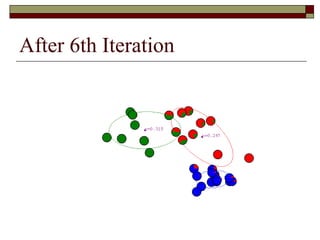
After 6th Iteration
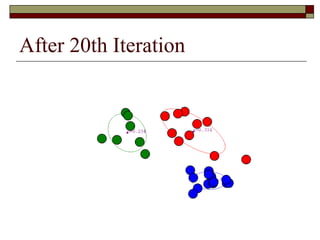
After 20th Iteration
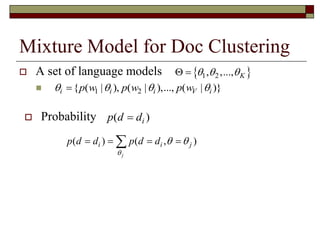
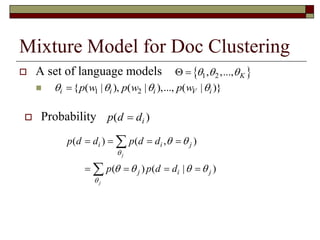
Mixture Model for Doc Clustering
 A set of language models

 1 2, ,..., K   
1 2{ ( | ), ( | ),..., ( | )}i i i V ip w p w p w   
Mixture Model for Doc Clustering
 A set of language models

 1 2, ,..., K   
1 2{ ( | ), ( | ),..., ( | )}i i i V ip w p w p w   
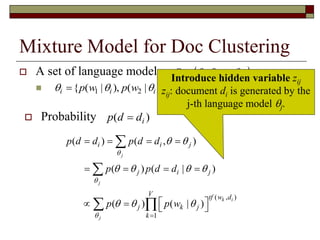
( )ip d d
( , )
1
( ) ( , )
( ) ( | )
( ) ( | )
j
j
k i
j
i i j
j i j
V tf w d
j k j
k
p d d p d d
p p d d
p p w



 
   
  

   
   
    


 
 Probability
Mixture Model for Doc Clustering
 A set of language models

 1 2, ,..., K   
1 2{ ( | ), ( | ),..., ( | )}i i i V ip w p w p w   
( )ip d d
( , )
1
( ) ( , )
( ) ( | )
( ) ( | )
j
j
k i
j
i i j
j i j
V tf w d
j k j
k
p d d p d d
p p d d
p p w



 
   
  

   
   
    


 
 Probability
Mixture Model for Doc Clustering
 A set of language models

 1 2, ,..., K   
1 2{ ( | ), ( | ),..., ( | )}i i i V ip w p w p w   
( )ip d d
( , )
1
( ) ( , )
( ) ( | )
( ) ( | )
j
j
k i
j
i i j
j i j
V tf w d
j k j
k
p d d p d d
p p d d
p p w



 
   
  

   
   
    


 
 Probability
Introduce hidden variable zij
zij: document di is generated by the
j-th language model j.
Learning a Mixture Model
 
( , )
1
( , )
1 1
( | ) ( )
( | ) ( )
k i
k i
V tf w d
m j j
m
VK
tf w d
m n n
n m
p w p
p w p
  
  

 
   




1
[ ] ( | )
( | ) ( )
( | ) ( )
ij j i
i j j
K
i n n
n
E z p d d
p d d p
p d d p
 
   
   

  
  

  
E-Step
K: number of language models
Learning a Mixture Model
M-Step
1
1
( ) [ ]
N
j ij
i
p E z
N
 

  
1
1
[ ] ( , )
( | )
[ ]
N
ij i k
k
i j N
ij k
k
E z tf w d
p w
E z d
 




N: number of documents
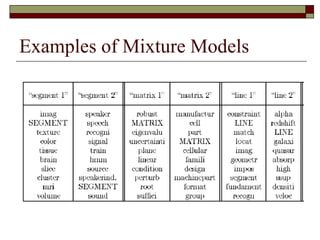
Examples of Mixture Models
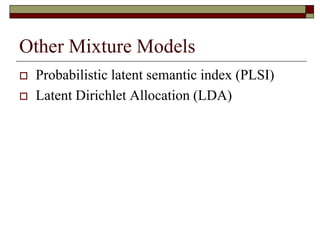
Other Mixture Models
 Probabilistic latent semantic index (PLSI)
 Latent Dirichlet Allocation (LDA)
Problems (I)
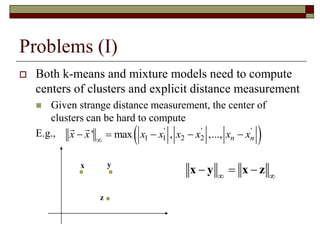
 Both k-means and mixture models need to compute
centers of clusters and explicit distance measurement
 Given strange distance measurement, the center of
clusters can be hard to compute
E.g.,  ' ' '
1 1 2 2' max , ,..., n nx x x x x x x x
    
x y
z
 
  x y x z
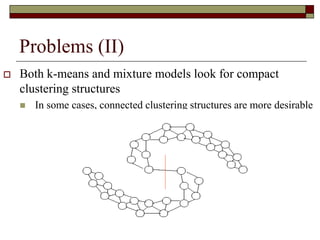
Problems (II)
 Both k-means and mixture models look for compact
clustering structures
 In some cases, connected clustering structures are more desirable
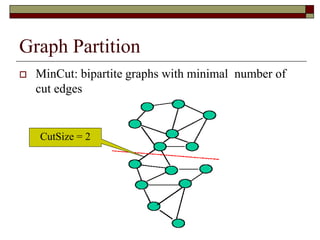
Graph Partition
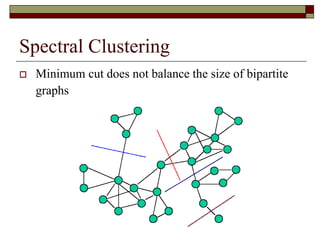
 MinCut: bipartite graphs with minimal number of
cut edges
CutSize = 2
2-way Spectral Graph Partitioning
 Weight matrix W
 wi,j: the weight between two
vertices i and j
 Membership vector q
1 Cluster
-1 Cluster
i
i A
q
i B

 

 
[ 1,1]
2
,
,
arg min
1
4
n
i j i j
i j
CutSize
CutSize J q q w
 

  
q
q
Solving the Optimization Problem
 Directly solving the above problem requires
combinatorial search  exponential complexity
 How to reduce the computation complexity?
 
2
,
[ 1,1] ,
1
argmin
4n
i j i j
i j
q q w
 
 
q
q
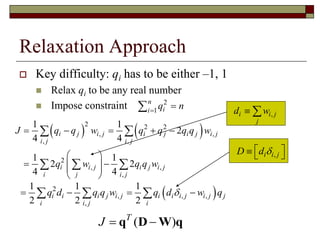
Relaxation Approach
 Key difficulty: qi has to be either –1, 1
 Relax qi to be any real number
 Impose constraint 2
1
n
ii
q n

   
2 2 2
, ,
, ,
2
, ,
,
1 1
2
4 4
1 1
2 2
4 4
i j i j i j i j i j
i j i j
i i j i j i j
i j i j
J q q w q q q q w
q w q q w
    
 
   
 
 
  
,i i j
j
d w 
 2
, , ,
,
1 1 1
2 2 2
i i i j i j i i i j i j j
i i j i
q d q q w q d w q     
,i i jD d    
( )T
J  q D W q
Relaxation Approach
2
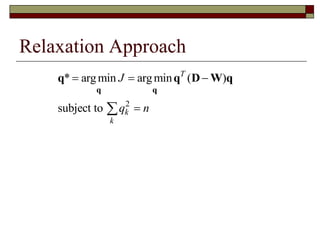
* argmin argmin ( )
subject to
T
k
k
J
q n
  

q q
q q D W q
Relaxation Approach
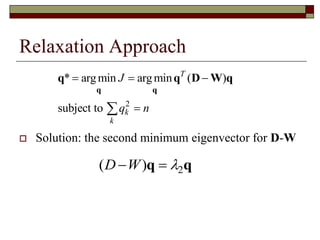
 Solution: the second minimum eigenvector for D-W
2
* argmin argmin ( )
subject to
T
k
k
J
q n
  

q q
q q D W q
2( )D W  q q
Graph Laplacian
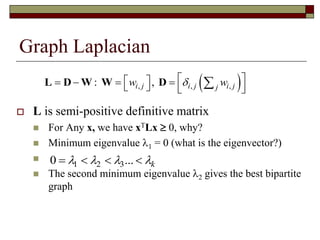
 L is semi-positive definitive matrix
 For Any x, we have xTLx  0, why?
 Minimum eigenvalue 1 = 0 (what is the eigenvector?)

 The second minimum eigenvalue 2 gives the best bipartite
graph
 , , ,: ,i j i j i jj
w w         L D W W D
1 2 30 ... k      
Recovering Partitions
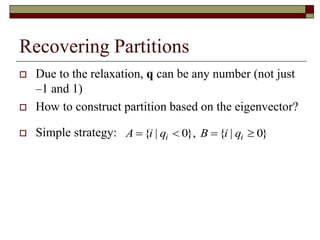
 Due to the relaxation, q can be any number (not just
–1 and 1)
 How to construct partition based on the eigenvector?
 Simple strategy: { | 0}, { | 0}i iA i q B i q   
Spectral Clustering
 Minimum cut does not balance the size of bipartite
graphs
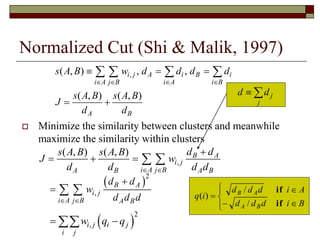
Normalized Cut (Shi & Malik, 1997)
 Minimize the similarity between clusters and meanwhile
maximize the similarity within clusters
,( , ) , ,
( , ) ( , )
i j A i B i
i A j B i A i B
A B
s A B w d d d d
s A B s A B
J
d d
   
  
 
   
,
( , ) ( , ) B A
i j
i A j BA B A B
d ds A B s A B
J w
d d d d 

    
j
j
d d 
 2
,
B A
i j
i A j B A B
d d
w
d d d 

  







Biddd
Aiddd
iq
BA
AB
if
if
/
/
)(
 
2
,i j i j
i j
w q q 
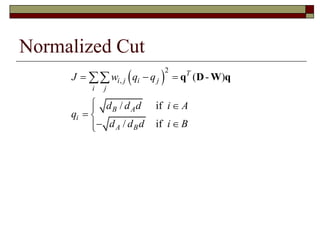
Normalized Cut
 
2
, ( - )
/ if
/ if
T
i j i j
i j
B A
i
A B
J w q q
d d d i A
q
d d d i B
  
 
 
 
 q D W q
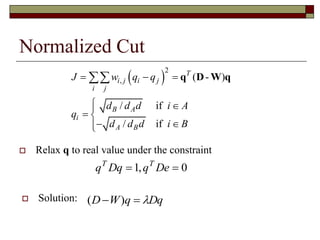
Normalized Cut
 Relax q to real value under the constraint
 
2
, ( - )
/ if
/ if
T
i j i j
i j
B A
i
A B
J w q q
d d d i A
q
d d d i B
  
 
 
 
 q D W q
0,1  DeqDqq TT
 Solution: DqqWD  )(
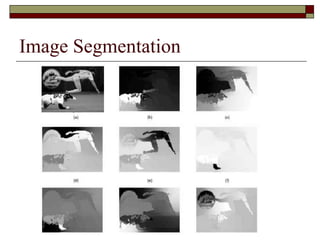
Image Segmentation
Non-negative Matrix Factorization

Pert 05 aplikasi clustering

  • 1.
  • 2.
    Outline  K meansfor clustering  Expectation Maximization algorithm for clustering  Spectrum clustering (if time is permitted)
  • 3.
    Clustering $$$ age  Find outthe underlying structure for given data points
  • 4.
    Application (I): SearchResult Clustering
  • 5.
  • 6.
  • 7.
    Application (III): Visualization Islandsof music (Pampalk et al., KDD’ 03)
  • 8.
    Application (IV): ImageCompression http://www.ece.neu.edu/groups/rpl/kmeans/
  • 9.
    How to Findgood Clustering?  Minimize the sum of distance within clusters C1 C2 C3 C4 C5     , 6 2 , 1 1, arg min j i j n i j i j j iC m m x C     , 6 , 1 1 the j-th cluster 0 the j-th cluster 1 any a single cluster i i j i i j j i x m x m x         
  • 10.
    How to EfficientlyClustering Data?     , 6 2 , 1 1, arg min j i j n i j i j j iC m m x C        ,Memberships and centers are correlated.i j jm C   , 1 , , 1 Given memberships , n i j i i i j j n i j i m x m C m      2 , 1 arg min( ) Given centers { }, 0 otherwise i j kj i j j x C C m      
  • 11.
    K-means for Clustering K-means  Start with a random guess of cluster centers  Determine the membership of each data points  Adjust the cluster centers
  • 12.
    K-means for Clustering K-means  Start with a random guess of cluster centers  Determine the membership of each data points  Adjust the cluster centers
  • 13.
    K-means for Clustering K-means  Start with a random guess of cluster centers  Determine the membership of each data points  Adjust the cluster centers
  • 14.
    K-means 1. Ask userhow many clusters they’d like. (e.g. k=5)
  • 15.
    K-means 1. Ask userhow many clusters they’d like. (e.g. k=5) 2. Randomly guess k cluster Center locations
  • 16.
    K-means 1. Ask userhow many clusters they’d like. (e.g. k=5) 2. Randomly guess k cluster Center locations 3. Each datapoint finds out which Center it’s closest to. (Thus each Center “owns” a set of datapoints)
  • 17.
    K-means 1. Ask userhow many clusters they’d like. (e.g. k=5) 2. Randomly guess k cluster Center locations 3. Each datapoint finds out which Center it’s closest to. 4. Each Center finds the centroid of the points it owns
  • 18.
    K-means 1. Ask userhow many clusters they’d like. (e.g. k=5) 2. Randomly guess k cluster Center locations 3. Each datapoint finds out which Center it’s closest to. 4. Each Center finds the centroid of the points it owns Any Computational Problem? Computational Complexity: O(N) where N is the number of points?
  • 19.
    Improve K-means  Grouppoints by region  KD tree  SR tree  Key difference  Find the closest center for each rectangle  Assign all the points within a rectangle to one cluster
  • 20.
    Improved K-means  Findthe closest center for each rectangle  Assign all the points within a rectangle to one cluster
  • 21.
  • 22.
  • 23.
  • 24.
  • 25.
  • 26.
  • 27.
  • 28.
  • 29.
  • 30.
    A Gaussian MixtureModel for Clustering  Assume that data are generated from a mixture of Gaussian distributions  For each Gaussian distribution  Center: i  Variance: i (ignore)  For each data point  Determine membership : if belongs to j-th clusterij iz x
  • 31.
    Learning a GaussianMixture (with known covariance)  Probability ( )ip x x   2 / 2 2 2 ( ) ( , ) ( ) ( | ) 1 ( ) exp 22 j j j i i j j i j i j j d p x x p x x p p x x x p                                  
  • 32.
    Learning a GaussianMixture (with known covariance)  Probability ( )ip x x   2 / 2 2 2 ( ) ( , ) ( ) ( | ) 1 ( ) exp 22 j j j i i j j i j i j j d p x x p x x p p x x x p                                    Log-likelihood of data  Apply MLE to find optimal parameters   2 / 2 2 2 1 log ( ) log ( ) exp 22j i j i j d i i x p x x p                        ( ),j j j p   
  • 33.
    Learning a GaussianMixture (with known covariance) 2 2 2 2 1 ( ) 2 1 ( ) 2 1 ( ) ( ) i j i n x j k x n n e p e p                 [ ] ( | )ij j iE z p x x   E-Step 1 ( | ) ( ) ( | ) ( ) i j j k i n j n p x x p p x x p                
  • 34.
    Learning a GaussianMixture (with known covariance) 1 1 1 [ ] [ ] m j ij im i ij i E z x E z       M-Step 1 1 ( ) [ ] m j ij i p E z m      
  • 35.
  • 36.
  • 37.
  • 38.
  • 39.
  • 40.
  • 41.
  • 42.
  • 43.
    Mixture Model forDoc Clustering  A set of language models   1 2, ,..., K    1 2{ ( | ), ( | ),..., ( | )}i i i V ip w p w p w   
  • 44.
    Mixture Model forDoc Clustering  A set of language models   1 2, ,..., K    1 2{ ( | ), ( | ),..., ( | )}i i i V ip w p w p w    ( )ip d d ( , ) 1 ( ) ( , ) ( ) ( | ) ( ) ( | ) j j k i j i i j j i j V tf w d j k j k p d d p d d p p d d p p w                                Probability
  • 45.
    Mixture Model forDoc Clustering  A set of language models   1 2, ,..., K    1 2{ ( | ), ( | ),..., ( | )}i i i V ip w p w p w    ( )ip d d ( , ) 1 ( ) ( , ) ( ) ( | ) ( ) ( | ) j j k i j i i j j i j V tf w d j k j k p d d p d d p p d d p p w                                Probability
  • 46.
    Mixture Model forDoc Clustering  A set of language models   1 2, ,..., K    1 2{ ( | ), ( | ),..., ( | )}i i i V ip w p w p w    ( )ip d d ( , ) 1 ( ) ( , ) ( ) ( | ) ( ) ( | ) j j k i j i i j j i j V tf w d j k j k p d d p d d p p d d p p w                                Probability Introduce hidden variable zij zij: document di is generated by the j-th language model j.
  • 47.
    Learning a MixtureModel   ( , ) 1 ( , ) 1 1 ( | ) ( ) ( | ) ( ) k i k i V tf w d m j j m VK tf w d m n n n m p w p p w p                  1 [ ] ( | ) ( | ) ( ) ( | ) ( ) ij j i i j j K i n n n E z p d d p d d p p d d p                      E-Step K: number of language models
  • 48.
    Learning a MixtureModel M-Step 1 1 ( ) [ ] N j ij i p E z N       1 1 [ ] ( , ) ( | ) [ ] N ij i k k i j N ij k k E z tf w d p w E z d       N: number of documents
  • 49.
  • 50.
    Other Mixture Models Probabilistic latent semantic index (PLSI)  Latent Dirichlet Allocation (LDA)
  • 51.
    Problems (I)  Bothk-means and mixture models need to compute centers of clusters and explicit distance measurement  Given strange distance measurement, the center of clusters can be hard to compute E.g.,  ' ' ' 1 1 2 2' max , ,..., n nx x x x x x x x      x y z     x y x z
  • 52.
    Problems (II)  Bothk-means and mixture models look for compact clustering structures  In some cases, connected clustering structures are more desirable
  • 53.
    Graph Partition  MinCut:bipartite graphs with minimal number of cut edges CutSize = 2
  • 54.
    2-way Spectral GraphPartitioning  Weight matrix W  wi,j: the weight between two vertices i and j  Membership vector q 1 Cluster -1 Cluster i i A q i B       [ 1,1] 2 , , arg min 1 4 n i j i j i j CutSize CutSize J q q w       q q
  • 55.
    Solving the OptimizationProblem  Directly solving the above problem requires combinatorial search  exponential complexity  How to reduce the computation complexity?   2 , [ 1,1] , 1 argmin 4n i j i j i j q q w     q q
  • 56.
    Relaxation Approach  Keydifficulty: qi has to be either –1, 1  Relax qi to be any real number  Impose constraint 2 1 n ii q n      2 2 2 , , , , 2 , , , 1 1 2 4 4 1 1 2 2 4 4 i j i j i j i j i j i j i j i i j i j i j i j i j J q q w q q q q w q w q q w                   ,i i j j d w   2 , , , , 1 1 1 2 2 2 i i i j i j i i i j i j j i i j i q d q q w q d w q      ,i i jD d     ( )T J  q D W q
  • 57.
    Relaxation Approach 2 * argminargmin ( ) subject to T k k J q n     q q q q D W q
  • 58.
    Relaxation Approach  Solution:the second minimum eigenvector for D-W 2 * argmin argmin ( ) subject to T k k J q n     q q q q D W q 2( )D W  q q
  • 59.
    Graph Laplacian  Lis semi-positive definitive matrix  For Any x, we have xTLx  0, why?  Minimum eigenvalue 1 = 0 (what is the eigenvector?)   The second minimum eigenvalue 2 gives the best bipartite graph  , , ,: ,i j i j i jj w w         L D W W D 1 2 30 ... k      
  • 60.
    Recovering Partitions  Dueto the relaxation, q can be any number (not just –1 and 1)  How to construct partition based on the eigenvector?  Simple strategy: { | 0}, { | 0}i iA i q B i q   
  • 61.
    Spectral Clustering  Minimumcut does not balance the size of bipartite graphs
  • 62.
    Normalized Cut (Shi& Malik, 1997)  Minimize the similarity between clusters and meanwhile maximize the similarity within clusters ,( , ) , , ( , ) ( , ) i j A i B i i A j B i A i B A B s A B w d d d d s A B s A B J d d              , ( , ) ( , ) B A i j i A j BA B A B d ds A B s A B J w d d d d        j j d d   2 , B A i j i A j B A B d d w d d d             Biddd Aiddd iq BA AB if if / / )(   2 ,i j i j i j w q q 
  • 63.
    Normalized Cut   2 ,( - ) / if / if T i j i j i j B A i A B J w q q d d d i A q d d d i B           q D W q
  • 64.
    Normalized Cut  Relaxq to real value under the constraint   2 , ( - ) / if / if T i j i j i j B A i A B J w q q d d d i A q d d d i B           q D W q 0,1  DeqDqq TT  Solution: DqqWD  )(
  • 65.
  • 66.