CS229 Lecture notes 
Andrew Ng 
The k-means clustering algorithm 
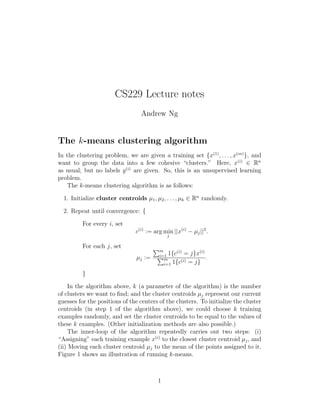
In the clustering problem, we are given a training set {x(1), . . . , x(m)}, and 
want to group the data into a few cohesive “clusters.” Here, x(i) 2 Rn 
as usual; but no labels y(i) are given. So, this is an unsupervised learning 
problem. 
The k-means clustering algorithm is as follows: 
1. Initialize cluster centroids μ1, μ2, . . . , μk 2 Rn randomly. 
2. Repeat until convergence: { 
For every i, set 
c(i) := argmin 
j 
||x(i) − μj ||2. 
For each j, set 
μj := Pm 
1{c(i) = j}x(i) 
i=1 Pm 
1{c(i) = j} 
i=1 . 
} 
In the algorithm above, k (a parameter of the algorithm) is the number 
of clusters we want to find; and the cluster centroids μj represent our current 
guesses for the positions of the centers of the clusters. To initialize the cluster 
centroids (in step 1 of the algorithm above), we could choose k training 
examples randomly, and set the cluster centroids to be equal to the values of 
these k examples. (Other initialization methods are also possible.) 
The inner-loop of the algorithm repeatedly carries out two steps: (i) 
“Assigning” each training example x(i) to the closest cluster centroid μj , and 
(ii) Moving each cluster centroid μj to the mean of the points assigned to it. 
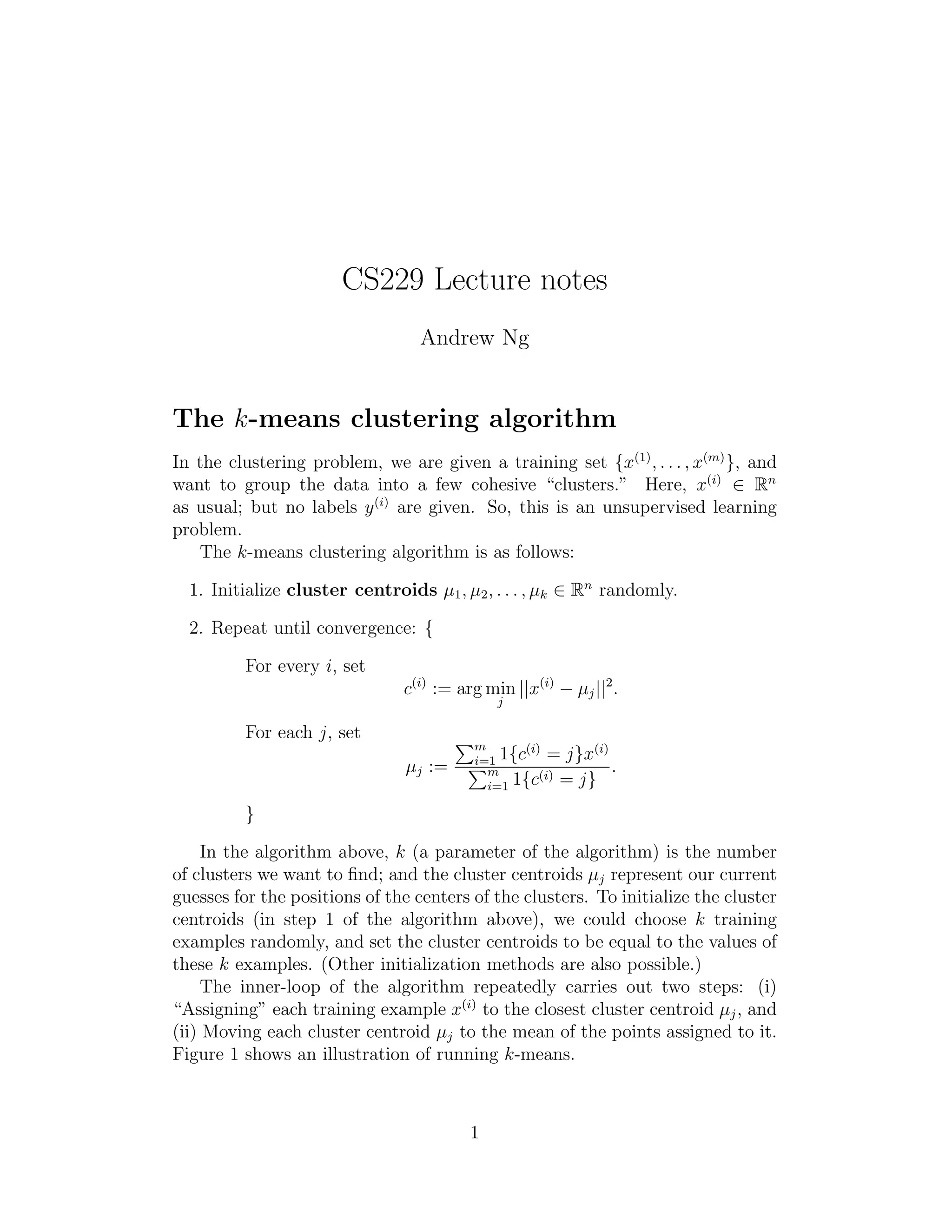
Figure 1 shows an illustration of running k-means. 
1
2 
(a) (b) (c) 
(d) (e) (f) 
Figure 1: K-means algorithm. Training examples are shown as dots, and 
cluster centroids are shown as crosses. (a) Original dataset. (b) Random ini- 
tial cluster centroids (in this instance, not chosen to be equal to two training 
examples). (c-f) Illustration of running two iterations of k-means. In each 
iteration, we assign each training example to the closest cluster centroid 
(shown by “painting” the training examples the same color as the cluster 
centroid to which is assigned); then we move each cluster centroid to the 
mean of the points assigned to it. (Best viewed in color.) Images courtesy 
Michael Jordan. 
Is the k-means algorithm guaranteed to converge? Yes it is, in a certain 
sense. In particular, let us define the distortion function to be: 
J(c, μ) = 
m 
X 
i=1 
||x(i) − μc(i) ||2 
Thus, J measures the sum of squared distances between each training exam- 
ple x(i) and the cluster centroid μc(i) to which it has been assigned. It can 
be shown that k-means is exactly coordinate descent on J. Specifically, the 
inner-loop of k-means repeatedly minimizes J with respect to c while holding 
μ fixed, and then minimizes J with respect to μ while holding c fixed. Thus, 
J must monotonically decrease, and the value of J must converge. (Usu- 
ally, this implies that c and μ will converge too. In theory, it is possible for
3 
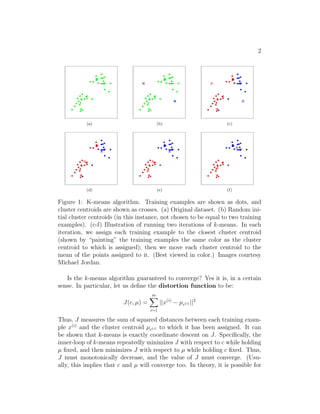
k-means to oscillate between a few different clusterings—i.e., a few different 
values for c and/or μ—that have exactly the same value of J, but this almost 
never happens in practice.) 
The distortion function J is a non-convex function, and so coordinate 
descent on J is not guaranteed to converge to the global minimum. In other 
words, k-means can be susceptible to local optima. Very often k-means will 
work fine and come up with very good clusterings despite this. But if you 
are worried about getting stuck in bad local minima, one common thing to 
do is run k-means many times (using different random initial values for the 
cluster centroids μj). Then, out of all the different clusterings found, pick 
the one that gives the lowest distortion J(c, μ).

Machine learning (7)

  • 1.
    CS229 Lecture notes Andrew Ng The k-means clustering algorithm In the clustering problem, we are given a training set {x(1), . . . , x(m)}, and want to group the data into a few cohesive “clusters.” Here, x(i) 2 Rn as usual; but no labels y(i) are given. So, this is an unsupervised learning problem. The k-means clustering algorithm is as follows: 1. Initialize cluster centroids μ1, μ2, . . . , μk 2 Rn randomly. 2. Repeat until convergence: { For every i, set c(i) := argmin j ||x(i) − μj ||2. For each j, set μj := Pm 1{c(i) = j}x(i) i=1 Pm 1{c(i) = j} i=1 . } In the algorithm above, k (a parameter of the algorithm) is the number of clusters we want to find; and the cluster centroids μj represent our current guesses for the positions of the centers of the clusters. To initialize the cluster centroids (in step 1 of the algorithm above), we could choose k training examples randomly, and set the cluster centroids to be equal to the values of these k examples. (Other initialization methods are also possible.) The inner-loop of the algorithm repeatedly carries out two steps: (i) “Assigning” each training example x(i) to the closest cluster centroid μj , and (ii) Moving each cluster centroid μj to the mean of the points assigned to it. Figure 1 shows an illustration of running k-means. 1
  • 2.
    2 (a) (b)(c) (d) (e) (f) Figure 1: K-means algorithm. Training examples are shown as dots, and cluster centroids are shown as crosses. (a) Original dataset. (b) Random ini- tial cluster centroids (in this instance, not chosen to be equal to two training examples). (c-f) Illustration of running two iterations of k-means. In each iteration, we assign each training example to the closest cluster centroid (shown by “painting” the training examples the same color as the cluster centroid to which is assigned); then we move each cluster centroid to the mean of the points assigned to it. (Best viewed in color.) Images courtesy Michael Jordan. Is the k-means algorithm guaranteed to converge? Yes it is, in a certain sense. In particular, let us define the distortion function to be: J(c, μ) = m X i=1 ||x(i) − μc(i) ||2 Thus, J measures the sum of squared distances between each training exam- ple x(i) and the cluster centroid μc(i) to which it has been assigned. It can be shown that k-means is exactly coordinate descent on J. Specifically, the inner-loop of k-means repeatedly minimizes J with respect to c while holding μ fixed, and then minimizes J with respect to μ while holding c fixed. Thus, J must monotonically decrease, and the value of J must converge. (Usu- ally, this implies that c and μ will converge too. In theory, it is possible for
  • 3.
    3 k-means tooscillate between a few different clusterings—i.e., a few different values for c and/or μ—that have exactly the same value of J, but this almost never happens in practice.) The distortion function J is a non-convex function, and so coordinate descent on J is not guaranteed to converge to the global minimum. In other words, k-means can be susceptible to local optima. Very often k-means will work fine and come up with very good clusterings despite this. But if you are worried about getting stuck in bad local minima, one common thing to do is run k-means many times (using different random initial values for the cluster centroids μj). Then, out of all the different clusterings found, pick the one that gives the lowest distortion J(c, μ).