Atterberg Limits
Presented By:
Faizan Tanoli
AtterbergLimits
Introduction:
The Atterberg limits are a basic measure of the critical
water contents of a fine-grained soil: its shrinkage limit,
plastic limit, and liquid limit. The Atterberg limits can
be used to distinguish between silt and clay, and to
distinguish between different types of silts and clays.
The water content at which the soils changes from one
state to the other are known as consistency limits or
Atterberg's limit.
AtterbergLimits
Liquid Limit:
Liquid Limit is defined as the minimum water content at percent
on dry bases at which the soil changes its state from Liquid to
Plastic State.
Plastic Limit:
Plastic Limit is defined as the minimum water content at percent
on dry bases at which a soil enters from Semi-Solid State to
Plastic State.
Shrinkage Limit:
Shrinkage limit is defined as, the maximum water content at which a
reduction in water content will not cause a decrease in the volume of a soil
mass.
It is lowest water content at which soil can still be completely saturated.
AtterbergLimits
Determination of Liquid Limit of Soil:
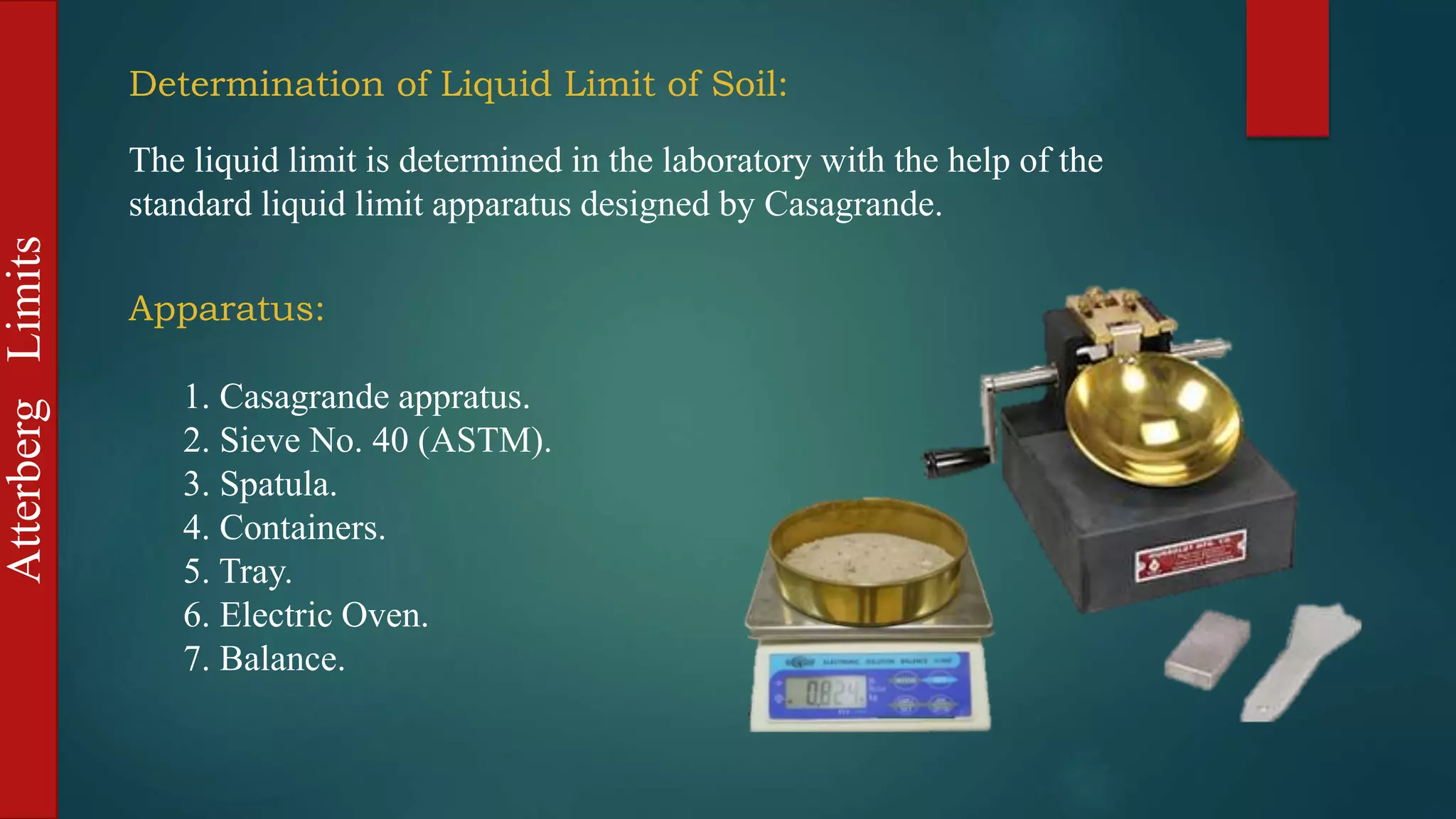
The liquid limit is determined in the laboratory with the help of the
standard liquid limit apparatus designed by Casagrande.
Apparatus:
1. Casagrande appratus.
2. Sieve No. 40 (ASTM).
3. Spatula.
4. Containers.
5. Tray.
6. Electric Oven.
7. Balance.
AtterbergLimits
Procedure:
1. About 120 g of the specimen passing through 425 micron sieve is mixed
thoroughly with distilled water in the evaporation dish or on a marble plate
to form a uniform paste.
2. A portion of the paste is placed in the cup over the spot where the cup rests
on the base, squeezed down and spread into position and the groove is cut
in the soil pat.
3. The handle is rotated at a rate about 2 revolutions per second, and the
number of blows is counted until the two parts of the soil sample come
into contact at the bottom of the groove along a distance of 10 mm.
Some soils tend to slide on the surface of the cup instead of the flowing. If
this occurs, the result should be discarded, and the test repeated until flowing
does not occur.
AtterbergLimits
Procedure:
4. After recording the number of blows, approximately 10 gram of soil from
near the closed groove is taken for water content determination.
Since it is difficult to adjust the water content precisely equal to the
liquid limit when the groove should close in 25 blows, the liquid limit
is determined by plotting a graph between the number of blows as
abscissa on a logarithmic scale and the corresponding water content
as ordinate.
AtterbergLimits
Procedure:
For plotting the flow curve, at least four to five sets of reading in the range of 10
to 50 blows should be taken.
The water content corresponding to 25 blows is taken as the liquid limit.
AtterbergLimits
Determination of Plastic Limit of Soil.
Apparatus:
1. Glass plat (2 x 2 feet).
2. Spatula.
3. Sieve No. 40 (ASTM).
4. Electric oven.
5. Balance.
AtterbergLimits
Procedure:
1. To determine the plastic limit, the soil specimen, passing
425 micron sieve, is mixed thoroughly with distilled
water until the soil mass becomes plastic enough to be
easily molded with fingers.
2. The plastic soil mass should be left for enough time to
allow water to permeate through the soil mass.
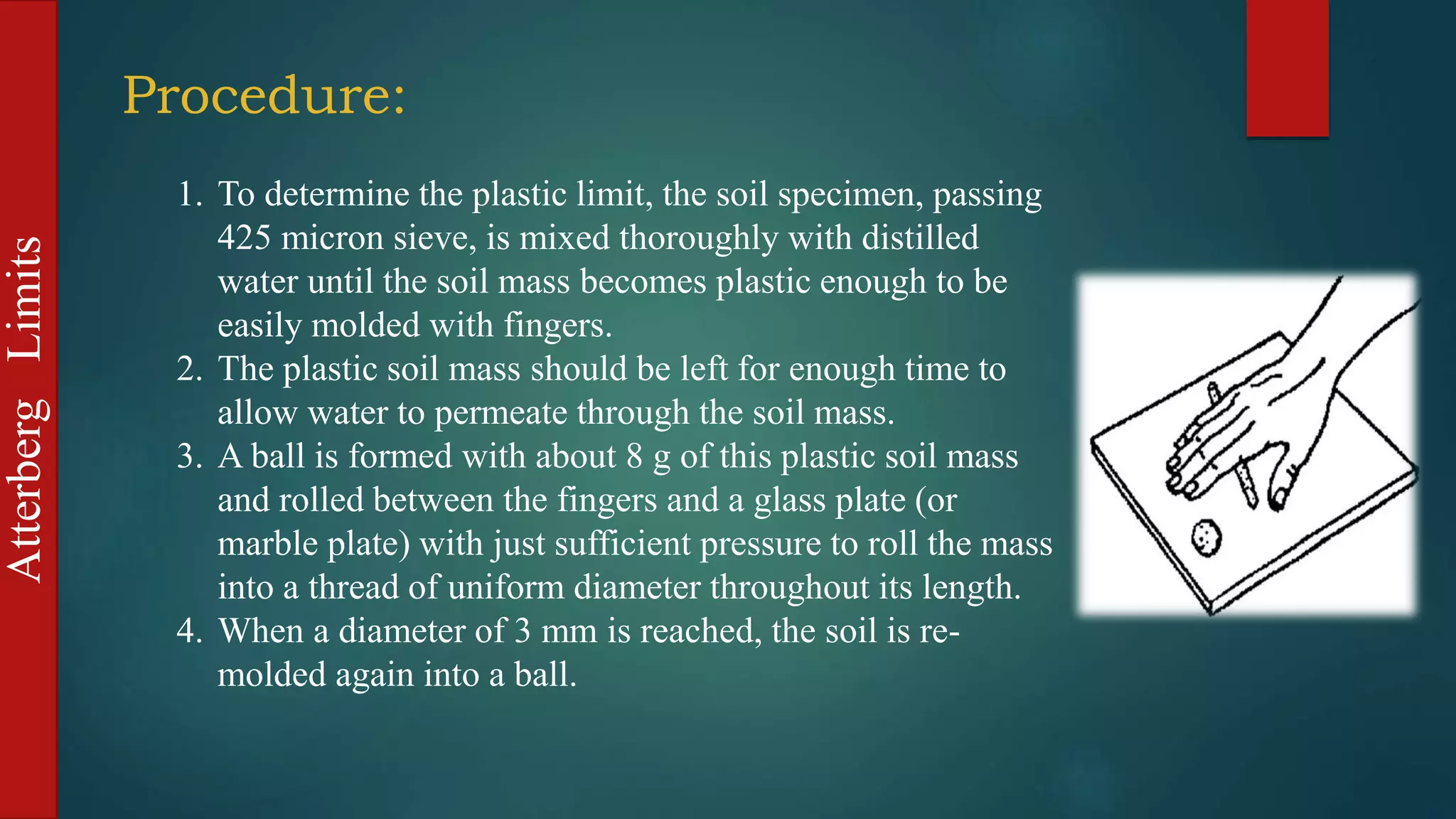
3. A ball is formed with about 8 g of this plastic soil mass
and rolled between the fingers and a glass plate (or
marble plate) with just sufficient pressure to roll the mass
into a thread of uniform diameter throughout its length.
4. When a diameter of 3 mm is reached, the soil is re-
molded again into a ball.
AtterbergLimits
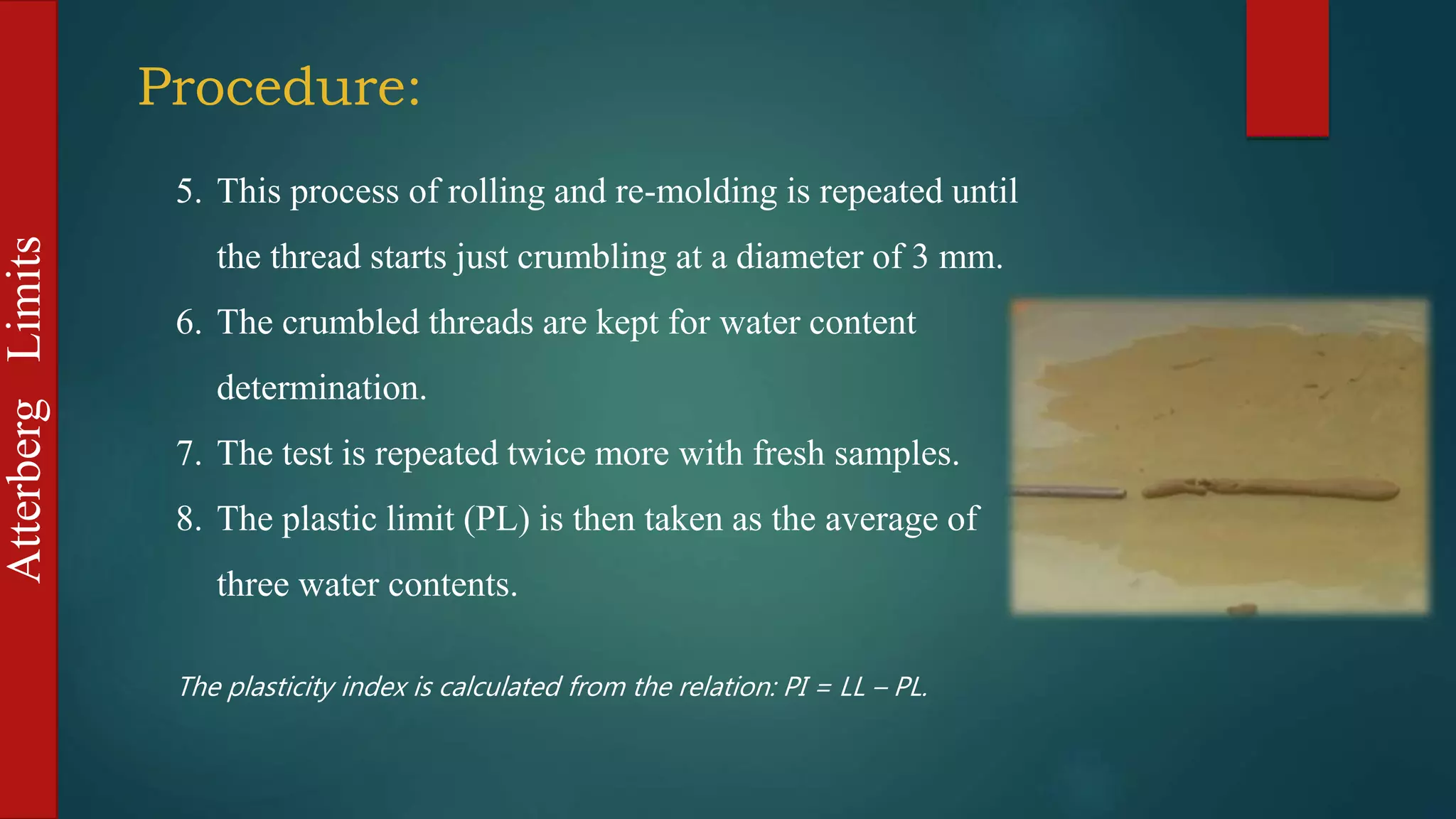
5. This process of rolling and re-molding is repeated until
the thread starts just crumbling at a diameter of 3 mm.
6. The crumbled threads are kept for water content
determination.
7. The test is repeated twice more with fresh samples.
8. The plastic limit (PL) is then taken as the average of
three water contents.
The plasticity index is calculated from the relation: PI = LL – PL.
Procedure:
AtterbergLimits

Atterberg limits

  • 1.
  • 2.
    AtterbergLimits Introduction: The Atterberg limitsare a basic measure of the critical water contents of a fine-grained soil: its shrinkage limit, plastic limit, and liquid limit. The Atterberg limits can be used to distinguish between silt and clay, and to distinguish between different types of silts and clays. The water content at which the soils changes from one state to the other are known as consistency limits or Atterberg's limit.
  • 3.
    AtterbergLimits Liquid Limit: Liquid Limitis defined as the minimum water content at percent on dry bases at which the soil changes its state from Liquid to Plastic State. Plastic Limit: Plastic Limit is defined as the minimum water content at percent on dry bases at which a soil enters from Semi-Solid State to Plastic State. Shrinkage Limit: Shrinkage limit is defined as, the maximum water content at which a reduction in water content will not cause a decrease in the volume of a soil mass. It is lowest water content at which soil can still be completely saturated.
  • 4.
    AtterbergLimits Determination of LiquidLimit of Soil: The liquid limit is determined in the laboratory with the help of the standard liquid limit apparatus designed by Casagrande. Apparatus: 1. Casagrande appratus. 2. Sieve No. 40 (ASTM). 3. Spatula. 4. Containers. 5. Tray. 6. Electric Oven. 7. Balance.
  • 5.
    AtterbergLimits Procedure: 1. About 120g of the specimen passing through 425 micron sieve is mixed thoroughly with distilled water in the evaporation dish or on a marble plate to form a uniform paste. 2. A portion of the paste is placed in the cup over the spot where the cup rests on the base, squeezed down and spread into position and the groove is cut in the soil pat. 3. The handle is rotated at a rate about 2 revolutions per second, and the number of blows is counted until the two parts of the soil sample come into contact at the bottom of the groove along a distance of 10 mm. Some soils tend to slide on the surface of the cup instead of the flowing. If this occurs, the result should be discarded, and the test repeated until flowing does not occur.
  • 6.
    AtterbergLimits Procedure: 4. After recordingthe number of blows, approximately 10 gram of soil from near the closed groove is taken for water content determination. Since it is difficult to adjust the water content precisely equal to the liquid limit when the groove should close in 25 blows, the liquid limit is determined by plotting a graph between the number of blows as abscissa on a logarithmic scale and the corresponding water content as ordinate.
  • 7.
    AtterbergLimits Procedure: For plotting theflow curve, at least four to five sets of reading in the range of 10 to 50 blows should be taken. The water content corresponding to 25 blows is taken as the liquid limit.
  • 8.
    AtterbergLimits Determination of PlasticLimit of Soil. Apparatus: 1. Glass plat (2 x 2 feet). 2. Spatula. 3. Sieve No. 40 (ASTM). 4. Electric oven. 5. Balance.
  • 9.
    AtterbergLimits Procedure: 1. To determinethe plastic limit, the soil specimen, passing 425 micron sieve, is mixed thoroughly with distilled water until the soil mass becomes plastic enough to be easily molded with fingers. 2. The plastic soil mass should be left for enough time to allow water to permeate through the soil mass. 3. A ball is formed with about 8 g of this plastic soil mass and rolled between the fingers and a glass plate (or marble plate) with just sufficient pressure to roll the mass into a thread of uniform diameter throughout its length. 4. When a diameter of 3 mm is reached, the soil is re- molded again into a ball.
  • 10.
    AtterbergLimits 5. This processof rolling and re-molding is repeated until the thread starts just crumbling at a diameter of 3 mm. 6. The crumbled threads are kept for water content determination. 7. The test is repeated twice more with fresh samples. 8. The plastic limit (PL) is then taken as the average of three water contents. The plasticity index is calculated from the relation: PI = LL – PL. Procedure:
  • 11.