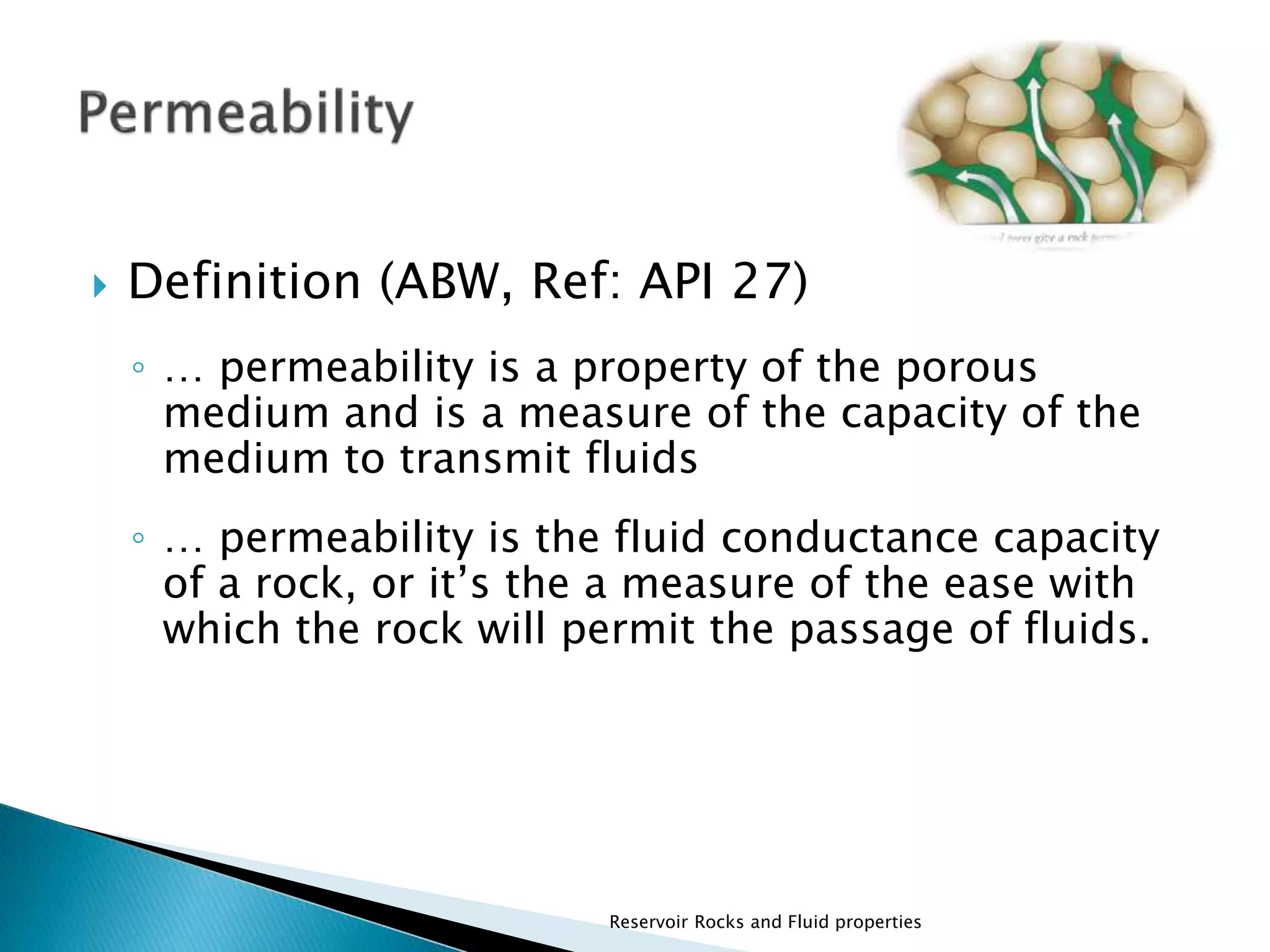
 Definition (ABW, Ref: API 27) 
◦ … permeability is a property of the porous 
medium and is a measure of the capacity of the 
medium to transmit fluids 
◦ … permeability is the fluid conductance capacity 
of a rock, or it’s the a measure of the ease with 
which the rock will permit the passage of fluids. 
Reservoir Rocks and Fluid properties
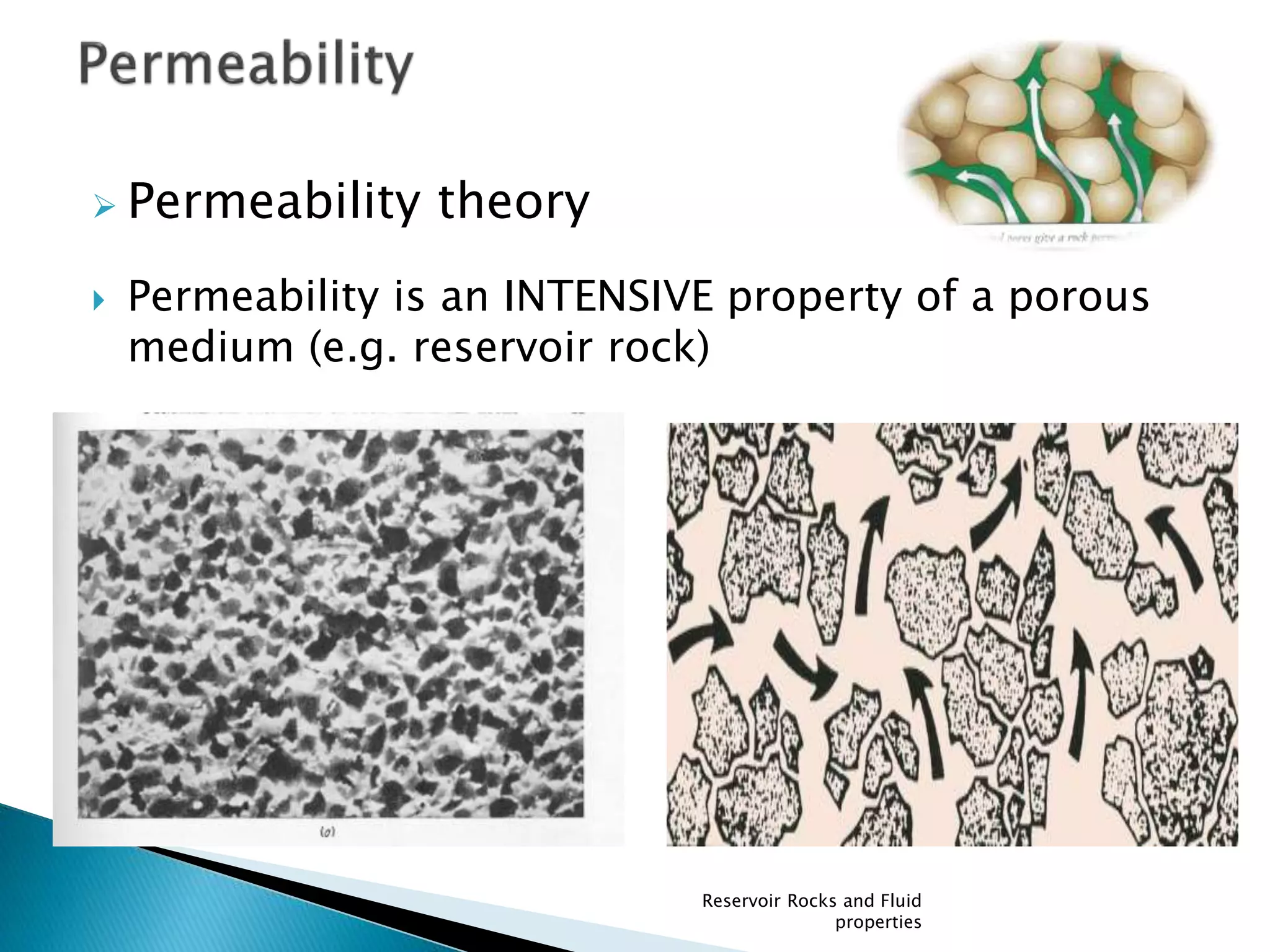
 Permeability theory 
 Permeability is an INTENSIVE property of a porous 
medium (e.g. reservoir rock) 
Reservoir Rocks and Fluid 
properties
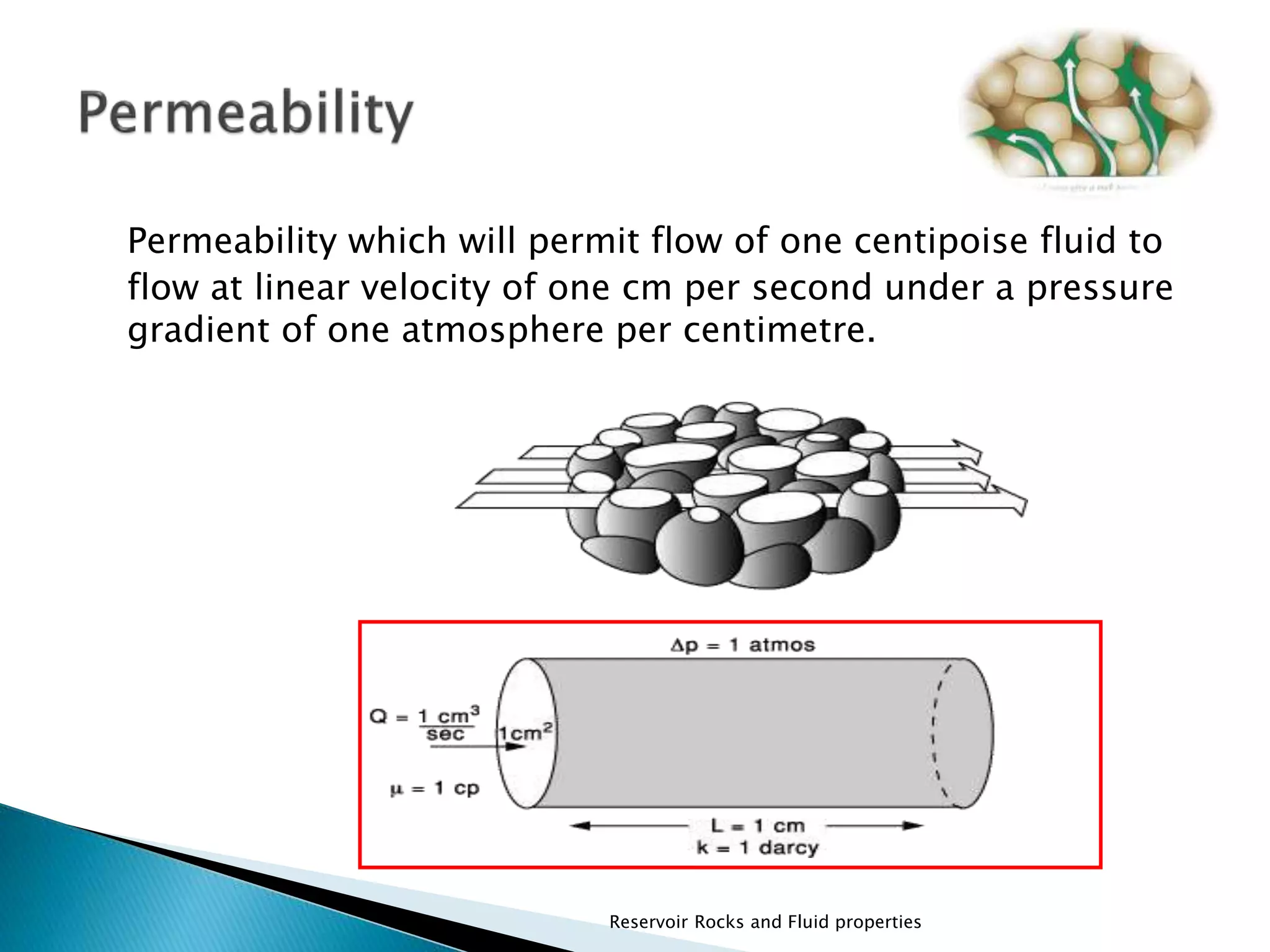
Permeability which will permit flow of one centipoise fluid to 
flow at linear velocity of one cm per second under a pressure 
gradient of one atmosphere per centimetre. 
Reservoir Rocks and Fluid properties
 Three types of permeability 
 Absolute permeability - the permeability of a porous medium 
with only one fluid present (single-phase flow). 
 When two or more fluids are present permeability of the rock to a 
flowing fluid is called effective permeability (ko, kg, kw). 
 Relative permeability is the ratio of absolute and effective 
permeabilities kro=ko/k, krg=kg/k, krw=kw/k. 
Reservoir Rocks and Fluid properties
 A French hydrologist named Darcy did the first work on 
permeability. He was concerned about flow of water through 
filters. He found that flow rate Q, is proportional to area of flow 
A,h, and 1/L. This is expressed mathematically as flows: 
1 
h h 
Q KA 1 2  
 
L 
 Darcy’s “K” was determined to be a combination of 
◦ k, permeability of the sand pack (porous medium, e.g. 
reservoir rock) 
◦ K is a constant of proportionality 
◦ , viscosity of the liquid 
 K constant may be written as; 
2 
Reservoir Rocks and Fluid properties 
k 
μ 
K 
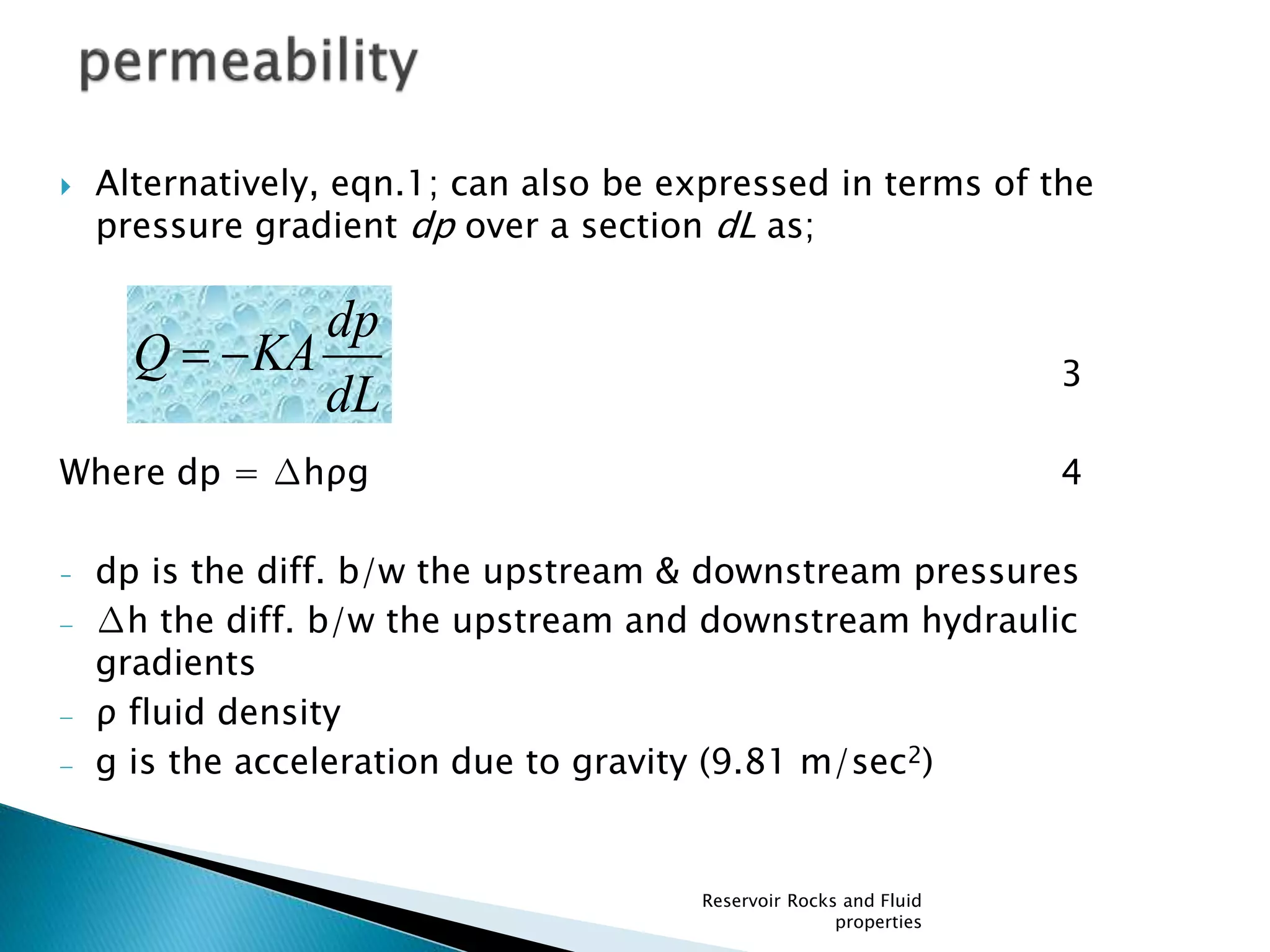
 Alternatively, eqn.1; can also be expressed in terms of the 
pressure gradient dp over a section dL as; 
3 
dp 
Where dp = Δhρg 4 
– dp is the diff. b/w the upstream & downstream pressures 
 Δh the diff. b/w the upstream and downstream hydraulic 
gradients 
 ρ fluid density 
 g is the acceleration due to gravity (9.81 m/sec2) 
Reservoir Rocks and Fluid 
properties 
dL 
Q  KA
Darcy’s 
Apparatus for 
Determining 
Permeability 
h h 
1 2 
 
Q A 
volumetric flow rate 
cross sectional area 
 
 
& hydraulic head at inlet and outlet 
(Sand Pack Length) L 
Reservoir Rocks and Fluid properties 
length of the porous medium 
Q 
A 
L 
1 2 
 
 
 
h h 
L 
Q 
 
h1-h2 
h1 
h2 
q 
A 
q 
A
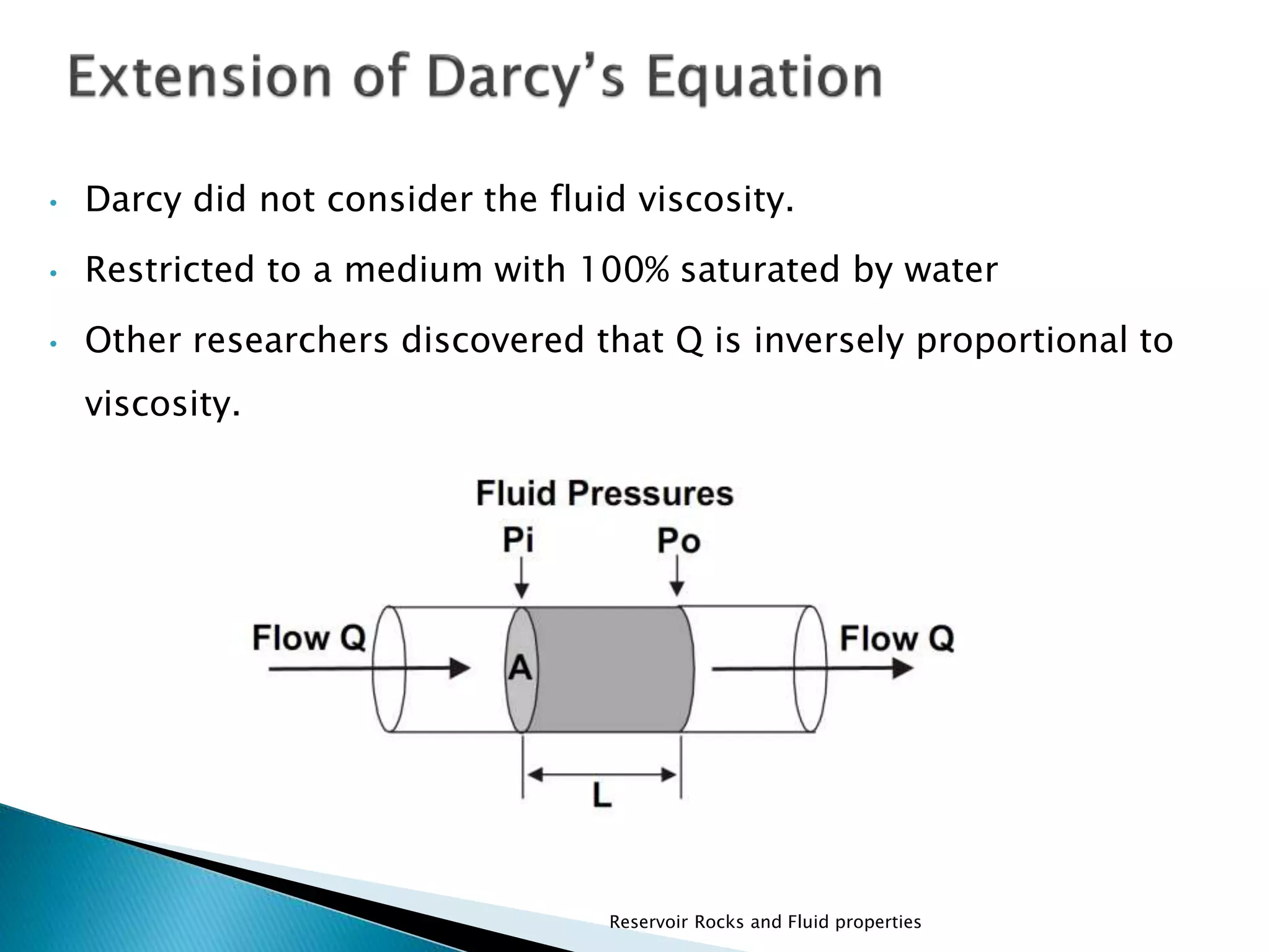
• Darcy did not consider the fluid viscosity. 
• Restricted to a medium with 100% saturated by water 
• Other researchers discovered that Q is inversely proportional to 
Reservoir Rocks and Fluid properties 
viscosity.
Extension of Darcy’s Equation 
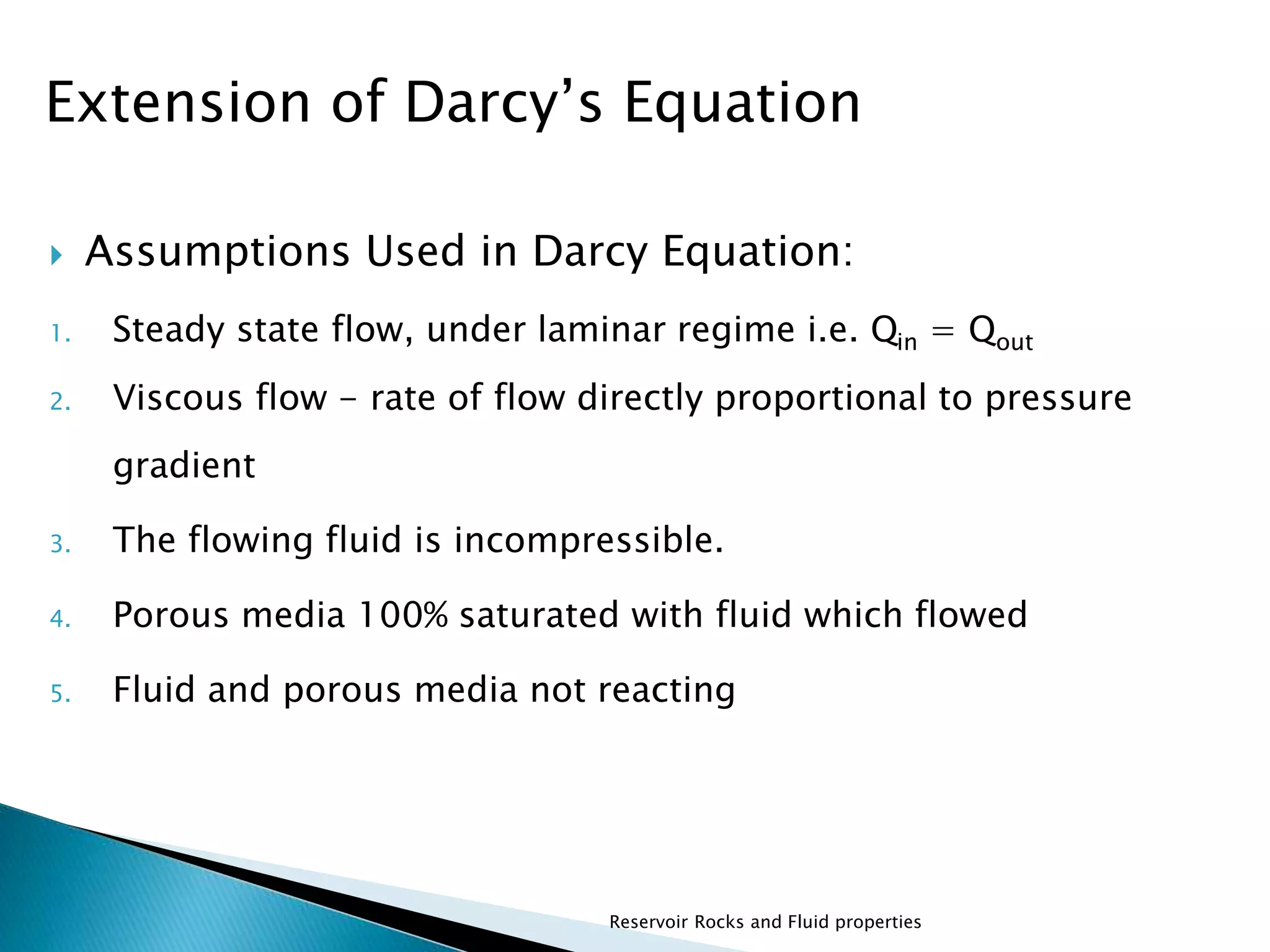
 Assumptions Used in Darcy Equation: 
1. Steady state flow, under laminar regime i.e. Qin = Qout 
2. Viscous flow - rate of flow directly proportional to pressure 
gradient 
3. The flowing fluid is incompressible. 
4. Porous media 100% saturated with fluid which flowed 
5. Fluid and porous media not reacting 
Reservoir Rocks and Fluid properties
 Darcy’s Law can be extended to other fluids, if K is expressed as a 
ratio of /μ, where μ is the viscosity of a given fluid and  the 
permeability of the porous medium. 
 Eqn. 3 can be written to account for viscosity μ as; 
k 
dp 
Q = - A 5 
Eqn.5 can be integrated b/w the limits of length from 0 to L and 
pressure from P1(upstream) to P2 (downstream), for a fluid flow 
case. 
Reservoir Rocks and Fluid properties 
 
dL
 Therefore, 
6 
7 
KA  
P 
or 8 
Q L 
Q 
 0    
KA 
Q   
Q 
Hence, the original equation of Darcy was modified to account for 
viscosity as follows: 
9 
KA 
Q   
Reservoir Rocks and Fluid properties 
    
p 
p 
dp 
k 
dL 
A 
2 
1 
0  
 k 
L 
 p p  A 
2 1 
 
  1 2 p p 
L 
  
L 
 
  1 2 p p 
L 

 Permeability is determined by: 
 Core analysis 
 Well test analysis (flow testing) 
◦ RFT (repeat formation tester) provides small well tests 
 Production data 
◦ production logging measures fluid flow into well 
 Log data 
◦ MRI (magnetic resonance imaging) logs calibrated via core analysis 
Reservoir Rocks and Fluid properties
• Shape and size of pore system 
• Sorting 
• Cementation 
• Fracturing and solution 
• Lithology or rock type 
Reservoir Rocks and Fluid properties
 Two sets of units are generally used in reservoir engineering: 
Darcy units and Oil-field units 
 For the purpose of the mathematical derivations, a system of 
units commonly referred to as Darcy units are used. These 
units are: 
 Vs= cm/sec; μ = cP; ρ = gm/cc 
 K = Darcy; g = cm/sec2; dp/ds = atm/cm 
 For application to field data of the various mathematical 
expressions, the second system of units called the practical 
oil-field units are used. 
Reservoir Rocks and Fluid properties
 From dimensional analysis, the dimension for K is [L]2. 
We could use ft2, ins2, or cm2 for measure of permeability, but 
these units are all too large to be applied in porous media. 
 So Darcy unit is used and recommended , but in many cases the 
millidarcy (mD) 
 1 Darcy = 1000 miliDarcy 
 1 Darcy ~ 10-8 sm2 (10-6 mm2) 
 1 miliDarcy ~ 10-11 sm2 (10-9 mm2) 
Reservoir Rocks and Fluid properties
Darcy’s Law - Darcy Units 
 Linear (1-D) flow of an incompressible fluid 
kA 
μ L 
q  
◦ where, 
Δp 
 q cm3/s 
 k darcies 
 A cm2 
 p atm 
  cp 
 L cm 
◦ The Darcy a derived unit of permeability, defined to make this 
equation coherent (in Darcy units)
Darcy’s Law - Oilfield Units 
 Linear (1-D) flow of an incompressible fluid 
CkA 
μ L 
q  
◦ where, 
Δp 
 q bbl/D 
 k millidarcies 
 A ft2 
 p psia 
  cp 
 L ft
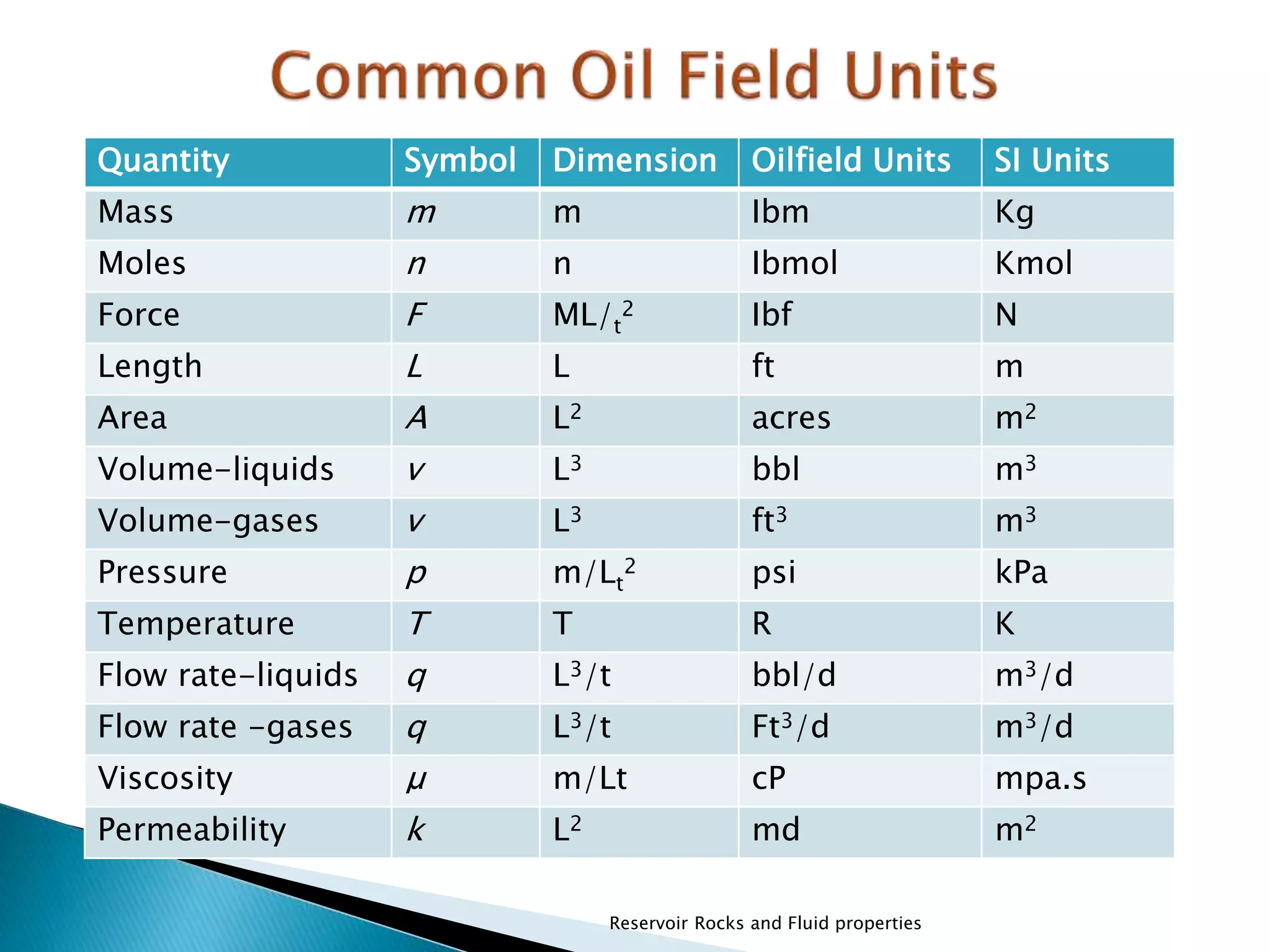
Quantity Symbol Dimension Oilfield Units SI Units 
Mass m m Ibm Kg 
Moles n n Ibmol Kmol 
Force F ML/2 Ibf N 
t 
Length L L ft m 
Area A L2 acres m2 
Volume-liquids v L3 bbl m3 
Volume-gases v L3 ft3 m3 
Pressure p m/Lt 
2 psi kPa 
Temperature T T R K 
Flow rate-liquids q L3/t bbl/d m3/d 
Flow rate -gases q L3/t Ft3/d m3/d 
Viscosity μ m/Lt cP mpa.s 
Permeability k L2 md m2 
Reservoir Rocks and Fluid properties
 Permeability is an important parameter that controls the 
reservoir performance. Its importance is reflected by the 
number of available techniques typically used to estimate it. 
 These different techniques provide formation permeability 
that represents different averaging volumes. 
 The quality of the reservoir, as it relates to permeability can 
be classified as follows 
< 10 md fair 
10 – 100 High 
100 – 1000 Very High 
>1000 Exceptional 
 This scale changes with time, for example 30 years ago k< 
50 was considered poor. 
Reservoir Rocks and Fluid properties
 What is 1 Darcy? 
 A porous medium has a permeability of one Darcy, when a 
single-phase fluid of one centipoises viscosity, that completely 
fills the voids of the medium will flow through it, under 
conditions of viscous flow (also known as laminar flow), at a 
rate of one cubic centimeter cross sectional area, and under a 
pressure or equivalent hydraulic gradient of one atmosphere 
per centimeter. 
Reservoir Rocks and Fluid properties
 Important Characteristics that must be considered in the 
reservoir: 
 Types of fluids in the reservoir 
 Flow regimes 
 Reservoir geometry 
 Number of fluid flowing in the reservoir 
Reservoir Rocks and Fluid properties
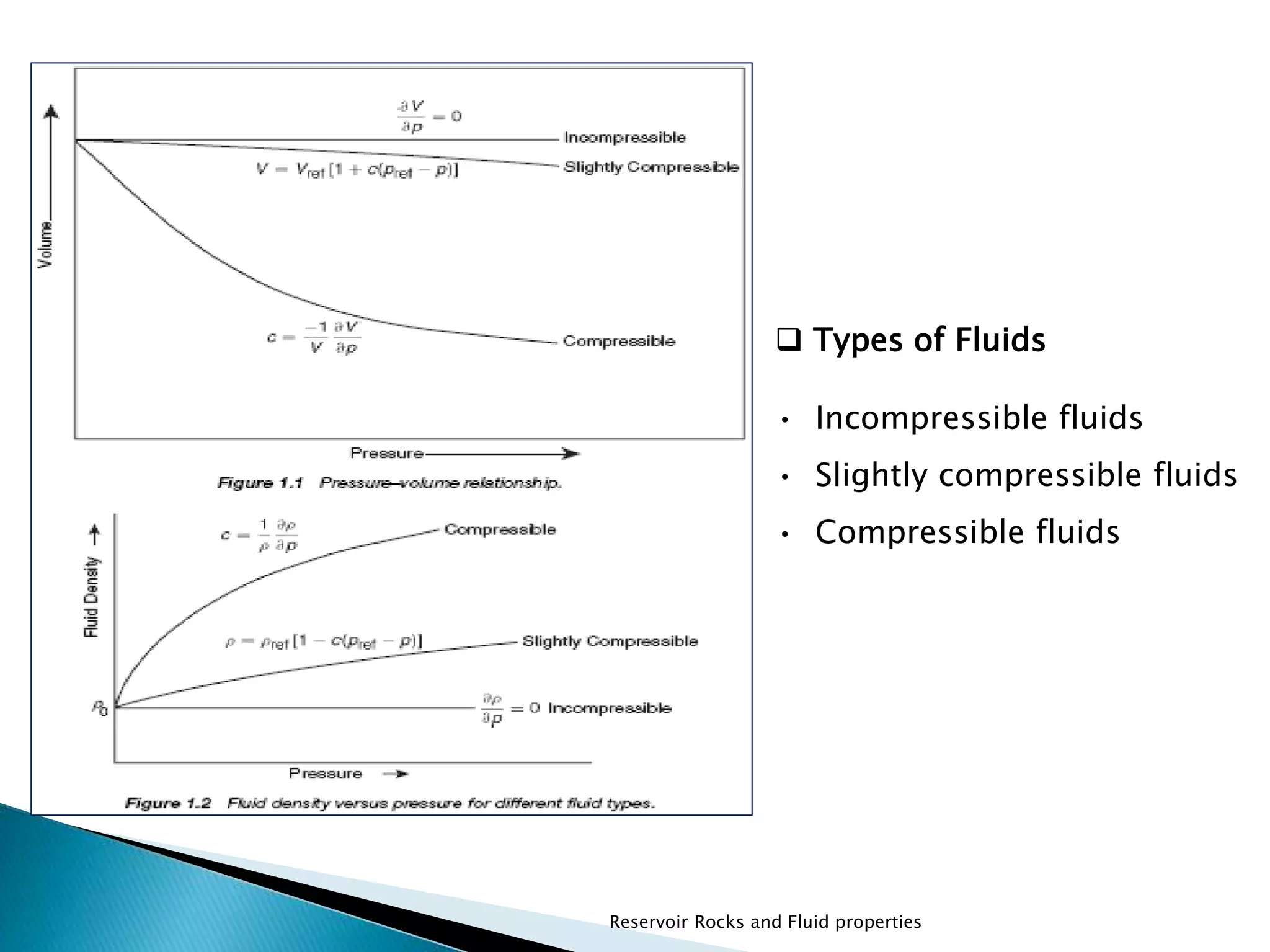
 Types of Fluids 
• Incompressible fluids 
• Slightly compressible fluids 
• Compressible fluids 
 Flow Regimes 
• Steady state flow 
• Unsteady state flow 
• Pseudosteady state flow 
Reservoir Rocks and Fluid properties
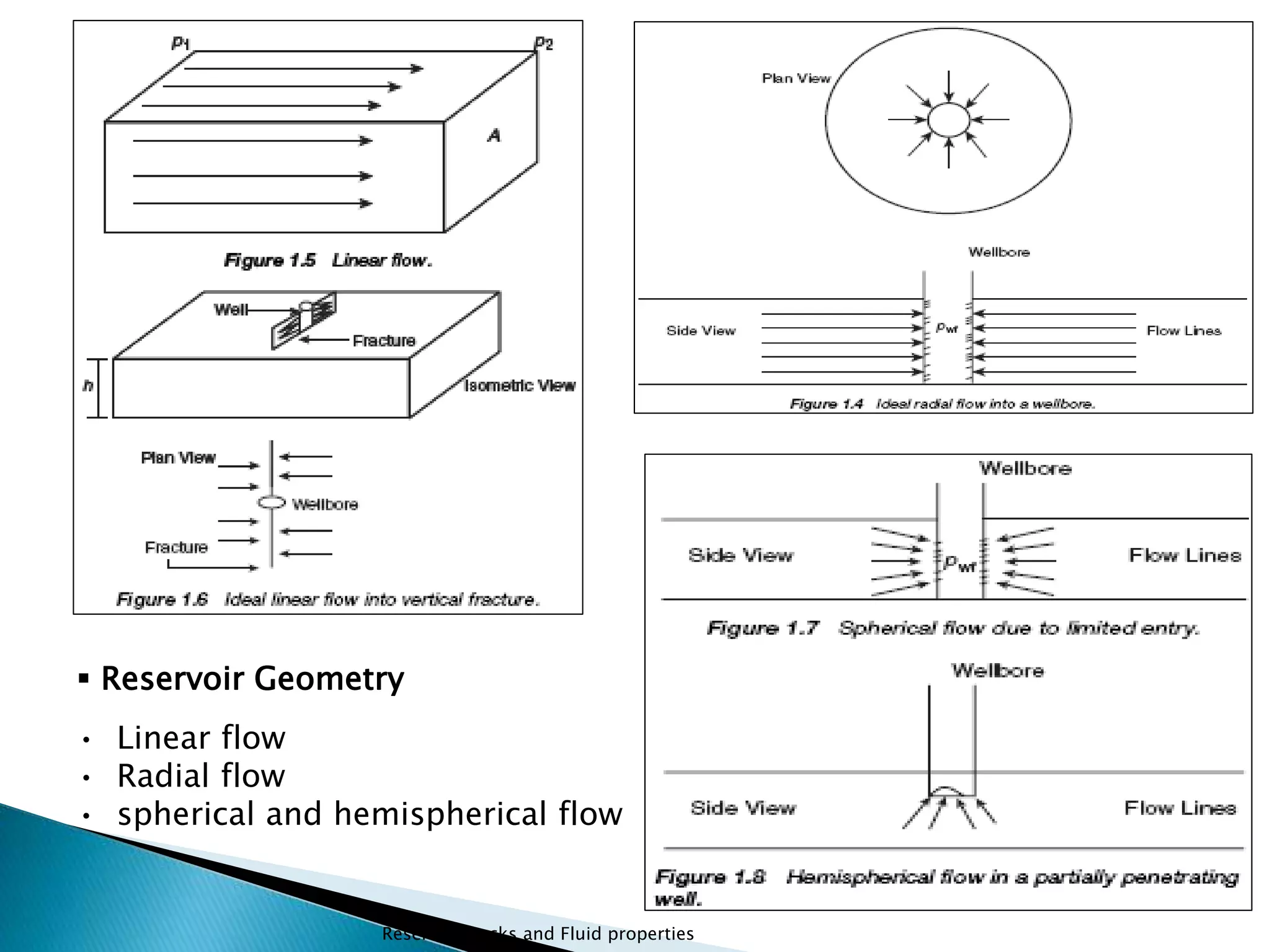
 Reservoir Geometry 
• Linear flow 
• Radial flow 
• spherical and hemispherical flow 
 Number of fluid flowing 
• Single phase flow 
• Two phase flow 
• Three phase or multiple phase flow 
Reservoir Rocks and Fluid properties
 Types of Fluids 
• Incompressible fluids 
• Slightly compressible fluids 
• Compressible fluids 
Reservoir Rocks and Fluid properties
 Flow Regimes 
• Steady state flow 
• Unsteady state flow 
• Pseudosteady state flow 
Reservoir Rocks and Fluid 
properties
 Reservoir Geometry 
• Linear flow 
• Radial flow 
• spherical and hemispherical flow 
Reservoir Rocks and Fluid properties
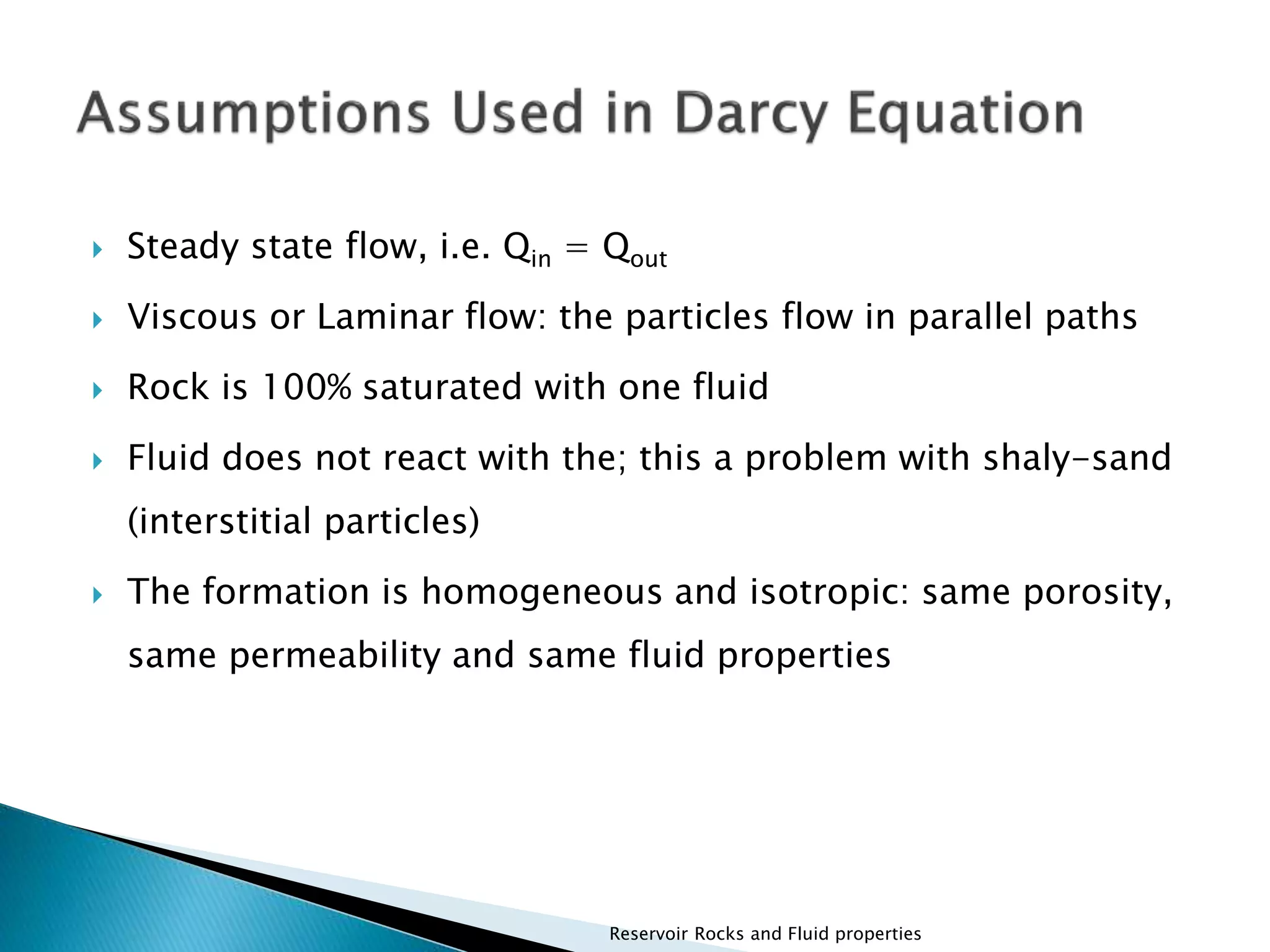
 Steady state flow, i.e. Qin = Qout 
 Viscous or Laminar flow: the particles flow in parallel paths 
 Rock is 100% saturated with one fluid 
 Fluid does not react with the; this a problem with shaly-sand 
(interstitial particles) 
 The formation is homogeneous and isotropic: same porosity, 
same permeability and same fluid properties 
Reservoir Rocks and Fluid properties
 Generalized form of Darcy’s Law 
 The generalized Darcy’s law is given by the following equation: 
k  
dp 
Vs 
  
 
 Vs = Q/A and dp/ds = dp/dx, hence 
 
 
 
KA dp 
Reservoir Rocks and Fluid properties 
  
ds 
 
 
 
 
 
 
  
dx 
Q 
 
Separating the variables and 
integrating gives the following eqn.: 
Note that P1>P2
    
  
   
0 
6 
k dP 
 
k dP 
k dP 
Q 
g dz 
  
  
 
 
 0 
     
2 1 1 2 *10 
1.0135 
2 
1 
P P 
k 
P P 
k 
L 
Q 
Q 
Q 
Q 
A 
dP 
k 
dx 
A 
dP 
k 
dx 
A 
dx 
A 
dx 
v 
ds 
ds 
v 
A 
P 
P 
L 
x 
s 
      
 
 
 
 
  
  
 
 
 
 
 
• Fluid not compressed (no density 
change with pressure) 
• Steady flow (mass in = mass out) 
• In horizontal flow (Linear): 
dP 
dx 
dP 
ds 
dz 
ds 
 0 ,   
  
kA P P 
Q 1 2  
  
L 

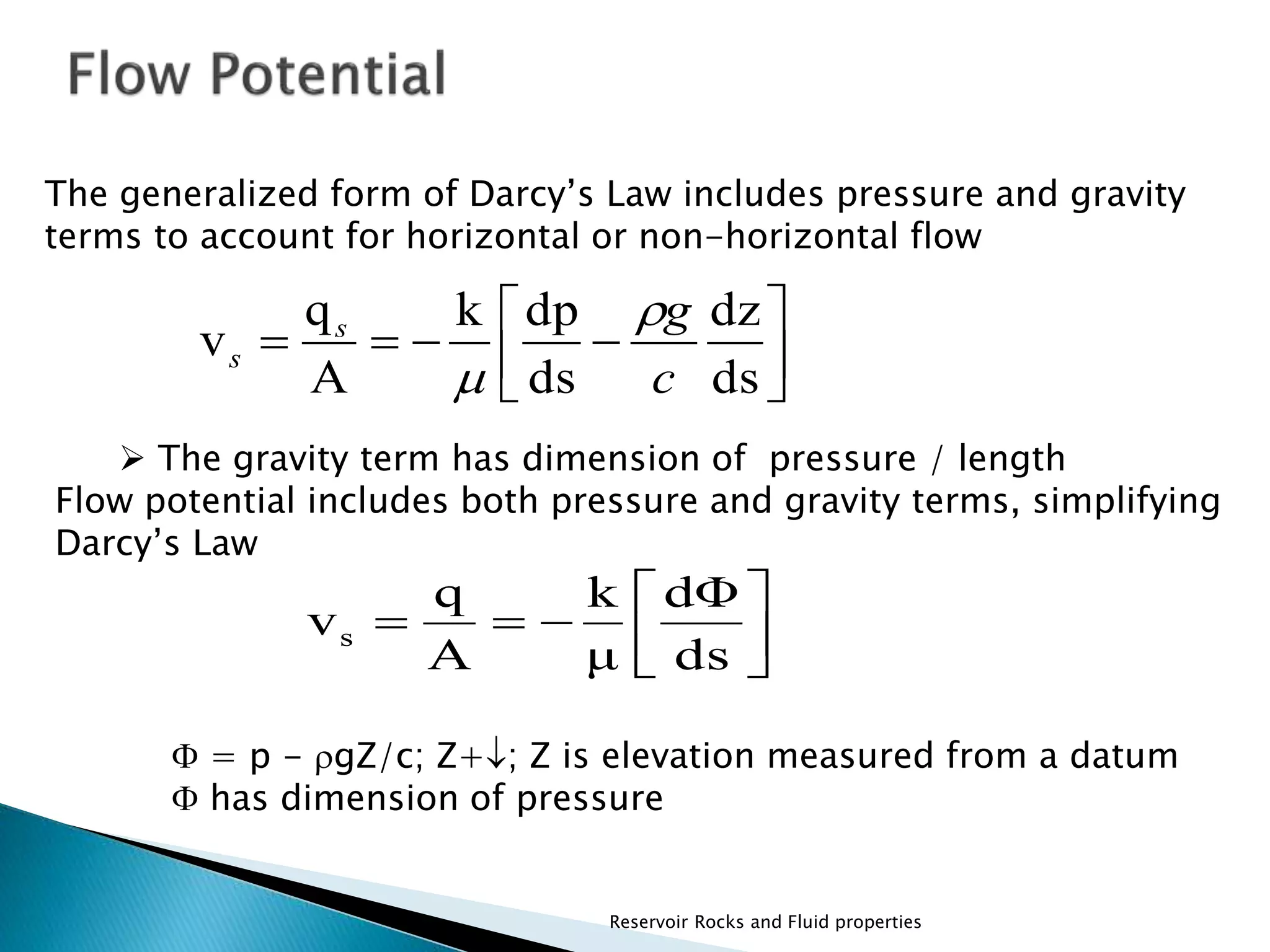
The generalized form of Darcy’s Law includes pressure and gravity 
terms to account for horizontal or non-horizontal flow 
 
 
 
k dp 
g s 
q 
    
dz 
 
 
dΦ 
k 
Reservoir Rocks and Fluid properties 
 
 
 
ds 
ds 
A 
v 
c 
s 
 
 
 The gravity term has dimension of pressure / length 
Flow potential includes both pressure and gravity terms, simplifying 
Darcy’s Law 
 
 
 
 
q 
   
ds 
μ 
A 
vs 
 = p - gZ/c; Z+; Z is elevation measured from a datum 
 has dimension of pressure
 The gravitational conversion constant, c, is needed to convert 
the gravity term to units of pressure gradient 
[pressure/length] 
 A clear way to determine the sign of the gravity term (+ or -) 
is to consider the static case. If no fluid is flowing, then there 
is no potential gradient (potential is constant), while pressure 
changes with elevation, due to fluid density (dp=(g/c)dZ). 
Reservoir Rocks and Fluid properties
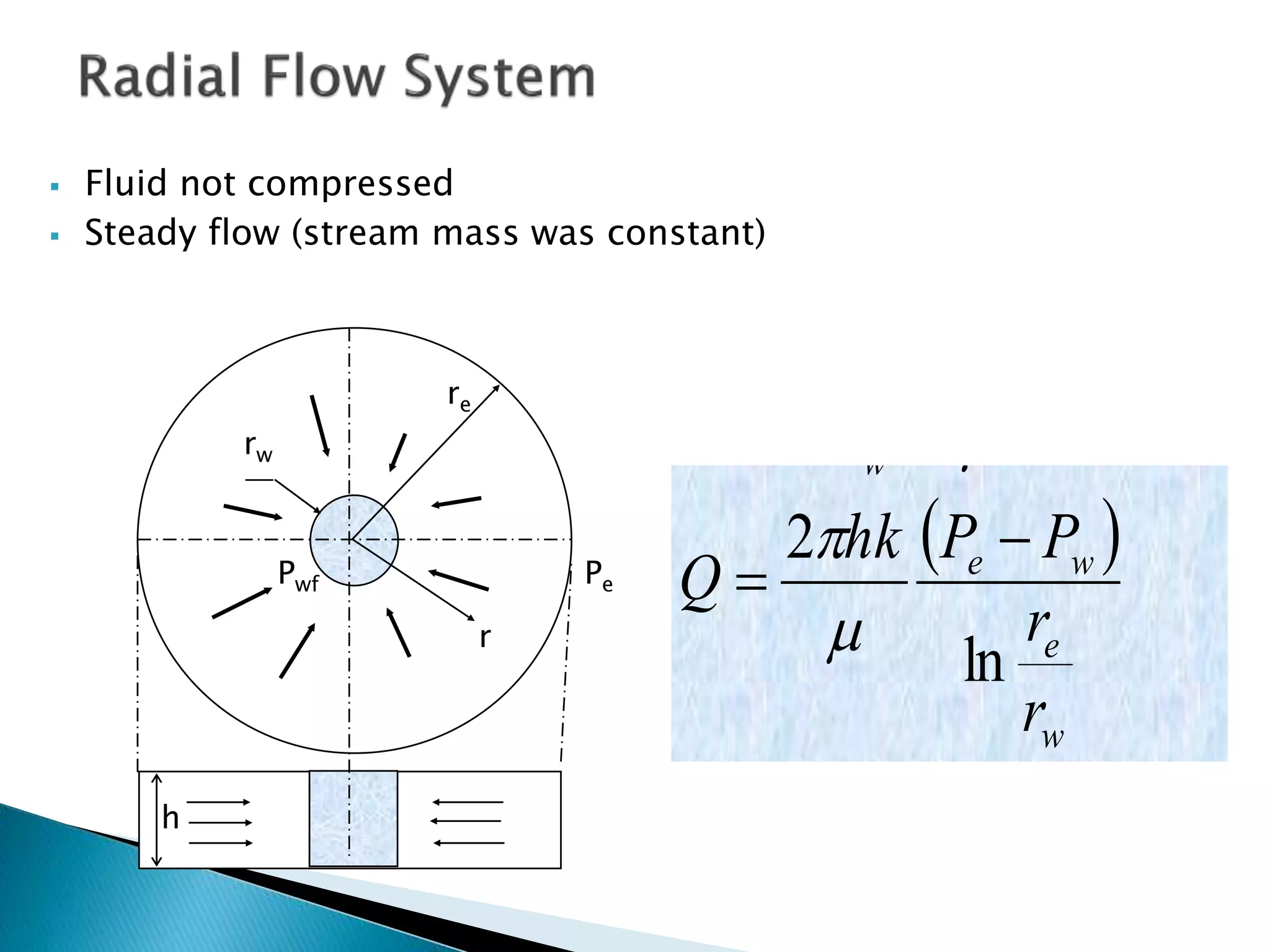
 Fluid not compressed 
Q 
  
Q 
 Steady flow (stream mass was constant) 
rw 
re 
Pwf Pe 
h 
r 
   
P 
r 
w 
w 
    
  
  
e w 
 
  
  
r 
hk P P 
e w 
r 
e 
w 
e 
w 
P 
P 
r 
r 
r 
Q 
Q 
P P 
k 
r 
h 
P 
k 
r 
h 
PdP 
k 
dr 
h r 
e 
w 
e 
w 
ln 
ln 
2 
2 
ln 
2 
1 
2 
 
 
  
 

 Q = flow rate, m3/sec 
 K = permeability, m2 
 h = thickness, m 
 Pe = pressure drainage radius, N/m2 
 Pwf = flowing pressure, N/m2 
 = fluid viscosity, N/m2 
 re = drainage radius, m 
 rw = the well-bore radius, m 
Reservoir Rocks and Fluid properties 

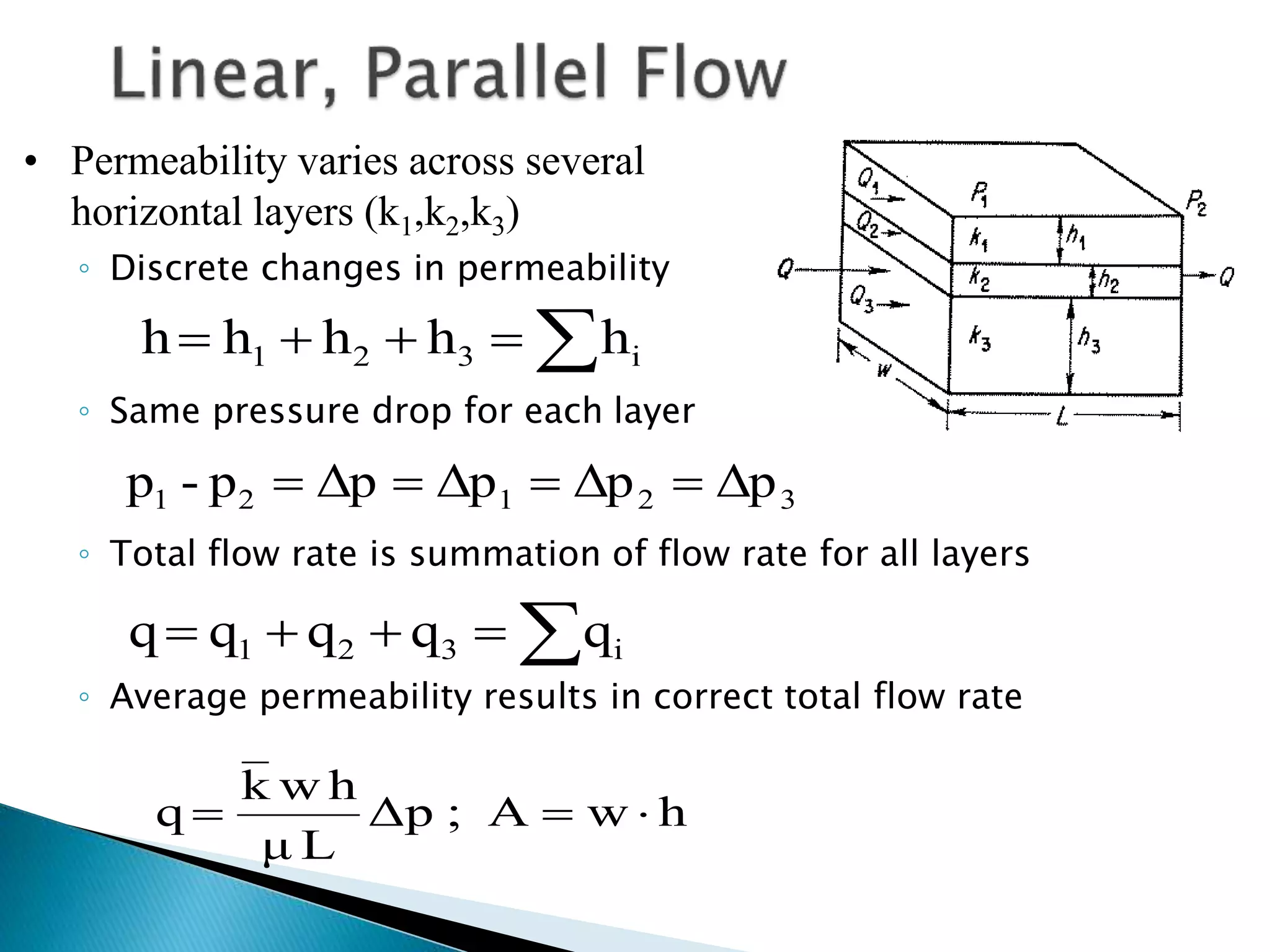
• Permeability varies across several 
horizontal layers (k1,k2,k3) 
◦ Discrete changes in permeability 
    1 2 3 i h h h h h 
◦ Same pressure drop for each layer 
1 2 1 2 3 p - p  Δp  Δp  Δp  Δp 
◦ Total flow rate is summation of flow rate for all layers 
    1 2 3 i q q q q q 
◦ Average permeability results in correct total flow rate 
q   
Δp ; A w h 
kwh 
μ L
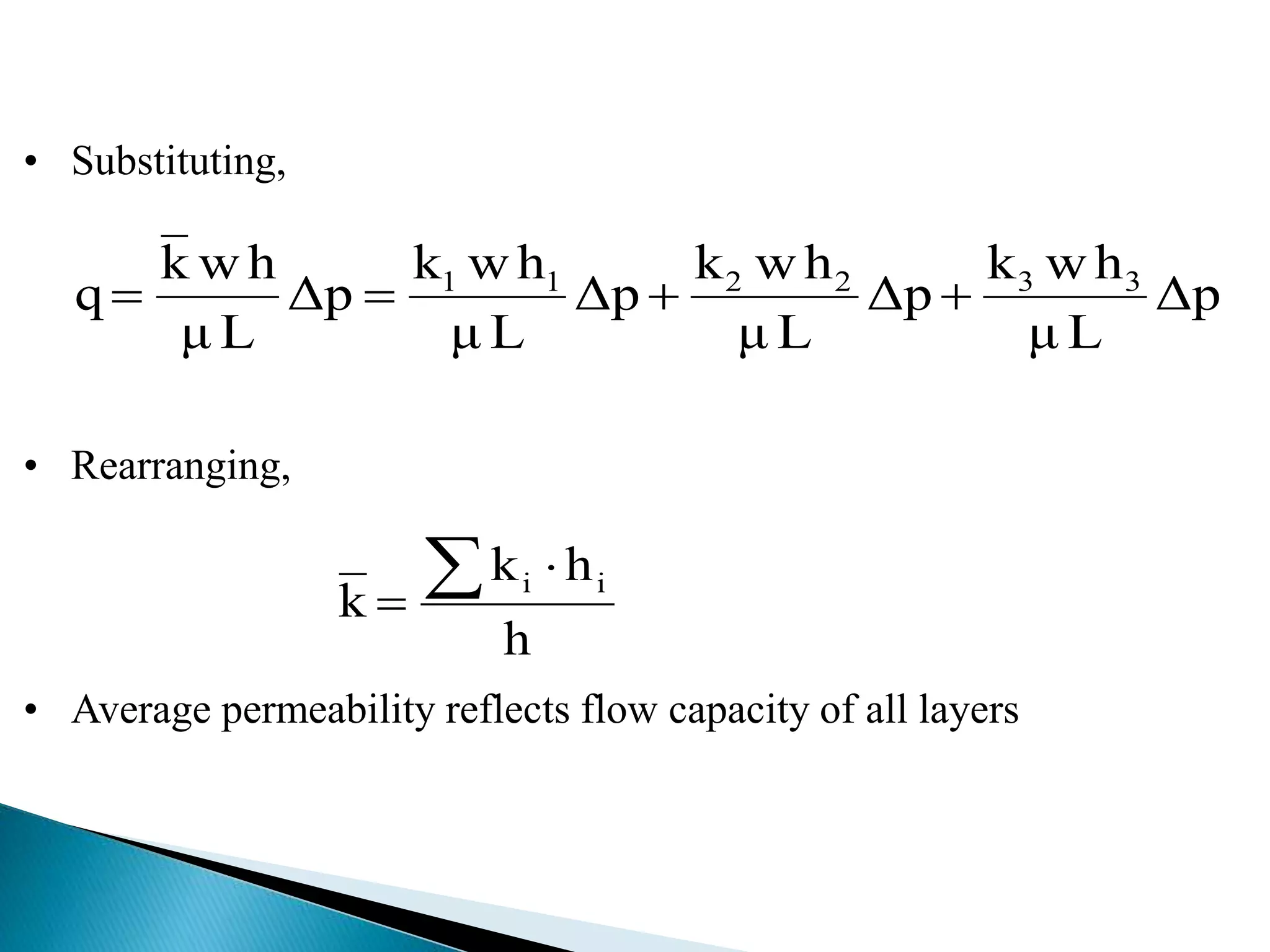
• Substituting, 
kwh 
q 1 1 2 2 3 3     
• Rearranging, 
k wh 
 k  h 
k  
i i 
h 
k wh 
k wh 
• Average permeability reflects flow capacity of all layers 
Δp 
μ L 
Δp 
μ L 
Δp 
μ L 
Δp 
μ L
• Permeability varies across several 
vertical layers (k1,k2,k3) 
◦ Discrete changes in permeability 
    1 2 3 i L L L L L 
◦ Same flow rate passes through each layer 
1 2 3 q  q  q  q 
◦ Total pressure drop is summation of pressure drop across 
layers 
     1 2 1 2 3 i p p Δp Δp Δp Δp 
◦ Average permeability results in correct total pressure drop 
p - p1 2    
; A w h 
qμ L 
kwh
qμ L 
k wh 
qμ L 
k wh 
qμ L 
k wh 
• Substituting, 
qμ L 
kwh 
p - p 
3 
3 
2 
2 
1 
1 
1 2     
• Rearranging, 
k 
• If k1>k2>k3, then 
L 
 
 
L 
i 
k 
i 
– Linear pressure profile in each layer 
0 L 
x  
p  
p1 
p2 
0 
k
• Permeability varies across several 
(3) horizontal layers (k1,k2,k3) 
◦ Discrete changes in permeability 
    1 2 3 i h h h h h 
◦ Same pressure drop for each layer 
e w 1 2 3 p - p  Δp  Δp  Δp  Δp 
◦ Total flow rate is summation of flow rate for all layers 
    1 2 3 i q q q q q 
◦ Average permeability results in correct total flow rate 
Δp 
2π k h 
μ ln(r /r ) 
q 
e w 

• Substituting (rw=r1, r2 ,re=r3), 
qμ ln(r /r ) 
e w    
• Rearranging, 
e w 2 w 
ln(r /r ) 
e w 
qμ ln(r /r ) 
(ln(r /r ) 
  
 
i 1 i 
k 
All Layers i 
k 
qμ ln(r /r ) 
e 2 
2π k h 
2π k h 
2π k h 
p - p 
2 
1
It is necessary to determine an average value of permeability. 
Three common types of computed averages are as follows: 
Reservoir Rocks and Fluid properties 
i) arithmetic average 
ii) harmonic average 
ii) geometric average 
Selection of the averaging technique should be based primarily on 
the geometry of the flow system.
Reservoir Rocks and Fluid properties 
k1 
k2 
k3 
h1 
h2 
h3 
  
k h 
A h 
 
i i 
i 
k 
Q 
Parallel Flow 
Arithmetic Average
L 
H L k 
Series Flow 
k1 k2 k3  
Reservoir Rocks and Fluid properties 
L1 L2 L3 
  
i 
i i 
k 
/ 
 Harmonic Average
1 
Random Flow 
Geometric Average 
  h h h  hi 
G k k k k 
1 2 3 ....... 1 2 3 
Reservoir Rocks and Fluid properties

Permeability

  • 2.
     Definition (ABW,Ref: API 27) ◦ … permeability is a property of the porous medium and is a measure of the capacity of the medium to transmit fluids ◦ … permeability is the fluid conductance capacity of a rock, or it’s the a measure of the ease with which the rock will permit the passage of fluids. Reservoir Rocks and Fluid properties
  • 3.
     Permeability theory  Permeability is an INTENSIVE property of a porous medium (e.g. reservoir rock) Reservoir Rocks and Fluid properties
  • 4.
    Permeability which willpermit flow of one centipoise fluid to flow at linear velocity of one cm per second under a pressure gradient of one atmosphere per centimetre. Reservoir Rocks and Fluid properties
  • 5.
     Three typesof permeability  Absolute permeability - the permeability of a porous medium with only one fluid present (single-phase flow).  When two or more fluids are present permeability of the rock to a flowing fluid is called effective permeability (ko, kg, kw).  Relative permeability is the ratio of absolute and effective permeabilities kro=ko/k, krg=kg/k, krw=kw/k. Reservoir Rocks and Fluid properties
  • 6.
     A Frenchhydrologist named Darcy did the first work on permeability. He was concerned about flow of water through filters. He found that flow rate Q, is proportional to area of flow A,h, and 1/L. This is expressed mathematically as flows: 1 h h Q KA 1 2   L  Darcy’s “K” was determined to be a combination of ◦ k, permeability of the sand pack (porous medium, e.g. reservoir rock) ◦ K is a constant of proportionality ◦ , viscosity of the liquid  K constant may be written as; 2 Reservoir Rocks and Fluid properties k μ K 
  • 7.
     Alternatively, eqn.1;can also be expressed in terms of the pressure gradient dp over a section dL as; 3 dp Where dp = Δhρg 4 – dp is the diff. b/w the upstream & downstream pressures  Δh the diff. b/w the upstream and downstream hydraulic gradients  ρ fluid density  g is the acceleration due to gravity (9.81 m/sec2) Reservoir Rocks and Fluid properties dL Q  KA
  • 8.
    Darcy’s Apparatus for Determining Permeability h h 1 2  Q A volumetric flow rate cross sectional area   & hydraulic head at inlet and outlet (Sand Pack Length) L Reservoir Rocks and Fluid properties length of the porous medium Q A L 1 2    h h L Q  h1-h2 h1 h2 q A q A
  • 9.
    • Darcy didnot consider the fluid viscosity. • Restricted to a medium with 100% saturated by water • Other researchers discovered that Q is inversely proportional to Reservoir Rocks and Fluid properties viscosity.
  • 10.
    Extension of Darcy’sEquation  Assumptions Used in Darcy Equation: 1. Steady state flow, under laminar regime i.e. Qin = Qout 2. Viscous flow - rate of flow directly proportional to pressure gradient 3. The flowing fluid is incompressible. 4. Porous media 100% saturated with fluid which flowed 5. Fluid and porous media not reacting Reservoir Rocks and Fluid properties
  • 11.
     Darcy’s Lawcan be extended to other fluids, if K is expressed as a ratio of /μ, where μ is the viscosity of a given fluid and  the permeability of the porous medium.  Eqn. 3 can be written to account for viscosity μ as; k dp Q = - A 5 Eqn.5 can be integrated b/w the limits of length from 0 to L and pressure from P1(upstream) to P2 (downstream), for a fluid flow case. Reservoir Rocks and Fluid properties  dL
  • 12.
     Therefore, 6 7 KA  P or 8 Q L Q  0    KA Q   Q Hence, the original equation of Darcy was modified to account for viscosity as follows: 9 KA Q   Reservoir Rocks and Fluid properties     p p dp k dL A 2 1 0   k L  p p  A 2 1    1 2 p p L   L    1 2 p p L 
  • 13.
     Permeability isdetermined by:  Core analysis  Well test analysis (flow testing) ◦ RFT (repeat formation tester) provides small well tests  Production data ◦ production logging measures fluid flow into well  Log data ◦ MRI (magnetic resonance imaging) logs calibrated via core analysis Reservoir Rocks and Fluid properties
  • 14.
    • Shape andsize of pore system • Sorting • Cementation • Fracturing and solution • Lithology or rock type Reservoir Rocks and Fluid properties
  • 15.
     Two setsof units are generally used in reservoir engineering: Darcy units and Oil-field units  For the purpose of the mathematical derivations, a system of units commonly referred to as Darcy units are used. These units are:  Vs= cm/sec; μ = cP; ρ = gm/cc  K = Darcy; g = cm/sec2; dp/ds = atm/cm  For application to field data of the various mathematical expressions, the second system of units called the practical oil-field units are used. Reservoir Rocks and Fluid properties
  • 16.
     From dimensionalanalysis, the dimension for K is [L]2. We could use ft2, ins2, or cm2 for measure of permeability, but these units are all too large to be applied in porous media.  So Darcy unit is used and recommended , but in many cases the millidarcy (mD)  1 Darcy = 1000 miliDarcy  1 Darcy ~ 10-8 sm2 (10-6 mm2)  1 miliDarcy ~ 10-11 sm2 (10-9 mm2) Reservoir Rocks and Fluid properties
  • 17.
    Darcy’s Law -Darcy Units  Linear (1-D) flow of an incompressible fluid kA μ L q  ◦ where, Δp  q cm3/s  k darcies  A cm2  p atm   cp  L cm ◦ The Darcy a derived unit of permeability, defined to make this equation coherent (in Darcy units)
  • 18.
    Darcy’s Law -Oilfield Units  Linear (1-D) flow of an incompressible fluid CkA μ L q  ◦ where, Δp  q bbl/D  k millidarcies  A ft2  p psia   cp  L ft
  • 19.
    Quantity Symbol DimensionOilfield Units SI Units Mass m m Ibm Kg Moles n n Ibmol Kmol Force F ML/2 Ibf N t Length L L ft m Area A L2 acres m2 Volume-liquids v L3 bbl m3 Volume-gases v L3 ft3 m3 Pressure p m/Lt 2 psi kPa Temperature T T R K Flow rate-liquids q L3/t bbl/d m3/d Flow rate -gases q L3/t Ft3/d m3/d Viscosity μ m/Lt cP mpa.s Permeability k L2 md m2 Reservoir Rocks and Fluid properties
  • 20.
     Permeability isan important parameter that controls the reservoir performance. Its importance is reflected by the number of available techniques typically used to estimate it.  These different techniques provide formation permeability that represents different averaging volumes.  The quality of the reservoir, as it relates to permeability can be classified as follows < 10 md fair 10 – 100 High 100 – 1000 Very High >1000 Exceptional  This scale changes with time, for example 30 years ago k< 50 was considered poor. Reservoir Rocks and Fluid properties
  • 21.
     What is1 Darcy?  A porous medium has a permeability of one Darcy, when a single-phase fluid of one centipoises viscosity, that completely fills the voids of the medium will flow through it, under conditions of viscous flow (also known as laminar flow), at a rate of one cubic centimeter cross sectional area, and under a pressure or equivalent hydraulic gradient of one atmosphere per centimeter. Reservoir Rocks and Fluid properties
  • 22.
     Important Characteristicsthat must be considered in the reservoir:  Types of fluids in the reservoir  Flow regimes  Reservoir geometry  Number of fluid flowing in the reservoir Reservoir Rocks and Fluid properties
  • 23.
     Types ofFluids • Incompressible fluids • Slightly compressible fluids • Compressible fluids  Flow Regimes • Steady state flow • Unsteady state flow • Pseudosteady state flow Reservoir Rocks and Fluid properties
  • 24.
     Reservoir Geometry • Linear flow • Radial flow • spherical and hemispherical flow  Number of fluid flowing • Single phase flow • Two phase flow • Three phase or multiple phase flow Reservoir Rocks and Fluid properties
  • 25.
     Types ofFluids • Incompressible fluids • Slightly compressible fluids • Compressible fluids Reservoir Rocks and Fluid properties
  • 26.
     Flow Regimes • Steady state flow • Unsteady state flow • Pseudosteady state flow Reservoir Rocks and Fluid properties
  • 27.
     Reservoir Geometry • Linear flow • Radial flow • spherical and hemispherical flow Reservoir Rocks and Fluid properties
  • 28.
     Steady stateflow, i.e. Qin = Qout  Viscous or Laminar flow: the particles flow in parallel paths  Rock is 100% saturated with one fluid  Fluid does not react with the; this a problem with shaly-sand (interstitial particles)  The formation is homogeneous and isotropic: same porosity, same permeability and same fluid properties Reservoir Rocks and Fluid properties
  • 29.
     Generalized formof Darcy’s Law  The generalized Darcy’s law is given by the following equation: k  dp Vs     Vs = Q/A and dp/ds = dp/dx, hence    KA dp Reservoir Rocks and Fluid properties   ds         dx Q  Separating the variables and integrating gives the following eqn.: Note that P1>P2
  • 30.
            0 6 k dP  k dP k dP Q g dz        0      2 1 1 2 *10 1.0135 2 1 P P k P P k L Q Q Q Q A dP k dx A dP k dx A dx A dx v ds ds v A P P L x s                    • Fluid not compressed (no density change with pressure) • Steady flow (mass in = mass out) • In horizontal flow (Linear): dP dx dP ds dz ds  0 ,     kA P P Q 1 2    L 
  • 31.
    The generalized formof Darcy’s Law includes pressure and gravity terms to account for horizontal or non-horizontal flow    k dp g s q     dz   dΦ k Reservoir Rocks and Fluid properties    ds ds A v c s    The gravity term has dimension of pressure / length Flow potential includes both pressure and gravity terms, simplifying Darcy’s Law     q    ds μ A vs  = p - gZ/c; Z+; Z is elevation measured from a datum  has dimension of pressure
  • 32.
     The gravitationalconversion constant, c, is needed to convert the gravity term to units of pressure gradient [pressure/length]  A clear way to determine the sign of the gravity term (+ or -) is to consider the static case. If no fluid is flowing, then there is no potential gradient (potential is constant), while pressure changes with elevation, due to fluid density (dp=(g/c)dZ). Reservoir Rocks and Fluid properties
  • 33.
    Reservoir Rocks andFluid properties
  • 34.
    Reservoir Rocks andFluid properties
  • 35.
     Fluid notcompressed Q   Q  Steady flow (stream mass was constant) rw re Pwf Pe h r    P r w w         e w      r hk P P e w r e w e w P P r r r Q Q P P k r h P k r h PdP k dr h r e w e w ln ln 2 2 ln 2 1 2      
  • 36.
     Q =flow rate, m3/sec  K = permeability, m2  h = thickness, m  Pe = pressure drainage radius, N/m2  Pwf = flowing pressure, N/m2  = fluid viscosity, N/m2  re = drainage radius, m  rw = the well-bore radius, m Reservoir Rocks and Fluid properties 
  • 37.
    • Permeability variesacross several horizontal layers (k1,k2,k3) ◦ Discrete changes in permeability     1 2 3 i h h h h h ◦ Same pressure drop for each layer 1 2 1 2 3 p - p  Δp  Δp  Δp  Δp ◦ Total flow rate is summation of flow rate for all layers     1 2 3 i q q q q q ◦ Average permeability results in correct total flow rate q   Δp ; A w h kwh μ L
  • 38.
    • Substituting, kwh q 1 1 2 2 3 3     • Rearranging, k wh  k  h k  i i h k wh k wh • Average permeability reflects flow capacity of all layers Δp μ L Δp μ L Δp μ L Δp μ L
  • 39.
    • Permeability variesacross several vertical layers (k1,k2,k3) ◦ Discrete changes in permeability     1 2 3 i L L L L L ◦ Same flow rate passes through each layer 1 2 3 q  q  q  q ◦ Total pressure drop is summation of pressure drop across layers      1 2 1 2 3 i p p Δp Δp Δp Δp ◦ Average permeability results in correct total pressure drop p - p1 2    ; A w h qμ L kwh
  • 40.
    qμ L kwh qμ L k wh qμ L k wh • Substituting, qμ L kwh p - p 3 3 2 2 1 1 1 2     • Rearranging, k • If k1>k2>k3, then L   L i k i – Linear pressure profile in each layer 0 L x  p  p1 p2 0 k
  • 41.
    • Permeability variesacross several (3) horizontal layers (k1,k2,k3) ◦ Discrete changes in permeability     1 2 3 i h h h h h ◦ Same pressure drop for each layer e w 1 2 3 p - p  Δp  Δp  Δp  Δp ◦ Total flow rate is summation of flow rate for all layers     1 2 3 i q q q q q ◦ Average permeability results in correct total flow rate Δp 2π k h μ ln(r /r ) q e w 
  • 42.
    • Substituting (rw=r1,r2 ,re=r3), qμ ln(r /r ) e w    • Rearranging, e w 2 w ln(r /r ) e w qμ ln(r /r ) (ln(r /r )    i 1 i k All Layers i k qμ ln(r /r ) e 2 2π k h 2π k h 2π k h p - p 2 1
  • 43.
    It is necessaryto determine an average value of permeability. Three common types of computed averages are as follows: Reservoir Rocks and Fluid properties i) arithmetic average ii) harmonic average ii) geometric average Selection of the averaging technique should be based primarily on the geometry of the flow system.
  • 44.
    Reservoir Rocks andFluid properties k1 k2 k3 h1 h2 h3   k h A h  i i i k Q Parallel Flow Arithmetic Average
  • 45.
    L H Lk Series Flow k1 k2 k3  Reservoir Rocks and Fluid properties L1 L2 L3   i i i k /  Harmonic Average
  • 46.
    1 Random Flow Geometric Average   h h h  hi G k k k k 1 2 3 ....... 1 2 3 Reservoir Rocks and Fluid properties
  • 47.
    Reservoir Rocks andFluid properties