Civil Engineering - Texas Tech University
CE 3121: Geotechnical Engineering Laboratory
Class 5
Permeability Test
Sources:
Soil Mechanics – Laboratory Manual,B.M. DAS (Chapters 10, 11)
Soil Properties, Testing, Measurement, and Evaluation, C. Liu, J. Evett
Civil Engineering - Texas Tech University
 Permeability in Soils
 Hydraulic Conductivity
 Darcy’s Law
 Permeability Tests
 Constant-Head Test
 Falling-Head Test
Class Outlines
Civil Engineering - Texas Tech University
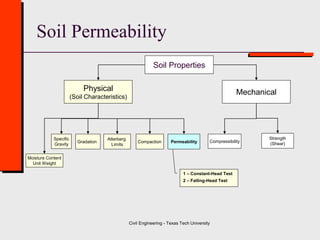
Soil Permeability
Physical
(Soil Characteristics)
Mechanical
Moisture Content
Unit Weight
CompressibilityPermeability
Specific
Gravity
Gradation
Atterberg
Limits
Strength
(Shear)
Soil Properties
Compaction
1 – Constant-Head Test
2 – Falling-Head Test
Civil Engineering - Texas Tech University
Permeability in Soils
 Permeability is the measure of the soil’s
ability to permit water to flow through its pores
or voids
 It is one of the most important soil properties
of interest to geotechnical engineers
Civil Engineering - Texas Tech University
Importance of permeability
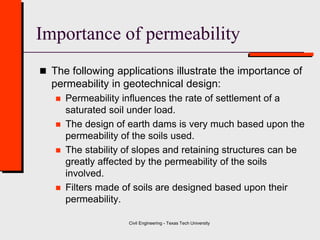
 The following applications illustrate the importance of
permeability in geotechnical design:
 Permeability influences the rate of settlement of a
saturated soil under load.
 The design of earth dams is very much based upon the
permeability of the soils used.
 The stability of slopes and retaining structures can be
greatly affected by the permeability of the soils
involved.
 Filters made of soils are designed based upon their
permeability.
Civil Engineering - Texas Tech University
Use of Permeability
 Knowledge of the permeability properties of
soil is necessary to:
 Estimating the quantity of underground
seepage
 Solving problems involving pumping seepage
water from construction excavation
 Stability analyses of earth structures and earth
retaining walls subjected to seepage forces
Civil Engineering - Texas Tech University
Hydraulic Conductivity
 Hydraulic Conductivity, k, is a measure of soil
permeability
 k is determined in the lab using two methods:
 Constant-Head Test
 Falling-Head Test
 K is usually expressed in cm/sec
 Hydraulic conductivity is also known as the
coefficient or permeability
Civil Engineering - Texas Tech University
Hydraulic Conductivity (Cont.)
 Hydraulic conductivity of soils depends on
several factors:
 Fluid viscosity
 Pore size distribution
 Grain size distribution
 Void ratio
 Degree of soil saturation
Civil Engineering - Texas Tech University
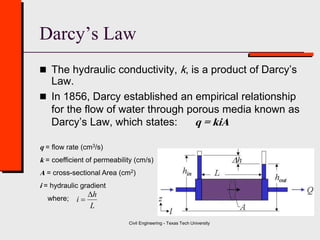
Darcy’s Law
 The hydraulic conductivity, k, is a product of Darcy’s
Law.
 In 1856, Darcy established an empirical relationship
for the flow of water through porous media known as
Darcy’s Law, which states: q = kiA
q = flow rate (cm3/s)
k = coefficient of permeability (cm/s)
A = cross-sectional Area (cm2)
i = hydraulic gradient
where;
L
h
i


Civil Engineering - Texas Tech University
Constant Head Test
 The constant head test is used primarily for
coarse-grained soils
 This test is based on the assumption of
laminar flow where k is independent of i (low
values of i)
 ASTM D 2434
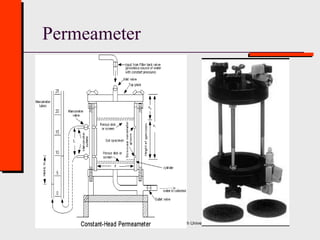
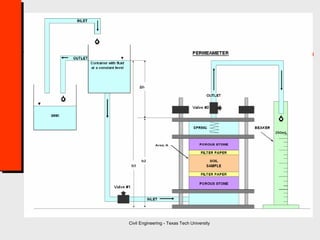
 This test applies a constant head of water to
each end of a soil in a “permeameter”
Civil Engineering - Texas Tech University
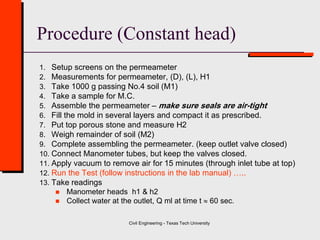
Permeameter
Civil Engineering - Texas Tech University
Procedure (Constant head)
1. Setup screens on the permeameter
2. Measurements for permeameter, (D), (L), H1
3. Take 1000 g passing No.4 soil (M1)
4. Take a sample for M.C.
5. Assemble the permeameter – make sure seals are air-tight
6. Fill the mold in several layers and compact it as prescribed.
7. Put top porous stone and measure H2
8. Weigh remainder of soil (M2)
9. Complete assembling the permeameter. (keep outlet valve closed)
10. Connect Manometer tubes, but keep the valves closed.
11. Apply vacuum to remove air for 15 minutes (through inlet tube at top)
12. Run the Test (follow instructions in the lab manual) …..
13. Take readings
 Manometer heads h1 & h2
 Collect water at the outlet, Q ml at time t  60 sec.
Civil Engineering - Texas Tech University
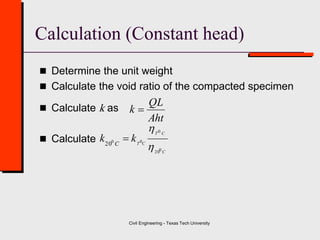
Calculation (Constant head)
 Determine the unit weight
 Calculate the void ratio of the compacted specimen
 Calculate k as
 Calculate
Aht
QL
k 
C
CT
CT
kk C
020
0
00
20



Civil Engineering - Texas Tech University
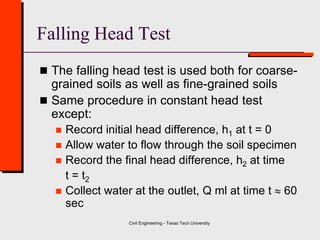
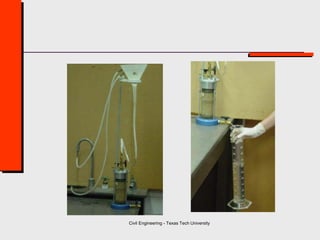
Falling Head Test
 The falling head test is used both for coarse-
grained soils as well as fine-grained soils
 Same procedure in constant head test
except:
 Record initial head difference, h1 at t = 0
 Allow water to flow through the soil specimen
 Record the final head difference, h2 at time
t = t2
 Collect water at the outlet, Q ml at time t  60
sec
Civil Engineering - Texas Tech University
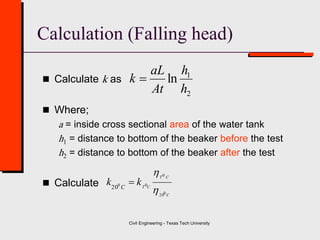
Calculation (Falling head)
 Calculate k as
 Where;
a = inside cross sectional area of the water tank
h1 = distance to bottom of the beaker before the test
h2 = distance to bottom of the beaker after the test
 Calculate
2
1
ln
h
h
At
aL
k 
C
CT
CT
kk C
020
0
00
20



Civil Engineering - Texas Tech University
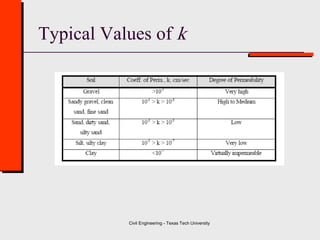
Typical Values of k

Class 5 Permeability Test ( Geotechnical Engineering )

  • 1.
    Civil Engineering -Texas Tech University CE 3121: Geotechnical Engineering Laboratory Class 5 Permeability Test Sources: Soil Mechanics – Laboratory Manual,B.M. DAS (Chapters 10, 11) Soil Properties, Testing, Measurement, and Evaluation, C. Liu, J. Evett
  • 2.
    Civil Engineering -Texas Tech University  Permeability in Soils  Hydraulic Conductivity  Darcy’s Law  Permeability Tests  Constant-Head Test  Falling-Head Test Class Outlines
  • 3.
    Civil Engineering -Texas Tech University Soil Permeability Physical (Soil Characteristics) Mechanical Moisture Content Unit Weight CompressibilityPermeability Specific Gravity Gradation Atterberg Limits Strength (Shear) Soil Properties Compaction 1 – Constant-Head Test 2 – Falling-Head Test
  • 4.
    Civil Engineering -Texas Tech University Permeability in Soils  Permeability is the measure of the soil’s ability to permit water to flow through its pores or voids  It is one of the most important soil properties of interest to geotechnical engineers
  • 5.
    Civil Engineering -Texas Tech University Importance of permeability  The following applications illustrate the importance of permeability in geotechnical design:  Permeability influences the rate of settlement of a saturated soil under load.  The design of earth dams is very much based upon the permeability of the soils used.  The stability of slopes and retaining structures can be greatly affected by the permeability of the soils involved.  Filters made of soils are designed based upon their permeability.
  • 6.
    Civil Engineering -Texas Tech University Use of Permeability  Knowledge of the permeability properties of soil is necessary to:  Estimating the quantity of underground seepage  Solving problems involving pumping seepage water from construction excavation  Stability analyses of earth structures and earth retaining walls subjected to seepage forces
  • 7.
    Civil Engineering -Texas Tech University Hydraulic Conductivity  Hydraulic Conductivity, k, is a measure of soil permeability  k is determined in the lab using two methods:  Constant-Head Test  Falling-Head Test  K is usually expressed in cm/sec  Hydraulic conductivity is also known as the coefficient or permeability
  • 8.
    Civil Engineering -Texas Tech University Hydraulic Conductivity (Cont.)  Hydraulic conductivity of soils depends on several factors:  Fluid viscosity  Pore size distribution  Grain size distribution  Void ratio  Degree of soil saturation
  • 9.
    Civil Engineering -Texas Tech University Darcy’s Law  The hydraulic conductivity, k, is a product of Darcy’s Law.  In 1856, Darcy established an empirical relationship for the flow of water through porous media known as Darcy’s Law, which states: q = kiA q = flow rate (cm3/s) k = coefficient of permeability (cm/s) A = cross-sectional Area (cm2) i = hydraulic gradient where; L h i  
  • 10.
    Civil Engineering -Texas Tech University Constant Head Test  The constant head test is used primarily for coarse-grained soils  This test is based on the assumption of laminar flow where k is independent of i (low values of i)  ASTM D 2434  This test applies a constant head of water to each end of a soil in a “permeameter”
  • 11.
    Civil Engineering -Texas Tech University Permeameter
  • 12.
    Civil Engineering -Texas Tech University Procedure (Constant head) 1. Setup screens on the permeameter 2. Measurements for permeameter, (D), (L), H1 3. Take 1000 g passing No.4 soil (M1) 4. Take a sample for M.C. 5. Assemble the permeameter – make sure seals are air-tight 6. Fill the mold in several layers and compact it as prescribed. 7. Put top porous stone and measure H2 8. Weigh remainder of soil (M2) 9. Complete assembling the permeameter. (keep outlet valve closed) 10. Connect Manometer tubes, but keep the valves closed. 11. Apply vacuum to remove air for 15 minutes (through inlet tube at top) 12. Run the Test (follow instructions in the lab manual) ….. 13. Take readings  Manometer heads h1 & h2  Collect water at the outlet, Q ml at time t  60 sec.
  • 13.
    Civil Engineering -Texas Tech University Calculation (Constant head)  Determine the unit weight  Calculate the void ratio of the compacted specimen  Calculate k as  Calculate Aht QL k  C CT CT kk C 020 0 00 20   
  • 14.
    Civil Engineering -Texas Tech University Falling Head Test  The falling head test is used both for coarse- grained soils as well as fine-grained soils  Same procedure in constant head test except:  Record initial head difference, h1 at t = 0  Allow water to flow through the soil specimen  Record the final head difference, h2 at time t = t2  Collect water at the outlet, Q ml at time t  60 sec
  • 15.
    Civil Engineering -Texas Tech University Calculation (Falling head)  Calculate k as  Where; a = inside cross sectional area of the water tank h1 = distance to bottom of the beaker before the test h2 = distance to bottom of the beaker after the test  Calculate 2 1 ln h h At aL k  C CT CT kk C 020 0 00 20   
  • 16.
    Civil Engineering -Texas Tech University
  • 17.
    Civil Engineering -Texas Tech University
  • 18.
    Civil Engineering -Texas Tech University Typical Values of k